Showing posts sorted by relevance for query highsmith. Sort by date Show all posts

Friday, September 27, 2013

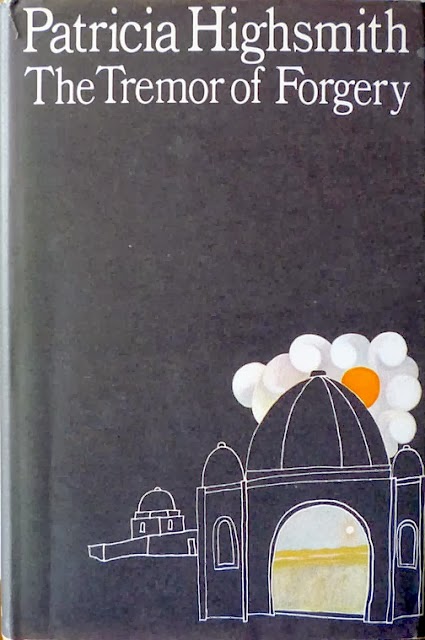
FFB: The Tremor of Forgery - Patricia Highsmith

UK Edition (Heinemann, 1969)
Despite its exotic and desert landscape filled setting of Tunisia The Tremor of Forgery (1969) covers some familiar territory for Patricia Highsmith. There is the usual assortment of strangers befriended by a somewhat dull American, some overt and covert homoeroticism in male friendships, and perhaps most importantly her obsession with duality be it in personality, cultural mores, or political viewpoints. Howard Ingham, the American protagonist, is also a writer. This strong theme of duality is carried through in the title, also the title of a novel Ingham is writing about a banker who is secretly embezzling funds from his employer. Crime will play a role in Ingham's life just as it does with Dennison, his own protagonist, but it is a murky and ambiguous world that Ingham inhabits. We know that Dennison is a criminal and thief; we never know if Ingham is one though it is strongly hinted he may have killed a man.

Perhaps the most subtle and insidious of her novels The Tremor of Forgery is unusual in how it incorporates criminal behavior into its supposedly simple plot. There are burglaries, thefts, attacks on a dog, one violent death most definitely a murder, and another possible murder. Though crime is present it is a shadow world of ambiguous and puzzling events; mixed perceptions and eyewitness accounts contradict one another throughout the action. We never know whose viewpoint we are to believe -- even that of our ostensibly innocent hero.

Yet crime is not Highsmith's primary concern here. This novel is a study in cultural and political disparity and their effect on visiting long term residents in a foreign country. It is also, strangely, something of a treatise on love. Besides The Price of Salt, I have never encountered in a Highsmith novel more discussions about love in all its forms, from platonic friendship to erotic desire, than I have in The Tremor of Forgery.

US Edition (Doubleday, 1969)
Highsmith's reputation rests largely on her development of what everyone likes to call noir these days - the dark crime novel that explores base motives, criminal impetus and the ugly side of human nature. Ironically, while exploring all these aspects of a noir novel The Tremor of Forgery turns out to be Highsmith's most life affirming and positive work. Even its slightly ambiguous ending is one I would classify as a happily ever after type.

Ingham is in Tunisia at the request of a film director friend who has commissioned the writer to pen the screenplay of a movie he wants to set in Tunisia. But the screenplay is soon abandoned when the director dies suddenly under suspicious circumstances. Ina, Howard Ingham's one time lover, eventually communicates with him via letter to explain the sudden death in a roundabout and vague way. Ingham can't decide whether to return home or remain in Tunisia largely due to the curious and sporadic letters he receives from Ina. Each time he writes he pours out his love to her, but she takes her sweet time replying to his letters. She must be prodded to tell the whole story of John Castlewood's death after Ingham's repeated urgings. One begins to suspect that Ina is complicit in what at first is described as an accident and then a suicide.

In the meantime Ingham toils away on his typewriter turning out page after page of his novel about the duplicitous banker. He is befriended by two men. The first is the overly friendly Francis Adams whose sunny personality masks a political and religious zealotry that will reveal him to be a bigot of the worst sort. The other is the artist Anders Jensen visiting from his native Denmark and making the most of his penchant for sleeping with Arab boys while attempting to bed Howard as well. Jensen has a dog named Hasso that will also play an important part in the story. Jensen tells stories of some attacks of cruelty on Hasso and when the dog suddenly goes missing he fears the worst.


A younger and happier Patricia Highsmith
Since living in Tunisia Ingham has found himself influenced by the apparent lawlessness and amorality of the Arabs he meets. He tells Ina "...if one is robbed five or six times, there might be an impulse to rob back, don’t you think? The one who doesn't rob, or cheat a little in business deals, some comes out in the short end, if everybody else is cheating." Even his discovery of a dead man in the street at night changes him. He finds it unnecessary to report the body and his indifference has dire consequences later when he attacks someone who he thinks is trying to break into his bungalow. Once again he does nothing but discuss the events in a rather vague manner with his true friend and confidante, Jensen, just as Ina danced around Castlewood's death (more duality). But Adams somehow gets word of the attack and begins to suspect that Ingham is trying to cover up the murder of a local thief and outcast who has recently vanished. Adams then shares his thoughts with Ina thus turning her visit from one of a reunion with her lover to one of suspicion, mistrust and betrayal.

The novel unfolds at what some might call a glacial pace. But it is fitting for this languorous story of developing friendships, reconnections, epiphanies and -- yes -- contentment and happiness found at long last. In the final pages Highsmith has a few surprises in store, some of which have been called ambiguous by other reviewers and critics. On closer reading of the subtle clues she drops the unanswered questions all become clearer. The mysterious disappearance of the Arabian thief is suddenly not so mysterious and Ingham may not be the bad man he thinks himself to be. He ends up leaving Tunisia with one final letter in hand, overdue from seemingly endless forwarding, that leads me to believe that he will go on to find the love he had been searching for throughout the book.

Thursday, March 12, 2015

COOL FLICKS: The Two Faces of January (2014)

I'll never pass on a Patricia Highsmith movie. This is one that I was completely unfamiliar with. I have read quite a few of her books, and reviewed one on this blog, but not only have I not read The Two Faces of January I hadn't any idea of the basic plot. Nor did I want to know before I saw the movie. From the opening scenes in which Viggo Mortenson and Kirsten Dunst are touring Greek ruins in their elegant attire to the final violent moments I was riveted. It may be one of the few sun-drenched noir movies in existence. Sun and heat and Greek ruins have never been more sinister on film.

I'm not sure I want to discuss the story at all but I urge any Highsmith fan, whether familiar with the novel or not, to see this movie. Viggo Mortenson and Oscar Isaac are fascinating to watch. Kirsten Dunst also does some interesting work in shading her character but the screen is dominated by the presence of the two men as one might expect in a Highsmith story. All of them are crooks of one sort or another. Each of the three leads is corrupt and a master manipulator. Isaac is Rydal a con man of a tour guide exploiting tourists' ignorance of the Greek language and the Greek drachma to his own ends; Mortenson plays Chester the shifty investment banker indulging himself in a life of excess; and Dunst is his wife Colette who hides her fear and hidden desires beneath a veneer of American charm and plastic smiles.

Highsmith's fascination with male bonding, friendship and fraternity is augmented in this story by a very strange surrogate father fixation in the attraction Rydal has for Chester. The catch is Rydal hated his real father who we learn has recently died at the opening of the movie. Yet he cannot help being drawn to Chester who uncannily resembles his dead father. Their initial meeting is all about stares and penetrating gazes and the father/son motif inexorably plays out in a dangerous and ultimately heartbreaking manner.

To me the most intriguing aspect of the film are the looks exchanged between characters and their silences. Often what isn't said is more important than what is and carries more weight. So much is conveyed only through glances or stares. It's an interesting choice not often used these days in movies that seem to be talkative monologue marathons. Not to disparage the intelligent dialogue devised by director/screenwriter Amini who also wrote the excellent screen adaptation of James Sallis' novel Drive. He uses dialogue with economy but is more interested in visuals to tell his story. This is a smart movie about smart and wily characters.

By the time the movie was about halfway done I suddenly had to know if it was being faithful to Highsmith's novel. So I went searching online for a book review or a plot summary and found that it was very much true to her novel with only a few minor tweaks. Having watched this cat and mouse game played out in the blazing Greek sun with more than a few references to it rich mythological heritage not the least of which is the eerie reverse Oedipal psyche I am now eager to read the book. I'm curious if Highsmith focusses more on young Rydal and his twisted family life and also if she delved into mythology as much as Amini did.

Friday, June 12, 2015

FFB: A Dog's Ransom - Patricia Highsmith

In the hands of other writers the simple story in A Dog’s Ransom (1972) might have been ripe material for low comedy. An anti-social misfit sends anonymous letters to randomly selected people he dislikes for various reasons eventually leading to a dognapping scheme and a demand for $1000. The dog’s owners don’t know the dognapper, have never encountered him even by chance, and have never done anything to merit their dog being snatched and held for ransom, nor has the dog misbehaved in any way to deserve such an attack. You can see the potential for farce here. But this is a Patricia Highsmith novel and the first crime, legally considered a misdemeanor, is handled with her usual flair for sinister and a malicious acts. When the dog is not returned as promised Ed and Greta Reynolds fear the worst. Soon the dognapping spirals out of control into more violent acts. There isn’t any real trace of humor in this book. It’s a study in urban alienation and enmity.

In the eyes of the Manhattan police the crime of dognapping is right down there in the priority list next to jaywalking and parking violations. No one Ed approaches seems to care. Until that is rookie patrolman Clarence Duhammel gets word of his colleagues' indifference. Duhammel -- whose name is often pronounced Dummel by his fellow cops -- is no dummy at all, but there is something a little bit off about his somewhat distant, all too officious behavior. He is primarily interested in helping Ed retrieve his poodle because no one else wants to. And unusual crime like the theft of a dog and a demand for ransom money is a lot more exciting than his uninspired street beat.

Clarence finds his routine life of arresting lowlife junkies and chasing after juvenile delinquent teens pilfering goodies from the local bodegas to be tiresome. Here is a chance to use his college education in police work. Clarence is a graduate of Cornell University where he studied psychology and sociology and he decides to put to use all he learned in textbooks to finding the dognapper. Clarence is on a quest. He is the do-gooder cop defiant of the buddy tactics and cronyism inherent in the NYPD. Using only instinct combined with college boy psychology and some incredible luck he actually finds the dognapper in two days. But the sociopathic Kenneth Rowajinski cleverly manages to implicate Clarence in the dognapping plot. Now the rookie cop must clear his name and do right by his promise to Ed and Greta.

A Dog’s Ransom shows Highsmith at her most misanthropic. It’s more of an indictment against the way Americans live in cities than it is a crime novel. Highsmith’s New York is a sinister city where hostility and self-interest are guiding principles, where contempt for one’s neighbors displaces any warmhearted feelings. Wariness and suspicion override trust and giving anyone the benefit of the doubt. Take the example of Mrs. Williams, an intolerant landlady. When the cops start asking questions about Rowajinski Mrs Williams follows up with her own interrogation and a warning. She’ll have no one living in her home who draws the attention of the police. "I'm not having any creeps in my house," she tells him, "...because I don't have to have them." No matter that Rowajinski pays his rent on time and is basically invisible. The police visit automatically makes him an undesirable and she gives him an ultimatum. If they show up again, she promises he will be evicted on the spot.

Clarence -- too much of an individual, too focused on doing good and too much of an intellectual -- is ironically a failure as a policeman. His biggest fault is not fitting in, not being a team player. He’s targeted by other patrolman as not being one of the guys, not honoring the tacit policeman’s code of watching out for each other first. And oddly Clarence's sympathy for the Reynolds plight gives way to a weird devotion to the Reynolds, a misplaced friendship that at first is met with feigned politeness but becomes increasingly disturbing to the couple, especially Ed. This relationship is contrasted with Clarence's cold and distant attitude with his mother and father. Ed and Greta become almost surrogate parents to him while his blood relatives continue to be puzzled by Clarence's aloofness, his refusal to introduce them to his girlfriend Marylyn and his reluctance to visit them though it's only a short ride on the subway to Queens.

There aren’t many nice or even likable people in this book. Everyone has it in for someone. And most of the antipathy is unfounded. To use the juvenile defense of pre-teens they dislike one another "just because". While there are outright villains like the vile Rojanowski, who finds his only joy in unsettling complete strangers with his creepy behavior and violent acts, the rest of the cast of characters are really no better. A runner-up for the most detestable character of the lot is Manzoni, a bigoted hostile patrolman who is determined to prove Clarence was in on the dognapping. He cruelly harasses Clarence, his parents, and his girlfriend Marylyn. He relentlessly follows Marylyn, interrogating her and insinuating that she is a prostitute being kept in a lust pad. He impersonates a detective in the process when he is no more than a beat cop just like Clarence.

"Why such malice?" Clarence keeps wondering. But when events lead Clarence to committing a crime himself he finds himself trapped and Manzoni's pursuit intensifies with determined hostility and a thirst for retribution.  Clarence turns to the only people he thinks will believe him and help him -- the Reynolds and Marylyn -- making them all complicit in his criminality.


The book is drenched in hatred in all its forms. Racial epithets are thrown around casually to further isolate the characters from one another. Rojanowksi is called the Pole or the Pollack, Manzoni is referred to as the wop. Marylyn, a symbol for the 70s counterculture type mistrustful of any authority figure, after being followed, questioned and insulted by Manzoni begins to hate all police including Clarence.  She calls them fuzz, pigs and worse. A dognapping which should have affected only two people infects the entire cast like a virulent disease and unleashes the worst in their personalities. And though Highsmith lulls the reader into thinking all will turn out well she still manages to pull off a few unexpected sucker punches in the final pages.

It's a fascinating book in the way that the sideshow of circuses long gone have been fascinating. We stare in disbelief, sometimes laugh self-consciously, or shake our heads in pity, but never truly see the manifestations of disfigurement and genetics gone haywire as a metaphor for the ugliness that lies deep within us all. In A Dog's Ransom Highsmith shows that all of us have the capacity to be creeps and freaks. Why is it that we decide to hate someone for no good reason? Why is that sometimes truly awful things happen to decent good people? She has no real explanations for this true mysteries of real life. She only holds up a mirror to ourselves and allows us to see the sudden bursts of unwarranted violence, the vulgar words, the betrayals and deceit and all sorts of freakishness that lie deep within most of us.

*   *   *


Reading Challenge update: Silver Age card, space I3 - "Animal in the title"

Wednesday, July 12, 2017

NEW STUFF: A Talent for Murder - Andrew Wilson

A Talent for Murder by Andrew Wilson
Atria Books/Simon & Schuster
ISBN: 978-1-5001-4506-3
310 pp. $26
Publication date: July 11, 2017

Back in 1978 I remember reading (and later seeing the movie) Agatha by Kathleen Tynan. This was the first attempt by an novelist to concoct a reason for Agatha Christie’s mysterious two week disappearance in December 1926, following an argument with her husband about his affair with a young woman. Christie's strange relocation to a spa at Harrowgate (where she was registered under the same last name as her husband’s lover) was attributed to amnesia and depression. But before she was found the press dreamed up wild stories ranging from an elaborate publicity stunt to help sell her books to kidnapping to possible murder. Tynan’s story reduced the mystery to a preposterous revenge plot completely out of character for the real Agatha Christie. Now Andrew Wilson, biographer of Patricia Highsmith and many others, has tried his hand at spinning his own thriller to explain the same period when the Grand Dame of Mysterydom vanished for several days in A Talent for Murder (2017). Having completed extensive biographical and literary research Wilson’s story is more in keeping with Christie’s personality and temperament but it is nonetheless just as implausible. Knowing that he was first interested in the life and writing of Highsmith ought to prepare you for what is clearly a crime novel inspired by both women’s books.

Wilson has fashioned an odd story of grief, depression and murder by proxy. Like Highsmith’s first novel Strangers on a Train he has created his own version of Charles Bruno in the person of Patrick Kurs, a megalomaniac physician who is tired of his invalid wife and wants her gone. He manipulates Agatha into carrying out the murder of his wife by threatening her with exposure of her husband’s affair which he knows far too much about. Agatha is just beginning to enjoy success as a bestselling writer thanks to the publication of The Murder of Roger Ackroyd and any publicity of her philandering husband would be scandalous to her personal life and detrimental to her professional life.

Kurs has read …Ackroyd, of course, and commends Agatha for the tour de force novel. He cannot stop talking about it and how he greatly admires the character Dr. Sheppard, who he feels is one of Mrs. Christie’s greatest creations. In fact, he regards the fictional doctor “something of a hero” much to Agatha’s horror. Even more horrifying is Kurs' additional threat of doing harm to Agatha’s young daughter Rosamund if the novelist does not follow Dr. Kurs’ implicit instructions on how to do in his wife.

A parallel story follows when Agatha meets Una Crowe and her friend John Davison. Una aspires to become a reporter and will have ample opportunity to do so when Mrs. Christie suddenly goes missing. Sensational newspaper headlines spur on Una who is determined to beat the pros at their own game and reveal the truth herself. Her amateur sleuthing uncovers Archie Christie’s affair which leads her to Nancy Neele, the mistress, and eventually to the office of Nancy’s confidante, her private physician Dr. Patrick Kurs.

Wilson has done an admirable job of incorporating Christie’s biography into A Talent for Murder. However, there is an unfortunate avalanche of this information within the first two chapters that almost ruins the crime plot before it has a chance to even start. Wilson has chosen to emphasize the recent death of Christie’s mother and he allows Agatha to spend much of her time wallowing in nostalgia and reminiscing about her childhood. This is how she is coping with her grief, but coupled with the knowledge that her husband is cheating on her and planning to leave her Agatha’s emotional life and state of mind are always at the near breaking point.

In the parallel story of Una Crowe there is also the shadow of a recent family death. We learn just as much about Una’s interior life as we do Agatha’s. The idea that fragile women both dealing with overpowering grief are channeling their energies into writing and sleuthing is an interesting one. While Una is determined to solve the riddle of the missing mystery writer, Mrs. Christie is determined to outwit Dr. Kurs in his bizarre murder plot and expose him at his own game. Each woman is doing her best to live up to the memory of her lost relative as well as finding a way back to herself and the real world. The juxtaposition of these two stories and their eventual intersection and overlap are the most successful aspects of this often gripping book.

Unfortunately, the character work is often heavy handed and one gets the feeling that Wilson couldn’t decide between his two crime novelist influences. Several scenes with the stubborn Supt. Kenward who suspects Archie Christie of killing his wife become repetitious in how Christie continually denies all accusations levelled at him increasingly losing his patience and temper with the unimaginative policemen. There are also elements of Christie’s Westamacott novels that threaten to drown the story in domestic soap opera. But then Wilson will insert a delicious scene with ambiguous dialogue and hidden motives straight out of Highsmith that invigorates the narrative.

Andrew Wilson
(photo ©Johnny Ring)
The use of unusual poisons in the plot, however, remind us we are clearly in the world of Agatha Christie. There are several chapters devoted to Agatha’s research into choosing a unique poison with chemical properties that will allow her to thwart Dr. Kurs’ murder plot. The final third of the novel in which Agatha finally meets up with Flora Kurs, their joining forces against the amoral doctor coupled with the story of Una Crowe’s near coup de grace in uncovering the truth about Agatha’s disappearance make for the most exciting parts of this on-again-off-again thriller.

If in the end the novel is less of a whodunit honoring Christie and more homage to Highsmith’s fascination with criminal behavior and the dark recesses of human emotion that is no real fault. The reader unfamiliar with Agatha Christie’s personal life will benefit from Wilson’s intensive research with an ample amount of biographical background that renders her more lifelike and true than Kathleen Tynan’s Agatha. Wilson’s love of Christie’s work and respect for her storytelling and plotting skills are also on grand display. There are some well done Christie-like touches and requisite plot twists that may catch a few readers off guard and perhaps even elicit a gasp or two.

Thursday, December 9, 2021

NEW STUFF: Who Is Maud Dixon? - Alexandra Andrews

Who Is Maud Dixon? by Alexandra Andrews
Little, Brown & Co.
ISBN: 978-0316500319
336 pp. $28
Publication date: March 2, 2021

I imagine many people have often said “I wish I had his/her life” at a low point when feelings of envy and jealousy often get the better of us. Count yourself lucky if you’ve been perfectly satisfied with your life in comparison to anyone else, especially someone much more successful in a career or wealthier or more attractive or anything that most people perceive as being the hallmark of what leads to happiness. The rest of us have been there. Dreaming of a life better than the one we have, hoping for the one we know we deserve. 

Florence Darrow, the protagonist of Who Is Maud Dixon? (2021), is such a person. With dreams of being a successful writer but not quite brave enough to take the plunge she has consigned herself to working as a lower echelon assistant editor at a high profile publishing house and is surrounded by people who she perceives as better than her – more informed, more sophisticated, more intelligent and hence more successful. Everything she experiences passes through a filter of her inexperience, her Floridian background cursing her and leaving her in the wake of faster moving, hipper co-workers speeding through the fast lane of a Manhattan lifestyle she had only dreamed of back in Port Orange in her teen years. She just can’t keep up. Each day reveals she knows little, lives a shallow too safe life, while her co-workers manage to see all, know all and take everything they want with ease.

Florence is going to try her hand at taking what she wants no matter what. She has no idea what awaits her.

Through a series of embarrassing choices that recall some of the worst revenge stories of the early months of the #MeToo rage Florence loses her job only to land at the feet of her idol – the mysterious Maud Dixon, bestselling novelist whose pseudonym has never been penetrated. Now Florence is employed by the real Maud Dixon -- Helen Wilcox -- and she is in awe of the woman behind the pen name. As unfettered and opinionated as anyone Florence has worked with Helen is sort of an unimaginable caricature of the independent woman. She lives her life large and damns anyone who settles for less: “Middle categories are for middling people” she tells Florence after denouncing the male species with this glib diatribe: “Men are blunt objects. There’s no nuance there.” Within weeks on the job ostensibly a mere transcription gig, turning manuscript into digital pages, Florence finds herself completely trusted by Helen. She is astonished as she is given access to not only the handwritten pages of Helen’s upcoming novel but her bank and email accounts. Even more unexpected Florence is asked to pretend to be Helen on occasion when her employer can’t be bothered to answer business emails, like the never-ending barrage of demands from her literary agent who wants to see the first chapters of the new book. It’s only the beginning of a shift in identity and a thirst to become a successful writer at any cost.

Who is Maud Dixon? has rightfully been compared to Patricia Highsmith though it discards Highsmith’s penchant for primarily male dominated storylines for an nearly all-female cast. Still, the comparison couldn’t be more apt. It’s one of the few contemporary suspense novels I’ve read that is all deserving of a Highsmith analogy. In Helen Wilcox Alexandra Andrews has created a character as ruthless and intimidating as Ripley, as charming as Bruno, as deadly as any of her antagonists driven to murder and steal in order to get what they want. Florence’s hero worshiping personality and her love/hate relationship with her mother Vera recalls the dreamy fantasist Carol who practically wishes her female lover into existence. And the shapeshifting, personality trading practices of Tom Ripley ironically wear rather well on Florence when a near fatal car wreck and mistaken identity allows her to fully immerse herself as Helen in what was previously only role playing.

What follows this quirk of fate is a highly suspenseful novel fraught with tension and devilishly constructed incidents in which Florence must outwit everyone who believes she is Helen and that the Florence is dead. Will she get away with it all? Or is this identity switch something not at all accidental but a sinister plot manufactured to doom Florence/Helen to a life that turns out to be not at all what she thought it would be. In taking on Helen’s identity Florence realizes too late that she must also embrace everything from Helen’s past life – the life of “Maud Dixon” – which slowly reveals itself to be not at all a work of fiction, but terribly and nightmarishly real.

Alexandra Andrews
(photo: Andrew De Francesco)

This is but one of a handful of new books I read this year that surpassed all the hype. And if I have one caveat it is that Andrews allows her characters to get the better of her. There is one scene that smacks of turgid B movie melodrama overloaded with the clichés of a psychotic killer on the rampage. The scene I'm thinking of has no place in a book that was so subtle and devious in its layering of manipulation, exploitation and identity theft. But I’ll excuse it all because I hear this is going to be a movie soon. That scene is going to make for some terrific scenery chewing and some nasty hand to hand combat (with a couple of household cleaning items deployed as weapons) for the two actresses who are lucky enough to be cast in the leading roles.

Who Is Maud Dixon? is highly recommended for those who think intelligent, original, and suspenseful crime thrillers are not being written anymore. It’s simultaneously literate, topical and filled with plot machinations of the kind that diehard crime fiction devotees crave. Patricia Highsmith would be have been proud to see her name invoked to sell this notable and deftly handled debut novel. And I think she might have conceded that after so many pretenders to the throne of Highsmithian suspense Alexandra Andrews is her legitimate heir.

P.S. I read this book last month and I wrote this review just after Thanksgiving despite it only being posted today. Coincidentally, I just learned that I'm not the only one who thinks this is worthwhile reading. Sarah Weinman, the regular crime fiction reviewer for The New York Times these days, selected Andrews' debut crime novel as one of the "Best Mystery Novels of 2021." Can I pick 'em or what?

Saturday, June 9, 2012

JACKET REQUIRED: Highsmith in the U.S.

Nick Jones at his blog Existential Ennui posted several striking examples of Patricia Highsmith dust jackets on the far better UK editions of some of her books.  I think the artwork on A Game for the Living, a book she has personally called her worst effort, is exceptional.

In response I'm posting some rather uninspiring examples of typographic DJ art (something I'm not a fan of) and some simpler examples of dust jacket illustrations on Highsmith's American editions. These all appear on the first US editions of her books, nearly all of which came after the UK firsts.

The contrast in DJ art design is radical.  Once upon a time US DJ art was evocative and vibrant and attractive.  Here are some early examples of what how DJ art devolved (in my opinion) when post-modernists and digital designers entered the realm of jacket illustration.

And just for the hell of it I'm adding a photo of her lesbian novel The Price of Salt published under the pseudonym Claire Morgan.

All images can be clicked to enlarge.  Deep Water is already at full size.


Harper & Brothers, 1957
Doubleday / Crime Club, 1964


Lippincott & Crowell, 1980
Knopf, 1974

Knopf, 1992 - Her last novel


Thursday, November 21, 2013

FFB: Troubled Daughters, Twisted Wives - Sarah Weinman, editor

Troubled Daughters, Twisted Lives: Stories from the Trailblazers of Domestic Suspense
edited and introduced by Sarah Weinman
Penguin Books
ISBN-13: 978-0143122548
384 pages $16.00
Publication date: August 2013

Yes, it's a brand new book and it's my choice for Friday's Forgotten Book. I guess this is a cheat of sorts. Since many of these women writers are utterly forgotten (but not by me -- I've written about many of their novels here) and this review is months overdue (I finished this book back in August) it's time to get it up on the blog.

Sarah Weinman has gathered together an impressive array of woman mystery writers who were instrumental in the development of a subgenre she likes to call domestic suspense. The anthology brings together pioneers in crime fiction like Margaret Millar, Elisabeth Sanxay Holding and Charlotte Armstrong with stalwarts like Patricia Highsmith, Dorothy Salisbury Davis, and Dorothy B. Hughes. Rounding out the group are the modern and all too often forgotten writers like Nedra Tyre and Celia Fremlin, and wonderful new finds like Joyce Harrington and Barbara Callahan. There are a total of fourteen women represented with a variety of stories that run the gamut from creepy and atmospheric to outright nasty. There is even a surprise happy ending delivered in "Everybody Needs a Mink", an atypically lighthearted story from Hughes normally known for her novels of paranoia and dread.

I would’ve liked a better story from Margaret Millar than her oft anthologized "The People Across the Canyon", a story even if you have never read it before will seem very familiar as it recycles an idea used too frequently in crime fiction. The story from Shirley Jackson, a master of both the novel and short story, is unfortunately the weakest and least satisfying in the collection. There has to be a better example from her pen than "Louisa, Please Come Home" which lacked bite and pizazz compared with the quality of the others selected. But the rest of the stories each have something to recommend them. Below are highlights from half the collection.

"A Nice Place to Stay" by Nedra Tyre
Tyre was a regular contributor to Ellery Queen’s Mystery Magazine where she published over forty short stories. In this tale she captures the voice of a loner woman whose only desire is a comfortable life, good food and a nice place to stay. An opportunistic lawyer jumps on her case and turns her into tool to advance his career. But the narrator has a surprise in store for all his hard work.

"Don’t Sit under the Apple Tree" by Helen Nielsen
I am a big fan of Nielsen’s novels and also her TV scripts for shows like Alfred Hitchcock Presents. In this story she takes the old trope of the anonymous phone caller and gives it a Nielsen triple twist. The story is notable for her narrative trick of weaving back and forth between the past and present in order to build suspense.

"Lavender Lady" by Barbara Callahan
An example of the creepy domestic suspense story and very well done. The story tells the origins of a popular folk tune as narrated by a singer/songwriter. Slowly we learn how her muse has affected her creative life. The repetition of the song lyrics are like the chants and doggerel of doom so often found in fairy tales.

"Lost Generation" by Dorothy Salisbury Davis
The most experimental and mature of the lot. As in The Judas Cat and The Clay Hand, both early novels about how violence uncovers the corruption of small town’s population, Davis does in miniature and with an economy of words another story of rural life and crime. The narrative structure is layered with ambiguity and requires assiduous reading to glean all the subtleties. The relationships are revealed through bare bones dialogue and minimal description. It’s almost like a radio drama. Quite an impressive feat, loaded with sharp details and yet it’s the one of the shortest pieces.

"The Heroine" by Patricia Highsmith
As I was reading this one I couldn’t help but think of “The Turn of the Screw” and movies like The Nanny. Another one of those stories about a possibly mentally ill woman left in charge of children. Lucille has an obsessive need to prove herself and suffers from a few delusions. You know something is odd about her but you keep hoping that she isn’t a crazed lunatic. The ending is a shocker.

Joyce Harrington (a former actress) confesses
she writes by the Stanislavski method
"Mortmain" by Miriam Allen DeFord
Probably the nastiest story in the collection. Reminiscent of the kind of macabre irony Roald Dahl perfected in his short fiction. DeFord tells the story of a greedy nurse taking care of an ailing deputy sheriff and how her scheme to steal money from his safe goes horribly wrong. Has a gasp inducing ending proving this story to be the only true noir tale in the collection.

For me the gem of the book is "The Purple Shroud" by Joyce Harrington, a writer whose work I knew nothing about until I read this tale. It’s a little masterpiece. Each carefully chosen word rings true. The brilliant use of weaving imagery from the work on the loom to the spider spinning its web, the language used to evoke the serenity of Mrs. Moon’s state of mind as she plots revenge on her womanizing husband –- it’s all perfect. Here is the epitome of what Weinman talks about in her informative introduction defining the aspects of domestic suspense. If I were you I’d save it for the very last and savor it like a fine wine. It’s really that good.

Friday, June 22, 2018

FFB: The Angel of Death - Philip Loraine

John Lang likes a challenge like any handsome sociopath does. When he learns that the fabulously wealthy Pietro Fontana has in his enviable art collection a mere copy of Da Vinci's "L'angelo della morte" and the real one still resides in an art museum in Florence he sees it as yet another opportunity to exploit the rich for his own benefit. He proposes that he can acquire the Da Vinci painting for Fontana as long as the price is right. And Fontana almost mockingly accepts the offer. Thus the two enter into a pact that leads to art forgery, theft, betrayal and death. You don't expect this kind of book to have a happy ending, do you?

A few week ago I reviewed the first crime novel in Robin Estridge's career as his alter ego "Philip Loraine." The Angel of Death (1961) is more in line with the kind of book he preferred writing - crime and suspense without the whodunit/detective novel angle. As an example of the art heist/caper novel this book is expertly executed and entertainingly done on a much smaller scale than the better known, overly complex capers novels of Lionel White, Donald E. Westlake and their modern imitators. Though lacking in the expected firework action sequences and techno-wizardry of contemporary caper thrillers it achieves a high level of excitement in the simple yet clever method that the painting is switched with a copy and ferreted out of the museum then past the officious Italian border patrol. Lang enlists only two assistants -- a gifted forger and a skilled antique frame builder -- to pull off the theft and switch of the lusted after painting. Of the two Henry Fletcher, a British oil painter, is the more fascinating character. In fact, Fletcher basically steals everyone's thunder in the final pages.

Extremely adept at copying Renaissance masterpieces and imitating nearly every 15th and 16th century Italian artist including Tintoretto, Mantegna, Filippo Lippi, Della Francesca and of course Da Vinci Fletcher is an undiscovered genius languishing in obscurity and dependent on small sales of his landscapes and portraits in minor London galleries. Fletcher turns out to be one of the most fully realized characters in a book with a relatively small cast. Among the duplicitous and avaricious villains (there are many!) Fletcher stands afar from the sociopathic charm of Lang and exhibits less greed than the others who are clearly in it for the money. He is the philosopher of the book and seems to be the sole reason that Estridge wrote this unusual thriller. This misguided but genius-like artist wins our admiration and sympathy more than anyone else. For in the end he is the only man who truly knows himself and one of the few men in the cast with a conscience or a soul. His last minute epiphany is fraught with tragic doom. Ultimately, he remains unrecognized for his unearthly talent and instead is flattered as a mere imitator thus rendering himself almost worthless. Estridge is clearly on Fletcher's side and gives him the best lines in the final exciting section of the book and allows him the most poignant of epiphanies. When everyone begins to turn on one another and the simple plan explodes in a series of betrayals and ironic incidents it is Fletcher who has the last laugh even as he faces his own demise.

Last time I reviewed a Philip Loraine book I skipped over the QUOTES section. This time I'll go overboard in treating you to his acerbic wit and trenchant observations:

Fontana to Lang: "We have something in common: it is the quality of aloneness, of the cat. It is probably the only thing we have in common -- or ever will have. No one can be successful without it."

Paolo, a hired thug, is combing his hair while talking to his employer: "I need [this gun]. But I need not use it. Any more than I need to use this." The comb had vanished, replaced by a flick-knife, blade gleaming.
  Brauner sighed. "Oh for God's sake, why are you Italians such children?"

English women are not used to being called "adorable" by total strangers, no one can blame them for liking it.

They crossed the Croisette and descended to the beach where already the nationalities were being laid out side by side in serried rows like prawns waiting to be canned.

He did not care about the money; he only cared that he was supposed to be a person--a human being with a heart and soul who, it seemed, must always face a world without compassion, a world without kindness, honesty or love. Never in all the years [...] that he had been alone had anything pierced him quite so savagely as this betrayal; and it seemed all the worse because the cause of it -- the money -- did not matter to him. It hurt him physically in the stomach. It was as if a brutal dishonest world had rejected him finally as a human being -- as if he could no longer live on the world's terms.

Fletcher to Lang: "Don't bother to lie anymore; it's a bore, you're a bore. You're a complete and utter write-off, both as a human being and as a crook. All you've got is a pretty face and in a few years even that'll look like anybody else's"

And he thought, If this is the world's reward, this feeling of satisfaction when one looks at a beaten man, then I don't want the world.

John Lang reminded me of a more charming Tom Ripley, no less dangerous or cunning, and the book recalls much of the darker explorations of Patricia Highsmith's world of loners, misfits and solipsistic criminals. But unlike a Highsmith novel here we get an unlikely pair of do-gooders trying their best to thwart the plan's of Lang and Fletcher. Stir in a mysterious man in gray on the trail of Lang at every corner and Fontana's watch dog German secretary into the mix and the caper plot begins to bubble over with double-dealing and mistrust. The story is never too complicated and the suspense is maintained throughout. The reader can't help but try to outguess each of the villains in their double-crossing and urge on Benedetto and Joanna as the eleventh hour heroes.

The Angel of Death was published in both the UK and the US. Copies of the US editions, both hardcover first edition and paperback reprint, are the easiest to come by in the used book market.  Fans of the caper novel, lovers of art history, devotees of thrillers set in scenic locales dripping in cultural richness will find much to their liking in this superior entry in the heist novel. I'm eager to read the next Loraine novel in my ever growing pile of his books. He's one of the best discoveries in crime fiction I've stumbled across in years.

Thursday, July 31, 2025

The Man Who Looked Back - Joan Fleming

THE STORY:  Anti-social Roy Unithorne has personal issues with the entire world. He dislikes his pleasant amiable, utterly harmless wife, Amy and is resentful of her friendships, especially with their boarder Islay Brown, a nurse at a local hospital. Roy begins to fantasize about Islay, imagining her a possible romantic partner. But she is repelled by him. Roy decides to "improve" himself by beginning an exercise regimen running along the beach every day.  Islay finds this amusing and she and Amy talk about Roy and his fitness kick.  Then Amy disappears.  Is she dead or did she leave Roy?  He tells two different stories to two different groups of people. To his new landlady and her daughter he says that Amy died suddenly. To the people he rents his home where he and Amy lived he says his wife became ill and went to live with a relative in Scotland. Why the two stories? Is either true? What really happened to Amy?

THE CHARACTERS: The Man Who Looked Back (1951) is Fleming's fourth novel, the second to be published in the US and it indicates a new style of crime novel for her, one that she would perfect in the 1960s. Like The Deeds of Dr. Deadcert (1955), her eighth novel, it is an inverted crime novel focusing on a criminally minded individual with a narrative emphasis on his thoughts and behavior. We mostly follow Roy's point of view though we do also get interruptions with the introduction of Islay and her fiancé Joe who become accidental amateur sleuths determined to find out the truth about what happened to Amy. Other minor characters also appear in various interludes. Fleming drops very subtle clues in these sequences about what happened to Amy Unithorne.

Roy is one of those fascinatingly odd characters that Fleming does so well in making believably eccentric and simultaneously creeping out the reader with his obsessions that ultimately will bring about his downfall. Living in his own world and fancying himself the object of desire of nearly every woman he encounters Roy goes about constructing plans for these women.  When they fail he sees the women at fault never himself, constantly perceiving his interactions only through his own skewed imagination without ever seeing those women as who they truly are.

Joan Fleming
(publicity photo circa 1966)

Lucy Shiplake, his landlady's daughter, is perhaps even more fascinating than Roy because we first learn that she finds Roy extremely odd and yet wants to find out why he seems so unhappy.  She makes him her "project" testing the waters by first teaching him to how to play chess, getting progressively closer to Roy with each new discovered pastime.

And yet Roy is still resentful and cannot appreciate Lucy's kindnesses. He has been snubbed by Islay who he foolishly proposed to in a scene that has a surprise for both Roy and the reader. He feels humiliated and explodes into one of his nasty fits and forever changes Islay's opinion of him.

Interspersed between the story of Roy and his women, we get several scenes with his boarders the Joneses who are baffled about the alternate story Roy gave them about Amy; marvelous scenes involving Roy and his landlady Mrs. Shiplake resulting in his destruction of a curtain that has terrible consequences for Roy and the Shiplakes; Joe and Islay's amateur detective work; and the late introduction of a police duo known only as Inspector A and Sergeant B who begrudgingly find themselves conducting what at first seems a routine missing person case but turns into a surprise murder investigation.

INNOVATIONS:  Apart from the unusual shifts in point of view I found Fleming's clever insertions of clues related to Amy's disappearance to be the most original part of the story.  And several amusing scenes dealing with the Unithorne's daffy neighbor Mrs. Parker and her obsession with Amy's cat Arthur who has been prowling around the local coal delivery company. Mrs. Parker is determined to capture Arthur and take him in as her pet.  She is worried about the animal which seems to be wandering around aimlessly taunting both her and the workers at the coal company.  Arthur enjoys spending an awful lot of time in two locations: in the branches of a tree overlooking Roy's flower and herb garden, and on the high roof of a building overseeing the coal cars at the factory. These scenes prove to be Fleming's most clever method of slyly indicating that the cat was a witness to some foul deed involving Amy.

Also, the book has a "howdunnit" element in that it takes the entire length of the book to discover exactly how Amy was killed and the body disposed of. In fact, there are multiple deaths and a couple of attempted murders. Although the clues related to Roy's highly unusual method are not really inserted into the story until well past the halfway mark Fleming has some unconventional scenes between Joe, a university medical student specializing in forensic medicine, and his mentor Dr. Giles Bangor, in which they discuss the possibility of poison. Suspecting Roy to be a murderer they indulge in some armchair psychology to figure out exactly what kind of poison he would select. Usually, I find this kind of pop psych to be risible in works of fiction, but here Fleming makes it seem not only logical but thoroughly believable.

For those who enjoy the works of Minette Walters, Ruth Rendell and even Patricia Highsmith I would highly recommend The Man Who Looked Back as an fine example of psychological suspense that those three other writers were masters of.  Joan Fleming in her early career was just as innovative as those three better known writers. Her work is unjustly ignored these days. At the height of her popularity when the books were first published she received accolades from fellow mystery writers turned reviewers like Anthony Boucher and Dorothy B. Hughes as well as numerous newspaper reviewers both in the US and in her native England. She ought to have remained in print as long as Highsmith, IMO. Luckily, her books were reprinted by the thousands in mass market paperbacks and you can still find most of her books, including this one, for cheap both in brick and mortar stores and online. Do yourself a favor and check her out!

Wednesday, July 26, 2017

Story of Classic Crime in 100 Books: An Additional Guide for the Curious

My copy of Martin Edward's Story of Classic Crime in 100 Books arrived yesterday and I was rather excited that I've already read and reviewed many of the books listed. As an additional guide to those who are interested in the books Martin discusses I've made a list of the titles that are reviewed here at Pretty Sinister Books. Here they are with hyperlinks to each page:

The Medbury Fort Murder by George Limnelius
Death Under Sail by C. P. Snow
Smallbone Deceased by Michael Gilbert
The Z Murders by J. Jefferson Farjeon
Family Matters by Anthony Rolls
Middle Class Murder by Bruce Hamilton (reviewed under the US title Dead Reckoning)

In honor of Martin's book I've created a new tag "Edwards' 100" and added it to the list of tags for the above posts.  I'll also be using that tag in the future for any book I write about that appears in Story of Classic Crime in 100 Books.


Additionally, I have reviewed at least one book (often many more) by these authors though the one book Martin cites is not among any of my posts:

Freeman Wills Crofts
Agatha Christie  and also here (2 books)
H. C. Bailey
Gladys Mitchell (6 books)
Rupert Penny
Anthony Wynne (2 books)
John Dickson Carr (3 books), also Carter Dickson (3 books)
Miles Burton and also John Rhode (4 books total)
John Bude
Newton Gayle
Victor L. Whitechurch (2 books)
Ethel Lina White
J. J. Connington (2 books)
Q. Patrick also Jonathan Stagge, Patrick Quentin (10 books)
C. St. John Sprigg
Henry Wade
Christianna Brand (2 books)
Martin Porlock
Joanna Cannan
G.D.H. & Margaret Cole (3 books)
Patricia Highsmith (2 books, 1 movie)
Georges Simenon
Shelley Smith (5 books, 1 movie)
Julian Symons

I've already read several sections and made notes on about a dozen or so books Martin discusses (or mentions in passing in other reviews) that I'd like to read. And quite by coincidence I will be reviewing about five books that appear as one of the "honored 100" in Martin's book in the coming months. Three of them I've read this year long before I knew they were included in his crime fiction survey.  Like minds, eh?

I also grinned widely and laughed a bit when I saw my name mentioned along with a handful of other booksellers and mystery novel mavens in the last two sentences of Martin's Acknowledgments page. I'm very happy I was able to contribute in my small way to the creation of this book.

(And yes, these are photos of my books. Just a sampling of the many bookcases in this book museum of a house.)

Friday, April 27, 2018

FFB: The Evil Wish - Jean Potts

THE STORY: The Knapp sisters are planning to murder their domineering physician father who is hoping to marry his much younger nurse assistant and then disinherit his daughters. Should the doctor's plan come to fruition the two sisters will be forced to leave the only home they have ever known and give up a comfortable life. The very day the murder is to take place, however, Dad and Pam the nurse both perish in a car wreck. The Evil Wish (1962) -- as Jean Potts reminds us in the epigraph that precedes the story -- is most evil to the wisher, some words of wisdom she quotes from the Greek poet Hesiod. Marcia, the elder sister, extends that thought to a troubling, haunting reality when she tells Lucy that their father has tricked them once again. "Cheating us out of what we were primed to do, and so here we are with a leftover murder on our hands." How they deal with this burden of guilt for a crime they never actually committed is told in a unnerving tale of cat and mouse with deceit and betrayal lurking around every corner of their home.

THE CHARACTERS: Marcia and Lucy are compelling portraits of two sisters clearly devoted to one another and yet at odds with each other. They are also described as opposites in both physical attractiveness and psychological make-up. Typically for Potts she describes these women with a huge dollop of irony. Lucy is the radiant beauty of the two but she's also socially awkward, emotionally stunted, and dangerously neurotic. Marcia, on the other hand, is darkly attractive, cynical, outspoken and a bit too protective of her younger sister. Since their youth the two have engaged in a game of eavesdropping that has made them privy to their father's secrets. An architectural anomaly in the basement, situated directly below his doctor's office, has allowed the sisters to listen in on conversations. They have continued to do this into adulthood. Their surreptitious behavior will recur throughout the novel and have dire consequences for both. What they never realize is that other people who live and work in the house have also discovered this ideal place to listen in on conversations while never being seen.

Most interesting about this book is that there does not seem to be a real protagonist the reader can root for while antagonists are plentiful. Lucy and Marcia may be presented as the central characters but neither is truly likeable or sympathetic. In effect they are a duo of anti-heroines similar to the men one finds in a Patricia Highsmith novel. While there may be some elements of pathos about Lucy's fragile mental state one can never truly side with her plight. Marcia comes across as the more wily of the sisters and yet she too will be revealed to be as sinister as the two men the women find themselves at the mercy of over the course of the novel.

Original painting for the ACE G-541 reprint
(Artist uncredited)
The menacing handyman Hansen is as vile a villain as those found in Victorian and Edwardian penny dreadfuls. Just like an old-fashioned stage melodrama baddie Hansen, an embittered employee who never felt appreciated by the Knapps, is someone you want to throw rotten vegetables at and boo and hiss whenever he enters the stage. In Potts' frequent use of unusual animal imagery Hansen is likened to a slovenly bear "rigged out in men's khaki work pants and shirt" who "shambles" his way through the house grunting and mumbling his resentful complaints.

In contrast to Hansen there is C. Gordon ("Call me Chuck. Everybody else does.") Llewellyn, a portrait photographer, interested in Pam the nurse's personal belongings left behind in her office. Chuck is is first described as a "bouncy, phoney guy, trying to seem younger than he was." He's also interested in leasing out Dr. Knapp's office if he can successfully cajole and manipulate the sisters into meeting his demands. But does he have an ulterior motive? When he finds Pam's diary why does he refuse to allow the sisters to read what's written inside? His sporting manner and affable charm mask a darker core and hidden motives. Chuck's presence sets Lucy on edge and sends her easily triggered morbid imagination into a frenzy of paranoid fantasies. Marcia is leery of Chuck, but she treats him with kid gloves.

Lucy's unfortunate obsession with the disposal of an old gas heater is not easily forgotten by Hansen who was entrusted to get rid of it quickly after the two deaths. She alternates between fretting about what Hansen knows and obsessing about where Chuck has hidden Pam's diary.  Either man might be able to expose the failed plot to do in her father. Growing suspicions of foul play surrounding the car accident lead to a battle of wits between the two men and two women as they attempt to outguess and out maneuver one another. And it won't end well for anyone.

The cast is rounded out by two quirky, gossipy neighbors who rent rooms on the second floor of the house. Each woman is a pet owner and they frequently are seen trotting out with their dogs, one of which is dressed in outfits that match its owner. Mrs. Sully and Mrs. Travers (aka "La Traviata" so dubbed for her large physique and grandiose manner) are clearly objects of ridicule, but also exist oddly as the two voices of reason in this household of fear, paranoia and scheming. Ironically, as grotesque and foolish as they are painted the two neighbors appear to be the only characters who see things clearly yet as loudly as they speak no one will pay them any attention.

INNOVATIONS:  Potts' ingenuity lies in the exploration of evil deeds not carried out and the festering remains of criminality that never come to fruition. To say that the novel is merely about the guilty consciences of these two sisters is to undermine its complexity. Take for example, the scene where Marcia executes a caterpillar by whacking it in two with a trowel:
Absently she scuffed some crumbs of dirt over the caterpillar. One of God's creatures. All right; but so were roses, and you had to make a choice. You had to accept the fact that some of God's creatures were no good. The law of rose-preservation, as basic as the law of self preservation.
The ease with which Marcia so callously and brutally severs the bug in two is mentioned repeatedly after this scene.  Potts' has created that resounding image as a reminder of how that evil wish has corrupted Marcia, how strong that desire to carry out violence is not only much easier for her but almost necessary.

QUOTES: "Yeah, but if Lucy planned it... It must do something to you, to plan a thing like that. You know what I mean? It's like you've crossed a line or something, and you can't ever get back to what you were before."

After finding a photo of Dr. Knapp and Pam: "Who's the guy?" Mr. Llewellyn asked, and she could not speak. She did not have to; she had one of those expressive faces, and that was Mr. Llewellyn's business, noticing faces.

Fear. How strange to live with it, get used to it, even thrive on it. It was like a fever running in her, sharpening her perceptions and quickening her to an abnormal animation. How strange, how different from other fears. [...] Instead of the old abject helplessness, she had a feeling of zest, sometimes even of power.

EASY TO FIND? This one looks good. Published in both the UK and the US The Evil Wish was also reprinted in the US twice in two different paperback editions. My search of the most popular bookselling sites turned up a little under 20 copies of the book in various editions. Of all of these versions the most common copies found are in the Ace Books (G-541) paperback, most of them reasonably priced. Happy hunting!

Friday, May 28, 2021

FFB: The Man Whose Dreams Came True - Julian Symons

Confession #87: I am not a fan of Julian Symons. Years ago when I was a teenager my treasured copy of Murder Ink introduced me to hundreds of mystery writers I was eager to sample. In that seminal anthology and history of crime fiction I learned of Julian Symons’ unique suspense novel The 31st of February. This was the first Symons “mystery” I read and only because of Dilys Winn’s rave calling it one of the best books with an unforgettable surprise ending. Well, it bored me more than my algebra class. I was only 15 so maybe the gravitas of a man being mentally tortured and hounded by someone who knows he killed his wife was beyond my experience. But shouldn’t the telling at least engage any reader? I’ve also read The Three Pipe Problem (too arch in its humor for my teenage mind), The Kentish Manor Murders (sequel to the previous book, snobby and pompous and tiresome), and The Blackheath Poisonings of which I remember nothing. I’ve tried a handful of others over the past couple of years and never finished them. Why on earth then did I specifically reserve two little read Julian Symons books from the Chicago Public Library?

Confession #88: it was for a silly idea I had. Review a slew of books with titles that begin The Man Who… Symons wrote three of them, one right after the other back in the 1960s. I read one excellent book by Dolores Hitchens (The Man Who Cried All the Way Home) and posted that a few days ago. Now here’s the second in my series of “Man Who…” reviews. And was I ever surprised! This book may single-handedly have changed my mind about Julian Symons.

The Man Whose Dreams Came True (1968) is an inverted detective novel with an anti-hero in the Patricia Highsmith mode. We know from the very first chapter that Anthony Scott-Williams is a cad. He dreams of a life in Venice, Italy while working as a researcher and secretary for an old General who is compiling a memoir that grows ever longer and may probably never see publication. Tony has several different identities. He willfully steals from his employer to supplement his gambling addiction, manipulates his friends and associates, lies and cheats to get what he wants and does it all with good humor and charm. Tony is bound to get mixed up with the wrong people as he continues to exploit the women and men he meets in his life of leisure. His girlfriend turns out to be a con artist but does he learn his lesson with her? No, he tries again with an older woman and his life turns upside down.

At first there is admiration for Tony’s hutzpah and a longing to see him taken down a notch. We briefly watch Tony in action trying to exploit a young woman he thinks is a rich heiress but when it all backfires he is more than a little angry. But when he next plies his charm on another wealthy woman, Genevieve Foster, he surprises himself by falling in love with her. Mrs. Foster has a plan, however, that includes a crime Tony has never dreamed of committing. This time he thinks his life will finally change for the better and he’s willing to anything for Jenny -- including murder her husband.

Like his own creation Symons seems to be playing the reader and exploiting his emotions with twists and layers of irony. First the novelist presents us with a likeable cad, then reveals him as a foolish and rash young man with an anger problem, and then ultimately as a victim of someone much more malicious and self-serving than himself. The shifts are all done with astonishing skill.

The one aspect that is unsurprising is that Tony has had a rather miserable life. We learn about his drunken father who beat him as a child, his ineffectual mother whose love was not enough to protect him from abuse, and his eventual descent into a life of crime. Free from maudlin sentimentality this history is told as cold and distant as an idealistically unbiased journalist. And yet the narrative elicits an affinity for the young man and a hope for a better future. The reader may join Tony in desiring a happily ever after ending no matter what he has to do in order to achieve his dreams.

When the tables are turned and Tony becomes a victim of an obvious frame-up, carried out in a heartlessly malicious manner, it only strengthens the reader’s desire for positive change in Tony’s life. He finds himself on trial for the murder of a man he never met. No amount of explaining to either the police or his wise team of public defender lawyers can muster much sympathy, even when he is forced to confess that he was conspiring to kill someone entirely different than the person he is charged with murdering! All the while the reader knows Tony is telling the truth and is eager for his lawyers to find the evidence that will prove Tony’s innocence. We find ourself rooting for this thoroughly unscrupulous and selfish man who was going to kill but never fulfilled his plans.

A bit past the halfway mark a private detective enters the story. He has been hired by a mysterious benefactor who has Tony’s best interests at heart. Dimmock works for Second to None Agency has been put on this case because the owner Clarence Newhouse trusts his most reliable and senior agent to do the kind of determined work he well known for. While other agents at Second to None may be fiddling with expense accounts and wasting time in pubs drinking away last week’s paycheck Dimmock is always on the case. As Symons describes him: “If Dimmock was asked to find a missing woman last seen in Birmingham he would go on doggedly looking until he found her or was called off the trail.”

The scenes with Dimmock are filled with a humanity and quiet dignity. The man is suffering from a cold while performing his job, the result of spending too much time chasing after witnesses during wet and rainy weather while dressed inappropriately. Sneezing and wiping his nose at nearly every home he visits Dimmock displays a skill in saying the right things to ward off anger and bring out the best in the witnesses who were guarded when questioned by police. With a down-to earth nature, an unapologetic manner, and despite his aggravating cold, Dimmock gets the various people on the list of witnesses for the prosecution to admit to facts that the police were not offered. He turns up crucial observations and perceptions that led him to finding damning physical evidence of Mrs. Foster’s guilt. Dimmock is the real hero of the novel and was my favorite character.

In the end for all its humanity, for all the shifts in sympathy we have for Tony, and even with the surprise of a nifty detective novel in miniature in the chapters that feature Dimmock The Man Whose Dreams Came True proves to be a darkly ironic piece of noir fiction. Can there really be a happily-ever-after for Tony? With a vicious attack on his character, with his ultimate admission of plotting to kill someone completely different than the victim of the murder trial, with that brazen and brave confession as his only defense can Tony receive redemption? He should be on the road to reform and ought to be rewarded with something other than the much desired acquittal. Perhaps a cruel Fate will intrude as happened when he met Mrs. Foster. The fourth section of the novel is titled “How the Dreams Came True” and in it Symons delivers a nasty punch to the gut. Despite all his dreams, despite all his good fortune after the trial, we get a finale that perhaps was the only possible ending for Tony.

QUOTES: “Tony understood that if there had been no threats it was a good thing for him, it meant that he had no reason to worry about the money. This meant also that it didn’t always pay to bring out the truth. Would it be right to say that truth was one thing and justice another?”

“Newton’s hand fell like an accolade on Dimmock’s shoulder as he said that they would need him also in court. That was an exciting prospect, but Dimmock afterward thought of the hour he had spent in those chambers, rather than the session in court, as the crowning point of his career. He had the prescription made up. And although it had no effect upon his cold he treasured the piece of paper to the end of his life.”