Showing posts with label espionage. Show all posts

Saturday, August 16, 2025

IN BRIEF: Murder in the Procession - Leslie Cargill

Back in 2021 I read Death Goes by Bus by Leslie Cargill which was his first foray in detective fiction.  I wasn't impressed.  But I had bought a slew of Cargill's books because many of them were the only copy being sold and all of them were fairly cheap. I figured one of them had to be better than his first attempt at a mystery novel.  Lo and behold!  Murder in the Procession (1937) proves that Cargill did not have the usual sophomore slump. In fact, it is much better on multiple levels -  in writing, plotting, characters, and sheer originality.

In this second novel Cargill introduces a new series character who would replace his less than interesting, supercilious and thoroughly irritating puzzle maven Morrison Sharpe. Major Mosson in no amateur sleuth like Sharpe luckily. Instead, he is a Scotland Yard administrator who after being permitted by the C.I.D. to assist in the investigation of what appears to be a political assassination enlists all manner of experts from ballistics and armory men to a woman who works in a cinema studio. Late in the book when Mosson is being lectured to by a French policeman who has figured out how the assassin disguised his rifle we get some insight into just what kind of lawman Mosson is:

Here he represented the very spirit of the British police system, its integrity, obstinacy, blind reliance in established principles of justice and all that had meant from the time of the Bow Street Runners to the establishment of [Hugh] Trenchard's famous [Metropolitan Police] college.

Two elements make this detective novel all the more intriguing.  It is set during the coronation of George VI in May 1937. There is a parade to take place with an assortment of international VIPS in attendance. Amazingly, during the parade in front of thousands of witnesses General Vincent Parminster is shot dead.  The gunman managed to kill the general without anyone seeing a weapon of any type and escaped promptly after the shooting. Who had accomplished all that so seamlessly?

The bulk of the book is spent on painstaking detective work using news reel footage to examine the exact moment of the shooting. Several different films from news cameras shot from various angles are reviewed repeatedly at a local cinema studio. Phyllis Hulme, a Jill of all trades in the world of photography, is one of the most fascinating characters in the book. She can develop film, enhance the contrast, edit, enlarge and anything else Mosson and his crew of policemen need done. She is instrumental in providing most of the best footage to help ferret out where the gunshot came from.  

You may be thinking that this all rings a bell, right?  "But this is just like the Zapruder film!" Yes, indeed. What a prophetic book. A detective novel with a fictional plot written two and a half decades prior to that tragedy. A novel that seems to have predicted how one man's amateur movie was key in the police investigation of the JFK assassination. I was floored by this eerie coincidence.

The method in Murder in the Procession is, however, far more bizarre than a sniper shooting from a tower.  The killer was in disguise and had also managed to cleverly hide the murder weapon. It's all rather ingenious reminding me of another detective novel by the obscure American writer Morrell Massey. But I better not mention the title because it will give a huge hint to the solution.

In addition to this impossible crime of sorts there is some political satire about Eastern Europe, a diplomatic imbroglio involving a delegate from the fictional country of Baltnia.  Some minor complications in that subplot but thankfully nothing as baroque as one of Anthony Hope's Ruritarain novels.  Eventually I was a bit let down when after the riddle of the murder weapon is solved and the murderer is apprehended we learn that the killing was rooted in a motive as old as the hills.  Ah well, there had to be one flaw in this almost perfect book.

Those interested in the full story of Murder in the Procession will be hard pressed to locate a copy.  I recently sold my copy on eBay, the only copy I know of in existence. There are unfortunately no other copies for sale online. Try your luck at a library or interlibrary loan.

Saturday, March 12, 2022

Death of an Editor - Vernon Loder

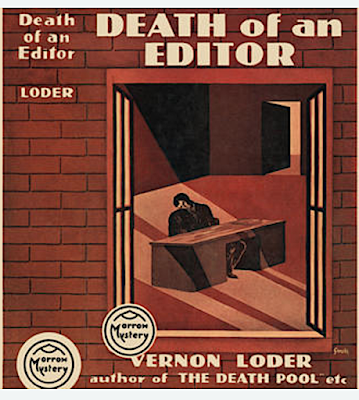
The newspaper crowd has descended upon Marsh House but not without an invitation. The impromptu house party consists of a gossip columnist, an advertising man, two reporters from France, and a serial fiction writer. All of them are waiting to speak with Hay Smith, editor of The Daily Record, one of the papers owned by publisher Sir James Sitheby. The guests are kept busy at recreations devised by Miss Roe Gay, a professional hostess tending to the various guests while Sir James is up in London. But no one has a chance to see Hay Smith. Right after a game of miniature golf the group disperses and someone finds Smith dead in the study. He’s been shot in the head and facing a window left open that looks out on the nearby seashore. Inspector Brews investigates this Death of an Editor (1931) and soon the murder reveals a complex web of questionable journalistic ethics and possible espionage. 

 Though I was disappointed that this mystery novel lacked the surreal qualities and outrageous touches that I thought were Loder's hallmarks this was a competently constructed and engaging police procedural.  Loder probably belongs in the camp of the "humdrum" detective novelists because his detective novels are very much about puzzling out the how and the why of the murder moreso than about exploring character or creating atmosphere.  The characters here are a bit flat and tend to fall into familiar stock roles of popular fiction.

Interestingly, Brews is the first of only two police detectives Loder created who appeared in more than one novel.  This is his second outing after his debut in The Essex Murders (1930), reviewed here under the US title The Death Pool.  While there may not be any blow guns and poison darts or murder victims who fall into their own death trap I found the complexity in this one above par for the usual Loder mystery novel.

First off, it's a quasi impossible crime.  All evidence seems to make it appear that Smith was the victim of a sniper's rifle fired from Sir James' yacht that was moored a few hundred yards form the open window of the study.  Brews finds signs that a rifle was fired from an open porthole and a strange wire mesh target was still in the porthole leading one to believe that the shooter used the intersecting wires as a sight.  when Smith's head appeared in the center intersection the shooter fired at his victim. But then why leave the wire mesh behind?  It seems not only sloppy on the murderer's part but might be manufactured evidence.  Are the police supposed to believe someone outside the house is the killer?

There is a lot made of everyone's alibis.  Some of the guests were together seemingly ruling them out while others were engaged in solitary habits.  The shooting took place almost directly after a malfunctioning car backfired several times.  No one could tell which were the gunshots and which sounds same from the ailing car. One of the most intriguing bits of evidence is the corners of several pieces of paper found still clutched in Smith's right hand.  Was something torn from his hand just before he died?  And if so, was it the killer who took the papers?  Or was someone in the study after the murder and took the papers from Smith when he was already dead?  

These several mysteries will all be explained with one of the most surprising elements being the actual method and manner of Smith's murder.  The documents in question are a sort of Hitchcockian McGuffin.  Loder never really needed to explain what they were (though he does vaguely allude to state secrets and British occupation in India);  they are merely an object "of great importance" to most of the characters in order to further the plot.  When the Home Office gets involved and wants to retrieve those missing documents an element of espionage enters the story.  Impostors, multiple chase sequences, and even Brews taking on the disguise of a gamekeeper further complicate the story as he tries to suss out the killer, find the missing weapon and attempt to recover those vitally important missing documents.  Death of an Editor morphs from a rather cut-and-dried quasi-impossible crime mystery to an engaging adventure thriller with Brews hot on the trail of a ruthless and devious French woman who holds the key to all the various mysteries.

THINGS I LEARNED: The world of bore guns or what Loder calls collector’s guns was revealed to me in the pages of Death of an Editor. Eventually the murder weapon is discovered to be a .410 bore rifle. He describes a weapon that was marketed to young men and teens in the advertising pages of boy’s magazines. I did some a-Googling and found several photos of these guns along with a couple of pages from period weapon catalogs. In the March 2022 issue of The Vintage Gun Journal I found an article titled “The Poacher’s Companion” all about these unique folding rifles. The article said this was the rifle of choice for poachers because they could easily fold up the gun and shove it out of sight into the deep pockets of their ulster or hunting jacket. Loder mentions that they were often called collector’s guns because there were used by people who collected bird specimens. Apparently the shot fired would kill the bird without obliterating the delicate body the collector would then take to a taxidermist.

QUOTES: “Look at the fever for all kinds of quack psychology in America. Every detective novel is full of it, and, what is worse for the police there, the country is infested with alienists, and experts full of mouth-filling words, who can prove that any criminal is not a criminal, but only ten years old.”

“There is a tendency...among newspapers to forget the purveying of news, and attempt the purveying of politics.”

Psychoanalysts to the contrary, [Brews] did not believe that egotists killed people. Narcissism is a full-time job.

“I have the advantage and the disadvantage of being a provincial, even a country detective -- that is to say, I am expected to do the work of a wise man while being regarded as an inevitable fool.”
“Which is the most advantageous, Mr. Brews?” she asked laughing.
“Being regarded as an ass,” he replied promptly.

Hard work and team work form the basis of police investigations; with a superstructure of observation and inquiry rather than lucky intuition. But, when the ends of the threads do begin to show, there is no one better at synthesis than your experienced detective. He knots up much faster than he unravels....

Friday, September 24, 2021

FFB: No Questions Asked - Edna Sherry

Police procedural gives way to domestic melodrama then morphs into a full blown cat-and-mouse thriller in No Questions Asked (1949), Edna Sherry’s sophomore novel in name only. No “wise fool” at all Sherry shows the hand of a master in her second crime novel by expertly plotting two simultaneous storylines that converge in a thrilling climax putting two rival cops practically at each other’s throats.

Steve Lake is a veteran cop, now captain of a homicide squad in Manhattan. As the story opens he is in charge of a murder investigation that smacks of Russian spies and stolen documents a triple combination that is sure to threaten “The American Way.” As if that wasn’t enough on his plate Steve is beginning to question his young wife’s fidelity when he catches her in multiple lies about how she has been spending her afternoons. Early on we get pitch perfect sampling of urban cop detection when in showing how Steve’s inherent mistrustfulness is infiltrating his home life Sherry has the cop trap his wife with easily proven misstatements about what happened at the horse track she claimed to have visited. Sherry must have loved horse racing for this is the first of three crime novels to feature that pastime so popular throughout the late 1940s and into the 1960s. So upset is Steve with Vicki’s obvious and flimsy lies that he begins to follow his wife to find out what she’s doing when she claims to have taken a train to Belmont betting on horses that don’t even exist. When he sees Vicki in the company of a Slevna, a well-known concert pianist and the man who has been tutoring her musician brother, Steve is enraged. Not so much angry that his 22 year-old wife is cheating on him, but furious that she’s doing it with a man old enough to be her father.

Mistrust leads to paranoia which in turn gives way to wild imaginings based on this one eyewitness account of Vicki seen with Slevna. Soon Steve Lake finds himself contemplating a violent revenge. But as with most revenge plots in well written crime novels -- and this one surely is -- the spontaneous plan, ostensibly foolproof in Steve’s crazed mind, backfires spectacularly. As the law of crime fiction irony would have it Steve is also faced with the outrageous coincidence that Slevna is involved in the murder and subsequent corporate espionage his team is investigating.  More than that basis for an intricately constructed and intriguing plot ought not to be revealed.

Sherry’s novel is a brilliant mixture of multiple subgenres, a well-oiled machine of suspense and complex conflicted characters. Steve is enraged with jealousy on one page then overcome with guilt on the next. His snarky and mean spirited lieutenant, a bully of a rival back at the station house, is an opportunistic cop eager for the captain’s desk at the start of the book then morphs into one of Steve’s allies by the end. Vicki is torn between telling her husband the truth and continuing with her weakening deceit. The novel is also an intriguing study of the tacit policemen’s code of honor and what cops will do for one another when one of their own is implicated in behavior that could ruin his career and life. In that regard this book is more timely than ever and might be cause for debate among those highly critical of such unwritten and questionable ethics.

No Questions Asked would have made an excellent film or TV episode. Brimming with cinematic details, excellent characters, and the requisite twisty plot peppered with unexpected moments this is a second novel that shows a real pro at work. Some enterprising Hollywood type ought to get a hold of this still resonant and suspenseful novel and could make it as memorable as Sherry's debut novel Sudden Fear that in its cinematic adaptation garnered four Academy Award nominations. With only two books under her belt Sherry's reputation as a solid crime novelist was firmly cemented in the annals of crime fiction history. She proved to be a contender with later novels Tears for Jessie Hewitt (reprinted by Stark House Press just this year), Backfire and Girl Missing, the last of these three being one of the most widely praised of her later novels.

Saturday, July 17, 2021

FIRST BOOKS: One Cried Murder - Jean Leslie

It's too bad that the striking cover illustration at left for this debut mystery novel by Jean Leslie, and the introduction to her decades long association with Doubleday Doran's Crime Club, is no indication of the story within. One Cried Murder (1945) has nothing to do with a horde of bats invading a town nor does it feature anything vaguely resembling  Gothic motifs. The story could have done with a few macabre and outre touches. But as it stands it is still one of the best academic mysteries I've read by any American writer of this era, including the many academics who hid behind pseudonyms and wrote mystery novels set on university campuses. In One Cried Murder Professor Peter Ponsonby makes his first appearance in what would be a three book series and turns amateur sleuth when faced with the apparent suicide of a psychology professor at a small university somewhere in California. This is one of the few academic mysteries of the WW 2 era where I got any inkling that the writer actually was a teacher (Leslie was a psychology fellow and taught for a while early in her career). The detail of university politics, the hierarchy of the deans and the faculty and how they influence and affect the various departments and division heads rang 100% true. I say this having worked in academic medicine for the past 24 years.

The only reason Ponsonby, an English professor, gets involved with the psychology department is because he wanted to talk with his friend Marshall d'Arcy, a child psychologist who was noticeably absent from his office on the day of Ponsonby's visit. In trying to locate d'Arcy Ponsonby enters the office of Prof. Wagner, a psychology professor of German heritage, and finds the man dead from a bullet wound to his head.

The gun it seems was astoundingly used as a prop in a variety of psychology experiments. Yes, a real gun, not a toy gun, not even a replica of a gun. A real gun. I guess that's another sign of the extreme changing times. I was flabbergasted that teaching professionals would allow a real gun to be used as a prop and handled by students in an experiment when a replica, or even a photograph of one would serve the purpose. The experiment is not crucial to the plot but is explained in detail and there is no reason why a real gun is necessary at all. [It's just a novel, I know. I'll calm down.] In any case, this gun used a prop, is never loaded during the experiments. But -- of course -- there is a box of bullets stored with the gun and anyone had access to both gun and bullets. It is kept stored in an unlocked supply closet which was covered by only a curtain. When Ponsonby finds the box two bullets are missing. He had no time to examine the gun and assumes that the second bullet is still loaded in the gun.

Suspects are many and the motives start to pour in when Ponsonby discovers that Wagner was an unethical psychologist who used confidential medical files to blackmail former patients. There is also some discussion as to the cabal of foreigners -- mostly German and Italian heritage -- who live within close proximity of one another and keep their offices just as close. Ponsonby toys with the idea of a conspiracy of Axis spies on the campus but this is soon dismissed as absurd by Mara Mallory, a secretary in the psychology department. She accuses the English professor of allowing his imagination to get the better of him. You see, Ponsonby is also a writer of murder mysteries. His most recent novel, rather popular and selling well, has a silly alliterative title. And Mara, the sassy secretary, pops off the percussive title with this derisive exclamation: "The Poison Pen Puzzle by Professor Peter Ponsonby, Purveyor of Pulp. What a comedown!"

Peter and Mara have a Benedict and Beatrice relationship that blossoms into a sleuthing partnership (albeit begrudgingly on Mara's part) as well as a cocktails and dancing partnership. He convinces Mara to allow him access to her boss' files and in return he'll take her out for a night on the town. This romantic subplot is handled with some wry humor, a sophisticated game of literary quote dropping, and a heavy dose of sexual innuendo the likes of which I've never encountered in any Crime Club novels. Jean Leslie seems to have taken a lesson from her hardboiled contemporaries when it comes to expressing the male libido and does so with relish. At times it gets to be a little much like when Ponsonby listens to one of the oversexed psychology faculty members talk about his hobby of watching the co-eds wearing skimpy gym costumes at archery practice outside his office windows. "Do you like legs?" he asks while "grinning offensively" to which Ponsonby replies, "I like legs, but I prefer them a pair at a time."

Leslie's plot meanders at times and she can't seem to make up her mind if she wants the book to be about the burgeoning romance between Peter and Mara or if she wants Peter to stick to his initial decision to match wits with his own creation, French criminal psychologist George Bouchet.  When Peter is left to his Q&A sessions with the various teachers, students, faculty wives and others Leslie displays some fine work at creating characters. The scenes with Drs. Ring, James, George and the graduate student Kurstein are highlights in the novel.  A mystery woman Ponsonby encounters in the waiting room near d'Arcy's clinic and dubs the "star sapphire woman" for the brooch she was wearing also provides him with some intriguing information about the staff.  As Ponsonby delves further into his snooping and questioning the list of blackmail victims grows, motives multiply and he inadvertently stumbles onto an undercover FBI operation which seems to validate his conspiracy of German spies among the faculty.

I enjoyed this book even if it took me three times as long to read it as it should have. The rambling nature of the story is crammed with red herrings and minutiae that prove in the long run to be pointless. Still, Leslie was clearly having fun with her story and her characters.  When Peter's mom appears it was like having a cameo by the British actress Frances De la Tour show up for some grandiosely arch comic relief. Agatha, his mother, is a radio personality with a cooking and housekeeping tips program. She also happens to have stopped by for a spontaneous chat with the wife of a faculty member. That chat comes in very handy in clearing up some alibi issues. It's characters like Agatha, Dr Ring, R.H.J. James and others among the supporting cast that will be keep me coming back for more in Jean Leslie's mystery novels.

I'll leave you with this one quote I thought was telling about how college life and college teaching in America has not changed one iota.  Dr Ring ,the self-confessed "hack professor" and the most senior member of the faculty int he psychology department has this to say about his survival and long lasting tenure:  "If I do no good I also do no harm. It is not my wish to call myself to the attention of the administration. I might also add that by the same token I never flunk a football player."

Prof. Peter Ponsonby Detective Novels
One Cried Murder (1945)
Two Faced Murder (1946)
Three Cornered Murder (1947)

Monday, March 1, 2021

IN BRIEF: I Did Not Kill Osborne - Victor Bridges

This is the year I’ve been reading books by several writers who I’ve known about for a long time and have been dancing around the periphery of my interest level. One of these writers is Victor Bridges (1878-1972) who was born George de Freyne in Bristol. Bridges worked in a bank and as an actor prior to becoming a full time writer.  Eventually he settled in Essex where most of his books are set. After getting several stories published in magazines Bridges turned to novels and averaged one published book a year from 1912 to 1961. Recently, many of his books started appearing for sale online by the dozens. He suddenly became of great interest to me especially when I learned that his career had lasted almost five decades. Surely there must be something to his work for his career to have lasted so long.

I should know better. Being prolific does not necessarily equate with quality or innovation. Bridges mostly reminds me of his equally prolific, bestselling contemporary J. S. Fletcher. Both writers churned out standard thrillers jam packed with action (albeit predictable action).  Here we have popular fiction that appealed to an audience of undiscerning readers who liked all their entertainment to be ripping yarns, easily identifiable and familiar.

Bridges' most enticing title for me seemed to be I Did Not Kill Osborne (1934) so I started with that one.  Ironically, this is an invented title slapped on the book by American publishers. In the UK the book was published as Three Blind Mice (1933), unimaginative and off putting for its nursery rhyme allusion, but aptly symbolic of the three lead characters who get caught up in a dastardly plot oblivious to the danger until it's too late. Despite the difference in titles the premise was intriguing – Nichols Trench, professional sculptor, is on trial for the murder of Jack Osborne, an acquaintance who stole a steel manufacturing formula that would revolutionize construction and engineering. In the opening chapter Nicholas is waiting to hear the jury’s verdict while his defense attorney assures him that he will be acquitted. Of course he is and Nicholas then turns his attention to trying to find out who killed the industrial thief.

Nicholas is aided by #2 mouse Molly O'Brien. She has attended every day of the trial and her presence was not unnoticed by Nicholas’ wandering eye. Molly is the daughter of the formula's inventor and gives us the requisite background on how Osborne became associated with her father back in New Orleans and how he managed to get the formula and return to England. The third of the “three blind mice” is Nicholas’ best friend Sir Jerrold Mordaunt (or plain ol' Jerry to his pals), wealthy heir to a baronetcy, whose money allows the three to finance their impending adventures.  Jerry has a devoted butler at his beck and call and a faithful dog, George, that accompanies the group. Nicholas and Molly set up their sleuthing base at Jerry’s vast estate and together the three hatch a plot to recover the formula and capture Osborne’s real killer. A group of professional criminals are hot on Nicholas’ trail and they kidnap Molly which sets in motion a series of high paced pulp magazine style incidents which don’t let up until the final pages. Any hope of the book being a true detective novel just fizzles out.

It's all fast paced, easy to read, hardly taxing on the brain, yet all too familiar. Many of Bridges’ first books were adapted for the silent screen and he himself had written several plays prior to this novel. No doubt influenced by silent movies and penny dreadful melodrama I Did Not Kill Osborne is so much like hundreds of other books you’ll be overcome with déjà vu long before you reach the halfway mark. “Haven’t I read this before?” you may ask yourself several times. Nicholas saves the girl, punches out several villains, earns several bruises and injuries before the last page. Molly is stoic and brave during her abduction ordeal. Jerry is dashing and charming and witty, like all best friends, ever ready with cash or his trusty butler to help at the last minute. Oh and there's Jimmy, the 12 year-old boy who idolizes Nicholas as an artistic mentor (the boy shows him drawings and wants Nicholas to help teach him how to be a great artist). Jimmy is recruited to help navigate a small boat that takes our intrepid group to Essex where the climax of the book takes place complete with terrifying death trap and an explosion that nearly does in everyone. The villains are dirty, lumbering, stupid and easily defeated except when Bridges needs to delay the finale.  The leader of the crooks turns out to be a Bolshevik spy, a classic cliche of the egocentric villain who talks too much and never sees what's behind him until it bashes him in the face.  Yes, he too is conveniently stupid when Bridges needs him to be.  It all works out well (did you think otherwise?) with a happy ending for our heroes and deserved arrest for the villains.

Oh! Almost forgot. We do find out who really killed Osborne. But there was no detective work involved at all. By the end of the book with Nicholas having nearly died three times and Molly's being abducted, beaten and nearly blown up herself does it even matter who killed Osborne?  The revelation is done in a confession by the killer's widow. Huge anticlimax.

In a word, passable. Very attractive dust jacket on the US edition up there at the top of this post. That's probably the only reason to seek out a copy.

Monday, February 15, 2021

Cherry Harvest – E. H. Clements

In the intriguing opening of Cherry Harvest (1944) set on a train filled with soldiers Duncan Carey in a fit of nostalgia is headed to Burbury Manor. He remembers visiting the place as a child and has fond memories, especially of its cherry orchard. He had been ordered to take a leave of absence from his job for what is vaguely hinted as some sort of nervous breakdown. A surprise is in store for him when he learns from Anthony Lord, one of his fellow train passengers, that Burbury has been transformed into Cleeve School, a boarding school for girls, and that most of the students have been evacuated. Lord is on his way to visit his music teacher girlfriend at the school and to help her with the few girls remaining behind waiting for relatives to claim them. Also in this opening chapter we learn that two sets of parents, the Passmores and the Willows, are headed to Burbury to pick up their daughters. Rounding out the varied cast of characters are Miss Hartland travelling with her Skye terrier to visit little Jill Mannister, who is the daughter of her friend Captain Mannister and Alan Brent, who also is a friend of Mannister’s. And of course there are the members of the school staff led primarily by headmistress Adela Knowles and music teacher Celia Staire. Ultimately, the mystery at the heart of Cherry Harvest is to ascertain Carey’s true reason for visiting Burbury, what his real job is and why he had the breakdown.

Languorous and nostalgia filled this protracted exposition introduces many characters and sets up myriad relationships. But literally nothing happens for the first 80 or so pages amid all the introductions. There is, however, plenty of dialogue: chit chat and gossip about the parent’s children, commentary on the war, tidbits about how railway cars are set up during wartime (no restaurant car, by the way, due to food rationing), on and on.

Where was Alister Woodhead, Clements’ series character, in all of this? I was beginning to be haunted by Carolyn Wells and her habit of waiting until the last third of the book before she inserts the real protagonist detective into the story. Woodhead does not appear until the middle of the third section titled “Sunday” in this four-sectioned book that takes place over a long weekend. The real action of the book does not pick up until after the characters arrive at the school and the students and teachers are introduced all of which lasts well into the “Sunday” section. Then suddenly poor Thomas, the dim-witted but friendly groundskeeper at Cleeve, is found shot. His body is at nearby a lever that controls a contraption called the bird-scarer – a conglomeration of tin cans and scrap metal fitted into the branches of the cherry trees in order to frighten away marauding jays and other birds who eat the cherries. How he was killed is a slight mystery and is rather important to the underlying mysteries related to Carey’s arrival. But none of that is fully explained until Woodhead shows up.

One of my primary problems with the way Clements chooses to tell her story is her insistence on having her characters talk nonstop in relating incidents that occurred offstage without the reader’s knowledge. This is the “Greek tragedy syndrome” of writing crime fiction that I loathe. I would prefer that the reader actually see the events occur rather than have two or three people talk about it to one another after the fact. When Clements does decide to give us action as it happens (about three times over the course of the novel's length) she is in high suspense mode. It is disappointing that she opts for more talk and less action for Clements has a true talent for action and creating an eerie atmosphere at Cleeve School. The story could have been that much more suspenseful and less satirical given the gravitas of her story. A man has suffered from nervous exhaustion while devoting himself to military secrets and inventions and has lost his memory. Another man has been gruesomely killed and is practically forgotten the moment he dies. But Clements would rather focus on the antics of the girls, their cutesy talk and competition in making friends with Duncan Carey, and the satiric humor embodied in Stella Passmore who represents a kind of ridiculous bourgeoisie British woman obsessed with propriety, status and materialism.

Cherry Harvest is a wartime novel given to fine detail about the intrusion of the military into British mundane routine, but it barely touches on detective fiction novel structure and conventions. True the story includes a smidgen of espionage, but it is so wispy and nebulous in that department that it barely exists. Alister Woodhead after his late entrance does step in as if he owns the place and sorts out the confusing mess of why Carey is there, why he is being hounded by mysterious and shadowy figures, as well as finding out why Thomas was shot and how the murder happened. The bird-scarer machine figures prominently and may hold the key to all the various puzzles and mysteries. But the crime and various mysteries serve almost as background while it is relationships and character that dominate the narrative.

Having only sampled this one book of the three I own I’m hesitant to try the others. I hope the languorous storytelling is a signature of only this particular title in the series. Clements has a flair for creating suspense and building atmosphere when she puts her mind to it. She seems to understand the concept of the MacGuffin fairly well and uses it very much the way Hitchcock does in his movies as that special something that the characters must go after and try to possess but which matters little to the viewer or, in this case, the reader. We know very little about this invention of Carey’s other than two words. Not why it is important to the war effort nor what it does nor anything really.

When not focusing on the main plot the writing, especially the first two thirds, is overloaded with lighthearted satire and archness reminiscent of Christianna Brand, Georgette Heyer and Gladys Mitchell. The more I read the more I found in common with Mitchell. Is it a coincidence that the headmistress’ first name is Adela? That the murder is not really a murder? That hidden motives are explained by 1940s style pop psychology? Perhaps I read too much into these things creating links where none really exist.

There is next to nothing about Eileen Helen Clements (1905 – 1993) on the internet. She has no interesting biographical tidbits found on any of the dust jackets of the few books I own. I can find no obituary online and the sparse coverage of her books came from Kirkus Reviews, as is usual with that journal the articles are ultra terse. Virginia Kirkus seemed to like the books giving favorable comments to the four Clements novels she reviewed over a five year period. She particularly liked the characterization of the children in Cherry Harvest.

Like Gladys Mitchell, the writer E. H. Clements most resembles in style and approach to crime fiction, only a handful of her books were published in the US and none of them received paperback reprint editions. This may be due to the thoroughly British flavor to the characters and events in her books that can sometimes be off-putting to American readers. They just may not have sold well at all during the war years. After Cherry Harvest was published none of the remaining eleven titles in the Alister Woodhead series appeared in the US.

I first learned about Clements and Alister Woodhead from the fan fiction website Spy Guys and Gals devoted to a wide range of US and UK spy thrillers and novels of espionage. This first book I sampled seemed a blend of detective novel – albeit rather obliquely structured – and some traces of espionage in the pursuit of a MacGuffin. I’m curious how Clements treated the other plots in the books that followed Cherry Harvest which is only the second appearance of Woodhead. He appears in two other novels previous to this, one of which has no crime plot (Bright Intervals, 1941) and tells the story of his first year of marriage to Elizabeth. It will be interesting to see if Clements turns out to be the Gladys Mitchell of WW2 era espionage fiction. Stay tuned.

Friday, April 17, 2020

FFB: Fatal Purchase - Anne Rowe

THE STORY: Rhana Haines, owner of an Asian antique gallery in New York City, is sent to Boston by her employer, wealthy Henry Maxfield, to bid on two specific items at an art and antiques auction. Rhana has $5000 and Maxfield wants her to win both items: a Sung ivory of Lao Tse and a Siamese bronze Buddha, neither of which Rhana knows is worth anything near the amount of the check she is given. She spends a mere $238 for both and has little competition during the bidding. An easy job but a curious one. Why does Maxfield want such unassuming and unimpressive trinkets?  On her way out she barely misses a collision with a man in a hurry who she overhears mentioning bidding on the Buddha. But he's obviously too late. Thanks to the wiles of Wong Riley, Maxfield's servant and right hand man, both items had their lot numbers reassigned and moved up in the auction order.  It's the beginning of a series of adventures for Rhana that begin with Maxfield's sudden death, a murder investigation that uncovers family rivalry, art smuggling, espionage and an unexpected secret dating back to Rhana's childhood in China.

THE CHARACTERS: Fatal Purchase (1945) is a fast paced, incident-filled detective novel modeled on the woman-in-peril books that were pioneered by Mignon Eberhart. Anne Rowe has done an excellent job of avoiding the usual formulaic pitfalls of the subgenre in the creations of her willful, smart and sassy heroine Rhana Haines. No whining, no wimpiness, no dithery-brained delayed decisions, no HIBK nonsense here at all. Rhana is on her own after losing her parents to the Asian flu epidemic in China. She was raised by her uncle who taught her all she knows about antiques, especially Asian art. Prior to the opening of the novel her uncle has died and Rhana has taken over the antique gallery in Manhattan. She lives on her own and is doing very well.

Henry Maxfield is one of those middle-aged demi-gods we often encounter in detective fiction of this era. A bit too much time is spent describing his unearthly good looks and powerful build for a man who is over 50 years old. In addition to his handsome looks and physique he' is aloof, mysterious and as inscrutable as the Chinese he so admires. His entire home is a replica of a Chinese palace right down to a re-creation of a Chinese water garden in his immense backyard.

Thai Buddha
Rhana feels she has traveled back in time while staying at the Maxfield home where she has been hired to catalog the vast collection of Asian art. It is so eerily reminiscent of the home where she was born and raised. But the vaguely recalled memories become tinged with Henry's perverse obsession. Reluctantly Rhana agrees to dress in a gown that was previously owned by Maxfield's deceased Chinese wife. Later, Rhana sees a life size portrait of the woman and notices that they are uncannily similar in looks. Is Henry trying to have Rhana replace his wife? She shudders at the thought but doesn't have much time to worry about the dangers of such a weird role playing because shortly after the dinner where she made her odd clone appearance Henry is found impaled on the dagger-like point on the Siamese Buddha's headdress.

There are other family members who arrived that night after the auction and the successful purchase of the art object that becomes a murder e weapon. Henry's second wife Edna, her daughter Connie, and Edna's paramour Frederic Trueman-March, a Czech aristocrat who has anglicized his name. The three are antagonistic to Rhan from the start. Family relations are bitter and tainted by avarice and jealousy. Connie is a haughty, vain wannabe actress with dreams of Hollywood and a rich husband. Edna and Fredric seem to have some sly plot they are cooking up. The Czech claims to be interested in Maxfield's vast and valuable Asian art collection but Rhana hears him says things that clearly indicate he hasn't a clue. Trueman-March has shifty con artist written all over him, she thinks. Could he also be a murderer?

Who would have wanted Henry dead beside his family? Well, there's John Kilbourne, a granite quarry manager who has wanted to take over the business since his father's death. Maxfield owns the quarry, likes John well enough but does not trust his business sense. There's Judd Norton, a mysterious stranger and associate of Maxfield's. Who exactly is he? Why is he immediately deputized by Sheriff Web Walker? Why does he seem to be in charge of the murder investigation with the sheriff following Norton's lead? What exactly was his business connection with Maxfield? Is he also an art collector as he claims? Rhana is highly suspicious of Norton especially since he appeared at the front door minutes after she found her employer's body in his study. SO was I. My notes have this comment: "It's The Unexpected Guest gimmick." I won't say if my intuition proved right or wrong. Let's just say Rowe has lots of tricks up her sleeve in this novel.

Another Thai Buddha, with a point
that looks like it could be fatal

The murder seems to be about the acquisition of the Siamese Buddha, an art object of unknown value that only Henry Maxfield seemed to understand. But then Trueman-March and Edna are also showing an abnormal interest in the item. Sheriff Walker and Norton won't let anyone near the statue. It's evidence now. Rhana is puzzled as the Buddha is hardly as valuable as some of the other treasures she has uncovered in Maxfield's collection. Some of them seem to be unique copies of Japanese masterpieces, but Maxfield assured Rhana that he had the originals. However, she knows the originals are practically priceless and are held in government museums. The mystery of the art objects' origins will be revealed along with the unusual motive for Maxfield's murder in the triple twist finale.

The star of the book is not our plucky heroine at all. Wong Riley, a Chinese-Irish servant who might as well have stepped out of a Harry Stephen Keeler novel, steps into that spotlight and rarely leaves. He has been with Henry Maxfield for close to thirty years and is more of his friend and confidant than his chauffeur, butler and man-of-all-work. Unique among all the characters in the book Wong has an odd split personality flitting between a colloquial Irishman who speaks fluent, unbroken and unaccented English peppered with "to be sures" and an "inscrutable Oriental" adopting both oracular enigmatic speech and the expected deferential demeanor. Rhana isn't the least bit disturbed by it, she finds this personality switching to make Wong all the more endearing. Though there is a point in the novel when it seems that Wong may in fact be a sinister turncoat, the reader can rest assured that he is the true hero of the novel.

Hikone screen section
THINGS I LEARNED: Reading Fatal Purchase is like taking a crash course in Asian art history. Rowe has scattered fascinating cultural and historical tidbits throughout the story, but never overwhelms the action with marathon lectures. I have two pages worth of "T.I.L." notes but I'll only mentions two.

Maxfield owns what Rhana thinks is a copy of the Hikone screen. He claims it's the original. Sections of this 15th century Japanese work fo art have been duplicated as posters, post cards and wearable art over the past two centuries when art became commercialized by museums. You'd immediately recognize some of its images like the one at the left. The six-panel byobu is dated to be from the Edo Period’s Kan’ei era (1624-44) according to Japanese website about the Shiga Prefecture. First displayed to Western culture at the Paris Exposition of 1900 the Hikone screen, considered a National Treasure, is now housed in Hikone Castle Museum.

Guanyin by Muqi
Rhana also finds the White Kwannon by Mokkei in Maxfield's fabulous collection. Once again he claims it is the true original though Rhana doubts him. I learned that this is now known as the white-robed Guanyin by the 13th century Chinese monk and artist Mu Ch'i or Muqi. The Guanyin is the central panel of a triptych that is officially named Guanyin, Crane, and Gibbons found at Daitoku-ji, a Buddhist temple, in Kyoto. Mokkei is the Japanese name of the artist. The use of Mokkei is a clue for Rhana indicating that Truefield-March has gained his knowledge of Asian art from Japanese sources.

Unlike many American mystery novels the war features prominently. Rhana mentions the dim-out helping her hideout on the estate at night. Much of the plot eventually involves POW exchange and espionage work. The setting is Maine where there were several work camps for German POWs. Maxfield owns several quarries that provide limestone for rock wool. Prior to the invention of Fiberglass, our most modern form of building insulation, there was rock wool, a fibrous mineral composition. This insulation product is used for improved sound absorption and fire protection in residential wood & steel construction projects. The rock wool from Maxfield's quarry is, as John Kilbourne says: "...needed for the war effort. Don't ask me for what. They're not telling me." More secrets to unfold!

THE AUTHOR: Anne von Meibom Rowe (1882-1961) has very little about her life or work on the internet.  I only found this ultra brief biosketch at the FictionMags Index. "Born in Germany; married Leon Randall Rowe; died in Alameda, California." That's it! Very few of her books have been reviewed in the vintage mystery blogosphere. Two reviews are at Mystery*File (Too Much Poison and Up to the Hilt) and Tomcat has also reviewed Too Much Poison.  A terse opinion (along with culled info from multiple websites) of her debut, Curiosity Killed a Cat is here.  Now with my review we have covered three of books. I own five of her six books and will be reading and writing about the remaining titles very soon. I'm looking into the mystery of a seventh book that I am suspicious might be one of the US titles re-dubbed by a UK publisher.

She had two series characters neither of whom appear in Fatal Purchase, her only stand alone, mystery but one of four books set in Maine, a favorite locale for her mysteries. Her first series detective is Inspector Josiah Pettingill, a policeman based in Maine who appears in two books, the other is Inspector Barry from Manhattan who is in three books. Mystery*File lists a UK title The Painted Monster with Pettingill, a title that appears to have only been published in the UK. But I am sure this is incorrect. I think Painted Monster is an alternate title for Up to the Hilt which is a Barry mystery novel. I have some photos coming my way to either prove or disprove this literary detective work. I'll update the post when I know for sure.

Anne Rowe's Detective Novels
Curiosity Killed a Cat (1941) [Pettengill]
The Little Dog Barked (1942) [Pettengill]
Too Much Poison (1944) [Barry]; UK title Cobra Venom (1946)
Fatal Purchase (1945)
Up to the Hilt (1945) [Barry]; possible UK title (?) The Painted Monster (1945)
Deadly Intent (1946) [Barry]

Friday, August 23, 2019

FFB: Secret Sceptre - Francis Gerard

THE STORY: The preposterous plot of Secret Sceptre (1937) reads like a matinee cliffhanger serial overloaded with harrowing incidents, gruesome murders, hairsbreadth escapes and eleventh hour rescues. Sir John Meredith investigates a murder by decapitation carried out by men in armor and eventually uncovers an ancient secret society made up of men entrusted with protecting the Holy Grail.

THE CHARACTERS: Our hero is the inscrutable Sir John Meredith, a Foreign Office agent who becomes a policeman almost by accident. In this seventh book in sixteen book series he is aided by Sergeant Beef (who is nothing like his namesake created by Leo Bruce) and some other associates from both Scotland Yard and both Foreign and Home Offices. Meredith is not at all a likable man in this book. He comes off as arrogant, classist, and racist. Surprised? I'm not. He has little patience for anyone, insults people to their faces passing it off as wry wit, is constantly telling his colleagues to shut up and is generally one of the worst examples of the ubermacho self-styled aristocrats found in pre-WW2 era fiction written by British men. Took a while for me to warm up to him, but even then I didn't' think him the ideal candidate for the protagonist of a sixteen book series. Maybe he becomes less haughty and sarcastic as the series progresses.

Thankfully the book is filled with interesting and colorful characters along the way like Dermot O'Derg an Irish mercenary "born several centuries too late" whose "out of time persona" makes him the stand out in the very large cast. O'Derg is a powerful red haired man who might have been descended from Vikings despite his obvious Irish speech and heritage. He falls hard for the requisite "pale beauty" of the novel -- Daphne Birrell, sister of sculptor Nicholas Birrell, of one the many handsome young men who met a grisly end over the course of the book.  (For some reason Gerard likes to kill off "handsome young men" with an almost gleeful sadism.  No sooner has an HYM appeared within the story he is almost immediately dispatched with callous cruelty. Wonder what that's about!)

Apart from O'Derg it's the villains who steal the show. There is the sadistic American who speaks with an indeterminate foreign accent Al Cartell-Ardew, the master criminal of the novel who is constantly slapping the face of his Asian-Jewish servant Li-Fu Isaacs. There is a Russian secret agent who join forces with Cartell-Ardew. And let me not forget the motley crew of oddball criminals Cartell-Ardew hires in order to free a prisoner who he needs for his master plan. In one of the more hilarious portions of this very odd book Cartell-Ardew engineers a prison break that seems like a Mission: Impossible episode as written by John Cleese and Graham Chapman. The group of crooks masquerade as French prison experts and demand a tour of Broadhurst prison then manage to ferret out their targeted inmate all without once resorting to violence.

INNOVATIONS:  Secret Sceptre is a strange mix of straightforward adventure with hard edged violence and loopy farce. I'm convinced that Gerard was in fact parodying all of the superhero protagonists of British pulp fiction. The prison break sequence alone is evidence enough. Gerard's irreverent humor mixes groaning puns, Abbott & Costello wordplay, a couple of dirty jokes (one about "Lord Hereford's Knob" amazingly escaped the blue pencil of McDonald's 1937 editor), and low farce clearly are all signs of high spirited fun. Nothing is meant to be taken too seriously here. Witness this pointless and ridiculous exchange between Daphne and Nicholas as they snack on pieces of melon while lounging in their pajamas and dressing gowns:

"Why must you make those disgusting sucking noises, Nick?"
"Can't help it," he replied, "the damn thing drips so and I haven't got a bib."

En route to the Welsh coast in order to get to Fishguard where Slim Shardoc, an American crook is being held for questioning Meredith has a car accident. While speeding down the foggy road a boy on a bicycle appears seemingly out of nowhere and he swerves and skids to avoid hitting the boy. He gets of out of the wrecked car and swears up a storm in Hindustani which Gerard graciously translates for us: "Now may Shaitan gather thee to his bosom in the nethermost pit which is seven times heated."  And then -- "John put his head back, raised his fists to the sky, opened his mouth and howled like a wolf, at which the small boy, hastily remounting his bicycle, peddled frantically into the darkness."

As the outrageous story progresses, the bodies pile up, the offbeat sense of humor becomes increasingly ludicrous and the climax seems like something out of Monty Python and the Holy Grail four decades before that comedy troupe ever thought up their King Arthur saga parody. Even if Gerard's description of the Knights of the Holy Grail is presented as deadly serious, the mix of nationalism and sanctimonious dogma in which the secret society members espouse their mission "to keep England English and Christian," the scene and group ultimately come off as absurdly risible while simultaneously being scarily resonant in our isolationist narrow-minded age. The Knights exploit the local superstition about a haunted abbey where they are headquartered by dressing as white robed monks thereby hoping to be seen as ghosts if anyone might accidentally encounter them in their nightly vigils. Typical of Gerard's eccentric humor the Grand Master of the Knights of the Holy Grail is an ornithologist whose keen observational skills aided by his high powered binoculars prove very helpful at a key moment.

I'll leave it at that. You must read the book to discover the rest on your own.

THINGS I LEARNED: Arabic lessons! Meredith suspects that Al Cartell-Ardew is not American at all. Using his knowledge of Arabic and Muslim culture Meredith tells his police colleagues that the man's name is an Anglicization of al kātil adū which translates as "deadly enemy." The actual 21st century transliteration of the Arabic for deadly enemy is alqatil aleaduu.

QUOTES:  John Meredith had the reputation of a complete lack of scruple, but this applied only to his methods, not to the end in view. He was one of those men who believe that if you have to fight at all, every weapon is justifiable.

THE AUTHOR: The most complete and interesting biographical information written about Francis Gerard appears on the rear flap of the Tom Stacey reissue of Secret Sceptre, the edition I own. Most of the bio blurb is quoted verbatim below with some additional trivia in brackets added by me:

"Francis Gerard was born in London in 1905. His father was French and much of his childhood was spent in France. He began to write while working in London as a dealer in precious stones. His first stories appeared in The Thriller [a weekly magazine that published the work of several well-known and prolific crime fiction writers like Gerald Verner, Berkeley Gray, Leslie Charteris and James Ronald].

"During the war he served as Major in the Essex Regiment, while his wife worked at the foreign Office. In 1946 he moved, with his family and aging parents, to Natal where he became a South African citizen. Gradually he wrote less and less, devoting much of his time to politics instead. Springbok Rampant, a semi-autobiographical account of his reasons for leaving Britain, was published in 1951. [The title is a heraldic reference pointing out Gerard’s lifelong interest in heraldry and coats of arms, an interest which featured prominently in Secret Sceptre and frequently turns up in his other fiction.]

"He married twice and had three children by his second wife. He died in 1966."

Sir John Meredith Adventure & Crime Novels
Number 1-2-3 (1936) (US title: The 1-2-3 Murders)
Concrete Castle (1936) (US title: The Concrete Castle Murders)
The Black Emperor (1936)
The Dictatorship of the Dove (1936)
Fatal Friday (1937)
Red Rope (1937)
Secret Sceptre (1937)
The Prince of Paradise (1938)
Golden Guilt (1938)
Emerald Embassy (1939)
The Mind of John Meredith (1946)
Sorcerer's Shaft (1947) - only in a minor role
Flight into Fear (1948)
The Prisoner of the Pyramid (1948)
The Promise of the Phoenix (1950)
Transparent Traitor (1950)
Bare Bodkin (1951)

Friday, February 15, 2019

FFB: Death Sends a Cable - Margaret Tayler Yates

THE STORY: Dr. Hugh McNeal, Navy physician and his wife Navy nurse Anne Davenport McNeal have been stationed in Guantanamo Bay in Cuba where the Navy runs a telegraph station in cooperation with the American Cable Company. "Davvie" (the nickname Anne prefers) has been comforting a Navy widow grieving over her husband's recent suicide, but May Patterson is convinced that her husband Tom was murdered and that his death is related to the accidental death of another navy officer who drove off a cliff a few weeks earlier. Things get more complicated when an undercover FBI agent shows up to investigate both deaths after Mrs. Patterson leaves the naval station, heads back to the mainland and complains to the US government.  Davvie starts poking around, asking lots of questions and uncovers officers in disguise, possible German spies, coded telegraph messages, a plot to steal a resident mathematician's formula, and the truth about the two suspicious deaths.

THE CHARACTERS:  Apart from Davvie and Hugh, our lead married couple, there are only a few standouts in this very large cast. Probably because Yates finds it necessary to populate her navy base with as many possible variations on a military married couple the book often seems crowded and it's hard to focus on who you should be paying attention to.  But after the long expository first third of the book with the barrage of character introductions, relationships, friendships and other basic info the reader can settle into the story of the investigation which deals primarily with two FBI agents, Davvie and Babs van Born, niece of a rigid Navy officer.

Babs is 22 years old, seems and acts much younger, and ostensibly appears merely a babysitter/nanny for two rambunctious trouble-making boys of a snobby navy couple. She is presented at first as a starry-eyed dreamer but will turn out to be the most formidable of the gaggle of adventurous and courageous women on the base. Another standout is Bill Duncan about whom I cannot say too much without ruining some of the genuine surprises in Yate's tricky and rather complex plot.

The rest are pretty much stock characters, especially the many stodgy military men. Among the other women characers Kay Brewster, a slangy smart aleck who never seems to have a serious thought in her head, was one of my personal favorites. She doesn't seem real at all, like your favorite supporting character on a sit-com, but she has all the best lines and is often hilarious with her stinging comebacks.

INNOVATIONS: Death Sends a Cable (1938) is Yate's second mystery novel but it turns out to be more of an espionage thriller.  I have not read any of the other books in the short series, though I do have a copy of the fourth book set on Pearl Harbor which uses the Japanese attack as part of the plot.  I'm guessing that since these are military mystery novels set just before and after the start of World War 2 that spies and espionage are featured in most of the plots. Though Yates uses the framework of a detective novel in trying to uncover the truth behind the supposed suicide and the car accident the whodunnit element takes a back seat to all the spying, role playing and secretive gathering of information. The book is filled with several well done action set pieces with the final third becoming rather cinematic as the heroes and heroines race against time during the onset of a tropical storm that threatens to become a hurricane.

For the most part the book reads like many mystery novels written by women during this time period. The female characters are the strongest in the cast, their dialogue and scenes together tend to be a combination of chatty exchanges and catty gossip and there is a lot of lively wordplay and punning that on occasion gets a bit grating. Her style reminded me of Virginia Rath, Kelley Roos, Manning Long and other contemporary mystery writers who specialized in husband and wife couples who get involved in baffling and adventurous crimes. While Yates does have a clever skill with the frequent wisecacre banter, clearly inspired by Hollywood movies, it seems out of place and often the book seems to be emulating a movie screenplay. Kay Brewster, for example, reminded me more of a movie character than a person, the kind of woman that Eve Arden used to play in screwball comedies.

But when Yates is focused on the plot and the action she is in her element; the book comes alive and couldn't be more realistic and believable. Being part of a navy couple herself Yates knows the way military men and their wives think and behave and those portions of the plot make the book definitely worth reading. 
 
QUOTES:  The [gossiping women] said her husband drank in the morning so he could face the food he knew he would get at noon.

"Bull" Durham had heretofore been merely one of my favorite cable men; now he was a young magician who must, I felt, sleep on thunderclouds and eat shredded watts for breakfast.

Some country wanted that formula -- wanted it badly enough to plant agents in our most secret port. There probably isn't another country in the world, I thought, where this would be possible. We shout in the headlines of our isolation until we confuse the term with impregnability. Even in the last war, when we woke with surprise to find our country honeycombed with already well-established spy systems, didn't teach us anything. We cleaned them out and left the door wide open for their return.

THE AUTHOR: Margaret Tayler Yates (1887-1952) was born in Riverside, California and spent her early career as special correspondent for the New York World while living in the Philippines with her husband, Navy Commander R. R. Yates. In 1941 she and her husband were stationed at Pearl Harbor at the time of the infamous Japanese attack. She was sent back to the mainland and settled temporarily in New York while her husband remained in Hawaii. According to her bio on the dust jacket of Murder by the Yard she had two sons and a daughter; the sons were both in the Navy and her daughter was married to an Army Air Corps lieutenant colonel.

Anne "Davvie" McNeal Crime Novels
The Hush-Hush Murders (1937) - set on board a Navy Transport ship in the South Pacific
Death Sends a Cable (1938) - set in Guantanamo Bay, Cuba
Midway to Murder (1941) - set in the Midway Atoll
Murder by the Yard (1942) - set in Pearl Harbor, Hawaii

Friday, February 2, 2018

FFB: Money on the Black - Allan MacKinnon

THE STORY: David Stanners, recently on leave from the army, is asked to help crackdown on black market thieves who have committed murder during their recent burglary of a fur warehouse. Money on the Black (1946) is rich with wartime details and its action packed, incident filled story is chock full of unexpected plot turns and shocks.

INNOVATIONS: MacKinnon has a sharp eye for character and action. The story is highly cinematic in its descriptions and many of the scenes are dramatically constructed as if intended for a movie or the stage. Mackinnon was in fact a screenwriter and wrote scripts for numerous movies, some of which were based on his stories.

UK edition originally titled
Nine Days' Murder (1945)
(apostrophe in wrong place on DJ)
Take, for example, the young elevator operator with a memory like a camera. He was a former page at a hotel until he literally outgrew the position. Now as a too tall elevator operator in an apartment complex he is training himself to remember the features and clothing of five people he meets everyday hoping this skill will help him land his dream job of being a reception desk concierge in at the same hotel where he worked as a page. His remarkable description of a man who leaves the scene of a murder helps the police track down a crucial witness.

THINGS I LEARNED: Really what made this one of the most fascinating reads so far this year was the exceptional attention to detail and the casual references to wartime that I was forced to research since all of it was foreign to me.

A passage mentioning "the Valor was burning low" led me to look up what exactly Valor referred to. I guessed that it was a kind of stove and some internet searching tells me its a brand name of a portable oil burning stove popular during wartime. I found a for Valor British Made Oil Stoves ad on a WW2 history blog that used the tagline "No smoke...No smell....No trouble."

Radiogram confused me a bit. From the context I figured maybe it was a record player, but why the radio part? Turns out it's a fancy piece of cabinet furniture that combined a radio with a record player. This is exclusively a British & Australian term. In the US a similar item would be called a hi-fi (short for high fidelity).

One of the characters goes strolling down the street and turns into an alley "where an illuminated S offered safety". Just an offhand way to tell the reader that he went in search of an air raid shelter. Of course I had no idea until I looked it up.

Anyone would know that "a Wren emerged from a kiosk" does not mean an actual bird. I figured it was a female officer in some military unit since the scene where this passage occurs takes place in a military club. Didn't know that it was the slangy way to pronounce WRN for Women's Royal Navy. Related to this was a passing reference to an A.T.S. Girl who was also among the many soldiers and officers at the King George Club. The Auxiliary Territorial Service was the women's branch of the British army. It was formed in 1938 after 17,000 woman volunteered. By the end of 1943 there were close to 200,000 women in the A.T.S. I found this on the "Women at War" website: "Women were not allowed to go into action with the men or to use firearms, but apart from that they did the same work as the men and were paid the same wages. Jobs in the [A.T.S.] army varied from cooks, clerks, telephonists and translators to lorry drivers, motorbike messengers and engineers. Women did most of the driving in the army. They drove everything from staff cars to trucks and had to be able to maintain and repair the vehicles. The ATS anti-aircraft crews watched out for enemy aircraft. They could track them with radar, pick them out with searchlights and aim the large anti-aircraft guns onto them, but only the men were allowed to fire the guns!"

Stanners' superior is a Scot who throws in a Gaelic phrase every now and then. He describes a murder weapon found plunged into the back of the first corpse as "a very ordinary sgian dubh". That sent me off to the internet again. Gaelic for "black knife" the term specifically refers to the kilt knife a Scotsman wears in a sock or tucked into his boot.

(BTW, all of these above references occur within ten pages of one another [pp. 46-56]. This next one didn't show up until page 122.)

"four day flitter" is a person who moved from hotel to hotel before five days were up. In wartime if you stayed in a hotel five days or longer you had to turn over your ration book to the front desk. This is not a casual mention but is tied into the plot. The explanation of a four day flitter (someone who refuses to give up their ration card and leaves to find another room for another four days at a different hotel) leads into a lengthy discussion about ID theft and ID card forgery. The head of the black market operations in the novel, Michael Hanley, is a "four day flitter" and is also thought to have forged an ID card with this fake Hanley alias.

THE AUTHOR: Allan MacKinnon was a Scottish novelist and screenwriter who like his countryman John Buchan was a specialist in the pursuit thriller and espionage adventure novel. Money on the Black, his first novel, reveals his trademarks of an intricate plot and fast pace. While he incorporates elements of the traditional detective novel I'd say it travels heavily into thriller territory. Most of Mackinnon's writing was for the movies. In addition to his many original scripts he adapted numerous novels, stories and radio plays for the screen during his career that lasted from 1939 to 1957. Among his scripts are Sleeping Car to Trieste, She Shall Have Murder (based on the Delano Ames novel), The Saint's Girl Friday (based on Leslie Charteris' Simon Templar story), Circumstantial Evidence, House of Blackmail and The Hornet's Nest.

EASY TO FIND? This one is pretty scarce, but that should come as no surprise. Originally published in the UK as Nine Days' Murder (1945), in France as Le dernier whisky, and under the title reviewed here in the US only a handful of each edition are currently offered for sale at various bookselling sites. My copy is the US Doubleday Crime Club edition, apparently the most common, with the striking surrealistic dust jacket by artist Vera Bock, a frequent Crime Club DJ illustrator. There was also a reprint for the US based Unicorn Mystery Book Club, a four-in-one volume with three other mysteries by Patricia Wentworth, H.R. Hays and Don Cameron. Checking with libraries may be helpful with this title.

Saturday, December 2, 2017

Calling All Johnny Fedora Fans!

A few days ago I received an email from Desmond Cory's son Richard McCarthy announcing the latest eBook release in the Johnny Fedora series. Here's the publicity for it:

A British secret agent in a deadly manhunt at the dawn of the Cold War.
Trieste 1952.
Johnny Fedora, a debonair British secret agent, knew he had only one week to prevent the Communists taking over Trieste - if he could stay alive to find the dreaded political genius Panagos, whose acumen for anarchy had left a trail of bloody revolution across the continent.
Spy adventure in the historical background of Europe soon after WWII.
In a relentless race against the clock, Johnny finds: a dead man's last message, a beautiful woman falling into his arms, a hidden photograph, and three unknown women whose initials spell out an A B C code.
Winner of the Sunday Times' Best Crime novel of the year, Desmond Cory delivers yet again a near-perfect mystery novel, written with intelligence and laced with wit, mystery and suspense.


This is not a brand new book. Intrigue is the fourth espionage novel in the Johnny Fedora series. Also published as Trieste in the US, the book originally appeared in 1954. That Best Crime Novel line is referring to the 1954 winner. I believe that Richard is hoping to release as many of his father's books as he can in digital format. We exchanged emails several years ago when he released Cory's previously unpublished novel On the Gulf as an eBook. I've remained on his email contact list ever since.

The email ends with this paragraph:

You are also very welcome to post a review of what you think of the book on Amazon - all opinions about the book are very welcome.

Lastly, please feel free to visit the new Johnny Fedora website for more information about this series.