Showing posts with label Tuesday's Overlooked Films. Show all posts

Tuesday, July 23, 2013

VIDEO: Water's Edge - Robert Bloch

One of the few examples of true noir that show up on The Alfred Hitchcock Hour "Water's Edge" (season 3, episode 3 - 1964) is adapted from the short story by Robert Bloch. The story originally appeared in Mike Shayne's Mystery Magazine in 1956. Interestingly, the story was rejected by Alfred Hitchcock's Mystery Magazine and ironically appeared in an anthology of short stories called Alfred Hitchcock Presents: Stories They Wouldn't Let Me Do on TV published in 1957.  Apparently several of those prohibited stories did eventually make their way to the anthology series.

Rusty Connors (John Cassavetes) is about to be released from prison. For months he has listened to the stories of his cellmate Mike Krause, bank robber and killer, who has been obsessed with his bombshell of a wife Helen. Now as Mike is dying of pneumonia he makes a deathbed confession. The money he stole years ago is still with his partner Pete. As soon as Rusty is out he plans to find the sexy Helen who he hopes to charm and seduce and that she will lead him to Pete and the money. When Helen turns out to be played by Ann Sothern Rusty immediately sees she has not kept her ravishing figure over time. He nearly scraps his plan. After an exchange of less than flattering remarks she agrees to meet Rusty.  Later, the two team up to locate Pete and the stolen money. You can be sure things do not work out as planned.

The script almost exclusively is a two character piece with a fascinating reversal on the noir trope of the sexy femme fatale and her gullible mark. This time we get an overweight frump and a slick and greedy Romeo. Cassavetes does a fine job, but it is Ann Sothern's interpretation of a character so completely against her usual type that makes this episode one of the highlights of the series. When Rusty first meets Helen in the diner she eats scraps off a customer's plate and licks her fingers; a perfect touch. Rusty is disgusted that he may have to seduce this slobby, porcine ex-sexpot. As the story progresses Sothern's subtle facial expressions hinting at her hidden motives are a nice contrast to Cassavetes' more overt emotional displays. You just know that this Mutt and Jeff team are out for themselves and not each other. The violent finale set in a rat infested, waterfront shack is one of the most gruesome and brilliantly filmed among the Hitchcock TV shows.

Albert Hayes wrote the teleplay adaptation that sizzles with sarcasm and irony. Bernard Girard, who began his career as a screenwriter back in 1948 and later became a prolific director for TV, brings top notch cinematic techniques to this above average entry in the series.

Highly recommended. The entire episode can be watched below.


Tuesday, June 18, 2013

COOL FLICKS: A Life at Stake (1954)

Crime and noir film devotees know the insurance policy plot is as old as Double Indemnity. Probably even older. A Life at Stake is yet another spin on the hapless mark duped into taking out a life insurance policy and realizing almost too late he's put a bullseye on his back. Just who is being duped in this story is something that is not all that clear at first. Screenwriter Russ Bender provides more than an ample amount of twists to what could have been a tired story.

Angela Lansbury turns in a neat performance as an unlikely temptress. She shows a glimmer of her monstrously manipulative mother soon to be unleashed in The Manchurian Candidate, a performance that earned her a third Academy Award nomination. As Doris Hillman she can flip the switch from sexy dame with dulcet voice and shapely gams to terrible termagant ready to slap a man's face and scream a torrent of abuse.

He-man hunk Keith Andes is Edward, the mark with a love of money and booze. In a gratuitous shirtless scene the viewer knows our hero is a manly man from the get-go. As the movie unfolds we may be watching him slowly wrapped around Doris' fingers but the director wants us to know that though he's weak of mind he's no Casper Milquetoast in the physique department. We also get to watch him fall in love with his framed $1000 bill, a chunk of cash that will come back to haunt him repeatedly.

As Doris' kid sister Madge, Claudia Barrett proves to be the biggest surprise of the movie. At first we think she's just hanging on to the muscular, lantern-jawed hero for a little thrill, stir up some sisterly jealousy. By the midpoint, however, she'll prove to be every bit as wily as Doris and her scheming husband. She adds a double dose of the twists to the plot with schemes of her own. The $1000 is released from its prison of a picture frame transforming itself from prop to a sort of a supporting character.


I liked this movie a lot. The plot seems heavily borrowed from Cain's novel but there's a delicious quirkiness to this movie's self-conscious low budget attitude. Offsetting Andes' mostly wooden monotone acting is the polished and sparkling performance from Lansbury and occasional inspired bits from Barrett combined with several expertly shot noirish scenes that lift A Life at Stake out of the realm of forgettable B flicks to make it something of a cult classic.

Jane Darwell: "He's a weird one. Him and his thousand dollar bill.
Framed like a picture and a-settin' on the table."


Douglass Dumbrille as Gus reminds his wife who's in charge

Other highlights include Jane Darwell in a cameo as a suspicious landlady and Douglass Dumbrille as Doris' urbanely menacing husband Gus. The melodramatic score is by Les Baxter and the clever script by B movie actor turned screenwriter Russ Bender. Another B movie stalwart, Paul Guilfoyle (dozens of character parts in films like The Grapes of Wrath, Mighty Joe Young, The Mark of the Whistler, Mad Miss Manton and White Heat) does a fine job in his directing debut. Guilfoyle teams up with neophyte cameraman Ted Allen (also his debut as Cinematographer) in creating some moody shots heavily influenced by classic noir movies of the 1940s and getting the most out of his capable cast. Maybe Guilfoyle could have cracked the whip a bit more on Andes. His strongman body deserved and could've taken the blows.

There are a couple of absurdities in the story (like a cabin in the woods with French windows that open onto a cliff side deck that was never finished) and the acting sometimes slips over into grandiose scenery chewing and posing for the camera, but it's such an odd film I was willing to overlook the few faults. In fact, by the midpoint when I realized the plot was headed straight into the land of weirdness I almost wanted more of the absurd and surreal. This is a little known movie that deserves full fledged cult status.  It can be seen in its entirety on several streaming websites for free. As it's one of several movies that has slipped into the public domain you should feel no guilt about watching it on YouTube or downloading it as I did. I've watched it about four times in the past few months and as derivative and hokey as it may be I still find things to enjoy about A Life at Stake.

"I feel just luscious. Uh...how much insurance do you have?"

Gus Hillman's coffee will send you to sleep rather than keep you awake.

Madge (Claudia Barrett) and Edward discuss putting to good use his treasured $1000.

Doris asks Edward to admire the view from the porch-less French windows.

That's quite a drop. Hmm...

The battle for Edward between two scheming sisters.

Tuesday, March 19, 2013

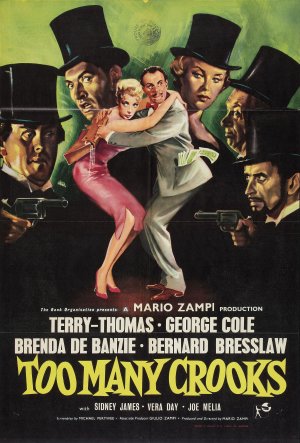
COOL FLICKS: Too Many Crooks (1959)

I've always loved Ruthless People, the 1986 comedy in which Danny DeVito tries to get rid of his harridan wife played by Bette Midler only to discover prior to killing her that she has been kidnapped.  He is elated and taunts the ineffectual kidnappers by not paying them and daring them to kill her and put an end to all his troubles. Screenplay writer Dale Launer claimed to have been inspired by O. Henry's "The Ransom of Red Chief" about the kidnapping of an obnoxious child who causes headaches for the crooks trying to get money from his parents who don't want him back.  Well, it appears that Launer really took the idea from an old Rank Organization/Pinewood Studios movie called Too Many Crooks. I only learned this a few days ago when Christopher Fowler mentioned it in passing on his blog here.  So of course I had to find the movie and see for myself. Too Many Crooks has an awful lot in common with Ruthless People. But the 1959 British movie happens to be funnier, less vulgar, and has a sense of fun and hysteria that outshines the American film of the 80s.


Terry-Thomas, premier sputterer and cad of so many British and American farces, plays Billy Gordon, a greedy businessman who fears banks and the taxman. He keeps all of his money hidden in several safes and other secure spots out of the hands of his wife and the British government.  A gang of inept thieves targets him for their latest caper, but they fail miserably at their group effort as masked yeggmen.  So they turn to Plan B - kidnapping his daughter.  Their ineptitude once again trips them up when they learn they have kidnapped not his daughter but his wife. And the joke is on them when Gordon has no interest in paying the ransom. Even when their gang leader Fingers (George Cole) attempts to barter on the ransom dropping it from £10,000 to £4,000 to a mere 200 quid Gordon will not fork over the money. When his wife learns that she is unwanted and not even worth 200 her meek demeanor gives way to vengeful Fury. No more Mrs. Nice Gal for Lucy Gordon played with wily charm by Brenda De Banzie.  She lets loose with a display of military combat techniques on her captors and lets them know who's got the real brains and brawn.  She convinces the gang of crooks to turn the tables on Gordon and rob him of every penny they can lay their hands on.


The movie is an all out farce with all the typical ingredients you expect from low comedy. Sight gags, goofy pratfalls and slapstick antics, silly disguises by the trunkful, shapely women in tight fitting costumes providing ample opportunity for  lots of breast jokes.  Cole shows off his skill at comic dialects yet his character always manages to slip into his native Cockney giving him away each time. But for every slapstick joke there are probably two or three genuinely witty lines in the very clever script by Michael Pertwee, son of playwright and novelist Roland Pertwee.  The screenplay is also apparently based on a story by novelist and journalist Christine Rochefort and Jean Nery, who was a Cannes Film Festival judge though I can find nothing else about him.

Terry-Thomas is blackmailed by "Sgt. Sykes" (Cole),
one of the many disguises of Fingers, the gang's leader
As with any farcical comedy there are a number of bizarre complications, utter coincidences and convenient accidents that add to the chaos.  Gordon is told if he doesn't pay up on the ransom his wife will be cut up into tiny pieces and distributed along the Great North Road.  Not much later he will be handed a newspaper with a headline emblazoned WOMAN MURDERED ON GREAT NORTH ROAD and frantically jump to conclusions. A series of mishaps lands him in court where one of the silliest sequences takes place. Gordon's incoherent rambling of "Money, no money. Oh, I wish I were dead" at the scene of his house fire is misinterpreted as "Mummy, Mummy." Then turned around by his defense attorney to be "Bunny. No, Bunny." As the lawyer explains, "Bunny, his budgerigar."  It goes on and on like the best kind of wordplay in a Marx Brothers movie or an Abbot and Costello routine.

The gang of crooks is made up of some veterans of the Carry On series, Sid James and Bernard Bresslaw,  and Joe Melia in his screen debut. Melia plays a scrawny, wannabe weightlifter who speaks almost all of his dialogue sotto voce and is called, aptly enough, Whisper. The shapely women are blond bombshell Vera Day as the gang's moll Charmaine and Delphi Lawrence as Gordon's unnamed secretary. Lawrence may be recognizable to keen 1960s TV fans for guest appearances on many US and UK shows like Wild, Wild West, The Man from UNCLE and Gideon C.I.D. Each of these supporting players gets their chance to shine in the chaotic, incident filled story.  Only Rosalie Ashley and Nicholas Parsons as Gordon's daughter Angela and her tax inspector fiance seem wasted as the symbols of sanity in this madcap world of criminal activity gone haywire.

Tuesday, March 12, 2013

COOL FLICKS: Cast a Dark Shadow (1955)

The opening scene of Cast a Dark Shadow was so bizarre I couldn't resist.  A woman screams in extreme close-up and we discover she's inside one of those dark rides at an amusement park. Intercut with her reactions to the fake monsters popping out of coffins and the whizzing and whirring of sirens we watch Dirk Bogarde's boyish face. The titles appear superimposed over various shots of Bogarde's sinisterly lit face, half in darkness, half in shadow. He continues to study the woman sitting next to him with a blank stare on his face. There is clearly something going on in his head but you may not want to know exactly what it is. When they exit the ride we see he's been sitting next to a woman who is considerably older than him. She could be his aunt or grandmother and when we finally recognize her as Mona Washbourne we know she just has to be a good and decent lady. You just have to stick with this movie and find out why this young guy has taken this woman to a spook house ride.

They head to a tea shop and we soon learn that the two are married. Despite his earlier creepy glares in the dark ride Teddy seems to be genuinely devoted to his wife, Monica "Mony" Baer. Wait, does that make him Teddy Baer? Yes, it does. And the relationship seems more like mother and son than husband and wife.


Back home we meet the equally devoted and simple-minded maid Effy (Kathleen Harrison) and an officious family lawyer Philip Mortimer (Robert Flemyng). Mortimer is there to discuss Mony's new will. He advises her against leaving the estate to her layabout unemployed husband. She should keep the present will leaving everything to her sister Dora who lives in Jamaica with her wealthy husband. Leave Teddy the house and keep the money in the family the lawyer suggests.  "Teddy is my family. All the family I've got," Mony counters.  She is adamant that the new will take effect especially after a recent bout with influenza that seemed fatal.  She is worried about Teddy's future. "I always thought your marriage to Philip was a mistake," sneers Mortimer.  Perfect cue line for Teddy's entrance.

Teddy (Bogarde) plies his wife with brandy and tea and more brandy
Mony in her rocking chair, which becomes a heavy handed symbol by the movie's end
Lawyer Mortimer (Flemyng) informs Emmy (Harrison) she will inherit £200
Just before Mortimer leaves he warns Teddy that even with a new will he should not be surprised when he doesn't get all he expects. He'll be back tomorrow for Mony to sign the will and alludes to her keeping everything in the family. Suddenly Teddy is worried. Anyone can see where this is leading. Older ailing woman, younger devil-may-care husband, suspicious lawyer, new will in the offing... But if you think the movie is just another run-of-the-mill fortune hunter thriller you'd be wrong. True, Mony meets with an untimely and purportedly accidental death, but the remainder of the film has a few surprises in store.

One of those surprises is Freda Jeffries played with vulgar relish by Margaret Lockwood. A more complete opposite of Mony could never have been found.  Self-assured, crass, flippant, bawdy, and most importantly wily, Mrs. Jeffries is a recent widow with some new wealth made from wisely invested money inherited from her late husband. She becomes Teddy's latest target.

Lockwood's character gives the movie just the right edge to lift it out of the realm of the ordinary. She has the best lines in the movie which give it a wicked sense of humor.  Sitting in Mony's chair and learning that she is in the room where the death occurred she says, "Oh? So we're in the morgue," and throws back her head in irreverent laughter.  Her scenes are cleverly written with an ambiguity reserved for only a few other characters.  It's never clear whether she has designs on Teddy herself or if she truly has agreed to the terms of their strictly financial arrangement disguised as a marriage.

With the entrance of Charlotte Young (cool and distant Kay Walsh) a third opportunity for making money complicates the plot. Jealousy rears its ugly head. Freda appears to be possessive not only of the house but of Teddy -- something we wouldn't have expected. Charlotte appears to be just as shady as Teddy. And the film becomes a battle of scheming women vying for Teddy's attention and property.

Based on the stage play Murder Mistaken by Janet Green, later novelized in collaboration with mystery writer Leonard Gribble, the movie successfully escapes the confines of its theatrical origins. John Creswell does a superior job with his screenplay adaptation in taking the story out of its single drawing room set by adding several nicely done exterior scenes, visits to the teashop, a local cabaret (the song "Leave Me Alone" is an ironic commentary on Teddy and Freda's burgeoning relationship), and allowing us to see more of the enormous house. Cinematographer Jack Asher, who would later become known for his camerawork on various horror and crime films for Hammer Studios, gives the film a distinctive noirish look when called for bathing the actors and the oppressive home in menacing shadows.

With the highly melodramatic finale, however, all the creakiness of the play's familiar territory and the staginess of a single room collapse onto what previously had been an above average and often stylish thriller. The dialogue becomes heavy handed, the symbolism of Mony's rocking chair intrudes too often, and the actors chew the scenery with abandon. Kay Walsh resorts to theatrical tricks and postures more suited for the stage than film. Dirk Bogarde so restrained and effectively sinister with terse speeches, unleashes a madman with the fury of a hurricane. His constant shouts of "Get out!" make no sense until the final twist is revealed. What previously been a contained film of cat-and-mouse tactics transforms into a full blown action thriller.

This is my contribution to "Tuesday's Overlooked Films & Other AV" sponsored by Todd Mason at his blog Sweet Freedom. For more writings on neglected movies, TV, video, radio and possibly music please consult the list of other posts here

Tuesday, March 5, 2013

COOL FLICKS: My Name Is Julia Ross (1945)


My Name Is Julia Ross, a neat suspense movie, has been a favorite among the film festival circuit and revival movie houses for years now. Early last year it was finally released on DVD as part of Columbia Picture Film Noir Classics, Volume 3. After months of trying to find a store in Chicago that had it for rental I stumbled across it through sheer luck when I found an online version. But like many movies which I have been waiting to see for years (I recall a similar experience when I finally got to watch The High and the Mighty) I was a little disappointed. For me it was an entertaining film with a few surprises, but due to its predictable and very familiar plot a movie that didn't thrill me as much as I had hoped for. Still, there's much to recommend the film.

Based on The Woman in Red by Anthony Gilbert, an out of print vintage mystery I have not read, it tells the story of Julia Ross, a down on her luck and unemployed secretary played with conviction and glamour by Nina Foch. In the opening scene Julia deals with Bertha, a bitter charwoman (Joy Harrington in nifty but unbilled minor role) who taunts her for being behind on the rent and out of work. "Secretary? Sittin' an' writin' all day. Call that work?" she sneeringly throws in Julia's face when the desperate young woman sees an ad that seems perfect for her. Julia rushes out of the boarding house to the Allison Employment Agency to apply.


At the employment office she learns of the odd requirements: no family ties, no boyfriends, and the job will require her to move in and live with her employer. Julia has no choice. She needs the job badly and wants to pay up on her back rent. A simple phone call to Mrs. Hughes by the hatchet faced Miss Allison (Anita Bolster) seals the deal. Julia must wait to meet Mrs. Hughes who just happens to be in the neighborhood for the interview and final approval. She shows up and it's Miss Froy from The Lady Vanishes. Whether she's playing a spy or an English matriarch Dame May Whitty is always a joy to watch. Julia also meets her gloomy but sharply dressed son Ralph (George MacReady with his signature thrilling and gravelly voice). They hire Julia immediately. All shake hands, Julia receives an advance, Mrs. Hughes urges her to go shop for new clothes and they'll meet her at the house later in the evening.

With Julia gone we now learn that the trio are up to no good. Mrs. Hughes drops her charming facade and cries out a bit sinisterly, "She's perfect!" Ralph adds cryptically, "There's even a small resemblance." Mrs. Hughes calls for Peters, a man who spied upon them from a closet. "Did she see you?" "No, madam," he says. "I made sure of that," confirms Miss Allison who we now know is really Sparks. "See that you keep it that way, especially at the house," Mrs. Hughes orders in a stern voice. They close up the agency and head on home. What have they in store for Julia? This doesn't seem like it's going to be your average everyday sittin' an' writin' job.


Julia is being groomed as a replacement for Marion Hughes, Ralph's wife. As the title implies Julia tries to get everyone to believe she is not Marion, but the Hughes family and the servants have done a wonderful job of covering their tracks. Everyone in town and everyone who visits the house think Marion is recovering from a mental breakdown. As the story unfolds we watch Julia do her best to escape and get word to her only ally Dennis Bruce (Roland Varno), a neighbor and friend back at the boarding house, while the villains manage to outwit her at every attempt. Slowly we learn what happened to the real Marion and pray that the same thing does not happen to Julia.

Nina Foch, gorgeous and frightened and later one feisty woman
George MacReady - he loves his knives
Dame May Whitty - Mother knows best
Anita Bolster starts the plot spinning with a phone call
Roland Varno - our hero

Joy Harrington - Bertha is nobody's friend
 The combination of smart script, moody camera work, and a director with a keen eye for cinematic artiness raise this familiar story out of the realm of the ordinary. Though utterly predictable from the moment the plot is revealed the movie nonetheless manages to hold the viewer's interest with an enviable panache. The music, the snappy line delivery, the performances from the entire cast -- it's a stylish little movie there's no doubt about it. And there are odd and surprising details that seem to come out of nowhere.  Mrs. Sparks draws Mrs. Hughes' attention to Ralph offscreen. Cut to Ralph on the couch seen from behind.  He's ripping a negligee to shreds with a pocket knife! Or an entire scene in which we see only Julia's frightened eyes over Ralph's shoulder while Julia and Ralph carry on their dialogue in voiceover.

The expert photography is by Burnett Guffey. After decades of filming B movies and programmers Guffey would go on to win two Academy Awards for From Here to Eternity and Bonnie & Clyde. Muriel Roy Bolton does an admirable job with the economical screenplay by quickly packing in pertinent backstory and stripping down the exposition to its bare essentials so that the meat of the story with all its suspense filled moments can get moving quickly. Even the melodramatic score mostly pulled from stock music written for other Columbia Pictures' films enhances the movie.

But it is largely due to director Joseph H. Lewis that My Name Is Julia Ross is a movie repeatedly mentioned as a something of a mini-masterpiece in suspense films. Lewis was a master at taking potboilers and turning them into entrancing movies that you can't turn away from. Each shot is a work of art. It also helps that in ...Julia Ross he had a top notch cast of talented actors. My Name is Julia Ross was supposed to be filmed in only ten days but studio executives were so impressed with what Lewis was doing they allowed eight extra days so he could produce the best movie possible. Lewis would go on to direct other thrillers like So Dark the Night, Gun Crazy (now something of a cult movie), and the melodramatic and brutally sadistic police drama The Big Combo. Each one shows his attention to detail, performance subtleties, and atmospheric lighting and framing.