Showing posts with label British Library Crime Classics. Show all posts

Friday, September 25, 2015

FFB: The Jefferson Farjeon Reprint Mystery

In light of the unusual interest in long forgotten mystery writer Jefferson Farjeon and the unrivaled popularity of the recent reprint edition of Mystery in White I thought I'd look at some of his novels that aren't getting the attention of the British Library Crime Classics imprint. Seven Dead (1939) is one they somehow overlooked yet to me is a better candidate for a reprint edition as it highlights Farjeon's skills in narrative experimentation, suspense and is overall one of the more original spins on a detective novel plot from the Golden Age.

As the title suggests the crux of the plot is the discovery of seven corpses found in a locked and shuttered room in a remote seaside cottage. They all show signs of the throes of a violent death but no trace of wounds on any of their bodies. The crime scene is investigated first by amateur Tom Hazeldean, a reporter and yachtsman, and Inspector Kendall. Entranced by a portrait of a young girl that has been inexplicably pierced by a bullet Hazeldean is determined to track down the subject of the painting, now a grown woman. She and her uncle were the occupants of the cottage called Haven House and he is sure they know what happened to the victims. Hazeldean heads to Boulogne after some initial inquiries indicate that Mr. Fenner and his niece were headed that way.

The book begins with the viewpoint of an itinerant pickpocket and thief who stumbles upon the crime scene after breaking into the house through the only open window, shifts to Hazeldean and then Hazeldean and Kendall. When Hazeldean heads off to France (for nearly one third of the book) the book morphs from detective novel into an adventure novel with the reporter as protagonist and Dora Fenner as the damsel in distress. The plot also takes on the air of a romantic thriller with several set pieces featuring our hero and heroine being captured and rescued and several supporting characters filling in as villains of one color or another. This section ends with a cliffhanger and then the story flashes back to England.

Back at Haven House the narrative style and mood switches back to the original detective novel mode as we follow Inspector Kendall and his police team through their investigation of the multiple murders and their desperate attempt to uncover the victims' identities. Most of all the plot is concerned with why all seven people were dispatched at once in the locked room. However, Farjeon has not devised an impossible crime mystery, for the murderer merely locked his victims in the room and left them to their fate in a fiendishly devised deathtrap. Rather the author is more concerned with the slow reveal of the motivation for the mass murder.

Like a good old fashioned detective novel we are treated to the discovery of tire tracks, footprints, other odd clues, and a mix of insightful deductions based on observation of human behavior. There is a well done scene in which Kendall and his Dogberry-like cohort Sgt. Wade follow the trail of a bicycle and discover the surprise method of the killer's escape. "If you weren't smarter than your conversation, Wade," Kendall says to his sergeant, "I'd have you in the bush to join the bicycle. Fortunately, during the past few hours I've found out that you are much more useful than you sound, even if sometimes it's only by accident." Poor Sgt. Wade is the butt of many such insulting jokes. Not as oblivious as Shakespeare's premiere sputtering and ineffectual head of the night watch Wade is nonetheless included for comic relief.

In the end Farjeon once again resorts to a shift in the narrative point of view and has the entire story resolved in an intricate tale of a shipwreck, survival on a desert island, and a horrific revenge plot all of which is recorded in the pages of a diary. The finale has a tendency to go way over the top in Farjeon's insistence on adding twist after twist, but you can't deny that he knows the definition of thriller when he sets out to write one. Seven Dead is a prime example of Farjeon at the top of his game and exemplifies his hallmark in the genre -- the use of narrative tricks and stylistic experimentation.

The same cannot be said of The Z Murders (1932), a much earlier effort that owes a lot to the work of John Buchan than it does to John Dickson Carr. Barely containing a smidgen of the usual plot elements of the traditional detective novel though it is in essence the story of the tracking down of a serial killer, The Z Murders is an outright pursuit thriller calling to mind in many of its scenes classic adventure novels like The 39 Steps.

Richard Temperley operating on a mixture of gallantry and instinct goes out of his way to protect a person of interest in a series of murders. In turn he is pursued by police who feel Temperley will lead them to Sylvia Wynne, the person of interest. The murders seem inspired by the kind of thing found in the pages of Edgar Wallace as a crimson Z made of metal has been left at each crime scene. Intended to baffle the police and signify the work of a mad killer working for some secret society a modern reader may easily see through the deception almost immediately. This is the kind of hackneyed device, already overused in the 1930s, is astonishingly still being used by modern writers of gruesome serial killer novels.

Farjeon writes of his characters being "implicated in the same mosaic." Mosaic is a good analogy for this kind of conspiracy thriller. Seemingly random encounters and strangers act as the colored tiles of a mosaic. When assembled together in the proper pattern they create the full picture and lead to a clearing up of the mystery. This "all things are connected" philosophy shows up again at the beginning of Chapter 17 ("What Happened at Midnight"). Farjeon points out the ironic positive effects of crime and uses as examples the taxi drivers and newsboys who benefit from a sudden rise in their income.

Fast paced and action filled The Z Murders' through line is impeded by repetition notably in the tiffs and spats Richard and Sylvia engage in. Sometimes this banter is entertaining and reminiscent of Beatrice and Benedick's sparring wit but in Farjeon's hands each reiteration becomes increasingly annoying. Another irksome gimmick is Richard's tendency to have conversation with himself. His thinking to himself rather than described in prose is rendered as dialogue and the narration even takes on his persona. While this is yet another instance of Farjeon's experimentation I found it to be cutesy and bothersome. Similarly, a Q&A between a police inspector and a "village idiot" rendered as a prose monologue rather than dialogue exists only as a writer's trick and fails to serve the story. The entire middle section of the book drags with the aforementioned tiffs, narrative play and protracted scenes of melodrama. The fifth example of an argument between Richard and Sylvia in which he demands information and she offers nothing almost had me closing the book and never finishing it.

Ultimately, The Z Murders is far too familiar and not as exciting or original as Seven Dead. Why then was something as tiresomely formulaic as The Z Murders chosen to be reprinted while a book as daring and convention breaking as Seven Dead continues to languish in the Limbo of Out-of-Printdom? The mysteries of reprint publishing are often too baffling for me to contemplate.

The Z Murders is available from the British Library Crime Classics imprint. They have also reprinted Farjeon's Thirteen Guests which seems to be more in the line of Mystery in White, being yet another country house style detective novel. I have not read that book, but I'll continue to delve into the work of Jefferson Farjeon. He is one of the most unique narrative experimenters of the Golden Age alongside Milward Kennedy. By the way...why aren't his books being reprinted?

Friday, April 11, 2014

FFB: The Cornish Coast Murder - John Bude

The Cornish Coast Murder
by John Bude
British Library Crime Classics
(US distributor: University of Chicago Press)
ISBN: 978-0-7123-5715-9
286 pp. $15.00
Publication Date: April 2014
(originally published in 1935)

In the first chapter of The Cornish Coast Murder (1935) appropriately titled “Murder!” we meet Reverend Dodd and his friend Dr. Pendrill for a Monday evening ritual consisting of diner, cigars, post-prandial drinks and the opening of a very special package. Inside the package is a pile of detective novels by the likes of Fletcher, Farjeon, Sayers, Crofts and their old friend Agatha Christie. Dodd hopes that the new book includes “new adventures of that illimitable chap Poirot.” The two men proceed to discuss their favorite books, plotting techniques and murder methods. It's clear form this opening scene that the author is a fan of the traditional detective novel and all its trappings. And we get more than a fair share of puzzles and mysteries all solved by both a police inspector and an amateur detective. It's pretty clear that Reverend Dodd will fill the role of the amateur sleuth and he stuns Inspector Bigswell with some ingenious examples of both intuitive and scientific detection.

The story centers around the shooting death of irascible Julian Tregarthan, local magistrate, who disapproves of his niece Ruth's attention for young writer Ronald Hardy who lives along the coast. At first all evidence points to Ruth who had recently had a volatile argument with her uncle who afterwards stormed out of the house and made way for Ronald's cottage. Later, Inspector Bigswell believes that Ronald may have in fact killed the magistrate. then as more evidence pile sup including "the puzzle of the footprints" he think that the two are perhaps in collusion and are covering up for one another. Reverend Dodd, however, is convinced both of the o young lovers are innocent and sets out to prove Bigswell's theories to be incorrect.

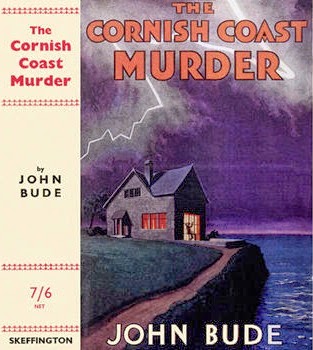
The very rare 1st UK edition (Skeffington, 1935)
The clergyman relies heavily on intuition as the basis for solving and theorizing his solution. Bigswell like a true policemen prefers to examine facts and evidence. In an effort to match brains with technique the wily Reverend resorts to an elaborate experiment involving string measurements in order to find the converging point of the path of the three bullets found at the murder scene. It’s an impressive and wholly imaginative piece of work. It reminded me of some of the baroque scientific experiments in the detective novels of J. J. Connington, notably the photographing of shadows in The Sweepstakes Murder. Reverend Dodd also impresses both the reader and Bigswell with his explanation for the absence of footprints which are directly related to where he believes the gun was fired.

For a debut mystery novel this is admirable work though not without a few faults. The surprise reveal of the murder is somewhat anticlimactic in that the solution involves minutiae. The murderer, as in most detective novels of this era, turns out to be the least likely suspect but as his motive is tied to a picayune plot point mentioned only once it seems less than fair for a mystery that up till the denouement follows all the tenets of a fair play detective novel. Nevertheless the writing is straightforward, the characters are believable and appealing and there are enough puzzles to keep the reader both engaged and mystified. Reverend Dodd would have made for a nice series character, but Bude chose not to develop him further.

The Cornish Coast Murder includes a immensely readable introduction by crime writer Martin Edwards who sheds light on the little known life and career of Ernest Elmore, aka “John Bude”. Bude’s sophomore mystery The Lake District Murder has also been reprinted by the British Library as part of their classic mystery imprint. Both are available for purchase through the regular bookselling outlets on the internet. John Bude is a welcome addition to an exciting explosion of classic crime reprints from a variety of independent presses and the British Library seems to be leading the way in discovering forgotten writers well worth reading. You’d do well to acquaint yourself with his entertaining mysteries.

*   *   *

Reading Challenge Update: Golden Age Bingo Card, space L3 - "A Book with an Amateur Detective." This gives me my first Bingo. Woo-hoo! I could stop now, but I'm shooting for the whole card.

Wednesday, November 20, 2013

IN BRIEF: The Santa Klaus Murder - Mavis Doriel Hay

Chances are you have no idea who Mavis Doriel Hay is. She wrote only three detective novels in her brief career and none of them were published outside her native England. But obscure or not and regardless of her brief output the British Library has decided to revive an interest in this forgotten woman by reprinting all three of her books. Fittingly, as we approach the holiday season, her third mystery The Santa Klaus Murder (1936) is the first to be released with others to follow in June 2014.

The plot is classic for the era. Set in the home of Sir Osmond Melbury wealthy patriarch who is rumored to be writing a new will in favor of his very officious and very young secretary The Santa Klaus Murder is practically a textbook version of the English country house mystery novel. During the Christmas morning celebrations Sir Osmond is shot dead in what appears to be his locked and shuttered study. The suspects include his son and three daughters, their spouses and a handful of servants and houseguests. Yet only one person – a guest dressed as Santa who also discovered the body – appears to have had the opportunity to have committed the crime. And he is without a motive for doing so. The story has all the makings of an impossible crime for those who had real motives have perfect alibis at the time of the murder.

The detection is top notch and there are multiple mysteries the police inspector must solve in addition to the baffling murder. As with many mystery novels of the day seemingly airtight alibis may be completely fabricated as many of the suspects lie and collude in order to protect one another. The book also includes such familiar components as a map of the crime scene and a list of characters and their relationships to one another. The well drawn map of the first floor detailing the unusual architecture of the Melbury estate serves as the frontispiece. The reader will find himself referring to it frequently in order to understand the complex arrangement of where each suspect was at the time of the murder.


Well placed clues are easy to spot and lend themselves to a nicely done competition between the reader and Colonel Halstock, chief constable who serves as one of the several narrators. A surprise element that comes as a late discovery to the characters will seem rather obvious to well-read detective novel readers. For the highly astute it is indeed possible to solve the complicated plot as this is a rather well done example of a fair play detective novel with all clues and evidence provided to the reader and nothing withheld or produced at the eleventh hour. In fact there is a "Postscript" explaining all the clues that reminded me of the notebook pages of Mrs. Bradley in Gladys Mitchell’s mystery novels. Let this be a warning to those who like to peek: the last chapter mentions the name of the murderer many times over in an enumerated list detailing motive, means and opportunity.

For those not as entranced with the puzzle elements of the plot The Santa Klaus Murder also has much to offer in intriguing characters. Hay has a few words to say on the misery of a shell shocked World War 1 veteran (ironically named Evershot) and the effects he has on his wife and relatives. Edith, Sir David Evershot’s haunted and conflicted wife, is probably the most interesting and complex of the women characters and her role adds a much needed gravitas to the sometimes lighthearted proceedings. As in most detective novels there is the recurring motif of role playing compounded by a literal masquerade in the use of the Santa Klaus costume that the murderer uses ingeniously in order to confuse everyone’s notion of time and location.

Hay’s other mystery novels Murder Underground and Death on the Cherwell will be released in new editions by The British Library in the early summer of 2014. Curt Evans has already given us a taste of Hay’s earlier work in his review of Murder Underground, though it does not sound as engaging or clever as this last book.

Friday, October 26, 2012

FFB: The Female Detective - Andrew Forrester

The Female Detective by Andrew Forrester
foreword by Alexander McCall Smith
introduction by Mike Ashley
British Library   $15.00
ISBN:  9780712358781
(distributed in the US by University of Chicago Press)

The British Library who earlier this year gave us a handsomely designed facsimile reprint of The Notting Hill Mystery have matched their efforts with a second forgotten cornerstone in the history of detective fiction. An informative introductory essay by Mike Ashley traces the authorship of The Female Detective, credited to the pseudonym "Andrew Forrester," to James Redding Ware (1832 – c.1909) and puts this fascinating series of short stories and novellas into the context of the policeman's casebook style of fiction popular in the early 1860s that would later develop into stories and novels about consulting and amateur detectives. Ware's stories dare to cast in the lead role a woman undercover police officer (yes, such a person existed in the mid 19th century) who shows she is made of tougher and smarter stuff than the buffoons and doltish coppers she encounters in her line of work.

Not all of the stories feature the anonymous G___ , who often goes by the nom de guerre Miss Gladden. She at times steps aside to relate a second hand account of a mystery solved by the physician Y___, one of her colleagues in crime fighting, or Hardal "the most eccentric barrister who ever donned a stuff gown and a wig" who resembles in many ways the kind of genius consulting detectives that would soon flood the pages of The Strand in the tales of Conan Doyle, L.T. Mead, Arthur Morrison and others. When she is on her own, however, in the longest of the two stories Ware's skills as a detective story writer as at their best. Who knew that as early as 1864 there were fictional writers detailing 19th century scientific investigative techniques that would foreshadow the high tech forensic police work that has become standard in any work of crime fiction? Miss Gladden (as I will refer to our anonymous lead) not only makes use of her wily feminine interviewing talents, but is well versed in such varied fields as anatomy, criminal psychology, and Victorian law all of which she makes use of in ferreting out the culprits and their unusual reasons for committing their crimes.

"Tenant for Life" is the first story -- really closer to a novella at more than 90 pages -- in the volume.  A chance remark from a cabman and his wife leads Miss Gladden to the family at Shirley House.  They may have gone to great lengths to preserve an inherited fortune. But was the stunt involving the switching of children really entirely criminal? Catherine Shedleigh and her brother turn out to be good and decent people though they have perpetuated what amounts to legal fraud in the eyes of the law and Miss Gladden. She is torn between feeling sympathy for the brother and sister and doing her duty as a policewoman. In fact, doing one's duty is at the heart of this particular story. Miss Gladden is constantly referring to the necessity of the detective in society. She believes they exist to bring about justice. This need for justice guides Miss Gladden first and foremost and leads her to inform on the Shedleighs despite their decency and goodness to which she is greatly attracted. Only later when the truth behind the Shedleighs' fraud is revealed will she subvert the law in order to protect them and punish someone else she sees to be more guilty, both legally and morally.

In "The Unraveled Mystery" we see a more scientific approach to crime solving. Miss Gladden recounts a past crime involving a dismembered body left in a carpet bag beneath a bridge. It turns out to be Miss Gladden's cold case having left the police baffled who filed it as unsolved. She displays a virtuoso performance in tandem with her physician cohort Y___.  Together the two combine their talents and devise an entirely plausible solution to how and why the crime was done, what specific weapon was used, who the victim was, and most astonishing of all where he most likely lived.  She derides the routine police methods that often trap and hinder genuine police work. The point driven home in this exercise of detection is "that more intellect should be infused into the operation of the police system." She would rather have imaginative thinkers on the police force than the brutish, nearly illiterate dullards she almost always must deal with.

Less a tale of detection than a morality lesson is "The Judgment of Conscience." Here is another example of Miss Gladden's observations of how crime is done for "noble" reason as as was first hinted at in "Tenant for Life." In this tale a man intent on murder confesses to a crime committed by another and nearly ends up hanged for it. Miss Gladden's insistence that ballistics evidence be examined saves him from the executioner's rope.

There is also "A Child Found Dead - Murder or No Murder?" inspired by the Road Hill Tragedy better known to students of true crime history as the Constance Kent case.  An imaginative but unconvincing argument for a sleepwalking killer being responsible is presented in a second hand account. The solution is founded upon Victorian law and the legal definition of murder. Hardal, the detective in the story is also a lawyer, and he is more concerned with fitting the circumstances of the crime to the legal reasons that constitute murder. Too rigid regarding legalities Hardal dismisses or overlooks the complex human emotions at the root of the murder of the boy which turned out to be a sort of juvenile version of a crime of passion as we know now.

The best story in the volume -- one that had been previously collected in an anthology of Victorian detective novels by E.F. Bleiler for Dover Books -- is "The Unknown Weapon."  Closer to a short novel (it runs to just under 100 pages) it is a rich and fascinating story of the mysterious murder of a squire's son told from the point of the discovery of the body to the involved coroner's inquest and ending in Miss Gladden's personal investigation and solution of the crime.

In this tale more than any other we get Ware's satiric side and his sense of humor. There is a parade of gossipy country servants, a nervous Nellie of a maid who can barely speak the language and is prone to "conniption fits", and one of the stupidest police officers in all of Victorian fiction. An abundant use of country and lower class dialects is on display in the numerous interrogation scenes Miss Gladden conducts; her interpretative skills are taxed to their limit. Numerous parenthetical translations of the simplest words -- Yoa is yes, Whoa is what, for example -- are peppered throughout the story in a wry manner.

The Female Detective is a very welcome addition to the ever continuing evolution of the detective novel as we know it.  As more and more of these early texts are uncovered it is becoming clear to me that some of the most modern works of crime fiction came to us from overlooked writers in the earliest part of the 19th century. Ware's book proves that it can hold its own against modern technical forensic thrillers, psychological suspense, and the intense legal and police procedurals that make up the bulk of contemporary crime fiction. In many cases the subtleties of the characters' motives and the uncharacteristic and surprising vagaries of criminal behavior explored at the hands of a woman detective in the Victorian era are much more interesting to me than similar themes that have practically become commonplace in contemporary crime fiction.

Friday, September 14, 2012

FFB: Antidote to Venom - Freeman Wills Crofts

I wonder how many vintage mystery readers out there are like me and read every page of a book. I mean every single page, my friends. I read the dedications and make notes of odd messages then do research on the mystery men and women mentioned. I read the copyright pages looking for unusual notations. And I always read author notes and prefaces. If I didn't I would never have known that Antidote to Venom (1938) was Crofts' "two-fold experiment" in crime fiction. In his own words "...it is an attempt to combine the direct and inverted types of detective story and second, an effort to tell a story of crime positively." Curious that second part, don't you think? I think he succeeds even if it comes about in the most manipulative fashion.

First, a crash course on terminology. The inverted detective novel is a departure from the traditional whodunit which focuses on the murderer and his motive. Instead of the murderer's identity being kept hidden until the final chapter we know the murderer from the onset and are privy to all his thoughts and plans. The suspense comes in following the detective as he tries to uncover the fatal mistake that upsets the apparently perfect crime presented to the reader through the murderer's point of view. R. Austin Freeman and his detective Dr.Thorndyke were the models of this subgenre during the Golden Age. The TV show Columbo has become the modern day equivalent and is how almost everyone has become familiar with this version of the "howdunit" or perhaps more accurately "howdhescrewup."

George Surridge finds himself trapped in a loveless marriage. He finds his only joy at work in his busy life as director of the Birmington Corporation Zoo. But he is in deep financial straits. His wife Clarissa has been living well beyond their means and George has kept secret from her his gambling problem. He owes an awful lot of money to debtors. But then there is his ailing aunt and her modest estate. If only she would die soon he could have about £8000 that would more than cover his debts and allow he and Clarissa to live comfortably again. George begins to daydream of murder plots.

One day he meets Nancy and a pleasant day of chit chat and an impromptu tour behind the scenes at the zoo soon leads to secret trysts at country inns and teashops. Before they know it the two are engaged in a full blown romance. George's criminal thoughts about murdering his aunt are displaced by his deceitful cover-up of his secret love life.

When his aunt's illness worsens leading to her death George finally thinks the legacy due him will solve all his problems. But he learns from his aunt's lawyer, David Capper, that the money is gone. The lawyer admits he stole from the woman to cover some bad investments. There is nothing left. The two of them are in similar predicaments, each needing to pay back debts with expediency. But there is another option - Capper's rich uncle. Coincidentally, this rich uncle also happens to be Professor Burnaby who was working with George in obtaining snake venom for use in his medical research. The lawyer proposes a murder by proxy scheme that will provide each of them with money they need. George will need to do four things one of which involves the deadly Russell's viper at the zoo. He will be clear of any possible guilt as he will have no motive for the death of the professor. Capper assures George he will also have an alibi the night of the murder. Driven to desperation and thinking he will be in the clear George agrees to become an accomplice to the murder.

The rest of the book details the amazing detective skills of Inspector French and the local police. At first the death of Professor Burnaby is seen as a freak accident. The snake appeared to have escaped through negligence on the part of the zookeeping staff. It also helps Surridge that a keeper had recently been let go for dereliction of duty. The local police see the snake theft as a mad revenge scheme gone wrong and look to the fired zookeeper as suspect number one. George of course is sweating bullets throughout the entire investigation. French suspects something more serious than a mere accident. Too many things seem too coincidental. Above all he is bothered by one thing: how did the snake bite the professor and then end up drowned in a rain barrel that was yards away from the body? French demands not only an autopsy of the professor's body but one for the snake.

Map endpapers in the 1st US edition (Dodd Mead, 1939)
(click to enlarge)

I haven't had much luck with finding books by Freeman Wills Crofts that were exciting or engaging. He is primarily known for detective novels in which trains and boats and their timetables are examined and studied ad nauseum as part of the murder investigation. I have been bored by a lot of them and never finished those. Luckily, there isn't a train table in sight in this book. And for once with Crofts I was completely caught up in his story. George is both an object of pity and fascination. As presented his criminal thoughts and philandering ways are completely understandable. He is shocked by his actions and yet cannot stop himself. It's a fine examples of a character who is completely human falling victim to inexplicable desires and wholly succumbing to them transforming into a person he never thought he'd ever become. For a writer often derided for his shallow characterizations I think Crofts pulled off one of the most difficult jobs in crime fiction -- a compelling portrait of a sympathetic murderer.

While there are some convenient inspirational moments and leaps of imagination in French's mulling over the oddities of the crime the real detection in the book outweighs those minor quibbles. Much of the best detective work is in French's research about the snake and the examination of a workroom of one of the suspects. I liked all of the zoo background which is most likely authentic based on Crofts' acknowledgments to a herpetologist who helped him with research.

The murder method alone is one of the most astonishing and bizarre deathtraps of this period in detective fiction.  It puts to shame the mechanical ingenuity of the gizmo in Fatal Descent by Carr and Rhode, a machine I still cannot understand. I think Crofts can be proud of this thoroughly diabolical and unfathomably constructed device for killing someone.  Even with a detailed schematic I couldn't see how anyone could dream it up - let alone build it and make it work. I imagine John Rhode letting loose with an impressive whistle when he read this book seventy plus years ago.

And about that bit about Crofts' "an effort to tell a story of crime positively"? I can't really give it all away. Let me just say it all has to do with guilt and justice and, oddly enough, an eleventh hour moment of prayer perfectly placed to achieve Crofts' desired effect. To me it seemed too pat and neat. It was an ending manipulated through coincidence and contrivance. A story of a crime positively told? Perhaps, but better to have labeled it the story of a crime with a moral lesson.

Tuesday, February 28, 2012

The Notting Hill Mystery Back in Print!

Under the hypnotic influence of the evil Baron R**
illustration from The Notting Hill Mystery
Just read this great article in The Guardian announcing the reissue of The Notting Hill Mystery (1863), an excellent Victorian sensation novel of crime and the supernatural that has been called by genre historian and crime writer Julian Symons "the first detective novel." The book caused a minor sensation over at Mystery*File where I reviewed the novel  back in December 2010 and then a few weeks later Paul Collins dogged investigative work turned up the long hidden true identity of the novel's author who had been hiding behind the pseudonym "Charles Felix" for centuries. Collins' article was published in the New York Times in January 2011. My review of the book was linked to the Wikipedia article on The Notting Hill Mystery three days after the Collins article appeared.

The new issue published by The British Library includes the original illustrations (including the one pictured above) by Georges Du Maurier (writer, artist, and grandfather of Daphne) that accompanied the first publication of the novel when it was serialized in Once a Week magazine starting on Nov. 29, 1862. The book also includes an introduction by Mike Ashley, who has done great work for Ash-Tree Press, Midnight House and other independent publishers.

Very excited about this.  I'm ordering my copy pronto. You can too by clicking here.

Thanks to the gang at Shotsmag Confidential for the link to the article.