Showing posts sorted by relevance for query john donavan. Sort by date Show all posts

Friday, February 21, 2020

FFB: Case of the Talking Dust - John Donavan

THE STORY: Sgt Johnny Lamb and his superior Inspector Cross are teamed up an intriguing case of a murdered man found with a mutilated face and no identification. In addition to determining the identity of the corpse through ingenious detective work the two policeman find the case complicated when they uncover a privately funded expedition to Scandinavia, a suspicious sculptor whose studio figures into the crime, and a wealthy patron of the arts whose recently felled beech trees were exploited by the murderer for an unusual purpose.

THE CHARACTERS: The Case of the Talking Dust (1938) is the second of the short series featuring Sgt. Johnny Lamb, the son of a renowned forensic pathologist who like his father is equipped with keen scientific mind. Lamb draws on his vast knowledge of chemistry, physics and biology to aid him in his detective work much to the exasperation of his superior Cross, a by-the-book policeman guided by routine principles and a bit skeptical of Lamb’s often byzantine approach to a crime scene. The contrast in their two methods as detectives makes for engaging often fascinating reading. Lamb is ironically often the teacher to his more experienced senior officer and Cross finds himself stubbornly listening to mini lectures on chemical compounds and skeletal deformities. In the end Cross is often marveling at Lamb’s observations.

The case focusses on a trio of characters who on the surface seem unconnected . After learning the name and profession of the corpse, Percy Dalby a pugnacious explorer given to impulsive journeys to points exotic and remote, the two policeman trace Dalby to financier Gregory Shard. Our heroes soon learn Shard was backing Dalby’s private expedition to Norway, the purpose of which he is reluctant to discuss since it involves business that may prove lucrative and he wants to protect his interests from competitors or as he puts it “we [have] to take the utmost precautions against leakage.” So guarded is their business that resort to using a special code in their correspondence. When some encoded telegrams from Dalby turn up after the murder is committed Shard and the police believe that Dalby is still alive. And if that is the case, then who is the corpse? And why was it disguised in Dalby’s clothes?

Pavilion Gardens in Buxton, UK
Beech tree sculpture (
© 2014, Andrew Frost)
The second and third characters are connected via money and sponsorship as well. They are Derek Hirsch, a sculptor of contemporary statues made from tree wood and bark, and his wealthy patron Jacob Essler. Hirsch comes into the story when his electric boat is proven to have transported the corpse to the scene of the crime.

Essler’s estate contains a grove of beech trees some of which he wanted cleared and he invited Hirsch to visit the grove to select a few choice trees for future artwork projects. Evidence of bloodstains prove that the cut down trees were used to help transport the corpse to the crime scene several miles from Essler’s estate. If this is the case Lamb reasons then the murder victim – Dalby or not – was killed on Essler’s grounds. How did he get there and why was he killed there in the beech tree grove? Lamb is determined to link Dalby with Shard, Hirsch and Essler and get to the bottom of an overly complicated crime committed by a murderer with a strange sense of humor.

INNOVATIONS: Nigel Morland writing as “John Donavan” is in his element in the series of books featuring Johnny Lamb. These intricately plotted books reveal Morland’s early interest in criminal behavior and strange motivations which would later become an obsession leading Morland to write a handful of non-fiction works on criminal psychopathology. The detective work here is mindboggling in its complexity. The title refers to some dust found at the crime scene purposely scattered on the hinges of a trapdoor that leads to a underground passage. Lamb has it analyzed and finds it to be a combination of two types of dust, one sample includes lead and radioactive lead to boot. This will be a major breakthrough in the case for the police duo.

Other pieces of ingenuity involve Lamb’s observations of the tailored clothing found on the corpse and the unusual construction of lapels that he knows are the signature work of only a handful of London tailors. They visit the editorial offices of a registry of tailors and manage to pinpoint the exact maker of the corpse’s jacket who of course knows the owner from memory.

In addition to this sartorial investigation other brilliant detective work highlights dentistry, radioactive isotopes, tides and river water movement, the differences between electric boats and gasoline powered boats, and the most impressive bit of all – the examination of the bill of lading from the truck that delivered the beech tree lumber to Hirsch’s studio and how Lamb uses his knowledge of tree wood weights (!) and some simple math to figure out that the excessive weight of one lumber bundle must have included something other than just the cut down trees.

Much of the detection in this book reminded me of the tour de force kind of plotting and ingenuity you find in the work of J. J. Connington and John Rhode. Morland can certainly be classed among those other so-called “humdrum” detective writers who wanted their mystery novels to be first and foremost about the art of detection. In his guise as “John Donavan” (and also “Neal Shepherd”) Morland was approaching true art in the detective novel.

THINGS I LEARNED: Lamb and a physician have a discussion devoted to the recent work of radioactive elements as a treatment for cancer which I thought was a much later development in medicine. And pages of talk are about the physics of lead isotopes, radioisotopes and the radioactive decay chain all of which led me to a-Googling to see whether or not it was true and accurate. Of course it was.

QUOTES: “I really don’t know how Hepplewhite does it. It’d have taken me days to collect all this when I was a junior.”
“Gradual mental evolution of the race,” Johnny remarked. “Alertness and vigour, the essence of modern youth.”
“Laziness and cinema-minded, more like.” Cross’s voice was savage.

[Lamb] had seen something of Hirsch’s work, and what he had seen had been a revelation. He suddenly felt convinced that a man who could do such work could be no killer. Whatever its artistic merit – and Johnny did not feel competent to judge, though he had been impressed – this was creative. And he could not associate the man who had done it with the idea of destruction.

EASY TO FIND? Take a wild guess. After reading TomCat’s laudatory review of Case of the Rusted Room, the first Johnny Lamb mystery novel, a few weeks ago I was reminded that I still had not found a copy of …Talking Dust and decided to look one more time Lo and behold! I found a copy for sale in a mystery bookshop I had visited in Minneapolis several years ago. The store now has an annex within the same shop devoted to the sale of vintage mystery novels and the entire stock is available via their store website. I don’t think that vintage mystery annex was there when I visited or else I would’ve bought a lot of their stock. Of course, I bought the book since it was only $20 and I had been wanting a copy for over 20 years now. Good luck finding another copy. Apart from The Case of the Plastic Mask (1940) this is the most difficult title in the Johnny Lamb series to find.

Sgt. Johnny Lamb Detective Novels
The Case of the Rusted Room (1937)

The Case of the Talking Dust (1938)

The Case of the Beckoning Dead (1938)

The Case of the Coloured Wind (1939) (US title: Case of the Violet Smoke)

The Case of the Plastic Man (1940) (US title: Case of the Plastic Mask)

Friday, November 13, 2020

FFB: The Dead Have No Friends - John Donavan

THE STORY:
  Intensely disliked, but extremely popular and financially profitable, novelist Emmanuel Cortal is murdered in his unique glass enclosed writing studio.  There is only one entrance and it was locked from the inside. His death may at first seem to have been natural, but police find he has been poisoned with a highly unusual toxin. How was the administered when apparently no one went into the studio the night he died?

THE CHARACTERS: Although The Dead Have No Friends (1952) is by John Donavan Sergeant Johnny Lamb, Donavan's usual series detective is nowhere in sight.  Instead we have Chief Inspector Roger Newlyn, the son of a Marquis who is affectionately referred to as "the Dook" by the policeman on his team or as Mrs. Coker, the cook in the Cortal household, describes him " a reel haristocrat." Despite the deferential attitude of servants who address him as "my lord" and the perks he gets that come with his family name Newlyn would much prefer to be done with his inherited title and just be known as a policeman.  He's efficient,  likeable and very good at his job as are the men who serve under him. Though as prominent as his role is Newlyn surprisingly is not the one who solves the case. Figuring out the strange murder weapon, the way it was administered and the unveiling of the identity of the killer falls to someone else entirely.

That man is Benjamin Scarle, who we first get to know in a scene of outrageous bluster and pompous anger in the office of literary agent T. F. Rodder.  Scarle is a former police commissioner, now retired, and is a bit behind in turning in the manuscript of his memoir he was coaxed into writing. Contentious, opinionated, and formidable Scarle will remind detective fiction fans of similar larger the life sleuths as Sir Henry Merrivale, Professor Stubbs, and Simon Gale.

Cortal, of course, is also one of Rodder's clients and this is how Scarle becomes involved in the case.  Though he claims to be retired Benjamin Scarle is one of those policeman who will never give up his work. Often Scarle serves as a consultant in some of the more complex cases involving Scotland Yard.  Newlyn is quick to enlist his aid when he is told the coincidence of Cortal and Scarle being clients at the same literary agency.

I made a long list of characters because the first section of this novel, a scathing satire of literary workplaces, was overflowing with names and personalities.  None of the people at the Rodder agency is pertinent to the murder case other than T. F. Rodder himself.  I wasted an entire piece of paper making notes on the staff and their delightful eccentricities only to never read of many of them after the first three chapters. Nigel Morland, the writer behind the "John Donavan" pen name, clearly was having a lot of fun in poking fun at the world of agents, publishers and writers. I wouldn't be surprised if many of these characters were based on people he knew. Instead of eagerly scribbling down notes on the staff of the agency I should have just waited until the police started their murder investigation. For it is the Cortal household with its myriad servants, Cortal's soon-to-be ex-wife Vivien, his 12 year old son Tony, and actress paramour Gerda Heywood who are the real characters to pay attention to.

INNOVATIONS:  The murder scene, of course, is perhaps the most original element.  Cortal has built for himself a private sanctuary where he can be in isolation while he writes. Within the cavernous ballroom converted into a library of his Georgian mansion he has placed his transparent studio, an entirely glass-enclosed private domain where he can see anyone coming toward him on all sides. Thankfully we are given a beautifully drawn and labeled plan of Cortal's glass room-within-a-room that definitely helps the reader understand how impenetrable it appears to be.


But in addition to the odd murder setting Morland adds clueing about the door of the ballroom's main entry which leads to the glass encased writing studio.  One of the maids has a great scene where she mentions the clicking of the door handle. She has exceptionally acute hearing and has always been aware of the odd noise which reverberates through the nearly deserted floor where the ballroom and studio are located.  Much is made of this and Newlyn sensing the young woman's sincere attitude and resolute testimony has his team investigate the door. They determine that the clicking sound only occurs when someone leaves the room. One brilliantly observant cop even shows Newlyn exactly how it makes the noise. This bit of info is crucial to eliminating possible suspects among the list of those who visited the ballroom just prior to Cortal's death.  The whole book is filled with excellent details like the "mystery of the clicking door" in helping the police determine who could have killed Cortal.

Also notable is Cortal's weird museum of African artifacts and medieval weaponry, a hodgepodge of dangerous objects that were left in an unlocked room. I was reminded of the many similar scenes from the crime museum in Isabel Ostrander's The Twenty-Six Clues to the collection of skulls in Freeman's The Uttermost Farthing all the way up to the prominently displayed weapon collection that features in the climax of the recent movie Knives Out.

Much of The Dead Have No Friends reminded me of a classic Agatha Christie novel. The multiple Golden Age motifs and conventions continued to pile up and delighted me the deeper I got into the book. A convoluted will with a cruel legacy, an actress who does more acting in real life than on stage, a murder mystery novel ghost written by one of the suspects, minor characters who seem to be thrown in only to  entertain the reader but who prove to be most important of all -- all of these elements make The Dead Have No Friends a corker of a murder mystery. Morland was always a thriller writer first and foremost, and he cannot resist adding a hair-rising climax worthy of the cinema. It's so well done that I found myself gasping in awe but moreso for it being highly reminiscent of the finale of one of Christie's best mysteries.

QUOTES:  Wessex Street on a Sunday forenoon has a peculiar air, like an old lady in a tube subway waiting for somebody to tell her where to go.

A typical outburst from Benjamin Scarle: "Hell's bell, Malcolm, you're a nasty-minded chap! Don't stare at me like a recalcitrant bacteria, startin' revolutions on a culture plate."

"Your mental dexterity is only equaled by your appalling audacity."

The English worship old customs, colourful anachronisms, and self-opinionated old men with original ways.

Scarle was not a psychic man: he had that quality of all real thinkers, in that he could parade invisible people before him and survey them from a godlike peak, guided by understanding and insight blessed with the incisive, merciless qualities of a scalpel. As the actors in the tragedy...passed before him each was dissected neatly, as if the heart was cut open and its secrets betrayed.

"'Turns out well'?" Scarle waved. "My dear chap, I'm takin' over, aren't I? That's an assurance of success."

EDGAR WALLACE ALLUSIONS:  Morland was Edgar Wallace's protege and friend. His early books were dedicated to Wallace and are modeled on his style of thriller with policemen as protagonists and not an amateur sleuth in sight.  Morland also claimed to be his secretary. Wallace is mentioned two separate times in this book. First, in a faint allusion that only a few might catch. Cortal is described as posing with a cigarette in an extremely long holder "copied from a long dead and still unforgotten writer of detective stories who had been loved as Cortal never would be."  The second time Wallace is directly mentioned when the investigation uncovers the ghost written novel The Pliny Problem. Rodder, the literary agent says: "Don't you recall how people used to say that Edgar Wallace had hacks to write his books? I knew E.W. well and I can assure you it was fatuous nonsense."  A clear case of Morland inserting himself into the narrative.

THINGS I LEARNED:  The Yost Typewriter is mentioned in a throwaway line and of course I needed to look it up.  Named after its inventor George Washington Yost it is one of the earliest typewriters, created in the last decade of the 19th century. An early ad proclaimed its original features: "No ribbon, direct printing, permanent alignment." As for the remarkable lack of ribbon here is how that worked according to an article at Antiquetypewriters.com: "Inking is done by a felt pad positioned in a full circle around the top of the tower where the type-bars rest. The type-bars travel an intricate half-flip upwards to reach the platen and then are channeled, by an inverse pyramid shaped guide hole, to strike the platen in exactly the same spot every time, giving the accurate alignment that Yost demanded."

I learned all about Acokanthera schimperi a plant indigenous to eastern Africa. Its bark wood and roots are used to make an arrow poison as well as being used in tribal medicines.

SUMMARY:  Written in 1952 and seemingly very modern The Dead Have No Friends simultaneously seems like a retro Golden Age book.  It may have been written years before and sat around waiting for the right time for Morland to submit it. The only sign that it is a later work is his more mature approach to characterization, the moral nature of the resolution, and the focus on psychology which was one of his main interests in the last half of his writing career.  I found little in his writing to arouse my irritation like xenophobic or ethnic slurs, misogyny or any of his other sins for which he has been derided.  The locked room puzzle, the clever murder method, the clues that lead to the solution, the abundance of suspects and motives -- all of this is redolent of the good ol' days of pure detection.  In fact, of all the Morland books I've read, whether under his real name or a pseudonym, I will concede that this is perhaps the best of the lot. As seen on the final page to the left (no spoilers at all in the bittersweet final paragraphs, BTW) the publisher promised more adventures from the thoroughly enjoyable Benjamin Scarle. Sadly, nothing ever came of that. The Dead Have No Friends is his first and only appearance.

It's a shame that this fine book is so ridiculously scarce. Purchased a few months ago my copy is the first I have seen in over 45 years of collecting and reading vintage crime fiction. This is one to add to the list of Must Be Reprinted titles. Here's hope that some enterprising publisher stumbles across this post and takes up the challenge.

Friday, December 1, 2017

FFB: Flashpoint - John Russell Fearn

THE STORY: Oscar Bilkin, grocer and fishmonger in the village of Halingford, receives an anonymous letter warning he and his family to "GET OUT BEFORE TOMORROW. YOU ARE ALL IN DANGER". He has no idea why he was warned nor who might have sent such an ominous letter. his family is convinced it's a nasty joke so Bilkin asks around and approaches a local known for stupid pranks. Everyone including the prankster (aptly named Wagstaff) denies sending the note. He heads to the police thinking it may not be a joke at all. They provide him with protection for the next two days. The policeman sent to guard the place will intervene if he sees anything remotely suspicious about to take place. the next day shortly after the daily delivery of Bilkin's ice he does as he always does - takes a hammer and chisel to the big slab to break it up for the fish display. After one strike of the chisel there is a horrible explosion and the Bilkin's shop goes up in flames. Everyone in the vicinity is knocked to ground. Mr. Bilkin does not fare as well. The police seem to have a sinister arsonist in their midst. Soon another building is targeted. Can the police prevent another raging fire and stop a mad arsonist from destroying the village?

THE CHARACTERS: Flashpoint (1950) is unlike many of the previous Dr. Hiram Carruthers detective novels I've read. First, Inspector Garth is nowhere in sight. Instead we have Supt. Denning and his crew of policeman in Halingford. Also, the suspect pool is much larger than usual and Fearn does a good job of making the arson attacks appear to be the work of several different people with different motives over the course of the story. There are more women characters than usual with a surprise coming in the form of Claire Denbury, a chorus girl who provides one of the more satisfying dramatic moments late in the book.

In this second outing in a relatively short series Dr. Carruthers proves to be less irascible than usual and reveals a hidden romantic side. He has hired as his assistant Gordon Drew recently returned to his hometown after losing his job when the London firm he was working for was destroyed in a fire. Pure coincidence that arson rears its ugly head again when Gordon comes to Halingford? Drew claims to have come to town to renew his friendship with Janet Lloyd, his former sweetheart. Dr. Carruthers approves and makes light jibes about Gordon and Janet whenever he has a chance. But of course the real reason he is on hand is to help the police solve the mystery of the fires. How did someone manage to start a fire in what appears to have been an explosive chunk of ice? Later the physicist is asked to explain the eerie purple color of a second fire (reminding me of The Case of the Violet Smoke by Nigel Morland writing as "John Donavan") and how the arsonist managed to set fire to a building when the place was under constant guard. Students of basic chemistry might be able to uncover these two mysteries pages before Carruthers stuns everyone with his knowledge.

INNOVATIONS: The means of the first arson is extremely clever. I managed to figure it out based solely on the description of how the ice was delivered and its odd appearance. Going into anymore detail might ruin what amounts to several well hidden clues. The second quasi-impossible fire was less impressive but did include similar unusual chemical properties that made it less than an average firebug's crime.

Apart from the chemistry involved in the arson Fearn neatly handles other clues related to motive and the identity of the culprit behind the fires and a later murder. By far this is the most mature detective novel of Fearn's I have read. It suffers not from Fearn's usual pulpy style of writing or the sense that it was a padded short story. All the characters were much more human, and believable than in other books in this series. This one resembles more closely the style of the Maria Black detective novels with their emphasis on character relationships and human drama, rather than outlandish plotting and detective novel gimmickry.

QUOTES: "The modern criminal, my boy is one of the most scientific beings alive," Caruuthers answered. "... The average murderer you'll find plastered in every newspaper in the country, but not the ingenious one--unless he's caught. That's where I come in--and other experts like me. We are dedicated to the task of defeating the new criminal, the man or woman who makes use of modern methods to perpetrate his or her villainy. ...Why else do you imagine the Yard has become so highly scientific these days? Only to keep pace with the even more subtle ways of the scientific evil-doer."

THINGS I LEARNED: This book was teeming with trivia and odd vocabulary. I haven't included this section in a while so here's a delayed avalanche for all you who have missed this regular feature.

Prior to his unfortunate death Mr. Bilkin spends the morning "arranging cabbages in the form of an Aunt Sally". I had no idea what that was supposed to mean. Off to the internet I went. Took a couple of searches before I came up with the right Aunt Sally. Turns out Fearn was alluding to a traditional pub game (see illustration at right). Players throw sticks at a model of a woman's head that had come to be called Aunt Sally. The game dates back to the 17th century apparently and today is still played by teams in pubs. However, the Aunt Sally now resembles something like a giant chess pawn than it does a woman's head.

pernoctation - multisyllabic, fancy way to say night vigil. Comes from the nearly obsolete verb "pernoctate" meaning "to stay up or out all night; especially: to pass the night in vigil or prayer."

Hans Gross is mentioned in passing when Carruthers is discoursing on the psychology behind and methods of arson. I vaguely recalled his name but had to resort to Googling to refresh my memory. Gross is a name that crops up many times in Golden Age detective fiction, especially in the works of John Dickson Carr. An Austrian psychologist who specialized in criminal behavior Hans Gross has been dubbed the "father of forensics" in various website articles. His seminal work, Handbuch für Untersuchungsrichter als System der Kriminalistik (1893) was a groundbreaking manual for the intended audience of police coroners but also was useful for judges and lawyers. In it Gross called attention to the psychology of the criminal mind and warned members of the police and legal professions to pay heed to everything over the course of a criminal investigation. He stressed preserving the integrity of a crime scene, to treat all physical evidence with care, and even discussed the importance of noting the body language of the accused while in the courtroom.

Chemical properties of elements and compounds are discussed in detail with an emphasis on flame color and smoke color. I can't say anything else about this or else the mystery of the arson methods will be spoiled.

EASY TO FIND? This was at one time one of the most difficult titles in John Russell Fearn's large output of detective fiction. Originally published under his pseudonym "Hugo Blayn" it was reprinted at least four times according to the copy I own. But used hardcover copies of this 1950s edition are rare these days. According to the email exchange I had with Philip Harbottle, Fearn's literary executor and tireless champion of his friend's work, this book will be reprinted by Endeavour Press and made available as an eBook. I'm unsure when it will be released. Until then you can find Flashpoint in a paperback, large print edition put out by Linford Mystery Library. Currently, there are at least five used copies available for sale online.


NEWS FLASH! Be sure to read TomCat's post "The Detective Fiction of John Russell Fearn", a guest post consisting of a long letter that Philip Harbottle wrote to me. But he made an error in typing my email address and it went into digital limbo. He then asked for TomCat's help in contacting me. Eventually I got the letter and he and I also exchanged some emails of our own. In the meantime TomCat had an idea to share this letter with everyone and Phil granted permission to have the letter uploaded to TomCat's blog.

Friday, January 9, 2026

Exit to Music - Neal Shepherd (aka Nigel Morland)

THE STORY: Chief Inspector Michael "Napper" Tandy attends a party at the home of musician John Farnham for what he thinks will be a private performance of a new composition for piano, violin, cello and clarinet. After being dared to attempt a complicated clarinet passage in the new piece Farnham drops dead. He's been poisoned with strychnine. Everyone is sure that the whisky he drank was poisoned but Tandy proves that Farnham never drank from the glass. How was the poison administered?  Was it that specially ordered bowl of sweet almonds that Farnham was so fond of? Or some other way?

THE CHARACTERS: There certainly are a lot of suspects to choose from and a many of them seem to have strong motives.

Myra Farnham - The victim's young and (of course) beautiful wife who seems to be the object of many of the musicians' attention. She's the only woman in the story which should come as no surprise to those familiar with the "Neal Shepherd" books which tend to deal with realms of übermacho businessmen and maverick scientists and engineers. In this case the world we are visiting is the milieu of contemporary composers of new chamber music. Not one female musician among them. Ugh. But Myra is presented as sensitive, intelligent and a bit complicated.  She is discussed at length rhapsodically by the men but when Tandy
finally interviews her he finds a woman of intelligence, indomitable spirit and a repressed independence.

Felix Hinton - the founder of a modern music quartet (piano, cello, violin, clarinet). He teaches violin to college students and gives private lessons to budding musicians. Not well thought of by the other members of his quartet. He is obsessed with Myra having once been engaged to her but losing her to Farnham, the clarinet player. Felix also has some depression issues and when his violin case reveals a hidden bottle of strychnine he descends into his morass never to return.

Dr. David Wylie - one of Myra's closest friends who has managed to move in with the Farnhams. Tandy soon learns that Wylie was receiving large payments from Farnham related to stock manipulations. Wylie is a gambler both in casinos and in the stock market. His medical case was broken into and the poison used to kill Farnham was certainly taken from a bottle stolen from him. Arrogant, suspicious and his greed knows no bounds. Tandy discovers nearly everyone in the house
was approached by Wylie who asked for loans of large sums of money.

Leslie Farnham - the victim's son.  Currently a 4th year medical student.  He asked for strychnine from Dr. Wylie to experiment with because his toxicology classes were fascinating to him.  That's what he claims. But was he planning to kill? Has a very eccentric religious belief system he calls "New Morality".  Has written a manifesto that Tandy finds among the young man's possessions. Comes across as a religious maniac to Sgt. Holland.  Tandy, however, sees Leslie's extreme beliefs as thoroughly sincere if utterly dispassionate and lacking in humanity. Views his father's death as a just end the result of Divine Intervention for his adultery and betrayal of his first wife, Leslie's mother Lily, who is long dead at the start of the novel.

Brian Tweed - composer who has finagled his way into the Farnham household as a lodger. Pretentious wanna-be, known to mimic the behavior, speech and dress of well known artists, writers and musicians. Still Myra finds him charming and he exploits his rare moments of charm in manipulating others.

Medlicone - Farnham family lawyer who talks with Tandy about the strange will that gave Farnham his wealth and cheated Dr. Wylie out of a fortune he thought he was going to inherit. The lawyer also provides some very interesting details about the odd financial relationship between Farnham and Wylie that seems to have bound Farnham to his lodger.  Also, early in the book and during the music party the lawyer inadvertently reveals the contents of Farnham's will and who will inherit what.

Anton Cheveral - cellist in the quartet. A despicable gossip who enjoys maligning everyone involved in the case. Builds on rumors of Myra's infidelity with two different men and disparges all the musicians, especially Farnham's lack of skill with the clarinet.

Jarvis - butler in the Farnham household.  Devoted to his former mistress Lily Farhman. Myra is treated with disdain by the butler. Slightly sinister in his omniscience of what goes on in the house. His refusal to accept the new Mrs. Farnham gives off a strong Mrs. Danvers vibe. I thought he was a baddie for most of the book.

Douglas Rome - clarinetist in the quartet. He dares Farnham to play the clarinet solo in the piece by composer Holt Linray (who does not appear in story).  When Farnham dies Rome flees the house without anyone noticing him.  Tandy sends police off to locate him.  Rome never appears again in the book.  Odd little plot element that I thought would pan out to a surprise, but nothing really comes of this.

INNOVATIONS: The murder method is diabolical and worthy of John Rhode's complicated death traps. Obviously I'm not going to discuss it. But I will mention that the portion of the book in which Tandy and Holland together review evidence about the whisky glass determining it could not have been used to administer the poison (even though the glass contains enough strychnine to kill five men) is extremely well done.  Overall, there is an emphasis on excellent detective work related to physical evidence.

Morland's fascination with abnormal psychology is on strong display here. By the mid 1940s and beyond this aspect of crime led Morland to write some non-fiction works on criminal pathology. In Leslie Farnham, the victim's son, Morland has created quite a religious zealot. He may remind modern readers of the new crop of neo-conservatives trying to revert Christian beliefs back dozens of centuries to the days of antiquity when God was truly the only Force to reckon with and the laws of men were negligible. Morland also delves into the consequences of men who become obsessed with women and the danger of falling in love and never getting over rejection. Felix Hinton suffers from an obsessive attraction to the victim's widow coupled with severe depression and it leads to his own demise.

Nigel Morland (1905-1986)
(aka Neal Shepherd, John Donavan,
Roger Garnett, et al.)
In the final pages Morland also attempted to introduce a moral dilemma for Tandy in his dual professions. he is not only a policeman but a scientist. Throughout the book some of the characters refer to him as Dr. Tandy. MD or PhD? I was never really sure. Tandy in previous books uses his knowledge of chemistry to help him in solving impossibilities in the murders he investigates.  But in this book he also acts as a physician.  In any case, during one crucial scene a character while recovering from a poisoning attempt and in a delirium re-enacts a conversation with another suspect. This rambling "conversation" reveals the murderer's motivation. Tandy doesn't know how to act on this. Has he eavesdropped? Has he heard this in a capacity as a physician? If so, then it's private and should not be revealed. But can he use this information he has overheard as a policeman to help capture the criminal?

Interesting idea, but I found the whole scene utterly contrived in that an entire conversation is re-enacted in a form of delirium and yet is done lucidly and clearly to deliver all the salient points. Other than that flaw in the story I thought this was the best of the Chief Inspector Tandy detective novels. It's rich with complicated characters, psychology and is teeming with wonderful detection set pieces throughout the story.  Even Sgt. Holland gets his due in three scenes when Tandy asks for his insights. 

And now the bad news... Ridiculously scarce! I think it's a genuinely rare book. My copy was the only one I've come across in over 20 years of looking for the book. And it's gone already. Sold to a lucky reader in Australia. Good luck finding another. Perhaps in a library in the UK, Canada or Australia? There must be a copy...somewhere!

Sunday, February 27, 2022

LEFT INSIDE: Promotional Post Card from 1938

Today for a change we have a legitimate "Left Inside" find.  I was sort of cheating for the past couple of months using inscriptions and bookplates (and there are more of those to come in case you were suffering from withdrawal) due to a lack of ephemera left inside my books. A plethora of bookplates and POIs  began turning up as well as autographs so I started taking photos and have quite a file to choose from now.  This post card, on the other hand, was a delightful and long overdue find.

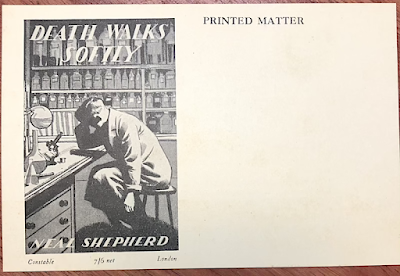
And the book itself is an even better find!  One of the best purchases I've made in years. It's an incredibly rare copy of Death Walks Softly (1938) --a Nigel Morland book, one of the Inspector Tandy detective novels he wrote using his "Neal Shepherd " pseudonym. At a mere $35 it was a steal. The description promised the exceptionally scarce dust jacket though based on the price clearly the seller had no idea about that. Overall, the description noted minimal damage and a book in good condition. A bare bones description to be sure and leaving a lot of room for my usually cynical imagination to fill in with all sorts of expected flaws. It could mean anything from genuinely good to battered and worn because "good" in the book trade does not mean good at all. Usually "good" translates to barely good. In truth the rating can be used to cover a condition that ranges from usual wear to beaten to hell.  This counterintuitive grading system that's been in place for centuries frankly still baffles me. 

Imagine my surprise when I opened the package to discover a review copy in Very Good condition!  Minor wear, faint foxing to the foredges, some tanning to the edges of the dust jacket, but absolutely much better than a mere "good."

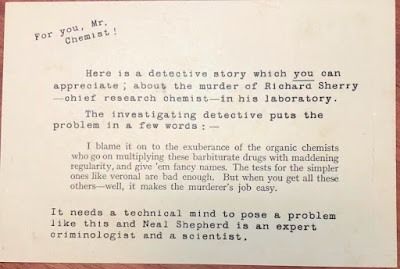
Laid inside I found a bonus not mentioned in the seller's description. A promotional post card from Constable & Co., the publisher, intended to be sent to professionals in the chemistry world. This makes me think that the book was a review copy and that the recipient was to send the card out to help promote sales. It also alludes to the fact that the book is the first in a new series although that fact is never mentioned outright. The front of the card has a miniature of the dust jacket illustration, but in black and white. The actual dust jacket is in three colors (blue, green and black). Click to enlarge for full enjoyment. You'll most likely have to enlarge the second one in order to read the message.


I own three of the four Neal Shepard books and have been promising to write about them for years now.  I think I've mentioned in passing the plot of Death Flies Low in a couple of comments over the past ten years, but still have not written up reviews of any of the books. They are all scientific detective novels with bizarre murder methods and unusual motives. Along with another brief series featuring Sgt Johnny Lamb that Morland wrote as "John Donavan" they are the best of his detective novels. Expect reviews of all the Neal Shepherd books starting in March and continuing through April. You'll have to wait for the photos of the beautiful copy of Death Walks Softly in the first review in the coming weeks.

Thursday, June 4, 2015

Death Takes an Editor - Nigel Morland

For one reason or another in the world of popular fiction some publishers and agents suggest prolific authors resort to using pseudonyms, especially if they are trying out new characters or writing books that veer away from their usual fare. This was a trend that dates back to the Golden Age and carried on into the 1970s.  I guess there are still a few prolific writers who have multiple identities, as it were (I can think of a few male thriller writers still active under several pen names), but it was more common decades ago. Nigel Morland was one of those prolific writers with a schizoid writing career.

Morland's Palmyra Pym police procedural mysteries were his mainstay and were published in the UK and the US by two top-line publishers.  When he chose to write outside of the series, usually under a pen name, his crime novels often tackled unusually technical and scientific concepts in a mystery novel and I guess he had to shop them around. Surefire sellers with recognizable series characters are easier to accept for a publisher while risky or controversial subject matter may not at all be attractive when it comes to selling books. It wasn't altogether clear to me why Death Takes an Editor (1949) wasn't released by his regular publisher in the UK. It seemed fairly straightforward with its newspaper setting, formulaic cast of characters, and an eccentric consulting detective with a background in abnormal psychology. Why did Morland hand over his book to the obscure and long gone publisher Aldus Publications Ltd.? At the halfway mark the book's content makes a startling turn into a lurid world and the answer to that question was made perfectly clear. In 1949 there weren't too many mystery novels that dealt with sadomasochistic sex so candidly.

At first I thought this was going to be one of Morland's strange forays into scientific detection because the police detective is Chief Inspector Jonathan Lamb. Under the pseudonym John Donavan Morland wrote a handful of complex and engaging detective novels with Johnny Lamb, a policeman with a background in chemistry who solves cases involving poisoning via an air conditioning system (Case of the Rusted Room), poisoning by iodine gas (Case of the Violet Smoke), and odd botanical toxins (Case of the Beckoning Dead). But this Lamb is of a completely different wool and he turns out to be the secondary detective.

The real sleuth in Death Takes an Editor is Professor Steven Malone, "the most brilliant medical jurist of his day." A former forensic professor at the University of Egypt Malone worked all over Europe and at the start of this novel he is employed in a "revolutionary Medico-Legal department...attached to Scotland Yard" where he acts as "part of a police organization without being subordinate to it." Malone, like his creator Nigel Morland, also happens to have an extensive knowledge of abnormal psychology and is well acquainted with some of the more sensational cases of the past as detailed in the numerous criminology textbooks he has devoured over his long career. This arcane information serves as the springboard to the solution of a series of murders all having their roots in possessive and controlling love.

The plot includes a few miracle problems like the vanishing of two men from a locked and guarded newspaper office as well as some odd red herrings like a box of poisoned chocolates and the appearance Bernard Ambrus, the mysterious "astropathologist" -- really nothing more than a glorified astrologist who claimed to treat disease. At first the case seems to focus on the puzzling personality of the murder victim Ernest Shipper. Each character presents a completely different perception of Shipper. At first a scold and office dictator disliked by all his co-workers, then a misunderstood quietly tolerant man, then a thrill-seeker slumming for sex in dive bars.

The more he thought about [Shipper] the more seemingly negative characters of the editor took on a full and amazing life. From being a minus sign in human form he was gradually emerging into the full flower of a thoroughly contradictory personality.

One of Morland's many true crime books
Malone however turns his attention on Jill Bethanny, Ernest Shippers wife who chooses not to use her husband's surname. This book is marketed salaciously on the DJ blurb as if Jill is some sort of femme fatale who weaves a spell over all the men in the story. This is not the case at all. She turns out to be a victim of the perverse sexual predilections of her husband. As Malone uncovers more dirty secrets in the Shippers' lives -- pornography in a secret drawer in Shipper's office, S&M paraphernalia hidden in the bedroom, signs that someone was lashed to a water heater -- the novel descends into a& world that Morland would like us to think is amoral and thoroughly evil.

Malone acts as Morland's voice here and it's hard to dismiss the misogyny that completely overtakes the story. Malone quotes from an ancient criminology book called The Female Criminal, gives examples of outdated Freudian psychology and tries to explain the difference between men and women who become criminals. It's all hogwash. Morland tries to shock his readers with a still misunderstood world of alternative sex practices but it just comes out embarrassing. His views (and the books he quotes from) are dated, chauvinistic and hateful. Additionally, these criminal facts color his moral worldview and for Malone (and presumably Morland) there is no room for forgiveness or redemption or a second chance when it comes to indulging in "perversity".

WARNING! ...SPOILERS A-COMIN'... I'm about to give away the biggest "shock" of the finale. Stop here if you don't want the book ruined. Not that it makes much of a difference, IMO.

Jill, we learn, was not only abused by her husband but as a result of succumbing to his will and participating in his hedonism she is doomed and cursed to a life of irredeemable amorality. She commits murder in order to free herself, but by then as far as Malone is concerned it is too late for her. She has become thoroughly corrupted. In the end he plants the idea in her head that she would be better off dead and she commits suicide. Nice, huh? There's some advanced twentieth century thinking for you!

...END OF SPOILER...

When Death Takes an Editor sticks to police procedure and forensics it makes for an intriguing detective novel. When Morland becomes a moralizing lecturer, however, the book fails disastrously. I'll be sure to avoid any of his other books published by the more obscure houses of the past like Aldus. It's clear to me that the mainline publishers saw some of his books as disguised treatises to espouse his personal beliefs and not as a novel meant to entertain.

* * *

I read this as part of Rich Westwood's "1949 Mystery Novel Challenge" for the month of May. But I so hated this book I decided to wait to write it up until after the challenge was over. I found a much better book -- Death Knocks Three Times by Anthony Gilbert -- to replace this one for that challenge.

Thursday, February 2, 2012

FIRST BOOKS: The Moon Murders - Nigel Morland

The dedication to The Moon Murders (1935), Nigel Morland's debut as a crime fiction author, is to his mentor Edgar Wallace who he also credits with having given him the idea for Palmyra Pym. In the history of all detective fiction Palmyra Pym is the first woman police officer of high rank in command all her investigations. There have been female fictional private detectives and perhaps a few female police officer characters in the crime fiction of the late 19th century and early 20th century, but Mrs. Pym is unique with her high rank of commissioner and therefore a true pioneer for women characters in the genre.

While they display the usual elements of a traditional detective story the Mrs. Pym books are at their core police procedurals. Morland was a true crime addict and journalist and knew how Scotland Yard really worked during his lifetime. The drudgery of paperwork, the backbiting among colleagues, the sergeant trying his best to prove his skills and shine in the eyes of his superior, and the utter bureaucracy of the life of policemen -- Morland captured it all. The Moon Murders is concerned with not only the investigation and apprehension of the criminal but also the inner workings and bureaucracy of police departments and most especially the relationships of police officers with their partners and superiors. The life of police behind the scenes is really what distinguishes a true police procedural from the usual whodunit and will become the hallmark of such later crime writers as John Creasey in his books about Commander Gideon and Inspector West representing the UK and Ed McBain and Jonathan Craig in the their treatments of urban American precinct life. Morland to me seems to have nailed the formula combining detection, police work and police relationships in his first book. It's not just an entertainment it is a real novel of character.

Man from the Moon 's disguise recalls
McCulley's ex-circus performer
Like the oddball characters of Johnston McCulley's pulp magazine stories (The Crimson Clown, Black Star, and the Demon) London is plagued with a master criminal with a penchant for theatricality. Several shooting deaths have been attributed to someone calling himself "The Man from the Moon." At each crime scene police find a calling card stamped with a yellow crescent and a taunting typed message. He makes surprise appearances at Scotland Yard dressed in a billowing shapeless gown, a grisly white mask and a red fright wig and challenges Mrs. Pym to stop him before he strikes again. She is certain that "The Man from the Moon" is not acting alone and it's all a smoke screen for a crime syndicate planning something far more insidious and harmful to the city.

In one of his more daring acts the masked criminal manages to escape her office unseen by a guard on duty foreshadowing Morland's later fascination with detective novels that feature impossible crime aspects. But Mrs Pym will have nothing to do with locked rooms and impossibilities. When anything seeming to be an impossible crime surfaces she quickly dismisses and proves within minutes how the "miracle" was accomplished. One thing a criminal should never do with Mrs. Pym is toy with her unshakable respect for logic and common sense.

Morland takes the Holmesian approach to crime detection to its extreme with Mrs. Pym who tries her best to get her men to see things as they really are. She walks into a room and within minutes can tell you who has been there and she teaches her police to do the same. In her partner Inspector Shott she glimpses the potential for an excellent detective, but their first few days together are like Beatrice and Benedict trading insults. One of the best examples of her amazing detective skills comes in her examination of the rooms at Ensor Mews where a reporter has been kidnapped. Based on indentations in the carpet, an uneaten breakfast, and hand prints left in dust on a table top Mrs. Pym figures out not only precisely what happened in the room, but the height and personality of the kidnapper. Holmes could do no better, I think.

When her loyal Chinese servant and dear friend is killed in a shootout/car chase that results in a fatal car wreck Pym's irascible personality transforms into a powerfully enraged and cruel Nemesis. She vows to bring in all the criminals in the gang headed by "The Man from the Moon" even if she has to kill every last one of them herself. It's an astonishing scene and the metamorphosis is something to marvel at. Rarely do we get this kind of character arc in any detective novel of the period.

Her shift in character and motivation is marked by an ever increasing unorthodoxy and flagrant violation of police protocol. She begins to resemble a brutal American cop not the usual genteel British police officer of a traditional detective novel. We know that she has spent some time in the U.S.A. (Omaha and Nevada are both mentioned) and she confesses that she had some respect for the tactics of the "third degree" favored by American police. She even stoops to bribing witnesses to speed up the investigation and get her closer to ferreting out the killers. Her superiors are shocked and lecture her. Even Shott is appalled by her sudden changes. He is concerned that Internal Affairs might get wind of Pym's "rule bending" and repeatedly warns her to curb her methods lest her actions lead to probation for both or the end of their careers.

The Wallace influence comes into full force when in the final pages Morland creates one action sequence after another in relentless succession. There is an exciting airplane chase complete with a gunfight that could've been lifted from a war movie. Vengeance is hers. Aiming straight at the plane's gas tank Mrs. Pym fires in rapid succession crying out "Frizzle you murderer!!" her fury punctuated with not one but two exclamation marks. Her rage so overcomes her Mrs. Pym doesn't even realize she has been shot in her wrist until she's on the ground. A later shoot out in the villains' hideout is a bloodthirsty barrage of bullets and bodies falling that makes the St. Valentine's Massacre look like a tea party. Mrs. Pym orders her men to open fire and "Give 'em all you got." When she is aiming at one of the nastiest of the lot she addresses him, "Speak well of me to the dead" then empties her gun into him. Mickey Spillane night approve of Palmyra Pym's crime fighting methods, though he would hardly approve of her bulldog features, her less than shapely figure and her taste in mannish attire and ugly hats.

A bibliography of the Mrs. Pym. detective novels can be found here along with an updated and complete list of all other crime fiction Nigel Morland wrote under a variety of pseudonyms. In the coming weeks I will feature an article on all of his Sgt. Johnny Lamb novels written under the name "John Donavan."

The Moon Murders counts as one more book in my Perilous Policeman category of my three part 2012 Vintage Mystery Reading Challenge sponsored by Bev at My Reader's Block. Links to the previously reviewed books are listed below.

Part I. Perilous Policemen
The Case of the Beautiful Body - Jonathan Craig
Murder by the Clock - Rufus King
The Death of Laurence Vining - Alan Thomas

Wednesday, November 21, 2012

Challenge to the Reader Trivia Contest #2

The "So You Think You Know Vintage Mysteries? Trivia Challenge" returns, my fellow detective novel bibliophiles! And I've renamed it "Challenge to the Reader" in honor of the early Ellery Queen novels. As I promised this year is much lighter on obscure authors like Hulbert Footner and John Donavan (aka Nigel Morland) who were never reviewed on my blog (and probably nowhere else either!) I have thoroughly researched these questions and teasers to ensure against possible multiple answers and  blatant errors. I'm knocking on wood that it is trouble free. I'm sure to hear from someone if something slipped by me.

Send your answers via an email to bibliophile61 AT gmail DOT com (and change those capitalized words to the symbols). Make sure the answers use the headings I have labeled each section and are properly numbered within each section. Type TRIVIA CONTEST in the subject area so the email doesn't go to my spam folder. Please also include at least your first name when submitting a contest entry.

Contest closes in three weeks. Make sure to submit your answers no later than midnight (US Central time) on December 16. Prizes for first, second and third place consist of winner's choice from a list of vintage mystery novels taken from the boxes of duplicates and discards in my inventory. No junk books - have no fear. Winners will be notified by email and on this blog on December 18 (or thereabouts).

Feel free to Google to your heart's content, use reference books, this blog and other mystery blogs. I can't stop you anyway. Good luck to all!

UPDATE:  The winners are determined by total number of points. I neglected to point that out.  Point values are now listed in parentheses after each section heading.  Perfect score, therefore, is 110 (including all bonus points).

I. ALTERNATE TITLES (1 point each)

Mystery novels more than any other form of fiction have the curious habit of changing titles as they cross the Atlantic Ocean. Below are titles of books published in England. You must give the renamed title in its American edition.

1. Mr Jelly's Business
2. Vegetable Duck
3. Surfeit of Lampreys
4. The Ten Teacups
5. There Came Both Mist and Snow
6. Why Didn't They Ask Evans?
7. The Hollow Man
8. Find Actor Hart
9. The Box Office Murders
10. Burglars in Bucks

Now do the opposite. Below are the American titles, you supply the British title.

1. The Hand of Fu Manchu
2. Remembered Death
3. Curse of the Bronze Lamp
4. The Crime on the Solent
5. A Wreath for Rivera
6. The Problem of the Green Capsule
7. The Face of the Man of Saturn
8. Dr. Priestley Lays a Trap
9. No Footprints in the Bush
10. Knocked for a Loop

II. EVIDENCE (1 point each)
Match the clue to the book in which it appears.
Answers should take the form of "NUMBER. LETTER" not the other way around.

  1. Handpainted door with recent smears                  A. Too Many Cooks
  2. Bookshop fronting a pornography operation        B. The Case of the Seven of Calvary
  3. Scarab fired from a slingshot (catapult)                C. The Moonstone
  4. Decaying corpse found in a deed box                   D. The Stars Spell Death
  5. A pair of missing boots                                         E. The Chinese Orange Mystery
  6. Doctored pitcher of cocktails                                F. Warrant for X
  7. Recipe for saucisse minuit                                    G. The Big Sleep
  8. Handkerchief embroidered with an H                   H. The Hound of the Baskervilles
  9. Murder victims' clothes turned backwards            I. The Scarab Murder Case
10. Decapitated head found in pot of stew                  J. Murder on the Orient Express
11. An antique automaton                                            K. Smallbone Deceased
12. Cryptic drawing on a slip of paper                         L. Murder Must Advertise
13. An astrological chart                                              M. The Crooked Hinge
14. An Egyptian sarcophagus                                       N. The Deadly Truth (McCloy)
15. A forgotten shopping list                                        O. The Rising of the Moon (Mitchell)

III. DISPATCHED WITH APLOMB (1 point each)
Match the murder method to the book in which it appears. Though there are several obscure titles here a clever sleuth can deduce from the title alone the method employed from the list without ever having read the book. And, of course, you can always read my reviews on this blog.

  1. Victim dragged behind a car                            A. Exit Charlie
  2. Liquid nitrogen sprayed via a shower head     B. The Case of the Velvet Claws
  3. Poisoned in a theater dressing room                C. The Three Taps
  4. Strangulation with blue and pink cords           D. And Then There Were None
  5. Defenestration                                                  E. Cat of Many Tails
  6. Victim shot while in a bathtub                         F. The Judas Window
  7. Natural gas poisoning                                      G. "Lamb to the Slaughter"
  8. Crushed to death by a stone bear                     H. The Grindle Nightmare
  9. Bee stings                                                         I. Murder on Wheels (Palmer)
10. Drowning in a scuttled boat                             J. Rebecca
11. Bludgeoned with a magnum of champagne    K. The Rose Bath Riddle
12. Crossbow                                                     L. Green for Danger
13. Murdered while being operated on                 M. The Clue in the Air
14. Strangled with a lariat                                     N. Vintage Murder (Marsh)
15. Bludgeoned with a hunk of frozen meat         O. A Taste for Honey (Heard)

IV. COMMONALITIES (2 points each)
Aha! And you thought it was easier this year. Once again you are charged with uncovering what each group has in common. First, we have fictional characters.

  1. Todd McKinnon, Charles Latimer, Ariadne Oliver
  2. Sherlock Holmes, Gideon Fell, Nigel Strangeways
  3. Irma, Sumuru, Madame Sara
  4. Pharoah Love, Toussaint Moore, Bubber Brown
  5. Thatcher Colt, Palmyra Pym, Maigret
  6. Lord Peter Wimsey, Hercule Poirot, Bulldog Drummond
  7. Tony Murchison, Daisy Armstrong, Chris Dobie
  8. Saul Panzer, Arnie Walters, Paul Drake
  9. Julie Bailey, Virginia Dodge, Linda Goldenberg Arden
10. Tommy Hambledon, Dr. Palfrey, Colonel Granby

In this second part find the commonality in the books named below:

1. Antidote to Venom by Freeman Wills Crofts, The Penguin Pool Murder by Stuart Palmer
2. The Scarecrow Murders by Frederick Kummer, Sign of Fear by August Derleth
3. The Shadow of the Wolf by R Austin Freeman, The Murder of My Aunt by Richard Hull
4. Case of the Green Felt Hat by Christopher Bush, The Secret of Bogey House by Herbert Adams
5. Tour de Force by Christianna Brand, The Greek Coffin Mystery by Ellery Queen
6. Fatal Step by Wade Miller, Nightmare Alley by William Lindsay Gresham
7. The Mysterious Mr. Quin by Agatha Christie, Department of Queer Complaints by Carter Dickson
8. Turn of the Table by Jonathan Stagge, He Who Whispers by John Dickson Carr
9. Ten Little Indians by Agatha Christie, The Invisible Host by Gwen Bristow & Bruce Manning
10. Traitor's Purse by Margery Allingham, Puzzle for Fiends by Patrick Quentin

BONUS ROUND - PICTURE PUZZLES (2 points)

Here's a chance to redeem yourself for any errors made in the preceding four sections.
Below are small sections taken from the front panels of some 1st edition dust jackets. Some are well known, some not so well known. Give me the title and author for each book. You earn two points for each correctly identified book/author.

DJ 1
DJ 2
DJ 3

DJ 4
DJ 5

DJ 6
DJ 7

DJ 8
DJ 9
DJ 10