Showing posts with label Patricia Highsmith. Show all posts

Thursday, December 9, 2021

NEW STUFF: Who Is Maud Dixon? - Alexandra Andrews

Who Is Maud Dixon? by Alexandra Andrews
Little, Brown & Co.
ISBN: 978-0316500319
336 pp. $28
Publication date: March 2, 2021

I imagine many people have often said “I wish I had his/her life” at a low point when feelings of envy and jealousy often get the better of us. Count yourself lucky if you’ve been perfectly satisfied with your life in comparison to anyone else, especially someone much more successful in a career or wealthier or more attractive or anything that most people perceive as being the hallmark of what leads to happiness. The rest of us have been there. Dreaming of a life better than the one we have, hoping for the one we know we deserve. 

Florence Darrow, the protagonist of Who Is Maud Dixon? (2021), is such a person. With dreams of being a successful writer but not quite brave enough to take the plunge she has consigned herself to working as a lower echelon assistant editor at a high profile publishing house and is surrounded by people who she perceives as better than her – more informed, more sophisticated, more intelligent and hence more successful. Everything she experiences passes through a filter of her inexperience, her Floridian background cursing her and leaving her in the wake of faster moving, hipper co-workers speeding through the fast lane of a Manhattan lifestyle she had only dreamed of back in Port Orange in her teen years. She just can’t keep up. Each day reveals she knows little, lives a shallow too safe life, while her co-workers manage to see all, know all and take everything they want with ease.

Florence is going to try her hand at taking what she wants no matter what. She has no idea what awaits her.

Through a series of embarrassing choices that recall some of the worst revenge stories of the early months of the #MeToo rage Florence loses her job only to land at the feet of her idol – the mysterious Maud Dixon, bestselling novelist whose pseudonym has never been penetrated. Now Florence is employed by the real Maud Dixon -- Helen Wilcox -- and she is in awe of the woman behind the pen name. As unfettered and opinionated as anyone Florence has worked with Helen is sort of an unimaginable caricature of the independent woman. She lives her life large and damns anyone who settles for less: “Middle categories are for middling people” she tells Florence after denouncing the male species with this glib diatribe: “Men are blunt objects. There’s no nuance there.” Within weeks on the job ostensibly a mere transcription gig, turning manuscript into digital pages, Florence finds herself completely trusted by Helen. She is astonished as she is given access to not only the handwritten pages of Helen’s upcoming novel but her bank and email accounts. Even more unexpected Florence is asked to pretend to be Helen on occasion when her employer can’t be bothered to answer business emails, like the never-ending barrage of demands from her literary agent who wants to see the first chapters of the new book. It’s only the beginning of a shift in identity and a thirst to become a successful writer at any cost.

Who is Maud Dixon? has rightfully been compared to Patricia Highsmith though it discards Highsmith’s penchant for primarily male dominated storylines for an nearly all-female cast. Still, the comparison couldn’t be more apt. It’s one of the few contemporary suspense novels I’ve read that is all deserving of a Highsmith analogy. In Helen Wilcox Alexandra Andrews has created a character as ruthless and intimidating as Ripley, as charming as Bruno, as deadly as any of her antagonists driven to murder and steal in order to get what they want. Florence’s hero worshiping personality and her love/hate relationship with her mother Vera recalls the dreamy fantasist Carol who practically wishes her female lover into existence. And the shapeshifting, personality trading practices of Tom Ripley ironically wear rather well on Florence when a near fatal car wreck and mistaken identity allows her to fully immerse herself as Helen in what was previously only role playing.

What follows this quirk of fate is a highly suspenseful novel fraught with tension and devilishly constructed incidents in which Florence must outwit everyone who believes she is Helen and that the Florence is dead. Will she get away with it all? Or is this identity switch something not at all accidental but a sinister plot manufactured to doom Florence/Helen to a life that turns out to be not at all what she thought it would be. In taking on Helen’s identity Florence realizes too late that she must also embrace everything from Helen’s past life – the life of “Maud Dixon” – which slowly reveals itself to be not at all a work of fiction, but terribly and nightmarishly real.

Alexandra Andrews
(photo: Andrew De Francesco)

This is but one of a handful of new books I read this year that surpassed all the hype. And if I have one caveat it is that Andrews allows her characters to get the better of her. There is one scene that smacks of turgid B movie melodrama overloaded with the clichés of a psychotic killer on the rampage. The scene I'm thinking of has no place in a book that was so subtle and devious in its layering of manipulation, exploitation and identity theft. But I’ll excuse it all because I hear this is going to be a movie soon. That scene is going to make for some terrific scenery chewing and some nasty hand to hand combat (with a couple of household cleaning items deployed as weapons) for the two actresses who are lucky enough to be cast in the leading roles.

Who Is Maud Dixon? is highly recommended for those who think intelligent, original, and suspenseful crime thrillers are not being written anymore. It’s simultaneously literate, topical and filled with plot machinations of the kind that diehard crime fiction devotees crave. Patricia Highsmith would be have been proud to see her name invoked to sell this notable and deftly handled debut novel. And I think she might have conceded that after so many pretenders to the throne of Highsmithian suspense Alexandra Andrews is her legitimate heir.

P.S. I read this book last month and I wrote this review just after Thanksgiving despite it only being posted today. Coincidentally, I just learned that I'm not the only one who thinks this is worthwhile reading. Sarah Weinman, the regular crime fiction reviewer for The New York Times these days, selected Andrews' debut crime novel as one of the "Best Mystery Novels of 2021." Can I pick 'em or what?

Sunday, April 5, 2020

NEW STUFF: Eight Perfect Murders - Peter Swanson

This is not a review. This is pretty much a diatribe and a warning to anyone vaguely titillated by the premise of Eight Perfect Murders (2020) by Peter Swanson. I have never read any of Swanson's other books. I was only interested in this because it is yet another contemporary crime novel that is paying homage to classic mystery novels -- or rather books (and one play, later a screenplay) that feature murder. The ostensibly "perfect murders" are found in eight different crime fiction works, only three of them genuine detective novels, spanning seventy years from The Red House Mystery by A. A. Milne published in 1922 to 1992's The Secret History by Donna Tartt.

Interesting that last title. Admittedly as far removed from crime fiction as one can get, Tartt's book is an overhyped 'literary novel' that features murder. It's not really a mystery as I define the genre nor is it anything remotely resembling a detective novel. However, the list in which these books appear is not really concerned with genre of any type even if it was composed by Malcolm Kershaw, a mystery bookstore owner and narrator of Swanson's novel. The list plays with the idea of a supposedly perfectly executed murder on paper that could have allowed the culprit to escape justice. In the novel this list appears to be the inspiration for a serial killer who is copying the murder methods from each book on the list. The killer's murders are similarly made to look like accidents or natural deaths and each victim is someone who deserves death for unpunished crimes.


#1 on the list
#2 on the list
My problem with Eight Perfect Murders is that Peter Swanson blatantly disregards one of the tacit rules of paying homage to any work of fiction, but especially a mystery novel. He ruins every one of the eight books by divulging in great detail the endings. He reveals not only the method of each "perfect murder" but the motivations and the identity of each murderer. Essentially, scattered throughout his own story Swanson has written a Cliff Notes of classic crime works.

#3 on the list
#4 on the list
It was not necessary to explain the entire plot of every book, it was quite easy to discuss the murder method without revealing who the killer was. Not only does he spoil these books once – he does so repeatedly. I got the feeling I was reading a old time serial there was so much repetition. The only thing missing was "Previously on..." or "In our last episode..." He tells us the plot of Malice Aforethought about three separate times. He mentions the ending of The Drowner by John D. MacDonald just as many.

[Aside: Where are the editors, BTW? Asleep at the wheel as usual. This is my eternal woeful complaint about contemporary publishing houses for the past 20+ years.]

#5 on the list
#6 on the list
That Swanson chose not to be circumspect in discussing the various killers' identities makes me think that the writer supposedly paying homage to works of the past is contemptuous of, or at least envious of, those writers and their capacity for ingenuity and originality. Who at Morrow and HarperCollins thought this was a cool idea to give away the endings of all these books? I was beyond disappointed with Swanson I was furious with him. Luckily, I was familiar with all of the old books mentioned, even less well known titles like The Drowner and The Burnt Orange Heresy by Charles Willeford, the latter mentioned only in passing towards the end of the book. [Both of those titles, BTW, are reviewed on my blog.] However, the vast majority of readers will not be familiar with even half of these books. More likely most people will be familiar with the movie and TV versions of five of them.

#7 on the list
#8 on the list
As for Swanson's novel itself? Extremely limited in originality from what is on display here. Since so much of the book is based on the works of more skilled, more interesting, and more imaginative writers Swanson had to surpass all of them in my estimation in order to succeed. He failed. His ideas are pedestrian or derivative of movies and TV shows. The overarching plot and the slow reveal of Malcolm’s true personality is a retread of every damn "unreliable narrator" book (a subgenre I am beginning to grow weary of) published in the past ten years. He even alludes to Gone Girl as a "clue" that Malcolm is just as unreliable as the narrator in that book. And makes it seem like Gillian Flynn invented the concept.

Nothing was surprising at all. The movie-of-the-week style motivations of the protagonist and the horrible secrets of the victims “who deserved to die” (another reprehensible conceit cropping up in modern crime fiction these days) were neither creepy nor spine-chilling. It was all just banal.

Finally, the biggest insult of all. In Malcolm Kershaw the writer has created a bookseller who doesn't read the books he sells, who pretends to have read them when having conversations with his customers and employees. He confesses that he just can't read crime fiction anymore even though this is his chosen profession. Swanson gives an entirely lame reason for Malcolm’s decision to stop reading crime fiction, one that is entirely in conflict with his the bookseller's personality, but tied to his deep, dark secrets in the past. Most readers will figure it all out.

Ultimately, all the twists are mechanical and cliched. Drawing from past writers' plots makes this book nothing more than rehash. As a result the story lacks suspense and the genuinely unexpected events that should be the hallmark of all crime fiction. That most of the rave reviews dismiss the blatant spoilers, Swanson's ballsy borrowing, and focus on what they think is original shows that very few people care about classic crime novels anymore. It's all up for grabs now. It's just a matter of who has the nerve to get there first.

Friday, June 22, 2018

FFB: The Angel of Death - Philip Loraine

John Lang likes a challenge like any handsome sociopath does. When he learns that the fabulously wealthy Pietro Fontana has in his enviable art collection a mere copy of Da Vinci's "L'angelo della morte" and the real one still resides in an art museum in Florence he sees it as yet another opportunity to exploit the rich for his own benefit. He proposes that he can acquire the Da Vinci painting for Fontana as long as the price is right. And Fontana almost mockingly accepts the offer. Thus the two enter into a pact that leads to art forgery, theft, betrayal and death. You don't expect this kind of book to have a happy ending, do you?

A few week ago I reviewed the first crime novel in Robin Estridge's career as his alter ego "Philip Loraine." The Angel of Death (1961) is more in line with the kind of book he preferred writing - crime and suspense without the whodunit/detective novel angle. As an example of the art heist/caper novel this book is expertly executed and entertainingly done on a much smaller scale than the better known, overly complex capers novels of Lionel White, Donald E. Westlake and their modern imitators. Though lacking in the expected firework action sequences and techno-wizardry of contemporary caper thrillers it achieves a high level of excitement in the simple yet clever method that the painting is switched with a copy and ferreted out of the museum then past the officious Italian border patrol. Lang enlists only two assistants -- a gifted forger and a skilled antique frame builder -- to pull off the theft and switch of the lusted after painting. Of the two Henry Fletcher, a British oil painter, is the more fascinating character. In fact, Fletcher basically steals everyone's thunder in the final pages.

Extremely adept at copying Renaissance masterpieces and imitating nearly every 15th and 16th century Italian artist including Tintoretto, Mantegna, Filippo Lippi, Della Francesca and of course Da Vinci Fletcher is an undiscovered genius languishing in obscurity and dependent on small sales of his landscapes and portraits in minor London galleries. Fletcher turns out to be one of the most fully realized characters in a book with a relatively small cast. Among the duplicitous and avaricious villains (there are many!) Fletcher stands afar from the sociopathic charm of Lang and exhibits less greed than the others who are clearly in it for the money. He is the philosopher of the book and seems to be the sole reason that Estridge wrote this unusual thriller. This misguided but genius-like artist wins our admiration and sympathy more than anyone else. For in the end he is the only man who truly knows himself and one of the few men in the cast with a conscience or a soul. His last minute epiphany is fraught with tragic doom. Ultimately, he remains unrecognized for his unearthly talent and instead is flattered as a mere imitator thus rendering himself almost worthless. Estridge is clearly on Fletcher's side and gives him the best lines in the final exciting section of the book and allows him the most poignant of epiphanies. When everyone begins to turn on one another and the simple plan explodes in a series of betrayals and ironic incidents it is Fletcher who has the last laugh even as he faces his own demise.

Last time I reviewed a Philip Loraine book I skipped over the QUOTES section. This time I'll go overboard in treating you to his acerbic wit and trenchant observations:

Fontana to Lang: "We have something in common: it is the quality of aloneness, of the cat. It is probably the only thing we have in common -- or ever will have. No one can be successful without it."

Paolo, a hired thug, is combing his hair while talking to his employer: "I need [this gun]. But I need not use it. Any more than I need to use this." The comb had vanished, replaced by a flick-knife, blade gleaming.
  Brauner sighed. "Oh for God's sake, why are you Italians such children?"

English women are not used to being called "adorable" by total strangers, no one can blame them for liking it.

They crossed the Croisette and descended to the beach where already the nationalities were being laid out side by side in serried rows like prawns waiting to be canned.

He did not care about the money; he only cared that he was supposed to be a person--a human being with a heart and soul who, it seemed, must always face a world without compassion, a world without kindness, honesty or love. Never in all the years [...] that he had been alone had anything pierced him quite so savagely as this betrayal; and it seemed all the worse because the cause of it -- the money -- did not matter to him. It hurt him physically in the stomach. It was as if a brutal dishonest world had rejected him finally as a human being -- as if he could no longer live on the world's terms.

Fletcher to Lang: "Don't bother to lie anymore; it's a bore, you're a bore. You're a complete and utter write-off, both as a human being and as a crook. All you've got is a pretty face and in a few years even that'll look like anybody else's"

And he thought, If this is the world's reward, this feeling of satisfaction when one looks at a beaten man, then I don't want the world.

John Lang reminded me of a more charming Tom Ripley, no less dangerous or cunning, and the book recalls much of the darker explorations of Patricia Highsmith's world of loners, misfits and solipsistic criminals. But unlike a Highsmith novel here we get an unlikely pair of do-gooders trying their best to thwart the plan's of Lang and Fletcher. Stir in a mysterious man in gray on the trail of Lang at every corner and Fontana's watch dog German secretary into the mix and the caper plot begins to bubble over with double-dealing and mistrust. The story is never too complicated and the suspense is maintained throughout. The reader can't help but try to outguess each of the villains in their double-crossing and urge on Benedetto and Joanna as the eleventh hour heroes.

The Angel of Death was published in both the UK and the US. Copies of the US editions, both hardcover first edition and paperback reprint, are the easiest to come by in the used book market.  Fans of the caper novel, lovers of art history, devotees of thrillers set in scenic locales dripping in cultural richness will find much to their liking in this superior entry in the heist novel. I'm eager to read the next Loraine novel in my ever growing pile of his books. He's one of the best discoveries in crime fiction I've stumbled across in years.

Wednesday, July 12, 2017

NEW STUFF: A Talent for Murder - Andrew Wilson

A Talent for Murder by Andrew Wilson
Atria Books/Simon & Schuster
ISBN: 978-1-5001-4506-3
310 pp. $26
Publication date: July 11, 2017

Back in 1978 I remember reading (and later seeing the movie) Agatha by Kathleen Tynan. This was the first attempt by an novelist to concoct a reason for Agatha Christie’s mysterious two week disappearance in December 1926, following an argument with her husband about his affair with a young woman. Christie's strange relocation to a spa at Harrowgate (where she was registered under the same last name as her husband’s lover) was attributed to amnesia and depression. But before she was found the press dreamed up wild stories ranging from an elaborate publicity stunt to help sell her books to kidnapping to possible murder. Tynan’s story reduced the mystery to a preposterous revenge plot completely out of character for the real Agatha Christie. Now Andrew Wilson, biographer of Patricia Highsmith and many others, has tried his hand at spinning his own thriller to explain the same period when the Grand Dame of Mysterydom vanished for several days in A Talent for Murder (2017). Having completed extensive biographical and literary research Wilson’s story is more in keeping with Christie’s personality and temperament but it is nonetheless just as implausible. Knowing that he was first interested in the life and writing of Highsmith ought to prepare you for what is clearly a crime novel inspired by both women’s books.

Wilson has fashioned an odd story of grief, depression and murder by proxy. Like Highsmith’s first novel Strangers on a Train he has created his own version of Charles Bruno in the person of Patrick Kurs, a megalomaniac physician who is tired of his invalid wife and wants her gone. He manipulates Agatha into carrying out the murder of his wife by threatening her with exposure of her husband’s affair which he knows far too much about. Agatha is just beginning to enjoy success as a bestselling writer thanks to the publication of The Murder of Roger Ackroyd and any publicity of her philandering husband would be scandalous to her personal life and detrimental to her professional life.

Kurs has read …Ackroyd, of course, and commends Agatha for the tour de force novel. He cannot stop talking about it and how he greatly admires the character Dr. Sheppard, who he feels is one of Mrs. Christie’s greatest creations. In fact, he regards the fictional doctor “something of a hero” much to Agatha’s horror. Even more horrifying is Kurs' additional threat of doing harm to Agatha’s young daughter Rosamund if the novelist does not follow Dr. Kurs’ implicit instructions on how to do in his wife.

A parallel story follows when Agatha meets Una Crowe and her friend John Davison. Una aspires to become a reporter and will have ample opportunity to do so when Mrs. Christie suddenly goes missing. Sensational newspaper headlines spur on Una who is determined to beat the pros at their own game and reveal the truth herself. Her amateur sleuthing uncovers Archie Christie’s affair which leads her to Nancy Neele, the mistress, and eventually to the office of Nancy’s confidante, her private physician Dr. Patrick Kurs.

Wilson has done an admirable job of incorporating Christie’s biography into A Talent for Murder. However, there is an unfortunate avalanche of this information within the first two chapters that almost ruins the crime plot before it has a chance to even start. Wilson has chosen to emphasize the recent death of Christie’s mother and he allows Agatha to spend much of her time wallowing in nostalgia and reminiscing about her childhood. This is how she is coping with her grief, but coupled with the knowledge that her husband is cheating on her and planning to leave her Agatha’s emotional life and state of mind are always at the near breaking point.

In the parallel story of Una Crowe there is also the shadow of a recent family death. We learn just as much about Una’s interior life as we do Agatha’s. The idea that fragile women both dealing with overpowering grief are channeling their energies into writing and sleuthing is an interesting one. While Una is determined to solve the riddle of the missing mystery writer, Mrs. Christie is determined to outwit Dr. Kurs in his bizarre murder plot and expose him at his own game. Each woman is doing her best to live up to the memory of her lost relative as well as finding a way back to herself and the real world. The juxtaposition of these two stories and their eventual intersection and overlap are the most successful aspects of this often gripping book.

Unfortunately, the character work is often heavy handed and one gets the feeling that Wilson couldn’t decide between his two crime novelist influences. Several scenes with the stubborn Supt. Kenward who suspects Archie Christie of killing his wife become repetitious in how Christie continually denies all accusations levelled at him increasingly losing his patience and temper with the unimaginative policemen. There are also elements of Christie’s Westamacott novels that threaten to drown the story in domestic soap opera. But then Wilson will insert a delicious scene with ambiguous dialogue and hidden motives straight out of Highsmith that invigorates the narrative.

Andrew Wilson
(photo ©Johnny Ring)
The use of unusual poisons in the plot, however, remind us we are clearly in the world of Agatha Christie. There are several chapters devoted to Agatha’s research into choosing a unique poison with chemical properties that will allow her to thwart Dr. Kurs’ murder plot. The final third of the novel in which Agatha finally meets up with Flora Kurs, their joining forces against the amoral doctor coupled with the story of Una Crowe’s near coup de grace in uncovering the truth about Agatha’s disappearance make for the most exciting parts of this on-again-off-again thriller.

If in the end the novel is less of a whodunit honoring Christie and more homage to Highsmith’s fascination with criminal behavior and the dark recesses of human emotion that is no real fault. The reader unfamiliar with Agatha Christie’s personal life will benefit from Wilson’s intensive research with an ample amount of biographical background that renders her more lifelike and true than Kathleen Tynan’s Agatha. Wilson’s love of Christie’s work and respect for her storytelling and plotting skills are also on grand display. There are some well done Christie-like touches and requisite plot twists that may catch a few readers off guard and perhaps even elicit a gasp or two.

Friday, June 30, 2017

GUEST POST: Martin Edwards, The Story of Classic Crime in 100 Books

In lieu of Friday's Forgotten Books this week I have a guest post by blogger, mystery novelist, genre historian and friend, Martin Edwards.  This is part of the blog tour to help promote his crime fiction survey The Story of Classic Crime in 100 Books. Over to you, Martin --

 *  *  *

One of the joys of delving into the world of “forgotten books” is that there are so many hidden gems waiting to be discovered. Over the years, I’ve come across quite a few as a result of following Pretty Sinister Books –- examples that spring to mind include Q. Patrick’s The Grindle Nightmare, and Claude Houghton’s I Am Jonathan Scrivener.

In writing The Golden Age of Murder (Harper Collins), I tried to offer fellow enthusiasts a guide to a range of books produced by members of the Detection Club in the Thirties, as well as talking about the authors’ lives, the real life crimes that inspired many of their novels, and the way the times in which they lived influenced their work. My latest book, The Story of Classic Crime in 100 Books (British Library) has a different angle. I’ve tried to offer a fresh look at the way in which the genre evolved over the first half of the twentieth century.

The approach is broadly chronological – from The Hound of the Baskervilles to Strangers on a Train (and wow, mention of those two very different books illustrates the remarkable scale of that evolution over fifty years!) – but along the way I examine a variety of themes. So there are chapters devoted to stories about impossible crimes, country house mysteries, and so on.

Conan Doyle’s novel, and Highsmith’s masterpiece, are exceptionally famous, but there are plenty of titles which I hope will come as a surprise to readers, however well-versed they are in the genre. The Medbury Fort Murder by George Limnelius and Death on the Down Beat by Sebastian Farr are just two examples. This is, after all, not a list of “the best” (supposedly) or even my own special favorites, but rather a book that focuses on an eclectic mix of novels (plus a smattering of short story collections) with a view to telling a story. Some of the choices may seem controversial, or even just idiosyncratic, but I hope that readers who come to the narrative with an open mind will find that the selections make sense – kind of! We will see.

I must just add that John Norris’s perceptive critiques have made Pretty Sinister Books one of my favorite blogs about forgotten mysteries. Thanks, John, for hosting this guest post. Over the course of the next few days, I’ll be travelling around the blogosphere, talking about different aspects of the book, and of classic crime. Here’s a list of the remaining stops on my blog tour:

Sat., Jul 1 – Confessions of a Mystery Novelist (interview)
Sun., Jul 2 – Eurocrime
Mon., Jul 3 – Tipping My Fedora
Tue., Jul 4 – Desperate Reader
Wed., Jul 5 – Clothes in Books
Thu., Jul 6 – Emma’s Bookish Corner
Fri., Jul 7 – Random Jottings

The Story of Classic Crime in 100 Books will be published in the UK on July 7 by the British Library, and in the US on August 1 by Poisoned Pen Press.

Wednesday, March 1, 2017

NEW STUFF: Cat Out of Hell - Lynne Truss

While browsing in a Barnes & Noble bookstore (one of three left in the entire city of Chicago) I came across Cat Out of Hell (2014) by Lynne Truss. The blurb on the book was enticing enough for me to make an impulsive purchase and I started it that very day. I didn't stop until I was finished. I can tell you that never happens with me reading a new book any more. What made it such an "un-put-downable" read? It's 100% original, 100% unpredictable, and 100% just plain fun.

On the dedication page Truss has this public notice: "To Gemma, who loves proper horror, with apologies". I don't know who Gemma is, a relative or friend of Lynne Truss, but she's a girl (or woman) after my own heart. I love proper horror, too. And this is the real thing. Plus, it's funny! Why Truss finds it necessary to tack on an apology I don't really know. Maybe because the book is about a talking cat? A couple of them, in fact.

Roger is a cat who has literally lived nine lives. He has suffered eight torturous deaths at the hands of his surrogate father -- a wiser, older, somewhat sinister and utterly intimidating black cat who goes by the moniker "the Captain." There is a mystery about The Captain and Roger isn't telling his present owner, a middling actor who makes a living touring in a production of that British farce chestnut See How They Run! The first part of the story -- the bizarre life of Roger and his owner Will Caton-Pines, the actor -- is told through a series of documents and emails sent to Alec Charlesworth a retired librarian who is getting over his wife's recent death. It's all a bit hard to swallow for Alec. Is the story a hoax? Much of it is told in the form of a bad screenplay. And why has Alec been sent these documents about a talking cat who seems to have been responsible for the deaths of several humans? Alec has several mysteries to solve. But all will be explained as this exceptional, brightly funny, and often bloodcurdlingly gory black comedy makes its way to the inevitable battle of good vs. evil in the final pages.

When a book is this good I cannot begin to summarize the plot. I don't want to. The thrill of this kind of popular fiction so well done, so imaginatively thought out, and suspensefully told is in the actual reading. Cats have always been a source of sinister inspiration from Edgar Allan Poe to Sax Rohmer to Stephen King. The movies also are filled with tales of villainous or murderous cats with Cat People, The Uncanny, and Eye of the Cat some excellent examples that come immediately to mind. Even heroic cats have been depicted trying to thwart evil human deeds as in the nasty revenge story Shadow of the Cat with a screenplay by George Baxt. But here is a horror story in which a cat is an anti-hero, a sort of feline Tom Ripley. You can't help but like this rather unlikeable, potentially murderous ball of fur. For much of this short and briskly told novel there is a Highsmithian air of ambiguity about the proceedings. Are the villains the cats or the humans? Is it all a coincidence that Roger's previous owners have all died in a series of bizarre accidents? How do Roger and the Captain figure into Alec's life? The denouement is completely unexpected and reminded me of Dennis Wheatley, Sax Rohmer, Aleister Crowley and a dash of H. P. Lovecraft all rolled into one weird hodgepodge in the insane blood-soaked finale.

For a thoroughly original spin on familiar horror themes, an ingeniously thought out feline conspiracy theory about the purpose of cats in the world, and a well plotted multiple murder mystery Cat Out of Hell gets high marks from me. I feel like reading it all over again. Rush out and get a copy right now!

Wednesday, June 24, 2015

Polly Put the Kettle On - Joan Fleming

Could this be the only nursery rhyme that Agatha Christie left untouched when she plundered the pages of Mother Goose for inspiration in plots and quaintly ironic titles?  I think it's an unfortunate tongue in cheek choice on Joan Fleming's part. Although there is a character named Polly in Polly Put the Kettle On (1952) and there is a tell-tale kettle left boiling on a stove as a clue to murderous intent the tone of the book does not lend itself to ironic or cutesy titles. This may be why it's one of Fleming's least known books.  It never received a reprint in either her home country or overseas here in the US where nearly all her books were reprinted in easily obtainable paperback editions. Such a shame because not only is it her only locked room detective novel that I have so far encountered, but it also seems to be her homage to James M. Cain.

Derek St. George Sudley has been released from prison in the opening pages of the novel. He intends to stay away from the city where he got himself into trouble and eventually arrested for robbery with violence.  Now having served three years of a five year sentence he's out to make a better life as a laborer. After a few words of advice he learns that Hill Farm may be looking for a new gardener and having spent much of his time tending to the ground of the prison gardens George (as he prefers to call himself) heads to the farm to meet with Eli Edge, his soon-to-be employer.

A gardener is not really what Edge needs. Instead, he offers George a chance to be a farmhand and help out with the cows in the dilapidated barn. Not exactly thrilled with this substitute job George is about to turn him down but when he catches a glimpse of Edge's extremely attractive and much younger wife, Polly, the former prisoner quickly accepts. Hard work might be easier on the hands with such a sight who's so easy on the eyes. And here we enter the territory of Cain with the ex-con trying to make the moves on the brutish husband's wife and the wife doing her best to ignore the hired hand's obvious advances. She's one of those ladies who protests too much and George knows how she really feels. You can bet that no good will come of their trysts in the barn.

But George is not your typical ex-con. He's an exceptionally literate former burglar.  He freely quotes Francis Bacon, Thomas Mallory and John Keats.  In his first person narration he sprinkles literary allusions with the ease of an Oxford don. There's even an ironic reference to George Eliot's The Mill on the Floss which will make sense to anyone familiar with that novel that features quite a bit of repressed sex and sudden bursts of passion in the Yorkshire countryside. With the entrance of Madge Clay, a neighbor who breeds Keeshonds on her nearby farm, we have the addition of another woman interested the virile George.  Madge with her vulgar humor, her lust for life and liquor, and a very forward pursuit of George is an obvious foil for the prim and obedient Polly. But of course it is always the forbidden often married woman that these men would rather pursue and never the single very available and readily willing woman. Madge warns George to stay away from Polly, that Eli is not the dumb farmer George may think he is. Trouble is a brewin', my friends. And it ain't tea Polly will be making when she puts her kettle on.


Unlike Cain, however, Fleming with her inimitable flair for breaking free of crime fiction expectations includes some clever misdirection. George, who is at first presented as nothing more than a Lothario, becomes rather quickly a figure of sympathy. When Eli Edge is removed from the story in a mysterious accidental death by poison gas, and is found in a locked room from which his pet dog Argo seems to have also mysteriously vanished, suspicion inevitably falls on Polly who seems to be the only person who could have tampered with a coal gas burner in the room where her husband died.

The plot is complicated by a series of incidents in which George quite innocently was trying to help improve the farm with plumbing upgrades and by teaching both Eli and Polly to drive the new Land Rover he convinced Eli to purchase. The farmer been very tight with his money for years until George cajoled him into spending money on the improvements and the vehicle.  No reason to live like 19th century country bumpkins with an outhouse and walking miles to fetch water for the cows when they can have modern plumbing.  Fleming, of course, has a few tricks up her sleeve.  Eli proves to be a poor driving student and a variety of accidents befall him and Polly while he is at the wheel and occur in such a way to implicate George as well.  Things do not look good for George when the police learn those accidents occurred only a few days prior to Eli's death. Discovery of a couple of dead cats near the sofa where Eli's body is found also indicate possible foul play.

Rare photo of Joan Fleming (no credit given)
George finds himself a victim of circumstance constantly at odds with the police, Madge and Eyvind, the ex-German POW (with a Norwegian or Icelandic name?) who at one time worked at Hill Farm and returns quite unexpectedly in an attempt to win back his job. George not only tries to prevent everyone from discovering his secret of being a former prisoner but tries to shift all blame to Polly who he no longer trusts. As in Double Indemnity when Walter Huff begins to suspect Phyllis of using him George turns on his paramour. He becomes an amateur sleuth doing his best to solve the mysteries of how the dog got out of the locked room and how Eli was poisoned. But it is Eyvind who will prove to be George's greatest adversary not Inspector Hope, the police inspector who has trained his eye on George as the prime suspect.

Luckily, in this renaissance of vintage crime novel reprinting we are experiencing of late Polly Put the Kettle On has been reissued from Orion Books in a new digital version. But it is only allowed for sale in the UK. Used copies of the briefly reissued paperback (or the original hardcover) might also be available to an assiduous book hunter no matter where you live. With a few clicks of your keyboard you'll soon have your hands on this very fine crime novel that blends both traditional detective novel with the impossible crime novel as well as a noirish thriller that would impress Cain and Highsmith.

*  *  *

Reading Challenge update:  Golden Age card, space O6 - "Woman in the title"  Et voila!  My first Bingo in the O column. I've now officially completed the challenge. But I persevere in my attempt to fill the card!

Friday, June 12, 2015

FFB: A Dog's Ransom - Patricia Highsmith

In the hands of other writers the simple story in A Dog’s Ransom (1972) might have been ripe material for low comedy. An anti-social misfit sends anonymous letters to randomly selected people he dislikes for various reasons eventually leading to a dognapping scheme and a demand for $1000. The dog’s owners don’t know the dognapper, have never encountered him even by chance, and have never done anything to merit their dog being snatched and held for ransom, nor has the dog misbehaved in any way to deserve such an attack. You can see the potential for farce here. But this is a Patricia Highsmith novel and the first crime, legally considered a misdemeanor, is handled with her usual flair for sinister and a malicious acts. When the dog is not returned as promised Ed and Greta Reynolds fear the worst. Soon the dognapping spirals out of control into more violent acts. There isn’t any real trace of humor in this book. It’s a study in urban alienation and enmity.

In the eyes of the Manhattan police the crime of dognapping is right down there in the priority list next to jaywalking and parking violations. No one Ed approaches seems to care. Until that is rookie patrolman Clarence Duhammel gets word of his colleagues' indifference. Duhammel -- whose name is often pronounced Dummel by his fellow cops -- is no dummy at all, but there is something a little bit off about his somewhat distant, all too officious behavior. He is primarily interested in helping Ed retrieve his poodle because no one else wants to. And unusual crime like the theft of a dog and a demand for ransom money is a lot more exciting than his uninspired street beat.

Clarence finds his routine life of arresting lowlife junkies and chasing after juvenile delinquent teens pilfering goodies from the local bodegas to be tiresome. Here is a chance to use his college education in police work. Clarence is a graduate of Cornell University where he studied psychology and sociology and he decides to put to use all he learned in textbooks to finding the dognapper. Clarence is on a quest. He is the do-gooder cop defiant of the buddy tactics and cronyism inherent in the NYPD. Using only instinct combined with college boy psychology and some incredible luck he actually finds the dognapper in two days. But the sociopathic Kenneth Rowajinski cleverly manages to implicate Clarence in the dognapping plot. Now the rookie cop must clear his name and do right by his promise to Ed and Greta.

A Dog’s Ransom shows Highsmith at her most misanthropic. It’s more of an indictment against the way Americans live in cities than it is a crime novel. Highsmith’s New York is a sinister city where hostility and self-interest are guiding principles, where contempt for one’s neighbors displaces any warmhearted feelings. Wariness and suspicion override trust and giving anyone the benefit of the doubt. Take the example of Mrs. Williams, an intolerant landlady. When the cops start asking questions about Rowajinski Mrs Williams follows up with her own interrogation and a warning. She’ll have no one living in her home who draws the attention of the police. "I'm not having any creeps in my house," she tells him, "...because I don't have to have them." No matter that Rowajinski pays his rent on time and is basically invisible. The police visit automatically makes him an undesirable and she gives him an ultimatum. If they show up again, she promises he will be evicted on the spot.

Clarence -- too much of an individual, too focused on doing good and too much of an intellectual -- is ironically a failure as a policeman. His biggest fault is not fitting in, not being a team player. He’s targeted by other patrolman as not being one of the guys, not honoring the tacit policeman’s code of watching out for each other first. And oddly Clarence's sympathy for the Reynolds plight gives way to a weird devotion to the Reynolds, a misplaced friendship that at first is met with feigned politeness but becomes increasingly disturbing to the couple, especially Ed. This relationship is contrasted with Clarence's cold and distant attitude with his mother and father. Ed and Greta become almost surrogate parents to him while his blood relatives continue to be puzzled by Clarence's aloofness, his refusal to introduce them to his girlfriend Marylyn and his reluctance to visit them though it's only a short ride on the subway to Queens.

There aren’t many nice or even likable people in this book. Everyone has it in for someone. And most of the antipathy is unfounded. To use the juvenile defense of pre-teens they dislike one another "just because". While there are outright villains like the vile Rojanowski, who finds his only joy in unsettling complete strangers with his creepy behavior and violent acts, the rest of the cast of characters are really no better. A runner-up for the most detestable character of the lot is Manzoni, a bigoted hostile patrolman who is determined to prove Clarence was in on the dognapping. He cruelly harasses Clarence, his parents, and his girlfriend Marylyn. He relentlessly follows Marylyn, interrogating her and insinuating that she is a prostitute being kept in a lust pad. He impersonates a detective in the process when he is no more than a beat cop just like Clarence.

"Why such malice?" Clarence keeps wondering. But when events lead Clarence to committing a crime himself he finds himself trapped and Manzoni's pursuit intensifies with determined hostility and a thirst for retribution.  Clarence turns to the only people he thinks will believe him and help him -- the Reynolds and Marylyn -- making them all complicit in his criminality.


The book is drenched in hatred in all its forms. Racial epithets are thrown around casually to further isolate the characters from one another. Rojanowksi is called the Pole or the Pollack, Manzoni is referred to as the wop. Marylyn, a symbol for the 70s counterculture type mistrustful of any authority figure, after being followed, questioned and insulted by Manzoni begins to hate all police including Clarence.  She calls them fuzz, pigs and worse. A dognapping which should have affected only two people infects the entire cast like a virulent disease and unleashes the worst in their personalities. And though Highsmith lulls the reader into thinking all will turn out well she still manages to pull off a few unexpected sucker punches in the final pages.

It's a fascinating book in the way that the sideshow of circuses long gone have been fascinating. We stare in disbelief, sometimes laugh self-consciously, or shake our heads in pity, but never truly see the manifestations of disfigurement and genetics gone haywire as a metaphor for the ugliness that lies deep within us all. In A Dog's Ransom Highsmith shows that all of us have the capacity to be creeps and freaks. Why is it that we decide to hate someone for no good reason? Why is that sometimes truly awful things happen to decent good people? She has no real explanations for this true mysteries of real life. She only holds up a mirror to ourselves and allows us to see the sudden bursts of unwarranted violence, the vulgar words, the betrayals and deceit and all sorts of freakishness that lie deep within most of us.

*   *   *


Reading Challenge update: Silver Age card, space I3 - "Animal in the title"

Thursday, March 12, 2015

COOL FLICKS: The Two Faces of January (2014)

I'll never pass on a Patricia Highsmith movie. This is one that I was completely unfamiliar with. I have read quite a few of her books, and reviewed one on this blog, but not only have I not read The Two Faces of January I hadn't any idea of the basic plot. Nor did I want to know before I saw the movie. From the opening scenes in which Viggo Mortenson and Kirsten Dunst are touring Greek ruins in their elegant attire to the final violent moments I was riveted. It may be one of the few sun-drenched noir movies in existence. Sun and heat and Greek ruins have never been more sinister on film.

I'm not sure I want to discuss the story at all but I urge any Highsmith fan, whether familiar with the novel or not, to see this movie. Viggo Mortenson and Oscar Isaac are fascinating to watch. Kirsten Dunst also does some interesting work in shading her character but the screen is dominated by the presence of the two men as one might expect in a Highsmith story. All of them are crooks of one sort or another. Each of the three leads is corrupt and a master manipulator. Isaac is Rydal a con man of a tour guide exploiting tourists' ignorance of the Greek language and the Greek drachma to his own ends; Mortenson plays Chester the shifty investment banker indulging himself in a life of excess; and Dunst is his wife Colette who hides her fear and hidden desires beneath a veneer of American charm and plastic smiles.

Highsmith's fascination with male bonding, friendship and fraternity is augmented in this story by a very strange surrogate father fixation in the attraction Rydal has for Chester. The catch is Rydal hated his real father who we learn has recently died at the opening of the movie. Yet he cannot help being drawn to Chester who uncannily resembles his dead father. Their initial meeting is all about stares and penetrating gazes and the father/son motif inexorably plays out in a dangerous and ultimately heartbreaking manner.

To me the most intriguing aspect of the film are the looks exchanged between characters and their silences. Often what isn't said is more important than what is and carries more weight. So much is conveyed only through glances or stares. It's an interesting choice not often used these days in movies that seem to be talkative monologue marathons. Not to disparage the intelligent dialogue devised by director/screenwriter Amini who also wrote the excellent screen adaptation of James Sallis' novel Drive. He uses dialogue with economy but is more interested in visuals to tell his story. This is a smart movie about smart and wily characters.

By the time the movie was about halfway done I suddenly had to know if it was being faithful to Highsmith's novel. So I went searching online for a book review or a plot summary and found that it was very much true to her novel with only a few minor tweaks. Having watched this cat and mouse game played out in the blazing Greek sun with more than a few references to it rich mythological heritage not the least of which is the eerie reverse Oedipal psyche I am now eager to read the book. I'm curious if Highsmith focusses more on young Rydal and his twisted family life and also if she delved into mythology as much as Amini did.

Friday, July 18, 2014

FFB: The Blue Horse of Taxco - Kathleen Moore Knight

Troy Bannister has flown to Taxco from her safe New York job at Frobisher’s where she is the jewelry buyer. She is to judge a contest of silver designs and the winner will be set up in a private studio to make a line of custom made jewelry for her employer. The contest was her idea and the winner unbeknownst to her employer has already been chosen. He is Jerome Blake, her old flame whom she has tracked down to Taxco. She is sure that when he is chosen the winner and given the $5000 prize money plus the opportunity to work in his own studio back in New York that she will finally have a chance to win him back and marry him. But when she learns of a local silversmith who is regarded as the best of the contest’s entrants she sees her deceitful plan start to crumble. She must see exactly what this talented artist, an immigrant Polish man named Casimir Lazlo, can create and if is indeed a superior craftsman find a away to eliminate him from the competition.

Someone does that job for Troy. Shortly after she has met Lazlo and seen his exquisite workmanship on an intricately stamped necklace, he is murdered. Troy’s guilty conscience and unethical ways get the better of her. Imagining the worst and thinking that she might actually be thought the killer she stages the scene of the bloody murder to look like a suicide. She flees Lazlo’s studio but not before impulsively stealing the copper plate that made the beautiful design in the silver necklace. All of this occurs in the first two chapters. This is our protagonist? Knight seems to be writing a Patricia Highsmith novel with a love mad female version of Tom Ripley, a woman who cares for no one really but herself.

Bracelet designed by Taxco silversmith
Hector Aguilar (circa 1940s)
Soon word is out that Casimir has committed and suicide yet no one can believe it. The other artists who have entered the contest recognize that their chances are now greatly increased for winning the coveted prize money and the job as jewelry designer in New York. But someone suggests that Casimir was murdered in order to achieve that advantage. When they also discover that Troy had visited Lazlo prior to the judging day they are in a furor and begin to think that the contest was rigged from the start. Troy has few friends among the artists including Jerome, living under the alias of Joe Blank, who is quick to uncover most of Troy’s deceit and her involvement in Lazlo’s death. Eventually it is Jerome/Joe, with the aid of Lazlo's daughter, who will take over as the lead character and solve not only Lazlo's murder but another murder of a local Mexican artist who was secretly entering a creation of his own in the contest.

The tone and language of The Blue Horse of Taxco (1947) is completely different than the Elisha Macomber (her best known series detective) novels in Knight’s early writing period. It’s darker, not at all lighthearted, and fueled with the illogical passions of impulsive desires not unlike the novels of pulp and noir writers. She is finding a way to tell a story of crime without resorting to old-fashioned thriller tropes and set pieces that seem lifted from cliffhanger serials. Gone are the quaint clues and girl sleuthing sequences found in her early books. Knight’s focus now is on character as opposed to multi-layered puzzling plots which is not to say that she has completely abandoned the puzzle. There is still the mystery of the pieces of the figurine of the title that will feature in the plot. But overall the story arises out of the characters’ behavior and thinking and their relationships not an artificial manipulation of events created only to bamboozle the reader.

(The above is a slightly edited portion from a longer essay on Kathleen Moore Knight I wrote for issue #68 of Geoff Bradley's fine journal Crime and Detective Stories (CADS). The issue will be coming out in a few months.)

Thursday, November 21, 2013

FFB: Troubled Daughters, Twisted Wives - Sarah Weinman, editor

Troubled Daughters, Twisted Lives: Stories from the Trailblazers of Domestic Suspense
edited and introduced by Sarah Weinman
Penguin Books
ISBN-13: 978-0143122548
384 pages $16.00
Publication date: August 2013

Yes, it's a brand new book and it's my choice for Friday's Forgotten Book. I guess this is a cheat of sorts. Since many of these women writers are utterly forgotten (but not by me -- I've written about many of their novels here) and this review is months overdue (I finished this book back in August) it's time to get it up on the blog.

Sarah Weinman has gathered together an impressive array of woman mystery writers who were instrumental in the development of a subgenre she likes to call domestic suspense. The anthology brings together pioneers in crime fiction like Margaret Millar, Elisabeth Sanxay Holding and Charlotte Armstrong with stalwarts like Patricia Highsmith, Dorothy Salisbury Davis, and Dorothy B. Hughes. Rounding out the group are the modern and all too often forgotten writers like Nedra Tyre and Celia Fremlin, and wonderful new finds like Joyce Harrington and Barbara Callahan. There are a total of fourteen women represented with a variety of stories that run the gamut from creepy and atmospheric to outright nasty. There is even a surprise happy ending delivered in "Everybody Needs a Mink", an atypically lighthearted story from Hughes normally known for her novels of paranoia and dread.

I would’ve liked a better story from Margaret Millar than her oft anthologized "The People Across the Canyon", a story even if you have never read it before will seem very familiar as it recycles an idea used too frequently in crime fiction. The story from Shirley Jackson, a master of both the novel and short story, is unfortunately the weakest and least satisfying in the collection. There has to be a better example from her pen than "Louisa, Please Come Home" which lacked bite and pizazz compared with the quality of the others selected. But the rest of the stories each have something to recommend them. Below are highlights from half the collection.

"A Nice Place to Stay" by Nedra Tyre
Tyre was a regular contributor to Ellery Queen’s Mystery Magazine where she published over forty short stories. In this tale she captures the voice of a loner woman whose only desire is a comfortable life, good food and a nice place to stay. An opportunistic lawyer jumps on her case and turns her into tool to advance his career. But the narrator has a surprise in store for all his hard work.

"Don’t Sit under the Apple Tree" by Helen Nielsen
I am a big fan of Nielsen’s novels and also her TV scripts for shows like Alfred Hitchcock Presents. In this story she takes the old trope of the anonymous phone caller and gives it a Nielsen triple twist. The story is notable for her narrative trick of weaving back and forth between the past and present in order to build suspense.

"Lavender Lady" by Barbara Callahan
An example of the creepy domestic suspense story and very well done. The story tells the origins of a popular folk tune as narrated by a singer/songwriter. Slowly we learn how her muse has affected her creative life. The repetition of the song lyrics are like the chants and doggerel of doom so often found in fairy tales.

"Lost Generation" by Dorothy Salisbury Davis
The most experimental and mature of the lot. As in The Judas Cat and The Clay Hand, both early novels about how violence uncovers the corruption of small town’s population, Davis does in miniature and with an economy of words another story of rural life and crime. The narrative structure is layered with ambiguity and requires assiduous reading to glean all the subtleties. The relationships are revealed through bare bones dialogue and minimal description. It’s almost like a radio drama. Quite an impressive feat, loaded with sharp details and yet it’s the one of the shortest pieces.

"The Heroine" by Patricia Highsmith
As I was reading this one I couldn’t help but think of “The Turn of the Screw” and movies like The Nanny. Another one of those stories about a possibly mentally ill woman left in charge of children. Lucille has an obsessive need to prove herself and suffers from a few delusions. You know something is odd about her but you keep hoping that she isn’t a crazed lunatic. The ending is a shocker.

Joyce Harrington (a former actress) confesses
she writes by the Stanislavski method
"Mortmain" by Miriam Allen DeFord
Probably the nastiest story in the collection. Reminiscent of the kind of macabre irony Roald Dahl perfected in his short fiction. DeFord tells the story of a greedy nurse taking care of an ailing deputy sheriff and how her scheme to steal money from his safe goes horribly wrong. Has a gasp inducing ending proving this story to be the only true noir tale in the collection.

For me the gem of the book is "The Purple Shroud" by Joyce Harrington, a writer whose work I knew nothing about until I read this tale. It’s a little masterpiece. Each carefully chosen word rings true. The brilliant use of weaving imagery from the work on the loom to the spider spinning its web, the language used to evoke the serenity of Mrs. Moon’s state of mind as she plots revenge on her womanizing husband –- it’s all perfect. Here is the epitome of what Weinman talks about in her informative introduction defining the aspects of domestic suspense. If I were you I’d save it for the very last and savor it like a fine wine. It’s really that good.

Friday, September 27, 2013

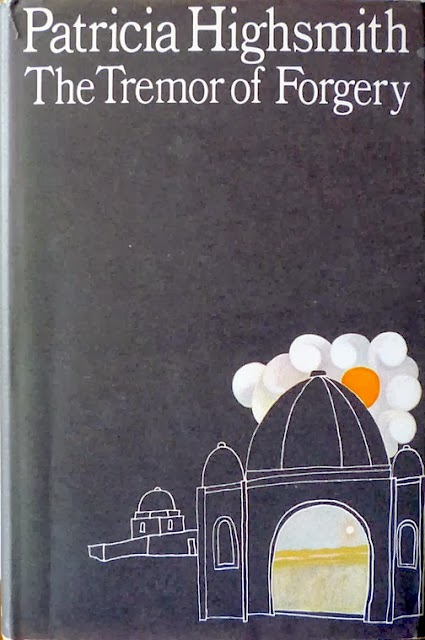
FFB: The Tremor of Forgery - Patricia Highsmith

UK Edition (Heinemann, 1969)
Despite its exotic and desert landscape filled setting of Tunisia The Tremor of Forgery (1969) covers some familiar territory for Patricia Highsmith. There is the usual assortment of strangers befriended by a somewhat dull American, some overt and covert homoeroticism in male friendships, and perhaps most importantly her obsession with duality be it in personality, cultural mores, or political viewpoints. Howard Ingham, the American protagonist, is also a writer. This strong theme of duality is carried through in the title, also the title of a novel Ingham is writing about a banker who is secretly embezzling funds from his employer. Crime will play a role in Ingham's life just as it does with Dennison, his own protagonist, but it is a murky and ambiguous world that Ingham inhabits. We know that Dennison is a criminal and thief; we never know if Ingham is one though it is strongly hinted he may have killed a man.

Perhaps the most subtle and insidious of her novels The Tremor of Forgery is unusual in how it incorporates criminal behavior into its supposedly simple plot. There are burglaries, thefts, attacks on a dog, one violent death most definitely a murder, and another possible murder. Though crime is present it is a shadow world of ambiguous and puzzling events; mixed perceptions and eyewitness accounts contradict one another throughout the action. We never know whose viewpoint we are to believe -- even that of our ostensibly innocent hero.

Yet crime is not Highsmith's primary concern here. This novel is a study in cultural and political disparity and their effect on visiting long term residents in a foreign country. It is also, strangely, something of a treatise on love. Besides The Price of Salt, I have never encountered in a Highsmith novel more discussions about love in all its forms, from platonic friendship to erotic desire, than I have in The Tremor of Forgery.

US Edition (Doubleday, 1969)
Highsmith's reputation rests largely on her development of what everyone likes to call noir these days - the dark crime novel that explores base motives, criminal impetus and the ugly side of human nature. Ironically, while exploring all these aspects of a noir novel The Tremor of Forgery turns out to be Highsmith's most life affirming and positive work. Even its slightly ambiguous ending is one I would classify as a happily ever after type.

Ingham is in Tunisia at the request of a film director friend who has commissioned the writer to pen the screenplay of a movie he wants to set in Tunisia. But the screenplay is soon abandoned when the director dies suddenly under suspicious circumstances. Ina, Howard Ingham's one time lover, eventually communicates with him via letter to explain the sudden death in a roundabout and vague way. Ingham can't decide whether to return home or remain in Tunisia largely due to the curious and sporadic letters he receives from Ina. Each time he writes he pours out his love to her, but she takes her sweet time replying to his letters. She must be prodded to tell the whole story of John Castlewood's death after Ingham's repeated urgings. One begins to suspect that Ina is complicit in what at first is described as an accident and then a suicide.

In the meantime Ingham toils away on his typewriter turning out page after page of his novel about the duplicitous banker. He is befriended by two men. The first is the overly friendly Francis Adams whose sunny personality masks a political and religious zealotry that will reveal him to be a bigot of the worst sort. The other is the artist Anders Jensen visiting from his native Denmark and making the most of his penchant for sleeping with Arab boys while attempting to bed Howard as well. Jensen has a dog named Hasso that will also play an important part in the story. Jensen tells stories of some attacks of cruelty on Hasso and when the dog suddenly goes missing he fears the worst.


A younger and happier Patricia Highsmith
Since living in Tunisia Ingham has found himself influenced by the apparent lawlessness and amorality of the Arabs he meets. He tells Ina "...if one is robbed five or six times, there might be an impulse to rob back, don’t you think? The one who doesn't rob, or cheat a little in business deals, some comes out in the short end, if everybody else is cheating." Even his discovery of a dead man in the street at night changes him. He finds it unnecessary to report the body and his indifference has dire consequences later when he attacks someone who he thinks is trying to break into his bungalow. Once again he does nothing but discuss the events in a rather vague manner with his true friend and confidante, Jensen, just as Ina danced around Castlewood's death (more duality). But Adams somehow gets word of the attack and begins to suspect that Ingham is trying to cover up the murder of a local thief and outcast who has recently vanished. Adams then shares his thoughts with Ina thus turning her visit from one of a reunion with her lover to one of suspicion, mistrust and betrayal.

The novel unfolds at what some might call a glacial pace. But it is fitting for this languorous story of developing friendships, reconnections, epiphanies and -- yes -- contentment and happiness found at long last. In the final pages Highsmith has a few surprises in store, some of which have been called ambiguous by other reviewers and critics. On closer reading of the subtle clues she drops the unanswered questions all become clearer. The mysterious disappearance of the Arabian thief is suddenly not so mysterious and Ingham may not be the bad man he thinks himself to be. He ends up leaving Tunisia with one final letter in hand, overdue from seemingly endless forwarding, that leads me to believe that he will go on to find the love he had been searching for throughout the book.

Thursday, May 9, 2013

FFB: The Kind Man - Helen Nielsen

A recent post on Friday's Forgotten Books host site, pattinase, asked us "Do Men Read Women?" I know I do, but I thought I read a lot more women writers than I have done so far this year. Out of my total of 45 books in 2013 I have read only a measly twelve books by women writers. With Mother's Day around the corner and my guilty conscience nagging at me I thought I'd write up another overlooked and very good crime writer who is a woman.

The Kind Man (1951) is Helen Nielsen's debut novel and eerily it shares quite a bit with another book by a woman writer published that year and previously reviewed on this blog -- A Gentle Murderer by Dorothy Salisbury Davis. In both books we have a young man quite obviously troubled, possibly mentally ill, and haunted by his past. In both the two young men are obsessed with killing and a specific murder weapon. In Nielsen's book the tortured soul is Marty Weaver and he has knives on his mind almost all the time. Make that a specific knife. One that he happens to find and take home with him. And he thinks he must use it over and over to kill the people he loves. He's clearly not well, my friends. But is he really guilty of the murders that take place?

What makes this particular knife so special is that also happens to be a piece of evidence that went missing from a murder trial many years ago. That it should happen to turn up now and is used to commit another murder on a person who Marty barely knew is what drives the plot. Nielsen is fascinated with the effects of crime on the people who are left behind. Do the survivors manage to forgive? Can they learn to heal themselves after violence has ripped their inner lives to shreds? Can families ever be the same? Marty's anguished past becomes the key to understanding his obsession with violence, knives, and murder.

Helen Nielsen (from the DJ of Obit Delayed)
Photo by Amos Carr/Hollywood
Though it sounds like a variation on the kind of thing Patricia Highsmith made famous a decade or so after, The Kind Man has its roots in detective fiction. Down to earth Chief of Police Homer Snyder serves as the detective of the piece. His reporter pal Max is a sort of Watson. With some prodding from Snyder Max goes digging into newspapers archives and uncovers Marty's notorious past. Under a different name Marty made headlines when he was a teen and so did the knife, a grisly weapon with a handle fashioned from an animal bone. That knife seems to be an exact replica of the one used to kill Francis Palmer.

The "kind man" of the title is Sampson Case, owner of a cannery business. His much younger wife Lola turns out to be one of those philandering temptresses that populated the paperback originals of the 1950s. Snyder soon discovers she is linked to the murder victim, Palmer, an avid gambler who was relentless in collecting his debts. For a while it looks as if Palmer's death is nothing more than gambling and gangster stuff. Several thousand dollars has gone missing and the search for the money and who took it from the corpse makes up a secondary part of the murder investigation. The case gets rather complicated when the man who discovered Palmer's body, a poor Mexican Sampson Case took pity on, is also murdered with that ubiquitous knife. Now it looks as if Snyder has a homicidal maniac on his hands. Sampson Case will play an important part in the unusual finale and the title of book will have greater significance than merely describing his demeanor.

Nielsen tells a great story. It's a multi-layered, complex plot riffing on the old-fashioned detective novels of the 30s and 40s but with a keen insight into the ravages of violent crime and its long ranging effects on those who have to pick up the pieces in its aftermath. The manner in which Marty's past keeps intruding, and the presence of the eerie knife make for an almost supernatural element controlling the characters. At times Nielsen is so masterful in her writing that she makes the murderer appear to be a menacing omnipresent force haunting Marty and not a real human being at all. And there is mounting suspense in the last eight chapters with gripping incidents following in quick succession. Impressive work from a novice to be sure.

James Farentino can't resist Vera Miles in "Death Scene"
 Helen Nielsen went on to write  more crime fiction including the noir novels Detour (not the basis for Edgar Ulmer's movie) and Sing Me A Murder, both made well known when they were reprinted by the original Black Lizard imprint prior to its purchase by Vintage Books. Her short stories appeared regularly in Alfred Hitchcock's Mystery Magazine throughout the 1960s and she also wrote frequently for TV, notably two episodes for Perry Mason and several teleplays for both incarnations of Alfred Hitchcock's anthology series. Her story "Death Scene" as adapted by James Bridges for The Alfred Hitchcock Hour starred Vera Miles as a femme fatale mixed up with the chauffeur (James Farentino) for her Hollywood movie director father (John Carradine) and is one of the better episodes in the entire series.

Helen Nielsen's Crime Fiction
The Kind Man (1951)
Gold Coast Nocturne (1951) aka Murder by Proxy (UK hardcover) and Dead on the Level (US paperback)
Obit Delayed (1952)
Detour (1953) aka Detour to Death
The Woman on the Roof (1954)
Stranger in the Dark (1955)
The Crime is Murder (1956)
Borrow the Night (1957) aka Seven Days Before Dying
The Fifth Caller (1959)
False Witness (1959)
Sing Me A Murder (1960) aka The Dead Sing Softly
Verdict Suspended (1964)
After Midnight (1966)
A Killer in the Street (1967)
Darkest Hour (1969)
Shot on Location (1971)
The Severed Key (1973)
The Brink of Murder (1976)