Showing posts with label Anthony Berkeley. Show all posts

Saturday, December 18, 2021

Best Vintage Mystery Reprint of 2021, part two

Here's my second nomination for Best Vintage Mystery Reprint of 2021.I've chosen a male wirter for this second book, a classic writer whose books deserve wide readership, and a book that has been ought of print for nearly a century.

But first some mandatory plugging. Reprint of the Year (I still refer to it by the original, longer, and more specific title) is the brainchild of Kate Jackson. Everything you need to know about this years' contest can be found at her blog Cross Examining Crime. There will be two nominations from each of the twelve participating in-the-know crime fiction mavens. The first nominations were posted on everyone's blogs last week. Voting opens tomorrow, December 19 and the winner will be announced on December 30.  Head over to Kate's blog to cast your all important votes. 

Without further ado, Pretty SInsiter offers for your consideration vintage mystery reprint #2:

The Wintringham Mystery by Anthony Berkeley

  • Berkeley, of course, is one of the giants from the Golden Age.  Any reprint of one of his books is cause for celebration, especially in the US where during his lifetime very few of his books were ever reprinted. As far as I know only his crime fiction under his pen name "Francis Iles" was reprinted in paperback during the 1940s and maybe 1950s. Though many of Berkeley's books were reprinted in the US in hardcover (prior to the invention of the mass market paperback in 1939) I can't think of a single Anthony Berkeley mystery that was reprinted as a paperback in the US.
  • The Wintringham Mystery is a rarity in Golden Age Detective Fiction.  It appeared originally as a newspaper serial in the UK then received a modest printing in hardcover under a new title -- Cicely Disappears.  After that just like its title character it disappeared into the Limbo of Out-of-Printdom for a very long time.  It's wonderful to have it back finally among the living.  I'd never seen a copy at all until this reprint came out.
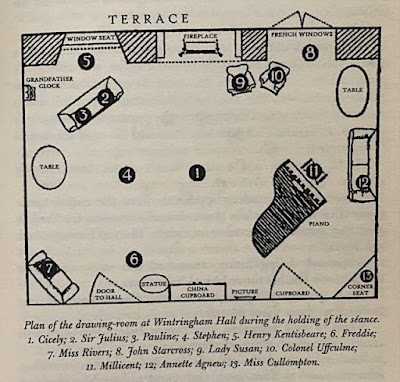
  • Check out the nifty floor plan at the top of this post!  I love floor plans and maps of the scene of the crime.  Give me more of them in modern crime fiction books, please.  Publishers and writers are you listening?
  • The Wintringham Mystery first appeared in 1926 as a serial.  A year later under one of Berkeley's oddball pseudonyms (A. Monmouth Platts) it was published in book form by John Long Ltd. As one might expect for such an early detective novel it's teeming with conventions and tropes that even in this early time were probably considered tiresome or predictable. Yet typical of Berkeley he subverts most of these conventions and employs fanciful and innovative ideas in his plotting that makes the book a corker of a mystery.  Notably, for much of the book there is no murder! And when a violent death occurs -- once again typical of this inventive writer -- one never knows if the victim suffered an accident, murder or committed a weird type of suicide until the final chapter when all is explained.
  • The plot features an amateur sleuthing duo of a young man and woman who eventually fall in love.  It reminded me of the early Christie books of the 1920s in which adventure seeking Bright Young Things did battle with secret societies as well as the detective novels of Herbert Adams who always let his detective duos find not only the killer but love in the finale.
  • Readers familiar with the detective novels of Vernon Loder and John Rhode might be excited to  know that Berkeley makes use of a motif that those contemporaries of his would later use in numerous detective novels: death by devilish mechanical means. Like Loder he also employs a detective novel convention (one I have still have not revealed on this blog) that makes that death doubling surprising.
  • Finally, though the book is mostly about a mysterious nearly impossible disappearance there is also a mystery about the violent death. The explanation for that death makes use of one of the Golden Age's hoariest of clichés and made me smile in the way that Berkeley manages to subvert that one as well.

Not enough reasons for you? Well, here's one more. I learned that Sarah Weinman also picked this book (along with two others) as one of her favorite Golden Age reprints for 2021.  I love it. Great minds, eh?

What are you waiting for?  Go buy your copy of this extremely inventive, thoroughly entertaining and 100% old-fashioned detective novel.  It contains everything we love that makes mystery novel reading so fun.

Sunday, April 5, 2020

NEW STUFF: Eight Perfect Murders - Peter Swanson

This is not a review. This is pretty much a diatribe and a warning to anyone vaguely titillated by the premise of Eight Perfect Murders (2020) by Peter Swanson. I have never read any of Swanson's other books. I was only interested in this because it is yet another contemporary crime novel that is paying homage to classic mystery novels -- or rather books (and one play, later a screenplay) that feature murder. The ostensibly "perfect murders" are found in eight different crime fiction works, only three of them genuine detective novels, spanning seventy years from The Red House Mystery by A. A. Milne published in 1922 to 1992's The Secret History by Donna Tartt.

Interesting that last title. Admittedly as far removed from crime fiction as one can get, Tartt's book is an overhyped 'literary novel' that features murder. It's not really a mystery as I define the genre nor is it anything remotely resembling a detective novel. However, the list in which these books appear is not really concerned with genre of any type even if it was composed by Malcolm Kershaw, a mystery bookstore owner and narrator of Swanson's novel. The list plays with the idea of a supposedly perfectly executed murder on paper that could have allowed the culprit to escape justice. In the novel this list appears to be the inspiration for a serial killer who is copying the murder methods from each book on the list. The killer's murders are similarly made to look like accidents or natural deaths and each victim is someone who deserves death for unpunished crimes.


#1 on the list
#2 on the list
My problem with Eight Perfect Murders is that Peter Swanson blatantly disregards one of the tacit rules of paying homage to any work of fiction, but especially a mystery novel. He ruins every one of the eight books by divulging in great detail the endings. He reveals not only the method of each "perfect murder" but the motivations and the identity of each murderer. Essentially, scattered throughout his own story Swanson has written a Cliff Notes of classic crime works.

#3 on the list
#4 on the list
It was not necessary to explain the entire plot of every book, it was quite easy to discuss the murder method without revealing who the killer was. Not only does he spoil these books once – he does so repeatedly. I got the feeling I was reading a old time serial there was so much repetition. The only thing missing was "Previously on..." or "In our last episode..." He tells us the plot of Malice Aforethought about three separate times. He mentions the ending of The Drowner by John D. MacDonald just as many.

[Aside: Where are the editors, BTW? Asleep at the wheel as usual. This is my eternal woeful complaint about contemporary publishing houses for the past 20+ years.]

#5 on the list
#6 on the list
That Swanson chose not to be circumspect in discussing the various killers' identities makes me think that the writer supposedly paying homage to works of the past is contemptuous of, or at least envious of, those writers and their capacity for ingenuity and originality. Who at Morrow and HarperCollins thought this was a cool idea to give away the endings of all these books? I was beyond disappointed with Swanson I was furious with him. Luckily, I was familiar with all of the old books mentioned, even less well known titles like The Drowner and The Burnt Orange Heresy by Charles Willeford, the latter mentioned only in passing towards the end of the book. [Both of those titles, BTW, are reviewed on my blog.] However, the vast majority of readers will not be familiar with even half of these books. More likely most people will be familiar with the movie and TV versions of five of them.

#7 on the list
#8 on the list
As for Swanson's novel itself? Extremely limited in originality from what is on display here. Since so much of the book is based on the works of more skilled, more interesting, and more imaginative writers Swanson had to surpass all of them in my estimation in order to succeed. He failed. His ideas are pedestrian or derivative of movies and TV shows. The overarching plot and the slow reveal of Malcolm’s true personality is a retread of every damn "unreliable narrator" book (a subgenre I am beginning to grow weary of) published in the past ten years. He even alludes to Gone Girl as a "clue" that Malcolm is just as unreliable as the narrator in that book. And makes it seem like Gillian Flynn invented the concept.

Nothing was surprising at all. The movie-of-the-week style motivations of the protagonist and the horrible secrets of the victims “who deserved to die” (another reprehensible conceit cropping up in modern crime fiction these days) were neither creepy nor spine-chilling. It was all just banal.

Finally, the biggest insult of all. In Malcolm Kershaw the writer has created a bookseller who doesn't read the books he sells, who pretends to have read them when having conversations with his customers and employees. He confesses that he just can't read crime fiction anymore even though this is his chosen profession. Swanson gives an entirely lame reason for Malcolm’s decision to stop reading crime fiction, one that is entirely in conflict with his the bookseller's personality, but tied to his deep, dark secrets in the past. Most readers will figure it all out.

Ultimately, all the twists are mechanical and cliched. Drawing from past writers' plots makes this book nothing more than rehash. As a result the story lacks suspense and the genuinely unexpected events that should be the hallmark of all crime fiction. That most of the rave reviews dismiss the blatant spoilers, Swanson's ballsy borrowing, and focus on what they think is original shows that very few people care about classic crime novels anymore. It's all up for grabs now. It's just a matter of who has the nerve to get there first.

Sunday, May 3, 2015

In Celebration of the Golden Age: Guest Blog Post by Martin Edwards

As part of Martin Edwards' blog tour promoting his new book on the history of the Detection Club and the Golden Age of detective fiction I am happy to hand over the steering wheel to the author himself.  Here is Martin's guest blog post:

When organising my blog tour to celebrate the publication of The Golden Age of Murder, I approached several bloggers whose work I admire, and John is certainly one of them. I’ve learned a huge amount from Pretty Sinister Books, and I share John’s enthusiasm for finding out-of-the-way books from the Golden Age that deserve to be better known.

Long before either John or I developed our love of classic mysteries, Anthony Berkeley Cox, better known as Anthony Berkeley, was writing them, and also reviewing them, usually under the name Francis Iles. His novels and criticism were highly influential, but possibly his most lasting achievement was the foundation of the Detection Club. This was a London-based dining club, the first significant social network for leading detective novelists, and it flourishes to this day. Membership has always been by election (by secret ballot) and the number of members has never been more than about 70.

My own election, in 2008, was a source of great pride to me (but would Berkeley have sniffed that standards have slipped? Who knows? He was an acerbic fellow...) I was subsequently asked to become Club archivist. A great honour, and a supreme thrill for someone as fascinated by the genre’s history as I am. The only snag was that, in reality, there were no archives. I found I was embarking on a voyage of discovery when I tried to find out more about the early days of the Club, and the remarkable people who piloted it through the Thirties.

In trying to build up the archives, I found that I was in effect also undertaking research that influenced the direction of the book about the Golden Age that I’d been writing, on and off, for years. It became a kind of literary quest, to find out the truth about writers whose lives were often as puzzling as their fictional murders. I travelled up and down Britain, talking to descendants of the Detection Club’s early members (including Berkeley’s niece, who proved extremely hospitable when I visited her in Kent), trying to capture memories before it was too late. And thanks to the wonders of cyberspace, I picked up snippets of information from across the globe about Golden Age books and the men and women who wrote them.

The Golden Age of Murder discusses a wide range of authors, and there is also good deal of information about writers who were not members of the Detection Club, although they feature mainly in the chapter end notes; I didn’t want this to be a dry scholastic text with lots of ibids and op.cits, and when Harper Collins bought the rights to publish the book, they made it very clear that they didn’t want it to become overly academic. Neither did I. So although the end notes contain plenty of references to sources, they are also crammed with details about people who made a contribution to the Golden Age, including several unexpected names. There are also plenty of items of trivia that pleased me and will, I hope, entertain as well as inform. This is a 520 page book, so I thought the ends of the chapters provided a good opportunity for readers to draw breath, and take a short break from the ongoing story of the Detection Club!

One challenge for anyone writing about Golden Age puzzles is the question of how to avoid “spoilers”. One solution is to include “spoiler alerts”, but although this device can work effectively in some cases (Douglas G. Greene’s superb biography of John Dickson Carr is the prime example), it can disrupt narrative flow. I decided early on that it would not suit The Golden Age of Murder – I was, after all, using the techniques of the novelist when writing this book. So while there are few if any direct spoilers, it is possible in some cases for astute readers who put their minds to it to figure out a few of the plot twists to which I allude. A price that I thought worth paying in order to avoid a fragmented text (and skipping “spoiler alerts” can itself be rather frustrating, I find.)

Berkeley plays a central part in my story, because the more I learned about him, the more I realised that his life played a crucial part in his fiction. He was a secretive man, with a famously perverse sense of humour, and although he refused to allow much biographical data to become public, and refused to allow his photograph to appear on his books (but two previously unseen pictures appear in my book, thanks to his niece’s generosity), he loved to slip in to his novels portrayals of himself, and people in his circle.

I felt like a detective myself, trying to interpret the clues, and figure out which were the red herrings. Whether my deductions are as fallible as some of those of Berkeley’s main sleuth, Roger Sheringham, who knows? I’m sure there will be people out there ready and willing to correct me. No matter - writing this book has definitely been a labour of love. Of course, I hope that fans of the Golden Age (and perhaps even those who have until now dismissed the novels as old-fashioned and of little merit) will love reading it. Most of all, I hope that it will encourage more people to discover the pleasures of the fine and often neglected mysteries written in an era that was very different from our own – and yet, in some ways, surprisingly similar to it.

*    *   *

The Golden Age of Murder by Martin Edwards is now on sale at all the usual online bookselling sites and I'm sure can be ordered from your local bookseller.  Get yours now! Mine is in the mail as I write this and I can't wait to dig into its pages.     

Tuesday, October 25, 2011

The Death Wish - Elisabeth Sanxay Holding

I had to keep checking the copyright date on The Death Wish, Elisabeth Sanxay Holding’s third foray into the crime novel. It had a very post World War Two feel to it: life in the suburbs, men car pooling to the train station to get to their routine city jobs, wives staying at home tending to their domestic comfort, and an insidious atmosphere of discontent and resentment lying beneath the surface. But this book was written in 1935. It shows the American genesis of a crime novel subgenre dominated by character psychology and criminal thoughts that was already being pioneered in England in books like Malice Aforethought, and Before the Fact by Francis Iles (aka Anthony Berkeley) and Payment Deferred by C. S. Forester.

If the title alone hasn’t informed the reader of the story that awaits him then surely the opening pages will do it. Josephine Delancey berates her husband for sneaking out of the bedroom once again in his stealthy manner. She nearly accuses him of wanting to kill her. Shawe Delancey heads out of the house to pick up his friend and neighbor, Robert Whitestone, a struggling painter who has had to take a day job just to live an ordinary life. He confesses to hating his stifling home life, his wife Rosalind is smothering him with demands, belittling his artistic aspirations and impeding his creative progress. He would like to kill her. Whitestone then challenges his friend, “You’re the same with Josephine. Don’t deny it.” Shawe is insulted, gets indignant and walks away from his friend though secretly he knows that Whitestone is correct.

Two unhappy husbands -- one who has voiced his desire to rid himself of his wife, the other feeling the same, but too cowardly to openly admit it. Add into the mix Elsie Sackett, a young woman who sets her eyes on Robert Whitestone and wants him as much as he wants her, and you have the basic ingredients for a time bomb of impassioned desires and dark impulses waiting to explode in violence. Soon Rosalind Whitestone is dead – a drowning accident at the beach that is much too suspicious to believe given that she was such an excellent swimmer.

Elisabeth Sanxay Holding
The story is told in an omniscient voice and we are privy to the thoughts of all the characters. Much of the dialog is thought rather than spoken and is a stark contrast to what the characters actually speak aloud. Whole interior monologues are set out as dialog as if the characters cannot relate to one another truthfully, that this Long Island town is populated with nothing but tormented loners forever walking about talking to themselves trying to work out their troubles. This may not seem too radical and to some perhaps may come off as prosaic for crime fiction, but in 1935 there were few writers doing this kind of thing. The reading public was still enthralled with the puzzle of the traditional whodunit and the inner life of the characters was not the emphasis of the story.

That is not to say that Holding has completely discarded the tropes of the whodunit. Hugh Acheson, also smitten with the temptress Elsie, takes it upon himself to turn detective and prove that Whitestone helped Rosalind into the great beyond. With only two pieces of evidence -- a bathing suit accidentally discovered drying in a pantry rather than outside on a clothesline, and the fact Whitestone was not wearing his glasses when they found him painting in his studio the day his wife died -- he builds up a case against Robert Whitestone who scoffs as the flimsy circumstantial nature of Acheson’s finds. Then Whitestone’s glasses are found on the beach on the other side of some rocks near a path that leads to his home and the police take a serious interest in Acheson’s accusation.

Like Lucia Holley in Holding’s later book The Blank Wall, Delancey is determined to protect someone he cares for from being prosecuted as a criminal. Of Robert Whitestone he says, “He’s no more capable of a dastardly crime like that than I am.” He enlists Elsie’s help in freeing Robert and clearing him of the murder charge. They will say Robert was wearing his glasses when he was painting. It will be Hugh’s word against theirs. A childish tactic certainly, but desperation and devotion often lead adults to act impetuously.

Even stranger is that Hugh suddenly wants to protect Elsie. Her brash behavior, her open flirting, and her relationship with Whitestone he warns her will come to light and will only further tarnish her already sullied reputation and – more importantly – further damn Whitestone as a guilty man. Elsie will be seen as the primary motive for Whitestone killing Rosalind. Hugh’s idea? That they pretend to have fallen in love and act out a sham engagement. He even gives her his mother’s ring to wear as further evidence for the police of their betrothal.

Yet all this pretense and rearranging of the truth does not serve to help Whitestone and only creates more unrest and turmoil in the lives of all those involved. Delancey is deeply affected – perhaps more accurately he is deeply infected – when Whitestone is arrested and thrown in jail. The “death wish” so early recognized by his friend as something they both shared develops into a full blown disease. He contemplates his own murder with truly tragic results.

Holding is best known for The Blank Wall, an equally suspenseful crime story of a mother who goes to great lengths to cover up what she believes is a murder her daughter committed. That novel was twice adapted for the movies: once as The Reckless Moment and much later in a radically updated version (with the daughter substituted for a gay son) called The Deep End. Some of her other books and stories have also been translated to movies and have shown up on old TV anthology shows like "Lights Out!" She was truly a gifted writer with keen insight in the darker side of human nature. Somehow she has faded into the background along with several other woman crime writers who picked up where Holding left off. I count among those writers Margaret Millar, Dorothy B. Hughes and Charlotte Armstrong. I am curious why nearly all of these women's books have been allowed to go out of print. Contemporary crime writing owes much to all four of these women, but probably to Holding most of all. She came first and she left an indelible mark.

Most of Holding's books can be found in affordable paperback editions from used bookstores and booksellers specializing in vintage crime books. Only one independent publisher, Stark House Press, has been wise enough (and brave enough) to reissue a handful of her works in a series of books that include two titles in one volume. The Death Wish is coupled with Net of Cobwebs, an amnesia tale that will be reviewed here in the coming weeks. As I have done Christianna Brand I will be devoting a lot of space on this blog to Elisabeth Sanxay Holding's work in the months ahead. I think she is one of the unsung pioneers in American crime fiction and she deserves to be noticed for her accomplishments.