Showing posts with label Oddities. Show all posts

Sunday, August 16, 2020

The Woman in the Wardrobe - Peter Shaffer

There are some books which have achieved legendary status in the Detective Fiction Hall of Fame simply because they have been largely unobtainable for decades. These are books which for one reason or another disappear from the used book marketplace and libraries yet still retain an aura of mystique, books that whisper to us throughout the ether: "Come and find me! Read me! Yes, I'm that good."  I've been lucky enough to stumble across such books several times over my lifetime and can tell you that often this prestige is dubious at best.  In many cases it would have been better to ignore those whispered temptations and saved that rather large chunk of cash which I usually doled out for one of these "legendary" murder mysteries.  The Woman in the Wardrobe (1951) is one of these elusive and legendary books, long out of print, spoken with hushed reverence and nearly impossible to get hold of a copy.  I'm happy to report -- since it is now widely available in yet another attractively packaged volume from the British Library Crime Classics imprint -- this book does still merit its prestigious label, if only for two daring stunts its authors pull off.

As with the other two books in the trilogy of mystery novels featuring the blustering and egocentric Mr. Verity we have a puzzling locked room murder and a variety of eccentric oddballs among the list of suspects. A loathsome blackmailer has been done in in his hotel room at a seaside resort located in the fictional town of Amnestie in Sussex. We learn that Mr. Verity is situated not far from Amnestie in his ostentatious "villa" Persopolis where he lives a rather solitary life surrounded by his vast collection of antiques and esoteric statuary. How else would a brilliant amateur criminologist live?

Alice Bruton, the maid
Not at all the usual minor character

Richard Tudor, the eccentric
Steals the show on every page he appears


It's not long before Verity has inveigled his way into the murder investigation -- well, more like barged in and commandeered the proceedings -- leading Inspector Jackson by the hand as they interrogate the residents of the Charter. Together they (and later Inspector Rambler from Scotland Yard) and uncover myriad secrets in the hotel guests' pasts that link them to the much hated Maxwell, found shot and beaten in his locked and bolted room. The telling of the story is, for about the first half, very routine with some discovery of clues and physical evidence but lots of Q&A. I was beginning to lose interest in the story despite the occasional touch of ironic humor and acerbic asides that Verity likes to toss out. Only with the entrance of the bizarrely funny Richard Tudor, a man who envisions himself as the rightful monarch of England, did the novel pick up pace in both outrageous humor, tangential history lessons and unexpected plot machinations.

Mr. Verity

Overall, this is a fine pastiche of the traditional detective novel. So well done in style and genre technique I got faint whiffs of classic authors in the plotting of Shaffer's book. Whether or not any or all of them were inspirations for The Woman in the Wardrobe I leave to your imagination.  Christianna Brand, a pioneer in multiple solutions, comes immediately to mind as Shaffer manages to fit the evidence to nearly every suspect and make it seem possible there are variations on the murderer's identity. As the plot begins to resolve itself we see a further dimension which I cannot reveal but calls to mind the work of Vernon Loder, the master of a particular gimmick that appeared repeatedly in his work. And I noted that the solution of how the victim's hotel room came to be locked was used several times in multiple variations by another neglected impossible crime writer who shares one of the Shaffers' names -- Anthony Wynne.

Peter Shaffer, we are told in the preface by his sister-in-law Elinor, wrote the book on his own but with some help on the complex plot from his brother Anthony. Only in the other two novels of the trilogy would they collaborate more officially in the writing and plotting with each getting credit in the shared pseuodonym of "Peter Antony."  In the US rather than using the pen name for the two sequels to The Woman in the Wardrobe both authors' real names are listed on the cover and title page if only by their first initial and last name. Of the three books I still consider Withered Murder, the final book of the trilogy, to be the best plotted and even more devilishly funny.  It is also long overdue for a reissue. We can only hope that The Woman in the Wardrobe will sell enough copies to make it worthwhile reprinting that far superior mystery.

Shaffer's denouement is something of an eyebrow raiser if it didn't succeed entirely in eliciting that all important gasp of surprise. Interestingly, the finale coincides with the theme explored in a very recent book I've read -- The Eighth Detective, a clever detective novel pastiche of short stories and detective novel conventions.  Tune in later this week when I dissect The Eighth Detective and its mathematical permutations of "detective novel ingredients."  Shaffer amazingly explored the very same ideas in The Woman in the Wardrobe and did so decades earlier without actually outright stating he was doing so.  Which only serves as proof that a true homage to detective fiction tends to rely first and foremost on a love of the genre combined with a shrewd attention to its conventions and plotting tricks.

Friday, August 30, 2019

FFB: Death at "The Bottoms" - A. B. Cunningham (a repeat)

Busy planning a vacation and tending to our rooftop garden (splendiferous photos coming tomorrow!) so I've little time for a new post. Here's a rerun for you instead, a review originally posted back in 2011. This is one of my favorites by Cunningham, a sorely underappreciated American mystery writer who wrote about crime in rural Kentucky.

*   *   *

Here's an odd cast of characters for you: Snotnose Kale, Bigfoot Paden, Dummy Axling, Carlyn Aljor, Wib Turner, Butch Thord, Keb Folden, and Rod Kloth. Are we in Harry Stephen Keeler territory here? Maybe some kind of Damon Runyon tale with quaintly dubbed gangsters? Could it be some Lil Abner style murder mystery? The last guess isn't too far off. These are the people of A.B. Cunningham's WW2 era Kentucky in his fourth novel Death at "The Bottoms."

This is the first book by Cunningham I've read and I'm glad I chose this one as my introduction to his work. It's one of those old-fashioned backwoods detective novels that has echoes of the kind of detection done by Hesketh Pritchard's November Joe and not a little bit of Sherlock Holmes.

The victim is Vivian Beck and she appears to have been attacked by a pack of dogs that has been roaming and attacking livestock. Her body has been found in deep snow with several sets of dog tracks surrounding the immediate area. Farmers in town have been keeping their shotguns by their doors in case they hear the marauding canines. Sheriff Jess Roden, Cunningham's series detective, almost immediately sees that the wounds that caused her death could not have been made by dogs or any other animal. Why? Because many of them contain rust stains and flecks of corroded metal. Roden's investigation of the crime scene is only the first instance of some interesting fundamental detective work.

In a surprisingly violent scene early in the book a group of overgrown delinquents bent on ending the dog pack attacks go on a killing spree savagely and sadistically doing in a number of pets unfortunately running loose in the area. When Roden gets word of the dog killing spree he and a friend set out to avenge the town's pets. Roden sets his own dogs (he owns five) on the men with a hidden agenda in mind. He wants to have a few of the men incur dog attack wounds so that he can compare them with the wounds in the corpse of Vivian Beck. This is how the law works in rural Kentucky in the early 1940s.

As the book progresses it becomes increasingly odd. It seems to be suffering from a schizoid identity. While it is definitely a detective novel, the characters, the extreme violence and the dark tone make me want to treat it differently. It's almost as if Cunningham managed to create his own version of country noir not unlike the plots found in Daniel Woodrell's crime novels which were written more than forty years after this book. Although there is no real doomed obsessive love story here as in noir, there is a love triangle of sorts. Also, the characters are grotesque enough to have been created for a typical noir story.

Bigfoot Paden is a moonshine maker with a still hidden away in an abandoned mine. Carlyn Aljor is a femme fatale of a nurse taking care of Ivy Martin, an ungrateful invalid, but spends her time seducing Chas Beck, the victim's handsome husband, whenever she has a chance. Then there's Dummy Axling, a deaf mute who is a key witness but whose communication skills are almost completely absent. His wild gesticulating and grunting lead only to more confusion rather than clearing up the strange circumstances surrounding the murder of Vivian Beck.  Finally, there's Big Nig, the token stereotyped black character complete with insulting phonetic dialect.  He's deputized by a US marshal in order to persuade moonshiner Bigfoot Paden to cooperate with the law. Big Nig's major scene is a Kentucky duel of sorts with the moonshiner. Bigfoot is armed with a fish gig and the giant black man threatens to cut Paden to ribbons with his straight razor he conveniently carries on a string around his neck. You don't find these kinds of characters in Agatha Christie, do you?

The finale has a few nice twists in store and I was genuinely taken by surprise when the murderer was unmasked. There's the usual summing up in the final chapter in the manner of a typical detective novel and all the odd angles of the story suddenly are revealed in their true light. The grotesqueness of some of the characters is what serves as the main form of misdirection in this book. The reader spends so much time appalled by their actions and words that he fails (as does Roden) to see what is really going on. Cunningham must be given credit for putting a very American spin on his mystery novels.

Monday, April 1, 2019

ODDITIES: The Hand of the Chimpanzee - Robert Hare

Imagine a mystery novel that is an extravagant conglomeration of Planet of the Apes, The Island of Dr. Moreau and that creepy cult classic 1973 TV movie A Cold Night's Death. Is such a melange possible? Oh yes my friends, it is. It's called The Hand of Chimpanzee, written in 1934 by Robert Hare who was inspired to write his fantastical novel after a visit to a primate research center. He even dedicates the novel to four "anthropoid apes" that he observed at that center. And what -- I hear you ask -- exactly goes on in this genre-blending alternative classic? Is it a detective novel? A horror novel? Or science fiction? Do the apes talk as in Pierre Boulle's novel and the later fantastic series of 1970s movies? Calm down, gang. All will be revealed.

The setting is the home and laboratory of Damian Strengland, former medical doctor who was stripped of his license after ethical questions about his research. The man has been involved in some genetics research and behavioral studies of chimpanzees. The usual glandular and endocrine mad scientist stuff crops up in the story and we learn that in addition to producing chimps who are now capable of performing human tasks and following orders guided by simple language commands some of the ape servants are actually hybrids of chimps and humans, altered by experimentally changing their endocrine systems that result in physiological changes like lightening of skin. One of the chimps in fact is completely hairless, wears human clothes and responds in simple, one word guttural syllables that seem like genuine speech. Another chimp has mastered spelling out the word "mad" on a typewriter which later turns out to be a key plot element in the solution of the various mysteries.

Hairless chimps and gorillas are a
natural phenomena of aging apes.
There are several murders, all of them rather gruesome, all of them apparently the work of either the gorilla in the research facility or the most violent chimp named Sebastian. Long finger marks and scratches are found on each of the strangled victims. Fingers that are too long to be human. Everyone is convinced that someone among the lab staff has trained one of the apes to become a killer. Increasingly it appears that Strengland whose behavior becomes more unhinged and erratic might be the culprit. But might it also be Gatrall, the slovenly lab assistant? He view their work as the wave of the future when all menial jobs will be performed by apes allowing humans more free time and better job opportunities in more challenging and cerebral work. Or perhaps De Silva, the primary trainer and caretaker of the apes? An aloof and cynical man DeSilva has the cruel streak of sadism in his blood. And what of Lenka, the sinister Greek housekeeper? Thanks to her creativity the apes have all been named, names which supposedly come from her native language. In my translations, however, I get completely different meanings in English (see THINGS I LEARNED for more).

As the story progresses and Strengland's monomania for his ape research begins to affect his sanity the story often also descends into scenes of unintentional self-parody. During the investigation of the violent deaths the police begin to treat the apes as suspects and Strengland launches into a series of tirades. In one scene after trying to figure out how a window that was always locked is now unbolted and hearing one of his chimps accused of fiddling with the bolt he sees the accused ape in his cage locked and secure. He turns to the others and says: "This ape is innocent. Thank goodness! He's a valuable one!"  Later Strengland rants about the most dangerous animal of all: "The police! What do they know of apes? They think all apes are dangerous. Any young fool in a sports car is ten times more dangerous than an ape!"

One of the many splendid pulps offered for sale at John W Knott Jr., Bookseller

I am so tempted to reveal some of the more outrageously horrific sequences but will only allude to Hare's clear influences of H.G.Wells, Maurice Renard, and a humorous nod to Poe. There is quite a bit of Dr. Moreau in this story and more than a fair share of homage to French crime novels, weird menace pulp magazine stories, and mad scientist movies of the 1930s.

THINGS I LEARNED:  Greek lessons!  Strengland and Lenka (and of course this is really Hare speaking) claim that Vlaha means "blabber" (name of a chittering female chimp) but the closest Greek word I found was Vlacha and that translates as shepherdess; Tima he says means "timid" but I got honors in my translation. Basho (name of the gorilla at the lab) does not come up in the Greek dictionary at all. Hare says its English equivalent is "horrible", but the closest phonetic match (páscho) translates as to suffer.  Only Philologos, the ape who has mastered the typewriter and can speak a few words, has a name that any elementary Greek student could figure out and that's because it's a neologism coined by Hare, an elementary student of Greek himself who perhaps got very poor grades in both transliteration and translation.


I wanted to find out how early ape and primate research was being conducted in the United States and that's how I discovered Robert Mearns Yerkes (1876-1956) who is shown above. Yerkes was a prominent psychologist and academic who studied at Harvard and taught at both Harvard (1902-1917) and Yale (1924-1944).  His research was varied beginning with intelligence studies (he developed as test used by the military during WW2) then moving on to human behavior and eventually correlations between ape and human behavior.  In an article for a 1916 issue of Science he wrote: “I am wholly convinced that the various medical sciences and medical practices have vastly more to gain from the persistent and ingenious use of the monkeys and the anthropoid apes in experimental inquiry.” He founded the research laboratory for primate study in 1930 and based it in Orange Park, Florida. The Yale Laboratories for Primate Biology belonged to Yale University for decades but was sold to Emory University in 1956 upon Yerkes death. It was renamed Yerkes Primate Research Center and eventually relocated in 1965 to its present location in Atlanta where Yerkes' work and vision still continue.

Oliver, a trained chimp that started
the human/ape hybrid insanity
Sometime in the late 1970s and becoming blown out of proportion by the age of the internet in the late 1990s several bizarre conspiracy theories began to surface about human and ape hybridization projects conducted at the Yerkes Primate Research Center. Although there have been factual stories of horrible cruelties perpetuated on the animals during one period of poor management when the facility was under the direction of a non-scientist there has been no proof of the existence of "humanzees" being created at the facility. I wonder if anyone had read this book and used it as fodder for the rumor mill and creating the Wellsian nightmare conspiracy theories.

HARE & YERKES: Robert Hare Hutchinson was a 1910 graduate of Harvard University. After his marriage to Delia Dana in 1912 and their tour of New Zealand he returned to the US and planned on getting his Masters degree at Harvard. He attended the university at the graduate level from 1912-1913. There he met Robert Mearns Yerkes who was Assistant Professor in Comparative Psychology during the same time span. Both men were also active in the eugenics movement. The Hand of The Chimpanzee addresses the concept of eugenics and ethical medicine at various points in the book. The unusual dedication of the novel coupled with their shared Harvard background leads me to believe that Hutchinson kept in contact with Yerkes and must have visited his research center in Florida prior to writing this detective novel.

Don't mess with me, Doctor!
INNOVATIONS:  The first murder to occur in Strengland's home involves a locked laboratory with a body found on a table several feet away from the door and the key still in the corpse's hand.  The two self-appointed amateur sleuths, Evan Heath and his fiancee Jessie (Strengland's niece), try to convince the police that the victim could not possibly have locked the lab and kept the key in his hand afterwards. He would've locked the door, put the key in his pocket or the desk. But the key is found lying loose inside the dead man's hand. And so there is, in fact, a locked room problem, one not listed in Adey's bibliography Locked Room Murders. The solution is suitably bizarre for such a fantastical book.

EASY TO FIND? Those interested in owning their own copy ought to act fast. There are is only five  ONE! copy for sale on the usual bookselling sites. Three copies are priced fairly but have no dust jackets. The other two copy is in better condition, comes with the original DJ, and of course is priced well above $100. Though published both in the US and the UK I only uncovered US editions for sale. I guess the UK first edition is a genuine rarity. I'd suggest trying libraries for other copies out there.

UPDATE:  Please note the strikeouts and grammatical changes in the above paragraph. Once again, within one week after I wrote about an obscure book nearly every available copy was sold to readers of this blog. Where are my referral royalties?

Friday, September 9, 2016

FFB: Let Him Have Judgment - Bruce Hamilton

THE STORY: Robert Teal has been very busy in London. He's been digging around courtroom archives, reading newspapers, spending the day listening to how a certain judge talks to a jury.  Then he up and leaves and heads off to the village of Moxton where he becomes interested in a local ne'er-do-well named John Willoughby. Suddenly Teal disappears and so does Willoughby.  A body turns up and it looks like a very nasty murder.  But who is it?  And who exactly is Teal?  Or Willoughby for that matter?

THE CHARACTERS: I'd rather skip this section because so much depends upon masquerade, impersonation, and double identities. The appeal of this story is that it's another one of those in which the less you know the more you will enjoy it. Let's just jump ahead to what makes this book such a unique example of crime fiction--

INNOVATIONS:  The book has a brilliant construction that could only be accepted by someone who admires crime fiction plotting. There is a Prologue which is sort of a mini tale in itself, but lays the groundwork for Hamilton's purpose in writing the book. Let Him Have Judgment (1948) is clearly meant to serve as an indictment against the vagaries of the law and how criminal justice is often left in the hands of those who seek retribution. The reader learns of the fate of Harry Gosling who apparently was wrongly sentenced for a murder he never committed. On the eve of his execution he pleads with the reverend who is sent to his cell to give him solace. The two conspire to break basic rules about  written communication posted from the prison. Harry writes a letter and has the minister vow that he will take the letter, not read it, and conceal it another letter written by the reverend himself. Then the reverend is to send both letters to an address in America. The prologue fades out as Harry is led to the gallows.

The story then veers off in a completely new direction with the entrance of Teal focussing on his mysterious visits to the courts and other detective work, his vanishing, and the discovery of the corpse. All of this leads to the arrest of a judge and a murder trial. The bulk of the tale shows us various aspects of a murder investigation and how it is exploited by the press, by members of the inquest jury, by the lawyers presenting their cases, and even by members of the trial jury. It's all an ingenious concept showing how the legal system is vulnerable to master manipulators and subtle powers of suggestion.  The US title of this book is Hanging Judge and we learn that Judge Brittain is far from an admirable man of law who has allowed his cruel pleasures and indulgent lifestyle to corrupt him and the way he views the law. As the murder trial progresses it becomes clear that the Judge has some secrets he wants to kept hidden and yet he manages to admit to them while remaining ostensibly untouchable and unsullied.  But Hamilton allows us to follow the thoughts of one jury member whose perceptions of the case are thoroughly prejudiced. His offhand comments made to other jury members when court is out of session will change the way all of the judge's testimony is heard and viewed.

The real ingenuity of the story comes in the triple twist of the Epilogue when all the mysteries of identity, wrongful accusations, and seemingly unjust verdicts are all explained.  On my paperback copy there is a laudatory blurb from Erle Stanley Gardner who says, "This book is in my opinion a mystery masterpiece." Very true. I'd go so far to call this novel a tour de force of a legal mystery as well as a caustic depiction of the fragility of a legal system all too susceptible to manipulation.

THE AUTHOR:  Arthur Douglas Bruce Hamilton was the older brother of novelist and playwright Patrick Hamilton best known for Angel Street, Rope and Hangover Square all of which became crime classics in their movie adaptations. Bruce Hamilton's crime novels take after his brother's in that both are more about the psychology of the criminal mind rather than following the formulae of traditional detective fiction. Both writers tend to indulge in the bleaker aspects of humanity with books that have noirish endings. Bruce's novels, so little known and celebrated, may not match his brother's flair for writing but can often surpass --as in this case-- the younger Hamilton's more conventional approach to exploring crime.

EASY TO FIND? The book is out there in both US and UK editions, but it is the US edition that oddly is in relative abundance with twenty copies for sale. The UK edition was reprinted at least three times that I can verify and yet I find only four copies for sale online. As always you ought to check libraries when copies for sale are this scarce.

Tuesday, April 12, 2016

ODDITIES: Clue for Murder - Ronald Barker

THE STORY: Very simply Clue for Murder (1962)  is a detective novel inspired by the board game Clue®.

CHARACTERS: Mrs. Pocock, Colonel Charlock, Angela Lake, Oliver Verdon and of course Professor Plumb have all been invited to Dr. Wight’s hotel apartment for a party. When all are present they are instructed to play a game of Clue® while their host readies himself. A few hours later poor Dr. Wight is found in the hallway closet with a bashed in head. It doesn't take long for the guests to see the similarities in their names to the roles they were assigned in the game. And the fact that the cards said that Colonel Mustard did the murder in the conservatory with the candlestick. Dr. Wight has no conservatory but he does have a consulting room and it seems that a candlestick is missing from the fireplace mantel in that room. Someone is having a perverse laugh at the expense of these apparent strangers. Did Colonel Charlock (check your botany catalogs for the connection) kill Dr. Wight? Or is he being framed? It takes the combined efforts of hotel detective Burt Charles and Detective-Inspector Harris to uncover the reason the strangers were brought together and to track down the villain behind the deadly games.

INNOVATIONS: Clearly, the entire novel is an innovation having used the popular board game as its inspiration for a devilishly clever murder mystery. After a brief and superfluous section about who had which cards during the play of the board game the story gets very interesting as everyone attempts to find out what the guests have in common, why they were invited to Dr. Wight’s, and why they have been targeted by a mad killer.

For a while it seems that Professor Plumb will become the real detective of the novel since he does quite a bit of pontificating and armchair sleuthing on his own. Overall, there is some good detection and the uncovering of all the various secrets is told with crisp dialogue and nicely controlled suspense. Several floor plans add to the nostalgic atmosphere and may a elicit a smile when the reader realizes that the hotel room where the murders take place is a near duplicate of the Clue® board game with only the bedroom and Wight's consulting room standing in for other rooms in the game. There are, however, no secret passages. Thankfully.

The finale caught me completely off guard and I have to applaud Barker for some excellent misdirection. I like being surprised when I always think I never will be. The story has an element of the impossible crime subgenre as one of the murders seems to have been committed by an invisible intruder. All the guests were in the company of at least one other person when the murder was done and no one could have got into the locked hotel suite from outside.


THE AUTHOR: Ronald Barker was born in Scotland and raised in England. After a brief career in business and then a stint in the British Army medical corps he entered the publishing field in 1947. At the time of the publication of Clue for Murder he was the president of the British Publishers Association.  He was commissioned by Unesco to write a study of the international book trade and two of those volumes focused on the trade between the UK and African nations. Using the pseudonym "E. B. Ronald" he wrote a handful of detective novels modeled after the American hard-boiled private eye novel but all of the books were set in England. Clue for Murder (1962) was his sixth mystery novel and the only one published under his real name. I've found a copy of one of the  those E.B. Ronald books about some murders in a pub and will be reviewing it soon. Supposedly there is another locked room murder in that book.

One mystery never explained: though the story is set in England and written by a British man why are they all playing on a Clue® game board and not a Cluedo board? I guess it was altered for this side of the Atlantic. I'd be interested to know if the UK editions of this book refer to Cluedo instead.

Detail from the rear panel of the 1st US edition DJ

Friday, June 20, 2014

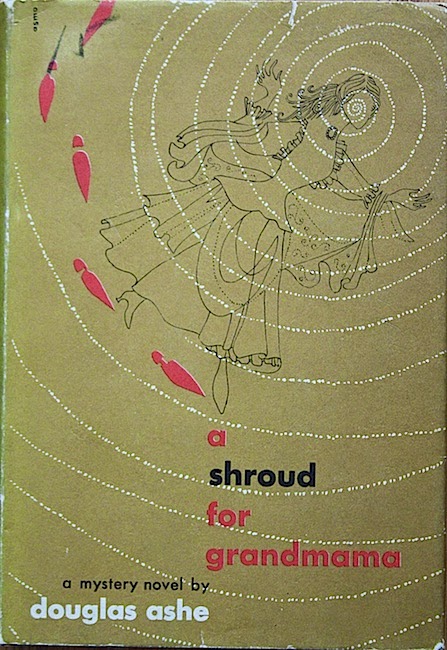
FFB: A Shroud for Grandmama - Douglas Ashe

John Franklin Bardin wrote this delightfully odd genre blender using the pseudonym "Douglas Ashe." A Shroud for Grandmama (1951) begins as a HIBK style Gothic suspense but from the get-go Bardin assures the reader the story will not be your average Gothic with a damsel in a nightie running rampant through a spooky house. To begin with Abigail Longstreet wouldn't be caught dead wearing a nightie. In the second place she stumbles upon her octogenarian grandmother's corpse at the foot of a staircase surrounded by dancing footprints in the dust with no other footprints leading to or from the body. And lastly, dead old Grannie Ella is wearing nothing but a white bikini. Abigail immediately takes care of this embarrassing situation by removing the puzzling footprints that suggest a ghost was present and hauling dead Ella upstairs and making her more presentable by removing the scanty swimsuit and dressing her in the shroud conveniently left in her bedroom closet. Just what the heck is going on at the Longstreet estate?

And then there is Abigail herself. She's only twenty-eight years old but she chooses to dress and speak as if it were 1900 rather than 1950. Her quasi-Edwardian way of narrating the book is exemplified by lines like "Grandmama abhors hurly-burly". She also tells us that her preferred manner of dress includes brocade dresses with high collars, hemlines that are ankle length, and high button shoes. No close fitting revealing clothes or high heels for her. One character calls her a Gibson girl lookalike. She's anachronistic to the max. Yet being a heroine in a Gothic suspense novel she is of course drop dead gorgeous and it's her beauty that entrances handsome young stranger Albert Crump who just happens to be passing by her grandmother's home the night of her mysterious and bizarre death.

Just as soon as Abigail is finished tidying up the scene of her grandmother's death she is interrupted by the perfectly timed appearance of a policeman. Inspector Stephen Elliot is shrewd and crafty and he immediately gets down to business. Turns out he's been a watching the house at the request of an anonymous tipster and he saw Abigail enter, find Ella and rub out the footprints, and take the dead body upstairs. He also stuns Abigail with the news that her grandmother was murdered. Thus begins an expertly told tale of deceit, family secrets, betrayal, revenge and avarice.

Inspector Elliot has his work cut out for him. Each member of the family received a letter purportedly from Ella summoning them to her house. Never mind her being blind. Abigail explains away how a blind woman as disciplined as her grandmother could still painstakingly compose letters in her beautiful copperplate handwriting. There is only a tell tale upslant. Re-examination of the letters shows an absence of the upslant. Elliot thinks the letters are forged. Was the murderer luring everyone to the house to prevent them from having alibis and thus complicating the case?  Is this murderer out for more than just the death of Grandmama Ella?

There are some other Gothic touches like the legend of Sybil, a rambunctious ghost who haunts the house with poltergeist activities when she's not waltzing through the corridors leaving a trail of footprints behind her. And there is the secret of Claude Bryant, Abigail's father, who supposedly died during his service as a soldier but who may still be alive. Finally there is Claude's bastard son whose complicated history is slowly revealed throughout the murder investigation. But my favorite part is when we meet Abigail's sister Maude who is completely caught up in her new found way of life through Dianetics! Bardin has great fun mocking L. Ron Hubbard's pseudo-religion in Maude's dialogue. She spouts forth her zealous beliefs peppered with the ridiculous vocabulary of Dianetics. She does a lot of talking about "engram pressure" and firmly believes that Sybil maybe responsible for killing their grandmother.

This is a lively and entertaining detective novel highlighted by great sleuthing from Elliot who often resorts to verbal trickery and sets a few traps for his deceitful suspects; the utter bizarreness and impossibility of the murder itself; and a fantastic protagonist with an engaging and eccentric narrative style in the person of Abigail Longstreet. The book was reprinted under the title The Longstreet Legacy in its paperback edition and is somewhat scarce in either hardcover or paperback. Still for those who like their detective novels fanciful and odd this one comes highly recommended. The hunt for this scarce book is well worth your efforts.

 *     *     *


Reading Challenge update: Golden Age Bingo card - space L1, "Book with spooky title"

Friday, May 30, 2014

The Glass-Sided Ants' Nest - Peter Dickinson

“That was the whole trouble with police work. You come plunging in, a jagged Stone Age knife, to probe the delicate tissues of people’s relationships, and of course you destroy far more than you discover. And even what you discover will never be the same as it was before you came; the nubbly scars of your passage will remain.”
I seem to be on a roll with anthropological mysteries. First, The Glass Spear taught me all about aboriginal Australia, coming soon a visit to Peru and the ancient Incans, and now I get the amazingly inventive world of the Ku tribe as imagined by Peter Dickinson in his debut mystery novel. Dickinson is a much underappreciated writer, something of an acquired taste, and always surprising in how different each book can be.

James Pibble is a Scotland Yard inspector who is assigned the oddball cases. The murder in The Glass-Sided Ants' Nest (1968) is typical of the strange crimes that have become his specialty. In a house where the last surviving members of a little known tribe from New Guinea have settled one of their members has been found bludgeoned. The weapon is a wooden balustrade ornament in the shape of an owl. What makes the crime so unusual is that the tribe have been living according to their laws and cultural mores and the victim is a revered elder. Men and women live in separate areas of the house in dorm-like bedrooms and it is forbidden for either sex to visit the quarters of the opposite sex. The rules of tribal interaction are complicated but strictly adhered to and it seems that no one among the Kus could have committed the murder. Who then did in the old man? It's an impossible crime of sorts which make the sharp witted inspector imagining bizarre entries into the house. He even contemplates the possibility of an outsider having climbed up the side of the stone house and entering through an easily opened window.

The imagination involved in creating an entire culture is impressive. Dickinson invents social customs, tribal rituals, a hierarchy of members and gender role rules that make the Ku tribe seem to be as real as any group studied by Margaret Mead or Richard Leakey. The murder investigation reveals multiple hidden relationships and ulterior motives among some the tribe members. The youngest Ku, for instance, seems to be exploiting beliefs in magic for his own ends. But no one is talking and Pibble is continually frustrated by the reticence and stubbornness of the Kus.

One of the most bizarre aspects of the story is the relationship between Eve Mackenzie, daughter of Scottish missionaries who was raised in New Guinea, and her husband Paul Ku. She fell in love with Paul as a young girl while still living in New Guinea and becoming an anthropologist there. The Kus forbid marriage outside of their tribe but oddly male/male relationships outside of the tribe are allowed. In order to allow Eve and Paul to fulfill their love the tribe members decide to view and treat Eve as if she were a man, referring to her as him. They make her undergo a special ritual that allows for a male/male love relationship. Paul is then somewhat of an outcast and viewed less than a man, but he and Eve are allowed to "marry."

Flagg Terrace, the metaphorical glass-sided ants' nest (ant farm to us Americans) of the title, becomes a prominent character too. All of the tenants suddenly become suspects in the murder of Aaron Ku. When it is learned that he served as member of the trust that owns the property and that he was intent on selling the entire building Pibble begins to see motives multiplying. Other real estate schemes are uncovered. Pibble needs to sort through skulduggery in the business world as well as the intricacies of the Kus' tribal life and their reluctance to reveal the truth of their relationships to the outside world.

There is a lot of good character work here. Notable among the supporting players are Mr. Evan Evans, a real estate agent; and Nancy Hermitage, an "actress" and "professional escort". They are the most colorful and fascinating of the large cast of characters. Dickinson also has a great skill at creating character through dialogue, a talent that is all too often lacking in contemporary fiction of any kind. People talk and we immediately know who they are, not just in what they say, but how they say it. Vocabulary changes drastically from character to character. This is the hallmark of a genuinely talented novelist.

Pibble went on to play the lead in five other detective novels. Each one is unique and strange. Dickinson concocts mystery novels like no other writer of his era...or any era for that matter. The Old English Peep Show tells of a murder in a Victorian country house turned into a theme park, long before the theme park craze took over popular culture. ESP and telepathy are side effects of a mysterious disease afflicting the children in Sleep and His Brother. Pibble must attempt to free his friend Sir Francis who seems to be a prisoner of a weird cult awaiting the apocalypse in The Sinful Stones. Readers looking for something truly different and original in mystery fiction ought to investigate the James Pibble novels or any of the many unusual crime novels by Peter Dickinson. Unique is the best adjective I can come up with to describe his books, but even that word seems an understatement.

James Pibble Detective Novels
The Glass-Sided Ants' Nest (1968) (aka Skin Deep)
The Old English Peep Show (1969) (aka A Pride of Heroes)
The Sinful Stones (1970) (aka The Seals)
Sleep and His Brother (1971)
The Lizard in the Cup (1972)
One Foot in the Grave (1979)

*     *     *
 

Reading Challenge update: Silver Age Bingo Card, space E6 -- "A book you have to borrow." I found this one in my local library.

Friday, April 25, 2014

FFB: That Cold Day in the Park - Richard Miles


Later US Paperback (Pyramid, 1974)
I first came to know That Cold Day in the Park (1965) in its effectively creepy and sometimes heartbreaking movie adaptation starring Sandy Dennis in the lead role. Dennis plays an extremely lonely woman who takes the term "kept boy" to its literal extreme. I thought perhaps the book might be the female counterpart to John Fowles' first novel The Collector, also turned into a memorable film. While the movie shares its basic premise with its source and both include three key scenes, the story of Miles' original novel is remarkably different.

Madame (we never learn her real name) meets a young man in the Tuilleries, the famous public garden of Paris, befriends him in a short conversation and convinces him to come home with her. Throughout their brief meeting the young man, a stunningly gorgeous blond haired Adonis, never speaks. Madame thinks, as does the reader, that the boy is mute. That he can hear her is made very clear. Only in the second chapter titled "The Boy" do we realize he has chosen not to speak. He often plays the role of a mute in order to manipulate his targets. The boy goes by the nickname Mignon. He and his friend Yves are male hustlers roaming the streets and bars of Paris' less than touristy areas taking advantage of lonely, affection starved men and robbing them.

Mignon stays with Madame most of the time, but escapes his new home each night by climbing out the window and down the fire escape in order to visit Yves. As the book progresses we see that Mignon is both manipulator and manipulated. He is caught between two worlds -- his life of crime with Yves (who he is clearly sexually attracted to) and his freer, more creative life with Madame who is also controlling him and shaping him to become what she wants. She is a hostess, a housemaid, a mother and eventually his lover. The book takes on a sinister element when Madame learns of his nightly escapes. We begin to see the fragile state of Madame's mind when she imprisons Mignon in an attempt to possess him completely.

UK 1st ed (Souvenir, 1966 )
The novel explores this very strange ménage à trois of sorts and its inevitable deceit and betrayal through alternating chapters told in the first person by Madame and in the third person omniscient voice when it focuses on either the boy or Yves. There is a middle section entitled "Interlude" centering on a minor character's visit to a sex club. Here we see the kind of sex trade Yves engages in with both men and women. It's the first taste of what will become a more lurid, sexually graphic, and sensational story.

The key scenes that I remembered from the movie -- Madame bathing the boy, her locking him in his bedroom and nailing the windows shut, and the climactic scene when she procures a prostitute for him -- all are present in the book. It is the story of Yves' relationship to Mignon that was removed in the movie adaptation.

In the novel the boy is conflicted between trying to change himself under the guidance of Madame, who seems to be the only person who doesn't desire him only for his body and good looks, and his life of adventure and crime with Yves -- his best friend, pseudo-brother and quite obviously a surrogate father. As the silent kept boy Mignon is at first a pet, then a student of painting, and finally a lover. With Madame the boy is more compassionate and pitying, emotions he does not feel for the men he robs when he is with Yves. There seems to be hope for both of them in their secret life together.  Yves doesn't want things to change. Mignon must make several decisions -- who is he really, who does he want to be with,  and perhaps most important of all who and what can he become.

In the final pages the book turns into a lurid thriller complete with embarrassingly written sex scenes that reminded me of the worst of 60s erotica ("throbbing rod" and "swelling member"). Madame's character transforms too quickly into yet another psycho-sexual lunatic bent on deadly violence. Miles nearly destroys the interesting contrast in characters that, up to the bloody climax, was the most fascinating part of the book. The story works best in the sections between Madame and Mignon and weakens in the too predictable sequences when Yves appears.

1st UK paperback (Corgi, 1967)
Richard Miles is the pseudonym for a former child actor turned writer and high school teacher named Gerald Perreau-Saussine. He first performed in movies under his slightly shortened, given name (Gerald Perreau) and later as "Peter Miles". His movie roles include Possessed w/ Joan Crawford, The Red Pony w/ Robert Mitchum and Myrna Loy, Heaven Only Knows and Quo Vadis . As a teenager and young adult he later appeared in a variety of TV shows such as Dragnet, The Lone Ranger, Maverick and Perry Mason. He had a long running role on The Betty Hutton Show where he played brother to his real life sister, actress Gigi Perreau.

That Cold Day in the Park is Miles' first novel. He followed up with Angel Loves Nobody (1967), a prize-winning novel about high school violence and The Moonbathers (1974), a revenge thriller featuring a Japanese secret society. One of his lesser works is the script for one of the worst movies ever made -- They Saved Hitler's Brain. But we all make mistakes, don't we? Don't judge him by that big one.

Tune in tomorrow when I examine Robert Altman's movie version of this book with a screenplay adaptation by Gillian Freeman. It's an example of taking the basic story of an intriguing novel and transforming it into a much improved and resonant character study.

*   *   *


Reading Challenge update:  Silver Age Bingo card, space  L2 - "Book Made into a Movie"

Tuesday, December 10, 2013

ODDITIES: Department of Uncollectable Collectibles

I get a lot of book catalogs in my email and I peruse them mostly for my select interests: Victorian sensation fiction and obscure detective, supernatural and adventure fiction. Every now and then pulp magazines strike my fancy. While looking over the pulps offered by Michael John Thompson, a bookseller in British Columbia, I came across one of the most absurd catalog listings ever. It's reproduced below (with some typos fixed) along with the illustration that accompanies the listing.

I'd file this under "Why Bother?" Seems it was included in the catalog only for the amusement of the bookseller and his customers. He's right about that artwork. It's a real nightmare.


"THE NIGHT LAND" by WILLIAM HOPE HODGSON - CLASSICS OF SCIENCE - FANTASY FICTION. The cover artwork for CANADIAN FANDOM 17. September, 1951 issue.

HODGSON, William Hope [marginal interest].
$30.00 CAD

First edition. Quarto, original pictorial wrappers, stapled at spine. A fanzine, issued in an edition of 104 numbered copies, this being copy #56. 17 pp. Contains Editorials and Convention reports, no fiction. Most notably, it bears perhaps the singularly worst drawing ever to illustrate a Hodgson story, the cover artwork, which is by Bill Grant. The editor prints a long report on the convention, an SF con; and reproduces the signatures of the likes of Bok, Leiber, Williamson et al., but it is of little interest. In fact, there really is nothing of interest in this fanzine at all except for the atrocious cover artwork. It's not like anybody needs to buy this thing - it's hideous. A very good copy in original wrappers, if that matters.

You can click to enlarge this, but be prepared for a real horror show.

Tuesday, August 2, 2011

ODDITIES: Hang Ten, Hercule!

Cowabunga!  Who would ever have thought that the Grand Dame of the Mystery Novel was into surfing?

Peter Robinson, a researcher, at the Museum of British Surfing, has discovered photographs and proof that Dame Agatha, along with first husband Archie, hit the waves and attempted stand up surfing in 1922 while on a Hawaiian vacation.

Read the article here.

Wednesday, July 13, 2011

Little Grey Cells Not Included

First I read of Judge Dee becoming a martial arts expert and ghost fighting detective in a recent Hong Kong action flick.  Then all this talk about toy detective action figures (see posts at The Rap Sheet and Mystery Fanfare).  It got me hunting the internet for the possibility of action figures more suited to my kind of mystery novel hero. Look who I found!

Click to enlarge
Click to enlarge

Like the Jim Rockford figure this one of the brilliant Hercule is not for sale and is a one of a kind.  Found at the website Onesixthwarrior.com, an internet fan site devoted to custom action figure making.

Monday, April 11, 2011

ODDITIES: Chalk Face - Waldo Frank


Here's another one of those books that crops up on want lists of collectors of arcane and supernatural fiction. Waldo's Frank's esoteric novel of 1924, Chalk Face, is a puzzle to me. I was simultaneously hypnotized by his prose and the sinister tone of the book, yet completely left in a fog as to what it all meant. Unlike a similar story overloaded with inexplicable menace which was much easier to follow (Fully Dressed and in His Right Mind reviewed on this blog here) I was a bit lost in this ambiguous convoluted tale of a man haunted by a mysterious figure who seems to be killing all of his enemies.

Is it a metaphysical mystery? Is it genuinely supernatural? Is it a story of a man losing his mind? It is indeed a tale of murder and there is some genuine detection along the lines of an R. Austin Freeman or J.J. Connington scientific detective novel (the narrator is a physician). But the apparition of the “man with the white head” who is on the scene of each violent death leads the reader to believe some supernatural agent is acting on the narrator’s evil thoughts. A weird dream sequence which takes up the entire second section of the book makes one think that the narrator is in fact going mad and that he himself has committed all the murders. Frank's fascination with Feud and his theories may explain this entire sequence.  It's like a prose version of the Dali dream sequence in Hitchcock's Spellbound. Then again, it’s possible that there is a genuine doppelganger device playing out here along the lines of Poe's "William Wilson".

Waldo Frank, circa 1923
(photo by Alfred Stieglitz)
The book is written in an arty, pseudo-sophisticated style that literary critics like Kathleen Pfeiffer call "modernist" and "experimental." I won't argue with her. I wonder what readers in the 1920s thought of it when it was originally published? Was it only popular with the intelligentsia and the bohemian crowd?  There is no denying that Frank has mastered an eerie and claustrophobic mood throughout the book. Just what he intends this to mean eludes me.

Tuesday, April 5, 2011

ODDITIES: Death at "The Bottoms" - A. B. Cunningham

Here's an odd cast of characters for you: Snotnose Kale, Bigfoot Paden, Dummy Axling, Carlyn Aljor, Wib Turner, Butch Thord, Keb Folden, and Rod Kloth. Are we in Harry Stephen Keeler territory here? Maybe some kind of Damon Runyon tale with quaintly dubbed gangsters? Could it be some Lil Abner style murder mystery? The last guess isn't too far off. These are the people of A.B. Cunningham's WW2 era Kentucky in his fourth novel Death at "The Bottoms."

This is the first book by Cunningham I've read and I'm glad I chose this one as my introduction to his work. It's one of those old-fashioned backwoods detective novels that has echoes of the kind of detection done by Hesketh Pritchard's November Joe and not a little bit of Sherlock Holmes.

The victim is Vivian Beck and she appears to have been attacked by a pack of dogs that has been roaming and attacking livestock. Her body has been found in deep snow with several sets of dog tracks surrounding the immediate area. Farmers in town have been keeping their shotguns by their doors in case they hear the marauding canines. Sheriff Jess Roden, Cunningham's series detective, almost immediately sees that the wounds that caused her death could not have been made by dogs or any other animal. Why? Because many of them contain rust stains and flecks of corroded metal. Roden's investigation of the crime scene is only the first instance of some interesting fundamental detective work.

In a surprisingly violent scene early in the book a group of overgrown delinquents bent on ending the dog pack attacks go on a killing spree savagely and sadistically doing in a number of pets unfortunately running loose in the area. When Roden gets word of the dog killing spree he and a friend set out to avenge the town's pets. Roden sets his own dogs (he owns five) on the men with a hidden agenda in mind. He wants to have a few of the men incur dog attack wounds so that he can compare them with the wounds in the corpse of Vivian Beck. This is how the law works in rural Kentucky in the early 1940s.

As the book progresses it becomes increasingly odd. It seems to be suffering from a schizoid identity. While it is definitely a detective novel, the characters, the extreme violence and the dark tone make me want to treat it differently. It's almost as if Cunningham managed to create his own version of country noir not unlike the plots found in Daniel Woodrell's crime novels which were written more than forty years after this book. Although there is no real doomed obsessive love story here as in noir, there is a love triangle of sorts. Also, the characters are grotesque enough to have been created for a typical noir story.

Bigfoot Paden is a moonshine maker with a still hidden away in an abandoned mine. Carlyn Aljor is a femme fatale of a nurse taking care of Ivy Martin, an ungrateful invalid, but spends her time seducing Chas Beck, the victim's handsome husband, whenever she has a chance. Then there's Dummy Axling, a deaf mute who is a key witness but whose communication skills are almost completely absent. His wild gesticulating and grunting lead only to more confusion rather than clearing up the strange circumstances surrounding the murder of Vivian Beck.  Finally, there's Big Nig, the token stereotyped black character complete with insulting phonetic dialect.  He's deputized by a US marshal in order to persuade moonshiner Bigfoot Paden to cooperate with the law. Big Nig's major scene is a Kentucky duel of sorts with the moonshiner. Bigfoot is armed with a fish gig and the giant black man threatens to cut Paden to ribbons with his straight razor he conveniently carries on a string around his neck. You don't find these kinds of characters in Agatha Christie, do you?


The finale has a few nice twists in store and I was genuinely taken by surprise when the murderer was unmasked. There's the usual summing up in the final chapter in the manner of a typical detective novel and all the odd angles of the story suddenly are revealed in their true light. The grotesqueness of some of the characters is what serves as the main form of misdirection in this book. The reader spends so much time appalled by their actions and words that he fails (as does Roden) to see what is really going on. Cunningham must be given credit for putting a very American spin on his mystery novels.

I'm interested in reading the four other Cunningham books I managed to acquire this year.  Anthony Boucher in his reviews done for the San Francisco Chronicle has some good things to say about Cunningham's detective novels.  This one must be atypical of his work.

 *  *  * 

NOTE: I have started receiving requests for books to loan out by mail. Can you believe it? For those who are yet unaware of this service read this post. The above book I DO NOT own. Please do not send requests for it.

I am trying to come up with a way to signal whether or not a book is available for loan. Other than flat out telling you, I am stumped. I'm not good with this kind of shorthand symbol thing. Anyone have any ideas? A free book from one of my many duplicate copies is yours if you come up with a simple solution.  Is this my first contest?  Maybe.

Wednesday, March 16, 2011

ODDITIES: The Crime with Ten Solutions

The Crime With Ten Solutions (1935) - Patrick Leyton

Sometimes a book starts off with a great opening and promises so much. Eleven passengers board a bus en route to a London suburb during a threatening snowstorm. We learn of each passenger's intent on their trip via Leyton's omniscient narrative voice and are privy to secrets early on that none of the other characters discover until much later in the story. Clifford Ransome confides in the woman seated next to him, Barbara, that he is going to an inn in order to hunt for a will that is supposedly hidden on the premises. If he succeeds in finding it he will clear the name of his wronged father who was the intended heir of his grandfather's fortune. Instead the fortune is in the hands of his crooked uncle who apparently forged a second will. Clifford shows Barbara an advertisement announcing that a reward is also available to anyone who can find the will and present it to a lawyer's firm. That advertisement also happens to have been seen by nearly every person on the bus. And the snow continues to fall.

If you notice that this seems like the formula for one of those 1970s disaster movies, you get a gold star. Maybe a free pizza. You've already guessed what happens, haven't you? A spectacular bus crash leaves the motley group stranded within a short walk of the inn where Clifford was headed. They are all forced to stay there until the weather clears and the bus can be rescued and repaired. Clifford soon learns that everyone knows of the ad and he – not so brightly – tells his story to everyone. The search for the will is on. Someone finds the will and instead of receiving the cash reward is killed. The remainder of the novel is devoted to the ten solutions of the title.

Leyton's detective novel with the intriguing title teases the reader with yet another murder mystery in which the author will pull off trick worthy of any stage illusionist – a crime that can have ten separate explanations with ten separate culprits. But there are magicians of the detective novel who are like Kellar, Carter the Great or Blackstone and there are writers like Leyton who aspire to brilliant flamboyance but come off more like a vaudeville hack doing a cheap levitation act with the wires showing. The Crime with Ten Solutions is no miraculous tour de force.

The problem lies in the presentation. After the exciting beginning two characters step forward as self appointed detectives: the innkeeper, Mr. Hartley, who was a former policeman and Dr. Warren who also happens to have been stranded by the snowstorm. They decide to sort things out until the snow lets up and the police can finally get to the inn. The bus passengers are interviewed in succession with each one giving his or her own guess as to what happened in the library when Miss Sprotson, the hapless victim, found the will. And the reiteration begins.

One right after the other the solutions are expounded. Many of them are not very interesting or clever. Only when Edna Lane, a snooty spinster offers her version (the seventh) does the book get a slight lift. She is an arrogant, middle aged woman who treats nearly everyone with disdain and condescension. Her reasoning for knowing the solution – that she is highly observant and reads detective novels – is one of the few amusing moments in an otherwise pedestrian, very familiar story. She shows up the ex-police officer and the doctor both with a few interesting Holmesian bits of inductive reasoning. Her acerbic dialogue is some of the best in the book.

The other interesting character is Father Allendale, a Catholic priest who has a bit of Father Brown in him.  He acts altogether too mysteriously, speaks in cryptic sentences and hints that he knows much more about the crime than the two men investigating it.  I could not completely dismiss him as a mere supporting character. For quite some time I suspected he was a policeman in disguise in pursuit of another character who is a thief on the run.  Even though Father Allendale practically hides in the background while Leyton focusses on the interviews conducted by Hartley and Warren, I was convinced the priest would turn out to be the person who solved the crime. All you regular readers know my track record on these hunches.

The tenth and final solution when it comes is hardly a surprise at all. Sadly, it is one of the few books where the solution is rather ridiculously obvious. I was hoping for something special and I got a pale imitation. A Sondheim lyric came floating out of my memory: "What once was a sumptuous feast is figs. No, not even figs -- raisins!"

I have not read any of Leyton's other books. He created no series characters. The list in the back of my edition lists several titles of his other books with synopses that make them sound like rip-offs of other very well known detective novels of the 1930s. I wonder if Leyton was one of those writers who "borrowed" his ideas from others. Only two of his books were published in both the US and the UK, the remainder only released in his native England, making him one of the many lesser known writers of his time period.