Showing posts with label domestic suspense. Show all posts

Wednesday, September 16, 2026

Listen, Please Listen - Naomi A. Hintze

Single mom Jo St. John is hiding from her past. Her real name is Darlene Heckart. Back in Missouri something happened when she was a teenager. Something bizarre and newsworthy. Books were written about her.  And her past pursued her to Chicago where she and her daughter were harassed. Nasty phone calls cam e almost nightly. Someone nailed a dead cat to their door. But now in Camelot, Connecticut with a new name and a second chance it seems she and Becca can start again. Will Jo's past catch up with her?

Listen, Please Listen (1973) begins as a domestic suspense novel with a heavy emphasis on the domestic side with detailed descriptions of daily routines, chit chat at the breakfast table, gossip about the daughter's friends, etc. etc. This is a typical novel of the 1970s overloaded with mundane minutiae and sprinkled with "hot topics" mentioned in passing to keep the book relevant, as they like to say these days. Among these side commentaries are passages about women's lib, male chauvinism, Native American abuses and retaliatory politics. The only really interesting aspect of the dull and plodding first half of the book is learning all about Jo's life as teenage Darlene and the dread secret she carries.

I have to mention this secret even though it came as something of a surprise despite the DJ blurb ineptly giving it all away in the first sentence. It has to be mentioned in order to discuss the book at all. And anyway that secret is revealed early on in a flashback. So here goes...

Darlene had telekinetic powers as a teen.

She was such a raging child that she consistently destroyed her home, both inside and out, with flying dishes and glasses, pelting stones, cracking windows and mirrors. Her religious zealot of a grandmother and her leering creepy uncle who were keeping her at home, basically imprisoned, because they would not have her attending a school that showed explicit sex education films, complained about the odd child and gossiped in town. Subsequently, the newspapers got a hold of the story and Darlene became headline news in her small Missouri town.

If this book actually had been about Darlene as a teen rather than Jo remembering her past via a flashback I think it would have been a lot more interesting. Certainly this entire flashback sequence which explains her powers, what happened to her house and her relatives, her meeting a 19 year-old newspaper reporter, her fleeing the house and subsequent shacking up with the reporter and eventual pregnancy are well written and often suspensefully told. But this amounts to a mere ten or so pages in a single chapter. 

I should have figured out that what Hintze was really after was a story of sins of the mother revisited on her child. Because --that's right -- the telekinetic disasters recur in her new Connecticut home.  At first Jo thinks this is her doing, but her landlady thinks that it's all Becca. She persuades Jo that her daughter has somehow inherited the mother's curse.

Simultaneously, Becca is going through a phase of teenage jealousy. Her friend Candy from her girl scout troop seems to be in competition with everyone. More disturbingly Candy flirts with Mr. Kenyon, the landlord of the boarding house where the St Johns live. Becca loves Mr K and sees him as a kindly grandfather figure. She can't stand Candy becoming overly familiar with the man. She sees Candy sitting in his lap and kissing him whenever he compliments or praises her. Is it possible that Becca is channeling her anger into telekinetic explosions with flying plates and glasses smashing against the walls?

The novel has one strength in that is is actually a cleverly disguised detective novel.  Jo cannot accept that Becca has inherited her curse.  She begins poking around and finds evidence that all of the phenomena were faked. Just as this plot point is beginning to resolve and Jo is planning to confront the culprit a shocking and violent death occurs.  I was totally unprepared for this in the final third of the book.  But I guess if I had been paying attention to subtle clues I would've been able to predict exactly who died so violently. And the entire book shifts focus, mood and intent. The two plot lines conveniently overlap and all is explained if a tad too contrived.

In the end the book is a mix of real and faked psychic phenomena and a unpalatable subplot (which I did manage to predict) that leads to the shocking death. The story resolves itself in a Grand Guignol fashion so common in books of this type published in the 1970s.  For all its piled on melodrama and shocks Listen, Please Listen fails to really carry off most of its intended thrills in our modern cynical times where such scandals and shameful secrets are commonplace.

Naomi A. Hintze (1909-1997) is best known for her debut suspense thriller which she does not seem ever to have topped. That book, You'll Like My Mother (1969), was nominated for an Edgar for Best Mystery.  It was also adapted into a claustrophobic and chilling movie starring Patty Duke, Richard Thomas and Rosemary Murphy. Another of her suspense novels Aloha Means Good-bye (1973) was also adapted into a TV movie in 1970s and starred Sally Struthers as a young woman pursued by a killer hired by an evil doctor who wants her heart for an organ transplant. Hintze's other four novels are a mix of occult, supernatural and suspense novels. After reading this book it was not surprising to learn that she was also a member of the American Society of Psychical Research and wrote a couple of non-fiction books on ESP and psychic phenomena. 

Of note, fans of Stephen King may be thinking this novel sounds like a rip-off of Carrie. A telekinetic teen living in a oppressive home with a religious zealot parental figure is too coincidental, right? However, Listen, Please Listen was published a full year before King's cult classic. Hintze ought to be congratulated for beating the soon-to-be multi-million bestselling author at his own game. 

Wednesday, July 1, 2026

FIRST BOOKS: A Man Died Here - Gina Dessart

THE STORY:  Liz & Bob Macklin purchase an old home in Marshall, Massachusetts and begin an extensive rehab project transforming the gloomy, dark paneled, house into a bright, livable home. Liz is curious about the former owner, Seton Williams, who died in the house several years ago. Cancer she's told was the cause. A lonely old man dying alone, she thinks. But who was he? One day at the post office the gossipy Postmistress Mrs. Moore asks Liz, "Why did you buy the Williams house?  A house where that man killed himself?" Liz is shocked by this news. Why did the estate agent lie to her about Mr. Williams' death? She begins a subverted investigation making her way through the neighborhood ostensibly getting to know her neighbors when in fact she is slyly inserting questions about the house and the man who died there. Some townspeople offer up tidbits but clam up when Liz presses on with specific questions. Why is it no one wants to talk about Seton Williams, his death, or his family? Fighting common sense Liz and Bob keep digging and soon learn that perhaps the past is better left untouched.

THE CHARACTERS: A Man Died Here (1947) has an abundant cast of characters apart from the husband and wife amateur sleuths.  The novel is also written in the author omniscient voice allowing the reader to know the private thoughts of every character including the most minor characters like Jacob Kingman whose wife Harriet died by suicide years ago. As the novel progresses Dessart focuses on the Williams family and a handful of Marshall's residents including:

Miss Greeley - The high school principal who is beginning to lose her grip on reality as she spends much time dwelling on the lives of two of her favorite pupils, now grown adults. Her daydreaming and nostalgia lead her to spend too much time thinking about Seton Williams' death when Liz keeps asking prying questions.

Mrs. Moore - an inveterate gossip the local postmistress is responsible for re-opening the past with her casual but intrusive question to Liz about why she moved into the Williams house. Each time Liz runs into Mrs. Moore she gets more unusual info about the Williams family.

Prentiss Williams - the only member of the Williams family who left town for a successful life. Now a general practitioner with several patients in neighboring Colby, Prentiss is still troubled by what happened to his father. He and his brother seem to have a secret between them. When Liz uncovers a trove of letters hidden away in books left in the Williams’ library we learn that Prentiss had a violent argument with his father a few months before he died.

Henry Williams - youngest member of the Williams family and a rather sad man. He took over the family hardware store begrudgingly and never really seemed to get along with anyone let alone his father.  Luckily, he and his brother are close, but Henry can't understand why Prentiss was so antagonistic to the old man. He is sure Prentiss had something to do with their father's death.

Dr. Kilander - was at the Williams house to pronounce the old man dead.  One of the few witnesses to see exactly how the body was found he relates some crucial info to Bob & Liz when they hound him for details about the night Seton died. 

Mrs. Chmielewski, the Williams housekeeper; her daughter Agnes; and Blanche Milliman, a girl who died in a drowning accident also feature prominently in the plot.  Liz and Bob begin to wonder why so many young women who crossed paths with Seton Williams die violently. The more they uncover about this supposedly lonely old man they more they learn he was malevolent, licentious, cruel and cared little for anyone but himself.

INNOVATIONS: Dessart starts off her novel in a dreary outline of Liz and Bob house hunting, some pedestrian small town interactions almost as if the book will be a soap opera-like litany of mundane observations.  But it's a sly move because this seemingly prosaic beginning slowly gives way to the timeworn exploration of a town's populace haunted by violent death. The narrative voice Dessart adopts allows her to leak into the story, in a mixture of subtle and overt clues from a variety of character viewpoints, just exactly what took place the night Seton Williams died. Though the detective work is minimal and largely relegated to Q&A and the discovery of letters which are rendered in full into the narrative, there are a couple a notable scenes.

Liz decides to visit the local cemetery and almost by accident finds the gravestone of Blanche Milliman whose drowning death also seems to hold some of the townspeople under a spell. She spends much of this scene wondering if Seton Williams' grave is also in the cemetery. Eventually she finds it in a far corner of the yard in the dark shade of a hemlock tree. It's an eerily conceived scene and adds some much needed atmosphere to a novel that tends to skirt around the edges of mystery and violence.

Perhaps the highlight of the book (maybe the purpose that Dessart wrote the book) comes when Bob and Liz have a debate about whether they should continue with uncovering the truth about Williams' death which by this point they realize is a cleverly covered up murder. They have a dilemma: do they report what they've discovered? Do they leave it alone? Liz argues for a murder committed by a vigilante Good Samaritan and that perhaps the murder of Williams brought more good than bad. Let that person get away with it.  Bob tells her murder is murder no matter the motive. He cannot justify letting the culprit escape no matter if the end result was beneficial for many people.

By this penultimate chapter it becomes clear that Dessart has been exploring something resonant with our time of podcasts obsessed with true crime, the resurrection of cold cases and the desire to seek justice for unsolved crimes. Should a criminal be sought out after decades have passed? Is vengeance a moral solution? Where does forgiveness enter the picture? If a murder occurred that brought about good and happiness was the crime a just murder and was the killer a hero? All these idea float around the periphery of the story until Liz and Bob finally voice them in their at times heavy-handed conversation.

QUOTES:  Bob: "So--having detected to the extent of discovering the murder, I guess it's up to us to go on detecting until we find the murderer. Only God knows where we begin."

Liz: "But if Mr. X is a truly fine person, would you agree that it might be a special case, sort of?"

Bob: "...I thought it was all nicely set up with black is black and white is white. Damn it all, how can I tell at this stage of the game?"

THE AUTHOR: Georgine Belle Dessart (1912-1979) was born in Chicago but spent her youth in and around Long Island, Brooklyn, and Syracuse, NY as well as a brief stay in Germany. She attended Smith College but was compelled to end her studies after her second year.  She and Phillip Hildreth (soon to be her husband) borrowed $50 and went into business doing silkscreen printing and display advertising. They quit the business after about five years and moved to the Berkshires in Massachusetts. In the mid-1940s she began writing as a "retirement venture."

She credits becoming a mystery writer with the bizarre educational experience of learning French while in a German school while she was still mastering the German language. "Any child lost in three languages simultaneously is apt to be marked for life and end up as a mystery story writer," she wrote on her biographical sketch on the rear DJ panel of A Man Died Here.  

Dessart had a story published in Mike Shayne's Mystery Magazine ("Counterpoint" in the Nov. 1965 issue) as well as other stories published in several noteworthy literary journals like The Virginia Quarterly and The Literary Review. Her three crime novels were written and published between 1947 and 1959. While her first, A Man Died Here, is heavily inspired by detective fiction the later works are more geared toward domestic suspense. Her third novel, Cry for the Lost (1959), takes place in a desert town called San Paulus no doubt based on Tucson, Arizona where she and her husband settled and where she was lecturer in English and a creative writing teacher at the University of Arizona in the mid-1970s.

Friday, May 15, 2026

Net of Cobwebs - Elisabeth Sanxay Holding

THE STORY:  Malcolm Drake has returned from his WW2 Navy service a damaged man. He keeps dwelling on a young sailor whose death he feels he caused. While recuperating in his brother's home he has been amassing sleeping pills for what seems like a planned suicide. Then at an impromptu party he insists his teetotaling Aunt Evie join in drinking and she accepts a strongly prepared cocktail more on a dare than a willingness to be a social drinker. After downing that cocktail she dies on the spot, a rare case of alcohol poisoning that affected her weak heart. Malcolm is led to believe that he caused her death too. Police want to rule out murder and label the death a horrible accident.  But the family physician and several relatives lay the blame with Malcolm.  His mental state worsens with the additional guilt. Reality and imagination blur so that neither can be distinguished from one another.  Then another person dies - this one an obvious murder. Will Malcolm be able to escape the Net of Cobwebs (1945) that have entangled his mind and altered his reality?

THE CHARACTERS: The story is told exclusively through Malcolm's point of view and everyone he meets or knows is filtered through his skewed view of reality. This is an intriguing touch on Sanxay's part as everyone may not be presented as they really are. Just as Malcolm's mind is cracking and his guilt affects all of his actions and thoughts so we see the characters through this veil of cobwebs, an eerie but apt metaphor for a mind trapped in the past and at odds with the present. Of the supporting players in the the story these are the stand-outs:

Aunt Evie - the victim and a woman with a lot of money. Her nieces and nephews are expecting a share in her estate but when the will is read they are all in for a shock when Malcolm, someone Aunt Evie seemed to be ridiculing most of the time, receives $20,000 -- the largest bequest.

Virginia - One of Malcolm's in-laws, sister to Helene, his brother's wife. Virginia seems to be the kinder of the two sisters. Immediately following the reading of the will she begins to profess a fondness for Malcolm that grows increasingly obsessive.  She calls it love but it seems more like she has eyes on his inheritance.

Ivan Jenette - A musician who has inveigled his way into Aunt Evie's life and her bank account.  Described as a "detached sort of person" by Helene, Arthur Drake's wife. He's a wannabe artist with no ambition other than to grab as much money as he can from the older woman who becomes his patron of sorts.  She pays the rent on his apartment and supplies him with additional income when she has him perform concerts for her high society matron friends. He loathes his life but a indolent parasite can only cling to his gravy train. He's furious when he is left out of her will. Ivan then begins to bother Malcolm and claims to have seen something the night that Aunt Evie died. They arrange to meet, but he never shows up.

Lily Kingscrown - One of the next door neighbors to Malcolm's brother's house. She appears to be the embodiment of kindness. Her striking beauty captures Malcolm's eye and soon his heart.  She seems to good to be true.  Spends her free time volunteering at a mental institution for war veterans. She has an empathy for the men she cares for and this seems to give her an insight into Malcolm's troubles and perhaps why she listens to him more carefully than others.  She seems to be his only ally, but does she like everyone else have an ulterior motive in becoming friendly with Malcolm. Apart from Malcolm she's the most fascinating character in the book 

Gussie - Lily's not too bright housemaid.  Only 18 years old and thinks she knows the world. Malcolm must find a way to get her to reveal what she saw in Lily's garage.  A little bribe might work...

Ben - Servant in the Drake household.  Works for Arthur, Malcolm's brother. Ben may have something to do with Ivan's disappearance. Malcolm also discovers he and Gussie have some kind of sexual relationship that creeps him out because Ben is considerably older than Gussie.

Dr. Lurie - The family physician who is on hand for all the deaths. He is highly suspicious of Malcolm and wants everyone to know that the war vet is most likely unstable and liable to do something they will all regret. Wants Malcolm sent to the mental home. Reveals at a key moment in the plot that Malcolm has been hoarding sleeping pills. Comes across as a sinister threatening doctor, but we're seeing him through Malcolm's perception. Is he actually a good physician or is in he in cahoots with someone?

ATMOSPHERE:  Sanxay's strength in writing these kinds of suspense stories is her skill in creating an atmosphere of fear and dread.  Malcolm is truly haunted by the young sailor's death; it colors every waking moment so that the first half is almost a ghost story.  When Ivan disappears and his body turns up in Lily's garage a new kind of terror begins. Then just as quickly as it appeared the body disappears. We can only sympathize with this poor man who believes he is losing his mind. Nothing in the book is ever treated lightly.  Every event and incident has the potential for danger. No one's words ever seem honest or truthful. No one at Arthur's house seems to be on Malcolm's side, not even Virginia whose love seems over-the-top and insincere. By the midpoint we want Lily to be the ally Malcolm desperately needs.  But even Lily seems to be hiding true intent in her friendship with Malcolm. 

QUOTES: Four o'clock is the zero hour. That's when your vitality is at the lowest ebb. Ebb tide, when life is going out; when people die. All right, then die at four o'clock, and be done with it.

Three o-clock is certainly a quiet hour. What the hell is the matter with all the little crickets and things? Too late in the year? Or is it the rain? Or is it because I-- can't hear them?  Four o'clock is the zero hour. Then let it be. You've got to be dead or alive, one or the other. Not like this.

Cobwebs are pretty. I've looked at them. I saw a bee caught in a cobweb once. It was getting dragged along, by the littlest spider in the world. Dragged into web. The bee could break one thread, and another thread. But in the end there were too many threads. Each one of them is so little, you think, well, I'll bust out of this. But then there's another.  And another...

EASY TO FIND?  There were at least three paperback reprints after the initial 1945 Simon & Schuster hardcover edition in the US: two editions from Bantam and one in a 2-for-1 Giant Ace. Most copies for sale are one of those three paperback editions.  For some reason several of the Bantam 1st paperbacks are priced at the cost of a 1st edition hardcover.  I'll never understand the prices of vintage paperbacks these days. Who is paying these absurd prices? No one, it seems, because they just sit out there in the digital shopping mall gathering ethereal dust. Anyway, the US 1st edition is pretty damn scarce these days though I did turn up two US hardcovers but they look to be beat up reading copies.  The paperback reprints seem to be the only options now. There may be a digital reprint, but I don't spend much time looking for them. Happy hunting! 

Thursday, April 2, 2026

MOONLIGHTERS: Collin Brooks - Journalist, Broadcaster, Writer of "Shockers"

Reporters always seem to be the best crime fiction writers. Collin Brooks is one of better journalists turned detective novelists that I've encountered in my vast reading of the genre.  His first "shocker" (as he preferred to call them) Mr. X was published in 1927. He joins the ranks of fellow Brits and former reports B.L. Farjeon and Edgar Wallace along with a slew of Americans like Lawrence Blochman, Daniel Mainwaring (aka "Geoffrey Holmes"), Dorothy B Hughes, and Deloris Stanton Forbes. The tradition of journalists who become successful crime fiction writers has continued to the present day with a slew of them often topping best seller lists like Laura Lippman and Michael Connelly. The combination of discipline for deadlines and interview skills must come in very handy when plotting a crime novel. And of course many of these journalists were crime reporters giving them insight into the workings of police procedure and the court system.

Found Dead (1930) was Brooks' sixth crime novel, a true detective novel unlike many of his earlier thrillers and introduced Oswald Swete McTavish, punningly referred to as "Oh Sweet McTavish" throughout the story. McTavish has many similarities to early 20th century amateur detectives and yet both adheres to and defies all traditions of the typical fictional sleuth of the era. He is independently wealthy, has held a variety jobs, and is highly eccentric in manner and speech.  The front cover of my reprint edition likens him to Sherlock Holmes, but McTavish is far from the egocentric dispassionate icon of detective fiction. On the contrary, McTavish is immensely likeable, witty, warm and generous in spirit. He is not without his moments of arrogance but they are infrequent and often tinged with a ironic humor.  One of the most unique aspects of this book is that McTavish discovers his skill in sleuthing in the moment and it develops over the course of this first book.  He is not an established inquiry agent, he decides to become one and enlists the help of two witnesses to a crime as his colleagues.

The book opens with a young women fixing her broken suspender (a stocking garter for us Yankees) on a sidewalk.  Our narrator, Armistead (no first name given) freezes on the sidewalk just behind her to admire the young woman's leg and her provocative pose.  As Armistead is eyeing the woman McTavish comes rushing out of a building and collides with him.  Just then the woman screams and come rushing at the the two men recovering from their crash and she grips both of them crying out "A dead man!" As she was adjusting her garter she has seen a dead body through the window of the basement.  This all happens within the first chapter and the action is non-stop from then on.

Amy Renton, the young woman, eventually is hired to be McTavish's secretary in his instant decision to become a private detective and Armistead is enlisted as his Watson. Both of them will have fine moments to show off their innate talents at detection.  Both are intelligently drawn characters with keen insights and understanding of criminal motives. Interestingly, Brooks has Armistead take over at the climax of the novel and travel to Barfield, a small town in Yorkshire, where many of the puzzling mysteries will finally be explained. Armistead has about four chapters of adventures on his own in which he meets a variety of people who speak openly and frankly ranging from a cheerful and garrulous travelling salesman to a stock in trade gossipy hotel maid.  He also meets and befriends a tobacconist, a barmaid, a junior reporter at the town's local newspaper and finally Amy Renton's mother.

It is, however, McTavish who is the star of the novel. His physical appearance is most striking, especially his large head and unusual facial features consisting of high forehead, long nose and jutting chin leading to a weird comparison to Punch from the famed puppet show. Later we learn that Inspector Ipps enjoys a relaxing hobby of making puppets. Allusions to Punch and his trickster ways involving the hangman puppet in the Punch and Judy shows crop up often.

One of McTavish's many side hustles is writing detective novels. He has published a handful of them using the pen name "Alfred Bruce."  His books are often referred to over the course of the novel. At one point Amy decides to read one and is appalled at the lurid and gruesome nature of the story making her wonder about the turn nature of O. Swete McTavish.  McTavish loves to ruminate about a case while wearing a fez (his thinking cap or sorts) and puffing on a porcelain pipe. He pontificates on a variety of topics -- often in an odd stream of conscience -- and somehow makes it all seem relevant to the strange murder of the man found garrotted in the basement.

Much of the first half of the novel is spent trying to ID the corpse who had no identification on him nor any laundry marks on his clothes. McTavish, to the surprise of everyone, predicts a second murder and when it happens not far from his home the police begin to suspect the eccentric detective as masterminding all the crimes. Amy even begins to suspect him and voices her fears to Armistead in a scene where she lucidly and logically explains exactly how all evidence seems to indicate McTavish is the killer. Inspector Ipps of Scotland Yard in charge of the case is also on the trail of McTavish.  Could our affable detective hero actually be a cruel and sadistic villain?

Found Dead is a corker of a novel. From the bizarre murder weapon to the highly unusual motive for the murders this book is teeming with innovation and excellent writing. Brooks has created vibrant characters, sparkling, often witty, dialogue and filled the book with action and unusual settings. One of the most outre scenes takes place in a Turkish bath just before Armistead sets out for Barfield. At the bath he is approached by a man who seems to be following him. The dialogue exchange is sprinkled with sinister innuendoes and the two men clad only in towels and sweltering in a sauna begin to see each other as adversaries. The stranger even hints to Armistead that a sauna is an excellent setting for the perfect murder -- isolated location, limited exits, steam acting a fog to obscure one's vision. It's the creepiest set piece of the novel. 

photo by Howard Coster, 1935
Courtesy of National
Portrait Gallery website
THE AUTHOR:  William Collin Brooks (1893-1959) was born and raised in north of England. After brief early careers in accounting and as a commercial traveller he took to journalism. In 1913 he founded the Manchester Press Agency and two years later joined the British Army. After his service in World War 1 he wrote for various newspapers in Liverpool, Yorkshire and London ending up as editor at the Financial Times. In 1933 he began working for the Sunday Dispatch where he eventually became Editor.  Between 1927 and 1951 Brooks wrote about 14 novels a mix of thriller, horror and detective novels. He also used the pseudonym “Barnaby Brook” for nine mainstream novels, usually of a romantic nature. In addition to fiction Brooks wrote several non-fiction books covering everything from journalism to economics. He even published two volumes of poetry.  Eventually he became involved in radio broadcasting appearing regularly on Any Questions? and The Brain Trust for BBC Radio. Of his five children, his youngest daughter Vivian Collin Brooks (1922–2003) also became a crime fiction writer and published books under the pseudonym "Osmington Mills", the name taken from a coastal village in Dorset. 

THINGS I LEARNED: When McTavish learns that one of the suspects is named Pedro he describes the name as transpontine. I thought: "Does that mean between the bridges?"  I was close. The dictionary definition is "on or form the other side of a bridge". How on earth does that apply to a First names, you may wonder (as did I)? In the late 19th century transpontine was often used to denigrate melodramatic and sensational theatrical productions which were located on the other side of the Thames, hence the other side of the bridges. McTavish's bit of ambiguous dialogue runs: "He apparently rejoiced in the commonplace and transpontine name of Pedro. Half the faithful muleteers in popular melodrama are called Pedro." Context is not too clear here and I was forced to look up the word to figure out what seemed like two non sequiturs.

Another odd word crops up during the steam bath scene when Armistead calls the sinister gent valetudinarian after he remarks that it's not a good idea to sip water while in a hot room because of the possibility of getting a stomach cramp. (Never heard that one before!) The multi-syllabic word describes  a person who is anxious about their health. A pompous and antiquarian synonym for germophobe, I gather. 

QUOTES: Inspector Ipps on McTavish's stream of conscience style monologues: "You ought to have been a dutch-auction merchant or a camp meeting peanut seller. As a tracer of lost persons your verbal flow is wasted."

McTavish to Armistead: "...when I suggested that I was keen upon finding the murderer of that poor fellow you said that amateur detecting wouldn't work outside the pages of a seven-and-sixpenny thriller, because life is too sane and humdrum. And I replied that it is the novelist's fictional world which is sane and humdrum, because no novelist dares to suggest one tithe of the oddities of life or to use a first-rate coincidence for you. Well, here's a first rate coincidence for you!"

McTavish on his intuition: "I only guessed. I have medals and cups and shields and things for successful guessing. My two hobbies as a boy -- guessing and floating. The modern worship of athletics. The cult of strenuous life. When I wasn't guessing, I was floating. Sometimes as I floated I guessed whether if I turned over I'd be able to swim. Fortunately I never tried."

EASY TO FIND?  Of all of Collin Brooks’ crime novels Found Dead was apparently the most popular.  It was published in three separate editions between 1930 and 1950.  The 1950 hardcover reprint with pictorial covers (shown in the middle of this post) is still offered for sale and at affordable prices. I turned up about eight copies from various online sellers and I'm sure a copy or two may turn up in libraries in the UK, Australia or in used bookstores. It most definitely ought to be reprinted. Innovative, intelligent, and well plotted Found Dead is highly original on so many levels for a GAD book published in 1930.  Happy hunting! 


Sunday, November 30, 2025

The Girl Who Passed for Normal - Hugh Fleetwood

At the start of The Girl Who Passed for Normal (1973) I was prepared for yet another spin on the Jane Eyre plot motif done up as a suspense thriller.  It's one in a long line of novels about a young girl hired by a matriarch or patriarch to care for a young girl.  Though in this case Barbara Michaels, the woman hired, is not really seeking to be a caretaker or even a teacher of anything.  She meets her prospective employer Mary Emerson almost by chance at a party in Rome where Barbara is living temporarily. Mrs. Emerson casually drops into their conversation that her daughter is different and needs watching more than anything but she never seems to be able to find the right person. We are never really told what is wrong with Catherine, the daughter, only that her mother calls her slow and sometimes stupid. Supposedly, Catherine cannot read and cannot do much of anything.  When Barbara meets Catherine she is oddly taken with the girlwho is about 20 years old but often acts as if she were a tween. Despite what Mrs. Emerson has told her Barbara discovers that on occasion Catherine appears to understand Italian and can read English. Who is fooling who here?

And so I was sure this was going to be another book about a sinister mother plotting to have her daughter left in the care of a naive governess of sorts and abandon both of them. But the book is filled ambiguity and shifting points of view. No one is really trustworthy. At the start of the novel Barbara's boyfriend (of sorts) has disappeared. Everyone tells her he's gone off to America. But at one point when Catherine and Barbara are alone the young woman tells her teacher that she believes her mother was having a sexual relationship with David. Barbara knows that she could never keep her hands off of him and begins to suspect this is true. Then Catherine continues with her story-- because David didn't really want Mrs. Emerson he was going to leave Rome.  Catherine says her mother would never have that and so she killed him and buried him in the fields out back of their Italian estate. Barbara dismisses all of this as imaginary story chalking it up to Catherine's child-like nature. But she would be very wrong to dismiss anything that Catherine says from this point onward.

The novel begins as an odd travelogue of ex-pats in Italy focusing on Barbara's education of Catherine and the young woman's transformation from child-like nitwit into a mature young woman with occasional episodes from the past describing Barbara's love-hate relationship with her ailing mother in London and her obsessive love for David. Inexorably the story morphs from mainstream character study into a creepy suspense novel with the main questions being what happened to David? Did someone kill him? Or did he really leave for America?  And if dead, is he really buried in the fields out back of the Emerson estate?

By the midpoint the reader can't really trust anything that anyone says. Mary Emerson at first appears to be a flaky eccentric, transplanted from her American Southern roots into her private oasis on the outskirts of Rome and looking for every opportunity to get rid of her nuisance child hoping to dump her on any young woman she can exploit as a nursemaid. Barbara is obsessed with her unrequited love for David and she allows her imagination to get the better of her on a daily basis.  She is quick to believe that anyone has run off with him or that he was having sex with anyone who paid attention to him At times she even believes him to be gay and in love with his best friend, an older philosopher professor named Marcello.  Meanwhile, Catherine continues to tell frightening stories about violence in the present and the past. She can't help herself.  The stories just come tumbling out. Like the one about her mother poisoning her father and trying to make it look as if he committed suicide. Barbara begins to worry, but soon it will be too late to worry.

The Girl Who Passed for Normal is ostensibly meant to refer to Catherine. By the end of the novel when Catherine and Barbara have become inextricably entwined in a perverse surrogate mother/daughter relationship and bound to each other through a gruesome and utterly bizarre violent act it is pretty clear that the girl in the title is no longer Catherine but Barbara.

I was very impressed with this book. Some of the paperback blurbs promise a horrible surprise in the final chapters. Another understatement! Fleetwood strikes me as a male version of Patricia Highsmith. I was very much drawn into this strange world pervaded by a sinister ambiguity in his second novel. Everyone seemed a little bit off and I was never sure who was up to no good and who was truly telling the truth. Though the gothic elements pile on a bit too thick in the last three chapters it seemed to be the inevitable outcome for this odd pair of young women.

Hugh Fleetwood, circa 1979
from the jacket of The Redeemer, US edition
THE AUTHOR: Hugh Fleetwood (1944 - ) is a writer and painter still alive and creating works of art. At 18 he moved to France to paint and by age 21 he was living in Italy. He lived there for 14 years and set many of his early novels in and around Rome. The Girl Who Passed for Normal was his second novel but his first foray into weird crime/suspense. It won the John Llewellyn Rhys Memorial Prize in 1972.  He followed up with about eight or so other novels that might be classified as crime or psychological suspense novels. In total he produced 24 novels, a volume of poetry and several collections of short stories.  As an artist he has had exhibits of his paintings in Spoleto and in London. Fleetwood continues to write and paint in his home in London. His most recent novels were all written (or revised versions of incomplete books) during the pandemic year of 2020 and are available as digital books produced by the author himself.

EASY TO FIND?  There are several paperback versions of this book in US, UK and foreign language translations.  Most copies in English I found were affordably priced.  Sadly, I have yet to locate a UK 1st edition.  The DJ illustration was designed and painted by the author and I was hoping one would turn up online. But not even his website where you can view his eerie, other worldly artwork offers one up for viewing. Ah well...  happy hunting anyway! More reviews of Hugh Fleetwood's crime novels are coming in the months ahead. But probably not until next year.

Thursday, July 31, 2025

The Man Who Looked Back - Joan Fleming

THE STORY:  Anti-social Roy Unithorne has personal issues with the entire world. He dislikes his pleasant amiable, utterly harmless wife, Amy and is resentful of her friendships, especially with their boarder Islay Brown, a nurse at a local hospital. Roy begins to fantasize about Islay, imagining her a possible romantic partner. But she is repelled by him. Roy decides to "improve" himself by beginning an exercise regimen running along the beach every day.  Islay finds this amusing and she and Amy talk about Roy and his fitness kick.  Then Amy disappears.  Is she dead or did she leave Roy?  He tells two different stories to two different groups of people. To his new landlady and her daughter he says that Amy died suddenly. To the people he rents his home where he and Amy lived he says his wife became ill and went to live with a relative in Scotland. Why the two stories? Is either true? What really happened to Amy?

THE CHARACTERS: The Man Who Looked Back (1951) is Fleming's fourth novel, the second to be published in the US and it indicates a new style of crime novel for her, one that she would perfect in the 1960s. Like The Deeds of Dr. Deadcert (1955), her eighth novel, it is an inverted crime novel focusing on a criminally minded individual with a narrative emphasis on his thoughts and behavior. We mostly follow Roy's point of view though we do also get interruptions with the introduction of Islay and her fiancé Joe who become accidental amateur sleuths determined to find out the truth about what happened to Amy. Other minor characters also appear in various interludes. Fleming drops very subtle clues in these sequences about what happened to Amy Unithorne.

Roy is one of those fascinatingly odd characters that Fleming does so well in making believably eccentric and simultaneously creeping out the reader with his obsessions that ultimately will bring about his downfall. Living in his own world and fancying himself the object of desire of nearly every woman he encounters Roy goes about constructing plans for these women.  When they fail he sees the women at fault never himself, constantly perceiving his interactions only through his own skewed imagination without ever seeing those women as who they truly are.

Joan Fleming
(publicity photo circa 1966)

Lucy Shiplake, his landlady's daughter, is perhaps even more fascinating than Roy because we first learn that she finds Roy extremely odd and yet wants to find out why he seems so unhappy.  She makes him her "project" testing the waters by first teaching him to how to play chess, getting progressively closer to Roy with each new discovered pastime.

And yet Roy is still resentful and cannot appreciate Lucy's kindnesses. He has been snubbed by Islay who he foolishly proposed to in a scene that has a surprise for both Roy and the reader. He feels humiliated and explodes into one of his nasty fits and forever changes Islay's opinion of him.

Interspersed between the story of Roy and his women, we get several scenes with his boarders the Joneses who are baffled about the alternate story Roy gave them about Amy; marvelous scenes involving Roy and his landlady Mrs. Shiplake resulting in his destruction of a curtain that has terrible consequences for Roy and the Shiplakes; Joe and Islay's amateur detective work; and the late introduction of a police duo known only as Inspector A and Sergeant B who begrudgingly find themselves conducting what at first seems a routine missing person case but turns into a surprise murder investigation.

INNOVATIONS:  Apart from the unusual shifts in point of view I found Fleming's clever insertions of clues related to Amy's disappearance to be the most original part of the story.  And several amusing scenes dealing with the Unithorne's daffy neighbor Mrs. Parker and her obsession with Amy's cat Arthur who has been prowling around the local coal delivery company. Mrs. Parker is determined to capture Arthur and take him in as her pet.  She is worried about the animal which seems to be wandering around aimlessly taunting both her and the workers at the coal company.  Arthur enjoys spending an awful lot of time in two locations: in the branches of a tree overlooking Roy's flower and herb garden, and on the high roof of a building overseeing the coal cars at the factory. These scenes prove to be Fleming's most clever method of slyly indicating that the cat was a witness to some foul deed involving Amy.

Also, the book has a "howdunnit" element in that it takes the entire length of the book to discover exactly how Amy was killed and the body disposed of. In fact, there are multiple deaths and a couple of attempted murders. Although the clues related to Roy's highly unusual method are not really inserted into the story until well past the halfway mark Fleming has some unconventional scenes between Joe, a university medical student specializing in forensic medicine, and his mentor Dr. Giles Bangor, in which they discuss the possibility of poison. Suspecting Roy to be a murderer they indulge in some armchair psychology to figure out exactly what kind of poison he would select. Usually, I find this kind of pop psych to be risible in works of fiction, but here Fleming makes it seem not only logical but thoroughly believable.

For those who enjoy the works of Minette Walters, Ruth Rendell and even Patricia Highsmith I would highly recommend The Man Who Looked Back as an fine example of psychological suspense that those three other writers were masters of.  Joan Fleming in her early career was just as innovative as those three better known writers. Her work is unjustly ignored these days. At the height of her popularity when the books were first published she received accolades from fellow mystery writers turned reviewers like Anthony Boucher and Dorothy B. Hughes as well as numerous newspaper reviewers both in the US and in her native England. She ought to have remained in print as long as Highsmith, IMO. Luckily, her books were reprinted by the thousands in mass market paperbacks and you can still find most of her books, including this one, for cheap both in brick and mortar stores and online. Do yourself a favor and check her out!

Saturday, June 14, 2025

The Holm Oaks - P. M. Hubbard

Jake Haddon and wife Elizabeth move into his uncle's home, a surprise inheritance. The house is located on a wooded estate but the forest of Holm Oaks was sold to neighbor Dennis Wainwright. Haddon has access to a right of way through the forest, but Wainwright seems unneighborly about the way Jake and Elizabeth, an avid birdwatcher who has spotted a night heron roosting in the trees, are spending time there.  Contentious relations follow. The problem is exacerbated when Jake begins an odd romance with Carol Wainwright, Dennis' wife. The two have secret trysts in the forest, talk of love, but never do much other than hold hands and embrace. Sex does not occur. Not even kissing! But Dennis senses that something is up between the two.

There follows a sort of symbolic rage expressed through legal battles about the forest and property rights. Wainwright wants to chop down the forest. The Haddons enlist the aid of a forestry council to prevent destruction. Then Wainwright puts up a fence and -- most bizarrely -- introduces some unruly and apparently violent pigs in the woods.  Elizabeth is fatally injured in a brutal encounter with a boar. Jake is certain that Wainwright means to kill his wife or him or both.

The setting, as is usual with Hubbard, is extremely well done.  The forest is imbued with menace. Throughout the entire book all of the Wainwright's actions and some of the Haddon's reactions are tainted with sinister ambiguity. This is Hubbard's hallmark as a suspense writer.  No one is ever really thoroughly good in a Hubbard novel.

Jake is depicted as a furtive man, spying on Dennis and Carol in early chapters, fantasizing about Carol, eventually falling in love with her. But his habit of lurking, eavesdropping and spying is as creepy and unsettling as the way Dennis comes across as a threatening, unfriendly neighbor.  Jake is the narrator and everything is filtered through his eyes so Dennis Wainwright is a villain from the get-go with little room for sympathy.

Late in the novel Elizabeth's sister Stella, a painter, shows up. She senses the house and forest are "not right". All her warnings to leave fall on deaf ears. Her antipathy for the entire area despite its wild beauty and tempting as a subject for her painting lead to an ugly argument.  Elizabeth kicks out her sister.  But Stella returns when all the warring with the Wainwrights leads to a violent death.

Overall, the book is very odd and sadly not one of my favorite Hubbard novels. It all turned out to be unsatisfying for me. The menace and weird spell-like hold the forest has over all the characters dissipates as the story focuses on Jake's infidelity. The whole thing devolves into a soap opera of hatred, jealousy and temporary madness.  There are better Hubbard books out there.

Friday, August 25, 2023

Celia Dale -- Mistress of Menace

Readers of this blog know the term domestic suspense as a subgenre that encompasses crime novels usually set in sinister suburbs populated with secretive close knit families and dozens of housewives embroiled in perilous journeys, both physical and emotional. Within this subgenre are further subsets of books featuring menacing senior citizens, a group of these I've given my own label of "Badass Biddy"crime novels. Of the dozens of writers who wrote almost exclusively within the realm of "domestic suspense" nearly all of them are women and the best in my estimation are Margaret Millar and Ursula Curtiss in the US and Shelley Smith in the UK. Add to that list one more name.

Up until a few months ago I'd never heard of Celia Dale, a British writer who began her novelist's career in 1945 then turned to crime novels of a very special kind in the mid 1960s.  Dale was writing her books just as her sister in crime Ruth Rendell was emerging on the scene.  Later Rendell would adopt her alter ago of "Barbara Vine" and using that pseudonym she created crime novels of menace that surpass the "domestic suspense" subgenre while clearly still influenced by them.  To my delight I discovered that Celia Dale was writing better, creepier and more nightmarish books before Rendell ever conjured hers into existence.

The Helping Hand (1966) takes the idea of the badass biddy to extremes in that it is not just one sinister senior citizen but a married couple who are the scheming villains.  The story is a slow burning, unsettling tale of Mr. and Mrs Evans who prey on ailing elderly women. On the surface it seemed like The Forbidden Garden, Ursula Curtiss' flipped out story of a middle-aged woman serial killer. Dale forgoes the slaughter of Curtiss' bloody novel preferring the more chilling, passive aggressive form of murder. In fact, Dale's novel is practically a rewrite and modern update of a book I read a while ago that is set in the 19th century.

The victims are twofold -- Cynthia Fingal, an elderly woman travelling with her 40ish niece Lena Kemp. Josh sets his sights on Mrs. Fingal while Maisie Evans targets Lena.  The Evans' are ersatz charmers masking their true natures.  Josh Evans is actually a randy, ogling and groping Casanova while his wife is an unctuous spy gathering info on relatives and their bank accounts. Mrs. Fingal warms up to Josh in no time after his one or two carefully targeted compliments.  Soon she is as garrulous as a shop girl and she travels down memory lane frequently narrating tales of her daughter who died at age 10 and her devoted husband, a soldier in the “Great War”.  She spices up these nostalgic stories with self-pitying remarks about her longing for male companionship.  Josh is eager to fulfill her desires.

Soon Mrs Fingal has moved in with the Evans setting up the major plot highlighted by casual cruelty, saccharine smiles and "There, Theres". The married couple smother the older woman with attention and keep her housebound and under their control.  When Christmas comes Maisie begins a campaign of lies and deceit. Through subtle manipulation Maisie manages to turn Mrs. Fingal and her niece against each other. The nastiest blow is the ease with which the Evans manage to negate Mrs. Fingal's very existence.  They soon turn 180 degrees and deny her every wish, never allowing her to leave the house.  She cannot attend church nor even open her Christmas presents in the morning the way she always did with her husband and daughter. Dale sums up Mrs. Fingal's state of mind with terse heartwrenching sentences: "She would hardly look, hardly listen, withdrawn into the cavern of her misery."

Celia Dale (1912 - 2011)
With the entrance of Graziella The Helping Hand I could not help but recall the remarkably nightmarish novel Harriet by Elizabeth Jenkins.  Jenkins' novel tells a similar story of a household supposedly caring for an invalid but whose cruel indifference ultimately tortures her and the maid who is the sole person who is alarmed at the abuse. Graziella is the servant in Dale's novel who serves the same purpose. Yet in the hands of a master manipulator like Maisie it is no use to call out abuse and cruelty.  Graziella without realizing is soon inculcated and succumbs to all of the lies the Evanses manufacture. There seems no hope for Mrs. Fingal's rescue from the clutches of the amoral couple.

The climax of the book includes a disturbing mix of sexual predation and accidental violence. This is domestic noir with no real happy endings for anyone.  Not even the villains.  For in the finale Dale  delivers an ironic blow to all the scheming and plotting that most readers will never see coming.

Dale revisits the theme of a sinister married couple in A Dark Corner (1971). Here we have Nelly and Arthur Didcot who meet young Errol Winston one rainy cold summer night. Errol is looking for an apartment to rent and winds up at the Didcot's home, the wrong house, because he misreads the address on his paper. All seems well when the Didcots offer him their own room instead of the one in his advertisement. But their kindhearted gesture and seeming friendliness are masks for bizarre desires.  Nelly's maternal instincts seem to be transforming into erotic desire with kisses on Errol's cheek giving way to warm embraces that last too long. Arthur becomes an odd tutor of sorts, way too invested in his lodger's adult education by taking him to seedy night clubs and picking up drugged out prostitutes.

This may seem a familiar plot to some ardent readers of unusual crime fiction.  For me I could not help but draw comparisons to Entertaining Mr. Sloane, Joe Orton's satiric and savagely funny sex farce about a married couple in their 60s lusting after the titular hunky young man.  A Dark Corner is neither funny nor satiric.  And while Dale does explore some dark sexual pathology in her novel she recasts the gorgeous Lothario in ...Mr Sloan with a timid young Black man in the person of Errol Winston.  A Dark Room delves into the stereotypical myth of the Black stud compounding that racist ideology with the sexual nature of senior citizens, a topic that most people never want to think about. 

I think of the two books A Dark Corner succeeds both as a crime novel and a psychological horror story more than the creepy story of A Helping Hand.  Probably because A Helping Hand reminded me too much of Harriet which is a true horror story and I couldn't get Jenkins book out of my mind. I tended to dismiss what Dale was doing in her version.  A Dark Corner, however, is transgressive and daring for its time.  More importantly, you feel for Errol's plight and long for his escape more because he is able to leave and go to work and yet somehow manages to be trapped in a way that's more terrifying than Mrs. Fingal's physical entrapment.

Luckily both books have been reprinted for new audiences.  Depending on where you live you'll have to look for the correct edition. In the US Dale's two books reviewed here are reprinted by Valancourt Books but are unavailable for sale in the UK.  That's because Daunt Books has exclusive UK reprint rights for Dale's entire body of work. A Helping Hand is available from Daunt Books and for sale in the UK only.  Daunt Books is also releasing Sheep's Clothing (1988), Dale's final novel, in September. There may be other Celia Dale books planned for subsequent release in the UK.  I'm unsure if Valancourt is reprinting any more of Dale's books. But these two are fine entry points into the world of Celia Dale, both excellent examples of modern crime novels that also serve as superior examples of the novel of psychological terror.

Sunday, March 27, 2022

I Am Afraid - Elma K. Lobaugh

THE STORY:  Dorothy marries divorced Edward, a non-fiction writer.  All is well until Edward's children are sent to live with him. Caroline, Edward's ex-wife, has decided to move to California to start life anew and feels the children will only burden her.  If her new life doesn't pan out and she returns to Chicago she'll ask for the children to move back with her.  And so for Dorothy her romantic idyll in Edward's custom built home by the dune-lined shores Lake Michicgan in northern Indian comes to an abrupt end. The children are odd to say the least. And Stephen, Edward's 11 year-old son, is positively creepy.  Life becomes increasingly tension-filled and soon Dorothy feels she is being persecuted by the children, abandoned by her husband, and imagines she is slowly losing her mind. 

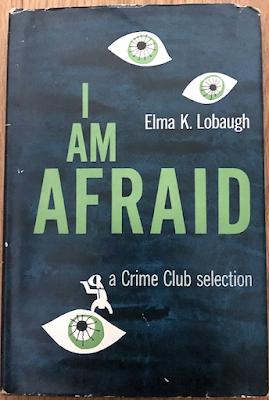
THE CHARACTERS:  From the opening paragraph we get the sense that Dorothy, our narrator, is a fragile woman easily intimidated and a victim of a runaway imagination. The dust jacket illustration (see image at left) shows several surreal looking eyes that are meant to suggest the eyes in a portrait hanging on her bedroom wall. As Dorothy's persecution (real or imagined we are never really sure until the final chapter) continues the eyes in the portrait take on a sinister aspect and represent to her the eyes of everyone in the house -- her indifferent, apparently unloving, husband and the two judgmental children, especially the elder Stephen.  I Am Afraid (1948) is a reverse fairy tale, a nightmare story for adults with Dorothy cast in the role of a victimized stepmother seemingly at the mercy of sinister stepchildren.  

When Stephen first appears the reader knows there is something not quite right about the boy. He talks and behaves like a middle-aged man.  He treats his stepmother not as a parent, but as someone to pity. Stephen has a patronizing manner about him. In his daily visits to Dorothy's bedroom with her morning or afternoon cup of tea he seems ingratiating and deferential, but Dorothy begins to imagine the boy has an ulterior motive. He doesn't act like a son or even a child when he's around her. She calls him strange and weird. She wonders if the tea should be drunk at all.

It doesn't help that Edward dismisses all of Dorothy's ideas when she attempts to discuss the boy's disturbing behavior. The boy is not athletic, disdains anything remotely boyish and shuns any type of play, preferring to read books. He's already suspect in the eyes of 1940s America.  Imagine any American boy not wanting to play baseball or football and turn into a bookworm! Dorothy becomes increasingly frightened by the children, but especially Stephen. It's not just the bookishness that gives her pause. And it's only a mater of time before the strangeness gives way to malicious and dangerous acts.

There may no other suspense novel as intensely domestic as I Am Afraid. The small cast of characters helps build a claustrophobic atmosphere resulting in a stifling melodrama. Dorothy has no real friends outside of her immediate family and spends much of her energy trying to win over her stepchildren or trying to entice her husband back into her bedroom.  The sex has gone from their marriage now that the children have arrived.  Adding insult to injury Edward has retreated to his writer's den claiming a need for no distractions while he tries to hammer out his articles under the pressure of fast approaching deadlines.

The only other character worth mentioning is the neighbor Frank Henderson, a gym teacher and football coach at the elementary school. Dorothy goes for strolls along the shores of Lake Michigan and chances upon Frank walking his dog.  They have a casual conversation that feels so alive and adult to Dorothy she finds a way to get out and go walking nearly every evening just in order to meet up with the coach and his dog.  Little does she realize that her walks and utterly harmless friendship is under close observation.

French translation of I Am Afraid
SETTING:  While the house may be an oppressive and loveless place filled with portraits of staring eyes and oddball children too much in charge of the adults the locale is contrasted with the outside setting.  Edward's home is situated in the dune lined shores of Northern Indiana. Lake Michigan and the dunes are favorite locations in Lobaugh's crime novels.  For Dorothy the lake, the beaches, and the dunes surrounding the house serve as an idyllic escape from the sterile and claustrophobic home that increasingly seems like a prison.

INNOVATIONS:   With a cast of only three adults, two children and one dog it seems almost as if it was meant to be a script for either theater or the movie screen. It's confined settings also make it prime material for a theatrical adaptation.

I think Dorothy's pre-occupation with her dwindling sex life was pretty modern for a book published in 1948.  Clearly her life with Edward was a happy and passionate one prior to the arrival of the oddball kids, Emily and Stephen. Her private life with her husband all but disappears once the children are in the household. I was impressed with Lobaugh's insistence on making Dorothy a woman with desire and whose life requires sexual expression.  Her descent into depression and isolation has a lot to do with her being ignored by her husband as much as it is about the weird and later thoroughly malicious behavior of her creepy stepson. There aren't many crime novels that address this aspect of marriages gone bad and the consequences of one isolated partners mental health.

INFLUENCES:  The real thrill of this suspense novel doesn't occur until the final third of the book and involves lies, deception and spiteful violence.  I can't help but think that Lobaugh was familiar with Lillian Hellman's The Children's Hour, a play first produced on Broadway in 1935 with its first of two movie adaptions in 1936.  It became a standard choice of melodrama in colleges and community theaters by the mid 1940s. The ugly rumor spread by Stephen that serves as the climax of the book seems so entirely inspired by the malicious talk of Mary Tilford in Hellmann's play that it can't be mere coincidence.  When Stephen is forced to confess to his lies in Lobaugh's novel the boy's fury and anger is like a madman's hysteria. His character foreshadows all the "Bad Seed" kids and demonic children that would flood the pages of popular fiction throughout the 1960s and 70s.  In this regard Lobaugh's book prophesies an entire crime and horror novel subgenre decades before it became a cliché.

QUOTES:  Their poise was more unnerving than if they'd come in the house screaming.

He kissed me good night, a sweet gentle kiss befitting my supposedly nervous, wrought-up state. I could have slapped him.  He might have kissed me differently--as a woman, as a lover, as a wife.

I began to think that it was too bad we were civilized. If I were to slap him, if he were to hit me at least that would be honest. At least that would be more sincere than this quiet politeness that was a living lie. 

(In reference to the painting that causes so much of Dorothy's paranoid anxiety)  ...one of these days I'm going to throw something at that smirking bitch on the wall.  I can pretend she's Stephen.

AUTHOR:  Elma Klinedorf Lobaugh (1907-1997) was born and raised in Indiana where she lived most of her life.  In 1928 she graduated with honors from University of Chicago.  Among her first jobs was labor analyst for the Indiana State Employment Service.  She wrote three crime novels under her own name then disappeared from the Crime Club roster for four years.  In 1946 her melodramatic novel The Devil Is Loneliness was published by the second tier house A. A. Wyn.  Described as a "steel mill soap opera" by one newspaper reviewer it was her only mainstream novel. When she resurfaced in the 1950s as a mystery writer she used the pen name "Kenneth Lowe" and was once again published by Doubleday's Crime Club. The Lowe crime novels are all set in Indiana and at least one (Haze of Evil) deals with murder and crime in the steel industry. Some of them are set in a fictional town called Merrittville which is most likely modeled on the real Indiana city of Merrillville. At least two of her novels were translated into French:  I Am Afraid became A devenir folle (literally "to become crazy) and L'Envoûtements (Bewitchments) was the translated version of her sophomore mystery, Shadows in Succession, a mystery involving voodoo in New Orleans.

Elma K. Lobaugh Crime Novels
She Never Reached the Top (1945)
Shadows of Succession (1946)
I Am Afraid (1949)


As Kenneth Lowe
Haze of Evil (1953)
No Tears for Shirley Minton (1955)
The Catalyst (1958)

Friday, June 25, 2021

MOONLIGHTERS: Victor Wolfson - A Playwright Dabbles in Gothic Dread

A little digging is a dangerous thing, to paraphrase Alexander Pope.  His original quote about a little learning continues: "Drink deep, or taste not the Pierian spring."  Often I find that my digging into the past lives of these obscure authors unearths a treasure trove of information that I hit that spring and before I can sample it I find I'm drowning in it.  Buried in data about the writer's lives I try to sort it out and assemble it and then I forget about writing about their books. In the case of Victor Wolfson, a prolific writer of plays, television scripts and a handful novels, there are just a couple of crime novels to his name.  So it should be easy to toss off a brief review of this one before I unleash the torrent of info on his other writing. I think he was a little embarrassed by this one book for he hides behind the androgynously odd pseudonym of Langdon Dodge.  Perhaps a signal that he was planning to dodge metaphorical bullets fired from the typewriters of harsh or indifferent book reviewers.

Midsummer Madness (1950) is the one of two books Wolfson left fans of crime novels and it's as odd as his choice of pseudonym (the source, inspiration or meaning of which I was unable to determine in my digital shovelling through his past).  I've tagged this as a "badass biddy" suspense novel but truthfully the two women battling each other for the affection of the Byronic hero and possibly the wealth he is due to inherit are far from biddy age.  Selena our protagonist and heroine is barely forty years old while her antagonist the extremely unbalanced and duplicitous Zilla is just entering her middle aged years.  And Zilla's no biddy in the looks department.  Described by Dodge as a sort of Jayne Mansfield type gone off the deep end Zilla is Rubenesque, blond and deeply disturbed. Still, at its core Midsummer Madness is very much in the tradition of what I like to call "badass biddy" novels in which two women go to great lengths to do each other in, or drive one or the other to the brink of madness. Selena is not really the target here but her charge is -- the young son of Gayden Goodale.  Wolfson's early playwriting days betray him here in his use of awkwardly and groan inducing alliterative names as odd as the consonance of his pen name.

In a nutshell this is Jane Eyre redux with an overdose of nasty cruelty and murderous avarice.  Selena is cast in the role of Jane, Gayden is Rochester, and instead of Adele as the governess' charge we have Bobby, Gayden's asthmatic son.  While there is no real counterpart for the crazed ex-wife kept hidden away in an attic Wolfson does offer up an invalid mother in the person of Mrs. Goodale, the specter of a long dead wife named Lucy who may have been murdered, and of course the nasty villainess Zilla.  So Mrs. Rochester's spirit at least is present albeit divided into three different characters.  The structure is Jane Eyre no matter how you look at it. But the conflict is pure badass biddy crime novel.  Zilla is out for the Goodale money and she is intent on eliminating every one of the Goodale family starting first with Bobby whose respiratory ailments and frail physique make him a prime target for Zilla's devilry.  And she has some extremely cruel and nasty methods of attempting to do in the poor boy. One of which involves trapping Bobby on a speedy roller coaster at a local carnival and preventing him from leaving as they repeatedly ride the coaster as he screams to be let off.

Rounding out the cast of characters are Zilla's bullying son Allan; a sinister butler named Collins who seems to know more than anyone at Hawk's End; a Polish handyman who speaks no English; Millie, an easily intimidated simpleton of a maid who attempts to become Selena's ally and fails, and Mrs. Goodale the archtype of the imperious invalid matriarch confined to her bedroom who is policed and tended to by an overly protective matron nurse.

French paperback edition.
That can only be Zilla on the cover!

The Gothic elements continue into the marvelous setting. Thornfield Hall is replaced by Hawk's Head, a rambling estate near oceanfront cliffs in northeastern United States, perhaps somewhere in New England. The house is ironically claustrophobic in its immensity and the typical brooding atmosphere of dread and paranoia infects the place. Two key scenes take place at a summerhouse situated on the precipice of the seaside cliffs. It is a place that the boys were warned to avoid because of its rickety wooden railings and a porch in disrepair. You just know that something awful its going to happen there. And it does. Twice! 

Midsummer Madness for all its stereotypical trappings and familiar character types makes for an interesting read.  The battle of wits and two hand-to-hand battles --these are tough women!-- between Selena and Zilla hold the reader's attention for the most part even if the filler story is easily guessable.  Zilla is never meant to be ambiguous as the villain of the novel.  Though Wolfson tries to make Gayden seem like he may be a baddie he's too steeped in the Gothic traditions to be anything but a requisite Byronic hero. Selena is smart, strong willed, outspoken and athletic.  A refreshing change from the guileless nitwits one usually finds in neo-Gothics.

Best of all -- the climax of the book, the ultimate reveal of what happened to Lucy, and the revelation of Zilla in all her malevolence includes a neat surprise in the person of the sinister Collins who turns out to be not so sinister after all. And whose knowledge of the household is matched by his knowledge of foreign languages. I'll say no more. There are plenty of copies of Midsummer Madness out there to be found and you will have to discover the thrilling escapades and nasty schemes of Zilla, her tortured victim Bobby, and the resourceful heroine Selena all on your own.  You can find it in both hardcover editions under the Langdon Dodge pseudonym and paperback editions under Wolfson's real name.

Victor Wolfson (1909 - 1990) began his professional career "organizing acting clubs for striking miners in West Virginia" according to his New York Times obituary. Theater was apparently his first love and from 1926 through 1955 he worked as an actor, assistant stage manager, director and producer in addition to his seven contributions as a playwright.

Though his career as a playwright did not yield many memorable or long running plays despite the star power of Shirley Booth in the shipboard comedy Excursion (1937) or Gloria DeHaven, Ricardo Montalban and Bea Arthur in Seventh Heaven (1955), a musical for which he supplied the book, Wolfson would go on to become highly successful as a television script writer. He wrote for several anthology series throughout the 1950s when such shows were at the height of popularity. Among his TV credits are scripts for Suspense (14 episodes!), Kraft Theater and Climax. The episode "No Right to Kill" on Climax (Aug 9, 1956), starring John Cassavetes and Terry Moore, was based on Wolfson's own stage adaptation of Dostoevsky's Crime and Punishment which had been on Broadway at the Biltmore Theater in 1935. Most notably Wolfson wrote six scripts for Alfred Hitchcock Presents.

The Hitchcock TV scripts include some of the best of that series, some of which were based on well known short stories by master crime fiction writers.  Wolfson wrote the scripts for "The Specialty of the House" and "The Orderly World of Mr. Appleby" both based on the stories by Stanley Ellin, "Malice Domestic" based on Philip MacDonald's story and "The Perfect Murder" taken from the story of the same name by Stacy Aumonier, an underrated crime writer of short stories whose work was made more famous thanks to at least three episodes on the Hitchcock TV series.

Perhaps the crowning achievement of Wolfson's years in TV came in 1961 when he won an Emmy for his work on ABC-TV's 26 part mini-series "Winston Churchill: The Valiant Years."  

Some of his mainstream novels all published under his real name are The Lonely Steeple (1945), reprinted as The Passionate Season (1966);  The Eagle on the Plain (1945); and Cabral (1972), his second crime novel. My Prince! My King! (1962), a novel based on several of his autobiographical stories, focuses on his days as a child of Russian immigrants. The stories originally appeared in The New Yorker back in the 1940s told, amongst other things, the story of his mother's grief following the death of Wolfson's father. His nonfiction works include The Man Who Cared (1966), a biography of Harry S Truman; and The Mayerling Murder (1969), in which he examines the legends and myths surrounding the still unsolved apparent murder–suicide pact of Rudolf, Crown Prince of Austria, and his lover, Mary Freiin von Vetsera.

In May 1990 Wolfson died tragically in a fire in his home a Wellfleet, Massachusetts. He was 81 years old.