These bits of ephemera are rather remarkable for both being well over 100 years old. Both post card and newspaper story were Left Inside my extremely scarce copy of The Memoirs of Sherlock Holmes (Harper & Brothers, 1894. Revised 2nd edition). I have to brag a little about this book because my partner Joe found it at a book sale in Libertyville, Illinois many moons ago. I paid one buck for the book! I was astounded that no one had snagged it prior to us showing up. Vaguely I recall it was the last day of the sale. The book is in beautiful condition for a 19th century book with the only problems being a minor stain on the spine of the book, an offset stain on the prelims from the acidic newsprint reacting to the paper in the book, and some discoloration to the illustrated front board (photo at left). Definitely one of the treasures in the Norris Collection of Detective Fiction Rarities. Probably will never sell it until I contact an auction house about five years into the future, a plan I have been devising for a while now.
Onto the items. First is a German postcard.

Translation of the caption on the front is "Official Post Card from the International Exhibition of Culinary Arts for the Hotel and Hospitality Trades/combined with a wine market in Frankfurt-Main." The caption is followed by the dates of the exhibition: "Sept. 30 through Oct 11, 1905." Unusual that even in the early 20th century German typesetters were still using the odd F-like letter to indicate the letter S, but in a word that ends in S the typesetter would use an actual S character. I thought that F-like letter was out of use by 1905. American typesetters used that F shape for an S in 18th century typesetting in the USA, but it fell out of favor by the middle of the 19th century.
The postcard was mailed from the exhibition which had its own post office as can be seen on the postmark on the stamp. Another postmark obliterates a portion of the lightly penciled message and is dated Oct 8, 1905, the date It was received by the post office in Barmen, a town in Wuppertal about 140 miles northwest of Frankfurt. I can make out the message as With hearty greetings ("aus [?] grüsst herzlich.") but I have no idea what the signature says. The card is addressed to a man named Paul Kraft (maybe Kraus?) who lived in Barmen. But I can't read the street or whatever is on the last line of the address area that ends with the number 18. Also, it looks as if the writer wrote 19 first then corrected it to 18.


The second bit of ephemera is a short story written by Frank Marshall White which first appeared in Life, Oct 18, 1894. Later it was picked up by syndicated news services and appeared in The Brooklyn Eagle in Oct 24, 1894. The reverse side of the first half of the story luckily shows a portion of the left hand side of the front page. Based on what I found from online resources, the newspaper is definitely an issue of The Brooklyn Eagle in the year 1894 (vol. 54). Whether it is the actual October issue I didn't bother to further research. Both the layout of the front page of a November 1894 issue and the fonts of their masthead match exactly. This story was one of the earliest Sherlock Holmes parodies, probably also one of the shortest. You can find the full text of "The Recrudescence of Sherlock Holmes" online at the Arthur Conan Doyle Encyclopedia. My newspaper copy has a portion of some lines missing due to a fold that eventually broke in half. The poorly trimmed edge of the second half cuts off the final two sentences: "This contemptible trick I can never forgive. Sherlock Holmes is again dead to me. — Life."
 |
 |
 |

First, the photographer. Sally Savage has had her work shown in galleries and museums in her native Nyack, NY. She specialized in "documenting just about every aspect of life and change in [Rockland] county since the late 1960s" according to the New York Heritage website of the Nyack Library. Her photo entitled "reeds on Piermont pier" was apparently sold in a set of stationery that Ruth Brawner bought sometime in the 1970s. A large collection of Savage's photographs is in the New York Heritage Digital Collections held in the Nyack Library.
The letter itself is a quaint "thank you" written by Ruth Brawner to Mrs. Paul (Charlotte) Bardwell. I'm not including a photo of the envelope because of the street address on the return address label and the street address of Mrs. Bardwell.

For those of you who cannot decipher American cursive handwriting the letter reads:
Dear Charalate [sic],
Thank you for arranging the Madrigal Singers to take part in our BiCentennial [sic] dinner.
Everyone without exception has said how much they enjoyed the singing and the fine menu.
Gratefully,
Ruth & Howard


Today we have a sales slip for a used book purchased at a antique shop formerly located in Montpelier, Virginia. (I thought the name of the capital of Vermont was unique to that state alone.) The Lamp Post was apparently some sort of curio shop that was in someone's actual home. I've marked out the address and phone numbers in the stamped info because it is now a private home sold back in 2018. I found all sorts of real estate records for that property indicating its previous life over that past 26 years. Not only was it The Lamp Post but in 2002 the house itself was listed with the National Historic Registry as it is a home built in 1936 and included in the Montpelier Historic District along US 33, aka Mountain Road.

Interestingly, there is still an antique shop a mere stone's throw from the former location of the old The Lamp Post. It's called Plum Pickings and appears to be an antique mall with 40+ vendors. Looks like a cafe is attached to it also. Their Facebook page (older owners I'm guessing) was advertising a Big Breakfast event today (June 7), part of the thousands of celebrations across the USA this summer in honor of the 250th anniversary of American Independence. They also say they are the #1 rated antique shop in the Richmond area.
And the book itself is an even better find! One of the best purchases I've made in years. It's an incredibly rare copy of Death Walks Softly (1938) --a Nigel Morland book, one of the Inspector Tandy detective novels he wrote using his "Neal Shepherd " pseudonym. At a mere $35 it was a steal. The description promised the exceptionally scarce dust jacket though based on the price clearly the seller had no idea about that. Overall, the description noted minimal damage and a book in good condition. A bare bones description to be sure and leaving a lot of room for my usually cynical imagination to fill in with all sorts of expected flaws. It could mean anything from genuinely good to battered and worn because "good" in the book trade does not mean good at all. Usually "good" translates to barely good. In truth the rating can be used to cover a condition that ranges from usual wear to beaten to hell. This counterintuitive grading system that's been in place for centuries frankly still baffles me.
Imagine my surprise when I opened the package to discover a review copy in Very Good condition! Minor wear, faint foxing to the foredges, some tanning to the edges of the dust jacket, but absolutely much better than a mere "good."
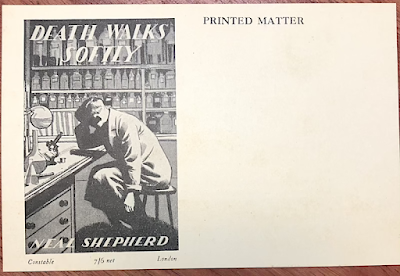
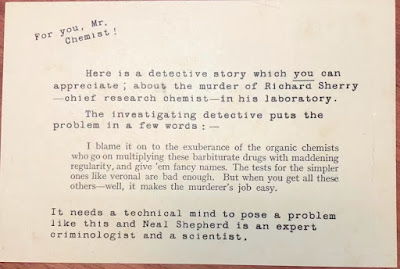
Laid inside I found a bonus not mentioned in the seller's description. A promotional post card from Constable & Co., the publisher, intended to be sent to professionals in the chemistry world. This makes me think that the book was a review copy and that the recipient was to send the card out to help promote sales. It also alludes to the fact that the book is the first in a new series although that fact is never mentioned outright. The front of the card has a miniature of the dust jacket illustration, but in black and white. The actual dust jacket is in three colors (blue, green and black). Click to enlarge for full enjoyment. You'll most likely have to enlarge the second one in order to read the message.
I own three of the four Neal Shepard books and have been promising to write about them for years now. I think I've mentioned in passing the plot of Death Flies Low in a couple of comments over the past ten years, but still have not written up reviews of any of the books. They are all scientific detective novels with bizarre murder methods and unusual motives. Along with another brief series featuring Sgt Johnny Lamb that Morland wrote as "John Donavan" they are the best of his detective novels. Expect reviews of all the Neal Shepherd books starting in March and continuing through April. You'll have to wait for the photos of the beautiful copy of Death Walks Softly in the first review in the coming weeks.
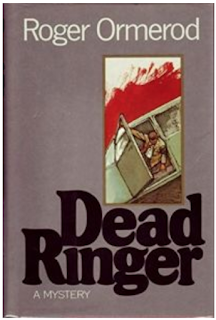
Well, people like me and other quasi-Luddites who are still reluctant to succumb to the ubiquity of digital books and electronic publishing still insist of these physical advance reader copies (ARCs) and love going to the mailbox to pick up packages loaded with books. It's a losing battle, however, these days when publishers who still do print these physical copies have very few to offer to us outliers.
My collection includes several copies of these old-timey ARCs from the 1960s, 1970s and 1980s. Much more exciting than boring and easily deleted electronic galleys. Below are two slips of paper I found in a copy of Dead Ringer by Roger Ormerod to be reviewed in the coming months. The papers are self-explanatory. You can click on the first one to enlarge it and read the content.
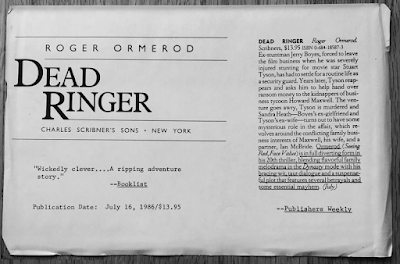
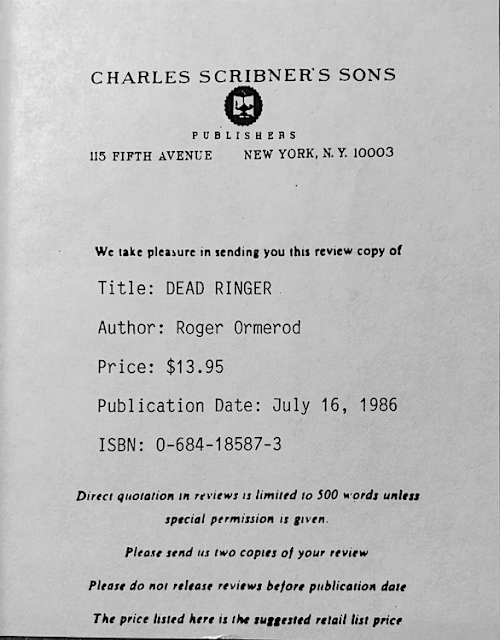
Scribner's seems to be the cheap kind of publisher who sent limited PR with the book. Other publishers included a lengthy cover letter announcing the book's publication date and instructions not to review the book prior to its release -- apparently no longer a stringent rule in this age of blogging and Instagram.
Sometimes photographs of the author and the book were also included. The reviewer would submit those with the copy to the layout crew at the magazine or newspaper. I had a few books with author photographs but I have no idea what I did with those photos. Maybe this copy also had such additional material and it was submitted with the review. But when I bought the book these two slips were the only items inside.
Pandemic boredom led me to amassing about three boxes of books (most of them still not read) and I noticed in reorganizing them and cataloging them that many had some intriguing bookplates. And here they are for your viewing pleasure...


One of the many popular bookplates from the famed Antioch Bookplate Company in Yellow Springs, Ohio. I've seen multiple copies of this bookplate in dozens of books (from obviously various owners) I've either owned or perused over the past twenty years.


I wish I knew who this artist was. I see the initials LCD at the edge of the book.


The Willebrew machine used pre-printed tickets. Unlike the earlier punches, these tickets had a large number of fare options on each ticket. This meant fewer tickets for the conductor to carry.
The conductor selected the ticket, inserted it into the machine and cut off a section up to the fare paid. This section was retained inside the machine and the remainder handed to the passenger.
Willebrew model #10288
photo from Bob-Mockford.co.uk
The conductor did not know the value of tickets issued. This would be calculated later in the office, preventing the conductor from taking any surplus cash.
The Willebrew is opened by inserting a small screwdriver into a hole in the bottom of the machine, pressing the spring-loaded catch inside and pulling the cover downwards. It is not necessary to completely remove the cover as shown in the photo, in fact it is better not to as holding down the catch while re-inserting the cover is difficult.
Once opened, a clerk in the office would remove the pieces of ticket to calculate the takings.


 |  |

 |  |
 |
| Click to enlarge |