Showing posts with label H. P. Lovecraft. Show all posts

Thursday, October 31, 2019

HALLOWEEN SPECIAL 2: Kthulhu Reich - Asamatsu Ken

Rudolf Hess battles the elder gods. Adolf Hitler monkeying around with black magic books after he dropped out of art school. A female vampire lures Nazi soldiers to her castle and tricks them into setting in motion an apocalyptic plot. So you thought Dennis Wheatley was the only writer obsessed with Nazis and black magic? Think again.

Kthulhu Reich (2019) is a collection of bizarrely over-the-top, sometimes ludicrously entertaining, horror stories from the fertile imagination of Asamatsu Ken. The tales have been meticulously translated into English by Jim Rion, an expatriate English teacher and translator formerly of Kansas now living in Yamaguchi prefecture. Publisher Edward Lipsett of Kurodahan Press assures me that while Rion’s translations seem to be near parodies of the Weird Tales school of writing they are accurate and in the spirit of the original Japanese texts. I found them to be generously peppered with enough American vernacular and colloquialisms to give the stories a retro-pulp magazine feel. Lipsett joked that though I may think they may be too Western or “Americanized” these are German characters written by a Japanese writer who speak in Japanese in the original stories and now English in this translation. But in all accounts they should be speaking in German! No matter. They do indulge in the typical “Ja wohl, Herr Kapitän!” we are used to hearing from British accented actors who play Nazis in the old war movies of days gone by.

I didn’t really know what to make of this book before I cracked it open. I figured I should prepare myself for some kind of Dennis Wheatley/H. P. Lovecraft mash-up by way of Japanese worldview. Was I ever wrong! These stories could easily have been lifted from the pages of any of the American shudder pulps. Rion, the translator, must clearly be a fan of the kind of stories Lovecraft and all his imitators wrote back in the day. So faithful are these stories to the spirit of Lovecraft’s Cthulhu Mythos that the entire book is annotated with scholarly footnotes that make it sound as if the creatures encountered in the pages are actually real. In addition to the detailed descriptions recounting the history of Lovecraft’s many “elder gods” that appear in the book, along with the lives of Lovecraft characters (and those created by Derleth, Bloch and Robert E. Howard) there are eye-opening footnotes on the historical facts surrounding the occult interests of Rudolf Hess and his influences on Hitler. We also learn about the members of The Hermetic Order of the Golden Dawn who were also wrapped up with the Axis powers and German soldiers. Who knew there were magicians in wartime England sympathizing with the Nazis?

But onto the stories themselves…

Those that are modeled after Lovecraft and pay homage to his Cthulhu Mythos are by far the most entertaining. Minor stories like “The Colonel’s Self-Portrait” and “April 20, 1889” rely too much on gimmicks. The first is a shaggy dog story with an ending I should’ve seen coming from page two. The other is done as a collection of diary entries and letters. Both stories are less effective if the reader is an avid student of World War 2 history. The title of the second is a dead giveaway to the final twist and lessens the power of what might have been an eyebrow raising surprise on the last page had it been named anything else. And a warning to the fainthearted (are there any among horror fiction fans?) -- "April 20, 1889" also deals graphically with the Jack the Ripper murders and goes into disgustingly obscene detail in how the crimes were committed. Splatterpunk fans have something to look forward to there.

The most successful and effective stories of the seven in this volume are those that abandon the traditional trappings of vampires and witchcraft and go all out in depicting the wild adventures of trippy black magic obsessed Nazis.  The footnotes tell us that a lot of this stuff is based on fact. That's double the trippiness for your buck right there.

First published in separate issues of Hayakawa S-F in 1994 and 1995 two stories make up one long novelette of recurring themes and characters. These two should be read in the order as arranged and saved for last for they are truly the cream of the crop in this nifty book. The first of this double feature "The Mask of Yoth Tlaggon" is like a Hammer horror movie on paper. Instead of Charles Gray as the evil sorcerer I'd cast the more appropriate Klaus Kinski as the evil Rudolph Hess, Hitler's Deputy Führer, bent on mastering the universe and conquering Third Reich with the help of an ancient artifact that allows the wearer to commune with powerful gods from an alternate universe.  It's a wild ride of a story that almost tops the best scenes in Dennis Wheatley's masterful occult thriller The Devils Rides Out. Hess is joined by Tatewaki Goto and Clara Haffner, two intelligence agents in disguise as diplomats. Clara is also "a runic magus" well versed in reading the language of ancient spells that will come in handy during the rousing climax, an operatic showdown of black magic and phantasmagorical visions.

"Call of Cthulhu"
(courtesy of redskullspage.tumblr.com)

The saga of the Mask of Yoth Tlaggon continues in the story immediately following “In the Wasteland of Madness” in which a young aristocratic Nazi, Major Erich von Müller, is forced to wear the mask and report what he's seen. His visions offer up clues of an impending expedition to the Antarctic where Kriegsmarine Leutnant Krenze, the brawny, blond haired "very model of a German soldier" expects to uncover the lost world of Thule, believed to be the origin of the Aryan race. What they discover there instead is more horrifying than beautiful.  Lovecraft fans will eat this one up. Once again the plethora of footnotes fills in the background on the origins of the strange creatures, the lives of the historical figures who appear or are mentioned in passing, and the litany of arcane occult texts and forbidden books created by Lovecraft and his acolytes. It's hard to believe that the Nazis genuinely were involved in explorations of the occult and black magic, but there are documented facts to reveal it is in part true. The legendary and secretive exploration of the Antarctic seems to be more anecdotal and apocryphal than factual though many people believe it did take place. What the German soldiers discovered there is left to the imagination of the true believers and writers like Asamatsu.

This is a bizarre and surreal example of mash-up of fact and fiction that delivers the goods in three of the seven stories. Reading these stories seemed like a flashback trip to the 1960s drive-ins that used to show Hammer horror movies overstocked with bloodthirsty vampires and vengeful creatures from the dark side.  I had a blast reading this book, loved the Lovecraft homage, and recommend it to  the horror hounds out there in search of something completely different.  Dennis Wheatley and Lovecraft I'm sure are smiling somewhere in the Great Beyond knowing that this book exists.

Wednesday, March 1, 2017

NEW STUFF: Cat Out of Hell - Lynne Truss

While browsing in a Barnes & Noble bookstore (one of three left in the entire city of Chicago) I came across Cat Out of Hell (2014) by Lynne Truss. The blurb on the book was enticing enough for me to make an impulsive purchase and I started it that very day. I didn't stop until I was finished. I can tell you that never happens with me reading a new book any more. What made it such an "un-put-downable" read? It's 100% original, 100% unpredictable, and 100% just plain fun.

On the dedication page Truss has this public notice: "To Gemma, who loves proper horror, with apologies". I don't know who Gemma is, a relative or friend of Lynne Truss, but she's a girl (or woman) after my own heart. I love proper horror, too. And this is the real thing. Plus, it's funny! Why Truss finds it necessary to tack on an apology I don't really know. Maybe because the book is about a talking cat? A couple of them, in fact.

Roger is a cat who has literally lived nine lives. He has suffered eight torturous deaths at the hands of his surrogate father -- a wiser, older, somewhat sinister and utterly intimidating black cat who goes by the moniker "the Captain." There is a mystery about The Captain and Roger isn't telling his present owner, a middling actor who makes a living touring in a production of that British farce chestnut See How They Run! The first part of the story -- the bizarre life of Roger and his owner Will Caton-Pines, the actor -- is told through a series of documents and emails sent to Alec Charlesworth a retired librarian who is getting over his wife's recent death. It's all a bit hard to swallow for Alec. Is the story a hoax? Much of it is told in the form of a bad screenplay. And why has Alec been sent these documents about a talking cat who seems to have been responsible for the deaths of several humans? Alec has several mysteries to solve. But all will be explained as this exceptional, brightly funny, and often bloodcurdlingly gory black comedy makes its way to the inevitable battle of good vs. evil in the final pages.

When a book is this good I cannot begin to summarize the plot. I don't want to. The thrill of this kind of popular fiction so well done, so imaginatively thought out, and suspensefully told is in the actual reading. Cats have always been a source of sinister inspiration from Edgar Allan Poe to Sax Rohmer to Stephen King. The movies also are filled with tales of villainous or murderous cats with Cat People, The Uncanny, and Eye of the Cat some excellent examples that come immediately to mind. Even heroic cats have been depicted trying to thwart evil human deeds as in the nasty revenge story Shadow of the Cat with a screenplay by George Baxt. But here is a horror story in which a cat is an anti-hero, a sort of feline Tom Ripley. You can't help but like this rather unlikeable, potentially murderous ball of fur. For much of this short and briskly told novel there is a Highsmithian air of ambiguity about the proceedings. Are the villains the cats or the humans? Is it all a coincidence that Roger's previous owners have all died in a series of bizarre accidents? How do Roger and the Captain figure into Alec's life? The denouement is completely unexpected and reminded me of Dennis Wheatley, Sax Rohmer, Aleister Crowley and a dash of H. P. Lovecraft all rolled into one weird hodgepodge in the insane blood-soaked finale.

For a thoroughly original spin on familiar horror themes, an ingeniously thought out feline conspiracy theory about the purpose of cats in the world, and a well plotted multiple murder mystery Cat Out of Hell gets high marks from me. I feel like reading it all over again. Rush out and get a copy right now!

Friday, May 17, 2013

FFB: Scream for Jeeves - P.H. Cannon

Sheer serendipity, this one. Was in the library looking for something completely different and saw the title of this little book just to the left of some Victor Canning books. P. G. Wodehouse's best loved characters entering the world of the Cthulhu Mythos? How could I resist?

The subtitle for Scream for Jeeves (1995), seen on the book's cover, is "A Parody" and that it is. With Bertie Wooster narrating, Jeeves supplying his usual brand of wry wit and wise advice, and creatures from other dimensions, seen and unseen,  looming ominously in the background it's not exactly going to be all that terrifying. Especially when Cannon creates absurdly apt characters like Captain Tubby Norrys who "resembled one of those Japanese Sumo wrestlers after an especially satisfying twelve course meal" and who "shook in gratitude like a jelly -- or more precisely like a pantry full of jellies." The juxtaposition of Wodehouse and Lovecraft does make for some bizarreness. Witness this section taken from the first story "Cats, Rats and Bertie Wooster":

"The walls are alive with nauseous sound--the verminous slithering of ravenous, gigantic rats!" exclaimed the master of the manse.

"You don't say. As a child I think I read something about a giant rat of Sumatra--or at any rate, a passing reference."


Towards the end of the story Jeeves pronounces a typical warning to the reader found in all of Lovecraft's work: "We shall never know what sightless Stygian worlds yawn beyond the little distance we went, sir, for it was decided that such secrets are not good for mankind."

You get the idea. It's lightweight parody getting just the right flavor of a frothy airy cappuccino. In addition to pastiches of Wodehouse and Lovecraft there are allusions to the work of Arthur Machen, Conan Doyle, Poe and even "Fawlty Towers." I had a fun evening reading the tales. Knowledge of both Wodehouse and Lovecraft is not all that necessary, but I imagine the enlightened and well read will better appreciate the stories.

There are three stories in the brief volume, the other two are "Something Foetid" and "The Rummy Affair of Young Charlie."  The book concludes with the essay "The Adventure of Three Anglo American Writers" in which Cannon -- who claims membership in three societies devoted to Conan Doyle, Wodehouse and Lovecraft -- describes among many observations, the friendship between Doyle and Wodehouse; Lovecraft's admiration for Sherlock Holmes; Wodehouse's familiarity with Lord Dunsany's stories; and manages to find similarities in the works of all three writers. Sometimes Cannon is convincing in his analogies, sometimes he stretches them far too thin.

The Jazz Age style illustrations are by J.C. Eckhardt. The homage to the two writers extends even to paired initials in the book's creators.

Thursday, July 14, 2011

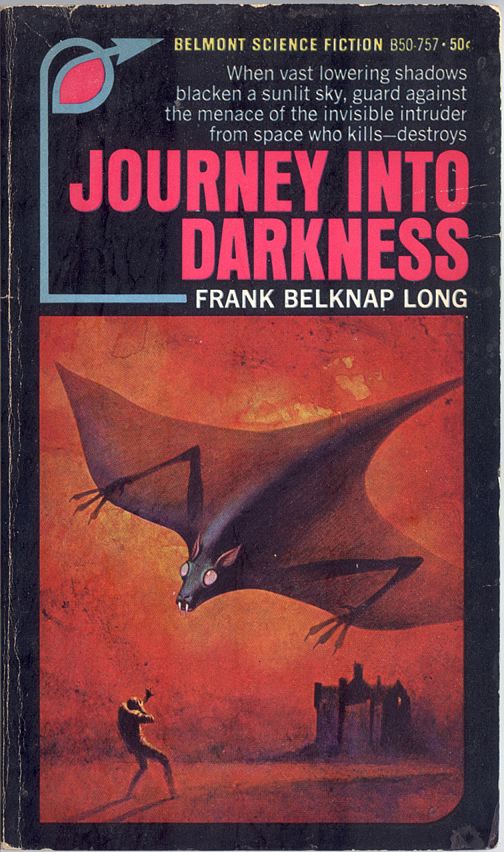
Journey into Darkness - Frank Belknap Long

It was jury duty for me yesterday. I know all too well what that means. A day of nothing but reading. And I get paid for it! As my nephews would say, "Sweet!" Granted from the city of Chicago I only get $17.20 for sitting in a quiet room filled with strangers and reading crime fiction all day, but luckily I have a real job with genuine benefits and jury duty pay is one of them. I could write a whole other post on jury duty and my insane run of bad luck and fill that post with ridiculous anecdotes and tales of Cook County bureaucracy gone haywire, but I'll spare you. This is a blog about books.

While I was sitting and waiting for my jury panel number to be called I managed to read an entire paperback novel and three short stories from The Department of Queer Complaints by Carter Dickson. The Dickson book will be reviewed later when I finish it. For now you get a review of the novel. I picked it because it seemed like it would be a detective novel with fantastic elements. But it turned out to be a Lovecraftian style horror/sf story with a lot of gruesome murders and a heck of a lot of new age crapola. The blurb was definitely misleading. But surprisingly I found the book was something I could not put down.

Frank Belknap Long was one of those frenetically prolific writers in the heyday of the pulp magazine era. He wrote everything. Horror, fantasy, science fiction, Gothic romances, and a couple of scripts for comic books including Green Lantern, Superman and Captain Marvel. I have a paperback reissue of The Hound of Tindalos and in that book there is a mini biography of his writing career passed off as an introduction. He tells some amazing anecdotes and he writes lucidly, clearly and entertainingly of his life as as "fictioneer" and of his fellow writers. Long's fiction writing is another thing altogether.

Journey into Darkness was the first novel by Long I've read having only been familiar with a handful of his stories penned for Weird Tales. It's dense and rambling, hypnotic and maddening, revelatory and derivative. A cornucopia of contradictions. While much of it irritated me I never found it boring. I couldn't stop reading. It seems like you know what's going to happen then he'll thrown in some off the wall sequence and the story takes off in a completely different direction.  Forget about the utterly bland title that tells you nothing about the story. What begins as a story eerily similar to Samuel Hopkins Adams' The Flying Death slowly reveals itself to be a re-telling of Lovecraft's "The Color Out of Space."  Long even directly references that story (without coming right out and naming it) in a four paragraph sequence that also discusses Wilhelm Reich, his fascination with the color blue and the male orgasm, and his bizarre theory of orgonomy.

Psychologist John Holloway has invited a group of creative souls (three artists, a singer, and a professor of philosophy) to his East coast retreat-cum-lab for a weekend of personality experiments and treatment methods. The discovery of the gruesomely mutilated body of one of those guests initiates a police investigation (see the blurb on the rear cover at left).  Over the course of the weekend several of the other guests witness strange flying creatures, worm-like manifestations on the beach, and glowing lights in the dunes surrounding the Holloway estate.  More bodies turn up each with similar burn wounds and mutilations.  Two of the guests - Ralph Kilmer, the professor, and Joan Wilderman, the singer/dancer -- turn amateur sleuths in order to learn if these manifestations are real or merely hallucinations caused by Holloway's experiments.  The secret lies in a bomb shelter they discover as they flee yet another creepy amorphous being that pursues them on the beach.

The author in his youth
If all this sounds like a bad marriage between new age intellectualism and a pulp magazine plot that's because it is. But for some reason I had to keep reading. There is even a didactic dialog section that could have come from an episode of The X Files in Chapter 12 where Kilmer lectures on endlessly about the Jungian collective unconscious. He also gives a crash course in the iconography of fear and the power of the mind to transcend imagined horrors. It all got to be a bit grating. I was thankful for the outbursts from Joan who at least displayed a sarcastic sense of humor and shut up Kilmer's new age mumbo jumbo with snappy retorts like: "If that sand starts moving again I'm pretty sure I'm not going to just stand here and fight them with my mind."

But if I hadn't trudged through the book I would never have learned about Wilhelm Reich and his crackpot ideas. Nor would I have been acquainted with the American College of Orgonomy.  Truth can be stranger than fiction. And often even more gasp inducing. For these bits of trivia I will be forever indebted to Frank Belknap Long.

As for jury duty --  it was another day of sitting and reading. I was never called. For the twelfth time in 25 years.