Showing posts with label golf mysteries. Show all posts

Monday, February 28, 2022

IN BRIEF: The Queen's Gate Mystery - Herbert Adams

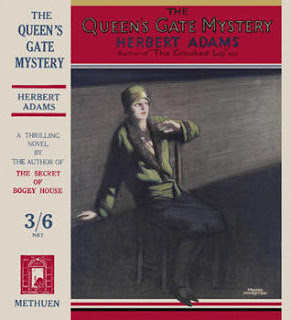
Jimmie Haswell receives a note from his friend Capt. Gregory Bruden inquiring about the legality of finding something of value in a home in which the owner died.  Is it a case of finders keepers?  Or does the cache of treasure still belong to the estate, the heirs of the dead former owner of the house. What if the finder then buys the house?  Is it legally his property because it was found in the house?  Jimmie is mulling over these various legal riddles when he learns of a murder in a house that was for sale.  And the corpse turns out to to be Capt. Bruden.  Could Bruden have been killed because of the letter?  Was there some hidden cache of something valuable in that supposedly empty house now for sale where Burden  was found bludgeoned?  Well, of course the two are tied together!  That's the core of The Queen's Gate Mystery, a quasi detective novel of murder, hidden treasure and a gang of ruthless criminals.

The Queen's Gate Mystery (1927) is Jimmie Haswell’s third outing as an amateur detective.  He  is a lawyer --a solicitor, not a barrister -- recently married to Nonna, a French woman he met and fell in love with in his previous adventure The Crooked Lip.  Nonna convinces Jimmie to investigate the various legal questions posed in Bruden's letter and to prod the police into tying the letter to the murder.  The two of them get in over their heads and soon what began as a detective novel transforms into a full blown action thriller rife with the kind of 1920s set pieces that would make this novel suitable for the afternoon serials of Adams' contemporary cinema. 

Nonna is abducted, Jimmie must rescue her.  Jimmie is attacked, bound and gagged and must escape. The search for the treasure intersects with a subplot of a ring of criminals some of whom are looking for the treasure, others who have their own reasons for using the house.  Secret passageways which featured prominently in Haswell's debut (The Secret of Bogey House, 1924) are key to solving the mystery of how the crimes are committed but this is no surprise at all and rather obvious early in the book.

Jimmie says late in the book, "What an ideal place golf links must be for conspirators to meet and plan their crimes."  Golf courses recur as settings for murders and the game crops up in a variety of ways throughout Adams' novels. Here it isn't so much the game itself as it as an aspect of golf.  One of the clues Haswell stumbles across while searching the rooms of the murder site -- actually it's Nonna who finds it -- is a golf scorecard that includes a hole-in-one. The scorecard is prominently stamped with the name of the golf course and club. Knowing that this high achievement in golf is almost always celebrated at the course and talked about in the clubhouse Haswell heads to the course and with clever questioning discovers the person who made the shot. He then sets out to prove that person was present in the house around the time of the murder.  Eventually, that ace golfer is implicated in several other crimes as well as the murder.

As always romance plays an important role in the story. Haswell often riffs on the life of a newlywed with some amusing remarks. His devotion and love for his wife spur him on giving him a sort of superhuman talent in rescue and survival. Nonna is interested in getting the other couple to repair their relationship after a damaging quarrel seems to turn them against one another. Never fear. They all make up and both Jimmie and Nonna and Philip and Enid foil the villains and live happily ever after.

The action sequences leave a lot to be desired, however. While I found it hard to believe that he could actually untie knots by simply manipulating the tight cords on his wrist on a hook embedded in a brick wall and do this all with his back against the wall in pitch darkness it still made me smile.  Oh the days of derring-do in 1920s action adventures.  The story is pure cliffhanger movie fodder.  But Jimmie and Nonna are just plain likeable so it's hard to make fun of such familiar stock in trade action and hackneyed devices, as Carolyn Wells liked to call them.

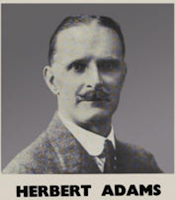
I have a few other Haswell books to get to and then I'll be sampling several of Herbert Adams' non-series detective novels.  But nothing has yet to outshine his remarkable achievement in the baffling and exciting detective novel The Crime in the Dutch Garden.

Jimmie Haswell Crime Novels
(reviews on this blog have hyperlinks)


The Secret of Bogey House (1924)
The Crooked Lip (1926)
The Queen's Gate Mystery (1927)
The Empty Bed (1928)
Rogues Fall Out (1928)
The Golden Ape (1930)
The Crime in the Dutch Garden (1931)
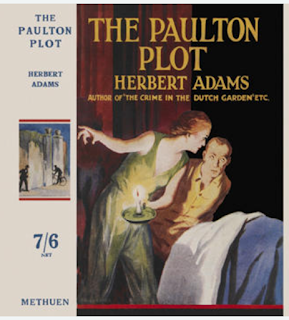
The Paulton Plot (1932)
The Woman in Black (1933)

Friday, February 14, 2014

FFB: My Late Wives - Carter Dickson

"If there's any flumdiddling of the police to be done, I'm the one to do it."

--Sir Henry Merrivale in My Late Wives

There is a lot of flumdiddling and farcical doings amid the criminal mischief and baffling murders in My Late Wives (1946), Carter Dickson's follow-up to the infamous The Curse of the Bronze Lamp.  I say infamous because in that book Dickson included a kind of twist that I consider something of a cheat in a murder mystery.  The rear panel on the DJ for My Late Wives hints that Dickson has surpassed the impossibilities of his previous book.  Did he really write a better mystery?

The story is pure fancy, one that could only take place in the pages of a detective novel. We learn that someone has written a play based on the life of a murderer and sent the script to a well known actor. His friend and colleague, Beryl West, would love to direct the play even though it may be libelous but it has a weak ending. The play is based on the life of Roger Bewlay, a known multiple murderer who killed and disposed of the bodies of his four wives. The requisite Dicksonian impossibility appears in the last murder. Bewlay managed to murder his wife in a house watched by two policemen and witnessed by another woman outside. But when the police broke into the house there was no sign of a murder and no body. What happened to the murder victim? And what happened to all the other bodies of his dead wives?

Bruce Ransom, the actor who receives the play, is challenged by Beryl to act out in real life the part and test the weak ending of the play. He is to pretend to be Roger Bewlay, court a young woman and all the while let slip that he is a wife killer and let that spread throughout the town. Then just as the girl is ready for Bruce to ask her to marry him he reveals that everything is a sham. He's really an actor and he's not a murderer at all, that it's all research for an upcoming play.  Crazily enough, Ransom accepts the challenge and the story takes off like gangbusters.

Enter Sir Henry Merrivale explosively. Literally. He makes his appearance in this novel accompanied by his Scottish golf instructor in an amusement arcade which he manages to destroy in one of Dickson's usual over-the-top low comedy sequences. As extreme as it was I burst out laughing. I guess I needed a dose of Three Stooges style nonsense that day. The book is filled with these usual blustery Merrivale escapades. A silly fight on a golf course and the following argument initially seem like filler, but will have greater significance in the final pages. However, it's one of the least clever bits of misdirection in the book, one that led me to the solution of how Roger Bewlay's victims were disposed of.

Merrivale is not really onstage all that much and that is part of the problem with the book. Though he gives a lot of advice to Dennis, Beryl's lawyer friend, and drops hints that he knows the real Roger Bewlay has shown up in the town where Bruce is doing his play-acting/research he does not really solve the case. Dickson allows the actor to have a melodramatic confrontation with the killer that might as well have taken place in a theater while Merrivale, Dennis and Beryl watch in an adjoining room. Bruce nearly is done in by the maniac and Merrivale steps in at the eleventh hour to stop one last murder.

The plot is difficult to summarize since the playscript, the story of Roger Bewlay's life of crime, and Bruce Ransom's "research" all intersect and overlap as the novel progresses. There are multiple mysteries to solve and it got a little dizzying for me as Merrivale tried to explain to Dennis and Beryl how he knew Bewlay committed all his wife murders, knew where the bodies were hidden and hinted at one more murder that might take place. Of course it does occur and both Denis and Beryl are devastated that they could have prevented it if only Merrivale hadn't been so damned ambiguous.

Such is the world of John Dickson Carr and Carter Dickson. His plots are all fancy and contrivance.  Who would ever write a play based on a murderer's real crimes, divulging previously undisclosed evidence, and then send it to an actor? Wouldn't someone just call the police and tell them what they knew? Asking questions like this when reading a book by Carter Dickson or John Dickson Carr is futile. You must surrender to his fantastical plots and absurdities or the book can never be enjoyed for the baffling puzzle it ought to be.

*  *  *

This counts as another book on my Golden Age Vintage Mystery Reading Challenge bingo card.  I've counted it as space G6 ("A Book Set in the Entertainment World").  I seem to be doing this haphazardly with no intention of trying to get a Bingo line, right?  But there is indeed a method to my reading selections. Solve that mystery if you can!

Tuesday, March 27, 2012

The Case of the Green Felt Hat - Christopher Bush

Here's a good example of giving a writer another chance. I attempted to read two Christopher Bush books in the past and each time I was put off by his tendency to drag out the proceedings with lots of tangential chit chat and extraneous business that had little to do with the real story. I never finished those books. Recently I found a rare title in Bush's large output and thought I'd give him one more chance hoping this wouldn't be his third and final strike. The Case of the Green Felt Hat (1939) proved to be one of his more engrossing efforts – a detective novel in which it appeared nearly everyone had an alibi the day and night the crime was committed. Throughout this book (and presumably the entire series) Ludovic Travers, Bush's amateur sleuth, has the uncanny ability of "alibi busting" and it is mentioned repeatedly by those who have worked with him in the past. His talent is put to impressive use in this book in which so many alibis appear to be completely fabricated but turn out to be true and others which seem to be iron-clad are painstakingly smashed open. As an added bonus the book also turns out to be part of a popular subgenre from the 1920s and 1930s – it's a golf mystery.

The story also appealed to me since it happens to have a resonance for me as one of the many people living with a wrecked retirement fund and who is attempting to recover from the financial ruin of the American economy. The murder victim is an ex-con who moves into a peaceful little village of Pettistone that just happens to be populated with several people who were targets of his financial chicanery. They all lost lots of money in his crooked investment schemes. Hanley Brewse unknowingly chose the town thinking he could start his life anew with a new identity, but he is unmasked by none other than Travers who has a memory for criminal faces and their checkered pasts. He reveals Brewse's past to Colonel Feen, Pettistone's chief constable, who for a lark then tells the town gossip, a nosey Parker by the name of Anthony Guff-Wimble. Guffy (as he is deprecatingly referred to by all) is shocked and outraged. He gathers together others from the town who he knows were robbed by Brewse and together they decide to oust the man from Pettistone.

Of course, you can guess what happens. Someone decides to help Brewse exit Pettistone in a manner that will ensure he never returns. He is found dead in a pile of cow manure with only his feet sticking out near a blazing woodshed. When the fire is extinguished and his body is extracted from the dung heap it is discovered that Brewse has been shot squarely in the chest. (A fitting fate I can easily fantasize for many of the avaricious executives of Enron and Shearson Lehman Brothers.) The scene where the police and Travers try to figure out if the body was meant to be incinerated in the dung heap is hysterical. A local farmer educates the city men on the not so inflammable properties of manure:
"But suppose there was paraffin or petrol in it?"
Haylock grabbed another handful or two of the manure heap and smelt it, then pushed one handful under Feen's nose.
"There you are sir. Do you smell for yourself. There ain't no paraffin nor nothing like that."
"Excellent," Feen said, and again was only too glad to take his word for it.
Travers, Colonel Feen, and George Warden (a visiting Scotland Yard inspector), spend much of their time interrogating the suspects, examining alibis, and weeding out the lies from the truth. The detection is not just confined to routine questioning, though much of that is complex and wily. There is some devious and amusing business with making plaster casts of shoe tread patterns found near the dead body. Travers dreams up an elaborate ruse in order to trick one of the suspects into stepping into fresh mud so that he can later make casts of the shoe prints to match up against those found at the crime scene.  Remarkably there are two automobile breakdowns on the same day within the vicinity of the crime that will be the focus of much discussion. There is also a neat map (see below) that serves as the frontispiece. The map hides a very subtle clue that eventually leads Travers to the final solution. An acute reader may also spot it, but it eluded me.


An act of vandalism adds additional mystery. A team of slanderous pranksters paint an insulting message outing Brewse as a former criminal and disguise it as a movie advertisement. "Now Showing CONVICT 99" is part of the elaborate sign found painted on Brewse's home. The artwork is discovered the morning after his body is dragged from the manure pile. Travers and crew decide it must have been done prior to the murder by more than one individual based on its size and detail as such a message would've been meant to be seen by Brewse and would hardly be a worthwhile effort had it been done after the man was killed.

Throughout the story golf also plays an important part. Similar to the novels of Herbert Adams Bush uses golf as a social setting that serves as a stratagem in talking about the crime. The dialogue during these golf matches is not the only thing that will help in unmasking the culprit. A keen reader will do well to pay attention to the numerous descriptions of expert golfing as well as errant shots and where missing golf balls turn up. The game of golf itself will play a very important part in the final solution. The manner in which the murderer planned the crime is devious but it will be complicated by the intrusion of both accidental and purposeful misdirection on the part of other suspects who monkey with evidence.

In this novel Travers is newly married to Bernice Haire, a former actress. Bernice joins her husband in the detection by acting as confidante to several of the women characters who all invite her to play golf. Her conversations provide Travers with some pertinent background that help him in his "alibi busting." Bernice's sister Joy, a talented impressionist and actress herself, makes a cameo in the final pages. Joy will also play an important part in the investigation by using her acting skill and her very malleable vocal cords. Travers' clever plan to employ her talents, however, nearly backfires when yet another unexpected event takes place.

I'm glad I gave Bush a third go. This turned out to be a real page turner with some expert misdirection, a cleverly thought out crime with all its oddities and red herrings explained, and a couple of well done surprises in the end. The detection is varied and unusual. The characters are colorful and original. Just when you think someone like Norman Quench, Pettistone's vicar, is just another detective novel cliche Bush surprises you when the vicar turns out to be one of the finest golfers in the bunch with some impressive trick shots. The book has a lot of nifty surprises like that. The overall flavor is more modern than many of the books of this pre-WW2 era. Finally, and most importantly for me, nothing is superfluous here, everything has a purpose, which is the way I prefer a genuine detective novel from this era.

The Case of the Green Felt Hat is the 20th book in a series which began in 1927 and ran all the way into the late 1960s. This particular title is available in both UK and US editions. A few copies are out there, but tend to run in the pricier range with the cheapest offered at $31 for a reading copy of the Thriller Book Club edition and the most expensive priced $296 for a copy of the Cassell first edition described as "very good" with no other supporting information. I think the higher prices are due to this particular title's scarcity and the sudden cultish status of Christopher Bush among collectors of Golden Age detective fiction.
Wednesday, January 18, 2012

Crime in the Dutch Garden - Herbert Adams

I lied. I said I was going to write up a Neglected Detectives entry on Jimmie Haswell, but this book is so rich and different that I had to give it special attention. Also, the three books I ordered by Herbert Adams turned out to be books without Haswell which threw a wrench into my plan to write up about three or four books with Haswell as the protagonist. What surprised me most about Crime in the Dutch Garden (1930) is that it is one of the few examples where the addition of multiple love stories works because love and the refusal of love are at the very core of the many mysteries of the plot.

Haswell visits newlywed cousin Donald and his wife Nancy (they both appeared in The Golden Ape, the book the immediately precedes this one in Adam's bibliography) and is asked to help solve the violent murder of Annabelle Querdling. She was found crushed to death by the statue of a satyr, something that will prove to be an ironic death when Haswell learns more about her personality.

Previously, Miss Querdling's niece Evelyn and her fiance Lionel Duckworth, visited Haswell to discuss the receipt of anonymous letters threatening Miss Querdling's life. Haswell wonders if her death a culmination of those threats. A chauffeur with a volatile temper is suspected. He had recently been sacked for showing an romantic interest in Miss Querdling's maid. Haswell soon learns that not only did Miss Querdling disapprove of the romance, but she has a neurotic antipathy for all romantic attachments and especially to the idea of marriage. Her revulsion of marriage is so far gone that she wants to prevent even her two nieces ever being happy with a husband and had plans to rewrite her will so that none of her money would go to the women if they were to marry. But the will has gone missing and thorough searches have turned up nothing.

Haswell is first and foremost a lawyer by profession. Similar to the stories by Melville Davisson Post featuring his devious lawyer Randolph Mason strange quirks in the law come into play in several of Herbert Adams' detective novels. The legal issues surrounding the withdrawal of an inheritance if a legatee were to marry are discussed at length and were a very interesting insight into British law.

Italian edition, 1932. Even Adams' name is translated!
The usual action thriller elements of Adams' early work give way to stronger character studies and a thematic exploration of love and marriage in the context of a criminal investigation. We learn that Evelyn is determined to marry Lionel despite her aunt's protestations. Her sister, Marjorie, on the other hand honors the aunt's wishes by remaining unattached. But who is Marjorie sneaking off to meet in the garden? It seems she has more to hide than Evelyn. Even the lives of the servants are affected by Annabelle Querdling's strange anti-romance obsession. Haswell's scenes with Janet, the maid who was engaged to marry the chauffeur, are some of the most poignant in the book. He has quite a humane and compassionate touch in dealing with the sensitive aspects in this investigation as opposed to the colder police methods of Supt. Richmond.

Detection, too, is on ample display in this book. Haswell and Supt. Richmond spend plenty of time going over the crime scenes discovering that a bench had been moved to better allow for an accurate hit when the statue was toppled. The statue itself is thoroughly examined and it is determined it was so finely constructed and keenly balanced that it could not have accidentally toppled from its mount. There is also some business with alibi checking with only Evelyn and Lionel seemingly out of the picture as they had retired to the parlor for piano playing and singing and were heard there fro the entire evening the night of the murder.

Miss Querdling's estate is bordered by a golf course and country club (see that excellent map endpapers below). Like many of Adams' books golf plays its part, but here it serves as more of a social background. A game of golf becomes the perfect excuse for several characters to have private conversations without the eavesdropping ears of other suspects or servants around.

Adams has all sorts of excellent touches in this book that may be overlooked by someone who approaches the book as a mere puzzle mystery. The victim abhors love and seems to shut out beauty, but lives in one of the most beautiful and romantic homes surrounded by artfully designed and lovingly cared for gardens. She is murdered with a statue of a mythological figure that symbolizes lust, a brilliant ironic touch. The site of her murder is one of the many picturesque, serene gardens that also happens to be a place where two characters have been having nighttime trysts.

Map of the gardens at Anabelle Querdling's estate
(click to enlarge)

The gardens themselves play an important role in the book not just serving as an unusual setting. I know this is going to sound pretentious but couldn't help but think of Shakepeare's plays and his forest and garden worlds where lovers are misunderstood or misaligned, where disguise and false identities impede and hinder the course of true love, but where in the end all is put right when foolishness is set aside, magic and illusion are dispelled, and common sense helps let true love prevail. All of this can be found in Adam's detective novel. While there's no fairy magic we can think of Haswell's deductions and brilliant insights as a sort of magic that allows the lovers to achieve their rightful union and deserved happiness.

Saturday, December 31, 2011

FIRST BOOKS: The Secret of Bogey House - Herbert Adams

Herbert Adams' first mystery novel is typical of the kind of crime fiction that was in ample supply in the early 1920s – a blend of the detective novel and the action thriller. This is the first appearance of Adam's lawyer detective Jimmie Haswell, but here he has a relatively minor role. Instead it is Tony Bridgman, a professional golfer and Haswell's buddy, who is our intrepid sleuthing hero. Interestingly enough The Secret of Bogey House (1924) begins with the search for a lost golf ball.

Golf will play a prominent role in Adam's later detective novels (sample these titles: The Body in the Bunker, The Golf House Mystery, Death off the Fairway, The Nineteenth Hole Mystery). It is usually the one thing that Adams is remembered for in his contributions to the genre. Both Jimmie Haswell and Adams' later detective Roger Bennion are avid golfers. The game is almost always present in some way in the majority of his mystery novels and in some cases takes center stage. Here golf serves only as atmosphere in a tale of a murdered man found dead in a sportsman's private hotel.

While hunting for a treasured golf ball in Mr. Teesdale's backyard Tony Bridgman is invited inside and quickly charms the old man and his young ward, Molly. Upon learning that Tony is the famous golfer Teesdale entrusts him with the task of discovering what happened to his nephew, David Gregson. The nephew recently asked for a loan of £2000 from his uncle but did not mention why he needed it so urgently. He then left with the money and has been not heard from since. Last word Teesdale had was that David had been staying at a private hotel for sportsmen run by James Mitchell. Entry to the hotel is by Mitchell's personal invitation and Teesdale hopes that Tony will be able to charm his way using his celebrity as a golfer as added incentive. Once inside he is sure Tony can learn what happened to David Gregson.

Tony finagles an invitation and sets up his investigation using Jimmie Haswell as an outside resource. Gregson does eventually return to the hotel but that very night is found stabbed (in the eye!) in a secluded area on the hotel grounds leading to a boathouse. No sign of a weapon but Tony is the only one at the scene of the crime making him suspect number one.

The story has some standard examination of physical evidence for a few chapters, but the mysterious activities of a Polish count, his reticent daughter who seems to be hiding a secret, and the sinister Mitchell overtake the story displacing any hopes for a legitimate novel of detection. Tony spends a lot of his time making midnight trips to the boathouse, eavesdropping behind curtains, risking his life swimming around the boathouse, and eventually finds a secret passageway (not so secret thanks to the first edition dust wrapper illustration) leading to an underground cave filled with smuggled antiques. A side trip to Belgium, a shifty antique dealer and his thuggish sons also feature in the fast paced story. All the while Tony is wooing Molly and trying his best to impress upon her that he is not just a dumb jock with a great tee shot.

For someone like me who usually dislikes the "starry-eyed-young-lovers-mixed-up-with-sinister-criminals" plot I was taken aback by how much I enjoyed this. Adams writes a ripping yarn and has a deft touch in creating a likeable hero and heroine, not the usual sappy love birds. His obvious romantic streak is prevalent in all his books. I think in addition to golf Adams is deserving of mention for being perhaps the preeminent detective novel writer who knew why and how to incorporate love and romance into a story about murder.

Making a nice segue into this plug:  Stay tuned for the "Neglected Detective" series, a soon-to-be regular feature on this blog that will discuss at length forgotten amateur sleuths from the Golden Age of Detective Fiction.  First up:  Jimmie Haswell who, when he takes the lead role, will turn out to be quite a sharp-witted young man.