Showing posts with label Valancourt Books. Show all posts

Friday, August 25, 2023

Celia Dale -- Mistress of Menace

Readers of this blog know the term domestic suspense as a subgenre that encompasses crime novels usually set in sinister suburbs populated with secretive close knit families and dozens of housewives embroiled in perilous journeys, both physical and emotional. Within this subgenre are further subsets of books featuring menacing senior citizens, a group of these I've given my own label of "Badass Biddy"crime novels. Of the dozens of writers who wrote almost exclusively within the realm of "domestic suspense" nearly all of them are women and the best in my estimation are Margaret Millar and Ursula Curtiss in the US and Shelley Smith in the UK. Add to that list one more name.

Up until a few months ago I'd never heard of Celia Dale, a British writer who began her novelist's career in 1945 then turned to crime novels of a very special kind in the mid 1960s.  Dale was writing her books just as her sister in crime Ruth Rendell was emerging on the scene.  Later Rendell would adopt her alter ago of "Barbara Vine" and using that pseudonym she created crime novels of menace that surpass the "domestic suspense" subgenre while clearly still influenced by them.  To my delight I discovered that Celia Dale was writing better, creepier and more nightmarish books before Rendell ever conjured hers into existence.

The Helping Hand (1966) takes the idea of the badass biddy to extremes in that it is not just one sinister senior citizen but a married couple who are the scheming villains.  The story is a slow burning, unsettling tale of Mr. and Mrs Evans who prey on ailing elderly women. On the surface it seemed like The Forbidden Garden, Ursula Curtiss' flipped out story of a middle-aged woman serial killer. Dale forgoes the slaughter of Curtiss' bloody novel preferring the more chilling, passive aggressive form of murder. In fact, Dale's novel is practically a rewrite and modern update of a book I read a while ago that is set in the 19th century.

The victims are twofold -- Cynthia Fingal, an elderly woman travelling with her 40ish niece Lena Kemp. Josh sets his sights on Mrs. Fingal while Maisie Evans targets Lena.  The Evans' are ersatz charmers masking their true natures.  Josh Evans is actually a randy, ogling and groping Casanova while his wife is an unctuous spy gathering info on relatives and their bank accounts. Mrs. Fingal warms up to Josh in no time after his one or two carefully targeted compliments.  Soon she is as garrulous as a shop girl and she travels down memory lane frequently narrating tales of her daughter who died at age 10 and her devoted husband, a soldier in the “Great War”.  She spices up these nostalgic stories with self-pitying remarks about her longing for male companionship.  Josh is eager to fulfill her desires.

Soon Mrs Fingal has moved in with the Evans setting up the major plot highlighted by casual cruelty, saccharine smiles and "There, Theres". The married couple smother the older woman with attention and keep her housebound and under their control.  When Christmas comes Maisie begins a campaign of lies and deceit. Through subtle manipulation Maisie manages to turn Mrs. Fingal and her niece against each other. The nastiest blow is the ease with which the Evans manage to negate Mrs. Fingal's very existence.  They soon turn 180 degrees and deny her every wish, never allowing her to leave the house.  She cannot attend church nor even open her Christmas presents in the morning the way she always did with her husband and daughter. Dale sums up Mrs. Fingal's state of mind with terse heartwrenching sentences: "She would hardly look, hardly listen, withdrawn into the cavern of her misery."

Celia Dale (1912 - 2011)
With the entrance of Graziella The Helping Hand I could not help but recall the remarkably nightmarish novel Harriet by Elizabeth Jenkins.  Jenkins' novel tells a similar story of a household supposedly caring for an invalid but whose cruel indifference ultimately tortures her and the maid who is the sole person who is alarmed at the abuse. Graziella is the servant in Dale's novel who serves the same purpose. Yet in the hands of a master manipulator like Maisie it is no use to call out abuse and cruelty.  Graziella without realizing is soon inculcated and succumbs to all of the lies the Evanses manufacture. There seems no hope for Mrs. Fingal's rescue from the clutches of the amoral couple.

The climax of the book includes a disturbing mix of sexual predation and accidental violence. This is domestic noir with no real happy endings for anyone.  Not even the villains.  For in the finale Dale  delivers an ironic blow to all the scheming and plotting that most readers will never see coming.

Dale revisits the theme of a sinister married couple in A Dark Corner (1971). Here we have Nelly and Arthur Didcot who meet young Errol Winston one rainy cold summer night. Errol is looking for an apartment to rent and winds up at the Didcot's home, the wrong house, because he misreads the address on his paper. All seems well when the Didcots offer him their own room instead of the one in his advertisement. But their kindhearted gesture and seeming friendliness are masks for bizarre desires.  Nelly's maternal instincts seem to be transforming into erotic desire with kisses on Errol's cheek giving way to warm embraces that last too long. Arthur becomes an odd tutor of sorts, way too invested in his lodger's adult education by taking him to seedy night clubs and picking up drugged out prostitutes.

This may seem a familiar plot to some ardent readers of unusual crime fiction.  For me I could not help but draw comparisons to Entertaining Mr. Sloane, Joe Orton's satiric and savagely funny sex farce about a married couple in their 60s lusting after the titular hunky young man.  A Dark Corner is neither funny nor satiric.  And while Dale does explore some dark sexual pathology in her novel she recasts the gorgeous Lothario in ...Mr Sloan with a timid young Black man in the person of Errol Winston.  A Dark Room delves into the stereotypical myth of the Black stud compounding that racist ideology with the sexual nature of senior citizens, a topic that most people never want to think about. 

I think of the two books A Dark Corner succeeds both as a crime novel and a psychological horror story more than the creepy story of A Helping Hand.  Probably because A Helping Hand reminded me too much of Harriet which is a true horror story and I couldn't get Jenkins book out of my mind. I tended to dismiss what Dale was doing in her version.  A Dark Corner, however, is transgressive and daring for its time.  More importantly, you feel for Errol's plight and long for his escape more because he is able to leave and go to work and yet somehow manages to be trapped in a way that's more terrifying than Mrs. Fingal's physical entrapment.

Luckily both books have been reprinted for new audiences.  Depending on where you live you'll have to look for the correct edition. In the US Dale's two books reviewed here are reprinted by Valancourt Books but are unavailable for sale in the UK.  That's because Daunt Books has exclusive UK reprint rights for Dale's entire body of work. A Helping Hand is available from Daunt Books and for sale in the UK only.  Daunt Books is also releasing Sheep's Clothing (1988), Dale's final novel, in September. There may be other Celia Dale books planned for subsequent release in the UK.  I'm unsure if Valancourt is reprinting any more of Dale's books. But these two are fine entry points into the world of Celia Dale, both excellent examples of modern crime novels that also serve as superior examples of the novel of psychological terror.

Friday, March 25, 2022

Winners of The Lake of the Dead giveaway

I put all the names in a hat so to speak.  Using a random number generator I found on the internet I got two numbers. I matched up those numbers with where your comment fell in the order of comments left on the post.  So the lucky winners of a copy of The Lake of the Dead are:

1. Joel

2. Book Glutton

I was thankful that the numbers matched up to people who had signed heir comment or had an ID attached.  Didn't have to deal with all those Anonymous comments and having to ID you by the book or writer you mentioned. Anyway, if you are Joel or Book Glutton please email me with your mailing address and I will ship your book to you.

Click here to email me. The Subject field should fill in automatically.

If you live in Canada, USA or UK you will be receiving your book from Amazon. Anywhere else I'll be shipping it to you via the regular US mail at my expense.

Thanks for all your comments and special thanks to James Jenkins for linking my review on the Valancourt Books Twitter page.  I'm sure a lot of you otherwise would never have read the review.

Saturday, March 19, 2022

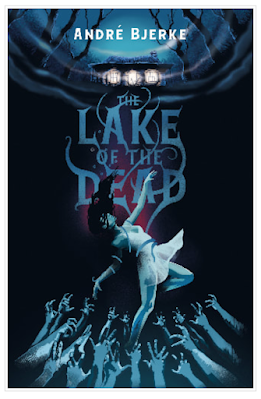
The Lake of the Dead - André Bjerke (and another giveaway)

"Let's summarize:  A lake that sucks people into it, an invisible phantom that screams and leaves footprints, a crazed double murderer on the loose, wandering around desperately in the dark of night. You might indeed say this is a fitting atmosphere for a psychoanalyst."

-- Gabriel Mørk in The Lake of the Dead (1942)

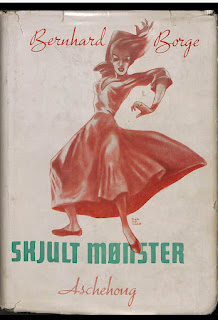
Is there anyone out there who knows of the existence of Bernhard Borge, the Norwegian author of four eerie detective novels tinged with horror and supernatural elements?  Unless you grew up and read Norwegian popular fiction I doubt it.  Borge is the pseudonym of André Bjerke, a well regarded poet who dabbled in crime and detective fiction during the 1940s. According to James Jenkins' extremely informative intro in this new English edition of the second Borge mystery novel I learned that it was Bjerke who is behind the Borge alter ego.  Jenkins, publisher and founder of the excellent small press Valancourt Books, also serves as translator for the first English edition of what has been deemed a classic in horror and crime fiction by Norwegain readers.  The Lake of the Dead (1942), or De dødes tjern as Norwegians know it, consistently appears on "Best of..." lists as the best remembered classic Norwegian mystery novel. Astonishingly, at one time it outranked even the work of modern Norwegian bestselling crime writer Jo Nesbó.

Let me add a clarifying bit to that statement about Norwegian readers only knowing about The Lake of the Dead.  The book was so popular that it has been filmed twice. It's first cinematic adaptation in 1958 with a screenplay by Bjerke (and featuring the writer in the role of Gabriel Mørk) is still available online from Sinister Cinema in a DVD with English subtitles. If any English speaker does know about the story it is probably because they have seen the movie rather actually reading the original book.

But to the book itself!

Anyone who craves the kind of detective novel that incorporates impossibility and apparently supernatural aspects will get more than they ever bargained for in The Lake of the Dead.  It easily stands beside the mystery novels of John Dickson Carr, Hake Talbot and Eric Harding's Pray for the Dawn for its eerie atmosphere and use of grisly legends. Each time Bjerke describes the lake and its surrounding forest the book amps up the horror and the macabre. All senses are employed as the reader is transported to the Norwegian haunted lake with the stench of rotting marshes, the croaking of frogs "as if calling from the abyss" and the miasma of fog that seems interminably wrapped around the perimeter of its waters.  Paranoia and terror infect the inhabitants of the cabin by the lake recalling the fear of the guests of U. N. Owen in And Then There Were None as they try to prevent more of their number becoming victims of the ghost that lures people to their doom in the lake's haunted waters.

And there's more to draw in fans of Golden Age detective novels here. Like the Philo Vance series Bjerke creates a narrator character along the lines of S. S. Van Dine. Bernard Borge is not only the author of his detective novels he is the narrator.  Borge is paired up with psychoanalyst Kai Bugge who serves as the real detective of the books in which he appears.  According to Jenkins' intro Bugge serves as detective in three of the four Bernhard Borge mystery novels.

Borge opens The Lake of the Dead with a bemoaning monologue in which he tells a group of friends that he is suffering from writer's block and is about to give up on writing altogether. We learn that Borge is a mystery novelist and his friends dare him to tackle a real mystery and challenge his failing imagination. His lawyer pal tells a story about a haunted lake where ages ago a crazed man grabbed an ax and chopped up his cheating wife and her handsome male lover, dumped their bodies in the water, then committed suicide by drowning himself. One of the friends, Bjørn Werner, has recently rented the shunned cabin by the shores of that very lake. The friends decide to visit for a weekend and hope that Borge will be inspired by the haunted locale to write his next mystery novel. When they arrive Bjørn is nowhere to be found, nor is his pet dog he took with him. They discover footprints leading  to the water but none that return to the cabin. It appears he was lured to the lake and disappeared. Or did the ghost of that mad murderer drag Bjørn down into the lake’s rumored bottomless depths?

3rd Borge novel, English title:
Dead Men Come Ashore (1947)
The novel features all sorts of intriguing horror set pieces including a sleepwalking damsel in distress, one attempt on another person's life, a near impossible break-in at the cabin, and --of course-- one genuine murder. Borge and Bugge are like GAD versions of Mulder and Scully, with Borge slowly but surely taken in by the occult lectures he hears from Gabriel Mørk while Bugge is the resident skeptic examining each supposedly ghostly manifestation and other-worldly event with the eyes of a rational scientist. But he's also a psychoanalyst and an avowed Freudian. He's not going to completely abandon his training and career mindset. Part of the most crucial evidence is found in handwritten notes Borge finds detailing one of Bugge's client's dreams. Together they also find Bjørn Werner's diary, the work of what appears to be a raving madman which also includes some bizarre dreams written down. Kai Bugge reminds Bernhard Borge that one of the greatest tools of any psychoanalyst is dream interpretation and he will use his Freudian training to glean from these dreams a more thorough understanding of Werner's troubled soul. Dream interpretation becomes key to helping solve the mysteries, not as bizarrely as Moris Klaw does in Sax Rohmer's Dream Detective mystery stories, but rather as a psychoanalyst approaches his work with patients. 

There are other ingeniously planted clues, much of it related to psychology and psychoanalytic observations. In this regard The Lake of the Dead is reminiscent of the mystery novels of Helen McCloy whose psychologist detective Basil Willing also acted as a police consultant by using his career training to help him understand the psyches of the suspects and the victim. Similarly, readers might recall the Freudian ramblings of Mrs. Bradley in the mystery novels of Gladys Mitchell.  I get a sense from Kai Bugge's character and his intense theorizing that Bjerke understood psychoanalytic methods much more in depth than Mitchell's often specious psychology when it cropped up in the Mrs. Bradley books.

Borge's 4th & final novel
English title: Hidden Pattern (1950)
This excellent mystery novel packs a wallop in the final pages. I want to bring up one final analogy but will have to be circumspect in doing so. Those who come away either gasping in awe or at least raising their eyebrows when reading the penultimate revelatory chapter ought to know that while it may appear to be unique and brand new it is not wholly original on Bjerke's part. The bizarre murder method and motive were both first introduced in a minor classic of English language detective fiction back in the Victorian era.

Whether you are keen on Carr-like supernatural elements, the battle between the true believer in other-worldly events and the rational scientist, or enjoy a detective novel that plumbs the depths of psychological mysteries that lead to crime The Lake of the Dead has a lot to offer. Jenkins is to be commended on his discovery and for making at least this one Borge mystery available to English language readers.  I certainly hope we have not seen the last of Bernhard Borge and the fascinating psychological detective Kai Bugge.

The web page for Valancourt Books edition of The Lake of the Dead will lead you to various other web pages where can purchase a copy.  Or you can enter my giveaway by leaving comment below. That's right I'm giving away two copies of this new edition!  Just tell me anything about a forgotten foreign language mystery or horror novel that you think we all ought to know about - translated into English or not. No geographic restrictions this time because I'm having Amazon ship the book to you!  [Why didn't I think of that before?]  So enter away and leave me loads of comments every one of you out there.  This new edition is really is a cause for celebration.

Saturday, August 29, 2020

HORROR SHOW: Harriet - Elizabeth Jenkins

"But Harriet's condition...had blinded Mrs. Ogilvy to the fact that the world contains many people who are far from decent."

If you had never read anything about Harriet (1934) by Elizabeth Jenkins -- not a review, not a blurb, not anything on the back covers of its many editions -- you would never expect it to turn out the way it does. From page one Harriet prepares the reader for a mesmerizing trip into England's Victorian past from the author's attention to domestic details, to the class hierarchy, to the painstakingly rendered 19th century syntax and language. It appears on the surface to be a homage to the age old story of a ne'er-do-well fortune hunter flirting with an ugly duckling heiress, successfully manipulating her easily swayed emotions and eventually marrying her for her money.  Henry James told a similar story in Washington Square, countless romance novelists have capitalized on this plot in hundreds of cheap entertainments.  What makes Elizabeth Jenkins' novel striking, no less appealing as an entertaining suspense novel, is that the ugly duckling heiress is also developmentally handicapped. Harriet Woodhouse is called a "natural" (a Victorian euphemism for someone who is mentally retarded) by her mother and those who have an affection for her.  She is called much worse by those who treat her with indifference, jealousy or outright cruelty. Above all what makes this novel most shocking is that Jenkins based her story on a notorious criminal case in which four people were charged with criminal neglect, wanton cruelty and eventual murder of a young woman and possibly her child. The story of Harriet is not the product of a novelist's imagination. It actually happened in 1875.

From the outset we know that Lewis Oman is no good. He has no real job, he enjoys using woman, and thinks nothing about turning Harriet into an object of ridicule. He tells his lover Alice Hoppner that he will become the charmer for Harriet. "She's going to fall a victim to my fascinations. You keep a straight face, and we'll have some fun." Alice watches with a combination of revulsion and jealousy as Lewis' aimless flirting transforms into something far more dangerous and cunning. His attentions cease to become fun and games when Alice notices Harriet has fallen in love with him. Then Lewis learns Harriet has a small fortune held in trust that will become hers as soon as she marries and, of course, he homes in on Harriet with relentless charm and smarm. Harriet is no longer a plaything but the means to instant wealth for this schemer.

Mrs. Ogilvy, Harriet's mother, is onto Lewis from the start and attempts to prevent the marriage. She tries reasoning with him but is too shrewd. She tries to block the marriage legally by exploiting Harriet's mental disability and making her a ward of the state.  But Lewis knows Mrs. Ogilvy who loves her daughter and treats  could never take the next step which would require her to put her daughter in a state run institution.  He also threatens the woman by promising to tell Harriet of her plans. If he does so he promises Mrs Ogivly that would be the end the mother/daughter relationship she has so carefully cultivated.


But there are others who become involved in the destruction of Harriet's carefully sheltered world. Once she has married Lewis her exploitation begins and with it the inexorable ruin of her health, her personality, and her soul. Harriet has a child almost without Jenkins having told us and she is quickly shuttled off to Lewis' brother Patrick where she is set up as a long term house guest and then months later as a prisoner.  The horror of Harriet's story, the ingenuity of the novel as a whole, is the skill with which Jenkins manages to capture a flavor of Victorian comfort and domesticity and how the introduction of an unwanted guest slowly erodes the veneer of civility among the household's would be aristocrats.

Elizabeth Hoppner Oman, Alice's sister and Patrick's wife, seems like the one person who might become an ally for Harriet. But when Harriet moves into her home Elizabeth, once ever proper and courteous, soon grows weary of having to deal with Harriet's childish demands, putting up with her imperfect grammar and most of all Harriet's lack of comprehension in learning how to care for her own son. Elizabeth is more concerned with propriety and her relationship to Lewis and Alice who is now being passed off as Lewis' real wife, though he is legally married to Harriet. Astonishingly, for someone who presents herself as upright Elizabeth turns a blind eye to the immorality and deceit of this pretense. When Lewis tells Patrick that Harriet should remain isolated in an upstairs bedroom and not be allowed outside Elizabeth is relieved to be spared the humiliation of telling everyone that Harriet is the real Mrs. Oman. The ultimate revelation of Elizabeth's remarkably repellent transformation comes when she utters a statement she thinks excuses not only her own indifference but the cruelty of her barbaric husband who beats Harriet: "After all, it isn't as if she feels anything..."

Taking the idea of the yet-to-be-named subgenre of "domestic suspense" to its extreme Jenkins includes several excellent set pieces that highlight a Victorian household turned topsy-turvy when a family member with erratic, unpredictable behavior upsets their comfortable routines. With incredible detail we are shown how meal times are structured, the apparently agonizing selection of clothes, the mundane tasks of getting dressed and having hair meticulously styled. While all the other characters are caught up in the inundation of domestic life the horror of what is happening to Harriet who is being neglected and ignored by everyone but the compassionate maid Clara becomes all the more heartwrenching. Harriet's clothes and her jewelry are appropriated by Alice; her child is taken away from her; she is denied doctor's care when she becomes violently ill; meals are regularly delayed, reduced to nothing more than milk and bread or entirely withheld -- all of this done for the slightest affronts to the household members. All of this leads to a radical transformation in Harriet's already fragile mental state. With each new instance of Harriet's deteriorating mind each family member reacts not with kindness, concern or even alarm but with unnerving cruelty, sometimes giving into savage brutality. When Penguin reprinted Harriet in 1980 they called the novel an "absolutely spine-chilling exploration of the depths of human depravity."

Harriet won a literary prize for its author in 1934, one of the last of the short-lived Prix Femina Vie Heureuse, given out by two French magazines to an English language novel that best presents life in England to a French language audience. The award should actually be for Jenkins' masterful invention of a new genre, the true crime novel. For here is a fictionalized account of a long past actual criminal case characterized by aberrant behavior accurately imagined with vivid insight and keen observations, teeming with paradoxes and riddles of human inconsistency, that it rightfully belongs in the same category as the "non-fiction novel" -- something Truman Capote claimed to have invented three decades later with In Cold Blood.

Her achievements are all the more powerful when you realize that using a non-fictional account (The Trial of the Stauntons), a copy of the court transcript from 1877, and her own imagination she envisioned a world two centuries ago in which something so evil could be carried out with such commonplace ease. As a side note students of true crime might like to know that the Staunton trial is now considered a landmark in appeals cases. In real life though all four individuals charged with Harriet Staunton's murder were found guilty and sentenced to hang no one was executed. A published letter written by a group of physicians protested that the true medical evidence was overlooked during the trial and the judge Henry Hawkins was prejudiced against all four defendants. The court's verdict was overturned:  Alice was pardoned, Louis and Elizabeth were sentenced to hard labor and eventually set free. Patrick who died in prison never reaped the benefits of this unusual decision.  Jenkins did not agree with the overturned verdict and her characters get the harsh punishments and justice she felt was mocked by real life's own cruel ironies.

Harriet is available in a new edition from Valancourt Books published five years ago. This latest edition includes an afterword by literary critic and Victorian scholar Catherine Pope. Readers can also choose from a wide variety of used editions dating back to the US paperback of 1946 (Bantam 64, shown in two illustrations on this post) to the handsome reprint from Persephone Press. There are also French and Spanish language translations in contemporary reprints

Friday, December 21, 2018

FFB: Valancourt Book of Victorian Christmas Ghost Stories, vol. 3

The Valancourt Book of Victorian Christmas Ghost Stories, vol. 3 (2018) is a brand new book, but the contents are mostly forgotten. In reviewing the Table of Contents I recognized only three writers' names: Mrs. Riddell, Hugh Conway and Mrs. Henry Wood. There is a Quiller-Couch, too. But this one is Lilian, Arthur's younger sister.  And the old reliable and immensely prolific author "Anonymous" crops up five times. Edited and introduced by Simon Stern, an associate professor of literature and law at the University of Toronto, this latest volume of Valancourt's annual tribute to the Victorian tradition of telling ghost stories is the usual mixed bag of maturely written and neatly constructed stories and a handful of trifles and vignettes embarrassingly showing their age. Gallivanting among the usual angry specters and troubled ghosts seeking retribution we get a haunted oven, a haunted churchyard, and a literally hitch-hiking creepy yellow-eyed child ghost. Only Mrs. J. H .Riddell's "Walnut-Tree House" seems to have been anthologized before; it was the only story I recognized here.

There are nineteen stories and one silly poem in this latest volume. About one quarter of the tales are mere wisps, two or three pages short, more vignettes and drawn out anecdotes than full-fledged stories. The earliest dated original publication in this collection is the story by Mrs. Henry Wood, "The Ghost of the Hollow Field," which appeared in Newry Commercial Telegraph on Dec 25, 1867.  The remaining tales are taken from newspapers and magazines published mostly in the 1880s and 1890s, with a few taken from the 1870s.

I was slightly disappointed to find three separate homages to Ebenezer Scrooge. "The Wicked Editor's Christmas Dream" is an obvious parody of Dickens and intended as a satire of commercial journalism, while another is straight out plagiarism. Prosaically titled "A Christmas Ghost Story" it substitutes Scrooge for a miserly mill owner named Frank Underwood visited by a single ghost that guides him to three separate scenes of his life which remind him of his cruel and avaricious ways. It all leads to an overnight personality transformation just as with Scrooge. Nothing original at all and one of the many Anonymous tales. Clearly no one wanted to be sued for plagiarism by attaching his or her name to that blatant rip-off.  The third is a rather well done re-telling of the Scrooge and Cratchit work relationship with the clerk almost as villainous as his employer. 

From "Walnut-Tree House"
Illustrated London News, Dec 28, 1878
"Old Simons' Ghost!" with its miserly old man who runs a business of questionable integrity is the best of the Dicken's inspired stories.  The story explores the work relationship between Simons and his beleaguered clerk who finds himself unemployed only a few days before Christmas when Old Simons drops dead in his chair. The clerk dubbed "Artful" Bruff knows that Simons has no relatives and sets up his home in the business determined to find Simons' hidden trove of money. Then on Christmas Eve Bruff is delivered a mysterious triangular shaped trunk with the warning "Not To Be Opened Until Christmas."  It's not hard to anticipate the contents of that trunk nor what follows in the conclusion. Despite the familiarity of the plot the anonymous author, in an ironic send-up and reversal of the usual Dickens sentimental style, tells an interesting story of how Bruff finds himself taking on the traits and attitudes that he despised in his employer. Of note, this is one of two American stories in the anthology. I can only imagine that there were dozens of these homages, on both sides of the Atlantic, after the wild popularity of Dicken's A Christmas Carol in 1843.

Of those I've sampled so far, a handful of the stories contain mystery elements and crimes gone unpunished with themes of revenge featured frequently. A ghost literally points to hidden evidence of who killed her in "The Haunted Ashchurch",  a mother's ghost wanders the streets trying to warn her son of impending danger the same day that a horrible murder occurs in "The Ghost of the Hollow Field",  and "A Dead Man's Face" (by Hugh Conway) haunts a man eager to marry a beautiful American woman who harbors a ghastly secret.

There are a few examples of the comic ghost story including the previously mentioned "...Wicked Editor...";  "The Barber's Ghost," a shaggy dog story that could be told in a few sentences rather than two pages; and the very strange story of "The Haunted Oven" by W.L. Blackley. I had a heck of time getting through this one because Blackley decided to use the voice of an Irish narrator and rendered all of the dialogue and the narration in Irish dialect. Thick Irish dialect. But it's a very bizarre idea for a story - bread baked in the titular oven comes out with dire warnings of impeding death spelled out in reverse letters. The reason for this "haunting" is rationalized with a mix of black humor and absurdity.  It says a lot about the resourcefulness of the Irish characters when building materials are lacking.

As a quintessential example of what the Victorian ghost story can achieve when in the hands of a talented and imaginative writer look to Lilian Quiller Couch's story "The Devils' Own".  She makes use of her penchant for folklore and presents a tale that is seemingly based on fact. This story features the creepy yellow-eyed child I mentioned above. Poor Octavius Nottage is relentlessly pursued by this hitchhiking apparition whenever he sets out on his wagon making his deliveries. Octavius is ridiculed by the townspeople who never once seriously believe in the ghost child he claims is haunting him.  Only Admonition Ellery feels sorry for him and in her sympathy slowly finds herself falling in love with "Ocky".  In order to get her man she tells him she believes him and lies about witnessing the specter while they ride together on his wagon cart. Then she comes up with a solution to his haunting.  After consulting with her aunt who has knowledge of occult ways she tells Octavius that he must ride with his promised bride, hold her hand, and utter a rhyming spell to chase away the ghost. When Ocky tells Admonition he has no promised bride she looks at him imploringly. And with that one look he understands everything. But there is one more ghastly event before all will turn out well.

Love and ghosts go hand and hand in the Victorian ghost story, especially those told at Christmastime.

Friday, December 14, 2018

FFB: The Auctioneer - Joan Samson

THE STORY: Harlowe, New Hampshire has a new resident. Perly Dunsmore set up house in the old Fawkes place and is asked to help raise funds for a new crew of deputies for the town’s meager police force. Perly is a talented auctioneer whose charismatic charm is his primary tool in getting the townspeople to donate their unwanted belongings to the auction that will help raise funds for the deputy’s pay. The success of the first leads to another until the auctions begin to occur almost weekly. With each new fundraiser Perly requires more things to sell. His simple requests for donations become more demanding until people find their homes invaded, their possessions taken away without consent or given up only after violent threats. The Auctioneer (1975) tells the story of a town at the mercy of Perly Dunsmore, his transformation from Good Samaritan to powerful controller of everyone and everything in Harlowe, and the dire effects of giving up and giving in to promises that may never come true.

THE CHARACTERS: Rather than seeing the effect Perly has on the entire town and getting multiple viewpoints and stories of several characters as a contemporary novelist might approach this intriguing set up, Samson focuses her story on the Moore family (John, Mim, daughter Hildie, and John’s mother) who have been farmers in Harlowe for generations. We watch them slowly lose everything they possess, everything they hold dear, including the love they have for each other. On occasion Samson has Mim visit her friends and we get some painful and harrowing vignettes featuring other families. Through Mim’s eyes we see how her friends are dealing with Perly’s sinister command of Harlowe and the treacherous ease with which he simply takes what he wants whenever he wants it.

After having lost her treasured vanity table, a wedding gift from her mother, and watching John’s milking cows taken away for one of the many auctions Mim travels into town to visit Agnes Cogswell, the wife of one of Perly’s chief deputies. Here in a home that the reader thinks may have been spared from Perl’s rapacious collection of furniture and livestock Mim finds just the opposite and worse. Agnes and her husband Mickey have not only given up their belongings, Angie has sacrificed even more – her sanity. Word has travelled fast about the perils of fighting back and refusing Perly’s demands. Some residents have been victims of fatal accidents while others are leaving town taking what little they have left. Agnes fears not for her own life, but for the life of her children. Mim finds Agnes babbling in her kitchen, barely coherent, but clearly not of sound mind. More disturbing is the fact that the Cogswell’s eldest teenage son is patrolling the grounds with a shotgun and two Dobermans to protect the home from unwanted visitors. Mim leaves fearing that she too may succumb to paranoid imaginings and rushes home to make sure that Hildie is unharmed, but deep in her heart praying that her daughter is actually still in the house.

That we never get to know Perly’s thoughts unless he in the company of other characters is Samson’s most effective tool. Everything he does and says is seen through the eyes of the victimized. Perly is rarely seen alone and we never get to know his inner thoughts the way we do those of John and Mim. His dialogue more than his actions is the most terrifying part of the book. His grandiloquent speeches promise a new life for the people of Harlowe – that prosperity is certain the more you spend, that even more riches will follow once you surrender your treasures and prizes that only have sentimental value.

With each sale Perly rewards those who “donate’ their goods with a pittance of a rebate. John’s first check is for $3. By the time he earns $300 for the sale of his own land that brought in $5800 he would rather destroy the money than accept it. Most insidious is the first scene where Perly manages to get Hildie to give away her favorite toy – a red wagon. John is forced to buy it back for $1.50. After that Perly wins the friendship of Hildie who agrees to attend his Sunday school classes. What exactly goes on in those classes we never find out. But it can’t be good.

ATMOSPHERE: Gothic touches come in striking and unexpected sequences as with the omen of poison ivy that slowly encroaches onto the Moore property. John says he will tend to it but he never follows through. Mim sees the aftermath of the ivy infestation when she visits an untended grave in their private family cemetery on the grounds of the farm. With her bare hands she tears out the poison ivy ("It climbed around and around the trunks of the old cheery trees and coiled its way along the branches, like snakes moving toward robins' nests.") and of course suffers the consequences. This leads to a new forced isolation “for fear of starting the plague’ on Hildie and her husband who is already avoiding her and now shuns her in bed.

After telling of her visit with Agnes to John (“She counts her children every night.”) and expressing her fears of farm country being developed into a city of Perly’s imagination John grabs Mim and holds her dearly. Around them the elements seem to rise up and express the dread and fear the Moore’s are feeling:
"John held Mim. The house banged and creaked and clattered as if it were full of secret footsteps. The November wind outside blew over the pond and the pasture and the stand of heavy white pine. It pulled at the shingles of the empty barn and rattled the loose sash, searching out the couple who lay in each other’s arms listening to the warm breath of the child on the floor beside them."

QUOTES: "You see me runnin', Ma?" John asked, jolting to his feet so that Hildie slid to the floor.
"Like a jackrabbit, boy," said Ma. "Where you think it's goin' to get you to?"
"Next time I'll stand up and let him shoot me," John shouted. "Then where'll you be?" He yanked the door open.
Ma took a step toward him. "And that's just another way of runnin'," she shouted back.


Mim stood at the sink scraping carrots. "Could we get ourselves on welfare, do you think?" she asked. "It's hardly shameful nowadays."
"Since when?" Ma said. "Maybe not for folk who ain't got sense enough to hang on to what's theirs."


"Things is things. But they can’t take your flesh and blood. And they can’t take the land because we’re on it."
"Words, John. That’s not stoppin’ them."
"This is still America, Mim. They can’t. There’s limits."


THE AUTHOR: Joan Samson attended Wellesley finished her undergraduate work at University of Chicago, received her M.A. from Tufts and married twice. After an interesting nomadic life (that included a home and job in London) she settled in New Hampshire. She held various teaching positions through the 1960s at elementary schools both in the US and the UK, then later became an editor at a literary journal. In the Viet Nam era she and her second husband Warren Carberg became active in the anti-war movement. Her first published work was a non-fiction book, Watching the New Baby, intended to teach children about what it's like having a new sibling. She also began writing short stories. Encouraged by Carberg she expanded one of the stories into The Auctioneer. It was rather a sensation during its day with a huge marketing campaign, rave reviews, sales of over one million copies and even a screenplay option which sadly never led to a movie. In one of life's cruel twists of Fate five months after the book was published Samson succumbed to a terminal illness and died. She has, however, lived long after achieving a cult status with The Auctioneer, her only novel and one that is well remembered, powerfully affecting anyone who has read it.

EASY TO FIND? After being out of print for over three decades The Auctioneer was reprinted this year by Valancourt Books. In this reissue you get the full novel, plus added bonuses of an informative introduction by horror fiction enthusiast and novelist Grady Hendrix, and afterword titled "Remembering Joan Samson" by Warren Carberg. Valancourt offers their books in paperback, hardcover or digital editions. Those who like the feel and smell of old books are in luck as well. There are dozens of copies of both US and UK editions with the US Avon paperback leading the pack. Most of these copies are extremely cheap, but check their condition before ordering. Vintage paperback editions of Samson's only novel far outnumber the hardcover editions. The US first edition is now rather scarce and those with dust jackets in G to VG condition range from $45 to $110.

Friday, March 16, 2018

FFB: Cast a Cold Eye - Alan Ryan

In honor of St. Patrick's Day tomorrow here's an eerie Irish ghost novel.

THE STORY: Jack Quinlan has travelled form the USA to small village of Doolin in western Ireland so that he can research the Irish potato famine for his new book. He plans to spend three months. But within days of settling in he begins to see visions of the past. One in particular --a thin, gaunt girl dressed in tattered clothes -- appears more and more frequently. Even manifesting when he travels to Galway for a getaway. Unsure if he has immersed himself too far in his research and allowing his imagination to run wild or if he is actually in the company of ghosts Jack reluctantly reaches out to Father Henning, the local priest. But he gets little help and some strange warnings. Meanwhile, a group of older men in Doolin are keeping their eyes on Jack for their own secret purposes that have their roots in ancient ceremonies.

THE CHARACTERS: While the story of Cast a Cold Eye (1984) is primarily focused on Jack it is the Irish villagers who give the book its life. Jack meets a young woman Grainne who works in a bookstore and a love relationship slowly develops. Mrs. Mullen is Jack's housekeeper who comes with the cottage rental as part of a package deal. She is also the link to the strange ritual the old men are preparing. The group of old men provide most of the eeriness to the book with so much mystery surrounding their brief meetings and ambiguous conversations. What exactly is going on in Doolin? What do they want of Jack? And will the seemingly kindly Father Henning prove to be less of a holy man than Jack thinks he is?

Jack is something of a frustrating character. Like many of these writer characters in books of the supernatural he is determined to go it alone. He is reluctant to confide in anyone for fear of what they will think of him. The writer and his ego come into play a lot here and often its tiresome. It should be obvious that something is not at all right in the village of Doolin. Many of the townspeople are well aware of the ghostly figures that appear around the perimeter of the village. Instead of relying on his innate inquisitiveness (he is researching a book after all) Jack keeps his thoughts to himself and only too late turns to Father Henning who, of course, is not too forthcoming with answers or explanations. Supposedly this is a tactic to add mystery and suspense, but this approach tends to work against the book.

INNOVATIONS: Ryan's novel belongs to the pagan ritual type of supernatural horror that seemed to explode onto the popular fiction scene back in the 1970s. Cast a Cold Eye (1984) with its overpowering religious motifs, secret ceremonies and blood sacrifices comes a decade after better known books with similar themes like Harvest Home and the cult movie The Wicker Man. I couldn't help but think of the whole lot of them and probably spent too much time trying to outguess Alan Ryan and what he had in store for Jack in the final pages.

The book is strong on atmosphere. Ryan does a fine job of evoking both the beauty of the barren Irish countryside as well as the an unsettling creepiness as we follow the story of a man out of his element. The people of Doolin are not typically sinister as one might find in pulpier versions of this kind of story. Rather, they are genuinely friendly and yet simultaneously distant, holding back a bit, harboring secrets in a tacit way that causes concern. The church scenes reveal a lot about the people of Doolin. These portions of the novel are depicted with great reverence and solemnity and one gets the feeling that the only time the people of Doolin ever feel safe and secure are within the walls of the Church while reciting their Catholic prayers. There is ample mystery here -- both theological and other worldly.

When the finale comes, however, the mystery remains and little is really explained. A strange ceremony does indeed take place. It's disturbing, not really as eerie or gory as Ryan probably intends it to be, and yet the reader hasn't much of a clue what it all means or why it is happening.

The biggest mystery left unexplained -- one that seems the biggest cheat of all -- is why we never get to see or read about the Irish famine. Jack comes to the country to do research on this and we never actually see him do any of that. So much lost opportunity for some rich detail and lore on this important part of Irish history. We are meant to associate the famine with the army of emaciated ghosts, I guess. But it's all as hazy of the foggy Irish bogs Jack strolls through.

THINGS I LEARNED: Irish writers don't pay taxes. I thought this was a joke in a brief dialogue exchange between Jack and Father Henning. Then I had to find out if it was true. Sure enough, it is. Well, it's slightly true. They do pay taxes, but the law is an exemption for a certain type of income. From an Irish history website: "Between 1969 and 2010, Ireland allowed writers and other artists who actually lived in Ireland to exempt all of their royalty income from taxation." The regulation was altered in 1997 in order to redefine what constituted residency and outline the rules related to advance royalty payments. From what I gather this law is still in place. As of January 2015 the maximum exemption allowed for all royalties earned is €50,000.

THE AUTHOR: Alan Ryan was born and raised in New York. He spent his early years as an English teacher at Cardinal Spellman High School in Bronx. Ryan's writing career began with literary criticism, then book reviewing, and later as an editor. He wrote several short stories and a handful of novels during the 1980s. Valancourt Books says at that time "Ryan was hailed as one of the bright new lights in the horror field." His other horror novels include The Kill (1982) and Dead White (1983). His short fiction was collected in Quadriphobia and The Bones Wizard. As an anthologist Ryan served as editor and contributor to Night Visions I (1984), Halloween Horrors (1986), Vampires (1987) and Haunting Women (1988). Alan Ryan eventually moved to Brazil where he resided for the latter portion of his life. He died in Rio de Janeiro in 2011.

EASY TO FIND? There are multiple copies of various paperback editions available, both US and UK, in the used book market. The majority of those copies are extremely affordable. Readers who want a new edition can choose from hardcover, paperback or digital all from the masterful Valancourt Books. Cast a Cold Eye was reprinted by this fine publisher in 2016.

Friday, January 26, 2018

FFB: The Other Passenger - John Keir Cross, illus. Bruce Angrave

This post was promised several years ago and got lost in my Drafts folder.  With the recent reissue of The Other Passenger by Valancourt Books I thought I ought to finish up and unveil these striking works of surrealistic art that appeared in the original UK edition of John Keir Cross' collection of macabre short stories.  The artist is Bruce Angrave.  The Other Passenger was originally published by John Westhouse (publishers) Ltd. in 1944 and cost a whopping £12, 6p, almost twice the usual 7/6 for a regular hardback at that time. And what a gorgeous book it is.

The paintings -- starting with the one at left and going in order to the bottom of the post -- illustrate the following stories:

"Couleur de Rose," "The Glass Eye," "The Last of the Romantics," "Hands," "Miss Thing and the Surrealists," "Music When Soft Voices Die...","The Other Passenger"


To see a variety of Bruce Angrave's illustration art click here.  Scroll down to the list of categories and click on the black boxes on the left to see his art work. A brief sketch on the life and work of John Keir Cross is included in an especially commissioned introduction I wrote for the new edition of The Other Passenger reissued by Valancourt Books.

Monday, December 4, 2017

NEW STUFF: The Other Passenger reprint coming soon!

Valancourt Books tells me that their exciting reprint of The Other Passenger by John Keir Cross will be released on December 12.

Exciting for at least two reasons:

1. It's the first time this landmark collection of supernatural and weird fiction has been reprinted in its entirety since its original publication in 1944.  In 1961 an abridged reprint of nine stories, omitting half of the total 18 tales in the original, was released by Ballantine Paperbacks.

2. This edition has a new introduction by some know-it-all genre fiction expert named J. F. Norris. He sure gets around.

They dared to put my name on the front cover. Such a honor. And if you get out a magnifying glass you can even see it!

I had a lot of fun researching this one. Learned all about Keir Cross' juvenile mystery and fantasy fiction (discussed in my The Other Side of Green Hills post), his career as a radio program scriptwriter, and his influence on other genre fiction writers.

Go order your copy (hardcover, paperback or digital) today! Please. Click here to go to the Amazon page for the book.

Friday, April 14, 2017

FFB: A Beastly Business - John Blackburn

THE STORY: Bill Easter, conman and rogue for hire, will do nearly anything for the right price. He’s recovered stolen goods, he’s located missing persons, he’s even committed murder. Now he’s been hired to dispose of a dead body in the ground floor apartment of a landlord who can’t bring himself to enter the place. The body turns out to be Henry Oliver, a enormously overweight and hirsute recluse who is suspected of having been a mass murderer known as the "Mad Vicar". After successfully disposing of the body employing unorthodox and slightly illegal methods Easter also uncovers some puzzling documents that hint at the existence of a valuable jewel encrusted relic that Oliver brought back from his travels in the Nueva Leone, South America. Easter’s detective work leads him to eccentric adventure J. Molden Mott, also looking for the jeweled relic. Easter along with his sidekick and sometime lover Peggy Tey find themselves in Scotland and knee deep in a macabre adventure that involves Russian spies, a mutating fungus, a mad scientist, the legend of a South American conquistador, and werewolf mythology that all adds up to A Beastly Business (1982).

THE CHARACTERS: Bill Easter is John Blackburn’s lesser known series characters. He, along with Peggy Tey, appeared in four books prior to their last appearance in A Beastly Business. This is also the only crossover novel to feature both Easter and General Charles Kirk, Blackburn’s primary series character whose work with foreign intelligence has often led him into the world of paranormal activity. The Easter books differ greatly from Blackburn’s other occult and supernatural thrillers because they have a very black humor. Easter is a vulgar, opinionated, often foul mouthed rogue who is out only for himself. Peggy is no better. They are often secretly double crossing one another when money, jewels or valuable treasure are involved.

Easter is hired by Allen Smeaton a pseudo-posh banker who thinks very highly of himself. Yet he and his corrupt wife Cynthia are all too easily tempted by the chance to get rich quick. Easter does all the work while they drool greedily in the background demanding he risk his life and what little reputation he has left to recover the treasure and split it four ways. Clever readers know that split is never going to be four equal shares. Someone is bound to be left out if not eliminated altogether.

INNOVATIONS: As with most of Blackburn's thrillers we get an abundance of weirdness, macabre deaths, strange legends and his usual trademark touch of an insidious organism, in this case a botanical fungus, as the cause for much of the mayhem. He always found new ways to invigorate old horror motifs.  The werewolves in this novel are like no others you have read about or seen in the movies.

This is much funnier than any of Blackburn's other books I've read, but you do have to be sort of a sicko to enjoy his vulgar jokes and black humor at the expense of other characters. I unapologetically admit to being one of those sickos. Revenge is served piping hot and supersweet in A Beastly Business and I very much enjoy seeing the wicked suffer punishments in Grand Guignol fashion.  Theatre of Blood, one of my favorite satiric horror movies, kept coming to mind as I pored over this entertainingly perverse book. Those familiar with that Vincent Price cult classic will have an idea of what kind of beastly business Blackburn gets up to.

QUOTES: "Owing to your wanton stupidity [Allen] I had to live over a monster. To nurture a viper in my bosom."
An unjust and inaccurate cliche. Even the smallest of vipers couldn't have found shelter between Cynthia Smeaton's skinny breasts, and I wouldn't have blamed her husband if he'd lost his temper and clouted her.

"Peg go could go to bed with [the reverend] if she wanted, though it was unlikely he'd fancy her. But during the last two hours I'd had a dead lamb lobbed at me. I'd been threatened by a twelve-bore shotgun and nearly killed by the bailiff's motor bicycle [...] and earned the displeasure of Sgt. Gillespie. I'd achieved quite a lot and what had Peggy done? Mrs. Tey had confided in an oily non-conformist minister and spilled the beans."

THINGS I LEARNED: One thing I must have known as a kid, but clearly had forgotten. The real name of a well known figure from the Russian Revolution turns up over the course of the book. If you're hip to this facet of world history and know it well, then you won't be taken in by a ruse of General Kirk's. Bill was. I was. And most readers will be. Sadly, part of this ruse is spoiled by the blurb on the rear cover of the new reprint edition. Do yourself a favor and don't read that before you read the book.

EASY TO FIND? Those savvy devils at Valancourt Books have done fans of 60s & 70s horror a great service in reprinting John Blackburn's books. A Beastly Business is yet another in their ever growing library of forgotten classics being revived for new generations of lovers of the macabre, be they the lugubrious and melancholy horror of 18th century Gothics or 20th century monsters on the rampage. I don't often see used copies of the original UK edition of A Beastly Business for sale as it's one of his scarcest titles.  If a copy should turn up expect to see it outrageously priced. Best to stick with the $17 paperback from our good friends at Valancourt. This new reprint is also the first and only US edition.

Friday, March 3, 2017

FFB: Requiem at Rogano - Stephen Knight

THE STORY: Having just retired from the police force Inspector Reginald Brough is not finding a life of leisure to his liking. Fortuitously, he receives a letter from his nephew Nicholas who invites him to collaborate on a book called The History of Murder. Their research leads them to the discovery that a series of murders in London attributed to a killer dubbed "the Deptford Strangler" by the tabloid press are actually replications of murders that were committed in an Italian village called Rogano in the 15th century. Further research links the prophecies of Nostradamus to both sets of murders, and some startling revelations that lead them to believe that the present day victims as well as the Deptford Strangler are reincarnations of the Italian victims and killer.

CHARACTERS: In Requiem at Rogano (1979) Inspector Brough and Nicholas Calvin meet a variety of eccentrics all of whom uncannily have information related to the murders in Rogano. From Dr. Orchard who telephones Brough with an urgent message and arranges to meet with him privately to the strange old man who gives Nicholas his personal translation of some obscure passages in Nostradamus' book of eerie prophecies everyone seems to be privy to the disturbing parallels between the Deptford Strangler and the murders in Rogano. Nicholas has been having blackouts and weird dreams which he vaguely recalls. He says he was putting his hands on the necks of people he has never seen. Then Nicholas is told that he is the reincarnation of Antonio Aquilina, one of two brothers executed for the Rogano murders centuries ago. Adding to overall paranoia of the novel Nicholas keeps encountering a mysterious figure he calls "The Man with Odd Eyes" who seems to be following him everywhere. Eventually the mystery man steps out of the shadows to introduce himself as Rudolf van Galen. Galen joins forces with the two researchers when he reveals that he is the reincarnation of Giuseppe Aquilina, brother of Antonio.

All three of our main characters find it necessary to travel to Rogano to complete their research. The novel comes alive in this section. The lecturing and info dropping gives way to thrilling incidents of adventure hearkening back to cliffhanger thrillers of silent cinema and Victorian sensation novel plotting. The story increasingly becomes more and more paranoid, imbued with sinister occult influences. All the time Knight has been concocting a clever murder mystery. The final three chapters deliver several unexpected turns of events that make the book something of a tour de force in supernatural and mystery fiction.

INNOVATIONS: For the first half of the book I could not stop thinking that this fell into a subgenre of reincarnation thrillers that were so popular in the 1970s with The Reincarnation of Peter Proud and Audrey Rose probably the most well remembered thanks to their movie adaptations. Knight tries his best to put forth his understanding of reincarnation by drawing parallels from the German legend of the Doppelgänger to the Norwegian myth of the fylgja, "a soul or spirit as mortal and physical as the body itself" that emerges and forms alongside every human from the minute they are conceived. At first the notion that every character in the book is a reincarnated soul from 15th century beggars belief. And yet by the time the characters set foot in Rogano Knight manages to make sense of his idea because the novel really belongs to conspiracy theory fiction.

Knight's universe is one in which no human is controlled by free will, but rather at the mercy of a previous life. Behavior and personality are predetermined by an ominous force that allows for this transference of souls over the ages. Some specific examples: Nicholas finds himself repulsed by the sight and smell of meat. He learns he has visited a male brothel and apparently had sex with another man. Why? Because Antonio Aquilina, his former soul, was both a vegetarian and a gay man. Or so he learns from Rudolf van Galen. The truth behind Nicholas' strange behavior transformation is, in fact, much more bizarre.

If the reader fully embraces that Requiem at Rogano is actually a form of conspiracy theory fiction, then the book that readers may find it easier to draw comparisons to is The Da Vinci Code. It is not only Knight's obsession with Nostradamus's writings that made me think of Dan Brown. The climactic revelation about the motivation for the Rogano murders having to do with the viability of Christianity was his crowning touch. The solution and killer's motive are jaw dropping quite frankly. It made me reassess the entire structure of the novel. When Brough delivers the truly shocking conclusion the reader discovers that all along the novel was an ingeniously plotted detective novel with all the evidence and clues right there in front of him.

QUOTES: "The idea of the fetch, once prevalent in Great Britain, is revived every time we read newspaper reports of ghosts of the living appearing at the moment of death to relatives and or dear friends. In Ireland the fetch is often thought to haunt its own human double."

"I am inured against shock in such cases. [...] The great lesson I learned [in India] from first-hand experience was that almost anything is possible."

"Herr van Galen has only demonstrated what you say you have believed all your life, what Christians have been taught for nineteen hundred years. Man has a soul. What's so monstrous about that?"

"We speak of enormous issues, far beyond our comprehension, and yet we use words like certainty and truth with such confidence. Most of us don't even know for certain that our heart will make its next beat. Do we, in fact, really know anything at all?"

THINGS I LEARNED: As mentioned above Nostradamus and his oracular writing are featured prominently. I learned that there are numerous translations, some of which tinker with his original wording in order to make the prophecies more adaptable to modern events and historical figures. Knight draws on some of these translations but also treats us to literal translations and his own interpretation of those sentences. Much of it is laughable, but some of it is clever. Reading someone's interpretation of a prophecy applied to a man called Hitler who will rise to power in the year 1939 in a book set in 1902 and yet published in 1979 is hardly impressive or awe inspiring as was probably his intent. The characters are impressed, but I was not.

Learning about the fylgja was an eye-opener for me. Knight only briefly mentions it in the novel, but further online research was enlightening. The word means "follower" in Norwegian. The concept as I learned on a Norse mythology website is more akin to the idea of a witch's familiar and the fylgja is always in the form of an animal. In some variations of the myth the human can actually shapeshift into the fylgja.

Towards the end of the book there is a lot of talk about the Inquisition which I learned was not geographically confined to Spain. There were acolytes of the Inquisition carrying out punishments, torture and executions on heretics all over Europe including Italy, France and even England.

Stephen Knight in 1979 as seen on
the rear DJ of the US edition
(photo: Fay Godwin)
THE AUTHOR: Stephen Knight was a reporter for most of his life. Requiem at Rogano was his only novel. Prior to this book he was known for his non-fiction true crime book, Jack the Ripper: The Final Solution (1976), quite the bestseller during his lifetime. While working as a reporter he met a man who claimed to know the truth behind the murders and the identity of the infamous serial killer. Clearly that investigative work influenced the conspiracy theory aspect that permeates Requiem at Rogano. I think his 1976 book was the work that started the mad obsession with solving the Ripper case; it certainly was one of the earliest and best selling versions. It has had multiple printings since 1976 with the most recent being a reissue in 2000 from HarperCollins.

EASY TO FIND? The quick answer is the best answer for the majority of you out there. Valancourt Books has reprinted the book under its original British title Requiem at Rogano. Their reprint includes a brief foreword by Bernard Taylor, horror writer and one time collaborator with Knight on a true crime book. As with most small press distribution methods these days the book is available only through internet book sites. My experience says that they unfortunately do not distribute to brick and mortar stores. For those of you who like the smell and feel of an old book I found 55 copies of the 1979 edition for sale, a mix of US and UK editions, and nearly all of them offered at less than $5. Such a deal!