Showing posts with label Ramble House. Show all posts

Wednesday, June 17, 2026

Giveaway Results Are In

The results of the Cecil M. Wills book giveaway are in.  After a highly scientific method that I left to one of the many Random Number Generators on the internet a winner was selected at random by a machine.  How fitting for our new age of omnipresent AI and robots.

And now for the Lucky Stiff...uh, lucky winner --

Comment #5 assigned to jdf21 was selected.  Congrats to jdf21!  You are the winner of one copy of the Ramble House reprint of Author in Distress.

Got the address. Thanks, JDF!  Book is in the mail. 

 Thanks to those who participated and for the mentions of all your favorite detective novels and mystery books you thought deserved a reprint. Perhaps one or two may soon see the light of day!


Wednesday, June 10, 2026

Cecil M. Wills New Reprint on Sale & Giveaway!

A couple of years ago I bought a small pile of rare hardcover editions of Cecil M. Wills mystery novels.  These included Author in Distress (his debut as a mystery writer), The Chamois Murder and Death Treads.  I read all of them in quick succession, but only reviewed Author in Distress (1934) on the blog.  Shortly after I posted that review I sent a PDF of the entire book to Gavin O'Keefe as a suggestion for a Ramble House reprint. RH has already reprinted Fatal Accident (1936), Wills' sixth detective novel, and I thought it would be a good idea to have another in their catalog. Gavin liked the idea and asked if I wanted to write a foreword.  I agreed and then promptly dropped the ball. Sad forgetful ol' codger that I am.

Flash forward to March-April 2026.  I emailed Gavin again asking if he still wanted to go ahead with the reprint and I had an intro I could offer based on the blog post I wrote.  We emailed back and forth with interesting ideas about how to assemble and present the book.  And now two and a half months later the finished product is available for sale!  You can purchase the book either by visiting the Ramble House site or accessing their small list of titles at Lulu.com (the book printer for this POD reprint). There may be a slight discount if you buy a copy via Ramble House and use the special email address on the page for Author in Distress. 

I received two copies as a standard benefit and today I'm offering one of those books in a giveaway.  Just leave a comment below mentioning any book you think deserves reprinting.  I'll offer those ideas to the "Powers That Be" at Ramble House. That reprint house which offers POD books is now under new management since Gavin and Fender Tucker (the original founder) have stepped aside from the operation.

CONTEST CLOSED

Next week --around Wednesday or Thursday-- I'll choose one of the comments at random to receive the book. You'll have to send me your physical mailing address in order to get the book. But please! DO NOT leave your address in the comments.  The sinister webcrawlers regularly haunt this blog and I'm afraid they will swallow up your personal information and slam you with unwanted spam and who knows what else. We can arrange a private email exchange to get the necessary info.  This giveaway is open to everyone across the globe.  I will pay either Media Mail rate for within the US or First Class International shipping rate to anywhere outside the USA. Good luck!


Monday, July 25, 2022

Reprints Looming on the Horizon

I was hoping that I would be able to give you some wonderful news about a few reprints, but alas there are delays with one exciting reprint that was supposed to be out this fall.  Some of you may have already discovered that it's in the works if you've been out there a-Googling.  But I promised the publisher not to promote it until the rights are officially cleared and it's taking some time.  But rest assured the book will be here, just a bit later than planned.  Assiduous readers will find more details in a recent comment exchange at the bottom of a past post on said book.  I will say no more until I'm allowed to.

However! Don't get your panties in a bunch, gang.

There is other exciting news I can announce -- Cecil Wills detective novels are coming back!

Those lovable rascals who run Ramble House have teamed up with yours truly and they will be reissuing two rather scarce, very early Wills mystery novels featuring his series detective Geoffrey Boscobell. Both should be out by the end of this year, possibly sooner.  Author in Distress, Will's debut mystery  novel and the first with Sgt. Boscobell, will be the first released followed shortly thereafter by a new edition of the third Boscobell mystery novel Death Treads.  Plans are to reissue both as retro mapbacks the way many of the early Ramble House detective novels and mystery novels paid tribute to the highly collectible original Dell Mapbacks back in the early 2000s when RH was first reprinting Golden Age mystery fiction.  With artwork by Gavin O'Keefe and partly inspired by the maps and floor plans found in the original books I have provided these promise to be attractive new editions.  I'll be writing up a brief study of the Boscobell detective novels as a foreword to both new editions.

But that's not all, kiddos!

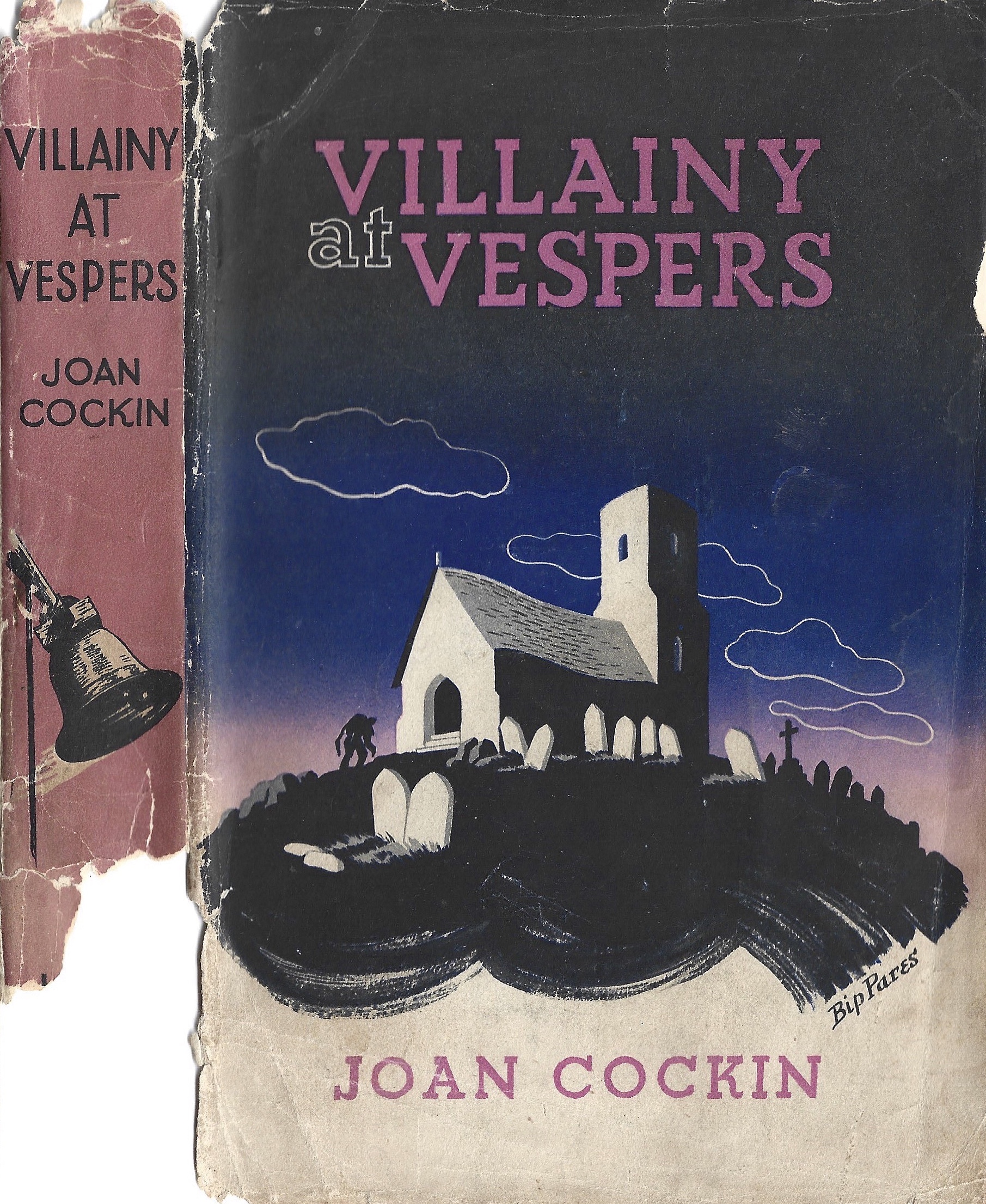
Galileo Publishers -- the same fine company that reprinted Clifford Witting's mysteries and will continue to do so over the next couple of years -- have secured the rights to the extremely hard to find mystery novels of Joan Cockin.  Her quirky detective novel, Villainy at Vespers, about the arcane art of brass rubbing, smuggling and bizarre murders was reviewed here at PSB back in February 2020.  All three of Cockin's detective novels starring her policeman Inspector Cam are planned for release over a two and half year period.  Villainy at Vespers will be the first. I believe it comes out in the fall or around Christmas.  It will be followed by Curiosity Killed the Cat (actually the first of the three mysteries) and end with Cockin's  highly elusive (dare I say rare?) and last mystery novel Deadly Ernest.  I've never seen a copy of that third book in my lifetime and I'm eager to get my hands on a review copy.

And the pièce de résistance, mes amies?

After years of thinking about creating my own imprint it's finally happening.  If all goes well Pretty Sinister Books will burst forth into the indie press world with the complete works of forgotten American writer Elma K. Lobaugh in the coming months.   I also have plans to reissue the nearly impossible to find detective novels by the highly original, utterly inventive, deliciously witty and thoroughly bizarre Reginald Davis. The line-up will then focus on dozens of under-appreciated and overlooked early 20th century American mystery writers whose books have languished in the Limbo of Out-of-Printdom for too long.

So much to look forward to as we head into the dog days of summer and autumn wends its brisk breezes and falling leaves our way.

Onward and upward!

Monday, October 4, 2021

Winners of Pray for the Dawn giveaway...

The winners of the two copies of the new Ramble House reprint of Pray for the Dawn were chosen entirely at random using our arcane method of colored tokens and coded entrant names.  And they are:

1. Jeff F.

2. Brad, from the "Ah, Sweet Mystery Blog"

I've already emailed each winner and I eagerly await your replies.  The sooner I get your address the quicker I can put your book in the mail.

Congratulations to the lucky winners. And thanks to all for playing. 

(Shown at right is a portion of the original DJ illustration from the 1946 British edition of Pray for the Dawn by Eric Harding)

Monday, September 27, 2021

GIVEAWAY: Pray for the Dawn Released!

Two book giveaways in one month?  What is the world coming to?  (BTW, there was almost a third,...but I'm saving that one for October) For that matter what is this blog turning into?  Seems as much as I've eschewed all forms of social networking, I've succumbed to what the internet does best and become yet another self-promotion marketing machine, my friends. Sorry to disappoint.

I'm happy to hear from at least one of the previous book giveaway winners that the last prize, a copy of A Case for Solomon by Bruce Graeme, proved to be:

"...brilliant. Apart from being a true bibliomystery, it also pulls off one of the best plot surprises/twists I have come across. Thank you for introducing me to such an inventive and innovative series."

 And I can assure you that Pray for the Dawn is just as innovative and surprise filled. Just released from Ramble House last week the new edition of this EXTREMELY scarce book is available nowhere for free online and has never before been reprinted until this year  Here's your chance to win a brand spanking new, hot off the laser jets, copy.

Those who may have read my rave review back in April already are prepared for pulpy horror, genuine thrills, and paranoid ravings from terrified characters who are trying to survive the weekend in creepy house on an isolated island. Paranoid and terrified because they are at the mercy of a murderous and apparently revived corpse. And it's a detective novel to boot!  What do you need to do to win a copy? Just this...

Leave a comment and name your favorite mystery about a group of strangers stranded somewhere at the mercy of a crazed killer. I have two copies and will award one each to two different people. This new edition with an attractively gruesome cover illustration by Gavin O'Keefe also comes with an informative and amusing Afterword by Yours Truly done in a suitably offbeat Ramble House style of banter and wisecrackery.

1.  Open to all readers who live in the USA, Canada or UK.
2.  Winners must provide me with a legitimate email address and name (or nickname) when they leave the  comment.  Comments marked Anonymous or Unknown are not eligible.
3. Winners will be contacted by email and then must provide me with a legitimate shipping address in one of the three countries listed.

CONTEST CLOSED. 

Tuesday, August 17, 2021

The Pretty Sinister Influence, or News on Reprints & Reissues

Lots of news on my overwhelming influence in getting books back into print.  OK, that's an exaggeration.  But suggestion and influence seem to commingle these days.

First. the Bruce Graeme Project of reissuing the Theodore Terhune mystery books continues with the release of the third title from Moonstone Press: A Case for Solomon.

It's been on sale since the beginning of this month at various internet sites in the UK and should be available from the US based Amazon very soon. At Book Depository the listing for this book does not have Bruce Graeme's name as the author, but instead has mine as the author of the introduction. Oops! But my often bruised ego doesn't mind that at all.

The rest of the Terhune mysteries will follow in quick succession:
Work for the Hangman in September, Ten Trails to Tyburn in October, A Case of Books in November, And A Bottle of Rum in December.

A few months ago Stark House sent me a copy of their latest Black Gat paperback reprint of Tears for Jessie Hewitt by Edna Sherry. I was surprised and happy to see this back in print. Back in 2019 I reviewed Sherry’s novel and had good things to say about it. For those of you who like noir fiction it comes recommended. A snippet from my blog post appears inside the book as the last laudatory blurb. You can read my full review on Tears for Jessie Hewitt here.  

Out of curiosity I wanted to what else Greg Shepherd had reprinted in his Black Gat imprint. These are single, smaller books in old-fashioned 4.25" x 7" size rather than his 2-for-1 volumes in larger trade paperback size. Imagine my delight when I saw this:

Yet another book I raved about on this blog.  And there's a portion of my rave right on the front cover! If you want to read the rest of the review for So Young, So Wicked click here.

Saving the best news for last.  The long awaited reprint of Pray for the Dawn by Eric Harding will soon be out from our good friends at Ramble House.  As soon as I get my copy I'll be sure to let everyone know it’s available for purchase.  In quirky style so suited for Ramble House Pray for the Dawn will have an Afterword by Yours Truly rather than a foreword.  With an afterword I was able to talk about all sorts of surprise elements in the book without worrying about ruining the story for anyone. 

Expect book giveaways and fun contests to win copies when the Moonstone and Ramble House books are ready for sale.

Tuesday, June 10, 2014

ALTERNATIVE CRIME: Claim of the Fleshless Corpse

Claim of the Fleshless Corpse (1937). Great title, isn't it? The title alone would have got me to read the plot blurb. Conjures up all sorts of gruesome images and violent crime. Perfect title for a story in a shudder pulp like Dime Detective. A story that screams out for a lurid painting of a woman in bondage screaming out in terror while a madman hovers over her with a red hot poker or some other tool of devilry. But a fleshless corpse is after all nothing more than a skeleton, right? And that's what insurance investigator John "Toughy" Nichols faces in the furnace room of Albert Browning's "elegant residence" in the tony Long Island town of Briarcliff Manor. An incinerated skeleton but still a skeleton. Claim of the Incinerated Skeleton just doesn't trip off the tongue, does it?

Browning was carrying a hefty $500,000 life insurance policy and "accidental death gets him two-for-one" as Nichols puts it. He's sent by his boss to check out the incinerated body and find out if it is indeed Browning or yet another case of insurance fraud. In the first two chapters Nichols treats us to three separate cases of fraud and it seems like his job is a never ending battle with no good con artists trying to dupe their insurance agents with a shifty get-rich-quick scheme. With Nichols on the case, an expert in all sorts of fraud, Continental Insurance has been saving thousands of dollars a day. But when the case gets too scientific Nichols turns to his surgeon pal Dr. Lester Lawson, one of those wizard geniuses of pulp fiction. Lawson has an arsenal of up-to-date medical techniques that help him prove accidental deaths have been faked.

This story is very early forensic techno-thriller with all sorts of scientific detection. Over the course of the book Dr. Lester Lawson gives mini-lectures on Hans Müllner's technique of making a plaster cast of hand prints and fingerprints; George Weber's perfection of the Müllner technique used to get a "shadow" of a footprint off of a concrete floor; Dr. E. M. Hudson's method of getting latent prints from cloth, wood, metal or anything without a shiny or glossy surface; and the involved process of moulage used to reconstruct a face on a skull. Some of it is fascinating, some of it is old hat to crime fiction readers. All of it, however, was probably new to a 1937 reader. It might have been a lot more interesting and less frustrating to read had Bruce decided to make Lawson more of a gentleman.  Lawson's petulance and sarcasm outdo even the wisecracking narration we get from Nichols. The surgeon and the claims investigator are an oil and vinegar kind of detective team; somehow despite their bickering and insult trading they manage to solve the case.


Yes, Hans Müllner was a real criminologist.  The others are real men, too.

Of course the body turns out to be someone other than Browning. It is through the combination of this unlikely duo's investigative skills that the fraud is uncovered. Lawson's diligent scientific detection leads to the true identity of the corpse. Nichols' legwork and scene of the crime investigating uncovers the unusual method of faking an electrical accident in the furnace room.

But I've filed this book under "Alternative Crime." That means you get a fair share of absurdities and implausibilities amid all the scientific and criminological facts. Not to mention a less than literary writing style. Bruce's wordsmithing is pure pulp. Examples? I knew you'd want some.

Wise guy insults galore:
Lawson: "And you probably couldn't spell corpse."
Nichols: "I'll show you, you flat-faced, mummy-pussed, belly-opener. All I need is a lot of paper and pencils."
Lawson: "And the prayers of the congregation. And listen, you spell it c-o-r-p-s-e."
Nichols: "Try n-u-t-s!"

And the usual plethora of quirky metaphors:
"She was a swell kid, too, with her head in the right place and her heart ditto."
"...because the old boy had picked a pretty bizarre way of chucking in his chips and kicking off for the Styx." 
"...at this point my old brain did a few nip-ups of its own."
"...whether this tall story that Lawson's been assembling in his junkshop has any angles to it I'd dare take to [my boss] without a catcher's mitt and knee-pads."

Lawson pulls off a few crazy Holmesian miracles of observation and inference as in his assumptions about the lifestyle of the fleshless corpse. He tell Nichols to look for a "...a man who has hung around barrooms, who hasn't been so damned particular about keeping himself clean. When he worked he was a stone-cutter or a stonemason... The day before he died he had a job unloading flour from a truck." Quite a bit of info all gathered from a burnt up skeleton! It's all explained in the final chapter but I didn't buy much of it.

And all this work to identify the body! What's the first thing most police would do with when confronted with an incinerated skeleton and intact skull? Check the dental records, of course. Why then doesn't this dawn on anyone -- including the genius Dr. Lawson -- until page 174? But wait, the best is yet to come.

The skeleton is taken to Lawson's private hospital lab where he does the full autopsy and reconstructs the skull. Clearly the police are too inept to do it right. Then the "fleshless corpse" is transported (by ambulance no less) back to the police station! The station itself, not the morgue. Dr. Lawson wants the body now with its simulated face to be dressed in clothing and put into a line-up for policeman to study! I couldn't stop laughing throughout this section.

If you want to find out more, read it for yourself. Those arbiters of eccentric taste in mystery novels over at Ramble House have generously reprinted George Bruce's  wacky book. You can get a nice trade paperback edition of The Claim of the Fleshless Corpse direct from Ramble House (published under the UK title of Corpse without Flesh) or at the usual online bookselling sites. But if you've read this entire review, you have also been warned!

UPDATE - June 11, 2014: Just discovered a detailed biographical article about George Bruce who was indeed a pulp writer as I had guessed. His specialty, however, was airplane adventures and military aviation stories not crime. He also has a few screenplay credits. I should've known someone who wrote wiseacre dialogue as sampled above would succumb to the lure of Hollywood. Please visit the blog Bear Alley for Steve Holland's excellent article on this forgotten pulp writer.

*     *     *


Reading Challenge update:  Golden Age Bingo card, space E1 - "Book with a detective team"

Tuesday, November 5, 2013

The Incredible Adventures of Rowland Hern - Nicholas Olde

Who was Nicholas Olde? No one seems to know. In addition to this collection of clever and often quite funny mystery short stories, Olde apparently was also the author of two slim volumes of poetry published in pamphlet form in the early 1930s. It is generally thought that Olde was a pseudonym and attempts to uncover any biographical data on him have yielded nothing. Whoever he was he certainly read a lot of G. K. Chesterton. The plots and dialogue are rife with the kind of paradox that Chesterton imbued his mystery stories—not only with Father Brown but also in the Gilbert Pond stories and the tales found in The Man Who Knew Too Much.

Another Chestertonian aspect of some of the stories is an element of the supernatural and the impossible crime, or more often an impossible problem. Chesterton employed these often in the Father Brown stories. Readers will surely find analogies between many stories. “The Windmill” by Olde and “The Invisible Man” by Chesterton share similar solutions to their crimes, for instance. “The Monstrous Laugh” tells of a town haunted by phantom laughter and a local superstition that is similar to the seemingly supernatural aspects of “The Ghost of Gideon Wise,” “The Dagger with Wings” and several other Father Brown tales.

Robert Adey in his excellent bibliography of impossible crime stories and novels, Locked Room Murders, makes a side comment about Olde’s book having been undeservedly passed up for Queen’s Quorum status. Had it been listed in that Hall of Fame listing of seminal short story collections in the detective fiction genre, Olde would perhaps not have been condemned to obscurity and the book might not have descended into the limbo of forgotten and neglected works. In the countless anthologies devoted to crime and detective fiction published since the 1930s, only three publications have ever included a Rowland Hern story: “The Windmill” in Twelve Murder Tales, one of Jack Adrian’s anthologies for Oxford University Press (1988); “The Accidental Disembowelment of John Kensington" and “The Invisible Weapon” both in Japanese translation, the first in Hayakawa's Mystery Magazine (#468, 1995) and the other in a 1990s locked room story anthology, the title of which is Japanese (I cannot reproduce it here). It’s a shame this has happened because The Incredible Adventures of Rowland Hern contains some of the most ingenious and funny detective stories of the 1920s.

Like most detective fiction fans I had never heard of Nicholas Olde or Rowland Hern. No surprise given the fact that Olde and the quirky Rowland Hern have both been overlooked (or shunned) by nearly all of the crime fiction historians and critics. Through sheer serendipity -- that miracle that usually leads me to a treasure of a book -- I was lucky enough to obtain a copy through the internet in the spring of 2005. Lucky, because as I later discovered, it is among one of the rarer books in mysterydom and sought after by collectors of impossible crime stories. Later research revealed that the copy I stumbled upon was the only copy being offered via the internet and has been the only one for several years. An attempt to locate other copies, even in academic libraries or public libraries, showed less than ten copies held in the US and UK. There may be other copies in private collections, but I’ve been unable to verify the existence of even one. All of this made me think that someone ought to reissue this book. And the sooner the better.

As I delved into its pages I discovered the book to be filled with the bizarre, the surreal and the outrageous. Throughout the fifteen stories in the volume the reader is treated to several wicked clergymen, a devious physicist, a vengeful botanist, and many murderous lords, earls and other titled gentry. The plots involve a secret code in a lost language, a murder committed with an invisible weapon, a tell-tale beard, a near disembowelment, a village where no one laughs, and a killer whose motive is linked to a literal battle of wits.

The more I read the more I thought Olde cannot really intend these to be taken seriously. They must be detective fiction parodies. As such they are perhaps some of the earliest examples. I can think of only Philo Gubb, the correspondence school sleuth created by the American humorist Ellis Parker Butler, as the earliest of intentional detective fiction parodies in short story form. The first clue that Olde’s mood is far from somber in ...Rowland Hern are the characters’ decidedly British and often alliterative monikers. Here’s a brief line-up of these unusual suspects: Pounceby Brisket, K.C., Sir Chudleigh Chalfont, Mrs. Tregaskin Simpson, Hercules Herklot, Sir Pendragon Higginbotham and Porteous Pemberton- Drysdale. And the names give only a hint of the oddities that the reader will encounter.

In “Potter”, one of my favorites in the collection, Hern and his nameless sidekick head off to a boutique that specializes in the sale of exotic animals. Why? Because Hern is in need of an armadillo and the emporium has several sizes to choose from. Their advertisement is certainly enticing to anyone in search of exotic animals: “Potter & Hara, Wild Beast Merchants. Tigers from £85, certified Man-eaters 5s extra. Snakes and crocodiles a specialty. Free burglary insurance policy presented to each customer.” How can one go wrong with those promises? Exactly why Hern needs that desert beast is never explained. And must we really know? The mere fact that he needs an armadillo is surreal enough. How many fictional detectives have ever required an armadillo to solve a case? Or for anything!

Olde’s sense of humor reaches its pinnacle in “The Mysterious Wig-Box.” For a story written in 1920s it displays a truly contemporary black humor presenting us with legal professionals who make light of killing and death during a sensational murder trial. Their lively repartee receives hearty laughter and applause from the irreverent courtroom attendees. The trial ends in a surprising acquittal of the serial killer thought to be obviously guilty. Later the defense attorney (one of the punning wits of the courtroom) is found decapitated in his home and his head decorated with his barrister’s wig is found in a wig-box in a railway station. Hern sees in this bizarre crime a particularly nasty sense of humor. The victim lost his head, after all, along with his ears and nose. What appears to be a wanton and insane act is in fact a purposeful and vengeful crime. When Hern reveals the killer’s identity his cohort is astonished. He says, “Apparently [they] were on the best of terms. […] They were even joking with one another during the trial.” Hern replies, in his characteristic Chestertonian paradoxical manner, “Yes, and that was the trouble.” It was their sense of humor which led to the crime. The first time I know of in crime fiction that the telling of jokes served as a motive for murder.

For decades The Incredible Adventures of Rowland Hern was one of the legendary and unattainable books of the genre. Thankfully, that is a thing of the past.  Mystery fans now have an affordable edition to enjoy available from Ramble House. Nicholas Olde’s original sleuth need no longer be imprisoned in that limbo of forgotten and neglected fictional creations. I suggest you acquaint yourself with him soon.

(This is an abridged, slightly altered version of my introduction to the Ramble House edition of The Incredible Adventures of Rowland Hern first reissued in 2005.)

Friday, October 11, 2013

FFB: Policeman's Holiday - Rupert Penny

Though Rupert Penny only wrote a handful of books, all published by the esteemed Collins Crime Club, not a single one of his books was published in the United States during his lifetime. It took the ingenuity of Fender Tucker and Gavin O'Keefe, those very busy men over at Ramble House,  to resurrect these fiendishly clever, often preposterous, and genuinely baffling detective novels and allow American readers an opportunity decades overdue to read them.  Policeman's Holiday (1937) is the second of only eight novels featuirng the "talkative policeman" Inspector Beale and his Watson of sorts the financial reporter Tony Purdon. And it's one of the strangest detective novels I've read in a long while.

Rupert Penny is the adopted pseudonym of Ernest Basil Charles Thornett, a newspaper writer and cruciverbalist when he wasn't concocting incredibly complicated murder mystery plots. In Policeman's Holiday he decided to combine his two passions -- detective novels and crossword puzzles, or more accurately acrostics. The murder victim Bernard Pommery is a J.P., philanthropist, ex-publisher of novelty magazines and an acrostic enthusiast. His body is found hanging in Dillow Woods several miles from his home. In his pocket is an acrostic puzzle that has not one but two solutions (!) each of them providing the police with clues to the killer's motive and means.

I'll forgo any attempt to summarize the intricate, multi-layered plot. Some readers may complain that this book is saturated in plot, that it's nothing but plot. I wouldn't quibble with that observation, but then there are an entire subset of detective novels that exist solely for the plot and the puzzle. Curt Evans has written about some of the better writers in his book Masters of the Humdrum Mystery. I'd class Rupert Penny with those "humdrums" as well. As a crossword puzzle constructor Thornett would naturally be drawn to writing detective novels in which puzzles and an abundance of enigmatic clues are integral to the story. His former life as a cryptographer in the British secret service no doubt also aided him in his puzzle-making abilities.

Policeman's Holiday is something of a tour de force in that regard. It's hard not to resist the pull of the puzzle from the moment the body is discovered hanging from the beech tree when all appearances say it must a suicide and all reason says it cannot possibly be so. And Thornett's storytelling pulls the reader just as an expert angler knows how to pick the perfect lure. The manner in which Inspector Beale approaches solving the crime is both entertaining and gripping. True to the style of most Golden Age detective novels Policeman's Holiday is also gussied up with maps and diagrams, including one that shows how nearly impossible it was for the victim to have committed suicide.


The pièce de résistance of Rupert Penny's detective novels is his gimmick of the "Interlude." Occurring a few chapters from the end these breaks in the narrative are similar to Ellery Queen's "Challenge to the Reader" in which the reader is asked to pause, mull over the story, sift through the clues and toss out the red herrings, and come up with his solution before turning the page and reading the actual revelation of the murderer. Just as with Queen a Penny "Interlude" is akin to a medieval knight tossing down his gauntlet. You're in for a real battle, albeit a battle of wits if you dare to take up the gauntlet and attempt to figure out the solution of a Rupert Penny mystery. I've failed three times so far. And as for that acrostic -- I managed to figure out one of the eight diabolically clued lights. I'd be willing to bet a wad of money that no one will be able to get both solutions to that particular puzzle.

Rupert Penny as he appears on the rear DJ
of a Collins Crime Club edition
Rupert Penny's Detective Novels
The Talkative Policeman (1936)
Policeman's Holiday (1937)
Policeman in Armour (1937)
The Lucky Policeman (1938)
Policeman's Evidence (1938)
She Had To Have Gas (1939)
Sweet Poison (1940)
Sealed Room Murder (1941)

As "Martin Tanner"
Cut and Run (1941)

Friday, September 9, 2011

FFB: Jack Mann & His Occult Detective Gees

Cover artwork by Rudolph Belarski
E. Charles Vivian was a prolific British writer who wrote detective novels, espionage thrillers, adventure stories and supernatural thrillers. Under the pseudonym "Jack Mann" he gave us Gregory George Gordon Green, or as he is known to his friends "Gees," a private investigator who had a habit of stumbling upon mysterious crimes and murders that had supernatural origins. He appeared in eight books and only one of them was a straight crime novel. The other seven touched upon ancient curses, shape-shifters, the practices of a Druid cult, Viking legends, Egyptian reincarnated princess, Atlantean witchcraft and other visitors and entities from other dimensions.

I especially like Maker of Shadows (1938) set in Cumberland, in the northwest corner of England now known as Cumbria. Here Gees must do battle with a powerful warlock who might easily have stepped out of the pages of a book by Sax Rohmer. He is descended from a mythical race Mann created called the Azilians. Like the Picts of ancient Scotland the Azilians are a pagan people of pre-medieval times. But they deviate from the Picts in their religion devoted to "the Unnamed" – a demon goddess who brings the worshipper all he or she desires. The supernatural content in the book is less familiar and trite than found in some of the other books.

Take, for example, Grey Shapes (1937) which for me seemed like a complete rip-off of The Door of the Unreal by Gerald Biss. The entire first half of Mann's book from the sheep mutilations to the strange relationship between the father and daughter and the finale are nearly exactly the same in each book. The Door of the Unreal (1919) is considered a classic of its type but I really shouldn't mention anything of the plot for fear of ruining each book. Written almost twenty years earlier than Mann's Grey Shapes there is a strong case for plagiarism that few critics have ever pointed out. Having previously read Biss' book before Mann's I found nothing new about Grey Shapes, wasn't surprised in the least by anything, and was dumbfounded by the transparent similarities in the two books.

Illustration by Virgil Finlay for Maker of Shadows as serialized in Argosy

from the DJ collection at the Supernatural Fiction Database
Nightmare Farm (1937) is another unusual treatment of the supernatural in a detective novel. This is more along the lines of a ghostbuster adventure complete with haunted house and grisly material horror in one of the best scenes towards the end of the novel. Gees must solve a murder or two and exorcise some evil spirits trapped in the haunted farmhouse.

The Glass Too Many (1940) is sequel of sorts to The Maker of Shadows in that it also deals with a descendant of Mann's completely made-up "lost race" of the Azilians. There is also some more lurid business as in Maker of Shadows with ritual sacrifice in the catacombs beneath an ancestral home and some impossible poisonings that John Dickson Carr might envy. Gees is hired to discover who might be poisoning a British lord. He has started to tremble and shake uncontrollably just like a parlor maid had weeks earlier. Five weeks after her tremors she attacked another maid in a homicidal rage and was sent off to an asylum. As part of his investigations Gees, along with young Claire, discover an underground altar where very recently someone had been burning hallucinogenic herbs as part of a ritual to "the Unnamed."

At one time seven of the eight Gees books were easily found in used bookstores in the reissued formats from Bookfinger. Several years ago I found a bunch of the Bookfinger editions for $15 each. Sometimes it was possible to find one or two for under ten bucks. But as usual with scarce books of this type that are in demand the prices have skyrocketed. Luckily, Ramble House has issued affordable trade paperbacks. Only The Kleinert Case has proven to be elusive. It was the only title not reissued by Bookfinger and to date remains a truly rare title in the Gees series. I have never seen a copy in my lifetime, though there seem to be a few copies in public libraries in the United States.  I doubt they circulate though.

UPDATE: Several months after I originally posted this article I learned that Ramble House has reissued all the Gees books including The Kleinert Case. What a boon to Jack Mann collectors! It is currently the only affordable edition of that extremely rare title. I suggest Jack Mann and E. Charles Vivian fans make their way to the Ramble House or amazon.com and buy a copy pronto.

The Gees Books by Jack Mann
*Gees’ First Case (1936)
*Grey Shapes (1937)
*Nightmare Farm (1937)
*The Kleinert Case (1938)
*Maker of Shadows (1938)
*The Ninth Life (1939)
*Her Ways Are Death (1940)
*The Glass Too Many (1940)

*Available in trade paperback editions from Ramble House.