Showing posts with label supernatural. Show all posts

Tuesday, September 8, 2026

Murder Mansion - Herman Landon

THE STORY:
Donald Chadmore, newly released from prison for an assault charge has come to his uncle Theodore's home in order to protect him from a possible attack. He takes his uncle to the library at the ancient gloomy Chadmore home known to locals as "Mystery Mansion" and locks both of them inside.  The heavy door is bolted twice and locked from the inside. All windows are barred. There is no way anyone can get inside. And yet spectral music plays from the piano in the corner of the library and a shadowy figure emerges from the darkness. Uncle Theodore cries out to Donald. Donald fires his revolver at the shadowy figure. He goes to the divan where his uncle was sitting but it's empty.  Uncle Theodore is found behind the furniture piece on the floor. He's been shot. Not only shot but stabbed with an antique dirk that Donald had handled only a few hours ago and which was left in the hands of someone now locked upstairs in the attic. Who was the shadowy figure and how did it get in to kill Theodore Chadmore?

HIGHLIGHTS: Murder Mansion (1928) is another Herman Landon pulp extravaganza.  Think of any pulp magazine story trope and its bound to be in this novel.  Several beatings and fistfights, abduction, two locked rooms, a haunted house, a family curse, hidden jewels, strange legacies, disguise and masquerade, ventriloquism, a dying message, and a handful of gangsters all make their appearances in this story. The entire book is surprisingly well written (at times rather literary), cleverly plotted, and often laugh out loud funny.  Landon can't help but pile on the Gothic excesses and melodrama which tend to turn up the moody atmosphere to 11, 12 or even 13 too often. Still it's a helluva story, well told and teeming with fun characters, innovation, exciting incidents, and enough puzzling elements to keep any hardcore GAD fan glued to the pages.

THE CHARACTERS:  This book has a huge cast of characters but even some of the most minor characters have memorable moments. There are too many to list, including six mystery guests who turn up for a secret meeting with Theodore on the night of his murder. Below are the best of the cast.

Donald Chadmore - Our ostensible protagonist and an amateur sleuth of sorts. As the book continues he is more of a victim of circumstance, chosen by the villains of the piece to take the fall for his uncle's death as well as being blamed for several other bizarre activities. His  dancing partner, both literal and figurative is...

Gloria Westcott - The Bright Young Thing of the book. A real Jazz Age girl complete with 1920s lingo she shows off to her "big boy."  One wonders why she  turns up so often too coincidentally in the most unusual locations. All will be explained later in the book. She's an utter delight providing much of the lightheartedness to offset the heavy-handed strum and drang whenever Donald and Gloria exploring dark passages or dealing with yet another thunderstorm. I loved the Jazz era slang she slings around as easily as she does the foxtrot.

Samuel Peterkin - Valet who works at a luxury hotel, on loan to Donald for his stay and travels to Mystery Mansion to help him as not only valet, but personal assistant.  Peterkin can't help but offer up his talents as a detective and comes up with an ingenious idea to solve the locked room murder. He turns out to be the real sleuth of the book despite the presence of police, a D.A. and a private detective working for the prosecutor's office.

Milliken - Investigator for D.A. Mott. Won't have anything to do with ghosts or locked rooms. The whole crime gets his goat.  "It ain't natural!" he continually pronounces. He can't stand anyone who "blows froth" at him.  Some kind of 1920s slang, I gathered, for telling lies or making up stories (a running gag in the last third of the book). He has a few excellent scenes showing off his detective skills. Notably, he proves that the odd placement of Donald's fingerprints found on the dirk show that Donald could not have stabbed his uncle. Almost everything and everyone he encounters in this case is classified as "unnatural." Nevertheless, he's determined to find the real reasons for the murder and dismiss all the claptrap.

Mr. Amicus - A very dead character whose presence is always felt at Mystery Mansion.  Real name Jacob Hamilton Chadmore, he is Donald's great grandfather.  The story behind his self chosen moniker is too involved to explain here. But it is a bronze bust of the dead man and his promise to return from the grave on the anniversary of his death that keeps Theodore and his wife on their toes and often up late at night unable to sleep. They’re especially troubled every October 7, the night he died back in 1800 and something. The novel of course opens on October 7 and Theodore is killed on the anniversary night. Could it be a ghost that did him in?

Groody - A butler with a suitably weird name this servant to the Chadmore household is privy to several secrets that he won't reveal until the final chapter. He's a bit shifty but always answers Donald's questions honestly.  Trouble is Donald never asks the right questions.

"Doc Locks" - For a while I thought this exceptionally astute expert would turn out to be the detective. But he has only one scene and then he's gone. Neither a physician nor a PhD scholar "Doc Locks" is a nickname given to him by the police and the prosecutor's office. We never know his real name, still Doc is clearly the Gideon Fell of this novel. No locked rook can stump him. Through careful examination of any murder scene deemed a locked room and using his knowledge of criminal tricks and clever illusions he finds any secret passages and all possible means of exit and always proves a locked room is never hermetically sealed. Until this one, that is. Before he tells everyone that it seems impossible for anyone to have entered the locked room tells a few interesting true crime anecdotes like the one about the 19th c. French murderer who managed to infiltrate a locked room with a blazing fire in the hearth by coming down the wide mouthed chimney wearing an asbestos suit and a helmet with built-in oxygen tank!

John Pagan - One of six guests who were to visit Theodore Chadmore on the night of his death. He arrives t dressed in white tie and tails, the only person in such formal attire. He has an unusually deep and theatrical voice that Donald recognizes as belonging to someone he heard plotting his uncle's death. That person calls himself Staglawn.  Much of the book involves characters trying to uncover the true identity of Staglawn. Pagan denies being the murder plot mastermind. He also has a hilarious running gag of sorts that takes the form of an aversion to certain vocabulary and vernacular.  When anyone uses these words he responds with outrage and satirical wit: "Candid? Abominable word! Just as if anyone could be candid in this world of sham and pretense and stupid amenities!" See the quotes section for a couple more of these amusing outbursts.

QUOTES: Gloria: "Secrets should only be told in the moonlight."

Donald: "What do you think, Milliken? Do I look like a murderer?"
Milliken: "You do.  All the murderers I've seen looked innocent."

Pagan: "Hunch? I detest that word. It's a lazy man's designation of an idea he is too indolent to think out clearly."

Pagan: "Kindness? That's another word I detest. What we call kindness is only inverted selfishness." 

"This will be a lesson to me," Don added. "I'll never again trust strange women."
"Poor Don!" Gloria gave a mock sigh. "Everything is a lesson to you, isn't it, Don? But you always forget."

Peterkin: "[Valeting is] the best education in the world. Keep a man waiting two minutes for his trousers before he's had his morning coffee, and you learn as much about human nature as it would take you two years to learn in any other way. To know human nature, you've got to study it in the raw, with the frills off. Sometimes I've found it awfully raw, sir." 

THINGS I LEARNED:  Mr. Amicus is a great devotee of Haydn and remarkably has learned several haunting themes from his opera The Devil on Two Sticks.  Prior to any Mr Amicus manifestation in the library the weird dissonant music from this opera plays on the piano.  I was intrigued by "dissonant" music from Haydn most of whose music I think of as bright and melodious.  Lo and behold!  It is true that he wrote the music for an opera titled Der Krumme Teufel (his first full opera written at the age of 19) based on the 17th century French satirical novel by Alain-René Lesage translated as The Devil on Two Sticks. But how Mr. Amicus can play the music is the ultimate unsolved mystery of Murder Mansion.  According to all accounts I found online Haydn's opera is a lost work and though there are archival copies of the libretto no sheet music nor any recordings are known to exist. The only anecdote I could find connected to the actual composition was told in an 19th century collection of composer biographies. Here it is related that Hadyn and Josef von Kurz, his librettist collaborator, had a discussion on how to capture in music the sound of a thunderstorm.  Haydn could not come up with a suitable musical motif.  In frustration he slammed his hands on the keyboard and his companion exclaimed, "That's it!" Probably someone's vivid imagination at work. Landon certainly makes the music seem creepy in his lush descriptions. Don't know why he didn't use something more immediately recognizable like "Danse Macabre". I guess music that doesn't exist is easier to work with for a novelist; he can make it sound any way he wants it to sound. 

THE AUTHOR:  Herman Landon (1882-1960) was born in Stockholm and came to the United States with his family in 1895. At one time he worked as a journalist for the Washington Herald where he was feature writer and a managing editor. His primary fame, however, is as a pulp magazine short story writer and crime fiction novelist.  Throughout his fiction writing career lasting from 1907 to 1942 he wrote close to 200 short stories and 20 novels. He created several popular series characters for the pulp magazines among them The Gray Phantom (who may have been the inspiration for Batman), The Picaroon, Godfrey Usher, and Kingdon Cole. Some of his Picaroon stories were collected into book format and published in the UK only. Most of his stories were published in Street & Smith magazines with the majority of them (more than two thirds of his total output) appearing in Detective Story Magazine and Detective Fiction Weekly. His stories also appeared in 10 Story Book, The Blue Book, The Smart Set, The Corner Magazine. and The Popular Complete Stories. Some of his stories were adapted into silent movies.

EASY TO FIND?  Nearly impossible these days I'm sorry to report.  I found one copy available for an cheap price due to its poor condition. Looks beat to hell, but if you don't mind reading copies (I certainly don't when the book is extremely hard to find) then it's waiting for you. Two copies (maybe only one listed at two different sites) translated into French also turned up for sale. My copy in VG condition, pictured at top of this post, was sold within 12 hours of the post appearing. Sorry to anyone who was looking for it earlier. 

UPDATE:  Remarkably, three days after this review was posted I checked for copies of Murder Mansion and discovered all were sold. Even the French translated copies! Also sold were two copies of The Forbidden Door (before I even mentioned it in the comment below). Oddly, another copy of Murder Mansion has turned up. That one final copy is the Liveright 1st edition and is priced exorbitantly. It will cost you well over $300 including shipping and taxes if you live in the US. Even more if you live outside of the US. But the copy has four torn pages. In pieces! Still, I am sure that someone will buy that book soon. That and a roll of Scotch tape. 

Thursday, October 30, 2025

HALLOWEEN SPECIAL: Sinister House - Leland Hall

The most uncanny thing about my reading Sinister House (1919) is not so much the content of this fine tale of a haunted house and malevolent ghosts but my timing.  A few days after I started the book I attended a performance of the new stage thriller Paranormal Activity (conceived and directed by Felix Barrett, written by Levi Holloway) based on the series of horror movies of the same name. The play deserves a post all to itself and I will have to refrain from talking about it here. But the eerie coincidences between a supernatural novel written more than a century ago and a play only written one year ago are seriously unreal. They both begin as commentary on routine living then morph slowly into tales of malign presences infecting the living. There is even a manifestation that takes place in the novel that is exactly the same as a fleeting moment in the play I saw.  That's chillingly coincidental and mindbogglingly uncanny as far as I’m concerned!

Leland Hall's novel starts out so utterly mundane that he includes lectures on the real estate business, building concerns and one of the characters' disdain for developmental communities which were already a blight on American neighborhoods in 1919, at least according to Leland Hall. Then the routine of everyday life gives way to disturbing and unsettling events. The first major shift in the story happens when the narrator Pierre is visited -- during a torrential thunderstorm, no less -- by his neighbor Eric Grier who has recently moved into a ramshackle home on the outskirts of the cookie cutter development known as Forsby. He has returned from a business trip in Buffalo, walked from the train station as there were no cabs at that late hour and when he saw the light on in Pierre's house hoped to gain entry and shelter from the storm. Eric is eager to get home to his new bride Julia who he could not stop thinking of while he was away.

Immediately, there is a discussion of the difference between the two homes in the novel. Pierre's house in Forsby is wholly modern made of cement with a "granolithic walkway" leading up to the front door, equipped with modern plumbing including turn-of-the-century fad of exposed pipes and, of course, electricity. Eric's 19th century home is still trapped in the past made almost entirely of wood and stone and no modern conveniences. Gaslight and fireplaces providing heat and illumination, water is fetched from a well. Eric is beginning to behave differently and Pierre and his wife Annette notice that Julia is especially happy in the gloomy house when her husband is absent. At first Pierre cannot understand why the two young newlyweds have moved into such an eyesore of a house. Annette finds nothing at all attractive about the place neither outside nor in. But Julia seems happy and finds comfort in its old-fashioned atmosphere. Pierre, however, finds that atmosphere chilling -- literally and figuratively.

Frontispiece from the US 1st edition,
illustrations all by Haydon Jones
 

It seems a malign influence has permeated the house and is infecting Eric. One night when Pierre, his wife and three year-old son Bobbie are traveling home their car breaks down with not one but two flat tires. They are forced to seek out help and shelter from the Griers. Little Bobbie is terrified of setting foot in the house having had his fertile young imagination stimulated by some strange fairy tales his mother has told him, notably one about the Loreley. In her version the siren sings tempting songs in order to lure men to the death and she eventually eats them! Bobbie calls the Grier home the "Singing House" and does not want to go in. His mother manages to calm him until he sees Eric. Bobbie has a fit of hysterical screaming crying out: "No, mama! Get him away, get him away! Don't let him touch me. He's going to eat me!"

Annette's cousin Giles is the primary skeptic in this cast. He is certain that Eric did not just stumble upon the house in Stanton by accident as he claims. Pierre learned that the house belonged to Morgan Snart, "an eccentric old man, very religious," and his  homely daughter Huldah "who had taken to religion even more entirely than her father." Giles digs into the Snart's past and uncovers secrets about the two that belie their supposed good character and surface religious demeanor. He also finds out a bit more about Eric but is circumspect in relaying that news to everyone.  Compounding this mystery is a forbidden room that Julia insists Eric never open. It remains locked for the majority of the novel. When it is opened out of necessity terror reigns down upon everyone.

Sinister House is clearly a precursor to Shirley Jackson's pioneering haunted house novel The Haunting of Hill House published five decades later in its depiction of a malign presence in an evil house that affects one single person. Hall's novel is both prophetic and iconoclastic in that he defies the traditions of Gothic literature by making the man the object of the haunting and not the woman. In fact, both Julia and Annette are the voices of reason throughout the entire book. It is the men who suffer the most -- from fear, susceptibility, and rash judgment -- when the evil presences finally manifest themselves and carry out their wicked plans. True Julia is targeted in a frightening scene (see illustration plate at right) but it is Eric, Pierre and even Giles who are the sorriest victims suffering both physical and psychological injury more than either of the women.

QUOTES:   I say it walked; but really it moved in some half-human, half-fiendish gait, slowly yet in springs. It was the shape of a tall woman. ...as this thing passed along the wall, its insubstantial head was turned to me, so that I was subjected to a lidless stare of incredibly sinister malice.

Books which teach etiquette of the drawing room had better put in a special clause to warn students against behaving before their hosts as if they were seeing the hideous family specter pass along the wall of the dwelling in which they are being entertained.

There's nothing like a familiar unpleasant job to keep the mind from brooding. 

Giles: "Dead men rise up never --read even your poets.  Ghosts breed in the living. That's where we'll catch them."

Truly I believe that the past was dead to [Eric]. By force of his will to live he had made it as if it had never been. He denied it to himself. And if he denied it to himself, it was no lie for him to deny it to others.

It doesn't do any good at all to say "Boo!" at the past if you're afraid of it.

THINGS I LEARNED:  Pierre talks about his intolerance for lack of modern utilities at the Grier house. He mentions one of his pet peeves is the presence of cannel coal in so many country homes and how he much prefers gaslight. Cannel coal, also called  candle coal and oil shale, was used in the 19th century for its bright and steady flame. Because it burned longer than wood it was a preferred choice for home fireplaces. Its compact dense structure also made it an easily carved material for sculpture, ornaments and jewelry.

Pierre comforts an injured Giles in the finale and describes himself as "kneeling like a Mussulman beside him in the gloom." He's not talking about an apple sauce brand or a misspelling of a he-man here. Mussulman is an archaic term for anyone of the Islam faith. We use the word Muslim now.

THE AUTHOR:  Leland Hall (1883-1957) was born and raised in Massachusetts. I was unable to locate a newspaper obituary online to share other biographical info. According to his gravestone shown in a photo at Find A Grave he was born in Malden and was laid to rest there alongside one of his relatives. Based on the dates this is most likely his father. Anyone with info on Hall is welcome to email more info or comment below. I can't even verify any other books he may have written. I'm curious about his work, if any more exists.

EASY TO FIND? Copies of the original edition are few and far between.  I found only two copies, priced rather steeply, of the US edition (Houghton & Mifflin, 1919) offered for sale online. It was first reprinted in hardcover in the 1970s by the private publisher Bookfinger in a limited edition of about 500 copies. Some if those turn up frequently for sale at affordable prices. Finally, there is a comparatively cheaper reprint in a paperback omnibus (Hippocampus Press, 2008) that is still out there in the used book market and available brand new from the publisher. In addition to Sinister House you get another classic haunted house novel in that two-fer reprint:  Cold Harbor by Francis Brett Young. 

Monday, February 10, 2025

Murder Up the Glen - Colin Campbell

THE STORY:  Lorin Weir is on a walking tour of the West Highlands. He is warned to stay away from his intended hiking paths because of the dangerous  poorly maintained trails that proved deadly to a couple of young men on recent unsuccessful climbs. But the terrain is not the only danger. Lorin learns of the legend of the Black Walker, ghost of a Spanish invader to Scotland, that appears in the area on Beltane (May 1) and Midsummer -- two nights favored by witches, warlocks and haunts.  Lorin dismisses the superstitious warning and camps in the forbidden area.  He witnesses a murder an d sees a black caped figure fleeing into the night.  Lorin also flees but in doing so he dsrops his monogrammed knife. Uh oh! Now he'll be implicated.

CHARACTERS:  Initially, Lorie Weir appears to t be the protagonist detective in Murder Up the Glen (1933), but the novel is structured in an unusual manner. In Part One Lorin and the villagers are featured as they all search for Duncan Grant, a gameskeeper who has gone missing then turns out to be the murder victim Lorin found in the highlands.  In Part Two a writer, Martin Loan, and his colleague Dr. Lawrence Neal, an Irish physician interested in crime and supernatural, take over as narrator and detective respectively.  As the story gets more complex and detailed Loan adds several letters and diary entries to his "manuscript" to offer up alternate points of view and provide eyewitness testimony that he was unable to provide himself.  Loan and Dr. Neal take an arduous journey to Fantassich Lodge where they set up temporary headquarters to help the Neil family (distant cousins of the physician) make sense of the murder and  clear up whether the ghost might be involved or not. 

The Neil family is headed up by Colonel Evan Neil. The others -- Cynthia, a 17 year old preparing for university, and John 14 years-old -- are joined by Neil's two stepchildren Alan and Mary, both under 10 years old. All these supporting characters have their own special scenes with Cynthia eventually taking on a major role as she becomes more and more attracted to Lorin Weir and determined to clear his name. In fact, the youngest boy Alan serves to be crucial to the investigation when he stumbles on the incriminating knife with Lorin's initials in a burn (a large stream) while fishing.

The austere and grim setting with its foreboding landscape dominates the first half of the book. Descriptions of the craggy land, mountains and glens, burns and rivers provide substantial creepy atmosphere. The landscape and geography become like a character unto itself.  The inclusion of a gorgeously rendered map (see below & click to enlarge) that serves as the front endpapers in the first edition allows the reader to realize more fully the all-important landscape.

The Neil's maid Mairag and Dugald Cameron, her boyfriend of sorts, will also emerge from the background and take up a majority of the story when Lorin focuses his efforts on proving that Dugald killed Duncan Grant. The comely Mairag was the object of many of the local men's attentions including Grant, the murder victim. Lorin is sure jealousy is the motive. Mairag, of course, denies Duglad had anything to do with the crime pointing out his relatively good nature, despite his temper, he would never kill anyone. However, Dugald becomes surly and often violent in his own denials. The two seem to be protecting each other.  Or are their actually protecting someone entirely different?  Cynthia is puzzling out all the seeming jealousies and cover-ups and tries to help Lorin see the truth.

Meanwhile, Dr. Neil is out to prove that the ghost is real and that the legends and stories surrounding  The Black Walker have some legitimacy.  Is it possible that this caped figure is an actual ghost? And what of Daft Jimmy who has been seen wandering the mountainous terrain in his own black cape? This local "half-wit" who spends much of his time herding sheep seems to be part of a crime. Lorin suggests that Daft Jimmy is being exploited and manipulated by an angry, more intelligent man in order to carry out violence and is doing so in a Black Walker get-up.

INNOVATIONS:  What makes Murder up the Glen a bit remarkable is the manner in which Campbell manages to blend the real with the legendary.  The shifting between suspects is also well done. By the final third of the novel the plot becomes similar to a Christianna Brand detective novel with quickly shifting accusations arising and almost as quickly demolished as new facts come to light. Ultimately, Dr. Neal uncovers a Gothic surprise of sorts and disproves what seems to be the ultimate accusation. Neal offers up his own ideas which incorporate a hint at supernatural activity while others dismiss his claims and point the finger at the only mortal suspect left to have been accused. While the book is not actually open-ended in the finale, there is a oddly ephemeral suggestion that is left up to the reader to either believe or dismiss. This book is unique among detective novels in this regard.  I thought of The Burning Court (1937) and wondered if perhaps John Dickson Carr had read this book and tried his hand at a similar introduction of genuine supernatural content revealed in the novel's conclusion.

THE AUTHOR:  Colin Campbell was the pseudonym of Douglas Christie (1894-1935) who wrote novels under his own name, his Campbell alter ego and a second pen name, Lynn Durie. According to Hubin's Bibliography of Crime Fiction Dr. Larry Neal, is a series detective and appears in two other mystery novels. The first novel, a frustratingly rare book I am still in search of for over 20 years (!), Out of the Wild Hills (1932) is a mystery with genuine supernatural content.  The third and last of the Neal mysteries, Murder on the Moors (1934),  I managed to find in a scarce POD reprint edition and will review that one in March.

EASY TO FIND?  If you want a hardcover edition -- well, good luck.  I found a battered copy a few years ago but recently sold that in my online listings. However, if you don't mind eBooks or digital texts, then you are indeed in luck!  I suggest you click here and you will find three different digital versions of Murder Up the Glen, one for Kindle, one in Epub, and one full length PDF.  Happy reading!

Wednesday, August 16, 2023

Let X Be the Murderer - Clifford Witting

Lookee here-- It's a book that was recently reprinted and one that you can actually purchase without having to take out a second mortgage! I did promise a few books that were much easier (and affordable) to find this week.

I have an interesting history with Let X Be the Murderer (1947).  I bought a first edition with the unusual illustrated dust jacket (bonus points to anyone who knows what is on the cover on that old edition over on the left.  I'll reveal it later in the post) but never received it.  It was one of two very expensive books that was lost or never delivered or --most likely-- destroyed in mountain of mail that went "missing" in my neighborhood of Rogers Park back at the height of the pandemic.  That loss was one of the most gut wrenching lessons I learned and I stopped buying books from the UK and all sellers overseas for two full years because of the combined loss and the general collapse of the Chicago mail delivery service between March 2020 and the summer of 2021.

This year, a few weeks before Galileo released their new reprint paperback edition, a relatively affordable copy of Let X... turned up in the catalog of a US seller I used to buy from regularly. I snapped it up and it arrived back in May.  Then out of the blue Galileo sent me a review copy!  It was completely unexpected and a delightful surprise.  When I opened the package and saw what it was I did remember that Robert Hyde, one of their publicists, had promised me that I'd get the last couple of Witting books that were planned for release as they came out.  I am also supposed to get copies of the other two Joan Cockin books that they have in the works.  

All these years I was under the impression that Let X Be the Murderer had something to do with mathematics. Anyone would think so based on the title.  Then when you open the book and see that the books is divided into four sections -- Theorem, Hypothesis, Construction, Proof -- once again most readers would be expecting an academic mystery perhaps about a murdered calculus or geometry professor. However, Inspector Charlton does not meet anyone involved in mathematics or geometry or even physics.  Instead it's almost as if he travels back to the 19th century because this detective novel turns out to be very much a homage to the Victorian sensation novel.  As a bonus, adding to the anachronistic atmosphere, Witting throws in eerie occult dabbling and explorations into the world of spiritualism and paranormal events.

Inspector Henry Charlton, Witting's usual protagonist detective, is paired up with the flippant Cockney copper, Det-Sgt Martin this time and they make an amusing pair.  Yet another surprise -- Peter Bradfield (who appears in several other Witting detective novels as a constable and in Subject-Murder as one of the lead characters) pops up in the last couple of chapters to help Charlton carry out some sneaky police business by gathering crucial evidence that might never have been collected. Bradfield eventually makes it to the rank of Chief Inspector, I think, and he becomes the lead detective in Witting's novels that were written and published in the 1950s and 1960s.

In essence this could be seen as Wilkie Collins redux.  The machinations of Mrs. Gulliver, a scheming housekeeper, and the Harlers, a devilish husband and wife, reminded me of the diabolical trio of Count Fosco, Lady Fosco and Percival Glyde in The Woman in White.  Mr & Mrs Harler in Let X Be The Murderer are intent on sending a poor old man to the madhouse just as those other three set their sinister designs on Laura Fairlie. Similarly, the bulk of the novel involves a highly convoluted history of philandering, adultery and questionable parentage. The often dizzying explanations of who was jumping into whose beds and who fathered what child got to be rather head spinning.  The climax of the book involves...well, can't really mention it without ruining a genuine shock.  But I must tell you that event is something that occurred in two other books I recently read and made me not only raise my eyebrows in surprise but burst out laughing.  Not so much because it's both absurd and so utterly unexpected but because who could believe that I would read three different books from three different decades over a period of three months that all featured the same bizarre revelation?  It was beyond surreal!

It's not just the slew of dastardly villains all of whom get what they deserve in the end that make this such an engaging page-turner.  Cast in the role of the apparent victim of the Harler's "Gaslighting" plot is elderly Sir Victor Warringham, head of the household at the dilapidated estate known as Elmsdale. Sir Victor had recently lost his wife and daughter in a wartime bombing and he's been devastated by their deaths. He turns to spiritualism for solace and has been acting increasingly eccentric. Someone caught him playing at witchcraft spells and black magic in the kitchen, he's written a book on haunted houses, and is currently involved in researching folklore and legends.  When Charlton interviews him Sir Vincent reveals what all his experiments have been about. It was a clever bit of misdirection very early in a novel teeming with reversals, upsets and topsy-turvy perceptions.

Perhaps the only drawback to this mystery novel is Witting's tendency to have his characters indulge in long monologues to fill in backstory or to explain themselves.  It's another aspect of the book that recalls a Victorian sensibility; an insistence that characters speak at length about their motivations or to dissemble and mislead.  Clement Harler, in particular, talks voluminously and pompously.  He also calls the lead detective Clayton for much of the book and it's only when Charlton has finally got Harler to come clean and stop lying that he humiliates Harler by sternly correcting him.

Oh yes, about that illustration on the DJ.  It's supposed to depict two different colored flex cords from a bedside table lamp.  The cords are used as a murder weapon in one of the many crimes that occur in the book.  A paper knife is also involved but is oddly not part of the drawing.  Down there in the lower right corner you can see what I think its meant to be the electrical plug.  But there's no way I think anyone would be able to name the objects depicted without having read the book. Anyone guess correctly?

Saturday, April 9, 2022

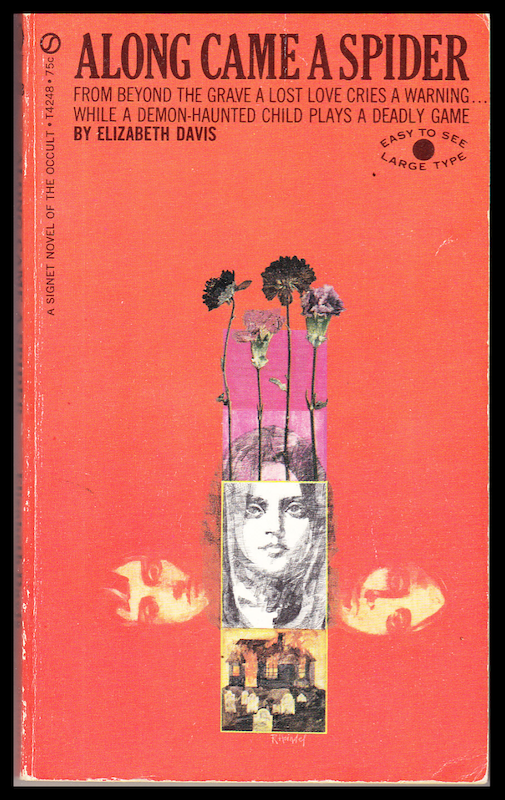
ALTERNATIVE CLASSICS: Along Came a Spider - Elizabeth Davis

I'm putting the sinister back into the Pretty Sinister Books blog this month as I tear through a pile of old horror novels and detective novels with supernatural and occult content.  Today's post also touches on the 1970s mania of the demon child in popular horror fiction.  I've read so much of this kind of book over the 11 years this blog has been around that I've finally decided to create yet another tag to label them all. If this is a subgenre in horror and mystery fiction that lights your chandelier you can click on the "Demon Child" tag at the end of this post and read more about them, perhaps find some obscure books dealing with killer children and demon-like adolescents.

Last month I had a mystery novel that incorporated a demon child motif -- well, more of a precursor to the Bad Seed trope -- in I Am Afraid (1948).  Today we go from the sublime and restrained domestic horror of that book to the outrageously ridiculous, horror bordering on parody in Along Came a Spider (1970).

Stephen, the nasty tween in I Am Afraid was 11 years old.  The bad kiddo in Elizabeth Davis' novel (apparently her sophomore effort in horror fiction under a second pseudonym) is remarkably only 9 years old. I found it incredibly hard to believe Anne Bishop, the evil little girl, was this young because for much of the book she comes across as a 45 year-old worldly wise woman.  But as you get to the the over-the-top finale our narrator posits her theory of why little Anne is such an adept sorceress.  She's basically the Wolfgang Mozart of black magic.

However, I'm getting way ahead of myself...

Davis's 2nd occult novel deals
with witchcraft and reincarnation
Inspired no doubt by Rosemary's Baby (1967) which almost single-handedly launched this new subgenre about children spawned from Satan and children possessed by demons, Along Came a Spider has been overshadowed by more well known (and better written) books employing this popular and by now hackneyed horror motif.  We have a wiseacre of a narrator in Eve Mercer whose colloquial voice is filled with idiomatic speech, sarcastic asides and a quasi stream-of-conscious narrative style that works against the suspense when Davis allows Eve to constantly interrupt her own thoughts. The narration is punctuated with dashes and ellipses as Eve trails off from one thought to the next like a distracted housewife running on a permanent caffeine high of extra strength Maxwell House.

The plot?  The Bishop family have moved in across the street and Eve fears her daughter Laurie has fallen under the diabolic influence of creepy little Anne, a primly dressed, too polite, too aloof miniature adult in the guise of a 9 year old girl.  Eve's first high-strung reaction to her daughter's new found friend comes when she learns that Anne is adept at painting. Laurie describes these paintings as nightmarish images of brutish monsters and other weird things she's never seen before.  They're so gory they look like they might have been painted with blood.  But Anne dismisses what was intended as an exaggeration by telling Laurie you can't paint well with blood. "It clots," says Anne's voice of experience, "and won't go on too smoothly."

The absurdity has entered the story early, my friends. This is only page 40!

There is an element of a detective novel in the story when Eve learns that the Bishop family knew a friend of a friend of a friend.  And so she hunts down some phone numbers and makes a couple of phone calls.  She reaches the boyfriend of a girl who died in an automobile wreck recently.  The young man tells Eve that his ex-girlfriend lived in the same building as the Bishops and ran into little Ann one day at the trash chute in the hallway. Anne was startled as she tried to shove something down the chute and quickly ran off leaving the object stuck. The now dead girlfriend went to see what Anne was trying to get rid of and found a mouse crucified on a handmade wooden cross.

It only gets more insane from here on.

There are strange rituals that Anne teaches her playmates. A girl dies in a cemetery but not before uttering a mysterious dying message.  Laurie begins to act strangely.  She has nightmares, disappears from her bedroom and can't be found late at night. Eve continues her detective work by consulting books on witchcraft and demonology and learns that Anne has been teaching Laurie and the other girls the ABCs of summoning demons and makes sure she is nowhere in sight when those rituals are being performed.

Ultimately the book is self-defeating because Davis allows Eve's hysterical imagination to get the better of her too often. The narration grows increasingly hyperbolic and her frequent wisecracks undermine the horror making it all seem like a black comedy.  Eve is also susceptible to superstition and imagines that her husband Jim who recently died has come back from the dead. He sends her warnings in her dreams, she hears his voice intoning "Move away! Take Laurie with you!"  Unfortunately as soon as that ghostly element is introduced Davis never follows through. Jim's ghost literally fades away as soon as he almost appears never to be talked of again. Davis seems to be suggesting that Eve might be headed for a nervous breakdown. Are we to think that Anne is innocent of all that Eve imagines her to be doing? The preposterous finale extinguishes that doubt as quickly as a sorcerer blowing out a scented black candle. But you must discover that on your own...if you dare.

You can read for yourself how this madness unfolds and whether or not Eve is a nut job or Anne is the spawn of a demon by buying one of the many copies available for sale out there in this vast shopping mall we call the internet.  I turned up about a baker's dozen in both English and foreign language translations.  It's an odd book, entertaining to be sure in an Alternative Classic way, but never really frightening at all.

Elizabeth Davis was born Lou Ellen Davis in Pennsylvania and raised her family in Connecticut.  Her fascination with witchcraft and psychic phenomena led to two other novels of crime and occult:  Suffer a Witch to Die (1970) and There Was an Old Woman (1971).  The 1971 novel was adapted for TV in 1972 and re-titled Revenge!  The made-for-TV movie has a script by Joseph Stefano (best known for his screen adaptation of  Psycho) and stars Shelley Winters (in one of the many badass biddy roles she succumbed to in middle age) and Bradford Dillman.

Saturday, March 19, 2022

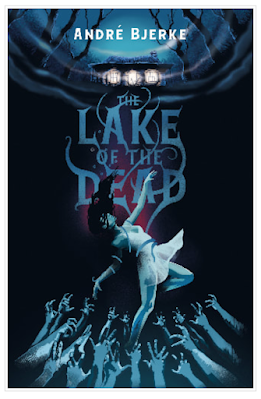
The Lake of the Dead - André Bjerke (and another giveaway)

"Let's summarize:  A lake that sucks people into it, an invisible phantom that screams and leaves footprints, a crazed double murderer on the loose, wandering around desperately in the dark of night. You might indeed say this is a fitting atmosphere for a psychoanalyst."

-- Gabriel Mørk in The Lake of the Dead (1942)

Is there anyone out there who knows of the existence of Bernhard Borge, the Norwegian author of four eerie detective novels tinged with horror and supernatural elements?  Unless you grew up and read Norwegian popular fiction I doubt it.  Borge is the pseudonym of André Bjerke, a well regarded poet who dabbled in crime and detective fiction during the 1940s. According to James Jenkins' extremely informative intro in this new English edition of the second Borge mystery novel I learned that it was Bjerke who is behind the Borge alter ego.  Jenkins, publisher and founder of the excellent small press Valancourt Books, also serves as translator for the first English edition of what has been deemed a classic in horror and crime fiction by Norwegain readers.  The Lake of the Dead (1942), or De dødes tjern as Norwegians know it, consistently appears on "Best of..." lists as the best remembered classic Norwegian mystery novel. Astonishingly, at one time it outranked even the work of modern Norwegian bestselling crime writer Jo Nesbó.

Let me add a clarifying bit to that statement about Norwegian readers only knowing about The Lake of the Dead.  The book was so popular that it has been filmed twice. It's first cinematic adaptation in 1958 with a screenplay by Bjerke (and featuring the writer in the role of Gabriel Mørk) is still available online from Sinister Cinema in a DVD with English subtitles. If any English speaker does know about the story it is probably because they have seen the movie rather actually reading the original book.

But to the book itself!

Anyone who craves the kind of detective novel that incorporates impossibility and apparently supernatural aspects will get more than they ever bargained for in The Lake of the Dead.  It easily stands beside the mystery novels of John Dickson Carr, Hake Talbot and Eric Harding's Pray for the Dawn for its eerie atmosphere and use of grisly legends. Each time Bjerke describes the lake and its surrounding forest the book amps up the horror and the macabre. All senses are employed as the reader is transported to the Norwegian haunted lake with the stench of rotting marshes, the croaking of frogs "as if calling from the abyss" and the miasma of fog that seems interminably wrapped around the perimeter of its waters.  Paranoia and terror infect the inhabitants of the cabin by the lake recalling the fear of the guests of U. N. Owen in And Then There Were None as they try to prevent more of their number becoming victims of the ghost that lures people to their doom in the lake's haunted waters.

And there's more to draw in fans of Golden Age detective novels here. Like the Philo Vance series Bjerke creates a narrator character along the lines of S. S. Van Dine. Bernard Borge is not only the author of his detective novels he is the narrator.  Borge is paired up with psychoanalyst Kai Bugge who serves as the real detective of the books in which he appears.  According to Jenkins' intro Bugge serves as detective in three of the four Bernhard Borge mystery novels.

Borge opens The Lake of the Dead with a bemoaning monologue in which he tells a group of friends that he is suffering from writer's block and is about to give up on writing altogether. We learn that Borge is a mystery novelist and his friends dare him to tackle a real mystery and challenge his failing imagination. His lawyer pal tells a story about a haunted lake where ages ago a crazed man grabbed an ax and chopped up his cheating wife and her handsome male lover, dumped their bodies in the water, then committed suicide by drowning himself. One of the friends, Bjørn Werner, has recently rented the shunned cabin by the shores of that very lake. The friends decide to visit for a weekend and hope that Borge will be inspired by the haunted locale to write his next mystery novel. When they arrive Bjørn is nowhere to be found, nor is his pet dog he took with him. They discover footprints leading  to the water but none that return to the cabin. It appears he was lured to the lake and disappeared. Or did the ghost of that mad murderer drag Bjørn down into the lake’s rumored bottomless depths?

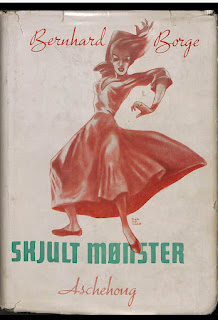
3rd Borge novel, English title:
Dead Men Come Ashore (1947)
The novel features all sorts of intriguing horror set pieces including a sleepwalking damsel in distress, one attempt on another person's life, a near impossible break-in at the cabin, and --of course-- one genuine murder. Borge and Bugge are like GAD versions of Mulder and Scully, with Borge slowly but surely taken in by the occult lectures he hears from Gabriel Mørk while Bugge is the resident skeptic examining each supposedly ghostly manifestation and other-worldly event with the eyes of a rational scientist. But he's also a psychoanalyst and an avowed Freudian. He's not going to completely abandon his training and career mindset. Part of the most crucial evidence is found in handwritten notes Borge finds detailing one of Bugge's client's dreams. Together they also find Bjørn Werner's diary, the work of what appears to be a raving madman which also includes some bizarre dreams written down. Kai Bugge reminds Bernhard Borge that one of the greatest tools of any psychoanalyst is dream interpretation and he will use his Freudian training to glean from these dreams a more thorough understanding of Werner's troubled soul. Dream interpretation becomes key to helping solve the mysteries, not as bizarrely as Moris Klaw does in Sax Rohmer's Dream Detective mystery stories, but rather as a psychoanalyst approaches his work with patients. 

There are other ingeniously planted clues, much of it related to psychology and psychoanalytic observations. In this regard The Lake of the Dead is reminiscent of the mystery novels of Helen McCloy whose psychologist detective Basil Willing also acted as a police consultant by using his career training to help him understand the psyches of the suspects and the victim. Similarly, readers might recall the Freudian ramblings of Mrs. Bradley in the mystery novels of Gladys Mitchell.  I get a sense from Kai Bugge's character and his intense theorizing that Bjerke understood psychoanalytic methods much more in depth than Mitchell's often specious psychology when it cropped up in the Mrs. Bradley books.

Borge's 4th & final novel
English title: Hidden Pattern (1950)
This excellent mystery novel packs a wallop in the final pages. I want to bring up one final analogy but will have to be circumspect in doing so. Those who come away either gasping in awe or at least raising their eyebrows when reading the penultimate revelatory chapter ought to know that while it may appear to be unique and brand new it is not wholly original on Bjerke's part. The bizarre murder method and motive were both first introduced in a minor classic of English language detective fiction back in the Victorian era.

Whether you are keen on Carr-like supernatural elements, the battle between the true believer in other-worldly events and the rational scientist, or enjoy a detective novel that plumbs the depths of psychological mysteries that lead to crime The Lake of the Dead has a lot to offer. Jenkins is to be commended on his discovery and for making at least this one Borge mystery available to English language readers.  I certainly hope we have not seen the last of Bernhard Borge and the fascinating psychological detective Kai Bugge.

The web page for Valancourt Books edition of The Lake of the Dead will lead you to various other web pages where can purchase a copy.  Or you can enter my giveaway by leaving comment below. That's right I'm giving away two copies of this new edition!  Just tell me anything about a forgotten foreign language mystery or horror novel that you think we all ought to know about - translated into English or not. No geographic restrictions this time because I'm having Amazon ship the book to you!  [Why didn't I think of that before?]  So enter away and leave me loads of comments every one of you out there.  This new edition is really is a cause for celebration.

Saturday, February 26, 2022

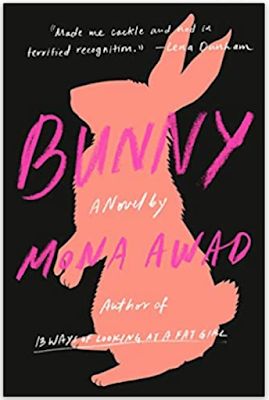
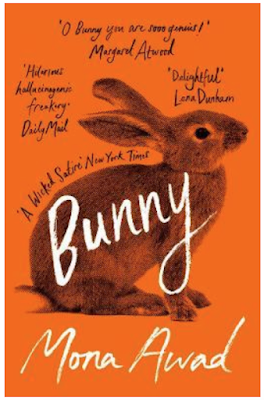
NEW STUFF: Bunny - Mona Awad

What if those stuck-up teens in Mean Girls and the snobby clique in Heathers made it to grad school in order to pursue a master’s degree in creative writing? And what if those girls then decided that their creative powers extended beyond the printed page. So much beyond mere typing or scribbling with a pen that they indulged in witchcraft filtered through a kind of Victor Frankenstein egomania? You’d have Bunny (2019), Mona Awad’s academic satire and utterly bonkers witchcraft novel, a book as far from cuddly and cute as that title implies.

Samantha Heather Mackey (see that wink-wink allusion to the Daniel Waters’ screenplay?) is the protagonist, an MFA candidate and the outlier in a coterie of young women all seemingly clones of each other. Her fellow writers call themselves Bunny and are the most obnoxious clique ever to have been created in either novels, TV or movies. Their saccharine sweet adoration of one another outdoes the clinginess of the Heathers. Samantha loathes them but of course secretly wants to be part of the group. And so when seemingly out of the blue Samantha is invited to a private writing workshop the Bunnys call their Smut Salon she accepts against her better judgment and the advice of her best pal Ava.

The Smut Salon is an extension, albeit a soft core porn version, of the pretentious nonsense they are subjected to in their writing seminar. In essence it's nothing more than a sharing of sex stories, but the kind of giggly girl stories you’d get from inexperienced pre-adolescents, not young adult women in graduate school. The Smut Salon is only one aspect of their life outside the classrooms. As the novel progresses, we discover their desires and obsessions with creativity manifest in sinister rituals that defy the outrageous spell work seen in TV shows like The Craft, Charmed and Buffy the Vampire Slayer. This is the work they do in Workshop, capital W mandatory. The Bunnys are toying with a supernatural method to create life and in keeping with their Smut Salon obsessions they keep creating young men. They are not referred to as boys, however. To the Bunnys they are Hybrids or -- fittingly -- Drafts, mere works in progress as befits the work of a writing Workshop of course. And in the maddest bit of twisted imagination Awad has them create life from another form. The word "alchemy" is overused in MFA programs to discuss the supposed magical quality of writing fiction and Awad grabs a hold of that transformation metaphor and turns it into an absurdity. The Bunnys create life from their own namesakes – cute rabbits they capture from the bunny infested campus grounds.

I told you this was bonkers! It’s also deliciously creepy and madly funny and at times sorrowfully moving.

The catch to all this delving into the dark side of creation is that the Bunnys are not very good at either writing or creating life. In Samantha they see their opportunity to bring someone better at creation into their fold and test her. On the surface however, they belittle her work in the seminar and they make it appear they are going to model shape and improve her underappreciated talent outside of the classroom. We all know that the reverse is true. That just as Samantha envies the close knit friendship among these clannish clones they also envy her outsider status, her individuality and her darkly attractive fiction that actually has a plot.

Awad’s brilliant ironic touch is shown in the men the Bunnys conjure from cute rodents. On the outside they may be gorgeously handsome and resemble movie stars, athletes and rock musicians the girls fantasize having sex with but they are broken and flawed. Their hands never fully form nor do their genitalia. And so they appear to the Bunnys in handsome blue designer suits but wearing black gloves to cover their stumpy clawlike paws. They are never able to actually touch the girls with real fingers or fulfill their desires with a real sex act. It’s a brilliant touch on Awad’s part. Just as the Bunnys passive aggressively critique Samantha’s writing for lack of a character development these girls clearly haven’t mastered that skill in their attempt to create human life in their gory rituals.

When it’s Samantha’s turn to whip up a Hybrid or a Draft she not only surprises herself but shocks the Bunnys. It’s the beginning of the end of the group, a sinister revenge begins to formulate far beyond the reaches of Samantha’s own warped imagination. And the Bunnys never see that the tables have turned and they are being victimized at their own games and rituals.

Bunny seems at first to be just another academic satire. Mean Girls Go to College, might be an apt subtitle. But those rituals change the entire focus of the book. At first I was utterly bamboozled by the fantastic elements of the Hybrid Workshop and the strange literature quoting things resembling good looking young men. It’s this linking of creative writing with creating life as a wish fulfillment for desire and love that makes the book worthy of attention. In years to come I imagine that Bunny will achieve the kind of cult classic status as similar books that explore twisted creation and perverse pursuit of love like the still noteworthy, unclassifiable novel of the fantastic Geek Love by Katharine Dunn.

Bunny has been compared to Heathers, The Secret History by Donna Tartt, and the movie Jennifer’s Body. Awad’s book has so little in common with those other works. The Heathers analogy is obvious of course, but this book is not so much about individuality vs. group identity or the need to belong or popularity or anything remotely like that. It’s really about the dark force of untethered imagination, the danger of an indulgent fantasy life. Why no one has ever mentioned Frankenstein, Geek Love, or even the charming fantasy novel Miss Hargreaves is beyond me. Ultimately, Bunny is simultaneously a love letter to and a dire warning about the power of imagination. For any person who has ever heard a parent, a friend, or anyone say “Stop pretending!” or “Get your head out of the clouds” or any number of warnings to snap out of it and get back to reality Bunny has a lot to offer, a lot to teach. Real life can be so much more rewarding if we only open our eyes and see what’s right in front of us rather than imagining what we think might be better for us.

Monday, September 27, 2021

GIVEAWAY: Pray for the Dawn Released!

Two book giveaways in one month?  What is the world coming to?  (BTW, there was almost a third,...but I'm saving that one for October) For that matter what is this blog turning into?  Seems as much as I've eschewed all forms of social networking, I've succumbed to what the internet does best and become yet another self-promotion marketing machine, my friends. Sorry to disappoint.

I'm happy to hear from at least one of the previous book giveaway winners that the last prize, a copy of A Case for Solomon by Bruce Graeme, proved to be:

"...brilliant. Apart from being a true bibliomystery, it also pulls off one of the best plot surprises/twists I have come across. Thank you for introducing me to such an inventive and innovative series."

 And I can assure you that Pray for the Dawn is just as innovative and surprise filled. Just released from Ramble House last week the new edition of this EXTREMELY scarce book is available nowhere for free online and has never before been reprinted until this year  Here's your chance to win a brand spanking new, hot off the laser jets, copy.

Those who may have read my rave review back in April already are prepared for pulpy horror, genuine thrills, and paranoid ravings from terrified characters who are trying to survive the weekend in creepy house on an isolated island. Paranoid and terrified because they are at the mercy of a murderous and apparently revived corpse. And it's a detective novel to boot!  What do you need to do to win a copy? Just this...

Leave a comment and name your favorite mystery about a group of strangers stranded somewhere at the mercy of a crazed killer. I have two copies and will award one each to two different people. This new edition with an attractively gruesome cover illustration by Gavin O'Keefe also comes with an informative and amusing Afterword by Yours Truly done in a suitably offbeat Ramble House style of banter and wisecrackery.

1.  Open to all readers who live in the USA, Canada or UK.
2.  Winners must provide me with a legitimate email address and name (or nickname) when they leave the  comment.  Comments marked Anonymous or Unknown are not eligible.
3. Winners will be contacted by email and then must provide me with a legitimate shipping address in one of the three countries listed.

CONTEST CLOSED. 

Friday, March 12, 2021

FFB: The Crime in the Crystal - Robert Hare

THE STORY: Portrait painter Elton Cleeves sees a vision of his nephew he before the man is found dead. Cleeve’s vision showed his nephew grasping one wrist then holding the other arm outstretched before collapsing. Minutes later Cleeves receives a telephone call informing that his nephew’s body has been found in a wood not far from the uncle’s home, he has been clubbed to death, a wound to the left temple and a bruise on his right wrist – exactly as in the painter’s vision. Believing he is clairvoyant Elton begins to investigate the crime by psychic means. He consults a crystal ball and believes he has seen The Crime in the Crystal (1933)

THE  CHARACTERS: His physician Dr. Adrian Berwick is concerned for Elton’s mental health. He thinks the elderly man is crumbling under stress and suffering from hallucinations. Adrian confiscates the crystal ball and keeps a watch on his patient. A physical examination raises concerns about the possibility of poison. Berwick does some sleuthing by analyzing chemical properties of Elton’s art supplies and uncovers a shocking plot.

Meanwhile Inspector Gearing is beginning his investigation of Dr. Michael Cleeves’ murder. Though the many routine interrogations we learn that Cleeves, the nephew, was an intolerable hedonist, nearly always drunk, gambling, and leading a libertine’s life. Uncle Elton lost all respect for his nephew, had turned his back on him and instead focused his attention and affection on his grandniece, Helena, the physician’s daughter. There are two guests of the physician who have moved into a small cottage on the Cleeve’s estate and they have had an insidious influence on Helena, normally a simple conservative young woman, almost a relic of the Edwardian era like her great uncle, she is surrendering to her father and his guests’ wild pursuit of cafes, bars and urban nightlife. Uncle Elton convinces Insp. Gearing that these guests, a brother and sister named Vincent and Irene Youles, have had a hand in his nephew’s death. Vincent has been paying extra attention to Helena with the intent of proposing marriage. Irene had been flirting with Dr. Cleeves and seemed to be thinking the same. The Youles, Elton tells the police, are nothing but “avaricious adventurers” and he is certain they plotted to do in the doctor hoping that Helena would inherit his money.

The joke’s on them, however, for Elton had several weeks ago disinherited Michael and made Helena his primary beneficiary. This makes the possible poisoning of Elton Cleeves all the more sinister. It is entirely possible that the Youles are so eager to marry rich that they will murder anyone who stands in the way of their plot to gain control of Helena’s money.

INNOVATIONS: Gearing and Dr. Berwick make an interesting detective team. Berwick with his scientific mind and a clearheaded common sense outlook contrasts with the near inhuman determination and obsessive mind of Gearing. Amusingly, Berwick tutors himself on “Investigation, Criminal” by reading a lengthy entry in an encyclopedia in the Cleeves library. He looks to this anonymous article as his inspiration to find the killer of Dr. Cleeves’ and the poisoner trying to murder Elton Cleeves.

All the while the idea of clairvoyance, omens, messages from beyond and the ability to have visions about the past and future haunt both Dr. Berwick and Elton Cleeves. A watercolor portrait of what appears to be Helena as a child turns up, but the date of 1885 proves it cannot be the grandniece because she was not born until 1911. Is it possible that this painting is also proof that Elton has some psychic gift? Could he have foretold the birth of his nephew’s daughter decades before she was even alive?

QUOTES:   All things are born and make their first growth in the dark, and premature exposure may kill them. So it is with ideas.

Was not the whole world made up of strange and extraordinary things which only the dullness of our senses had reduced to the level of the drab and commonplace?

The reawakening of memory! he pondered upon that, and with the thought there came -- as though it had sprang from the crystal itself -- an idea as startling in its inception as it was terrible in its implications, a supposition not quickly to be set aside. The shadows which darken the corners of a room...have a disturbing quality in their shapelessness which induces the beholder to clothe them with images of his own creation; because there is nothing we fear so much as a thing without form. ...[A]re they real, or must we account them the unnatural vapors of a disturbed imagination? For it is to be remembered, Adrian realized, that there are shadows in the corners of the mind as well as in the rooms of an old country house.

SUMMATION: The Crime in the Crystal is the first of three works of ingenious crime fiction by American writer Robert Hare. It’s a remarkable debut, such that in marketing the book Longman’s managed to get bestselling detective novelist J. S. Fletcher to write a laudatory foreword in which he succinctly describes why the book is a noteworthy contribution to the genre. Fletcher summed up Hare's work: "The highest praise that can be given to this first effort is to say that here is a story not only worth telling but told in really distinguished fashion." This is no hype, circa 1933, it's 100% accurate.

Hare’s second novel was an equally praiseworthy amalgam of inverted crime novel and detective novel The Doctor’s First Murder (1933) He rounded out his trio of works with The Hand of the Chimpanzee (1934), an over-the-top homage to weird menace stories of the 1930s pulp magazines like Dime Detective that nevertheless is an ingeniously plotted, albeit lurid and outlandish, traditional detective novel. I have recently discussed ad nauseum all three of these books in the "In GAD We Trust" podcast about rare and hard to find books that deserve reprinting. Having finally read the first of this trio of highly inventive and imaginative detective novels I will just reiterate what we’ve all said many at time: Will some enterprising publisher please reprint these books? Thank you.

Friday, January 15, 2021

Herald of Death - Max Dalman

THE STORY: Sound the bugle! Mount your horses! The fox hunt has begun. But this fox hunt ends with a decidedly different killing. Richard Marney is found stabbed with an ornate stiletto just short of an infamous hazard requiring skillful horse jumping maneuvers known as The Cliff. Suspicion falls first on Hugh Egmont, rival for the affection of Joan Marney, Richard’s cousin. Police investigation uncovers a history of other Marney family members having recently died in violent accidents. When Joan is attacked late one night the police begin to think that a killer is intent on murdering the entire Marney family.

THE CHARACTERS: Anonymous letters with cryptic statements using heraldry terms turn up a few days before Marney is murdered giving the book its title Herald of Death (1943). A letter sent to PC Retters seems to predict the death at the fox hunt though the message is worded nebulously, almost in riddle format. Luckily, there is an expert in heraldry in town who helps Retters make sense of the message which seems to hint at future deaths.

Egmont also receives a message telling him the hunt was cancelled the day of the murder, a tactic of reverse psychology that guarantees Egmont, known to be an avid hunter, would be sure to investigate. And so instead of not attending, Egmont makes sure he gets on his horse and rides the usual course. His timing couldn’t be worse, however. As soon as he shows up at the scene of the crime -- the perilous area known as The Cliff -- the police are there investigating what they think is a horse riding accident. Close inspection of Marney’s body reveals the oddly placed stab wound,

Charles Marney, Joan’s father who is in financial difficulty; Mrs. Handley, a mystery novelist; and Retters are the most interesting characters in the book. I vaguely remember an eccentric vicar in the mix, he appeared in only a few incidents at the start of the book, but since his name doesn’t appear in my notes I don’t think he had much to do with the story at all. Everyone else is a stock character of no real dimension – officious policemen, indignant heirs, several garrulous villagers, a pair of gossipy servants, and Joan as the requisite damsel in distress who anyone knows is completely innocent of anything and exists only for love interest and to have her life threatened once or twice.

Overall, the novel is intermittently engaging especially when PC Retters is on the scene. Rarely do we find police constables proving to be the smartest and most abstract thinker among the detectives in novels of the Golden Age. There are perhaps too many detectives in this book and I didn’t care much for the main sleuth Inspector Lyly. I wasn’t sure who I should be paying attention to – Lyly, Supt. Leyland or Retters who Dalman makes not only clever but slightly sinister. For a while I thought Retters had sent all the heraldry letters as an obfuscating distraction.

INNOVATIONS: Some well done scenes feature an eerie presence only heard and never seen. A horrid mournful screeching is heard in the night and at one point Joan is menaced and followed by this apparently invisible thing in the night. Cats are featured in the story and might appear as red herrings to all but the most astute reader. Dalman can be effective in creating atmosphere and chilling the bone in these quasi-supernatural sequences. He almost succeeds in making the reader believe some fantastical creature might be involved in the various deaths that occur. When the true explanation for the mysterious screeching comes in the final pages it fails to achieve the desired effect and comes almost as an anticlimax. Certainly nothing as chilling as what John Dickson Carr might have come up with.

This novel reminded so much of The List of Adrian Messenger by Philip Macdonald. Both feature a fox hunt and a family decimation plot similar to The Greene Murder Case, Israel Rank and other crime novels with rich families being murdered one by one. The difference with Dalman’s book is that the motive for murdering the Marneys is not made known in full until the final pages. There is an incident in the past mentioned two or three times over the course of the story that stuck out like a bloody thumbmark and made me think I knew exactly who the killer was and the motive for all the deaths. However, the actual “how” as applied to that character in relation to Richard Marney’s murder made no sense. As it turns out I was correct in my tagging the killer. Dalman is mostly good at misdirecting the reader over the course of the book until he overplays his hand with a monologue from the culprit that is intended to be a solution of the crime pointing the finger at another, but in effect turns out to be a confession. As such this is a clever way to attempt to trick the reader, but as it comes towards the end of the book it was too late for me. I had already seen through his flimsily veiled illusion several chapters before.

The overall narrative is also disjointed with no real flow of action. I found it to be repetitive and cyclical. The police revisit the scene of the crimes multiple times, suspects are re-interviewed, and the story is rehashed and repeated. Actual progress only comes in a rushing deluge in the final pages.

The unsurprising reveal of the murderer and a weak explanation of the eerie screech made this just a middling story. It falls well below the promise of what I discovered in Poison Unknown (1939), Dalman’s fifth mystery novel. Herald of Death is from the tail end of his writing career, the twelfth of a total of fifteen books. Maybe his first books are the ones to read. Are the later books lesser works? Had he lost his touch towards the end of his career? Three more Max Dalman mystery novels await me – one before this one in his chronological bibliography, and two right after. I’ll soon see if he’s a true discovery among the many neglected writers I write about here or if he is one of the many hit-or-miss writers who belong in the Hall of Ignominy in that ever growing annex of Forgotten Writers in the Golden Age of Detection.

Monday, April 13, 2020

HORROR SHOW: Tiger Girl - Gordon Casserly

Despite the subtitle on the original first edition cover of this genuine supernatural novel Tiger Girl (1932) is not really a love story. But is most definitely set in the jungles of India. True, there is an underlying love triangle being played out between two men vying for the attention of the young woman, but it is not the focus of the plot. Why it was marketed as a romantic love story amazes me. Anyone hoping for a hearts and flowers traditional romance would have been sorely disappointed -- most likely appalled -- at what they found in the pages of this outlandish ghost story. Here's just a sample:
  • Vampiric gray-furred tiger
  • Demonic female phantoms
  • Reanimated corpses
  • Astral projection
  • Telekinesis
  • Death by mind control
  • Cult that performs human sacrifice
Personally, I was not expecting a love story at all. And I was genuinely thrilled with what I found in this enthralling and thoroughly researched work of supernatural fiction. More thrills than I ever expected, in fact.

Alan Stuart is our hero, Margery Webb our plucky heroine, and Morton, Stuart's rival and the novel's human antagonist. When a a grey skinned tiger invades the Indian tea plantation owned by Margery's father Stuart turns hunter determined to track down the man-killer. He is warned by the superstitious locals that this will be no easy task for the tiger he is looking for is not an animal but a demon. Legend has it the shaitan kills only women and drains their bodies of blood. Bullets do not seem to harm this predator as Stuart soon finds out in his several battles with the phantom beast.

Meanwhile Morton plots revenge after he is spurned by Margery who he was hoping to marry. Morton allies himself with a powerful yogi who practices black magic and has paranormal skills including astral projection and the ability to revive corpses. Stuart must also contend with a mad elephant on the rampage and a bizarre religious cult that worships Kali for whom the tiger acts as a sort of human sacrifice delivery service.

A scene in which a minor character who, while looking for the rogue elephant hides himself high in a tree, witnesses the cult's ritual ceremony is one of the most gruesome in the book. But the climax of the book surpasses the cult sequence with genuine horror and follows with several scenes of more mystery and supernatural incidents. The action keeps building to an unnerving finale with a completely unexpected twist similar to something one might encounter in a murder mystery.

Tiger Girl has been one of the most elusive supernatural thrillers for decades having been out of print for over seventy years. Vintage copies are difficult to track down or absurdly priced when they ever so rarely turn up for sale. Thanks to Bruin Asylum and the efforts of some savvy collectors of supernatural fiction there is a new and affordable edition of this minor classic. Bruin Asylum's reissue has a brief but detailed biography of Gordon Casserly, highlighting his military service and life in India, as well as discussing his handful of adventure and supernatural novels. The new edition ends with an appendix consisting of an engrossing chapter from Occult Science in India and Among the Ancients (1875) by Louis Jacolliot, a non-fiction work briefly mentioned in the novel's story. His writing is just as evocative, fascinating and thrilling as Casserly's fictional story.

I urge fans of  forgotten supernatural and horror novels to buy a copy of this formerly out of print minor masterpiece. This attractively produced volume proves that it really was worth the long wait to have a new copy at a very affordable price.