Showing posts with label Crime Club. Show all posts

Wednesday, November 26, 2025

Poor, Poor Yorick - Frederick C. Davis

THE STORY:  Cyrus Hatch is invited to a cocktail party at the home of Marcia Clay, his former fiancee from their college days. When he arrives the apartment is filled with people none of whom Marcia invited. The party was as much a surprise to her as the invitation was to the guests. She tells Cy she had to make emergency order of food and liquor for the dozens of people who she was too overwhelmed to turn away.  She also tells Cy that she was just about to leave for Reno to divorce her husband. While Cy puzzles over the strange instant party thrown by some anonymous host and why it was arranged Marcia goes to her bedroom to finish packing. But she doesn't return Cy and his bodyguard break into her bedroom to discover she's been poisoned and a man is escaping via the balcony. Marcia is saved in the nick of time. Then Cy discovers what appears to be a suicide note that includes a confession to a murder and ends with the unfinished sentence: "The body is hidden in ..."  Is Marcia a murderer and who was murdered and where is the body?

THE CHARACTERS:  Cy Hatch is our unwilling sleuth in this story. He doesn't want to get involved but having saved Marcia and being confronted with the odd suicide note that he is sure was forced out of her by the mystery man they saw fleeing the bedroom he ever so reluctantly finds himself drawn into a complex case. As he proceeds in his sleuthing he will locate a missing person and have a gruesome discovery of where the body was hidden. But Cy is also the son of Police Commissioner Mark Hatch who is fed up with his son interfering in the city's most unusual murder cases. He was already nearly killed in the first case (Coffins for Three) and was tampering with evidence in another. Mark warns his son he will not hesitate to arrest him and throw him in jail if Cy insists on playing detective or obstructing justice in this case.

Everywhere Cy goes he's accompanied by Danny Delavan, his bodyguard who was initially hired by Cy's father. Since then they've become friends of sorts and Danny does his best to give his two cents worth on the many puzzling aspects of the case.  For a former boxer I thought he was rather inept as a bodyguard.  Cy tends to throw the punches first and Danny ends up at the mercy of some of the more talented assailants. At one point a woman with expert fencing skills holds Danny at bay at the end of her épée! Speaking of boxing Danny will be competing in a comeback match at Madison Square Garden defending his title as welterweight champion. He never ceases to talk about how he will knock out his opponent in the first round.  He also has a seemingly endless supply of comp ringside tickets and he hands these out to anyone who will accept them. By the evening of the actual fight all of the primary suspects will show up at the Garden for a boxing match that will end in a bizarre bit of spontaneous violence and a confession from the murderer.

As for the rest of the cast we have:

Richard Clay - theater producer, husband to Marcia, in love with Elspeth and primary suspect. His photography darkroom includes a variety of chemicals including cyanide that turn up to have been used in several crimes. The lover's tetrahedron of Richard-Elspeth-Marcia-Ronald (Elspeth's husband) serves as a one of the most obvious motives for Marcia's attempted poisoning murder by cyanide.

Marcia Clay - Poisoning victim and the victim of what Cy believes to be a complex frame-up to get her accused of the murder of...

Ronald Dexter - husband to Elspeth Burridge. He is a failed actor whose most notable a role was as Yorick, in a burlesque of Hamlet. The skull was not a prop in that production. Instead, Ronald played the deceased clown wearing a full skeleton outfit. It was supposed to be a silent comic role but he literally fainted onstage in his debut and gave up a stage career immediately after. Marcia has fallen in love with Ronald and was planning to leave her husband for him.  In giving up the stage Ronald turned to financial chicanery and has a reputation for con artistry and double crossing his investors.

Philip Carden - a professional adventurer obsessed with treasure hunting which requires a lot of money to pull off. Consequently he's always looking for investors. Ronald and Richard were primary investors in Carden's latest project to recover treasure from a shipwreck off the coast of Florida. Carden is also in love with Elspeth. They did the fall in love at first sight malarkey and Richard Clay was well aware of their instant attraction for each other.

Nicky & Toni DeLancey - two married Italian emigrants who have started a school for teaching a special form of contract bridge. Nicky is a professional bridge player and often competes at the Domino Club where Cy meets...

Nelson Sayre - president of the elite Domino Club which charges an initiation fee of $1000 and then $500 annual dues. Cy thinks the place is a front for card playing gamblers.  Ronald Dexter was involved in a scheme at the club for finding new members and for each new member he acquired he got a kickback.  Dexter has his fingers in everyone's bank accounts. He also was very vocal with Sayre about not receiving his fair share of those "incentives" for new members. Sayre was threatened repeatedly by Dexter who was planning to expose the club for what it really was.

Ted Pella - ridiculously handsome aide to Sayre.  Cy feels Pella has a sinister side based on the supercilious smirk that never disappears from his face. Danny thinks Pella is one of those pretty boy hitmen and he's more than just Nelson's aide.

Gail Reynolds - I was never sure of this woman. She appears at every scene as if she was employed everywhere at once. Did she work for Clay at the theater or for Sayre at the Club?  I hadn't a clue. But her primary role by midpoint is as a romantic foil. She is pursuing Philip Carden making it clear she wanted him and would possibly stop at nothing to get him.

Agatha Burridge - Elspeth's mother. Typical imperious matron found in murder mysteries of this era.  She's also a zealous stage mother who does everything in her power to advance Elspeth's acting career.  Also she tries her best to orchestrate a marriage between Richard and her daughter. She's not above exploitation, manipulation and possibly criminal behavior to make the match a reality. But could she actually have murdered Ronald Dexter and hidden his body?

Elspeth Burridge - a cipher character. Yes, she's an actress. Yes, she's excited many men's libidos. But we never really know her. She exists solely in relationship to other characters. We only know of her through other people. Elspeth appears in only two brief scenes (both alongside her mother) and she barely speaks. But she is always talked about by the rest of the cast and seems to be involved in the primary motive for Dexter's death

ATMOSPHERE: Frederick C. Davis began his career as short story writer in pulp magazines and their influence is always notable in his early full length novels. They are action oriented, chock full of fistfights and other violence between men, and include several truly bizarre, over-the-top murders. The discovery of Ronald Dexter's body is straight out of the weird menace pulps. It might even recall the macabre touches of Edgar Allan Poe to well read aficionados of the great writer. Poor, Poor, Yorick (1939) not only has Poe allusions, but a Shakespeare allusion and Gothic elements galore. Davis also throws in one of my favorite Golden Age plot motifs -- knife throwing!  Check out the illustration on the first edition dust jacket up there at the top of the post. Richard Clay has converted an old wine cellar in his home into a game room including knife throwing targets and a complete set of professional quality knives designed especially for throwing. Everyone in the cast has tried their hand at tossing around those knives; some excel at the skill, others aren't so adept. Four of those knives go missing at one point in the book and they are used inexpertly in several more murder attempts.

The detective novel motifs are also put to good use. Cy and Danny have a lot to contend with besides the strange attempted murder of Marcia and the faked suicide note. Another note turns up supposedly written by Ronald Dexter and fro a while everyone thinks he's alive until Cy proves that note also is a forgery when he points out the discrepancies in the typewriting in the body of the message compared with the greeting and date. It was a note actually written by Ronald long ago and altered to appear to be written two days ago. He later finds the typewriter used to alter that message and it implicates the Sayre's staff at the Domino Club. Which person used the typewriter?  Or was it a member who broke into Sayre's office to use it?

Other puzzling aspects of the case: why were two dozen bottles of Chablis stolen from the wine cellar in Richard Clay's home? How did human blood get on a dart gun used to pull darts out of a dart board? Why were the shoes on Ronald Dexter's body put on the wrong feet? And most surprising of all -- quite a shock for me -- was the second murder that occurs late int he novel.

Leonarde Keeler and wife with his update
of the polygraph machine, circa 1935
THINGS I LEARNED: My knowledge of polygraphs was certainly enhanced by reading this book. Davis goes out of his way to lecture (via his erudite criminologist hero) on the science of the polygraph. He makes sure that Cy calls it a deception indicator and not a lie detector, then goes into great detail about how the polygraph he is using records changes in pulse and respiration rate which are known to increase and later when a person is showing signs of deception while communicating. 

Philip Carden delivers a four page length monologue on the history of sunken treasures and shipwrecks that goes on for four full pages. He cites historical instance with dates or successes an failures in this risky and dangerous hobby of those looking to get rich quick.  The most fascinating was the case of a diver who accidentally came across a legendary shipwreck known to have been carrying gold bullion. He later went back surreptitiously to recover some of the loot but was ignorant of an approaching hurricane. He had to abort the search. After the hurricane subsided he returned only to find the entire wreck was gone. The storm had either moved it or entirely buried it once again. 

During one of Cy's criminology classes at Knickerbocker College,
where he is assistant professor in the sociology department, he lectures his students on the concept of the perfect murder and how a large per centage of murders never are prosecuted simply because they are never known to be murders. But, he posits, if you have been arrested on suspicion of murder there are a variety of instances in the inherently flawed American trial by jury system that may allow you to get away with your crime.  He then gives multiple examples ranging from jury boredom or indifference (citing several examples from actual court cases) to impartiality from the judge. I didn't make note of all the examples because the lecture goes on five or six pages and was utterly engrossing. This part of the book may have been the most insightful  castigation of American justice system I've come across in a popular work of fiction. Nothing seems to have changed in over 70 years. In fact, it's only worsened.

Danny at the mercy of Toni's
fencing skills on the UK edition
EASY TO FIND?  Good luck finding one, my friends. Of all of Davis' detective novels this one seems to be the most elusive.  I had a copy sitting on my shelves for almost ten years before I finally decided to read it. And I had to read it quickly because I had just sold it from one of my many listing online. Now it's on its way to a lucky reader/collector. It was the only copy of Poor, Poor Yorick offered since I bought it. There are no copies offered for a sale online as of today's date. And I know of no reprints either. Perhaps someone uploaded the book to an online library.  I never bother looking for those. If you come across a copy in the wild, as it were, snap it up.  This book though elusive is highly recommended as an imaginative, entertaining, unexpectedly educational, and often surprise-filled example of a traditional Golden Age detective novel.

UPDATE!! As pointed out in the comment below this book was published in the UK by Heinemann as Murder Doesn’t Always Out. I found three copies of that edition for sale online. One is priced affordably but has no DJ. The other two are well over  US$300. I’m sure all three will sell soon. Happy Hunting! 

Saturday, August 2, 2025

IN BRIEF: The Cock's Tail Murder - Hugh Austin

A wealthy bachelor who breeds and rents his prize cock-fighting rooter is found shot to death, a bullet in his head, in the doorway to the coop where several chickens are missing, including Bolivar of Reynor, the prize cock. In a surreal touch a brightly colored tail feather is draped along the outside of his ear.  ANd so The Cock's Tail Murder (1938) begins.

If the reader is expecting to learn a lot about the exotic breed of fowl (Oriental Anseel as Austin calls them in the book, but actually known as Aseel or Asil these days) or the now outlawed practice of cockfighting he will be a sadly disappointed. All facts related to fowl all info dumped very quickly in the second chapter and rarely talked about again. Instead we get another one of Hugh Austin's fair play methodical, police procedurals which does more for furthering the world of cynical policemen than it does anything else.

Lt. Peter D. Quint is in his sixth case in The Cock's Tail Murder.  Savvy readers will notice his initials spell out PDQ, a nickname he's earned from his fellow cops for his no-nonsense, efficient approach to police work.  Thankfully he's less than the annoying ass he was in his debut, It Couldn't Be Murder! (1935), the only other Austin novel I've read out of the small collection of Austin books I've acquired. Quint's most notable trait is his irascible nature and for this penultimate crime solving adventure he's been considerably toned down. When faced with lazy thinking cops or witnesses and suspects who toy with him Quint tends to lose his temper. This quote sums up Peter Quint succinctly: "When [he] stepped from the car his pointless irritability had changed to a sharp impatience with anything that delayed him from getting down to business as quickly as possible."

Numerous police sergeants and lower level cops appear throughout the story. Very quickly we get to know the crime scene photographer, a fingerprint expert who is squeamish at bloody murder scenes, and a rookie cop eager to prove he is first rate detective material by noticing key evidence before any of his more experienced colleagues.  There is also a robotic, insensitive slob of a Medical Examiner who makes a quip about the death being a suicide revealing he's also lazy and likes to write off obvious murders to close the case speedily and move on the next. Quint deals with this sarcasm impatiently as expected. The M.E. wants to know when the victim ate his last meal and wants that info soon so as to make his required autopsy go easily and quickly.  Every time we meet another law enforcement agent or cop (with the exception of the excitable rookie) they turn out to be jaded and blasé.  Interesting that a pre-WW2 era American writer had picked up on this aspect of police work so early in the genre. I thought the jaded cop in fiction grew out of the 1960s and 1970s.

But even with the unusual background of a womanizing chicken fancier and the art of rooster breeding the unfolding of the action is routine and a bit plodding. The majority of the book is devoted to Q&A style investigative work.  While Austin has fun with narrative tricks like alternating POV, and prose summaries of interviews rather than dialogue, they don't improve the flow or amp up the excitement. On occasion he creates a highly dramatic scene so artfully done it comes as a real shock. An example: a Q&A with a husband and wife who Quint finds playing croquet in their front c garden. Walter Atwood and his wife are clearly not getting on very well. Acerbic dialogue reveals this but the manner in how the two play their game is even more revealing.  Walt swings his mallet like a golf club and when his wife complains about his violent method he counters that he's on vacation and he wanted to be on the golf course. Mrs. Atwood delivers barbs and implies she was seeing Victor Reynor, the murder victim, as more than just a neighbor.  Immediately after that comment Walt sends his wife's croquet ball sailing across the yard, bouncing off the curb and rolling down the street along the gutter.  She leaves the yard and silently chases after the ball as Quint leaves completely put off by their behavior.

Austin likes to alternate the point of view by leaving Quint and his team of policemen to follow the action with other characters.  This is an attempt to create suspense and dramatic irony.  Suspects have confabs about their lying and cover-ups prior to Lt. Quint discovering those lies. It doesn't really work effectively because those scenes are inserted into sections of the story where they actually impede the action.

One more thing that makes Austin's books novelty items is his announcement that they are fair play mystery novels. In fact this claim is emblazoned on the endpapers of most of his books which were published by Doubleday Doran's "Crime Club".  The most interesting aspect of this book is not really the murder and whodunit, but the mystery of who stole the chickens and what became of them. That part of the novel is legitimately clued rather cleverly and the fate of the chickens is perhaps the most surprising feature in the entire book.

Wednesday, May 21, 2025

Exit Screaming - Christopher Hale

THE STORY:  It's 3:00 AM in Avondale, Michigan and Jill Trent has been awakened by a bloodcurdling scream followed by the sound of four gun shots. Against her better judgment she goes outside to investigate and meets up with her neighbors Gene Ramsay and Mr & Mrs Truax.  They find blood on the cement terrace of the home belonging to Mrs. Warner.  But there is no sign of any person anywhere near these bloodstains.  Two more pools of blood are found near a barn.  And inside a feed barrel covered with glass bottles they find the body of Mrs. Warner.  Soon Sheriff Perry Simmons, ill equipped to handle a murder investigation and too busy with some cattle thieves, is forced to call in help from the Michigan State Police. Lt. Bill French shows up in his Rolls Royce coupe dressed in smartly tailored clothes and gets to serious work very quickly. Before the killer is revealed there will be an attack on a dog, an escaped cottonmouth snake, a missing chauffeur, numerous rifles as possible murder weapons, several phony identities and two more murders.

THE CHARACTERS: The action of Exit Screaming (1942) is mostly confined to Avondale, a small town mixing wealthy Michiganders with cattle farmers and country folk. The primary characters consist of:

Jill Trent - our intrepid heroine with a violent secret in her past. She seems like she might have tiptoed out of a Mignon Eberhart "woman in peril" mystery novel because she is always at the mercy of insane dangers. She survives several shooting attempts and the attack from the escaped venomous snake mentioned above. Though she may have a bandaged head wound for most of the book she proves to be not only intrepid but pretty damn smart unlike the often foolhardy heroines found in neo-HIBK novels.

Gene Ramsay - the requisite dark and handsome man with a mysterious past. No one really knows what he is doing in the cottage on the grounds of Mrs. Warner's estate. Rumor has it he's writing a book. Others claim he is a doctor who gave up his profession. But Gene isn't revealing what he does for a living or what he's settled in Avondale. He does have a rifle that matches the caliber of the bullets found in Mrs. Warner's body and that makes him Suspect # 1 in the eyes of Sheriff Simmons. Jill wavers in and out of suspecting him. Gene proves to be her savior on more than one occasion. Can he possible have murdered his landlady? And if so, why?

Randolph & Ivabell Truax - Mrs. Truax is more of a bogey character as far as I'm concerned and appears in only two scenes. Let's just skip over her. It's Mr. Truax who is of interest. A lawyer, another rifle owner and innately suspicious of Mrs. Warner, her mother Mrs. Lynch and the shifty chauffeur he seems to know too much about medicine to be a real professional driver.  Lt. French thinks Mr. Truax has too much of a lawyer's mind, but spurred by TRuax's seemingly outrageous ideas begins to dig into Mrs. Warner's past and uncovers some intriguing details. Notably that her mother died more than 30 years ago. Then who is the elderly woman living in the house?  Mrs. Warner claimed that Mrs. Lynch was her mother.  And what happened to Mrs. Lynch? No one can be found inside the Warner house since the night of the gun shots, the scream and Mrs. Warner's murder.

Minnie MacDuff - What would one of these mystery novels be without the garrulous, foolish town gossip. Minnie fills this role extremely well. A dress designer and seamstress by profession she makes it a habit of visiting her customers in their homes for frequent dress fittings and alterations. A convenience for her customers but also an opportunity for Minnie to pick up free lunches and snacks at tea time while dishing the dirt about everyone in Avondale and the surrounding area.  Her thirst for info on everyone makes her a target...or is that just a clever ploy?  I was sure she was involved in something. Hale paints Minnie as such a scatterbrain I was convinced this was a cover for a shrewd and devious women with revenge in her blood.

Mark Macduff - Minnie's invalid brother who is also a ham radio enthusiast constantly broadcasting from his bedroom. Minnie is overprotective of her brother. Anyone who reads mystery novels ought to be immediately suspicious of an invalid.  When Gene and Jill find mud-stained shoes in Mark's closet and burrs on his trousers it seems to indicate that Mark is shamming his inability to walk.

There are also a variety of dimwitted gossipy servants who supply Hale with an unfortunate opportunity to make fun of "stupid farm girls" but also an intriguing way to reveal the small-minded prejudices of privileged wealthy "upper class" types who make up the majority of the characters. I felt sorry for the Lamb women, Jennie and her niece Alma, the butt of insults and jokes, but who also are rather observant and catch things that their snobby employers dismiss as irrelevant.

ATMOSPHERE: Hale does a good job of setting a scene of a sinister countryside in the town of Avondale.  Though the residents think of it as quiet farm country where the wealthy can escape their past and start life anew, from the very first page violence intrudes and never leaves. Mrs. Warner turns out to have alternate life and identity and her chauffeur, as suspected by Mr Truax, turns out not to be a chauffeur at all.  The story is replete with violent attacks. Rifle shots going off constantly. Jill and Gene are shot at many times , windows are shattered on an almost nightly basis, and even a birdhouse becomes a symbol for criminal activity.  For a book set in the WW2 era this story resonates with our 21st century world of constant gunfire and random acts of violence. 

QUOTES:  Hale has a wry sense of humor and often she can dish out some acerbic wit. Here's a single sentence summing up the bigoted, not too smart, deputy who helps Sheriff Simmons: 

Verne Hoskins' well-weathered face looked as if he had been expecting the worst for years and hadn't been disappointed.

When French accuses Gene Ramsay of not being trustworthy because he has both lied and withheld vital information, Gene retorts: 

"But, damn it all, I'm not guilty of anything but being an ass, and they aren't arresting people for that yet or the jails would be full."

THINGS I LEARNED:  During one of Minnie's  gluttonous visits while she is chowing down on more free food she spills gravy on her silk dress.  She says, "Dear me, best silk, too. Guess I ought to try a little Energine..." I figured this was some type of detergent.  Actually Energine was a dry cleaning fluid made with naphtha, highly flammable, that was apparently in many homes. It was still being made as late at the early 1960s much to my surprise. The popularity of commercial dry cleaning operations that became all the rage in the 1970s eventually replaced the need for private individuals taking care of their stained clothing. In looking for photographs of this defunct product I was a bit horrified to learn that vintage bottles (some still full!) are being sold on eBay. Bizarre!

At the start of Chapter 17 Jill is served some coffee and ginger flavored cookies by one of the young policeman. She refuses the coffee but samples the cookies while waiting for French to question her.  Hale writes: "Jill went on nibbling at the gingery cooky. It was rectangular, with MARY ANN stamped on it. She felt she'd never again taste ginger without thinking of this moment."  I wanted to know if these were also real, but all attempts at internet searching for "Mary Ann Ginger Snaps" yielded absolutely nothing. I know that Lorna Doone shortbread cookies are still made with the name stamped on them. That's a very old cookie, kids! Introduced in 1912, the same year as Oreos, another cookie with the brand name stamped on it. I figured if a Mary Ann ginger snap existed it must've been from Nabisco, the company that sells both Oreos and Lorna Doones. Sadly, I failed to find anything about a ginger snap with ANY name stamped on them. Ah, well. Anyone out there have any clue?


EASY TO FIND?
  Only a few of Hale's books were reprinted in cheap editions outside of the original Doubleday Doran "Crime Club" hardcover.  Exit Screaming was one of them. Alas, both hardcover and paperback digest (see photo above at right) are difficult to find these days. I located three copies out there for sale at various online bookselling sites. Hurry if you want one. 

Wednesday, June 22, 2022

She Never Reached the Top - Elma K. Lobaugh

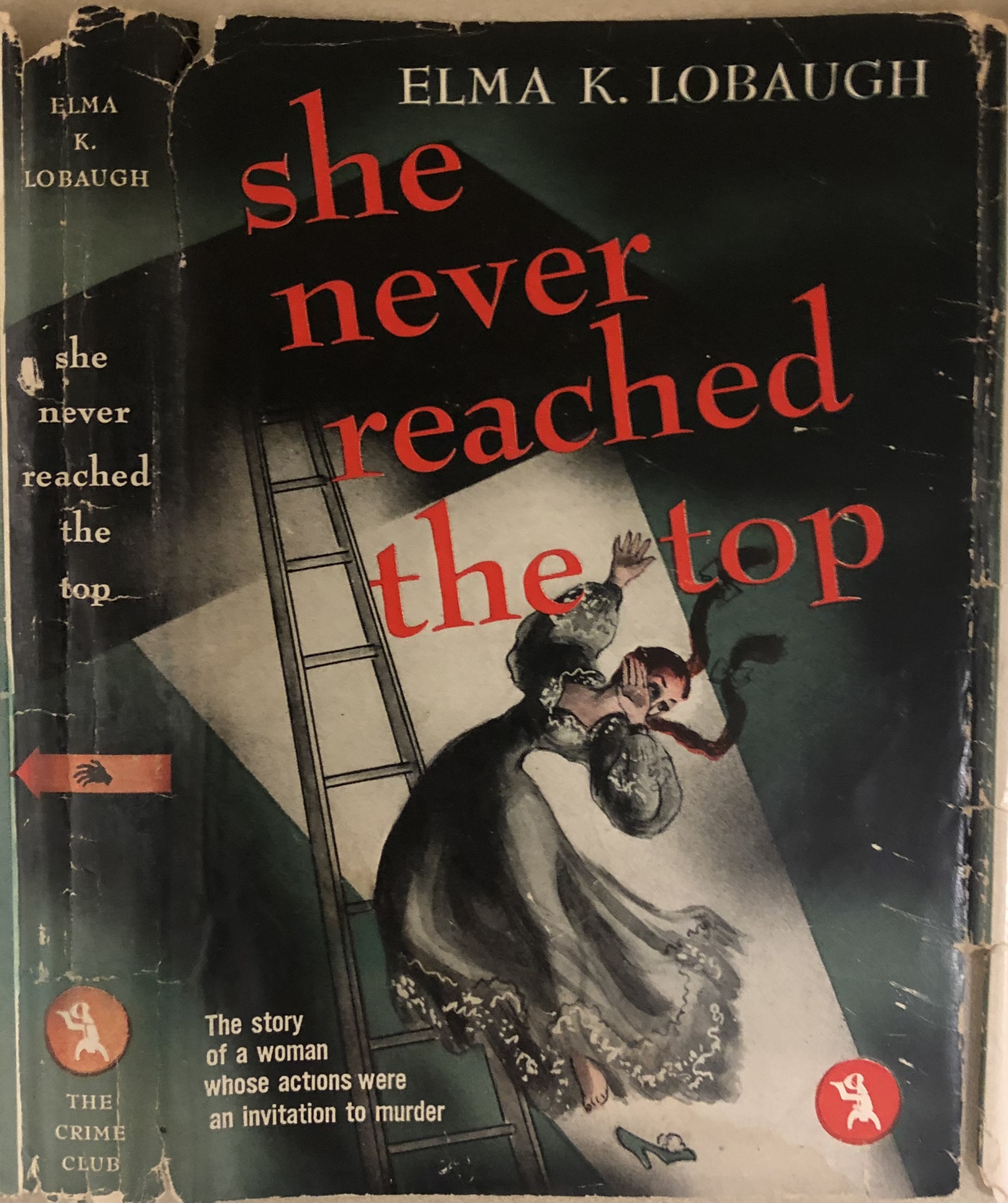
Elma K. Lobaugh's first mystery She Never Reached the Top (1945) was lauded by the editorial team at Doubleday Doran's "Crime Club" as "unusually competent."  But that, my friends, is an understatement like all true raves.  Very few first time popular fiction writers bother with thematic elements in that much maligned genre known as the whodunnit. A murder mystery is often dismissed as a trifle of a book, a mere entertainment as Graham Greene used to categorize his action-filled yet wholly intellectual espionage thrillers. Lobaugh's story is imbued with an soupçon of superstition and other-worldly events that not only add a frisson of terror to the house party haunted by past violent deaths and literally haunted by a ghost but enhance her theme of random violence as an act of chance and fate.  This is a thought-provoking murder mystery, and ultimately a bit of a transgressive novel in how Lobaugh treats her subject matter and how her "detectives" deal with the murder that only they have uncovered -- and then covered up.

Like many of Lobaugh's books this one is set in Indiana and like her later I Am Afraid (reviewed here) the story takes place in a house on the dune-lined shores of Lake Michigan.  The house itself features prominently and its bizarre unfinished state pays homage to the many weird architectural features of houses in books by John Dickson Carr, Carolyn Wells and Hake Talbot. The house in She Never Reached the Top, as the title may imply, has some missing staircases and incomplete steps leading to the second floor. Years ago a woman fell to her death from one of these unfinished staircases while using the DIY solution, a ladder that had no guardrails on the unexposed side.

Much of She Never Reached the Top seems mired in the past and the death of that unfortunate woman who fell from the ladder infects the house with doom.  Especially as the legend of the ghost has attached to it the prophecy that only those "who have been disappointed in love" will be cursed to hear and see the specter. Jennie Simpson, our Eberhart inspired narrator, is such a disappointed lover.  She reluctantly accepts an invitation to join the house party after a recent break-up with her boyfriend Peter.  Actually not much is know about why she and Peter are no longer together.  Did he die?  Was he killed in the war?  Did her just dump her for another woman?  We never really find out.  But thoughts of Peter and "what might have been" are never far from Jennie's mind.  And Jennie does hear the sounds of the ghost running to the ladder and the eerie brief silence just before the inevitable thud.  The reader just knows those noises are not a ghost at all but someone who has met the same fate as the woman from the past. But who could it have been?

Trendy floating staircases pose
similar possible fatal mishaps
When in the morning screams are heard and Pam, the youngest member of the house party, comes running into the breakfast room out of breath, in shock, and muttering, "I stepped on her! Oh my God, I stepped on her!" we have the proof of no ghost and a real corpse. It comes as no surprise that the troublesome wild woman, Margot Spendler, a free spirited, brazenly sexual woman who flirted with everyone including young Pam, was the victim.  But was it only an accident?  Bit by bit Jennie, Skip and Jim find evidence that Margot's death was a cleverly carried out murder. And each time they find evidence one of three either says nothing to the others or destroyys what they find. Will Margot's death be avenged?  Some of the "detectives" think it better to keep it all quiet.  The final chapter is satisfyingly thorough in explaining how the murder was accomplished. And there is a minor surprise in the identity of that killer. The final solution, however,  is entirely unconventional in how Lobaugh metes out her version of Justice.

I particularly enjoyed some of the occult sequences like when Jennie is goaded into reading palms.  Lobaugh treats the scene at first like a parlor game, but lets us know that Jennie takes palmistry very seriously, almost as if she is a psychic.  When Margot insists that Jennie look at her palm Jennie is terrified to discover that the flirtatious sexpot has no heart line. Furthermore, that her life line vanishes when it should extend to the wrist.  Could there be any more doom-laden foreshadowing than that?  There are other scenes tainted by superstition and many tales told about the ghost who first fell to her death that add to the fated atmosphere. Additionally, Lobaugh employs macabre folk songs (Jim is a professional piano player obsessed with melancholy tunes) and frequent recitations of lugubrious poetry to further play up her theme of lives pre-destined to violence.

She Never Reached the Top is (of course) rather hard to find anywhere. Currently, there are only four copies for sale from online sellers.  I never find Lobaugh's books in stores when I go book hunting.  Adding to the difficulty of locating copies is that it was published only in the US and only in hardcover.  Why it never received a paperback reprint (or even a cheap hardcover reprint from Triangle Books or Grosset & Dunlap) during Lobaugh's lifetime is another mystery that perhaps may never be solved.  It definitely deserved another life outside of the Crime Club edition. I'd say that Elma K. Lobaugh's work is due for a revival.  This is not only "unusually competent," it's rather a brilliant example of the mystery novel that defies categorization and one that dares to break several hallowed rules for a still young genre that too often was entirely formulaic.

Sunday, March 27, 2022

I Am Afraid - Elma K. Lobaugh

THE STORY:  Dorothy marries divorced Edward, a non-fiction writer.  All is well until Edward's children are sent to live with him. Caroline, Edward's ex-wife, has decided to move to California to start life anew and feels the children will only burden her.  If her new life doesn't pan out and she returns to Chicago she'll ask for the children to move back with her.  And so for Dorothy her romantic idyll in Edward's custom built home by the dune-lined shores Lake Michicgan in northern Indian comes to an abrupt end. The children are odd to say the least. And Stephen, Edward's 11 year-old son, is positively creepy.  Life becomes increasingly tension-filled and soon Dorothy feels she is being persecuted by the children, abandoned by her husband, and imagines she is slowly losing her mind. 

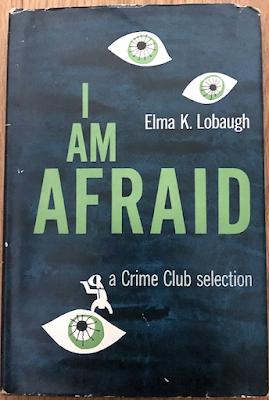
THE CHARACTERS:  From the opening paragraph we get the sense that Dorothy, our narrator, is a fragile woman easily intimidated and a victim of a runaway imagination. The dust jacket illustration (see image at left) shows several surreal looking eyes that are meant to suggest the eyes in a portrait hanging on her bedroom wall. As Dorothy's persecution (real or imagined we are never really sure until the final chapter) continues the eyes in the portrait take on a sinister aspect and represent to her the eyes of everyone in the house -- her indifferent, apparently unloving, husband and the two judgmental children, especially the elder Stephen.  I Am Afraid (1948) is a reverse fairy tale, a nightmare story for adults with Dorothy cast in the role of a victimized stepmother seemingly at the mercy of sinister stepchildren.  

When Stephen first appears the reader knows there is something not quite right about the boy. He talks and behaves like a middle-aged man.  He treats his stepmother not as a parent, but as someone to pity. Stephen has a patronizing manner about him. In his daily visits to Dorothy's bedroom with her morning or afternoon cup of tea he seems ingratiating and deferential, but Dorothy begins to imagine the boy has an ulterior motive. He doesn't act like a son or even a child when he's around her. She calls him strange and weird. She wonders if the tea should be drunk at all.

It doesn't help that Edward dismisses all of Dorothy's ideas when she attempts to discuss the boy's disturbing behavior. The boy is not athletic, disdains anything remotely boyish and shuns any type of play, preferring to read books. He's already suspect in the eyes of 1940s America.  Imagine any American boy not wanting to play baseball or football and turn into a bookworm! Dorothy becomes increasingly frightened by the children, but especially Stephen. It's not just the bookishness that gives her pause. And it's only a mater of time before the strangeness gives way to malicious and dangerous acts.

There may no other suspense novel as intensely domestic as I Am Afraid. The small cast of characters helps build a claustrophobic atmosphere resulting in a stifling melodrama. Dorothy has no real friends outside of her immediate family and spends much of her energy trying to win over her stepchildren or trying to entice her husband back into her bedroom.  The sex has gone from their marriage now that the children have arrived.  Adding insult to injury Edward has retreated to his writer's den claiming a need for no distractions while he tries to hammer out his articles under the pressure of fast approaching deadlines.

The only other character worth mentioning is the neighbor Frank Henderson, a gym teacher and football coach at the elementary school. Dorothy goes for strolls along the shores of Lake Michigan and chances upon Frank walking his dog.  They have a casual conversation that feels so alive and adult to Dorothy she finds a way to get out and go walking nearly every evening just in order to meet up with the coach and his dog.  Little does she realize that her walks and utterly harmless friendship is under close observation.

French translation of I Am Afraid
SETTING:  While the house may be an oppressive and loveless place filled with portraits of staring eyes and oddball children too much in charge of the adults the locale is contrasted with the outside setting.  Edward's home is situated in the dune lined shores of Northern Indiana. Lake Michigan and the dunes are favorite locations in Lobaugh's crime novels.  For Dorothy the lake, the beaches, and the dunes surrounding the house serve as an idyllic escape from the sterile and claustrophobic home that increasingly seems like a prison.

INNOVATIONS:   With a cast of only three adults, two children and one dog it seems almost as if it was meant to be a script for either theater or the movie screen. It's confined settings also make it prime material for a theatrical adaptation.

I think Dorothy's pre-occupation with her dwindling sex life was pretty modern for a book published in 1948.  Clearly her life with Edward was a happy and passionate one prior to the arrival of the oddball kids, Emily and Stephen. Her private life with her husband all but disappears once the children are in the household. I was impressed with Lobaugh's insistence on making Dorothy a woman with desire and whose life requires sexual expression.  Her descent into depression and isolation has a lot to do with her being ignored by her husband as much as it is about the weird and later thoroughly malicious behavior of her creepy stepson. There aren't many crime novels that address this aspect of marriages gone bad and the consequences of one isolated partners mental health.

INFLUENCES:  The real thrill of this suspense novel doesn't occur until the final third of the book and involves lies, deception and spiteful violence.  I can't help but think that Lobaugh was familiar with Lillian Hellman's The Children's Hour, a play first produced on Broadway in 1935 with its first of two movie adaptions in 1936.  It became a standard choice of melodrama in colleges and community theaters by the mid 1940s. The ugly rumor spread by Stephen that serves as the climax of the book seems so entirely inspired by the malicious talk of Mary Tilford in Hellmann's play that it can't be mere coincidence.  When Stephen is forced to confess to his lies in Lobaugh's novel the boy's fury and anger is like a madman's hysteria. His character foreshadows all the "Bad Seed" kids and demonic children that would flood the pages of popular fiction throughout the 1960s and 70s.  In this regard Lobaugh's book prophesies an entire crime and horror novel subgenre decades before it became a cliché.

QUOTES:  Their poise was more unnerving than if they'd come in the house screaming.

He kissed me good night, a sweet gentle kiss befitting my supposedly nervous, wrought-up state. I could have slapped him.  He might have kissed me differently--as a woman, as a lover, as a wife.

I began to think that it was too bad we were civilized. If I were to slap him, if he were to hit me at least that would be honest. At least that would be more sincere than this quiet politeness that was a living lie. 

(In reference to the painting that causes so much of Dorothy's paranoid anxiety)  ...one of these days I'm going to throw something at that smirking bitch on the wall.  I can pretend she's Stephen.

AUTHOR:  Elma Klinedorf Lobaugh (1907-1997) was born and raised in Indiana where she lived most of her life.  In 1928 she graduated with honors from University of Chicago.  Among her first jobs was labor analyst for the Indiana State Employment Service.  She wrote three crime novels under her own name then disappeared from the Crime Club roster for four years.  In 1946 her melodramatic novel The Devil Is Loneliness was published by the second tier house A. A. Wyn.  Described as a "steel mill soap opera" by one newspaper reviewer it was her only mainstream novel. When she resurfaced in the 1950s as a mystery writer she used the pen name "Kenneth Lowe" and was once again published by Doubleday's Crime Club. The Lowe crime novels are all set in Indiana and at least one (Haze of Evil) deals with murder and crime in the steel industry. Some of them are set in a fictional town called Merrittville which is most likely modeled on the real Indiana city of Merrillville. At least two of her novels were translated into French:  I Am Afraid became A devenir folle (literally "to become crazy) and L'Envoûtements (Bewitchments) was the translated version of her sophomore mystery, Shadows in Succession, a mystery involving voodoo in New Orleans.

Elma K. Lobaugh Crime Novels
She Never Reached the Top (1945)
Shadows of Succession (1946)
I Am Afraid (1949)


As Kenneth Lowe
Haze of Evil (1953)
No Tears for Shirley Minton (1955)
The Catalyst (1958)

Saturday, July 17, 2021

FIRST BOOKS: One Cried Murder - Jean Leslie

It's too bad that the striking cover illustration at left for this debut mystery novel by Jean Leslie, and the introduction to her decades long association with Doubleday Doran's Crime Club, is no indication of the story within. One Cried Murder (1945) has nothing to do with a horde of bats invading a town nor does it feature anything vaguely resembling  Gothic motifs. The story could have done with a few macabre and outre touches. But as it stands it is still one of the best academic mysteries I've read by any American writer of this era, including the many academics who hid behind pseudonyms and wrote mystery novels set on university campuses. In One Cried Murder Professor Peter Ponsonby makes his first appearance in what would be a three book series and turns amateur sleuth when faced with the apparent suicide of a psychology professor at a small university somewhere in California. This is one of the few academic mysteries of the WW 2 era where I got any inkling that the writer actually was a teacher (Leslie was a psychology fellow and taught for a while early in her career). The detail of university politics, the hierarchy of the deans and the faculty and how they influence and affect the various departments and division heads rang 100% true. I say this having worked in academic medicine for the past 24 years.

The only reason Ponsonby, an English professor, gets involved with the psychology department is because he wanted to talk with his friend Marshall d'Arcy, a child psychologist who was noticeably absent from his office on the day of Ponsonby's visit. In trying to locate d'Arcy Ponsonby enters the office of Prof. Wagner, a psychology professor of German heritage, and finds the man dead from a bullet wound to his head.

The gun it seems was astoundingly used as a prop in a variety of psychology experiments. Yes, a real gun, not a toy gun, not even a replica of a gun. A real gun. I guess that's another sign of the extreme changing times. I was flabbergasted that teaching professionals would allow a real gun to be used as a prop and handled by students in an experiment when a replica, or even a photograph of one would serve the purpose. The experiment is not crucial to the plot but is explained in detail and there is no reason why a real gun is necessary at all. [It's just a novel, I know. I'll calm down.] In any case, this gun used a prop, is never loaded during the experiments. But -- of course -- there is a box of bullets stored with the gun and anyone had access to both gun and bullets. It is kept stored in an unlocked supply closet which was covered by only a curtain. When Ponsonby finds the box two bullets are missing. He had no time to examine the gun and assumes that the second bullet is still loaded in the gun.

Suspects are many and the motives start to pour in when Ponsonby discovers that Wagner was an unethical psychologist who used confidential medical files to blackmail former patients. There is also some discussion as to the cabal of foreigners -- mostly German and Italian heritage -- who live within close proximity of one another and keep their offices just as close. Ponsonby toys with the idea of a conspiracy of Axis spies on the campus but this is soon dismissed as absurd by Mara Mallory, a secretary in the psychology department. She accuses the English professor of allowing his imagination to get the better of him. You see, Ponsonby is also a writer of murder mysteries. His most recent novel, rather popular and selling well, has a silly alliterative title. And Mara, the sassy secretary, pops off the percussive title with this derisive exclamation: "The Poison Pen Puzzle by Professor Peter Ponsonby, Purveyor of Pulp. What a comedown!"

Peter and Mara have a Benedict and Beatrice relationship that blossoms into a sleuthing partnership (albeit begrudgingly on Mara's part) as well as a cocktails and dancing partnership. He convinces Mara to allow him access to her boss' files and in return he'll take her out for a night on the town. This romantic subplot is handled with some wry humor, a sophisticated game of literary quote dropping, and a heavy dose of sexual innuendo the likes of which I've never encountered in any Crime Club novels. Jean Leslie seems to have taken a lesson from her hardboiled contemporaries when it comes to expressing the male libido and does so with relish. At times it gets to be a little much like when Ponsonby listens to one of the oversexed psychology faculty members talk about his hobby of watching the co-eds wearing skimpy gym costumes at archery practice outside his office windows. "Do you like legs?" he asks while "grinning offensively" to which Ponsonby replies, "I like legs, but I prefer them a pair at a time."

Leslie's plot meanders at times and she can't seem to make up her mind if she wants the book to be about the burgeoning romance between Peter and Mara or if she wants Peter to stick to his initial decision to match wits with his own creation, French criminal psychologist George Bouchet.  When Peter is left to his Q&A sessions with the various teachers, students, faculty wives and others Leslie displays some fine work at creating characters. The scenes with Drs. Ring, James, George and the graduate student Kurstein are highlights in the novel.  A mystery woman Ponsonby encounters in the waiting room near d'Arcy's clinic and dubs the "star sapphire woman" for the brooch she was wearing also provides him with some intriguing information about the staff.  As Ponsonby delves further into his snooping and questioning the list of blackmail victims grows, motives multiply and he inadvertently stumbles onto an undercover FBI operation which seems to validate his conspiracy of German spies among the faculty.

I enjoyed this book even if it took me three times as long to read it as it should have. The rambling nature of the story is crammed with red herrings and minutiae that prove in the long run to be pointless. Still, Leslie was clearly having fun with her story and her characters.  When Peter's mom appears it was like having a cameo by the British actress Frances De la Tour show up for some grandiosely arch comic relief. Agatha, his mother, is a radio personality with a cooking and housekeeping tips program. She also happens to have stopped by for a spontaneous chat with the wife of a faculty member. That chat comes in very handy in clearing up some alibi issues. It's characters like Agatha, Dr Ring, R.H.J. James and others among the supporting cast that will be keep me coming back for more in Jean Leslie's mystery novels.

I'll leave you with this one quote I thought was telling about how college life and college teaching in America has not changed one iota.  Dr Ring ,the self-confessed "hack professor" and the most senior member of the faculty int he psychology department has this to say about his survival and long lasting tenure:  "If I do no good I also do no harm. It is not my wish to call myself to the attention of the administration. I might also add that by the same token I never flunk a football player."

Prof. Peter Ponsonby Detective Novels
One Cried Murder (1945)
Two Faced Murder (1946)
Three Cornered Murder (1947)

Friday, July 2, 2021

SWAN SONG: The Intimate Journal of Warren Winslow - Jean Leslie

Today I introduce a new category for the blog -- the "Swan Song" post.  This will be devoted to a writer's final book in the crime fiction genre if not their final book altogether. Often I read a last book of a writer that's new to me without realizing that it was in fact their final book in their entire output.  Rarely do I do this consciously. I prefer to start at least in their mid-career if not at the very beginning when sampling a new writer. And so I thought I'd give a category to last books since it seems to be a n odd and coincidental reading habit of mine that is happening more and more frequently.  

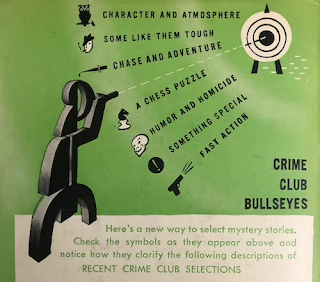
The Intimate Journal of Warren Winslow (1952) is also one of the many books I've purchased this year that were tagged by Doubleday's Crime Club with the ! logo as a mystery that promises "Something Special.” I've previously written about this tagging/categorization of the Crime Club books from the late 1940s through the early 1960s in other posts. Most recently I specifically wrote about the "Something Special" category which has been a lure for me over the decades in choosing books published by the Crime Club imprint,  in my post on The Magic Grandfather by Doris Miles Disney.  

Warren Winslow is a bestselling novelist suffering from a heavy case of self-doubt as he impatiently waits to hear from his publisher on when his latest novel is to be released.  Both his agent and the publisher seem to be dragging their feet in making a decision. To pass the time and occupy his obsession Winslow creates a diary capturing his thoughts and emotions on everything that is haunting him including his failing relationship with his wife, his dwindling creative powers, his past life as the wunderkind of the bestseller list and the insidious seed of jealousy that grows monstrously out of control. By the time the first diary is filled with his invective towards John Bailey, a rising writer who respects Warren and pays too much attention to Warren's wife Robin, Warren Winslow reveals himself to be a man overcome with a dangerous mixture of jealousy and self-doubt. He starts a second diary with the news of the fate of Thence to a Lonely Dwelling, a novel that he thinks will be his crowning achievement.  The manuscript, however, has been rejected.

The diaries soon grow to four full volumes and jealousy gives way to murderous rage.  We not only read of Warren's dwelling on his past glory as a novelist, but learn of his tortured childhood, his strange relationship with his wife and her mother, how he met both women, the affair he thinks Robin and Bailey are having, and his plans to put an end to John Bailey as his rival in love and the bestseller list. The murder plan is carried out but there are surprises in store for both Warren Winslow and the reader when he begins to realize that the truth was clouded by fantastic imaginings. But by then it is too late for him.

As a portrait of a vain, petty man who fails to see his days in the limelight are long over The Intimate Journal... initially makes for some difficult reading. The first diary is dominated by the outpourings of a mean-spirited man angry he has grown old,  envious of better writers, jealous of younger men with good looks and wholly possessive of his much younger wife who seems to be straying from him. Only when the novel begins to focus on Winslow's nasty murder scheme does the book become taut with tension and less off-putting as the non-stop name calling and insulting of everyone he meets gives way to an obsession of revenge.

Intermingled with the story of Winslow's murder plot and jealousies is a subplot involving Winslow's secretary who has been entrusted with rewriting portions of Thence to a Lonely Dwelling in order to make the book more attractive to the publisher.  This at first seems to be merely story filler, a way to flesh out Winslow's struggle to confront his dwindling creative powers and compromising himself for the sake of money and a contract, but will prove to be one of the more intriguing twists to the novel as a whole.

One of the most interesting characters is Dr. August Fremling, a psychologist who is also one of Warren Winslow's biggest fans. Fremling keeps asking Winslow to visit him to look over his fine collection of glass, something that Winslow belittles in his diary confessing that the many invitations are unwelcome while publicly he dons his genteel mask of the urbane sophisticate and politely and repeatedly declines. Eventually he finds himself at a party at Fremling's home and he reluctantly enters the room with Fremling's glass collection. Winslow is astonished by the collection, ironically entranced by something he disparaged as a childish hobby. He goes into great detail describing the way the art objects are arranged and how the light passes through each object and fills the room with color. This unusual scene gives way to an odd intimacy between the two men and a mutual admiration builds up almost instantly.  Fremling then slyly offers up some observations about Winslow's life, insights that are frankly shocking to Winslow, all the while paying homage to his writer hero and flattering him with deft praise.

Jean Leslie cleverly has inserted Dr. Fremling into the story as a sort of detective of the soul. Leslie was not only a mystery writer but also an academic in the field of psychology. She uses Fremling as a sounding board for theories that she must have learned and taught in her studies. Winslow's family doctor has a brief speech about the importance of psychiatry to heal the minds and souls of modern men.  The scenes with Fremling also contain some of Leslie's most compassionate writing and allow us to see Winslow in a new light, dimming some of the glare of his reprehensible traits and allowing a soft glow of humanity to emanate from his bitter, envious body.

And she adapts her love of all things psychological in the context of this story about writers and writing, the struggles of creativity, and the burden of a guilty conscience. Winslow at one point offers up a not too original, but still insightful observation that novelists and actors have much in common. Later Dr. Fremling expounds on his theory of the writer's life as a source for his supposedly fictional work. His keen understanding of Winslow comes almost entirely from having pored over the novels, sometimes reading his favorites more than once. For Fremling Winslow's novels reveal exactly who is he and where he came from. Having already read some of the anecdotes from Winslow's past life in the pages of the first three diaries we know that Fremling has nailed the man with an eerie accuracy.

QUOTES:  All novelists are actors. What else is a novelist but a man playing many parts? He must be able to project himself into a dozen roles if he is to write with authority.

This morning I awakened in a state of great mental perturbation... It was as though I had come back suddenly from some black abyss and I could not help but wonder if I would have died in my sleep if I had not awakened when I did and defied the Dark Stranger.  Reason tells me this is fanciful, but the feeling persists. [...] It is childish to be afraid of the truth, but I am afraid.

Bailey is dead. He died to save our marriage. Then what is this new ghost that stands between [Robin and I]?  Is there any peace for me, anywhere?

"Are we to call Sabrina inventive genius or are we to assume that Bailey wrote from that great reservoir of experience which is man's private world? Does he "dream up" the conflicts, as you say, or does he express his own conflicts disguised in such a manner that we accept them as fiction? I say this is what the writer does, sometimes consciously and sometimes unconsciously," Fremling said. "I would go further that that and say that the intensity of the inner struggle is positively correlated with the need to write."

Dennis Malcolm, Winslow's physician:  "Our culture has placed certain restraints upon a man so that he may not handle them for himself.  Confronted with a situation in which his behavior would be anti-social he must take his choice between driving the conflict underground or letting a psychiatrist help him to face it."

Friday, June 11, 2021

FIRST BOOKS: Bedeviled - Libbie Block

THE STORY: The malicious, exploitative and deeply disturbed wife of Willem Himbert, symphony conductor, becomes the target of Elizabeth Beel's undying animosity when the wife begins to concoct a fantasy in which she is the object of John Maicey's desire.  John is Elizabeth's boyfriend, perhaps soon-to-be husband, but Coca has other plans for the promising composer. Elizabeth's deep seated hatred is further fueled by the fact that she knows that Coca has infiltrated herself into the romantic lives of other musicians who at one time were Himbert's proteges.  She will not see John's chances at fame in the music world destroyed by Coca's petty and devious scheming.  She plans Coca's murder in her head almost nightly, various methods and means, until she doesn't know the difference between her fantasies and reality.  When Coca ends up dead Elizabeth is unsure if she carried out her murderous plan and turns detective to find out if it was she --or someone else -- who put a permanent end to Coca's twisted soap opera-like machinations.

THE CHARACTERS: Bedeviled (1947) consists of a relatively small cast of characters which allows for a claustrophobic atmosphere to build up in this melodramatic microcosm of musical composition and performance. Two couples --  Willem/Coca and Elizabeth/John -- are almost all we need in this story. Elizabeth, our narrator for much of the novel, provides  us with detailed but often skewed perceptions of the other characters for we can only "see" what she sees and reports to us.  Consequently, Coca appears to be a wily vixen reminiscent of the kind of villainesses you love to hate from the bygone era of night time soaps. The archetype of this superbitch is probably Alexis Carrington from the US TV show Dynasty.  Block's talent is in presenting us Coca as seen only through Elizabeth's eyes -- eyes that may be hateful but also part of a troubled mind. As much as Elizabeth wants to believe that Coca is some sort of female demon we never really know if she is exaggerating the truth  There are scenes with John in which he defends the conductor's wife and dismisses her attentions as juvenile flirting. So we are left to decide for ourselves whether or not Coca is the truly wicked woman Elizabeth would have us think she is.

Part of Elizabeth's trouble is that her love for John is intertwined with her desire to see him succeed as the "new discovery" of modern symphonic music.  The conflict arises out of the fact that Himbert can bring John much needed exposure by performing his works but Coca is included as part of that package.  Elizabeth cannot break John's relationship with Himbert and therefore she cannot break his relationship with Coca; the two are inextricable. She allows everything to take place simply because she wants John to succeed in his career.  This is the kind of supposed self-sacrifice done in the name of love that we keep finding in post-WW2 mainstream bestselling novels like the infuriating soap opera plot in Stella Dallas, the stereotype of the martyr mother, and crime infused melodramas like Mildred Pierce. 

We also get Elizabeth's perceptions that Willem Himbert is surreally devoted to Coca, in love with her in a way that seems to defy common sense. She finds it hard to believe that Himbert cannot see through his wife's scheming and deceit and her dangerous manipulation of his own love for her.  But is Coca really as thoroughly bad as Elizabeth sees her? Despite all the examples she reports of Coca's destructive plots and the careful construction of possible secret love affairs with Himbert's proteges and his intense jealousy of men who show the slightest interest in his younger,  strikingly beautiful wife we never really know if what Elizabeth is telling us is truth or a twisted interpretation of the truth.  Not until the introduction of a character late in the novel do we see Coca for what she truly is.

INNOVATIONS: Intriguingly, Block has inserted non-first person narrative sections into the story in which we are allowed to view the cast from a distant omniscient observer.  The sections with Elizabeth as narrator are labeled with the chapter heading "Inside" while the other sections are labeled "Outside" and there is one transitional chapter titled "Wayside" in which we get to see the murder happen. What appears at first to be a cleverly constructed inverted detective novel following the murderer's thoughts and deeds unexpectedly shifts in this pivotal "Wayside" section into a whodunnit. Then Elizabeth slowly adopts the role of a very reluctant sleuth when she tries to prove that she is not the killer.

Similar to The Evil Wish by Jean Potts Bedeviled is a fascinating portrait of a woman with a desire to murder who is left with a criminal plan that is unfulfilled. Those who have read Pott's brilliant book know that the characters who had a plan to kill ended up carrying out far worse criminal deeds having been infected with the mark of Cain, so to speak. But what happens to that murderous drive in Elizabeth's case in this book written more than a decade earlier?  She is tortured for much of the book truly believing that she did stab Coca to death but has no memory of the act. Even her sole confessor (who is also her employer) finds it hard to believe that she is anything but guilty.  She is so confused by the haunting blend of reality and fantasy that she often refers to herself in the third person, a classic example of dissociative behavior, perhaps the product of a guilty conscience, and one of the more compelling and prescient devices Block employs to add a sophisticated level of psychological insight to her gripping story.

QUOTES:  "How does one solve a murder? All the clue hunting and the rationalization seem so easy when I read mystery books [...] But this is a strange murder to solve. As though a bloodhound were sent to follow a long weary, and devious trail, with the full expectation that at the end he would tree -- himself!"

"I don't want to be different. I don't want to be a murderer. In this strange new afterward which will cost me my life and which has already cost me John, who is the very reason for my life, I can no longer understand the woman I used to be, the woman who fondled the idea of murder like a doll, dressing it in one bizarre scheme after another until the plaything took life and destroyed its keeper."

"I planned murder so many times, that like an automaton, I committed it. I have destroyed myself. And, my God, I am afraid. I am a coward. I don't want to die."

THE AUTHOR: Libbie Block (1910-1972) was born in Colorado, the daughter of Russian immigrants. Her father was a dentist who practiced in Denver.  She met her husband, an executive at Samuel Goldwyn Pictures, in Los Angeles, California where she lived for much of her life and where her two children were born. The author of over 250 short stories and three novels many of Block's writings were adapted into movies or TV shows.  

Labelling this post "First Books" maybe a misnomer and certainly a bit misleading for Bedeviled was her first crime novel, but not her debut as a novelist.  Her real debut book, Wild Calendar (1945) with a soap opera-like plot of a girl from Denver who marries a rich man, moves to New York, then leaves him to raise her child on her own, was made into the movie Caught starring Barbara Bel Geddes in one of her first starring roles opposite James Mason and Robert Ryan as the men in her life. One of her short stories was made into Pin-Up Girl as a vehicle for Betty Grable to show off the dancer/singer's talents. Two other stories were adapted for a couple of television anthology series:  "The Night the Doorbell Rang" appeared in season eight on The Loretta Young Show and "Last Concerto" was on Cosmopolitan Theatre in 1951. Several of her short stories were collected and edited by her husband Patrick Duggan and published under the title No Man Tells Everything (1959).

Friday, May 14, 2021

FIRST BOOKS: Dead Man's Float - Amber Dean

Set in a summer resort town on the shores of Ogg Lake Dead Man’s Float (1944) deals with the macabre drowning death of Bethine Coit who was married to ineffectual Chester a travelling salesman who sells dental supplies. Bethine was a notorious flirt with all the men at the resort when Chester is not around. And sometime when he is. It all looks to be a horrible accident but Max Johnson and Abbie Harris think someone deliberately sent Bethine to her watery grave.

Our narrator is Alberta “Abbie” Harris who lives with her two middle-aged sisters, Lily, the oldest, and Maggie, the fattest. Their nephew Bill Hunt, son of deceased sister Carrie, is staying with the Harris sisters while he studies aeronautics at a local college and awaits his military assignment. He’s 21 years old and newly enlisted in the army.

Neighbor Max Johnson is responsible for Abbie becoming an adult Nancy Drew almost against her will. Knowing full well that Bethine never swam, hated to get wet, in fact, despite enjoying parading around in her bathing suit Max is convinced that someone took Bethine out on a boat and did her in on the float then disposed of her body in the lake. He has already nosed around looking for her missing skiff and found some odd signs of disturbance on the float. During the annual sailboat regatta Max falls off his boat because someone has cut a jib rope. He nearly drowns during the boat race and is rescued in the nick of time by his sailing partner Bill. It seems someone is not too happy with Max and his amateur sleuthing. But that doesn’t stop him from enlisting help from Abbie to snoop around in the Coit home. He wants he to look for anything that may indicate someone wanted Bethine dead. Maybe she was blackmailing someone. The reason she and her husband turned up at Ogg Lake (presumably somewhere in upstate New York, Dean's home state) is all kind of fishy to Max. They’re not at all the camping, fishing and swimming types at all.

Abbie enters the Coit home through sheer luck, does her Nancy Drew bit and finds some intriguing letters and documents referencing the Harris family finances. Just as she is about to leave she’s shoved down the stairs and blacks out from the fall. When she regains consciousness the letters and documents she had in her hand are gone and a dead man is on top of her bleeding from a fatal head wound. It’s Chester. Looks like someone definitely had it in for the Coits.

The novel is teeming with characters and the first three chapters are dizzying in trying to keep all the neighbors and their children straightened out. We are told who is a local and who is a renter. When the renters are introduced the renters we are also told who owns the cottage (unnecessary info as it has nothing to do with the plot at all). A coterie of college girls have rented one cottage and they intrude with their chatter and nonsense every ten pages or so like the German tourists flitting in and out of the action in Night of the Iguana. They finally disappear after the second murder takes place. Took a while for me to figure out just who I should be paying attention to.

Max is married to a woman named Mommie (!) and they have three impish girls who figure in the plot. But Dean chooses not to give any of these little girls names. They are instead referred to as the oldest, the middle one, and the littlest one. Why don’t they get names? Especially since they are the ones who discover Bethine’s body. The “littlest one” has a larger role than the other two and figures in a scene with Abbie that leads her to discovering a secret in her sister Lily’s sewing basket. Very odd that none of these children gets a full identity with a name.

I liked Dr. Custom, another in a long line of flippant coroners with an irreverent sense of humor that devotees of vintage crime fiction ought to be familiar with. We’re actually still stuck with them on TV crime shows on both sides of the Pond. Still, Dr. Custom is a welcome addition to any scene he appears in bringing a much needed dose of black humor to the sometimes heavy-handed goings-on.

Dean’s frequent ponderous and obvious metaphors don’t do her otherwise fertile imagination real justice. She has the chops for challenging mystery plotting, but her choices when it comes to figurative language are often obvious and flat, at least in her debut novel.

Amber Dean
(circa 1970)
Despite these minor quibbles this is a nicely done mystery with quite a few surprises in its finale. Dead Man’s Float was Dean’s first mystery novel for the Doubleday Crime Club and she went on to have a rather prolific career. She wrote sixteen more books over the next 30 years. Abbie Harris appears in seven of those books. The titles are listed below.

Abbie Harris Detective Novels
Dead Man's Float
(1944)
Chanticleer's Muffled Crow
(1945)
Call Me Pandora
(1946), also published as The Blonde Is Dead
Wrap It Up
(1946)
No Traveler Returns (1948)
Snipe Hunt (1949)
August Incident (1951)

Friday, April 30, 2021

FFB: Evidence Unseen - Lavinia R. Davis

Lavinia Davis apparently struggled her whole life to improve her writing and to be taken seriously. Primarily known for her children’s books she wrote five mystery novels for adults, two of which feature antique dealer Eleanor “Nora” Hughes who meets her future husband, lawyer Larry Blaine, in the first book Evidence Unseen (1945) and settles into married life in Connecticut in the sequel Taste of Vengeance (1947). Well suited to detective novel conventions having knocked off a handful of mysteries for young readers Davis shows a flair for offbeat clueing and unusual details that make her plotting stand out from others of her school -- the women in peril crime fiction subgenre pioneered by Mignon Eberhart and Mary Roberts Rinehart.

In Evidence Unseen Nora Hughes has just finished an involved transaction related to the sale of a miniature desk that has been restored by an expert craftsman who specializes  in antique doll furniture and miniature pieces. Dealing with the temperamental Italian woodcarver and furniture restorer has been more than she can bear. The abrupt way the sale is ended forces her to take a break from her successful antique business. She hands over the reins to her assistant and heads to the bustling seaside resort of Atlantic City, New Jersey.

No sooner has she checked in but she finds a dead body in her room. She learns the room she entered was originally assigned to Professor Elmer Hughes. The same initials on their luggage and the same last name caused a mix-up and Nora was given the wrong key. Was the victim intending to meet Prof. Hughes or Nora? Complicating matters is the fact Nora actually met the victim. He rode up with her in a limo along with a middle-aged society woman named Eudora Singleton and her companion/servant Minna Plevins. She made a note of the odd conversation in the limo as well as the package the future murder victim was carrying with him because it had the distinctive wrapping paper of the famed toy store F.A.O. Schwarz.

Famous bell tag of F.A.O. Schwarz
often attached to gift wrapped packages


Nora uses her profession to her advantage as a sometime sleuth. Though not actually trying to solve the murder puzzling aspects of the crime linger in her imagination. As she makes friends and slyly questions people about what they were doing the day the man was stabbed in the hotel she studies her surroundings. Nora is always taking note of decor and furniture as a revelation of personality and character. Her keen vision and other senses also pick up unusual details like the bell logo on the package in the limo that signified it came from F.A.O. Schwarz, a missing black rubber cap from a walking stick or the bloody bandage on Prof. Hughes’ hand the day after she and Miss Singleton investigate a burglary in a cellar that was entered by a broken window. When speaking to a supposedly Swiss maid with a theatrically French accent Nora remembers that the maid slips into derogatory German slang when insulting an unliked female guest. And while pretending to sleep she hears a door open and catches a whiff of an exotic and distinctive perfume as someone enters, a perfume that can only belong to one person.

 THINGS I LEARNED:  Davis reminded me of Helen McCloy in her habit of dropping arcane literary references throughout her book.  Nora is clearly well read, highly educated, and in tune with 1940s pop culture as evidenced by the following matter-of-fact allusions:

1. Unable to sleep or even relax after having literally stepped on a dead body Nora takes a sleeping pill. As the drug takes effect and she starts to drift off Davis has Nora recite this obscure poem:  "Thy sweet child Sleep, the filmy-eyed,/Murmuring (sic) like a noontide bee."  It's from "To Night" by Percy Shelley, and I'm sure these days is only known to students and professors of Romantic poetry.

2.  In describing Eudora Singleton Nora cannot help compare her to the cartoons of famed New Yorker artist Helen Hokinson.  I had to find out what these society matrons so well remembered by Nora looked like.  So here's one of Hokinson's finest examples decorating the magazine's cover (she had several New Yorker covers as a matter of fact). Very suitable for this blog and this post. You can get an perfect image of what Miss Singleton looks like and how she behaves if you study the many Hokinson cartoons found online.

3. After a night of too much drinking celebrating her engagement to Larry Nora wakes up with a slight hangover.  She thinks of Pegler's New Year's column: "Dear Teacher, Cocktails, wine, and brandy do not mix."  Off I went to find out who she was talking about. I unearthed a wealth of info on James Westbrook Pegler, notoriously outspoken columnist, "the angry man of the press", harsh critic of Roosevelt's New Deal, and most recently accused of being a Nazi sympathizer and Fascist. Here’s an overview that gives both sides of the man. More on Pegler from William Buckley here and from J.C. Sharlet here.

Evidence Unseen, overall a rather simple murder mystery incorporating a smidgen of an espionage plot, is more noteworthy as one of the finest crime novels by an American mystery writer depicting effects of war on civilian life. During the final months of the war Atlantic City has been transformed into a temporary home for soldiers waiting for reassignment or who are recuperating in a special hotel converted into a military nursing home. In fact, nearly all of the hotels in this seaside resort have been turned over to the US military and are housing hundreds of enlisted men from the Army, Marines and Navy. Nora is staying in only one of three hotels still serving as stopovers for the dwindling tourist trade.

These soldiers on the surface seem to be joking young men, happy to be home, far from combat, but the war is never far from their memory. While traveling on a commuter train Nora and Larry are jolted when the train comes to an unexpected jerking halt. Larry tells Nora that a solider pulled the emergency cord when he heard several airplanes flying overhead. Then he apologized when he realized his mistake. Even Larry is not immune to flashbacks to combat when he grabs Nora and pulls her to the ground on the Boardwalk when a car backfires. One passage is particularly moving when Nora begins to notice why the wounded soldiers are different from the other military men:

It was not the bandages that made her throat suddenly tighten, nor even the pitiful slowness of their steps. It was their silence which was almost unbearable. The other squads of soldiers who had passed had been singing or had stepped out proudly to the gala blaring of a band. But these old young men were absolutely quiet. As they passed beneath the sundeck there was no sound except the distant thudding of the sea and the pitiful lagging rhythm of their footsteps.

Doubly stinging is the bitter comment from Professor Hughes who, standing nearby Nora, compares the indolent beachgoers and overweight tourists to the soldiers: “This is the place where those who have given most and those who have given least appear to meet.”

Unfortunately in this debut the mystery plot is mishandled in the final chapters. Melodramatic chaos ensues as Davis rushes to resolve the conflict and explain the motive for the stabbing death. The villain shows up with an entourage of thugs and proceeds to talk endlessly, feeble fights ensue, everyone is bound and gagged or hit unconscious, a fire is set to cause smoke and catch the eye of passing soldiers…. Piling up all these clichés on top of one another over the span of a mere five pages is the only aspect I can fault her as a novice writer for adults. Up to the less than satisfying ending Evidence Unseen is an excellent book, mostly for its wartime background and vivid characters. Davis’ commentary on wounded soldiers, the aftermath of combat, and what befalls those who saw actual fighting, killing and destruction all make this one American mystery set during the end of Word War 2 worth seeking out.

Finally, I must mention that Evidence Unseen is yet another mystery novel that uses knife throwing in the story. The way in which the idea is introduced is novel. Larry is watching several laborers amusing themselves by tossing their pocketknives at a target with Hitler's face on it.  He then asks one man what kind of knives work best for throwing and how far they can be tossed. Intriguingly, knife throwing is not used as means to commit the murder but rather as a way to get rid of the murder weapon. Though she gave us a flawed debut detective novel this odd touch seems to underscore how Lavinia Davis was trying to invigorate some of the conventions of detective fiction.  I have two more of her books to dig into.  Let us hope her plotting tightens up, she dispenses with hackneyed motifs and her unusual touches continue to multiply.