Showing posts with label Kathleen Moore Knight. Show all posts

Friday, February 8, 2019

FFB: Death on the Outer Shoal - Anne Fuller & Marcus Allen

THE STORY: Hammerhead Island, pop. 27. This community of fishermen, their wives and children, have no official organized government nor any police force to ward off crime. When the gruesome accidental death of one of their most beloved citizens, kindly “Preacher” Phineas Benson, turns out to be murder they find themselves with a dilemma. Do they call in the police from the mainland or deal with the crime themselves? It’s up to Jeremiah Corbett, the oldest and most respected leader, to investigate and decide whether the islanders’ “eye for an eye” philosophy should be instituted in meting out Justice.

THE CHARACTERS: Death on the Outer Shoal (1934) is another surprising discovery in a subgenre I like to call country noir. The rural community on Hammerhead Island is perfectly rendered in every detail from the rigorous descriptions of trawl fishing to the finely tuned ear for New England regionalisms and speech patterns that accent the characters’ dialogue. Jeremiah (Uncle Jerry) Corbett is ostensibly the protagonist but this novel seems more like an ensemble theater piece with each of the supporting character getting their moment to shine. Jean McKenzie, a young nurse who as the only medical professional on Hammerhead acts as the surrogate coroner to help Corbett. Jean verifies that the wounds in Benson's neck are not made by the fisherman's gaff stuck there but by a knife because the stab marks have clean edges and go deeper than the gaff's pronged hook. She also finds contusions on his scalp that prove he was stunned by a blunt object in order that Benson could be arranged in the nets near the gaff and then stabbed to give the appearance of an accident. There are gossipy women spying on the Committee men, Otto Wolfe the irascible lighthouse keeper with grudges aplenty, and Hank Thomas, the local alcoholic and wife beater all who have riveting scenes with Corbett.
Widow Grimshaw is perhaps the remarkable figure among the many supporting players. Following the death of her husband Captain Grimshaw she has gone into a permanent state of grief dressing only in black, disappearing into a huge hooded cloak, sporting a scowl cemented into her wizened face. As far as most people are concerned her interminable grieving and anger led to a spiraling descent into madness. The way Fuller and Allen describe her she might as well have stepped out of a Nathaniel Hawthorne story. If her appearance were not foreboding enough Widow Grimshaw points her accusing crone’s finger and lets loose with regular tirades denouncing everyone in sight. She is like some Puritanical witchfinder with a fervent desire for vicious retribution. She has a habit of heaping her curse on anyone who dares antagonize her.

Her antipathy to all allows for the introduction of another sinister influence – the collective hatred toward the Portuguese fishermen who live in nearby mainland town of Byport. While the Widow’s is the ugliest of bigotry expressed in dialogue, for her niece married one of the immigrants, none of the others on Hammerhead are too fond of the Portuguese either. Nick Dianno and his family tend to be singled out by name regularly. Nick is viewed as an opportunistic wheeler-dealer looking for his chance to buy up land. In the estimation of the citizens that will only ruin the heritage and life of Hammerhead Island and everyone is determined to keep the Portuguese off the island.

INNOVATIONS: The idea that an entire community needs to turn detective to root out an evil scourge is something that you usually find in horror fiction. The preservation of the land's purity, their insular lifestyle, and the inhabitants' desire to keep out foreigners and "outsiders" smacks of the kind of secrets that made fictional places like Cornwall Coombe, Summerisle and Crowhaven Farm the kind of town you'd never call home. And though most likely unintended it was hard to dismiss the vigilante mentality of how Justice prevails on Hammerhead Island. Too often someone quotes the Biblical "eye for an eye" concept that serves as the citizens' primary code of morality.  There are shades of not only Hawthorne here, but eerily prescient hints of the plots of modern thrillers like Harvest Home, Shirley Jackson's "The Lottery" and even Death Wish.

When Hank Thomas is brought before the Committee for drunkenness and wife beating then punished with a beating by a leather thronged scourge I cannot help but think that the authors intended this to be taken as a scene of appalling horror, especially considering that Hank is lashed five times by each of the five Committee members. It's an unexpectedly brutal scene that had me gasping. When it's all over and Hank is about to leave the tavern backroom where he received his beating he breaks down and weeps uncontrollably. It's a mix of horror and sympathy that I was both unprepared for and a bit awed by.

Death on the Outer Shoal was published by E. P. Dutton as part of their "Dutton Clue" imprint.  Included in this book is one of the standard "Stop!" pages that challenge the reader to pause, collect up all their notes (if they made any), think over all the clues presented and try to solve the mystery.  This is, in fact, a rare example of a very fairly clued mystery from Dutton. Some clues are subtle, others blatant and it might be rather easy for a veteran detective novel reader to weed out the correct killer from all the suspects. But the full truth may also come as a real surprise when all is revealed. The ultimate Justice is even a bit ironic with a subversive rather than an Old Testament touch.

Click to enlarge
QUOTES:  Widow Grimshaw: "Am I the only one who speaks to the [Portuguese]? Is Hammerhead the only spot for meeting and talking--and planning? The world is wide. Thieves find straight paths to each other."

"If I but knew [who killed my husband]!" Her old face became hideous with hate. "On him I would heap my curses--curses, not of words, but of blood--and Death!"

Soon the little harbor echoed with the throb of engines, and the Hammerhead fleet of trawlers was once more on its straggling way toward the fishing grounds. In each boat was a man dreading the night, whose dark, uncertain hours stretched ahead of him, and yet glad that here, at last, was work to be done.

And in each home on the sea-beaten island, an anxious woman wished silently that her man was safe within doors, and prayed that he might come back to her with the next day's sun.

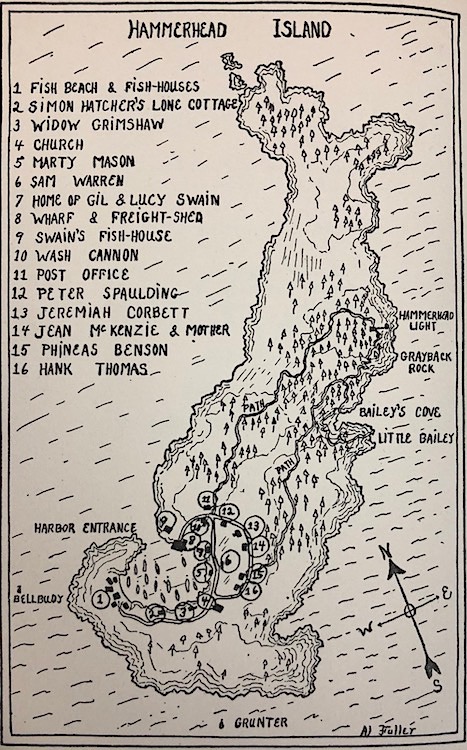
THE AUTHORS:  I could find little biographical data on Anne Fuller and Marcus Allen. I have an inkling that they were perhaps married, but that may not be true at all. My only clues come from the dedication pages in their two mystery novels. Their first mystery Blood on Common Ground (1933) is dedicated to Al Fuller, clearly a relative of Anne's (husband? son? brother?) and also the artist who drew and signed the frontispiece map of Hammerhead Island that illustrates this post. However a bigger clue appears on the dedication page of this novel which reads "To Louise and Richard Connell."  Could that be the same Richard Connell who wrote the iconic short story "The Most Dangerous Game" I asked myself?  Indeed it is.

Richard Connell was married to Louise Herrick Fox in 1919. Louise, like her husband, was a writer and at one time a playwright. Later she became involved in the publishing world first as a proofreader and then a prominent editor for Condé Nast publications. When Connell decided to give up his amazingly prolific career as a short story writer (close to 200 stories appeared between 1929 to 1940) he opted as many writers did for the life of a Hollywood screenwriter. He and Louise eventually settled in Beverly Hills.

Could Fuller and Allen have been part of the movie scene during the 1930s when this book was written? When Connell was just reaching the height of his popularity as a writer of scripts and stories for moviemakers?  Death on the Outer Shoal certainly has a very cinematic feel with its dramatic fishing and boating scenes, the setting of the island itself including the lighthouse and cliffsides, the often heightened dialogue, and an exciting courtroom-like finale. It could've made a gripping movie and might have been written as a scenario prior to it becoming a novel. Anyone who has knowledge about these writing duo your input will be greatly appreciated for filling in the missing details.

Friday, July 18, 2014

FFB: The Blue Horse of Taxco - Kathleen Moore Knight

Troy Bannister has flown to Taxco from her safe New York job at Frobisher’s where she is the jewelry buyer. She is to judge a contest of silver designs and the winner will be set up in a private studio to make a line of custom made jewelry for her employer. The contest was her idea and the winner unbeknownst to her employer has already been chosen. He is Jerome Blake, her old flame whom she has tracked down to Taxco. She is sure that when he is chosen the winner and given the $5000 prize money plus the opportunity to work in his own studio back in New York that she will finally have a chance to win him back and marry him. But when she learns of a local silversmith who is regarded as the best of the contest’s entrants she sees her deceitful plan start to crumble. She must see exactly what this talented artist, an immigrant Polish man named Casimir Lazlo, can create and if is indeed a superior craftsman find a away to eliminate him from the competition.

Someone does that job for Troy. Shortly after she has met Lazlo and seen his exquisite workmanship on an intricately stamped necklace, he is murdered. Troy’s guilty conscience and unethical ways get the better of her. Imagining the worst and thinking that she might actually be thought the killer she stages the scene of the bloody murder to look like a suicide. She flees Lazlo’s studio but not before impulsively stealing the copper plate that made the beautiful design in the silver necklace. All of this occurs in the first two chapters. This is our protagonist? Knight seems to be writing a Patricia Highsmith novel with a love mad female version of Tom Ripley, a woman who cares for no one really but herself.

Bracelet designed by Taxco silversmith
Hector Aguilar (circa 1940s)
Soon word is out that Casimir has committed and suicide yet no one can believe it. The other artists who have entered the contest recognize that their chances are now greatly increased for winning the coveted prize money and the job as jewelry designer in New York. But someone suggests that Casimir was murdered in order to achieve that advantage. When they also discover that Troy had visited Lazlo prior to the judging day they are in a furor and begin to think that the contest was rigged from the start. Troy has few friends among the artists including Jerome, living under the alias of Joe Blank, who is quick to uncover most of Troy’s deceit and her involvement in Lazlo’s death. Eventually it is Jerome/Joe, with the aid of Lazlo's daughter, who will take over as the lead character and solve not only Lazlo's murder but another murder of a local Mexican artist who was secretly entering a creation of his own in the contest.

The tone and language of The Blue Horse of Taxco (1947) is completely different than the Elisha Macomber (her best known series detective) novels in Knight’s early writing period. It’s darker, not at all lighthearted, and fueled with the illogical passions of impulsive desires not unlike the novels of pulp and noir writers. She is finding a way to tell a story of crime without resorting to old-fashioned thriller tropes and set pieces that seem lifted from cliffhanger serials. Gone are the quaint clues and girl sleuthing sequences found in her early books. Knight’s focus now is on character as opposed to multi-layered puzzling plots which is not to say that she has completely abandoned the puzzle. There is still the mystery of the pieces of the figurine of the title that will feature in the plot. But overall the story arises out of the characters’ behavior and thinking and their relationships not an artificial manipulation of events created only to bamboozle the reader.

(The above is a slightly edited portion from a longer essay on Kathleen Moore Knight I wrote for issue #68 of Geoff Bradley's fine journal Crime and Detective Stories (CADS). The issue will be coming out in a few months.)

Friday, July 4, 2014

Vintage Mystery Reading Challenge Update

I'm on vacation in Washington state (first time here, only seven more states left and I'll have been to all 50 at least once) and didn't have time to get my Friday's Forgotten Book post up. In fact I left all my notes for the past five books at home and I won't be able to write any reviews or essays until I get back home. Without my notes I'm lost. I read too many books each month to remember everything about the characters and plot details.

Life has been very chaotic and I've been forced to change a lot about how I live. I'll spare you the stories of my adventures with the two physical therapists I am currently seeing. Because of that I haven't been up to sitting at my computer for long periods of time to write the many reviews I am behind on.

In lieu of my usual FFB I'm going to list all the books I plan to review this month (all but one of them read in June) and also take this opportunity to catch up on my Golden Age Bingo Card in Bev's Vintage Mystery Reading Challenge

Rare photo of Richard Wilson Webb posing as "Q Patrick"
Death in the Dovecot - Q. Patrick
"Book with an animal in the title"
This is the British title for Murder at the Womens' City Club, a very rare Q Patrick title that I was very excited to find on eBay for a bargain price. The book is most interesting in that's it's the second of Richard Wilson Webb's mystery novels and the second (and last) book he wrote with his first collaborator Martha Mott Kelley.  An almost all female cast of characters (only three men) is an additional unique aspect to this detective novel.

Return to the Scene - Q. Patrick (Webb & Wheeler)
"Book featuring a mode of transportation"
Boats are featured in this mystery set in Bermuda. The victim falls overboard and people are constantly going back and forth to a small private island where the body washed up. I'm proud to say that I figured identity of the murderer, the motive and the method of one of the murders in this book. But I also think, while the killer is a surprise, veteran mystery readers will also be able to figure whodunit in this one. Reminded me of Christianna Brand because all the characters are lying and protecting one another and colluding during the murder investigation.

Come and Be Killed! - Shelley Smith
"Book featuring cooking or food"
Poisoned food is the killer's choice in this book. One of the best "badass biddy" books I've read. A groundbreaking book, I think, way ahead of its time. Reminds me of the best of Ruth Rendell but it was published in 1947. The murderous Mrs. Jolly (how's that for a killer's name?) almost tops my favorite spinster killer Claire Marrable in The Forbidden Garden. The climactic scene where one clever woman confronts the villainess is classic.

The Blue Horse of Taxco - Kathleen Moore Knight
"Book set in country other than US or UK"
Set in Mexico. A fascinating near noir thriller cum detective novel, very different from her Cape Cod books featuring Elisha Macomber. Troy Banister, the woman protagonist, is the closest I've come the discovering a female Tom Ripley. One of the first anti-heroines in detective fiction who at first is utterly despicable and then suddenly you find yourself sympathizing with. Plus, an unusual background in silver jewelry design and the silversmith industry which is still what Taxco is known for today. Very interesting and mature work from this unappreciated and very forgotten American mystery writer.

And the fifth book I will leave a mystery. It's the book I read for the July 11 "Femme Fatale" theme. And it's ready to go for next Friday. I guarantee no one has heard of it nor reviewed it since FFB has been going. It's a book that has been incredibly hard to find for decades and was just reprinted two months ago by a British indie press.

There's enough to tease you for the coming days. In depth reviews on all books listed above are coming when I return from Washington. Stay tuned...

Oh! and I now have a total of four Bingo rows on my Golden Age Mystery bingo card. I've read more than the mere 29 books shown on the card below. Some of the books were reviewed but didn't qualify for the challenge because I couldn't find a category to apply to the book. I'm excited that with half the year gone I have only seven more books to read (that will fit the categories left) and I've filled the card.

Friday, March 28, 2014

FFB: Death Goes to a Reunion - Kathleen Moore Knight

I went through a period last summer of reading Kathleen Moore Knight's detective novels and romantic suspense thrillers. A while ago I came across her name in a list of underrated mystery writers and since I had a small boxful of her books I thought it was about time to catch up on her. She was one of the best selling writers in the stable of popular American writers published by Doubleday's Crime Club and turned out to be rather prolific, creating three different series characters (one under the pseudonym Alan Amos). Knight showed variety and range in her subject matter which includes country house detective novels set in New England, urban crime and mayhem set in New York City with publicity agent turned amateur sleuth Margot Blair solving the mysteries, and a wide array of adventure thrillers and early forms of romantic suspense almost all of them set in Central and South America.

 I started with two of her books featuring her First Selectman Elisha Macomber who lives on the fictional Penberthy Island (most likely modeled on Nantucket) in a village so small there is no official police department.  Death Blew Out the Match (1935) and The Clue of the Poor Man's Shilling (1936) are admirable novice examples of quasi HIBK with a smidgen of fair play detective novel clues thrown in for good measure.  The second is far superior to the first. Though both of them end with the heroine bound and gagged in a cabin at the mercy of a token villain ...Shilling has tighter plotting, readable prose, a surprise reveal in the murderer's identity, deftly drawn characters, and one of the best examples of life on an isolated New England island in a detective novel of the late 1930s.

In doing research into her later books I also came across several book reviews in "The Criminal Record", a monthly column in the old Saturday Review in which "Sergeant Cuff" gave capsulized reviews of mystery books. One of Knight's books received high praise earning her the enviable adjective "ingenious" from the usually tough to please Cuff.  That book was Death Goes to a Reunion (1952).  I had to find a copy and see if it lived up to my own high standards.

Just last month I finally found an affordable copy.  I'm glad to report that while it may not be what I'd call ingenious it certainly has been the best of Knight's books I've read to date.

Essentially, what we have is yet another country house murder mystery with a small group of suspects. A group of sorority sisters who went to college in 1911 have gathered at the home of Helena and John Myrick for a 40th reunion. Oddly enough, all of the women at one time dated John, known as "Jocko" back in the day and still lovingly called by that nickname by his devoted granddaughter Nella. One afternoon during the reunion weekend a maid enters Jocko's study and finds him dead from an apparently self-inflicted gunshot wound. It's hard for anyone to believe that he would've committed suicide, especially during a reunion of his wife's friends. All signs, however, seem to point to that end. Elisha Macomber steps in and begins his own investigation enlisting the aid of Nella and her fiance Peter as well as Henry, a simple-minded, talkative handyman who finds new confidence and an improved self-image in his role as assistant detective. Later, it is also necessary to call in Chief Buck, the police chief at the down-island town of Medbury, when there is another death and Macomber is certain a revenge crazed murderer is hiding among the ex-sorority sisters.

Knight does something very daring with this book. Each time a death occurs she allows the reader to see the scene played out. Because it is clear she intends that her killer be a woman Knight can still make the killer anonymous through the use of feminine pronouns. Since there are really only two male supporting characters it's still a fair play technique. Knight also manages to shift suspicion among the six or seven women suspects several times. It's done convincingly with both character observations and skillfully laid out clues. She had this reader reassigning the role of murderer at least four times before finally picking the correct culprit based on a single well planted yet rather subtle clue.

Macomber, unlike the early books I've read, has an increased lead role as detective. Knight is obviously more comfortable with her creation to give him so much stage time. He has grown older and now in his early sixties he has softened a bit and recognizes his flaws. While often self-deprecatingly calling himself "a doddering old blunderbuss" or "a ruminating old codger" he picks out the genuine evidence from the misleading red herrings and points out clearly to all just why the two victims did not die accidental deaths but were callously murdered by a very clever killer.

Finally, in this book Knight makes some pointed observations in her writing. Each character has their chance to shine and there are no extraneous "bogey characters" inserted into the story as filler or red herrings. The reader sees several of the suspects in solo scenes with many of these sequences displaying impressive writing. One cannot help but be moved by lines like "One mourned -- not with the grief of loss, but because of the emptiness where love should have been" when Jocko's widow is meditatively recalling her reactions to her husband's death. In addition to the improved construction of the detective novel plotting this book is highlighted by similarly quiet yet powerful moments.

If you ever want the proper entry point for the detective novels of Kathleen Moore Knight I'd suggest you start with Death Goes to a Reunion. It's a stunner both as detective novel and a study of love gone terribly wrong. Agatha Christie would've been proud.

The Elisha Macomber Detective Novels
Death Blew Out the Match (1935)
The Clue of the Poor Man's Shilling (1936)
The Wheel That Turned (1936)
Seven Were Veiled (1937)
The Tainted Token (1938) (paperback reprint retitled: The Case of the Tainted Token)
Acts of Black Night (1938)
Death Came Dancing (1940)
The Trouble at Turkey Hill (1946)
Footbridge to Death (1947)
Bait For Murder (1948)
The Bass Derby Murder (1949)
Death Goes to a Reunion (1952)
Valse Macabre (1952)
Akin to Murder (1953)
Three of Diamonds (1953)
Beauty is a Beast (1959)