Showing posts with label Raymond Chandler. Show all posts

Friday, January 25, 2019

FFB: The Deaths of Lora Karen - Roman McDougald

THE STORY: Philip Cabot, private investigator, has been asked to the home of Charles and Lora Karen at the behest of the wife. She believes that someone is trying to kill her, but is being stubbornly secretive about it all. She promises to reveal everything to Cabot at the dinner party that will take place in the book's first chapter. But before she has a chance to talk about anything the killer strikes -- and with abandon. Lora Karen is poisoned, a maid is strangled, and Dr. Morley, who is called to try and save Mrs. Karen, is bashed on the head. Someone also seems to be hiding somewhere on the Karen estate -- someone who seems to be able to change shape from a large and powerful monstrous size according to the terrified maid to someone who wears shoes the size of a child's like the pair found mysteriously placed in a guest's bathroom. Cabot unravels all the mysteries and uncovers a group of criminals in the Karen household, including the murderer who devised The Deaths of Lora Karen (1944).

THE CHARACTERS: Cabot seems to be modeled on Philip Marlowe but which private eye of the 1940s wasn't? Unlike Marlowe, however, Cabot doesn't go it alone down those mean streets. He has a medium-sized agency in New York with not only a faithful and attractive secretary (Lib Terry), but at least five named operatives who are assigned the footwork to help with the Karen case. It's rare in crime fiction of this Golden Age to come across a private detective who actually runs a real agency with a full staff. Nero Wolfe is probably the best known of this type, but I also know of Carney Wilde created by Bart Spicer who also had a agency that grew in size and reputation over the course of the series. Still, most fictional private eyes go it solo or have only one partner.

In a nod to the Van Dine and Queen books there is also Jefferson Boynton, the Manhattan D.A. who can't resist rushing to the latest murder scene and getting his hands dirty in the police investigation. His wife (who is also Cabot's sister) is always complaining how Boynton is never home, always thinking of the next great case that he can add to his prosecution successes, always speeding away to be first on the scene of a grisly murder. She knows that her husband treats murder as a career stepping stone, and talks of how he hopes the next murder will be sensational enough in the news and can be used as political leverage when elections hit the calendar. We get more of Boynton and Cabot as detective than we do of Captain Kroll and his squad of o policemen. That Boynton is also Cabot's brother-in-law makes for an interesting dynamic with argumentative fireworks enlivening the investigation as the case gets more complicated.

Similar to Chandler novels the Karen family is wealthy and chockful of secrets and deception. Charles Karen is a boxing promoter who married into his first wife's well-to-do family. Lora Karen was his daughter's governess during that first marriage. The house party also sports Maurice Bode, a drop dead gorgeous portrait painter described as looking more like an artist's model than a painter; his girlfriend Avis Searcy, seductive and enigmatic; Felicie Karen, a teen-aged vamp typical of the hardboiled genre; Lora's money grubbing parasite of a cousin Barry Duret; and Roger Niehl, a waspish lawyer who deals with the Karens' legal and financial business. No wealthy household is without its loyal servants either. Jaffre is the butler willing to protect his employer at great risk and Josephine is Lora's easily terrified maid convinced a monster invaded the home and nearly strangled her to death.

Dr. Paul Morley shows up when a doctor is needed to try and save Lora after she is poisoned. The maid thinks Morley is Lora's physician, but it turns out he is her psychoanalyst who gave up his practice as a G.P. when he discovered being a disciple of Freud was more lucrative. When Lora dies Morley is one of the key figures who helps unravel the superstitious, highly imaginative woman's troubled life weeding out her fantasies from the truth. He is instrumental in aiding Cabot uncover the identity of a blackmailing fiend who may have turned killer.

Cabot not only needs to figure out who was threatening and blackmailing Lora Karen, but who eventually succeeded in her poisoning her, who broke into the house attempting to steal her jewelry, who left the tiny shoes in Avis' bathroom, who attacked Josephine and Dr. Morley. Before the case is finally disentangled and all the culprits are un discovered there will be two more violent attacks and one gruesome murder.

INNOVATIONS: Some of you may have heard of or read the new sensation mystery novel The 7 1/2 Deaths of Evelyn Hardcastle, a weird fantasy/sci-fi/detective/horror novel mishmash that I don't think much of unlike the rest of the world.  Unlike that book the deaths of the victim here are not fantastically repeated over and over.  In fact the title McDougald invented is more of a metaphor for the attempts made on Lora Karen's life and the other attempts made on the lives of others who knew Lora. Death seemed to haunt this woman, both in the present and the past. Of all these "deaths" it is the demise of the first Mrs. Karen that will figure prominently in the solution of the various mysteries.

McDougald has a good feel for Gothic atmosphere. The opening of the book is notably creepy with a pervading aura of paranoid delusions. Lora is presented as a wildly imaginative woman, ever fearful, and yet canny of her relatives and their underhanded motives. The night of Lora's poisoning is filled with violence and eerie events. Josephine seems to have been infected by her mistress' imagination and rants about the shape and form of her attacker. Evidence of an escape via a vine-covered trellis by a bedroom window with balcony shows that someone descended, but no large "monster" could have done so without tearing the vines from the trellis. No heavy footprints are found on the damp ground either. McDougald does a fine job of creating genuine mystery, adding an element of fantastic horror into the novel. When Cabot starts following leads about the possibility of a dwarf or midget being the criminal the novel enters the realm of the grotesque. Poe would have been proud of those sections.

The most striking and inventive part of the book for me was the number of crimes and the nontraditional aspect of multiple criminals. Gritty hardboiled private eye fiction tends to veer away from the formulae of the traditional detective story in which the finale unveils only one culprit responsible for all the crimes. Realism plays a big part is this subgenre and it shouldn't be too shocking to a reader to discover that the blackmailer and the murderer are not the same person. The sheer number of villains unmasked in this book, nevertheless, was indeed a surprise. Four separate endings follow in quick succession, almost as if each incident was being treated as a short story and then all of them were linked to form a novel.

QUOTES: There was a ghost of a smile on Mrs. Karen's own face [in the photo] as he came nearer, and the vision of that set and lifeless pleasantness was as subtly disturbing to the senses as though the photographer in some strange way had anticipated the embalmer.

"Don't tell me he skipped out! Incredible!" roared Boynton. "How could he have disappeared under the very eyes of your men?"
"You'll have to ask them," [said Captain Kroll]. "All I can say is that I ought to have had better sense than to send three Irishmen to a funeral."

THE AUTHOR: Roman Miller McDougald (1905-1960) wrote six crime novels, three of which feature his private investigator Philip Cabot. According to a living relative who left a comment at the Mystery*File blog, McDougald was known as Miller by his friends and family. He also apparently worked in Hollywood from information I found in a brief newspaper article I dug up on the internet. An attempt to confirm this at imdb.com was fruitless; there is no listing under either name in that database. Perhaps none of the movies or TV shows he worked on gave him credit in the final production. I was unable to find anything else about him.

Philip Cabot Private Eye Novels
The Deaths of Lora Karen (1944)
The Whistling Legs (1945)
The Blushing Monkey (1953)

Saturday, October 8, 2016

COVERING THEIR TRACKS: "Raymond Chandler Evening" - Robyn Hitchcock

There's a body on the railings
That I can't identify
And I'd like to reassure you but
I'm not that kind of guy


This is a moody tune evocative of walking down those mean streets. The lyrics are nicely metaphoric in the mid section which is also fitting for Marlowe's creator. "Raymond Chandler Evening" was originally recorded by Robyn Hitchcock and the Egyptians for their sixth album Element of Light back in 1985.  I was surprised to see that he's still performing all over the world as a solo act.  This is a favorite song of his and you'll find several uploaded videos of him performing it in places like upstate New York, Ashville, NC and even Valencia, Spain.  Here's the official video (not great quality) intended for play on music video channels back in the 80s.


It's a Raymond Chandler evening
And the pavements are all wet
And I'm lurking in the shadows
'Cause it hasn't happened yet

©1986, Tiny Ghost Records, Robyn Hitchcock

Friday, August 12, 2016

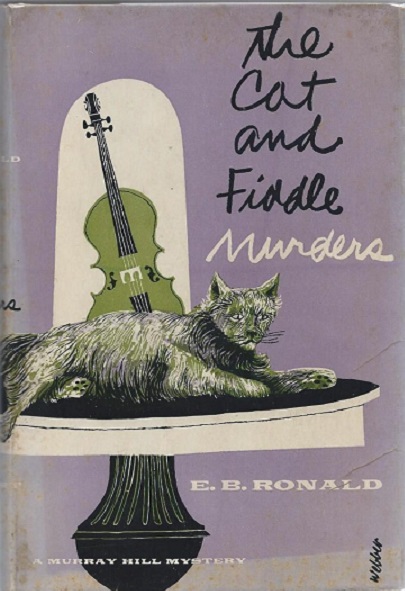
FFB: The Cat and Fiddle Murders - E. B. Ronald

THE STORY: Rupert “Brad” Bradley has been hired to find out who is spending time with the wife of night club impresario and antiques collector Arthur S. Barlowe. Bradley takes a single night to complete this easy shadowing job and reports back that Barlowe's wife Elaine is two timing him with Donaldson, his business partner. But the night Bradley wants to deliver the news he discovers that the "Cat and Fiddle" security guard has been coshed and the prized Guarnieri violin kept on display in the night club has gone missing. A search for the violin turns up the dead body of a musician in one of the several employee boarding rooms. Now Bradley is tasked with locating the missing violin and clearing his name as a suspect in The Cat and Fiddle Murders (1954).

CHARACTERS: Bradley talks and behaves like an American private eye borrowing his shtick from the pages of Chandler and all his imitators. But his syntax and vocabulary give him away as a bona fide Brit. Why the phony American talk and passable accent? He apparently has spent time in Missouri for a while and picked up the lingo and the accent while living there. He finds it somewhat to his advantage to pretend to be a Yank. I guess this was the writer’s attempt at wry or ironic humor but it all felt unnecessary and a bit cheap to me. Imagine a Marlowe-wannabe uttering a sentence like this: No one in the US talks like that especially a private eye in a novel. He insists that everyone call him Brad rather than Rupert a name he obviously hates calling it “his mother's idea.”

He’s not an unlikeable guy this “Brad” Bradley nor is he incompetent as a detective. But nothing really distinguishes him from the dozens of private eye clones in the post WW2 era, either Brit or Yank. He peppers his speech with the usual smart aleck’s patois, he has a weakness for the ladies yet will insult the more forward of the loose women he meets, and he does yeoman work as a detective. The case involves not only a stolen violin but a cache of diamonds purportedly part of a 16th century necklace that belonged to a courtier of Louis XV. The whole plot smacks of a Maltese Falcon rip-off with the diamond necklace acting as stand-in for the Black Bird; the "Cat and Fiddle" impresario Barlowe serving as a Casper Gutman clone, and Elaine and Donaldson’s shenanigans echoing the Spade/Archer/Iva imbroglio.

Some of the supporting players are worth mentioning so I’ll give nods to the violin expert Professor, a nicely etched portrait of the absent-minded savant; his waspish daughter Jackie, quick with a caustic comment for any of the poseur antique collectors she disdains; Benson, the lummox security guard whose doltish ineptitude provides some comic relief; and the alternately affable and supercilious headwaiter Francis Walters.

(Click to enlarge)

INNOVATIONS: The plot aspires to a locked room/impossible crime novel, but fails to carry it off. The floor plan of the "Cat and Fiddle" points out the various gates that prevent anyone from entering during its strict hours of 7 PM to 3 AM. The writer goes out of his way to explain that there are only two keys that will operate those gates, one in the hands of the owner and the other with his security man. The guard's key is taken from him and remains missing for much of the book but then turns up later in an obscure hiding place. The hiding place of the violin is not much of a surprise and the ostensible puzzle of how the thief got out of the club without being seen is presented as a baffling impossibility until conveniently someone notices something that any reader would've called out as obvious. There's also a lot of talk about the one elevator that is supposedly the only method of entry into the club yet as the story unfolds (and as any reader can tell by the floor plan) that is just not true. In creating this nearly impenetrable night club and his attempt to make it seem like there was an impossible theft and escape Ronald bungles the whole thing.

QUOTES: A sampling of the more nasty side of Bradley's tendency to crack wise
"What do you want me to do? Tell you you're beautiful, fired with the spirit of youth, desirable and that we could make sweet music together? It's all kid stuff. Grow up. Just because you've read a few books on birth control doesn't mean you've got to go to bed with every presentable man you meet."

THE AUTHOR: “E. B. Ronald” is the pseudonym for Ronald Barker, a publishing executive and writer, who penned a handful of private eye novels all featuring Bradley. I haven’t read any of them other than this one , but I suspect that they all have this quasi-American flavor to them even though all of the books are set in England. For more about Barker see my review of Clue for Murder, a non-series mystery and the only detective novel he had published under his own name.

THINGS I LEARNED: Loads of history on the Guarnieri dynasty, an Italian family of violin making geniuses who lived between the 17th and 18th centuries when luthiers were considered demi-gods in the music world. I learned that a Guarnieri violin is much more prized than a Stradivarius or an Amati, especially if it was designed and built by Bartolomeo Giuseppe, a third generation luthier of the Guarnieri family often referred to as “del Gesu”.

There is a legend related about the diamonds and the necklace that turn out to play an important part and the underlying motive in the several crimes and murders. I don’t know if this is a real legend or if Barker made it all up. It was a good little tale nonetheless. Could be the basis for a novel in itself.

EASY TO FIND? The US edition is relatively scarce as I thought it would be with about six copies for sale from various online sellers ranging in price from $6 to $25. Most of them have dust jackets. Exactly half of that number are offered in the original UK edition. I also found one German translated edition given the not so interesting title Nachtklub im Hochhaus (Night Club in the High Rise) that calls attention to the fact that the “Cat and Fiddle” night club is on the eleventh floor of the Metropolitan Hotel but would never signal to me that the story is about crime or detection.

Though most of these copies are relatively cheap I really can’t recommend this one. There is nothing that makes it stand out as exciting or innovative unless you’re interested in learning about the arcane world of antique violins.

* * *

This is one of three novels I've read for the Crime of the Century meme sponsored by the Past Offences blog. For this reading challenge each month participants read books published in a specific year. The books read in August come from 1954.

Friday, December 13, 2013

FFB: Hot Freeze - Martin Brett

 Michel Garfin is the man to go to in Montreal if you have a particularly nasty family secret you need to keep quiet. But call him Mike.  Only the Chief of Police calls him Michel and only because he doesn't speak any English.  Oh, and while we're talking about his name its GAR-fin, pronounced just like its spelled, not Gar-FAN as if it were French. He's Irish/French Canadian and though he's bilingual and lived in Montreal most his life where he was once on the Royal Mounted Police Force he could have stepped out of an office in Hammet's San Francisco or Chandler's L.A.  Hot Freeze (1954) marks Mike Garfin's first appearance out of three crime novels.

Montreal is a frigid violent world of illegal casinos luring gamblers to the barbotte and fan tan tables, brothels where the prostitutes serve as both companions and informers, and home to a wealthy dysfunctional family that would be all too familiar to Lew Archer or Philip Marlowe. The sexual imbroglio in the Astley/Remington household may call to mind the tawdriness of The Big Sleep or the family secrets that dominate Ross Macdonald's novels. But its the omnipresent, near paranormal influence of the wintry weather in Montreal becoming a formidable additional character almost as brutal as the human villains that reminds the reader he is far from the mean streets of California.

Mike is hired by Mrs. Remington to find out how her son Gerald is obtaining such a large amount of money. He receives an allowance but his ostentatious spending raises suspicions. He must be getting more money from some other source, she thinks. Mike soon learns that there are actually two families in the Remington home and that Mrs. Remington was previously married. Gerald and his sister Geraldine provide us the earliest examples of the unbridled sexuality that pervades the book.

Gerald is yet another of the handsome indiscriminate gay men, always flirting, always alluding, that one finds in 1950s private eye novels. It's his sex life that triggers the blackmail flag in Mike's mind as the possible source of the extra money. Geraldine is clearly a Carmen Sternwood knock-off but her insatiable taste for men eventually unearths a surprising facet to her character that all but erases any reminders of Chandler's teenage nympho. Then there's Marian, Mrs Remington's stepdaughter, who makes all too clear that she despises all of the Astleys and resents them living in her home.

Originally Mike plans to tail Gerald, find out his habits and bring the case to a quick close. Mike is sure that Gerald is blackmailing some wealthy influential man who can't risk having his sexual predilections uncovered. But Gerald surprises Mike by inviting him along to a barbotte casino and all thoughts of blackmail are almost entirely put out of Mike's mind when he sees how incredibly lucky Gerald is at the gaming tables.

Enter Tom Littleton, Mike's one time partner in the Mounties when they were both cops back in Winnipeg. Littleton is undercover as part of a narcotics investigation and he urges Mike to keep him that way by not mentioning his name. Mike in order to save his hide, however, lies about working with the RCMP and lets slip Littleton's name. When he returns later that night to find Littleton dead in the courtyard of his apartment building he is devastated. Up to this point Mike was all tough guy like many of the eyes of his day, but now we see a new side. A crowd of gawkers gather round the fence when Littleton's body is being taken away and Mike overhears them gossiping about another dead drunk who froze himself to death.
I kept my mouth shut, not answering any questions. I climbed into the back of the wagon when they were ready to go and sat near the bunched up thing that had been Tom. Grown men, they say, don't have such emotions. Grown men do. I sat with the tips of my fingers touching his frozen head and vowed to do slow murder to avenge this one.
The addition of this fraternal love between former police partners at times is heartbreaking. Mike is overcome with emotion several times during the novel. He suspects an insidious murder method and when it is confirmed that drugs are involved it only fuels his vengeful drive.

Brett toys with Chandleresque prose but makes it all his own as Montreal and Canadian culture dominate the proceedings. Hot Freeze is one of the better examples of a private eye novel that will appeal to a variety of crime fiction tastes. Enough tough guy manner and sex to satisfy the hardboiled crowd, real crimes committed for believable reasons for those who crave documentary style realism, quirky characters of truly original molds (including an acrobat dwarf with a sadistic side!) for lovers of offbeat fiction, and good investigating with a few examples of well placed clues for the detective novel fans. Above all there is an humanizing emotional undercurrent that controls every behavior in the violent and corrupt world of a bitter and savage Montreal.

Friday, January 18, 2013

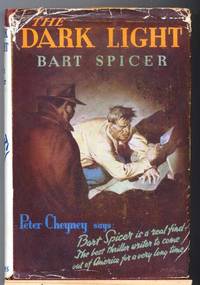
FFB: The Dark Light - Bart Spicer

"The uneasy breath of a nasty idea kept pace with me." -- Carney Wilde in The Dark Light

For anyone who has read all the Philip Marlowe books and all the Paul Pine novels and still craves a private eye in a similar vein with more than a few nods to the great Chandler I recommend the work of Bart Spicer. His Carney Wilde is a tough guy with a heart and in his debut The Dark Light (1949) is struggling to make a living at his game. Enter Deacon Andrew Jackson who wants Wilde's help in locating Matthew Kimball, the missing preacher from the Shining Light Church. As with all missing person cases in a private eye novel Wilde will face some dirty doings and a few murders along the way.

There is touch of Ross Macdonald in this first book but I'm guessing it's mere coincidence since only The Moving Target had been published by 1949. That Spicer chose to include one of the typical wealthy and morally corrupt families in this book is not all coincidence but the similarities to what Macdonald would soon be known for are. The Prentices really aren't all that bad as the story progresses but there is a creepy mother-son relationship depicted in Mrs. Prentice's devotion to her hunky son Alec. Also her daughter Alicia at first appears to be one of the many predatory females that populate private eye novels. She gets an eyeful of Wilde and wants more. So she invites herself along in Wilde's investigation by sitting in his car and refusing to leave until he starts the car and takes her with him.

I particularly liked this Chandleresque passage that comes early in the book:
I got in my car and went home for a cold bath. I lay back in the water, getting up enough interest to keep my date with Alicia. I had the courtroom stink in my nose and it didn't mix well with Alicia. The dead sourness of unwashed bodies and disinfectant and brutality and fear and the clumsy maneuvering of justice. I got out of the tub and tried to rub some of it off.
What makes Spicer's private eye different from most of the detectives of this type is that Carney Wilde is first and foremost a businessman. He's worried about his small firm and in his debut he's just learning to play the game. The entirety of Chapter 6 is devoted to his backstory in which we learn he was a member of the CID in the army who returned to work as a house detective for a department store. His former boss at that store, an astute businessman who made a killing in real estate and banking, hired Wilde as a security consultant and with that money he was able to start his own private detective firm. But the clients aren't rushing in. When they do show typically they are like Deacon Jackson, barely able to afford a day's work. But Wilde needs business and he takes what he can get. The chapter also goes into great detail outlining his work with an insurance company. It's a contact Wilde desperately needs. If he can get an insurance company as a regular client he'd have it made. He is hoping to earn some extra cash by giving testimony in a robbery case of great concern for a certain insurance company. With that money Wilde envisions buying a new car, a new office with a staff of three, and plenty more.

UK edition, (Collins, 1950)
The detection in this book is also a highlight. Unlike most private eyes who rely on intuition and guesswork Carney Wilde has the skills of a logical detective more often seen in the work of Ellery Queen. In tracking down Matthew Kimball to a Manhattan hotel he finds the illusion of a inhabited room but a few odd elements that make him suspect Kimball was never in the room. Chief among those clues are a radio speech without the changes he made on the original and a pair of eyeglasses with an old prescription. Combining these finds with some astute questioning of Deacon Jackson and the staff of Kimball's optometry store Wilde is faced with the fact that an impostor checked into the hotel.

What begins as a simple missing persons case soon becomes almost more than Wilde can handle. He finds himself enlisting the aid of his old army buddy who also happens to be a private detective working in New York to do some legwork and save on his commuting from Pennsylvania. He also finds himself collaborating almost against his will with Lt. Grodnick who thinks Kimball will turn up alive somewhere with a woman on the side. Wilde who has a much better understanding of human nature and without ever having met Kimball knows this is the wrong read on the preacher. Wilde will end up confronting blackmailers, an angry bigot with a sexually ravenous daughter, some talkative bartenders, and a nosey landlady before he manages to put all the pieces together and stop a killer who wants to protect a deep, dark secret.

Bart Spicer as he appears on the
rear DJ panel of the 1st edition
At journey's end Spicer piles on too much melodrama in what Grodnick calls "a Philo Vance like set up" but just getting to know this detective, a wise guy with a compassionate heart, in his debut was well worth the trip. I'm ready to start on the second and third books in the series and will report back on Carney Wilde's progress in the private eye biz.

For more on Carney Wilde and  Bart Spicer see the excellent info on this page at The Thrilling Detective Website.

The Carney Wilde Private Eye Novels
The Dark Light (1949)
Blues for a Prince (1950)
The Golden Door (1951)
Black Sheep Run (1951)
The Long Green (1952)
The Taming of Carney Wilde (1954)
Exit, Running (1959)

Tuesday, July 5, 2011

Estate Sale Bonanza - July 2, 2011

Just for a lark Joe and I went on an estate sale road trip and hit about nine sales in one afternoon.  Most of them were a complete bust as far as books were concerned.  If I was interested in old bedroom furniture, though, it would've been a big success.  Every house I went into had a striking fourposter bed, or a quaint vanity and mirror table, or an impressive armoir.  It wasn't until I went into the last two houses that I found the kind of thing I'm always in search of.

The first house had a nice library of old mystery novels including:

Red Wind by Raymond Chandler - the 1st hardcover printing from Tower Books.  Most people don't realize that this is also considered a first edition and NOT a reprint even though Tower Books is primarily known as a reprint house. 
The High Window by Chandler (Tower books reprint)
The Adventures of Sam Spade by Dashiell Hammett - 1st hardcover from Tower books (but a 2nd printing) Later in the car I discovered this was only a reading copy due damage to the boards and some scribbles on the endpapers.

But for 50 cents a book who really cares. None of them had dust jackets unfortunately

Other mystery books I picked up at that sale were Dead Skip by Joe Gores and Cop Killer (1st US edition with DJ in excellent condition) by Maj Sjowall & Per Wahloo.  This is a Martin Beck book that I had yet to find in a a decent US edition. Now I can get rid of the placeholder book club edition I have.

Also in this house I found several books by Antoine de Saint-Exupery but only took Flight to Arras -- a first edition, the one in the best condition, and one that I don't have a copy of nor have I read.  Wind, Sand, and Stars is one of my favorite books of all time.  It's a memoir, but it reads like a novel. His books about being a pilot during wartime are some of the best aviation memoirs.

It was the very last house located in Zion all the way up by the Wisconsin border that we found our genuine treasures. Zion was founded by an eccentric Scottish evangelist, John Alexander Dowie, who named most of the streets after towns, prophets, and other personages found in the Old Testament. On our way to the estate sale house located on Enoch Street we passed streets named Gideon, Galilee, Ezra, Ezekiel, Bethesda, Jericho, and most of them were in alphabetical order. I was very intrigued by that. When we got to the house I found that the "old books," as described in the ad, turned out to be exclusively religious textbooks, hymnals and other related books.  I was disappointed but had I known more about Zion I would have been prepared for something like that.

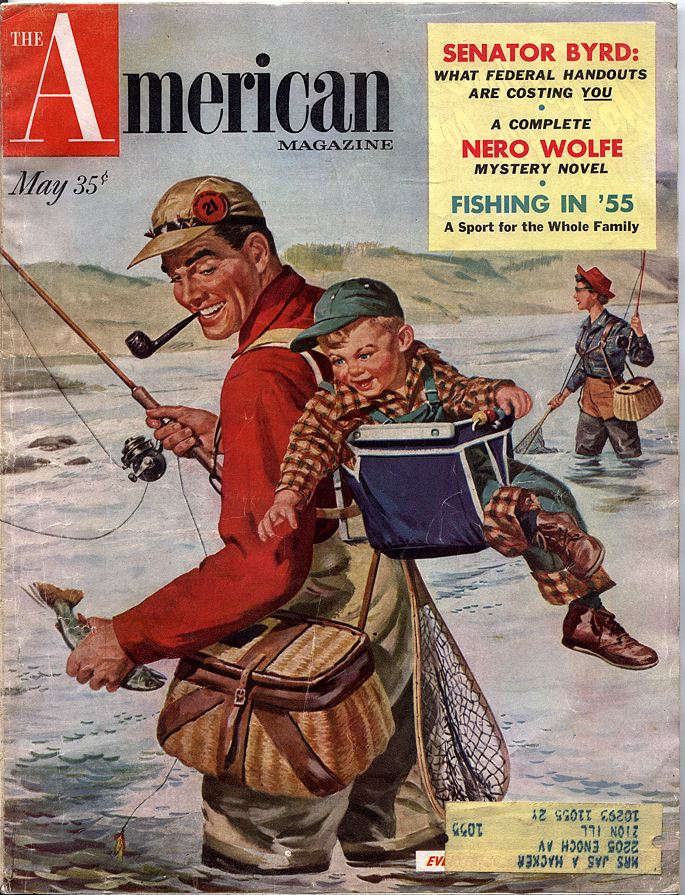
It seemed that we made a very long drive for absolutely nothing.  Just before we decided to leave the house, however,  I saw on the floor in a corner of the den a pile of The American Magazine.  I noticed on the cover of one issue the name Kelley Roos, an American husband and wife mystery writing team. Suddenly, I remembered that many of Rex Stout's novels and novellas appeared in The American Magazine before being published as books by Farrar & Rinehart and later Viking Press.  I immediately enlisted the help of Joe and we started flipping through the Table of Contents of all of the magazines.

At first I only looked at the magazines from the 1930s hoping I would find an installment from The Rubber Band or Too Many Cooks or any of the early Nero Wolfe novels.  But then we decided to look in the 1950s copies as well since they were in much better condition. Bingo! On the cover of one from 1955 was the brightly lettered ad proclaiming:  A complete NERO WOLFE mystery novel. It turned out to be "The Last Witness" - really a novella not a novel - later published as "The Next Witness" in the book Three Witnesses. We also found an issue with the final installment of The Red Box (illustration from that is pictured at the left).  And there were more surprises in store as we made our way through the entire stack.


After much flipping of pages and dirtying all of our fingers with the dust and grime of a house occupied by four successive generations of one family we found quite a nice pile of forgotten gems of mystery fiction.  Here is the list with a surprising variety of writers and styles.

Octavus Roy Cohen - "The Frame-Up" story featuring detective Jim Hanvey (June 1928)

P. G. Wodehouse - "The Missing Mystery" story (December 1931)
Max Brand - "Masquerade" a mystery novella not a western (June 1936)
Leslie Charteris - "The Saint and the Siren" story (same issue as the Brand novella0
Q. Patrick - "The Jack of Diamonds" novella (November 1936)


Alexandra Brown - "Curtain for an Actress" novella (April 1937)
Rex Stout - last installment of The Red Box (same issue as the Brown novella)

Q. Patrick - "Exit Before Midnight" novella (October 1937)
Kelley Roos - "Deadly Detour" novella (August 1952)
Kelley Roos - "The Case of the Hanging Gardens" novella (July 1954)
Rex Stout -  "The Last Witness" novella (May 1955)


Not a bad haul. The big bonus was that everything in the house was at half price since it was the final day of the sale. We ended up paying $20.50 for the stack of nine magazines. Lots of reading and reviewing to come - especially the Kelley Roos and Q. Patrick stories which I don't think have been published anywhere in book format.

Monday, March 21, 2011

Hardboiled Haiku #1

Today I start a new feature. Hoping it will appear at least once a month from now on. Reviews of hardboiled private eye novels done entirely in the Japanese verse form of haiku.

Read The High Window.
This plot less convoluted
Than most of Chandler.


Marlowe is hired
By the old lady Murdock
To find her son's wife.


Rare coin is stolen.
It's called the Brasher Dubloon -
Worth a chunk of change.


Two men are murdered.
Marlowe finds both their bodies.
Just his lot in life.


Chandler's good tough stuff:
Guns and blondes and hulking goons,
Marlowe cracking wise.


My favorite bits?
Chandler's use of similes.
Get a load of these:

It was a tight crackling voice, like someone tiptoeing across a lot of eggshells.

[T]he usual distorting mirror...made me look like a two-time loser sneaking home from a reefer party.

From thirty feet away she looked like a lot of class. From ten feet away she looked like something made to be seen from thirty feet away.

Her hair was as artifical as a night club lounge.

...a sound came out of him like a convalescent rooster learning to crow again after a long illness.

She had eyes like strange sins.


Favorites - Round Two
Chandler's clever metaphors
Try these on for size:


"You milk easy. But you give pretty thin milk

Fuzz grew out of his ears, far enough to catch a moth.

You could just manage to walk on the carpet without waders.

The room was painted egg-yolk yellow. All it needed was a few fat spiders painted on the yellow to be anybody's bilious attack.

She had the utterly disdainful expression of a dame who makes her dates by long distance.
Example the third:
How about this paragraph?
(I just can't resist)


Out of the apartment houses come women who should be young but have faces like stale beer; men with pulled down hats and quick eyes that look the street over behind the cupped hand that shields the match flame; worn intellectuals with cigarette coughs and no money in the bank; fly cops with granite faces and unwavering eyes; cokies and coke peddlers; people who look like nothing in particular and know it; and once in a while even men that actually go to work.  But they come out early, when the wide cracked sidewalks are empty and still have dew on them.
That's enough of that.
I'm too tired of counting
All these syllables.