Showing posts with label witchcraft. Show all posts

Monday, August 31, 2026

The Case of the Missing Sandals - Nancy Barr Mavity

THE STORY:  James "Peter" Piper, bespectacled, lanky reporter "with an ugly face" working for the Herald somewhere in northern California, is allowed access to the murder scene at a religious cult's colony. The victim, the domineering cult leader who calls herself Luna, claimed to be a witch in league with Satan. She is found both stabbed and shot, her hands bound in a strange fashion with the cord taken from a green and red bathrobe. Even more peculiar is she is found barefoot.  Earlier the same day she was killed Piper had a brief interview with Luna related to an accusation of the theft of $10,000 from one of her followers, He had seen her striking black satin sandals and knows she would never be caught dead without them. And yet she was. What happened to the shoes?  And why was she both shot and stabbed?

THE CHARACTERS:  The first half of The Case of the Missing Sandals (1930) deals too heavily with Earl Vincent who wrote some love letters found on Luna's body. He is the prime suspect for the police and the fact that he fled California on a freighter further underscores his probable guilt.  Several chapters are devoted to finding Vincent. Piper and police pursue the freighter and try to intercept it with a tug boat but Captain Marquand refuses to stop for the tug radioing the police that they will have to wait for the freighter to pull into port in Los Angeles.  When the ship arrives and the crew depart they discover that Vincent has vanished from the ship.  After another protracted pursuit Piper tracks down the young man and forces him to tell an elaborate story that convinces Piper that the lovelorn boy, supposedly in love with the murdered cult leader, is innocent of the crime. The police, however, refuse to look further than Vincent.

Once Piper turns his attention on the Luna Colony, the book becomes interesting, less laden down with monologues and overwriting, and focuses on detective work. Piper uncovers multiple suspects each with their own peculiar motives. Among the more fascinating characters are:

Ruth Morgan - Earl Vincent's girlfriend who serves as a foil for Piper.  She is determined to clear her beau's name announcing she is willing to do anything to find the real murderer.  In a chapter well past the midpoint she and Piper engage in the requisite tabulation scene in which Piper reviews all suspects, their motives and opportunities while Ruth listens patiently sorting out the probable from the preposterous and often ending each summation with her verdict of "not proven."

Frances "Frank" Hodgson - of all the suspects Frank is the most unique.  She dresses in men's clothes, professes an obsessive love for Luna and is caught by Piper at the murder scene long after police have left searching for what she claims is a special perfume Luna used to make for her. Based on her frantic behavior and twitchy nerves Piper sees through her lies, immediately coaxes a confession from her. She is a drug addict looking for her fix. Turns out Luna was not only a cult leader but a drug dealer. The more we learn about Frank the more we discover that she is a lesbian. Mavity is never daring enough to come right out and use that term however, but couches it all in euphemism and baroque phrases: "But this woman was patently one of Nature's tragic misfits, a victim of the warping fate that had veered her life away from its normal channels." Mavity goes on to describe Piper's assessment of Frank's personality (who he insists on calling Frances though she prefers Frank) with great empathy and feeling. When he sees that Frank is using her left hand due to an injured right hand he starts to formulate a theory that she could have killed Luna. The murderer stabbed Luna in such a manner that reveals a left handed assailant. And still listening to her story and seeing how she left behind a vase of cut flowers for her crush Piper confesses he is "somewhat more sympathetic to the murderer than to the victim." It is a poignant sequence in the book -- one of many such sympathetic musings for a misfit suspect. Still as is often the case in early 20th century fiction Frank is yet another gay character painted as disturbed and doomed: "Just how far toward madness her jealous obsession might have carried her he could not guess."

Albert Jackson - the blind caretaker and gatekeeper at Luna Colony.  Jackson, a Black man, is no stereotype or comic figure, thankfully.  He has two dignified scenes of gravitas with Piper towards the end of the book during which he likens himself to Piper. Both manage to see the truth, he tells Piper, while others live in darkness. There are interesting contrasts between real faith and spirituality and the pursuit of false idols also mentioned in these scenes. Mavity manages to pull off these scenes with a sophisticated touch using simple language and metaphor, never resorting to heavy handed preaching. Albert is a finely drawn character, perhaps the wisest of all people Piper meets and interviews.

Charlie Russell - A young cult member sent to the Luna Colony by his mother to be cured of a so-called bewitchment she feels has cursed her boy. Piper knows this is all superstition for it is obvious that Charlie, in both physiognomy and behavior is mentally deficient. His facial feature are described in such a manner as to match those of children born with what was once called Down's syndrome, now known as trisomy 21. When some new details about the case are revealed Charlie becomes the new lead suspect in the eyes of the police.  Charlie's presence, yet another outlier in this myriad cast, allows for Piper once again to show his emotional side.

Carey - Apart from Mrs. Russell Carey is Charlie's only ally and protector.  Described by Piper as a colorless, bland man not much older than Charlie he is something of an enigma. He appears to be one of the "true believers" of the Luna Colony. Later he refers to himself as an occult researcher.

Oscar Miller - One of Luna's many lovers and the object of envy and jealousy among many of the male members of the Colony.  He is seen hiding something of great importance in the hole of a tree trunk.  Piper later retrieves this object and confronts Miller.  He also owns a rifle that matches the caliber of the bullet used.  In fact, many of the characters own rifles that could be the murder weapon.

Amos Perkins - a mystery man who hires Harrison, a hire-powered lawyer to represent Earl Vincent. A handwritten note is sent to Harrison asking that he prove Vincent is not guilty of the murder.  Enclosed with the note is $1000 in cash.

INNOVATIONS: When Mavity finally gets down to brass tacks after the Earl Vincent section is disposed of The Case of the Missing Sandals is truly an intriguing, complex and engrossing mystery novel.  Piper is very much in line with the many reporter sleuths of early 20th century detective fiction. Ostensibly passing himself off as a cynic he is, in fact, a humanitarian with an open mind and a skill at abstract, often wildly imaginative, thinking.  In the tabulation sequence Piper finally reveals to Ruth Morgan that he is convinced that the solution of the case lies not in factual analysis but to put oneself into the mindset of someone wholly devoted to the world of superstition. The murder is almost ritualistic what with the strangely colored cord used to bind the victim and the outrageous use of two murder methods to kill Luna. The placement of love letters on her breast after she was dead and -- most importantly -- the removal of her shoes both seem to underscore a kind of supernatural ritual, or a curse placed upon her. Ruth Morgan tries to accept  Piper's theory as a possibility but it all sounds too outlandish to her practical mind.

Of course, Piper is on the right track. For in the end it all really comes back to the title of the novel.  While perusing a non-fiction work called Witches Still Live -- an actual book by Theda Kenyon published in 1926 by Ives Washburn (see photo) -- Piper stumbles across the reason Luna's shoes were stolen. Armed with this arcane trivia and with the help of Andrews, his photographer colleague at the Herald, he sets a trap for the murderer in a well done, somewhat stunning, finale.

QUOTES: Piper: "The story isn't dead, even temporarily. [...] There are angles to it -- angles and angles. And while the other reporters are all enjoying the lull and concentrating on Vincent, I'll be out angling the angles -- a regular complete angler I'll be."

Piper: "When you try to figure [all these motives] together, its enough to make you dizzy. And as for proof-- say, if I saw one single little sold fact that didn't change its shape while I was looking at it, I'd faint from sheer amazement!" 

Jackson: "There's two kinds of darkness. There's them that walks in darkness because they can't see their way ahead, and there's them that have eyes and see not. It ain't your fault if it's still dark. You used your eyes as good as you could. That's how I know you're him that was sent. The spirit of darkness is on this place. The spirit of fear is on it. You can't see it, and you can't touch it, but you can feel it. Because you can feel the thing that can't be seen, you'll use your eyes to see when the light comes. That's why you were sent."

 Jackson: "Facts are dangerous things to throw around when you don't know the meaning of 'em."

THE AUTHOR:  Much to my surprise Nancy Barr Mavity (1890-1959) has an entire Wikipedia page devoted to her life and work as a journalist, novelist and author of non-fiction works.  I won't bother to repeat any of it here.  But I will draw your attention to her book Sister Aimee (1931) published one year after this novel was released by Doubleday Doran's Crime Club.  Sister Aimee was the first full biography on Aimee Semple McPherson and it's not too coincidental to draw comparison between that charismatic evangelist (possibly a criminal and fraud) to the power mad, exploitative and cruelly Satanic Luna who dies so horribly in this detective novel. Apparently many of Mavity's crime novels are based on true crime cases.  Further details on which cases inspired her novels can be found in an introduction written by Randal Brandt, research librarian and curator of a crime fiction library at UC/Berkeley, that appears in the Penzler American Mystery Classics reprint of The Tule Marsh Mystery, Mavity's debut novel as a detective fiction writer.

EASY TO FIND? Several copies of the US edition are  available for sale from a variety of online bookseller with prices ranging from  $14 for a reading copy to $48 for a VG copy.  There is one copy with a VG+ dust jacket priced at $425.  I found no UK editions for sale.  I did not look for copies in internet archives but there may be one out there. I have a copy of this book myself, but will not sell it as it is signed by the author and inscribed to her fellow California journalist Alma Whitaker. Took me a while to decipher the addressee’s last name, but that’s definitely the name. In the brief inscription Mavity calls Alma "Best of the Good Scouts", a term Piper also uses to describe his co-worker Andrews, the photographer. A photo of the smeared inscription is included in this post.

Sunday, May 25, 2025

It's Her Own Funeral - Carol Carnac

THE STORY:  Anne Tempest is recuperating from a broken leg. Her primary caretaker and niece, Isobelle Verringer, decides she has  had enough of her aunt and the gloomy house. She summons two young cousins to come live with their great aunt, to take over as caretakers of both the bedridden woman and the grounds so Isobelle can finally leave.  The cousins -- brother and sister Roland and Jane -- move in and make substantial improvements to the antiquated home. The major renovation project is getting a gas cylinder operated stove to replace the immense, impractical and ancient range in the kitchen. Within weeks there is a horrible gas leak and the Palings, husband and wife servants working for Aunt Anne, succumb to gas inhalation and pass out in the kitchen. Jane rescues both servants then rushes upstairs to Aunt Anne whose bedroom is directly above the kitchen. The rafters have cracks in the ceiling and anyone can see through those cracks into Aunt Anne's bedroom floor. Jane fears the gas made its way into the bedroom and rushes upstairs. But she is too late. Her great aunt is dead and has been for hours, her body rigid and a disconcerting smile on her face.

THE CHARACTERS: It's Her Own Funeral (1952) is a claustrophobic story confined to a small cast of only five major characters along with policeman Julian Rivers who shows up to investigate the suspicious gas leak. The ruinous Tempest estate is a character unto itself. It consists of the old main house, filled with empty rooms and decrepit furnishings dating back centuries, and a cottage which was the home of the Palings. They've been displaced by Isobelle so that Roland and Jane can move in and make their home there. The Palings are ordered to move into the main house where they can be closer to Anne. Maggie Paling and her husband do not leave too willingly as they love the cottage, but eventually relent and give up their treasured cozy home for the young people.

The book is as much a murder mystery as it is a study of differing generations. Aunt Anne representing the eldest generation clinging to a past, honoring the antiquity of the only home she's known since her childhood.  Isobelle, one generation removed from Anne Tempest, is the haughty indifferent and impatient agent of a generation so desirous of moving forward with little room in her heart (what little heart she has) for a past best forgotten and buried. She cannot abide Dene Manor with its dust filled rooms, museum like atmosphere filled with useless relics and dour faced portraits of her ancestors hanging on the dingy walls. In fact she outright states she loathes the place on every occasion she can. Of course Jane and Roland, the youngest members of the cast, are the symbols of a bright and carefree future.

Roland is a would-be poet who looks forward to steeping himself in his family's rich past. Snuggled in the coziness of the warm and inviting cottage he plans to draw on that past to inspire him. Before Great-Aunt Anne dies she remarks that Roland is a remarkable dopplegänger for her brother, Roland's namesake and the black sheep of the Tempest family. The long dead and elder Roland, grandfather of Jane and her brother, had fallen in love with a servant and was disowned by his father. Roland the younger shares with his grandfather the Tempest temper; both Rolands have an angry violent streak. Inspector Rivers learns that Roland displayed that anger when the intrusive Guy Deraine, another cousin in the Tempest dynasty, barged into the cottage uninvited to lecture Jane on her "thievery." Guy suspects that the siblings took not only furniture from the main house but valuable objects and he wants them returned.  Roland interrupted the argument and ended it by punching Guy in the nose.  rivers suspects that Roland' temper may be a sign of a murderous streak.  Could the brother and sister be truly guilty of stealing from their aunt and killed her to get their hands on everything they wanted?

Complications arise with the introduction of two neighboring families who are tenant farmers on the Tempest estate. Of these two families the most intriguing of them are the Boltons and their strange daughter Kathie. Kathie is described by nearly everyone -- especially disdainful Isobelle -- as a deviant or a half-wit. She behaves oddly, chants in a sing-song manner, is often found hiding in bushes and shrubbery spying on the members of the Tempest household.  Rumor has it she also enters the Tempest kitchen uninvited regularly helping herself to food she may find on the table. Maggie Paling insists that Kathie has never set foot in the kitchen. And so Rivers tests the rumor with a fascinating experiment and learns that Kathie is easily tempted with treats.  In fact, it's quite possible that the girl entered the kitchen without anyone knowing. Was she responsible for monkeying with the gas taps? And did she cause the accidental death of Anne Tempest and the gas poisoning of the servants?

There is more to Kathie than any reader may suspect. She becomes instrumental in the story and her mother, a drunken woman of mercurial disposition with an ethnic background as a "gypsy", is the most surprising character of the entire novel. Mrs. Bolton has an adversarial relationship with nearly everyone due to her "gypsy" nature. She thinks very little of Mrs. Paling, and Rivers soon learns the feeling is mutual. But the relationship between Kathie and her mother and the somewhat startling secret that Mrs. Bolton keeps from everyone except the penetrating interrogation of Julian Rivers adds quite an unexpected twist to the already very convoluted and twisty plot.

INNOVATIONS:  Witchcraft comes up frequently throughout the story.  Mrs. Bolton is a gypsy with strange powers. Many people Rivers interviews mention the day Kathie wandered into the woods and "came back changed."  This coupled with the heavy Gothic descriptions of Dene Manor add a level of superstition and "the unknown" to a novel already teeming with unease and creepiness. Additionally, Rivers finds witnesses who talk of Anne Tempest as a witch for she eschewed modern medicine and concocted her own remedies using herbs from her rich and varied garden.

A subplot is introduced ever so subtly when Guy Deraine pursues his suspicions of Jane and Roland as stealing "valuables" from the main house. When Rivers questions Guy about what exactly the valuables consist of the man cannot name anything specific. He has only feelings and instinct that the brother and sister came to Dene Manor with ulterior motives. But Rivers sees the odd relationship between Isobelle and Guy (she openly insults Guy and belittles his accusations of the young people as petty thieves) as an artifice covering up something far more sinister. Anyone familiar with detective novel conventions would immediately suspect haughty Isobelle of ulterior motives herself. Her personality is so cultivated in its contempt for everyone and everything it can't possibly be genuine. Carnac handles the subtleties of this subplot and strews about a plethora of red herrings with mastery.  I was sure that Isobelle was a villain of some sort, but was ultimately surprised when Rivers exposes a truly devious clash of wills between several unsuspected villains that had been cleverly embedded throughout the entire book.

QUOTES:   Those who worked with Rivers at Scotland Yard knew how deceptive were his sleepy glance and his amiable if sometimes flippant manner. Rivers had not only an observant and retentive mind, he had a lively imagination, and a very small item of evidence sometimes set his imagination working, so that he saw the relevance of a fact which, however small, seemed anomalous.

"Nonsense is mischievous sometimes," said Rivers, "especially if people let themselves get frightened by it."

An Isobelle rant:  "If I have to put up with much more melodrama, I shall be a mental case Have you got enough imagination to realise what it's like for a civilized being in this charnel house? It's as if death were gibbering at you round every corner. Look at it!"

He thought hard as he strode along, and it occurred to him that his progress through the mist was very akin to his detection in this case.  In front of him was still the impenetrable mist of uncertainty. On either side were indications of progress--small facts which could be likened to the frosty verges which his torch illuminated. And how easy it would be to fall into the ditch or to take a side turning in detection, Rivers was only too well aware. [...] the ditch ready to fall into--the bottomless ditch which awaits every detective whose awareness fails to interpret the facts which edge his path.

EASY TO FIND?  Remarkably this Carol Carnac mystery was reprinted in a variety of formats apart from the original UK and US hardcover editions, some of which are out there for sale but of course are also the most expensive options. In the UK and Canada It's Her Own Funeral was reprinted by Collins in a paperback edition under their "White Circle Crime Club" imprint.  I found two of those offered for sale online. In the US the novel was reprinted as part of the ubiquitous Detective Book Club in a 3-for-1 omnibus. There are a handful of those DBC editions out there waiting for purchase.  These are always the cheapest options and you get two other books: Dead Man's Plan by Mignon G. Eberhart and Death Begs the Question by Lois Eby & John C. Fleming.

Oh, one more thing (as Lt. Columbo liked to say)... You can buy my copy  Sorry…it sold in only three days. Happy hunting for another copy.

Wednesday, August 9, 2023

Psst... Over Here!

Hello, there! Remember me? I think eight month’s hiatus is a little too long to have taken for what I thought was going to be “a little break”. What have I been up to? Oh, this and that…

I came to realize that like many collectors I had gradually turned into a monomaniac of sorts and I didn’t like it. My literary anecdotes were boring people and more importantly I was boring myself. I wanted to avoid vintage detective fiction for a while. It was long time that I returned to reading contemporary fiction of all types, reading non-fiction (!) that led me to seeking out the histories and memoirs that once upon a time I enjoyed even more than mystery novels. As I veered away from detective and crime fiction I rediscovered my passion for supernatural horror from all eras. In the process I learned that there has been a revival of “traditional” supernatural fiction in the past three years similar to the renaissance in detective fiction (both reissues and new writing). Quite an eye-opening surprise and a delightful one for someone like me who has always loved ghost stories, haunted house novels, and metaphoric treatments of the monster hiding under your bed.

And so after eight months I’ve come full circle and I’m ready to share with you some of the unusual and intriguing titles I’ve devoured since December 2022. Like this one…

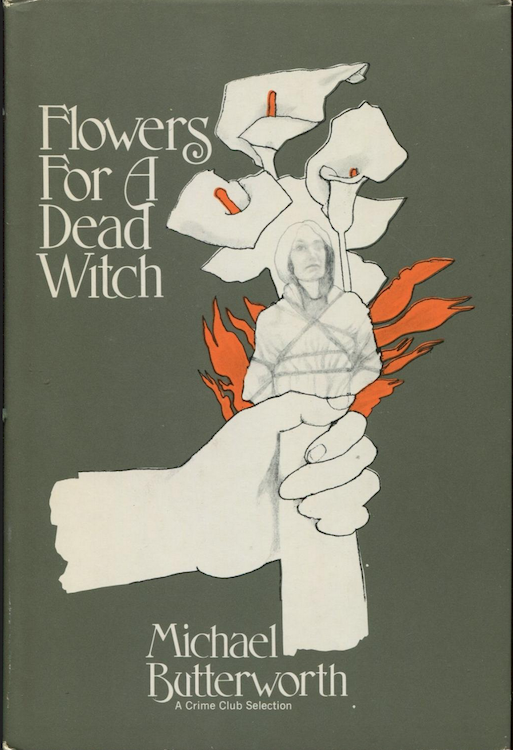
Flowers for a Dead Witch by Michael Butterworth

Readers of this blog will know that I love a good mystery novel dripping with Gothic elements and accented with witchcraft, hexes, black magic, voodoo, hoodoo or whatever the author is calling it. Butterworth’s third mystery novel is a brilliant example of the first revival of traditional mystery writing that occurred back in the 1970s. In Flowers for a Dead Witch (1971) he gives us what at first seems to be yet another of those Gothic “romances” that filled bookstore shelves and drugstore spinners five decades ago. Polly Lestrange travels from Canada to Suffolk to visit her bedridden ailing great-aunt in a crumbling medieval manor complete with moat surrounding the entrance. She is greeted by Miss Chesham, the great-aunt’s over protective companion who refuses the Polly’s request to visit the old woman. Even the local physician caring for Great Aunt Granchester insists that Polly leave the old woman alone. Well, what Gothic heroine is going to listen to either person? Certainly not this one and Polly determinedly breaks into the old woman’s room one windy and rainy night (of course it rains a lot in this book. It has too!) to discover… Oh, but that would spoil it all. The old woman has a secret of course and it will only be revealed in the final pages.

Before the startling conclusion – which I confess really took me by surprise – our plucky heroine will encounter a ragtag group of rebellious teens, rumors of a witchcraft cult cavorting naked in the moonlight, an ancient cemetery home to a mausoleum containing the corpse of a woman executed for witchcraft 400+ years ago, and literally stumble upon what appears to be the charred remains of that executed witch. But how is that possible? A 400 year old corpse of a woman burned at the stake would be nothing but rotting bones if not a pile of dust in 1971. The body found in the coffin in the mausoleum is freshly dead, and burned beyond recognition. When both the local reverend and his wife go missing whispers of foul play mix with the rumors of witchcraft.

This was the first book I’ve read by Michael Butterworth (1924 – 1986) who prior to turning his hand to bizarre crime and mystery novels was primarily known as a writer of comic books. Oh! A warning: Don’t confuse him with another (still living) writer of the same name who wrote science fiction novels and SF TV show novelizations. I had to notify the Admin of a crime fiction website that he conflated both Butterworths. I advised him to remove all the SF titles from the mystery writer Butterworth’s bibliography. He speedily updated that page on his website.

If Flowers for a Dead Witch is any indication of what Butterworth is capable of then I’m eager to check out as many of his other books that I can find. Most satisfying is that this is a legitimate detective novel with fair play clueing. Assiduous readers may catch onto what I overlooked as I foolishly fell for all of the writer’s rather clever red herrings. Butterworth mixes the formulaic plot of those 70s Gothic romances churned out by writers like Phyllis Whitney, Victoria Holt, and Mary Stewart with genuine mystery novel conventions and thankfully improves on both. Of course with a generous helping of creepy superstition and lurid witchcraft legends the plot is considerably spicier and more intriguing. I thoroughly enjoyed this book and completed it in a speedy two days. There are several copies available for sale out there in the vast shopping mall of the internet. I’m sure it ought to turn up in local libraries both in the US and UK. Check it out!


Michael Butterworth Crime & Detective Novels

The Soundless Scream (1967)
Walk Softly in Fear (1968)
Vanishing Act (1970) (US title: The Uneasy Sun)
Flowers for a Dead Witch (1971)
The Black Look (1972)
Villa on the Shore (1973)
The Man in the Sopwith Camel (1974)
Remains to be Seen (1976)
Festival! (1976)
X Marks the Spot (1978)
The Man Who Broke the Bank at Monte Carlo (1983)
  -- adapted into a musical: The Lucky Stiff by Ahrens & Flaherty
A Virgin on the Rocks (1985)
The Five Million Dollar Prince (1986)

As by “Sarah Kemp” – all feature Dr. Tina May, a psychiatrist detective
Goodbye Pussy (1978) (US title: Over the Edge)
No Escape (1984)
Lure of Sweet Death (1986)
What Dread Hand (1987)

Saturday, April 9, 2022

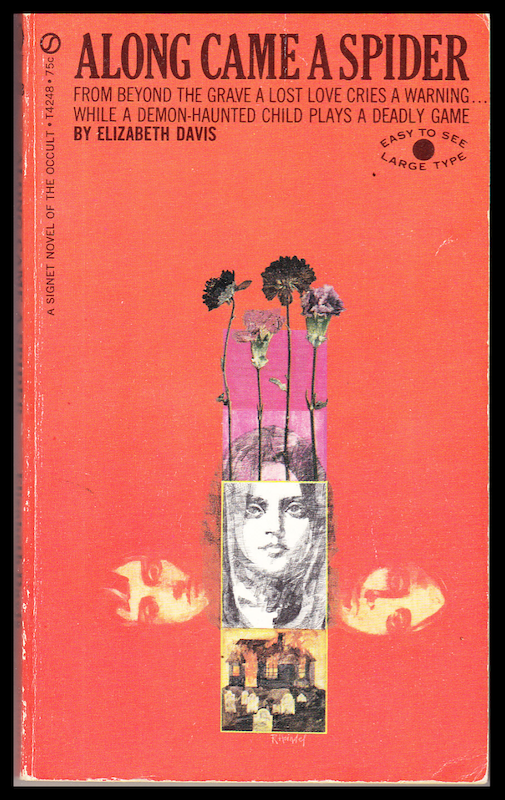
ALTERNATIVE CLASSICS: Along Came a Spider - Elizabeth Davis

I'm putting the sinister back into the Pretty Sinister Books blog this month as I tear through a pile of old horror novels and detective novels with supernatural and occult content.  Today's post also touches on the 1970s mania of the demon child in popular horror fiction.  I've read so much of this kind of book over the 11 years this blog has been around that I've finally decided to create yet another tag to label them all. If this is a subgenre in horror and mystery fiction that lights your chandelier you can click on the "Demon Child" tag at the end of this post and read more about them, perhaps find some obscure books dealing with killer children and demon-like adolescents.

Last month I had a mystery novel that incorporated a demon child motif -- well, more of a precursor to the Bad Seed trope -- in I Am Afraid (1948).  Today we go from the sublime and restrained domestic horror of that book to the outrageously ridiculous, horror bordering on parody in Along Came a Spider (1970).

Stephen, the nasty tween in I Am Afraid was 11 years old.  The bad kiddo in Elizabeth Davis' novel (apparently her sophomore effort in horror fiction under a second pseudonym) is remarkably only 9 years old. I found it incredibly hard to believe Anne Bishop, the evil little girl, was this young because for much of the book she comes across as a 45 year-old worldly wise woman.  But as you get to the the over-the-top finale our narrator posits her theory of why little Anne is such an adept sorceress.  She's basically the Wolfgang Mozart of black magic.

However, I'm getting way ahead of myself...

Davis's 2nd occult novel deals
with witchcraft and reincarnation
Inspired no doubt by Rosemary's Baby (1967) which almost single-handedly launched this new subgenre about children spawned from Satan and children possessed by demons, Along Came a Spider has been overshadowed by more well known (and better written) books employing this popular and by now hackneyed horror motif.  We have a wiseacre of a narrator in Eve Mercer whose colloquial voice is filled with idiomatic speech, sarcastic asides and a quasi stream-of-conscious narrative style that works against the suspense when Davis allows Eve to constantly interrupt her own thoughts. The narration is punctuated with dashes and ellipses as Eve trails off from one thought to the next like a distracted housewife running on a permanent caffeine high of extra strength Maxwell House.

The plot?  The Bishop family have moved in across the street and Eve fears her daughter Laurie has fallen under the diabolic influence of creepy little Anne, a primly dressed, too polite, too aloof miniature adult in the guise of a 9 year old girl.  Eve's first high-strung reaction to her daughter's new found friend comes when she learns that Anne is adept at painting. Laurie describes these paintings as nightmarish images of brutish monsters and other weird things she's never seen before.  They're so gory they look like they might have been painted with blood.  But Anne dismisses what was intended as an exaggeration by telling Laurie you can't paint well with blood. "It clots," says Anne's voice of experience, "and won't go on too smoothly."

The absurdity has entered the story early, my friends. This is only page 40!

There is an element of a detective novel in the story when Eve learns that the Bishop family knew a friend of a friend of a friend.  And so she hunts down some phone numbers and makes a couple of phone calls.  She reaches the boyfriend of a girl who died in an automobile wreck recently.  The young man tells Eve that his ex-girlfriend lived in the same building as the Bishops and ran into little Ann one day at the trash chute in the hallway. Anne was startled as she tried to shove something down the chute and quickly ran off leaving the object stuck. The now dead girlfriend went to see what Anne was trying to get rid of and found a mouse crucified on a handmade wooden cross.

It only gets more insane from here on.

There are strange rituals that Anne teaches her playmates. A girl dies in a cemetery but not before uttering a mysterious dying message.  Laurie begins to act strangely.  She has nightmares, disappears from her bedroom and can't be found late at night. Eve continues her detective work by consulting books on witchcraft and demonology and learns that Anne has been teaching Laurie and the other girls the ABCs of summoning demons and makes sure she is nowhere in sight when those rituals are being performed.

Ultimately the book is self-defeating because Davis allows Eve's hysterical imagination to get the better of her too often. The narration grows increasingly hyperbolic and her frequent wisecracks undermine the horror making it all seem like a black comedy.  Eve is also susceptible to superstition and imagines that her husband Jim who recently died has come back from the dead. He sends her warnings in her dreams, she hears his voice intoning "Move away! Take Laurie with you!"  Unfortunately as soon as that ghostly element is introduced Davis never follows through. Jim's ghost literally fades away as soon as he almost appears never to be talked of again. Davis seems to be suggesting that Eve might be headed for a nervous breakdown. Are we to think that Anne is innocent of all that Eve imagines her to be doing? The preposterous finale extinguishes that doubt as quickly as a sorcerer blowing out a scented black candle. But you must discover that on your own...if you dare.

You can read for yourself how this madness unfolds and whether or not Eve is a nut job or Anne is the spawn of a demon by buying one of the many copies available for sale out there in this vast shopping mall we call the internet.  I turned up about a baker's dozen in both English and foreign language translations.  It's an odd book, entertaining to be sure in an Alternative Classic way, but never really frightening at all.

Elizabeth Davis was born Lou Ellen Davis in Pennsylvania and raised her family in Connecticut.  Her fascination with witchcraft and psychic phenomena led to two other novels of crime and occult:  Suffer a Witch to Die (1970) and There Was an Old Woman (1971).  The 1971 novel was adapted for TV in 1972 and re-titled Revenge!  The made-for-TV movie has a script by Joseph Stefano (best known for his screen adaptation of  Psycho) and stars Shelley Winters (in one of the many badass biddy roles she succumbed to in middle age) and Bradford Dillman.

Saturday, February 26, 2022

NEW STUFF: Bunny - Mona Awad

What if those stuck-up teens in Mean Girls and the snobby clique in Heathers made it to grad school in order to pursue a master’s degree in creative writing? And what if those girls then decided that their creative powers extended beyond the printed page. So much beyond mere typing or scribbling with a pen that they indulged in witchcraft filtered through a kind of Victor Frankenstein egomania? You’d have Bunny (2019), Mona Awad’s academic satire and utterly bonkers witchcraft novel, a book as far from cuddly and cute as that title implies.

Samantha Heather Mackey (see that wink-wink allusion to the Daniel Waters’ screenplay?) is the protagonist, an MFA candidate and the outlier in a coterie of young women all seemingly clones of each other. Her fellow writers call themselves Bunny and are the most obnoxious clique ever to have been created in either novels, TV or movies. Their saccharine sweet adoration of one another outdoes the clinginess of the Heathers. Samantha loathes them but of course secretly wants to be part of the group. And so when seemingly out of the blue Samantha is invited to a private writing workshop the Bunnys call their Smut Salon she accepts against her better judgment and the advice of her best pal Ava.

The Smut Salon is an extension, albeit a soft core porn version, of the pretentious nonsense they are subjected to in their writing seminar. In essence it's nothing more than a sharing of sex stories, but the kind of giggly girl stories you’d get from inexperienced pre-adolescents, not young adult women in graduate school. The Smut Salon is only one aspect of their life outside the classrooms. As the novel progresses, we discover their desires and obsessions with creativity manifest in sinister rituals that defy the outrageous spell work seen in TV shows like The Craft, Charmed and Buffy the Vampire Slayer. This is the work they do in Workshop, capital W mandatory. The Bunnys are toying with a supernatural method to create life and in keeping with their Smut Salon obsessions they keep creating young men. They are not referred to as boys, however. To the Bunnys they are Hybrids or -- fittingly -- Drafts, mere works in progress as befits the work of a writing Workshop of course. And in the maddest bit of twisted imagination Awad has them create life from another form. The word "alchemy" is overused in MFA programs to discuss the supposed magical quality of writing fiction and Awad grabs a hold of that transformation metaphor and turns it into an absurdity. The Bunnys create life from their own namesakes – cute rabbits they capture from the bunny infested campus grounds.

I told you this was bonkers! It’s also deliciously creepy and madly funny and at times sorrowfully moving.

The catch to all this delving into the dark side of creation is that the Bunnys are not very good at either writing or creating life. In Samantha they see their opportunity to bring someone better at creation into their fold and test her. On the surface however, they belittle her work in the seminar and they make it appear they are going to model shape and improve her underappreciated talent outside of the classroom. We all know that the reverse is true. That just as Samantha envies the close knit friendship among these clannish clones they also envy her outsider status, her individuality and her darkly attractive fiction that actually has a plot.

Awad’s brilliant ironic touch is shown in the men the Bunnys conjure from cute rodents. On the outside they may be gorgeously handsome and resemble movie stars, athletes and rock musicians the girls fantasize having sex with but they are broken and flawed. Their hands never fully form nor do their genitalia. And so they appear to the Bunnys in handsome blue designer suits but wearing black gloves to cover their stumpy clawlike paws. They are never able to actually touch the girls with real fingers or fulfill their desires with a real sex act. It’s a brilliant touch on Awad’s part. Just as the Bunnys passive aggressively critique Samantha’s writing for lack of a character development these girls clearly haven’t mastered that skill in their attempt to create human life in their gory rituals.

When it’s Samantha’s turn to whip up a Hybrid or a Draft she not only surprises herself but shocks the Bunnys. It’s the beginning of the end of the group, a sinister revenge begins to formulate far beyond the reaches of Samantha’s own warped imagination. And the Bunnys never see that the tables have turned and they are being victimized at their own games and rituals.

Bunny seems at first to be just another academic satire. Mean Girls Go to College, might be an apt subtitle. But those rituals change the entire focus of the book. At first I was utterly bamboozled by the fantastic elements of the Hybrid Workshop and the strange literature quoting things resembling good looking young men. It’s this linking of creative writing with creating life as a wish fulfillment for desire and love that makes the book worthy of attention. In years to come I imagine that Bunny will achieve the kind of cult classic status as similar books that explore twisted creation and perverse pursuit of love like the still noteworthy, unclassifiable novel of the fantastic Geek Love by Katharine Dunn.

Bunny has been compared to Heathers, The Secret History by Donna Tartt, and the movie Jennifer’s Body. Awad’s book has so little in common with those other works. The Heathers analogy is obvious of course, but this book is not so much about individuality vs. group identity or the need to belong or popularity or anything remotely like that. It’s really about the dark force of untethered imagination, the danger of an indulgent fantasy life. Why no one has ever mentioned Frankenstein, Geek Love, or even the charming fantasy novel Miss Hargreaves is beyond me. Ultimately, Bunny is simultaneously a love letter to and a dire warning about the power of imagination. For any person who has ever heard a parent, a friend, or anyone say “Stop pretending!” or “Get your head out of the clouds” or any number of warnings to snap out of it and get back to reality Bunny has a lot to offer, a lot to teach. Real life can be so much more rewarding if we only open our eyes and see what’s right in front of us rather than imagining what we think might be better for us.

Saturday, October 31, 2020

HALLOWEEN SPECIAL: The Jules de Grandin Stories - Seabury Quinn

Jules de Grandin may not have been the first occult detective in weird and supernatural fiction but he will always be the original Night Stalker to me.  Around the time that cult TV show Kolchak: The Night Stalker was airing in the 1970s a series of paperback books appeared in my local Woolworth's on the paperback racks I used to regularly pore over. The garishly colorful covers with bizarre creatures and titles like The Horror Chamber of Jules de Grandin and The Hellfire Files of Jules de Grandin were perfect lures for my teenage eyes.  I eagerly bought them all over a period of three or four months that summer.  In them I was introduced to the small but fierce French physician who battled every possible evil creature imaginable and did it all almost entirely in a fictional town in New Jersey.  Of all places - New Jersey!  The only state in the USA that was the butt of jokes of every stand-up comic and episode of Laugh-In during the 1970s.  But from the pen of Seabury Quinn Harrisonville, New Jersey was one of the most terrifying places you would ever want to visit.  A town overrun with vampires, werewolves, reincarnated Egyptian mummies, worshippers of Satan, and myriad evildoers obsessed with immortality and willing to make bargains with any demonic being they could summon and not unwilling to kidnap, steal or murder in the process. Not all the tales took place in New Jersey, but the bulk of the stories that appeared in Weird Tales from 1925 through 1951 did.  I devoured these stories in the six paperback volumes thinking that that was all I could get my hands on.  Now all 92 Jules de Grandin supernatural stories as well as the single novel featuring the occult detective, The Devil's Bride, are available to devotees of pulpy horror in a five volume set. Each volume runs close to 500 pages and there are dozens of tales I'd never heard of or read before.

As George Vanderburgh, owner of the indie press Battered Silicon Dispatch and a Sherlockian of some note, and Robert Weinberg, that renowned collector of mystery and supernatural books and Weird Tales maven extraordinaire, remind us in the detail rich introduction to each volume Seabury Quinn is not the most famous of Weird Tales writers.  But Jules de Grandin, his engaging intelligent and extremely knowledgeable occult detective, was definitely one of the most popular characters among the readers of the magazine. From de Grandin's first appearance in "The Horror on the Links" in 1925 the Frenchman known for his frequent bizarre exclamations like "Barbe d'un chameau!" or "Larmes d'un poisson!" was an instant hit.  Readers demanded more stories from Quinn and the publisher. Every year de Grandin tales made the "best of " lists and were frequently reprinted in later issues.  It's not hard to see why for Jules and his physician sidekick Dr. Samuel Trowbridge are truly likeable and heroic in the manner that the best of pulp fiction characters always are.

Short in stature, athletic in build, blond, bearded, a speaker of several languages de Grandin is like a mix of Sherlock Holmes, Hercule Poirot and John Silence, all characters he must have been modeled on.  Well, perhaps not so much Poirot for he was only five years old when the first of the de Grandin adventures was published.  But surely Holmes, Silence and perhaps Carnacki, William Hope Hodgson's other well known occult detective might have been Quinn's source as Weinberg and Vanderburgh tell us in their introduction. Letters pored in from readers analyzing the stories, praising and critiquing Quinn's imagination. A cult grew around the character.  As the two men describe the popularity and the phenomenon of de Grandin he began to take on a life and legend similar to Holmes. They write in their intro: "Readers smitten by how believable de Grandin seemed as a character wrote to Weird Tales asked if he was a person in real life."

There is not enough room here to describe all of the stories and I have no way near finished even the first two volumes. At random I selected stories that I haven't read based merely on length (avoiding those over 25 pages in order to read as many as I could in two weeks) and also I was lured by those with odd titles. Vanderburgh and Weinberg's intro also whetted my appetite by pointing out the more grisly and horrific of the stories.  I was drawn mostly to Quinn's fascination with Eastern mythology and religions and his penchant for pitting de Grandin against creatures less well known in the lore of the supernatural. Here is a modest sampling of the strange and fantastic adventures of the French physician turned occult detective. Each tale's first appearance in is in parentheses.

"The Horror on the Links" - The life of the idle rich at a golf country club is no party when an ape-like creature kills a woman and pursues another. Shades of Poe's Rue Morgue and Well's Dr. Moreau meld in a story of revenge and diabolical experiments. (Oct 1925)

"The Isle of Missing Ships" - More of a pirate adventure than an occult detective story it foreshadows Indiana Jones' derring do. Jules Verne set pieces also crop up in this story of a self-proclaimed god who calls himself Goonong Besar and rules an island in the South Pacific populated with the usual cannibalistic inhabitants armed with poison arrows. Seemingly filled with silent movie clichés from its maze-like underground fortress to the scenes of captives tied to stakes being cooked for dinner. Tiresome, not thrilling nor original in the least. My least favorite story of those I selected. (Feb 1926)

"Ancient Fires" - Haunted house, ghost of an Indian princess and reincarnation. Nicely done, but very familiar to anyone who has read a lot of these types of tales. Margery Lawrence handles reincarnation and lost love in her Miles Pennoyer stories better than Quinn. (Sept 1926)

"The Grinning Mummy" - What's an occult detective series without a smattering of Egyptology and a vengeful mummy? Incomplete, that's what. Here's the requisite angry mummified corpse on the rampage.  De Grandin is in fine form acting as a true detective in this outing. It's genuinely thrilling. Jules' habit of bizarre French exclamations adds "Nom d'un porc!" and "Dieu et le diable!" to his ever growing list. (Dec 1926)

"The Gods of East and West" - Jules enlists the help of a medicine man of the Dakotahs to help save Idoline Chetwynde (love that name!) from the grip of a spell cast by the malevolent goddess Kali. Only one bizarre French expression ("Nom d'une anguille!") but the action filled tale, the spells and rites and originality more than make up for the lack of odd vocabulary. A good one! (Jan 1928)

"The Serpent Woman"  - Jules and Dr. Trowbridge prevent a woman 's suicide then hear her story of being accused of her child's murder.  She claims he was not killed but stolen in the night. However, there is no sign of anyone having entered her home.  An impossible kidnapping!  This is one of the rare genuine detective stories in the de Grandin canon. The title of course reveals the culprit, but the discovery of who she is, how and why she accomplishes her misdeeds makes for gripping and entertaining reading. It even makes use of a genuinely surprising reveal. Added bonus: Quinn incorporates the Jersey Devil legend, probably its earliest fictional appearance. (June 1928)

"The Devil's Rosary" - A curse has befallen the Arkwright family. Nearly every one of them has died a violent death and at the site of each death a small red bead is found.  Haroldine Arkwright has found a red bead in her purse and is terrified she will be the next to die. Jules and Dr Trowbridge investigate and uncover another supernaturally enforced vendetta this time at the hands of victimized Tibetan monks. One of the more original stories making use of Quinn's fascination with Eastern religion and mysticism. (Apr 1929)

The five volumes that make up The Complete Tales of Jules De Grandin are published by Night Shade Books.  Each hefty tome is available through the usual bookselling websites in both new and used copies.  The most recent volume, Black Moon (vol 5), was released in March 2019. I still have three more volumes to acquire and with all the other books I have in my mountainous TBR piles I may never finish reading the entire collection.

Seabury Quin wrote pulp fiction in its purest form. It's text book pulp, a quintessential example of early 20th century American popular storytelling and genre fiction. As such these are far from great literature but that doesn't make them any less entertaining. You need to enter the world of Jules de Grandin prepared for not only over-the-top action and melodrama, but xenophobic comments and a generous supply of ultra un-PC descriptions of "foreigners".  But I am never one to be repelled by these sins of the past.  Horror stories and movies from every era are replete with similar embarrassing and shameful depictions. It's the imaginative storytelling that will get me all the time. And I'm a sucker for learning new mythology, superstition and ancient rites. The de Grandin stories are chock full of that too and to me that's what makes them worth reading.

Saturday, October 24, 2020

FRIDAY FRIGHT NIGHT: The Half Pint Flask - DuBose Heyward

"Strange the obsession that an imaginative woman can exercise over an unimaginative man.  It the sort of thing that can follow a chap to his grave."

 One of the more unusual offshoots of collecting supernatural fiction is hunting for the numerous editions of one short story or novella published as a single volume. Lovecraft's The Shunned House, the horror author's first work to be published in book form, is such a volume. Not so elusive as it used to be, but exorbitantly expensive should you find a copy in an antiquarian bookshop. There are other more readily obtained books and much more affordable and often much more interesting as both entertainingly creepy genre fiction as well as well written literature. The Half Pint Flask by DuBose Heyward belongs to this other category. I recently re-read it for our monthly "Friday Fright Night" meme hosted by Curt Evans and a found it to be as chilling and evocative as I did when I first read over twenty years ago.

The book itself was handsomely produced in both a limited numbered and signed edition as well as a trade edition. Both editions are fully illustrated with three full page black and white line drawings by Joseph Sanford as well as head and tail pieces and numerous vignettes. Of the two editions the latter is much easier to find but not so easy to find with its exceptionally scarce dust jacket (see photo above, courtesy of Eureka Books in California).  I only learned of the fine binding in a limited and numbered edition when I went looking for the first edition dust jacket. My copy is a serviceable reading copy, jacketless with rather worn boards but with pristine pages inside.  It was very cheap when I bought it two decades ago and you'll be hard pressed to find a copy without jacket for under $25 these days.

The story is a fable of sorts teaching a lesson about respect for the dead, the sacred nature of cemeteries and ultimately a cautionary tale to greedy collectors of curios and objets d'art. DuBose Heyward, an expert on his home state of South Carolina and its native Gullah community, incorporates African legends and mythology, Black American superstition and funereal rituals, a tinge of witchcraft, and one appearance of a ghost. Its 55 pages tell a tale of collector's mania, desecration of a grave site, covetousness of a rare antique glass flask, and retribution from the ethereal world. The sections on African mythology and religious rites that mix with a suggestion of black magic are eye opening and rendered with a flair for authenticity without ever seeming sensational or lurid. Heyward had deep respect for the Black community of his home state and was fascinated with the Gullah culture, its language and customs. The reader learns quite a bit about the Gullah world in the telling of his tale.

The Half Pint Flask (1929) is narrated by Mr. Courtney, a writer of fiction, who plays host to Barksdale, a would-be anthropologist who has traveled to Ediwander Island in South Carolina Gullah country to write a "series of articles on Negroid Primates."  The term annoys and angers local Courtney who describes Barksdale's demeanor and tone: "Uttered in that cold and dissecting voice, [the phrase] seemed to strip the human from the hundred or more Negroes who were my only company..."  Courtney goes on to explain that the local Blacks are descended from the slaves who worked the largest rice plantation in South Carolina and that their isolation may seem have kept them "primitive enough."  This provides even more incentive for for Barksdale's impending research.

On route to their lodgings the two men pass by a cemetery reserved for burying the Blacks. The gravesites are covered with "a strange litter of medicine bottles, tin spoons, and other futle weapons that had failed in the final engagement with the last dark enemy."  Barksdale has the eagle eye of a manic collector and he immediately spots a treasure.  We learn he is a collector of antique glass, in particular a rare type of glassware found only in South Carolina. He orders the carriage to stop and races to the gravesite where he plucks the glass flasks from the mound and brings it back with him.  

"Do you know what this is?" he demanded, then rushed triumphantly with his answer; "It's a first issue, half pint flask of the old South Carolina state dispensary. It gives me the only complete set in existence. No another one in America."

Courtney warns his fellow writer that he ought not to mess with the graves of the local Blacks.  The objects placed on the graves are as sacred to them as the remains they protect. He pleads with him to put it back immediately.  But Barksdale will not hear him, dismissing all his warnings as superstition and nonsense. He assures Courtney he will offer a good sum to whoever placed the flask on the grave. Unfortunately, he never follows through with that empty promise. It is his undoing.

The rest of the story details the aftermath of Barksdale's rash act and disregard for the traditions and beliefs of the locals.  Eerie sounds and thundering seem to descend upon the house where he and Courtney are staying. The droning and weird vibrations that infect the household cause insomnia and headaches. Drumming and singing, strange chants fill the night air:

I have always had a passion for moonlight and I stood long on the piazza watching the great disc change from its horizon copper to gold, then cool to silver as it swung up into the immeasurable tranquility of the southern night. At first I thought the Negroes must be having a dance, for I could hear the syncopation of sticks on a cabin floor, and the palmettos and moss-draped live oaks that grew about the buildings could be seen the full quarter of a mile away, a ruddy bronze against the sky from a brush fire. But the longer I waited listening the less sure I became about the nature of the celebration. The rhythm became strange, complicated; and the chanting that rose and fell with the drumming rang with a new compelling quality, and lacked entirely the abandon of dancers.
That night Courtney beholds the vision of Plat-eye, a legendary figure of the Black community based on a African god of vengeance. "Plat-eye is a spirit which takes some form which will be particularly apt to lure its victims away," Courtney has earlier explained to Barksdale. It is clearly a foreshadowing of the climax of the book.

And Barksdale himself becomes a haunted man in the worst way. His mania for glass has turned a fascination into a curse. His flouting of the very subject of his writing which is filled with facts about the "deeply religious nature of the American Negro" results in a deadly lesson for the fatuous writer and puts an end to his collecting and studying for good.

DuBose Heyward, 1929
(photo by Ben Pinchot for Vanity Fair)

DuBose Heyward (1885-1940) was born and raised in Charleston, South Carolina and spent much of his writing career exploring the lives and culture of the Black people of his hometown and state.  Author of poetry, short stories, plays and novels his name nor face might not be familiar to most readers but certainly his one work should be remembered by many.  In 1925 he wrote Porgy, a novel of the tragic life of its disabled Black hero and his love for a woman being abused and dominated by a local criminal. Heyward and his wife, Dorothy, a frequent writing collaborator, turned the novel into a stage play which had a successful run on Broadway in the 1927-28 season. George Gershwin saw the play and approached Heyward with the hope of turning the play into an opera. That collaboration along with Gershwin's lyricist brother Ira gave us Porgy and Bess, the first American operatic work to have a cast of exclusively Black performers.  Since its first performance in 1935 the opera has been revived on Broadway seven times over a span of nine decades its most recent Tony award winning production ran for  between 2011 and 2012. The opera was also adapted into a movie musical in 1959 starring Sidney Poitier, Dorothy Dandridge, Pearl Bailey and Sammy Davis Jr.  Heyward also is known for his novel Mamba's Daughters, also adapted for the stage with his wife.


Saturday, October 10, 2020

FRIDAY FRIGHT NIGHT: Lucifer and the Child - Ethel Mannin

From its first sentence (“On the 18th March, 1618, Margaret and Philippa Flower were burnt at the stake…for witchcraft.”) Lucifer and the Child (1945) sets up what ostensibly will be a novel of witchcraft, black magic and the evolution of a child cursed by her afflicted past. The title is deceptive. True there is a man with horns, there is a child, there is even a bona fide witch, but it is so much more than bubbling cauldrons, sinister incantations, a mysterious and seductive man and the child entranced with his charismatic personality and all things forbidden to her by conservative often indifferent foster parents.

 Ethel Mannin explores ethics, morality, faith, love, the inherent magic of the natural world and the ultimate mystery of devotion -- both earthly and spiritual -- and does so with stark frankness, uncensored sexuality and near mockery of convention. Jenny Flower meets the man she will come to nickname Lucifer – for he is so much like the Angel of Light fallen from grace – when she is seven years old in 1930. We follow her first meeting of the mysterious man and subsequent meetings, each taking place on one of the four witch’s sabbaths over the next seven years. Her introduction takes place in a forest and like Adam and Eve after eating the forbidden fruit Jenny has hers eyes opened to a natural world of splendor and mystery. Her first act of daring, her first lesson of this new world, involves intently staring at a toad in attempt to strike it dead. Much to her surprise she is entranced by the toad, an animal she never actually looked at before. While staring supposedly with true hate she cannot bring herself to kill it and she spares its life. But the more time she spends with Lucifer the less kind she will be with her experiments.

Later she is drawn to the hovel of Mrs. Beadle, the town crone often shunned for being a witch herself. Mrs. Beadle sees in Jenny her younger self and nonchalantly begins to impart some of her arcane knowledge to the girl. They start with astrology, the names of the fallen angels, Lucifer and his followers whose names have become synonymous with demonology, and the Chart of the Characters of Evil Spirits. It is an education in complete reversal of her school and church learning. Soon Jenny and Mrs. Beadle are practicing spells together. The crone is always standing over her bubbling pot stirring up ingredients for unctions, philtres and potions, while simultaneously feeding Jenny’s insatiable curiosity for forgotten magic and unnameable rites.

Marian Drew, a schoolteacher, begins to notice a change in Jenny. She is concerned about her desire to run off to Mrs. Beadle’s, her derision of other schoolchildren. Jenny's constant talk of the man with the horns is alarming and her eager anticipation of his return on Candlemas or Lammas or Halloween, which fatefully happens to be Jenny’s birthday, inspire Miss Drew on a mission to save Jenny from both Mrs. Beadle's baleful influence and the friendship of the mysterious man -- if indeed he even exists.

Along the way we also meet Jenny's only real friend who she thinks is her aunt. Actually Nell Flower is Jenny's real mother who gave her up to her sister to raise. Nell is a free spirit, glamorous, unconventional who can't be bothered with the responsibility of being a mother. She doesn't even know the identity of Jenny's father nor does she care. She lives for her freedom, her life as a barmaid, her elaborate head-turning wardrobe, her cosmetics. Jenny loves her. Despite Nell's surface friendship and her referring to Jenny as a brat she is devoted and protective of her daughter. However, she never wants Jenny to know that she is her real mother. In an interesting twist of the plot Nell will also try to save Jenny from Mrs. Beadle and sever what the crone and the mysterious man assure is Jenny's cursed past.

Finally there are Jenny's foster parents -- aunt Ivy and her husband Joe. Jenny has two brothers, too, in this sadly loveless household. Ivy loses her patience with her willful but friendless child and never seems able to keep her disciplined. She resorts to screaming, yelling threats, and on occasion beating. Joe, the indifferent father, is also violent. Jenny, however, is immune to punishment of any sort. She seems to be a child of the devil himself. Yet Ivy doesn't seem too worried for Jenny or her slow transformation from a misbehaving yet innocent girl to a worldly, cynical and vengeful teen.

Illustrated front board of
Swan River Press reissue
Mannin’s novel is a wondrous book that raises intriguing questions about faith and love. Miss Drew acts the voice of reason and common sense who argues with Lucifer, a literal Devil’s advocate. She and Jenny are forced to reckon with the inextricably connected dichotomies of good and evil. One cannot believe in God without also believing in the devil, Lucifer constantly reminds the woman and the girl. Are not miracles the scared version of black magic? If you believe in Jesus raising the dead, changing water into wine and walking on water how can you easily dismiss the ability to communicate with dead spirits, making love potions, and flying through the air at midnight? Angels cannot exist without devils. Light is the forever companion of dark. What you truly believe in, your faith, shapes who you are for life. And that faith ultimately makes what you believe in exist. 

The writing often transcends a deceptively straightforward didactic style to achieve true poetry, especially in the sequences when Mannin celebrates the creatures of the forest, the flowers of a spring afternoon, the wild fury of the ocean where Lucifer who says he is a merchant seaman spends much of his life. The words carry a rhythm like beautifully constructed verses, and her frequent repetition of phrases like “the ice-green, ice-cold waters of the Gulf of Finland’ are like the chanting of Mrs. Beadle over her pot of mystery potions. Mannin calls on myth and legend when describing “the bells of lost Atlantis ringing under the sea.” She resorts to ancient archaic spelling like magicke and is compelled to quote Marlowe’s Faustus. Miss Drew cannot help but recall the line “Tis magic, a magic that hath ravished me” when she discovers that she has been willfully seduced by Lucifer despite all her attempts to resist him and draw him away from Jenny. In uttering that line Marian comes to realize that she welcomed the seduction and longs to see him again with a fervor almost as powerful as Jenny’s rabid devotion.

The conflict comes in the fight for Lucifer's attention. Jenny grows ever jealous of his closeness to Marian Drew. Marian slowly realizes she cannot save Jenny and must resort to bargaining. When she asks Lucifer to promise to leave Jenny alone for seven years she cannot foresee that promise will set in motion a fateful plot that will be the undoing for the trio.

Lucifer and the Child uses a supernatural motif that makes one recognize that magic is ever present in the world. That the wonders of the natural world are as hypnotic as any spell or incantation chanted in a candlelit kitchen. And yet there is danger in that attractiveness and seduction of the unknown. In the hands of Mannin's contemporary writers of supernatural and horror this novel might have become a lurid piece filled with gruesome scenes and nightmarish apparitions. But as Mannin would have it the horror is more subtle, heartwrenching rather than blood spilling. We watch the irrevocable destruction of a soul, the dissolution of friendships, and a fulfillment of what amounts to a fatalistic worldview.

After being out of print for decades Lucifer and the Child has been reissued.  The adventurous Swan River Press based in Dublin, mostly devoted to reprinting forgotten works by Irish writers of supernatural and fantasy fiction, has published a gorgeous new volume of Ethel Mannin's cult masterpiece. Only available for purchase directly from the publisher ordering info can be found on their website here. The book includes a well researched foreword by scholar Rosanne Rabinowitz which sheds light on the novel's re-discovery and Ethel Mannin's fascinating life as an iconoclast and counterculture figure.

Friday, February 14, 2020

FFB: The Devil Must - Tom Wicker

US paperback edition
Popular Library G291 (Dec. 1958)
THE STORY: The murder of a farmer appears to be the work of a disgruntled hired hand who happens to be Black. Reporter Sandy Martin and his editor Al Harris are given the privilege to review the crime scene by Sheriff Tyree Long. They are asked to handle the news story with discretion as this is an election year and Long wants to avoid unnecessary racial disputes. When the suspect is arrested and thrown in jail he begins to exhibit unusual trance-like behaviors, becomes withdrawn and nearly catatonic. Another Black man in a nearby cell tells Sandy that old Jumbo is hexed. And the murder starts to take on a sinister aspect when Sandy hears stories of witchcraft, spell casting and the power exerted over the superstitious denizens in the Black community.

THE CHARACTERS: The Devil Must (1957) contains a huge cast encompassing nearly every single person in the small North Carolina town of Marion. We follow the actions and thoughts of protagonist Sandy Martin, a cub reporter who hasn’t left his hometown since birth. He is disgruntled with his broken family: a devil-may-care brother has left the state to make a name for himself up North, his sister who he still loves dearly has fled the town, supposedly living with a man she chased. He’s not heard from her since she left town years ago. Sandy is carrying the torch for his high school sweetheart, now working as everyone’s favorite waitress in a whites joint aptly named Purity Café. Not too surprisingly given her name is Honey she has a reputation for being flirtatious and indiscreet with her affections. This family baggage and frustrated romance help to color the way Sandy views his boss, Al, and the rest of the people he comes in contact with. His many grudges, hidden prejudices and misperceptions of characters will be put to the test when he must willingly accept that the motivations of the murderer seem to be grounded in superstition and an insidious use of mind control in the form of actual witchcraft and hexes.

Marion is riddled with Southern prejudice against Negroes. The 1950s PC term and the ugly slur are used with equal frequency by all characters. Those who use Negro we know are supposedly the good guys, those who throw around the other N word are the baddies. Or so it seems.

The Sheriff wants the case of Carl Roger’s bludgeoning murder wrapped up quickly and is eager to fit evidence to the primary suspect poor, weak minded, and barely literate Jumbo James who protests his innocence until he can literally not speak a word and curls up into an immovable ball on his jail cell cot. Sandy openly listens to Nathaniel, Jumbo’s much older brother, relate horrific stories of how Mrs. Rogers, the real town tramp, has been caught having sex in public places and then threatened Nathaniel with her weird powers. He tells a bizarre tale of how she performed a frightening ritual involving fire and convinced Nathaniel that he was in her power. It is this unnervingly effective story that gives Sandy the idea that deeply held superstitious beliefs are as profound as deeply held religious faith. That the capacity for profound faith in either belief system can subvert common sense. That one human being literally can be in the hands of another who is savvy enough and perverse enough to exploit the talent of sympathetic understanding into tyranny of the mind.

Ironically, it is John the Baptist Jones, the incarcerated minister arrested on suspicion of raping one of his own parishioners, who explains to Sandy the importance of the belief in hexing and its dire effects on his community. There are many cultural lessons Sandy learns from people like Nathaniel and John the Baptist. Once he has in his hands a piece of surprise evidence in the form of a letter written by the murder victim and sent to a respected lawyer Sandy begins to formulate a plan that will redeem Jumbo, save the town of Marion from further harm, and deal with the true killer in a satisfyingly retributive manner.

INNOVATIONS: The Devil Must explores race relations in the dawn of the civil rights movement by examining superstition and its powerful effect on the Black community of the American South. Wicker has managed to use the exploitation of superstition in order to explore the prejudice and subjugation. He does so with an incisive, angry intelligent prose. The climax of the novel becomes nearly allegorical with the villain of the story serving as a symbol of all the iniquitous treatment of not just Black people, but everyone ignorant and foolish enough to give themselves over to hollow cant and vicious threats. After a story that at times seems to drown in Sandy’s romantic entanglements, his personal prejudices against all those he sees as threats to his pure love for Honey (all of this clearly meant to mirror the superstition of Jumbo and Nathaniel) the novel pays off big time with its true message of the treacherous nature of empty belief systems that have no foundation in genuine truth. And yet that truly terrifying finale is evidence to all the characters (and the reader) that witchcraft can be a real and useful tool for those immersed so deeply in its rituals and curses as to bring about healing change. The novel ends in an authentic conflagration in which fire purifies and allows for a phoenix-like rebirth for those lucky enough to survive.

QUOTES: Mrs. Rogers was not pretty; she was too dark and too hard and too worn out. But that night hate brought her close to beauty. Hate flashed in her eyes and stiffened her figure. She stood straight, seeming taller and slimmer than she was: and I was glad it wasn’t me that she hated.

…he clapped his hat on his head and, as if it were a crown, it made him the old Tyree Long, the powerful politician who shaped Jasper County with his shrewd plump hands.

US 1st edition, Harper & Row (1957)
I thought about Carl Rogers. I couldn’t place him out of all the milling half-glimpsed Saturday gallery of farmers’ faces. But he had been a human being; and where now was all that laughter and all that sorrow and all that hope that ought to have filled his life—anybody’s life? It seemed there ought to have been at least a trumpet blowing to mark the passage of so much humanity.

A Southerner – that is, a man who lives in what used to be the Confederate States of America – has to condone segregation of the races. He has no choice. It doesn’t matter what he believes; it doesn’t even matter if he is a learned man to whom people listen or pretend to listen, what he says on the radio or writes in the newspaper. Every day of his life in the South he gives tacit approval to segregation. He does this when he eats in a restaurant. He does it when he attends a motion picture or travels by public conveyance or stops at a hotel or motel or sits in a doctor’s waiting room or joins a civic club or sends his children to school.

Al Harris, the editor of the town newspaper, to Sandy: "You and Street [a lawyer] are doing just what you claim Tyree did, building up something that could have happened into something that did happen. I have always thought that it was just as bad to be blind in one eye as in the other."

Flanking the French doors was a pair of oil paintings of some earlier Kirby men, statesmen or educators or wielders of vast private influence, such as Kirbys had always been. … That room stood for order, for permanence, for security. It spoke for men of property and pride and it sheltered their affairs. It would brook no new light under its gloomy ceiling. … And, in its own way, its spell was as profound as that of any witch. It’s grip on the minds of those who lingered here would be as unshakable.

Nathaniel blinked, secretively, wisely, suddenly he seemed old and profound and powerful. Sitting there …amid his poverty, and in his ignorance, he still knew more than either of us; a party to dark deeds we feared to credit he dwarfed our rational assurance with his secrets.

courtesy of New York Times, 1976
THE AUTHOR: Tom Wicker (1926-2011) was one of the nation’s leading sociologically observant reporters for much of the later 20th century. He first made name for himself writing up his eyewitness account of John F. Kennedy’s assassination. He wrote an Edgar award-winning nonfiction book about the Attica prison riot. He was involved in a lifelong quest to speak up for the maligned and ostracized portions of American society, and was hugely involved in the civil rights and equal rights movements of the late 60s and early 70s. In addition to several non-fiction works Wicker penned a handful of pulp thrillers as equally affecting as The Devil Must. These were all published under the pseudonym Paul Connolly. I’ll be reviewing one of those books, reissued by Stark House this month, in a few days. Wicker’s fascinating and important life as journalist, novelist, analyst and activist is captured in his laudatory obituary available for all to read (without subscription!) on the New York Times website.