Showing posts with label Ross Macdonald. Show all posts

Friday, March 11, 2016

FFB: The Dark Tunnel - Kenneth Millar

THE STORY: Who knew that Detroit was a hotbed of Nazi sympathizers and American traitors? Robert Branch, a history professor at Midwestern University, accidentally learns that one of the most trusted members of the faculty is suspected of being a Nazi collaborator. But his meddling soon leads to attempts on his life, the questionable suicide of a colleague, and the police in hot pursuit of Prof. Branch as prime suspect for the murder of a faculty member. Complicating matters is the reappearance of a former flame he met in Germany who may be involved in the spy ring.

CHARACTERS: The novel is narrated by Branch and shifts between past and present. We get to know of his current work on the War Board at Midwestern University in Arbana, MI (clearly modeled on University of Michigan, Ann Arbor) and his past life as a student in Germany. There he meets Ruth Esch, a part time actress in a Munich theater guild. Ruth also has her own flashbacks where we learn of her life and her involvement in the anti-Nazi underground. But when she resurfaces in Michigan years later Branch begins to question her loyalty and truthfulness. Could she have turned sides? The other main character is Peter Schneider, son of the suspected faculty member Prof. Herman Schneider, and the obvious villain of the piece. He's one of those typical Germans you encounter in spy novels of this era. Eerily handsome, Aryan blond, overtly sadistic. If you're well read in spy novels of this era that description should also set off a red alarm about Schneider's deep, dark, secret which unfortunately is ruined on the cover of one well known paperback edition of this book. It's not really a spoiler for me as it was pretty much a dead giveaway the moment he was described. There are, however, other surprises and twists in the novel that actually are more shocking than that one. Shocking to a 21st century reader's sensibility, that is. But I'll refrain from going into greater detail. It deserves an essay of its own.

QUOTES:  The Dark Tunnel (1944) was Millar's first novel, completed while he was a graduate student at the University of Michigan. He, of course, would become better known as Ross Macdonald and the creator of Lew Archer, one of the best private eyes in the genre. Already his talent for metaphor, description and artful prose is on display. Here are some of my favorite passages:

Most of the women wore Paris dresses and had the unreal, glazed look of the too perfectly groomed, the look of orchids and rich men's wives and daughters of top-flight politicians' mistresses.

His eyelashes and eyebrows were so light that he seemed to have none, and his steady eyes were almost colorless and held no meaning. If the eyes are the windows of the soul, Peter Schneider's soul had long ago pulled down the blinds and gone into another room.

But there was a bright light over the main desk and a young man with carefully parted fair hair sat behind it like a saint in a lighted embrasure or a dummy in a show window. A bellhop leaning against the wall by the elevator doors stirred like a reptile at a touch of sun when I came in the door. He saw that I had no suitcase and went to sleep again against the wall.

It sounded like the kind of nonsense a man talks when final disillusion has deprived words of all meaning for him, but his gun was as steady as part of the building. Yet he sounded faintly regretful, like a mosquito-lover who has to kill a mosquito.

When the mind is held awake on the point of sleep, an imagined face will take a hundred shapes, changing like a movie fadeout and fadein from beauty to ugliness, from gracious intelligence to idiot evil and back again to virtue and beauty. [...] I sat and watched Ruth's face change all night.

I felt for him the kind of remote pity I felt for Agamemnon, a weak, well meaning man betrayed and murdered in a forgotten language on a stage that time had crumbled into dust.

Italian paperback edition.
Fencing scene?. Yes. Two, in fact!
INNOVATIONS: So much has been written about Millar in all his incarnations and styles that writing this review is almost pointless. This is a brilliant debut on so many levels, but I'll mention only two. As an academic thriller it has insights into both wartime in the US and the claustrophobic insular world of ivory tower think tanks. As a murder mystery -- and there are several facets of a detective novel here -- Millar constructs two diabolical methods of murder. One could be labeled a quasi-impossible crime in that the killer disguises one murder as a suicide so devilishly it fools the police and nearly everyone else. Not Robert Branch, however, who spots tell-tale clues and pieces together how the implausible suicide of his colleague was a savage murder. It's gasp inducing in its sadism.

THINGS I LEARNED: Where do I start? By page 22 I had already consulted my smart phone seven times! Millar stuffs his pages with esoteric references and literary allusions that eluded me. The wartime references surely would have been fresh in the minds of contemporary readers, but to a 21st century history-ignorant reader like myself I not only craved more background I needed it if I was to understand the novel.

1. Detroit really was a hotbed of spies. One spy ring was led by Grace Buchanan-Dineen, a Michigan society woman known as "The Countess" who recruited everyone from auto workers to doctors to a professor at Wayne State University in gathering information related to the war effort from various universities and industries, notably the aircraft factories in Michigan. There was also Max Stephan who helped German POWs escape form Bowmanville camp near Toronto and helped them settle in Michigan. All of this has been covered in newspapers of the era, several non-fiction accounts, and even a novel featuring Pucci Lewis, a woman Air Corps pilot turned sleuth who appears in Lipstick and Lies, the first of a series of mysteries by Margit Liesche.

2. Wobbly was a nickname for members of the International Workers of the World (IWW), a labor union formed in 1905 and affiliated with socialist and anarchists labor movements. AFL, the American labor union organization, was considered extremely conservative while IWW was seen as dangerously radical for their all-inclusive membership policy that allowed women, people of all races -- especially blacks, and immigrants many of whom didn't' speak English to join their ranks. Many IWW members were also aligned with the early Communist party movement.

Kenneth Millar - 1938 Univ of Western Ontario grad
He was 23 when this portrait was taken.
3. Branch is admonished for smoking during the playing of the Horst Wessel song in a key scene in the Germany flashback. "The what," I said?  And why couldn't you smoke during a song that preceded a military procession? Turns out this is the euphemistic term for the Nazi national anthem. No one moved or was supposed to show any disrespect while it played in public. Smoking was also taboo apparently as Branch gets his pipe knocked out of his hand by a stuffy old German man. This is how he meets Ruth who politely intervenes before the encounter turns into a brawl. Anyway,... Wessel wrote the militaristic poem that served as the lyrics for the anthem. Prior to World War Two and Hitler's rise to power Wessel was an SA (Sturmabteilung) Officer, or storm trooper to all us slang loving Americans.

4. Some vocabulary I picked up: arriviste - an upstart, someone promoted to a position of authority but who has not yet earned respect. Branch uses it self-deprecatingly to describe his unworthy assistant professorship.  cenotaph - literally "empty tomb", is a monument erected on a site to commemorate a person or group of people who are buried at a different location.  I've heard the slang term "Sellotaph" before to describe roadside memorials for car accident victims and suicides but never knew that this is obviously a pun on the word "cenotaph".  Sello meaning the cellophane wrapping that come with the flowers and other items left to memorialize the loved one.

EASY TO FIND? Good news to report on this one. All of Ross Macdonald's books, including his early work under his real name, were reissued in paperback and digital books by Mysterious Press/Open Road Media. They used the Macdonald name for all of them so don't go looking under Kenneth Millar if you want a new edition. And of course you can find hundreds of used copies in various paperback editions under either name at very affordable prices. If you have some spare cash on hand you can shell out $350 for a first edition with DJ. Wait! That's with a facsimile DJ. A first edition with a genuine DJ will cost you $1500. The prices only go up from there ending at an audacious price tag of $55,000 for a pristine signed copy. "Ye Gods!" as my mother used to say.

Vintage paperback collectors might know of the alternately titled I Die Slowly in the second Lion Library edition. Wisely, Lion decided to remove all spoiler references from this second edition cover. I'm not showing the cover of the first paperback edition of The Dark Tunnel. You're welcome to find it on the internet and ruin one of the twists in the book all on your own.

Thursday, January 8, 2015

The Way Some People Read

Periodically, I get very interesting email from readers of this blog.  Some like to discuss their latest find in a rare or used book shop.  Some ask me questions on where they can find books outside of the vast shopping mall we call the internet.  Some just pass on compliments and "keep up the good work" kinds of messages.  But then I get comments left on older posts that while definitely discussing vintage crime fiction are so intriguing or vital they deserve a post all their own.  Also, since these comments appear on posts from years ago chances are not many of you current readers will ever see them.  And so I decide to share them this way. Leading us to this tidbit of news...

Peter Quinones has a blog he calls Postmodern Deconstruction Madhouse, an academic in-joke if there ever was one.  Here he shares with readers a variety of essays and presentations he has made or plans to make at American Library Association conferences.  He has discussed Shakespeare's Macbeth, Saul Bellow, John Updike and most recently and at length the work of Ross Macdonald.

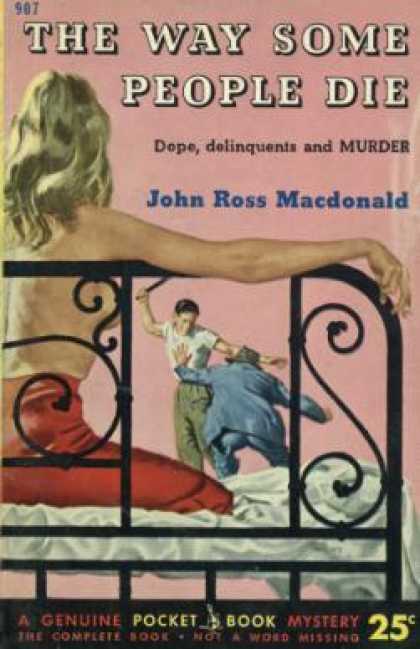
He has come up with a checklist of recurring themes, motifs and conceits in the Lew Archer novels and in his reading he applies them as they occur (or don't) and writes up his impressions.  So far he has covered The Moving Target (Archer's debut in print), The Drowning Pool, Black Money and most recently The Way Some People Die which inspired the title of this post.  Quinones considers this last book he's reviewed the best of the Archer novels. Bet he hasn't read The Chill or The Galton Case yet.

We always seem to be talking about detective novel tropes on the vintage mystery blogs whether we use the literary term or not.  And I know that I'm always looking for writers who subvert those tropes of the traditional detective novel and private eye novel. Those are the crime fiction writers who most appeal to me, whether they are firmly rooted in the past and were trying to reinvent the genre or are contemporary writers blazing new trails. But for anyone interested in this type of literary criticism in detective fiction I highly recommend you trot off to Peter's blog and read his essays.  I enjoyed them a lot.

Friday, December 13, 2013

FFB: Hot Freeze - Martin Brett

 Michel Garfin is the man to go to in Montreal if you have a particularly nasty family secret you need to keep quiet. But call him Mike.  Only the Chief of Police calls him Michel and only because he doesn't speak any English.  Oh, and while we're talking about his name its GAR-fin, pronounced just like its spelled, not Gar-FAN as if it were French. He's Irish/French Canadian and though he's bilingual and lived in Montreal most his life where he was once on the Royal Mounted Police Force he could have stepped out of an office in Hammet's San Francisco or Chandler's L.A.  Hot Freeze (1954) marks Mike Garfin's first appearance out of three crime novels.

Montreal is a frigid violent world of illegal casinos luring gamblers to the barbotte and fan tan tables, brothels where the prostitutes serve as both companions and informers, and home to a wealthy dysfunctional family that would be all too familiar to Lew Archer or Philip Marlowe. The sexual imbroglio in the Astley/Remington household may call to mind the tawdriness of The Big Sleep or the family secrets that dominate Ross Macdonald's novels. But its the omnipresent, near paranormal influence of the wintry weather in Montreal becoming a formidable additional character almost as brutal as the human villains that reminds the reader he is far from the mean streets of California.

Mike is hired by Mrs. Remington to find out how her son Gerald is obtaining such a large amount of money. He receives an allowance but his ostentatious spending raises suspicions. He must be getting more money from some other source, she thinks. Mike soon learns that there are actually two families in the Remington home and that Mrs. Remington was previously married. Gerald and his sister Geraldine provide us the earliest examples of the unbridled sexuality that pervades the book.

Gerald is yet another of the handsome indiscriminate gay men, always flirting, always alluding, that one finds in 1950s private eye novels. It's his sex life that triggers the blackmail flag in Mike's mind as the possible source of the extra money. Geraldine is clearly a Carmen Sternwood knock-off but her insatiable taste for men eventually unearths a surprising facet to her character that all but erases any reminders of Chandler's teenage nympho. Then there's Marian, Mrs Remington's stepdaughter, who makes all too clear that she despises all of the Astleys and resents them living in her home.

Originally Mike plans to tail Gerald, find out his habits and bring the case to a quick close. Mike is sure that Gerald is blackmailing some wealthy influential man who can't risk having his sexual predilections uncovered. But Gerald surprises Mike by inviting him along to a barbotte casino and all thoughts of blackmail are almost entirely put out of Mike's mind when he sees how incredibly lucky Gerald is at the gaming tables.

Enter Tom Littleton, Mike's one time partner in the Mounties when they were both cops back in Winnipeg. Littleton is undercover as part of a narcotics investigation and he urges Mike to keep him that way by not mentioning his name. Mike in order to save his hide, however, lies about working with the RCMP and lets slip Littleton's name. When he returns later that night to find Littleton dead in the courtyard of his apartment building he is devastated. Up to this point Mike was all tough guy like many of the eyes of his day, but now we see a new side. A crowd of gawkers gather round the fence when Littleton's body is being taken away and Mike overhears them gossiping about another dead drunk who froze himself to death.
I kept my mouth shut, not answering any questions. I climbed into the back of the wagon when they were ready to go and sat near the bunched up thing that had been Tom. Grown men, they say, don't have such emotions. Grown men do. I sat with the tips of my fingers touching his frozen head and vowed to do slow murder to avenge this one.
The addition of this fraternal love between former police partners at times is heartbreaking. Mike is overcome with emotion several times during the novel. He suspects an insidious murder method and when it is confirmed that drugs are involved it only fuels his vengeful drive.

Brett toys with Chandleresque prose but makes it all his own as Montreal and Canadian culture dominate the proceedings. Hot Freeze is one of the better examples of a private eye novel that will appeal to a variety of crime fiction tastes. Enough tough guy manner and sex to satisfy the hardboiled crowd, real crimes committed for believable reasons for those who crave documentary style realism, quirky characters of truly original molds (including an acrobat dwarf with a sadistic side!) for lovers of offbeat fiction, and good investigating with a few examples of well placed clues for the detective novel fans. Above all there is an humanizing emotional undercurrent that controls every behavior in the violent and corrupt world of a bitter and savage Montreal.

Friday, January 18, 2013

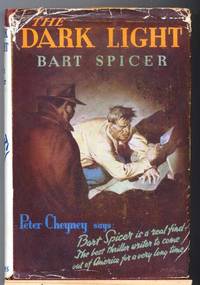
FFB: The Dark Light - Bart Spicer

"The uneasy breath of a nasty idea kept pace with me." -- Carney Wilde in The Dark Light

For anyone who has read all the Philip Marlowe books and all the Paul Pine novels and still craves a private eye in a similar vein with more than a few nods to the great Chandler I recommend the work of Bart Spicer. His Carney Wilde is a tough guy with a heart and in his debut The Dark Light (1949) is struggling to make a living at his game. Enter Deacon Andrew Jackson who wants Wilde's help in locating Matthew Kimball, the missing preacher from the Shining Light Church. As with all missing person cases in a private eye novel Wilde will face some dirty doings and a few murders along the way.

There is touch of Ross Macdonald in this first book but I'm guessing it's mere coincidence since only The Moving Target had been published by 1949. That Spicer chose to include one of the typical wealthy and morally corrupt families in this book is not all coincidence but the similarities to what Macdonald would soon be known for are. The Prentices really aren't all that bad as the story progresses but there is a creepy mother-son relationship depicted in Mrs. Prentice's devotion to her hunky son Alec. Also her daughter Alicia at first appears to be one of the many predatory females that populate private eye novels. She gets an eyeful of Wilde and wants more. So she invites herself along in Wilde's investigation by sitting in his car and refusing to leave until he starts the car and takes her with him.

I particularly liked this Chandleresque passage that comes early in the book:
I got in my car and went home for a cold bath. I lay back in the water, getting up enough interest to keep my date with Alicia. I had the courtroom stink in my nose and it didn't mix well with Alicia. The dead sourness of unwashed bodies and disinfectant and brutality and fear and the clumsy maneuvering of justice. I got out of the tub and tried to rub some of it off.
What makes Spicer's private eye different from most of the detectives of this type is that Carney Wilde is first and foremost a businessman. He's worried about his small firm and in his debut he's just learning to play the game. The entirety of Chapter 6 is devoted to his backstory in which we learn he was a member of the CID in the army who returned to work as a house detective for a department store. His former boss at that store, an astute businessman who made a killing in real estate and banking, hired Wilde as a security consultant and with that money he was able to start his own private detective firm. But the clients aren't rushing in. When they do show typically they are like Deacon Jackson, barely able to afford a day's work. But Wilde needs business and he takes what he can get. The chapter also goes into great detail outlining his work with an insurance company. It's a contact Wilde desperately needs. If he can get an insurance company as a regular client he'd have it made. He is hoping to earn some extra cash by giving testimony in a robbery case of great concern for a certain insurance company. With that money Wilde envisions buying a new car, a new office with a staff of three, and plenty more.

UK edition, (Collins, 1950)
The detection in this book is also a highlight. Unlike most private eyes who rely on intuition and guesswork Carney Wilde has the skills of a logical detective more often seen in the work of Ellery Queen. In tracking down Matthew Kimball to a Manhattan hotel he finds the illusion of a inhabited room but a few odd elements that make him suspect Kimball was never in the room. Chief among those clues are a radio speech without the changes he made on the original and a pair of eyeglasses with an old prescription. Combining these finds with some astute questioning of Deacon Jackson and the staff of Kimball's optometry store Wilde is faced with the fact that an impostor checked into the hotel.

What begins as a simple missing persons case soon becomes almost more than Wilde can handle. He finds himself enlisting the aid of his old army buddy who also happens to be a private detective working in New York to do some legwork and save on his commuting from Pennsylvania. He also finds himself collaborating almost against his will with Lt. Grodnick who thinks Kimball will turn up alive somewhere with a woman on the side. Wilde who has a much better understanding of human nature and without ever having met Kimball knows this is the wrong read on the preacher. Wilde will end up confronting blackmailers, an angry bigot with a sexually ravenous daughter, some talkative bartenders, and a nosey landlady before he manages to put all the pieces together and stop a killer who wants to protect a deep, dark secret.

Bart Spicer as he appears on the
rear DJ panel of the 1st edition
At journey's end Spicer piles on too much melodrama in what Grodnick calls "a Philo Vance like set up" but just getting to know this detective, a wise guy with a compassionate heart, in his debut was well worth the trip. I'm ready to start on the second and third books in the series and will report back on Carney Wilde's progress in the private eye biz.

For more on Carney Wilde and  Bart Spicer see the excellent info on this page at The Thrilling Detective Website.

The Carney Wilde Private Eye Novels
The Dark Light (1949)
Blues for a Prince (1950)
The Golden Door (1951)
Black Sheep Run (1951)
The Long Green (1952)
The Taming of Carney Wilde (1954)
Exit, Running (1959)

Friday, June 1, 2012

FFB: A Stranger in My Grave - Margaret Millar

There is no doubt about it.  Margaret Millar is first and foremost a great storyteller.  Her husband, Ross Macdonald, once confessed a deep envy of her ability as a natural born writer as well. The famous example quoted in Tom Nolan's biography (as much a life story of the two crime writers as it is a bio of the creator of Lew Archer)  goes like this:
"F'rinstance" -- and he recited to me a sentence of hers with a simile in it: "Her question trailed off into the room like a faint cigarette track in the air, or something like that. The comparison between the question and the...smoke trailing off, was so perfect; the ear is so fine and the tuning so good, there."
When you combine a "natural born" talent for crafting perfect sentences like the one above with tightly plotted stories and characters who speak dialog with unique voices and who sound like people you meet in everyday life you get an end result that is all too rare in contemporary crime fiction:  real novels with real plots that both entertain the reader as mysteries and stimulate the mind with human insight and literary power.  No better example of Millar's triple whammy of talent can be found than in A Stranger in My Grave (1960), a mystery story that also happens to be a timely modern novel about birth origins, children and parenting.

A Stranger in My Grave features one of Millar's favorite crime fiction metaphors - nightmares.  As early as her sixth novel The Iron Gates (1945), her second mystery novel set in her home province of Ontario, Canada, she was playing with the idea of dreams -- more often than not nightmares -- and how those subconscious images interplay with a character's waking life.  In the case of The Iron Gates the nightmare was an expression of a repressed guilt over a past crime and in that novel another character exploits that repression in one of the most wicked forms of revenge ever perpetrated in contemporary crime fiction.  Fifteen years later Millar returned with a similar idea in A Stranger in My Grave. 

Daisy Harker dreams of visiting her own grave and hires Steve Pinata, bail bondsman and sometime private detective, to help her learn more about the date carved into the gravestone. When the two visit the cemetery they discover the grave exists exactly as described down to the unusual tree standing guard over the site. The mystery deepens when the name on the gravestone -- Carlos Camilla -- means absolutely nothing to Daisy.  The investigation then ceases to be less of the search for a "lost day" and rather the search for the connection between Camilla and Daisy.  That search will lead to Daisy's work as a volunteer in a clinic and Juanita Garcia, a woman who had a seemingly incidental contact with Daisy four years ago.

Apart from the tantalizing plot, its labyrinthine intricacies, and the near Dickensian way in which Millar manages to connect all the characters in the story there is an abundant richness of life in her fully realized and original characters. There are too many scenes I want to list as wondrous vignettes that serve as excellent examples of how Millar uses action to reveal character.  She is in many ways more of a dramatist than a novelist for she fully understands the first rule of theater and all good dramatic works -- show rather than tell.

Among the highlights are a scene in which a dog's love for Daisy is used to express her state of mind; the curmudgeon diner owner, Mrs Brewster and how she uses her denim apron as a theatrical prop as an extension of her personality; the contrast between Stan Fielding, Daisy's father and his new wife, Murial, a not too bright woman deeply in love with the man who sees his dreaming and eccentric way of speaking as signs of sophistication rather than posturing and humbuggery as most people do; Fielding's reluctance to steal a woman's purse in order to get the keys to her car -- the only thing he wants to take from her -- and how his hesitancy leads to his being caught; a powerful scene when Juanita, in a furor, attacks a locked door in the home of her religiously obsessed mother by breaking down the door with a crucifix.

And there are, of course, her words:
The promise was as frail as a bubble; it broke before his car was out of the driveway.
She had never called him Steve, and the sound of it coming from her made him feel for the first time that the name was finally and truly his own. [...] [H]e would always be grateful to her for this moment of strong, sure identity.
Time had become a living, breathing thing, attached to him as inexorably as a remora to a shark's belly, never sleeping or relaxing its grip...

The marvel of this particular book and what is most striking in my mind more than any other of Millar's is the structure and the recurring themes of childlessness, orphans, and parenting styles.  Read today in the context of negligent parents, child abuse and pop culture figures like "the Octomom", the story in  A Stranger in my Grave is amazingly timely. Beyond that timeliness is Millar's unique structure of interspersing snippets from a letter as chapter epigraphs. As the story of Daisy unfolds and the hidden truth behind her odd dream is ultimately revealed we also read a letter than was meant to be delivered to her years ago.  Only in the final chapter to we get to read the full letter along with Daisy and discover the truth at the same time she does. Only in the final words, nearly in the final sentence, is the power of the novel fully felt.

For an in-depth study of Millar's work, her relationship with her husband, and how she taught him how to be a better dialog writer read this article originally published in the Fall 2001 issue of Mystery Readers International.

Margaret Millar is the featured author this week for "Friday's Forgotten Books." There should be several reviews of her books from the regular contributors. To learn who reviewed a Millar book, and for all the other books featured this week, see the list at our host site, Patti Abbot's blog.

The Crime & Detective Novels of Margaret Millar
The Invisible Worm (1941)
The Weak-Eyed Bat (1942)
The Devil Loves Me (1942)
Wall of Eyes (1943)
Fire Will Freeze (1944)
The Iron Gates (1945)
Do Evil in Return (1950)
Rose's Last Summer (1952)
Vanish in an Instant (1952)
Beast in View (1955)
An Air That Kills (1957)
The Listening Walls (1959)
A Stranger in My Grave (1960)
How Like an Angel (1962)
The Fiend (1964)
Beyond This Point Are Monsters (1970)
Ask for Me Tomorrow (1976)
The Murder of Miranda (1979)
Mermaid (1982)
Banshee (1983)
Spider Webs (1986)

Monday, May 7, 2012

The Ancestral Precipice - Jan Ekström

"The John Dickson Carr of Sweden" proclaims the dust jacket of the first UK edition of Ättestupan (1975) translated as The Ancestral Precipice and published nearly ten years later.  Takes a while for the English language speaking world to catch on to a great writer, doesn't it? While there is a baffling locked room murder in this cleverly constructed detective novel its central theme of family secrets and adulterous affairs has more in common with Ross Macdonald than Carr.

Charlotte Lethander, calls to her home her surviving nieces and their families to celebrate her ninetieth birthday. The entire multi-generational family arrives bringing with them plans for blackmail, scheming, adultery and murder. On the very first day of this rocky reunion we learn that the black sheep Victor, a womanizing photographer who likes shooting women nude, has a letter with incriminating information he wants to sell to his father, Martin, and demands 15,000 kronor for its delivery into his hands. Additional avaricious behavior is on display from the nieces, their husbands and children as they vie for the attention of the dying aunt Charlotte. In the midst of all this fawning adulation and scheming a murderer plots a revenge years in the making.

Before the weekend has hardly started Victor and Martin are dead.  It appears to be a murder/suicide. Martin having shot Victor apparently returned to his bedroom, locked his door, and allowed the extinguishing flames in the bedroom fireplace to suffocate him with carbon monoxide. But Martin's children - especially his sharp-witted and sharper tongued daughter Vera - know that the strong-willed man would never submit to Victor's demands and that the suicide has to be a cleverly disguised murder.  But how then did the murderer escape the room? It was locked on the inside. When the police investigate the scene the damper on the flue is open making it seem impossible for Martin to have died from carbon monoxide inhalation. And yet he did.  Further complicating matters is the fact that gun found in Martin's room though recently fired is not the gun used to kill Victor. The case takes an even stranger twist when a second gun is found in the attic with fingerprints of another family member who was thought to have an alibi the night of the deaths.

"Can't tell the players without a scorecard!"
The very necessary family tree I referred to frequently while reading

Hovering over these two crimes is the death of Mauritz Corn's wife, Stella, who accidentally fell to her death and was discovered at the foot of ättestupan, the ancestral precipice of the title. The letter Victor had in his possession revealed the truth about her fatal plunge long believed to be an accident. Aunt Charlotte delivers a jarring description of the foreboding feature of the ättestupan and also the Nordic legend that attaches itself:
Do you know what was here before the house was built, just where we're standing now, I mean? An ancestral precipice. It's been here since Viking days, though I don't suppose any Vikings lived here, you know, only cultivators. Nature is harsh. [...] You know what an ancestral precipice is, Inspector? Some of the old ones threw themselves down the precipice. Others were given help when they asked for it. I wonder if anyone would want to give me help without my asking for it. For an ancient old hag it would be eminently suitable.
Inspector Durrell, in charge of the murder investigation, must not only get to the truth of the curious events surrounding the death of Victor and Martin, but also the mysterious death of Stella now looking more and more like a murder. Will the letter from Victor's blackmail scheme ever be found?  Who does it name as Stella's killer?  Will the killer strike again?

The story is filled with the kind of brooding aura and dark family secrets that fill the pages of the cases of Lew Archer. When I saw the Swedish film version of The Girl with the Dragon Tattoo I also noted the pervading MacDonald-like atmosphere that imbued that film.  I wonder if Stieg Larsson was familiar with the mystery novels of Ekström who appears to have been influenced not only by Carr but by Ross Macdonald.  Fans of Larrson, Carr or Macdonald will find plenty to admire in The Ancestral Precipice, a real puzzler with plenty of twists and a good example of the least likely suspect revealed as the killer in the final pages.

AVAILABILITY:  The book was first published in the US in 1982 under the blase title Deadly Reunion.  Copies of both the UK and the US editions are readily available through the various internet bookselling sties. To date this is the only novel of the popular Swedish writer Jan Ekström that has been translated into English.