Showing posts with label Erle Stanley Gardner. Show all posts

Saturday, January 9, 2021

REAL LIFE: The Case of the Autographed Corpse

Gardner dictating one of his
many Perry Mason novels

Much has been written about mystery writers and their involvement in real life crime cases. Arthur Conan Doyle used his skills as an amateur sleuth and ophthalmologist to help clear the name of George Edjali accused of mutilating horses and other farm animals. A nurse who after reading Agatha Christie’s The Pale Horse recognized the signs of thallium poisoning in that book and managed to get proper treatment for a misdiagnosed patient in time to save the patient’s life. But what of other mystery writers' adventures in real criminal cases? Who else might have turned detective in real life or had their books used to help solve a crime? An article in the recent Smithsonian magazine highlights Erle Stanley Gardner’s involvement in helping to resolve a case of a wrongfully accused and imprisoned Apache shaman.

Gardner never stopped practicing law and, in fact, spent much of his later life helping prisoners. This may have been mentioned in Gardner’s biography by Dorothy B. Hughes but I’ve never read it. Nevertheless it was fascinating to learn that Gardner was one of the first people to create a foundation that examined miscarriages of justice (The Court of Last Resort), reviewing cases of prisoners who wrote letters claiming innocence and of being wrongfully imprisoned. One such letter written in 1951 found its way to Gardner’s desk. The writer was Silas John Edwards, an Apache medicine man who had started his own religion. In 1933 he had been tried for the murder of his wife, was quickly found guilty on largely circumstantial evidence, and sent to prison. Gardner reviewed the court transcripts and interviewed others on the reservation where the murder took place. Many of those he interviewed were convinced of the Apache’s innocence. Some even claimed to know the name of the true killer. It was a piece of supposed evidence presented by the prosecution, however, that set Gardner off on his quest to save Edwards.

Silas John Edwards (left) and his father
©E.E. Guenther, from collection of
William Kessel as published in Smithsonian

Edward’s wife had been bludgeoned and strangled. Near her body were bloody rocks inscribed with the initials of the accused. Gardner found convincing physical evidence that was overlooked or paid little attention to during the trial like blood that was smeared on Edward's clothing rather than splattered which would have happened if he had actually bludgeoned his wife. But in a bold and outrageous move the Prosecution claimed that the initialed rocks were part of an Apache ritual. The D.A. told the court that an Apache murderer left initials at a crime scene to prevent the victim's soul from seeking vengeance. Gardner thought it a ludicrous claim, something not only counterintuitive but utterly lacking in common sense, and he had his surmise backed up by Apaches on the reservation. None of the Apaches he spoke with could corroborate such a fraudulent sounding ritual. Not one Indian had ever heard of such a practice neither in their own culture or in the odd religion that Edwards had created. Working with the court transcript and gathering witness testimony from Apaches who were never called to the stand back in 1933 Gardner worked tirelessly to prove the prosecution manipulated facts and in some cases invented them to get the conviction. There is a happy ending for Edwards even though he served almost all of his time in prison.

Rather than summarize the entire story which has more than its fair share of life’s irony and twists to rival any Perry Mason novel I point you to the full story as written by journalist Jack El-Hai. Luckily it’s one of the articles you can read in full at the online version of the December 2020 issue of Smithsonian magazine. It makes for eye opening reading.

Friday, August 2, 2019

FFB: The D.A. Calls It Murder - Erle Stanley Gardner

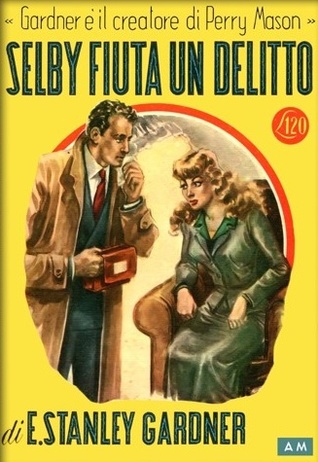
THE STORY: Newly elected district attorney and sheriff for Madison County, California, Doug Selby and Rex Brandon, have their work cut out for them. A dead body is found in Room 321 of the Madison Hotel and the owner and police want to hush it up as a suicide but The D.A. Calls It Murder (1937). Doug Selby takes charge of a case involving alternate identities, blackmail, arcane divorce laws and a missing heir.

THE CHARACTERS: Doug Selby is the polar opposite of Perry Mason. Mason is a criminal defense attorney while Selby is a prosecutor. Mason is shifty manipulator willing to do anything, even break the law in order to protect his client who is almost always innocent. Selby is upstanding and thoroughly decent, but with a very short fuse of a temper. In his first outing Selby must prove himself to be the people’s choice for D.A. and stand up to the inherently corrupt and grifting locals who have come to depend on the graft laden police and former D.A. When the owner of the Madison Hotel wants the possible suicide hushed up as quickly as possible to prevent bad publicity Selby must deal with ingratiating demands, implied favors and tacit bargains that Sam Roper, the former D.A. had in place with the hotel management. Selby will have none of it. He knows that something is suspicious about the death of the minister. And publicity cannot be avoided when they learn that the minister is not who he says he was. After bringing in the widow all the way from Nevada to identify the body she insists that the man is not her husband. Who was he? And why was he pretending to be Rev. Charles Brower?

1st US paperback, 1944
(8 printings over six years
with this cover)
Selby has a gal pal reporter in the person of Sylvia Martin. She represents a paper that backed Selby in the election and she wants the scoop on the minister’s murder. If Selby will give her the facts first she promises to report the truth and wipe away the bad press he is getting from an ugly tabloid whose specialty is insinuations and innuendo. The editorial staff are eager to besmirch Selby’s good name and make him look not only incompetent in his first week as district attorney but imply that he’s more corrupt than Sam Roper, his predecessor.

Selby also has to contend with the secretive actress Shirley Arden who has a special room at the Madison Hotel c complete with private entrance and all-expense paid for by an anonymous benefactor. She enters the case because Selby and Sheriff find among the personal effects of the dead minister a pile of press clippings with Shirley’s name and photo all over them. There are also newspaper articles about a high profile lawsuit involving the rightful heir to the Perry estate. Both the mystery surrounding Shirley Arden’s private retreat at the Madison Hotel and the Perry lawsuit will tie in with the murder of the mystery man in Room 231.

1950 Pocket edition, (9th prtg)
INNOVATIONS: Gardner was a master at convoluted plotting and The D.A. Calls It Murder is one of his trademark stories filled with interlocking subplots and neat little twists. Only Gardner could manage to find a way to make the nasty poisoning of a German Shepherd and the subsequent rescue of the dog become one of the most crucial clues to the unraveling of all the mysteries.

This particular novel is remarkable for Gardner’s portrayal of the women characters who usually come off as either wiseacres or vamps. But Shirley Arden is far from a typical wily vixen archetype found in his pulp fiction. Gardner has a unique understanding of the perils of celebrity in Hollywood and gives Shirley a monologue both trenchant and poignant about how she views her fan base and how she values her private life.

One of the most unexpected scenes comes when Sylvia accompanies Selby to the home of Mrs. Larrabie, the real widow of the murder victim. Together they deliver the dismal news of her husband’s violent death and his curious masquerade as a different person. The scene is a rare example of Gardner's understanding of women and how they are better suited to take care of each other in times of trouble. Selby may have the difficult task of breaking the news, but it is Sylvia who takes on the burden of comforting Mrs. Larrabie, a total stranger, and who is overcome with emotion herself when she sees how the widow takes the news stoically. In an ironic touch Sally finds herself being comforted by the grieving widow.

Cardinal C-295, 1958 1st thus
QUOTES: Shirley on how she views her public: "They're like telegraph poles whizzing by when you're traveling on a Pullman train, if you know what I mean. They tell me things about themselves and I smile at them sympathetically and work my eyes; but all the time I'm thinking about my last income tax return, how long I'm apt to be working on this present picture, whether the director is going to listen to what I have to say about the way I should say "Farewell" to my lover or whether he's going to insist on doing it according to some standards which don't register with me. I give my fan my autograph and turn loose my best smile on him. I know I'm never going to see him again and he's in sort of a daze anyway which he's conjured up to wrap around me as an aura."

Shirley on her keen observational skills: "Men who tell me how much they admire my acting are quite numerous, but it's not very often one comes in contact with a man who's so completely genuine, so wholeheartedly sincere as this man [the murder victim]. Naturally, as a woman, I noticed his clothes."

"You're a very prickly porcupine. When your quills are out, Mr. Selby, you're exceedingly difficult to deal with."

THINGS I LEARNED: A portion of the problem with determining the rightful heir to the Perry estate has to do with a marriage that was performed when an interlocutory decree of divorce was still in effect. The most concise definition comes from Law.com: "Interlocutory decrees were most commonly used in divorce actions, in which the terms of the divorce would be in force until a final decree could be granted... The theory was that this would allow for a period [of time] during which a reconciliation might be [reached...]. Interlocutory decrees of divorce have been abandoned as a procedure in most states because they seldom had the desired effect and appeared to waste the parties' time." California still allows for
interlocutory decrees in divorce; the time period can not exceed six months.

In the novel Charles Perry marries Edith Fontaine while he was in effect still married to his first wife. Edith has a child and Charles thinks this is his rightful son, but in the eyes of the law he was not legally married to Edith since his first marriage was still in effect under the interlocutory decree. When the first wife died it is generally believed that Charles never remarried Edith again in a legal ceremony and so his son could not legally be considered his heir. Charles' brother Herbert is contesting the will and claims he is the true heir. A search is on to find out whether or not Charles ever remarried Edith, who might have performed the ceremony, and where it took place so a certificate of marriage can be produced. This is why the several ministers in the story become extremely important.


Doug Selby Detective Novels
The D.A. Calls It Murder (1937)
The D.A. Holds a Candle (1938)
The D.A. Draws a Circle (1939)
The D.A. Goes to Trial (1940)
The D.A. Cooks a Goose (1942)
The D.A. Calls a Turn (1944)
The D.A. Breaks a Seal (1946)
The D.A. Takes a Chance (1948)
The D.A. Breaks an Egg (1949)

Friday, September 9, 2016

FFB: Let Him Have Judgment - Bruce Hamilton

THE STORY: Robert Teal has been very busy in London. He's been digging around courtroom archives, reading newspapers, spending the day listening to how a certain judge talks to a jury.  Then he up and leaves and heads off to the village of Moxton where he becomes interested in a local ne'er-do-well named John Willoughby. Suddenly Teal disappears and so does Willoughby.  A body turns up and it looks like a very nasty murder.  But who is it?  And who exactly is Teal?  Or Willoughby for that matter?

THE CHARACTERS: I'd rather skip this section because so much depends upon masquerade, impersonation, and double identities. The appeal of this story is that it's another one of those in which the less you know the more you will enjoy it. Let's just jump ahead to what makes this book such a unique example of crime fiction--

INNOVATIONS:  The book has a brilliant construction that could only be accepted by someone who admires crime fiction plotting. There is a Prologue which is sort of a mini tale in itself, but lays the groundwork for Hamilton's purpose in writing the book. Let Him Have Judgment (1948) is clearly meant to serve as an indictment against the vagaries of the law and how criminal justice is often left in the hands of those who seek retribution. The reader learns of the fate of Harry Gosling who apparently was wrongly sentenced for a murder he never committed. On the eve of his execution he pleads with the reverend who is sent to his cell to give him solace. The two conspire to break basic rules about  written communication posted from the prison. Harry writes a letter and has the minister vow that he will take the letter, not read it, and conceal it another letter written by the reverend himself. Then the reverend is to send both letters to an address in America. The prologue fades out as Harry is led to the gallows.

The story then veers off in a completely new direction with the entrance of Teal focussing on his mysterious visits to the courts and other detective work, his vanishing, and the discovery of the corpse. All of this leads to the arrest of a judge and a murder trial. The bulk of the tale shows us various aspects of a murder investigation and how it is exploited by the press, by members of the inquest jury, by the lawyers presenting their cases, and even by members of the trial jury. It's all an ingenious concept showing how the legal system is vulnerable to master manipulators and subtle powers of suggestion.  The US title of this book is Hanging Judge and we learn that Judge Brittain is far from an admirable man of law who has allowed his cruel pleasures and indulgent lifestyle to corrupt him and the way he views the law. As the murder trial progresses it becomes clear that the Judge has some secrets he wants to kept hidden and yet he manages to admit to them while remaining ostensibly untouchable and unsullied.  But Hamilton allows us to follow the thoughts of one jury member whose perceptions of the case are thoroughly prejudiced. His offhand comments made to other jury members when court is out of session will change the way all of the judge's testimony is heard and viewed.

The real ingenuity of the story comes in the triple twist of the Epilogue when all the mysteries of identity, wrongful accusations, and seemingly unjust verdicts are all explained.  On my paperback copy there is a laudatory blurb from Erle Stanley Gardner who says, "This book is in my opinion a mystery masterpiece." Very true. I'd go so far to call this novel a tour de force of a legal mystery as well as a caustic depiction of the fragility of a legal system all too susceptible to manipulation.

THE AUTHOR:  Arthur Douglas Bruce Hamilton was the older brother of novelist and playwright Patrick Hamilton best known for Angel Street, Rope and Hangover Square all of which became crime classics in their movie adaptations. Bruce Hamilton's crime novels take after his brother's in that both are more about the psychology of the criminal mind rather than following the formulae of traditional detective fiction. Both writers tend to indulge in the bleaker aspects of humanity with books that have noirish endings. Bruce's novels, so little known and celebrated, may not match his brother's flair for writing but can often surpass --as in this case-- the younger Hamilton's more conventional approach to exploring crime.

EASY TO FIND? The book is out there in both US and UK editions, but it is the US edition that oddly is in relative abundance with twenty copies for sale. The UK edition was reprinted at least three times that I can verify and yet I find only four copies for sale online. As always you ought to check libraries when copies for sale are this scarce.

Wednesday, August 24, 2016

1954 STORIES: Ellery Queen Mystery Magazine, Nov. 1954

In my mad obsession with the year 1954 for Past Offenses blog's monthly Crime of the Century meme I've completely immersed myself in writings from that year. This issue of EQMM was brought to my attention when I read that it included a story by L. Frank Baum reprinted for the first time since its original publication in an obscure magazine at the turn of the 20th century. TomCat, our resident locked room/impossible crime enthusiast, mentioned Baum's "The Suicide of Kiaros" as one of the stories he came across in a different locked room mystery anthology. Of course I had to track down a copy of the magazine. Luckily , I found a copy on eBay (why don't I have this kind of luck in casinos?!) and managed to make an offer for a price I thought more suitable for a 50 year old magazine. And when I pored over the table of contents what did I find but a more fascinating serendipitous discovery. The very first story by William Link and Richard Levinson, creators of Columbo and many other TV crime dramas and movies, when they were only 20 years old and still students at the University of Pennsylvania.

As readers of EQMM might know each first time writer's story is accompanied by a brief intro by the editors giving some biographical info on the writer and how the story came about. In the case of Levinson and Link the bio is longer than usual and filled with tidbits that you most likely will not find anywhere else on the web whether it be their separate IMDB.com pages or the Columbo tribute website. I learned that they knew each other since junior high in Philadelphia and became a writing team as early as their teen years. While still in high school they wrote and produced a musical comedy "that was so great a success that both were inspired to pursue a writing career." Having their first taste of "show business" the two college boys went on to write radio scripts in college and humor pieces for the UPenn humor magazine as well as detective short stories. They probably never imagined that their writing hobby would eventually lead to a career as the leading mystery writing duo of TV just under twenty years later.

"Whistle While You Work" is a neat little tale of a henpecked mailman who everyday looks forward to leaving his claustrophobic household dominated by his shrewish wife. Over a period of days a series of weirdly addressed letters in blue envelopes with black borders turn up in his mailbag all addressed to women. Later each woman who received such a letter is found brutally murdered. It's kind of a James Thurber meets James M. Cain story displaying a mature voice, an ironic sense of humor, and some keen insight for a couple of 20 year old college boys. If I were to give you the story to read and you knew nothing about the writers you'd imagine each might be a cynical old 50-something who had his fill of harpy of a wife.

The L. Frank Baum story is also a crime story rather than a detective story. It presents the life of a brazen bank teller with a gambling addiction and a taste for embezzlement who seeks out the help of a money lender to help him pay his debts and cover his "loans" from the cashier's till. He seizes an opportunity to make off with a sizable amount of the moneylender's cash only after resorting to murder. He then cleverly seals up the room and makes the crime look like suicide. Does he get away with it? The unusual ending -- especially for a story written in 1897 -- probably made jaws drop. I'm sure the story was shocking and considered tasteless and immoral by Baum's contemporaries.

Included also in the issue are a familiar Hercule Poirot story about poisoning and an unusual murder method ("How Does Your Garden Grow?"); a Lester Leith story ("The Candy Kid", first published in 1931 in Detective Fiction Weekly) featuring Erle Stanley Gardner's version of the urbane, wealthy playboy sleuth popular in the pulp magazines long before he created Perry Mason; and stories by John D MacDonald, Charles B Child and Peter Godfrey. I particularly liked an odd puzzle story by Laurence Blochman ("The Man with the Blue Ears") in which the reader is asked to find 18 intentional mistakes within the story. Some of them were easy to spot like knowing that lapis lazuli is a blue gemstone not a red one or that Washington and Lincoln appear on the $1 and $5 bills not Jackson and Hamilton. But lots of the errors like the mention of Pisco punch being made with Brazilian brandy (it's made with Peruvian brandy) or "a .32 police positive" (it should be a .38) went right over my head. Van Deen test for bloodstains? If you work in a forensic lab maybe. A regular Joe Reader knowing this? Probably not. Apparently Blochman, whose adventure thrillers and detective novels set in India I know very well and recommend highly, wrote a series of these type of "Spot the Mistake" stories for EQMM during the 1950s. This is also one of EQMM's more literary issues with reprints of two crime stories by Jack London and Roald Dahl ("Only a Chinago" and "Taste",  respectively).

Friday, May 29, 2015

FFB: TCOT Rolling Bones - Erle Stanley Gardner

If The Case of The Rolling Bones (1939) is any indication of how Gardner moved away from the rough and tough Perry Mason in the very first books to a Mason who is a combination of courtroom wizard and clever detective then sign me up for more! This was one heckuva improvement over the hardboiled Mason I first met several years ago in his debut, The Case of the Velvet Claws (1933) and the much later Mason of the late 1950s to early 1960s who liked to switch guns and play around with ballistic evidence that left my teenage head spinning in confusion. Granted there may be some dizzying plot twists in ...Rolling Bones having mostly to do with one character who has multiple aliases but for overall I liked this entry in Gardner's long running series very much. Unable to stop reading I whipped through the book in nearly a single day. That's a rarity for me.

It all starts rather innocently as Phyllis Leeds, Emily Milicant and Ned Barkler --all friends of Alden Leeds, a former gold prospector who struck it rich in Alaska back at the turn of the 20th century -- approach Perry Mason to help with what appears to be a blackmail scheme. A check for $20,000 made out to someone named L. C. Conway is specially endorsed by Leeds who insists that the money be handed over to a young woman who is not Conway. This odd incident is straightened out fairly quickly but Mason soon discovers that Conway's shady business of selling loaded playing dice has suddenly shut its doors, sold the business and skipped town.  Then Leeds writes another check for $15,000 to the same Conway and this time the money is handed over to a completely different woman. Mason demands to know what secrets in Leeds' past demand such large amounts of hush money to be doled out to two mystery women.  He learns of Leeds life as a prospector and the accidental death of his partner, an elaborate scheme involving masquerade, dual identities, and a corpse that has apparently come back to life. The case takes a nasty turn when L. C. Conway later turns up with a knife in his back and living under a different name. But the case is just beginning and the courtroom hearing to determine whether or not Leeds can be brought to trial for the murder of Conway will reveal even further complications.

This is an exciting novel in the Mason series for both reader and Gardner's series characters. Both Della Street and Paul Drake have key moments where they are directly involved in the case. Della saves Perry from being arrested for speeding and lying to police with the help of Gertie, the switchboard operator. This is Gertie's debut in the series, incidentally, and she marks a strong first appearance with the stunt she pulls in the office (on Della's orders) to distract the police. Later, Gertie shows her innate acting skills in a startling courtroom moment indicative of Mason's brazen legal trickery. Drake does a lot of nifty detective work both on his own and with the help of his private eye operatives based in Seattle and Alaska. He's got quite a lot of connections, gang. He also spends a lot of time chewing gum (did he ever do that in the TV show?) and slouching his lanky angular body in Mason's luxurious leather armchairs.

Gardner goes out of his way to paint interesting portraits of Mason's two most famous sidekicks. The characters as portrayed by the actors in the TV show are so staid and conservative and engrained in all of our minds. It's startling to discover how Gardner first envisioned them. Della is far more sexy and actively involved than Barbara Hale ever was. Paul is a lot more colorful than William Hopper's blandly handsome, not so imaginative hunk. Both of them are just as clever and slightly roguish as Mason. They make quite a formidable trio on the printed page and especially in this particular outing.

There may not be any gun switcheroos or bullets gone awry in the plot of The Case of the Rolling Bones but there is still enough to make the novel zing and swing. The story of Leeds' past in Alaska is never really cleared up until the final pages. We hear several different accounts of what happened, along the way some impersonations and aliases crop up that can at times be a bit confusing. It's one of those books where the list of characters that Pocket Books liked to print at the front of their paperback editions comes in very handy for reference. Nearly everyone is pretending to be or pretends to be someone else in this story. One character has four different identities making the courtroom scenes rather funny when the D.A. insists that everyone refer to that one person by one name. Since all the witnesses know him by three other names they keep correcting themselves until Mason and the judge have had enough of it. I think Mason even makes a joke about taking it easy on the courtroom reporter.

From a case of blackmail and check fraud to a con artist selling crooked gambling dice to the greed of gold prospectors back in the 1900s culminating in a violent murder in 1930s California The Case of the Rolling Bones is one of Perry Mason's most exciting cases. Gardner has really hit his stride with this book. Fast paced, tightly plotted with some darn clever twists, excellent set pieces featuring Della and Paul, the story ends with Gardner's trademark courtroom showdown complete with a breakdown on the witness stand. It's all here and then some. As Ned Barkler says punnily in the closing, "That's what I call a natural!"

*   *   *


Reading Challenge update: Golden Age card, space D2 - "book with lawyers or a courtroom"