Showing posts with label Demon Children. Show all posts

Saturday, April 9, 2022

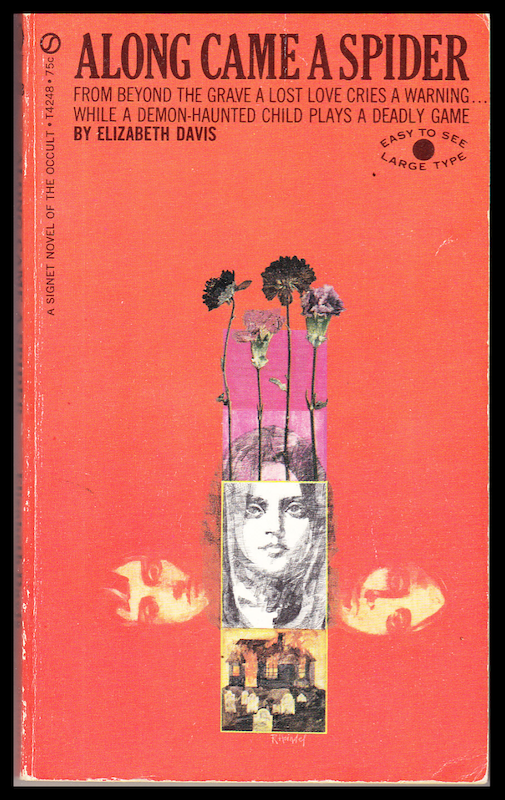
ALTERNATIVE CLASSICS: Along Came a Spider - Elizabeth Davis

I'm putting the sinister back into the Pretty Sinister Books blog this month as I tear through a pile of old horror novels and detective novels with supernatural and occult content.  Today's post also touches on the 1970s mania of the demon child in popular horror fiction.  I've read so much of this kind of book over the 11 years this blog has been around that I've finally decided to create yet another tag to label them all. If this is a subgenre in horror and mystery fiction that lights your chandelier you can click on the "Demon Child" tag at the end of this post and read more about them, perhaps find some obscure books dealing with killer children and demon-like adolescents.

Last month I had a mystery novel that incorporated a demon child motif -- well, more of a precursor to the Bad Seed trope -- in I Am Afraid (1948).  Today we go from the sublime and restrained domestic horror of that book to the outrageously ridiculous, horror bordering on parody in Along Came a Spider (1970).

Stephen, the nasty tween in I Am Afraid was 11 years old.  The bad kiddo in Elizabeth Davis' novel (apparently her sophomore effort in horror fiction under a second pseudonym) is remarkably only 9 years old. I found it incredibly hard to believe Anne Bishop, the evil little girl, was this young because for much of the book she comes across as a 45 year-old worldly wise woman.  But as you get to the the over-the-top finale our narrator posits her theory of why little Anne is such an adept sorceress.  She's basically the Wolfgang Mozart of black magic.

However, I'm getting way ahead of myself...

Davis's 2nd occult novel deals
with witchcraft and reincarnation
Inspired no doubt by Rosemary's Baby (1967) which almost single-handedly launched this new subgenre about children spawned from Satan and children possessed by demons, Along Came a Spider has been overshadowed by more well known (and better written) books employing this popular and by now hackneyed horror motif.  We have a wiseacre of a narrator in Eve Mercer whose colloquial voice is filled with idiomatic speech, sarcastic asides and a quasi stream-of-conscious narrative style that works against the suspense when Davis allows Eve to constantly interrupt her own thoughts. The narration is punctuated with dashes and ellipses as Eve trails off from one thought to the next like a distracted housewife running on a permanent caffeine high of extra strength Maxwell House.

The plot?  The Bishop family have moved in across the street and Eve fears her daughter Laurie has fallen under the diabolic influence of creepy little Anne, a primly dressed, too polite, too aloof miniature adult in the guise of a 9 year old girl.  Eve's first high-strung reaction to her daughter's new found friend comes when she learns that Anne is adept at painting. Laurie describes these paintings as nightmarish images of brutish monsters and other weird things she's never seen before.  They're so gory they look like they might have been painted with blood.  But Anne dismisses what was intended as an exaggeration by telling Laurie you can't paint well with blood. "It clots," says Anne's voice of experience, "and won't go on too smoothly."

The absurdity has entered the story early, my friends. This is only page 40!

There is an element of a detective novel in the story when Eve learns that the Bishop family knew a friend of a friend of a friend.  And so she hunts down some phone numbers and makes a couple of phone calls.  She reaches the boyfriend of a girl who died in an automobile wreck recently.  The young man tells Eve that his ex-girlfriend lived in the same building as the Bishops and ran into little Ann one day at the trash chute in the hallway. Anne was startled as she tried to shove something down the chute and quickly ran off leaving the object stuck. The now dead girlfriend went to see what Anne was trying to get rid of and found a mouse crucified on a handmade wooden cross.

It only gets more insane from here on.

There are strange rituals that Anne teaches her playmates. A girl dies in a cemetery but not before uttering a mysterious dying message.  Laurie begins to act strangely.  She has nightmares, disappears from her bedroom and can't be found late at night. Eve continues her detective work by consulting books on witchcraft and demonology and learns that Anne has been teaching Laurie and the other girls the ABCs of summoning demons and makes sure she is nowhere in sight when those rituals are being performed.

Ultimately the book is self-defeating because Davis allows Eve's hysterical imagination to get the better of her too often. The narration grows increasingly hyperbolic and her frequent wisecracks undermine the horror making it all seem like a black comedy.  Eve is also susceptible to superstition and imagines that her husband Jim who recently died has come back from the dead. He sends her warnings in her dreams, she hears his voice intoning "Move away! Take Laurie with you!"  Unfortunately as soon as that ghostly element is introduced Davis never follows through. Jim's ghost literally fades away as soon as he almost appears never to be talked of again. Davis seems to be suggesting that Eve might be headed for a nervous breakdown. Are we to think that Anne is innocent of all that Eve imagines her to be doing? The preposterous finale extinguishes that doubt as quickly as a sorcerer blowing out a scented black candle. But you must discover that on your own...if you dare.

You can read for yourself how this madness unfolds and whether or not Eve is a nut job or Anne is the spawn of a demon by buying one of the many copies available for sale out there in this vast shopping mall we call the internet.  I turned up about a baker's dozen in both English and foreign language translations.  It's an odd book, entertaining to be sure in an Alternative Classic way, but never really frightening at all.

Elizabeth Davis was born Lou Ellen Davis in Pennsylvania and raised her family in Connecticut.  Her fascination with witchcraft and psychic phenomena led to two other novels of crime and occult:  Suffer a Witch to Die (1970) and There Was an Old Woman (1971).  The 1971 novel was adapted for TV in 1972 and re-titled Revenge!  The made-for-TV movie has a script by Joseph Stefano (best known for his screen adaptation of  Psycho) and stars Shelley Winters (in one of the many badass biddy roles she succumbed to in middle age) and Bradford Dillman.

I will be reviewing both There Was an Old Woman and the movie Revenge! later this spring. Stay tuned!

Saturday, October 31, 2020

HALLOWEEN SPECIAL: The Jules de Grandin Stories - Seabury Quinn

Jules de Grandin may not have been the first occult detective in weird and supernatural fiction but he will always be the original Night Stalker to me.  Around the time that cult TV show Kolchak: The Night Stalker was airing in the 1970s a series of paperback books appeared in my local Woolworth's on the paperback racks I used to regularly pore over. The garishly colorful covers with bizarre creatures and titles like The Horror Chamber of Jules de Grandin and The Hellfire Files of Jules de Grandin were perfect lures for my teenage eyes.  I eagerly bought them all over a period of three or four months that summer.  In them I was introduced to the small but fierce French physician who battled every possible evil creature imaginable and did it all almost entirely in a fictional town in New Jersey.  Of all places - New Jersey!  The only state in the USA that was the butt of jokes of every stand-up comic and episode of Laugh-In during the 1970s.  But from the pen of Seabury Quinn Harrisonville, New Jersey was one of the most terrifying places you would ever want to visit.  A town overrun with vampires, werewolves, reincarnated Egyptian mummies, worshippers of Satan, and myriad evildoers obsessed with immortality and willing to make bargains with any demonic being they could summon and not unwilling to kidnap, steal or murder in the process. Not all the tales took place in New Jersey, but the bulk of the stories that appeared in Weird Tales from 1925 through 1951 did.  I devoured these stories in the six paperback volumes thinking that that was all I could get my hands on.  Now all 92 Jules de Grandin supernatural stories as well as the single novel featuring the occult detective, The Devil's Bride, are available to devotees of pulpy horror in a five volume set. Each volume runs close to 500 pages and there are dozens of tales I'd never heard of or read before.

As George Vanderburgh, owner of the indie press Battered Silicon Dispatch and a Sherlockian of some note, and Robert Weinberg, that renowned collector of mystery and supernatural books and Weird Tales maven extraordinaire, remind us in the detail rich introduction to each volume Seabury Quinn is not the most famous of Weird Tales writers.  But Jules de Grandin, his engaging intelligent and extremely knowledgeable occult detective, was definitely one of the most popular characters among the readers of the magazine. From de Grandin's first appearance in "The Horror on the Links" in 1925 the Frenchman known for his frequent bizarre exclamations like "Barbe d'un chameau!" or "Larmes d'un poisson!" was an instant hit.  Readers demanded more stories from Quinn and the publisher. Every year de Grandin tales made the "best of " lists and were frequently reprinted in later issues.  It's not hard to see why for Jules and his physician sidekick Dr. Samuel Trowbridge are truly likeable and heroic in the manner that the best of pulp fiction characters always are.

Short in stature, athletic in build, blond, bearded, a speaker of several languages de Grandin is like a mix of Sherlock Holmes, Hercule Poirot and John Silence, all characters he must have been modeled on.  Well, perhaps not so much Poirot for he was only five years old when the first of the de Grandin adventures was published.  But surely Holmes, Silence and perhaps Carnacki, William Hope Hodgson's other well known occult detective might have been Quinn's source as Weinberg and Vanderburgh tell us in their introduction. Letters pored in from readers analyzing the stories, praising and critiquing Quinn's imagination. A cult grew around the character.  As the two men describe the popularity and the phenomenon of de Grandin he began to take on a life and legend similar to Holmes. They write in their intro: "Readers smitten by how believable de Grandin seemed as a character wrote to Weird Tales asked if he was a person in real life."

There is not enough room here to describe all of the stories and I have no way near finished even the first two volumes. At random I selected stories that I haven't read based merely on length (avoiding those over 25 pages in order to read as many as I could in two weeks) and also I was lured by those with odd titles. Vanderburgh and Weinberg's intro also whetted my appetite by pointing out the more grisly and horrific of the stories.  I was drawn mostly to Quinn's fascination with Eastern mythology and religions and his penchant for pitting de Grandin against creatures less well known in the lore of the supernatural. Here is a modest sampling of the strange and fantastic adventures of the French physician turned occult detective. Each tale's first appearance in is in parentheses.

"The Horror on the Links" - The life of the idle rich at a golf country club is no party when an ape-like creature kills a woman and pursues another. Shades of Poe's Rue Morgue and Well's Dr. Moreau meld in a story of revenge and diabolical experiments. (Oct 1925)

"The Isle of Missing Ships" - More of a pirate adventure than an occult detective story it foreshadows Indiana Jones' derring do. Jules Verne set pieces also crop up in this story of a self-proclaimed god who calls himself Goonong Besar and rules an island in the South Pacific populated with the usual cannibalistic inhabitants armed with poison arrows. Seemingly filled with silent movie clichés from its maze-like underground fortress to the scenes of captives tied to stakes being cooked for dinner. Tiresome, not thrilling nor original in the least. My least favorite story of those I selected. (Feb 1926)

"Ancient Fires" - Haunted house, ghost of an Indian princess and reincarnation. Nicely done, but very familiar to anyone who has read a lot of these types of tales. Margery Lawrence handles reincarnation and lost love in her Miles Pennoyer stories better than Quinn. (Sept 1926)

"The Grinning Mummy" - What's an occult detective series without a smattering of Egyptology and a vengeful mummy? Incomplete, that's what. Here's the requisite angry mummified corpse on the rampage.  De Grandin is in fine form acting as a true detective in this outing. It's genuinely thrilling. Jules' habit of bizarre French exclamations adds "Nom d'un porc!" and "Dieu et le diable!" to his ever growing list. (Dec 1926)

"The Gods of East and West" - Jules enlists the help of a medicine man of the Dakotahs to help save Idoline Chetwynde (love that name!) from the grip of a spell cast by the malevolent goddess Kali. Only one bizarre French expression ("Nom d'une anguille!") but the action filled tale, the spells and rites and originality more than make up for the lack of odd vocabulary. A good one! (Jan 1928)

"The Serpent Woman"  - Jules and Dr. Trowbridge prevent a woman 's suicide then hear her story of being accused of her child's murder.  She claims he was not killed but stolen in the night. However, there is no sign of anyone having entered her home.  An impossible kidnapping!  This is one of the rare genuine detective stories in the de Grandin canon. The title of course reveals the culprit, but the discovery of who she is, how and why she accomplishes her misdeeds makes for gripping and entertaining reading. It even makes use of a genuinely surprising reveal. Added bonus: Quinn incorporates the Jersey Devil legend, probably its earliest fictional appearance. (June 1928)

"The Devil's Rosary" - A curse has befallen the Arkwright family. Nearly every one of them has died a violent death and at the site of each death a small red bead is found.  Haroldine Arkwright has found a red bead in her purse and is terrified she will be the next to die. Jules and Dr Trowbridge investigate and uncover another supernaturally enforced vendetta this time at the hands of victimized Tibetan monks. One of the more original stories making use of Quinn's fascination with Eastern religion and mysticism. (Apr 1929)

The five volumes that make up The Complete Tales of Jules De Grandin are published by Night Shade Books.  Each hefty tome is available through the usual bookselling websites in both new and used copies.  The most recent volume, Black Moon (vol 5), was released in March 2019. I still have three more volumes to acquire and with all the other books I have in my mountainous TBR piles I may never finish reading the entire collection.

Seabury Quin wrote pulp fiction in its purest form. It's text book pulp, a quintessential example of early 20th century American popular storytelling and genre fiction. As such these are far from great literature but that doesn't make them any less entertaining. You need to enter the world of Jules de Grandin prepared for not only over-the-top action and melodrama, but xenophobic comments and a generous supply of ultra un-PC descriptions of "foreigners".  But I am never one to be repelled by these sins of the past.  Horror stories and movies from every era are replete with similar embarrassing and shameful depictions. It's the imaginative storytelling that will get me all the time. And I'm a sucker for learning new mythology, superstition and ancient rites. The de Grandin stories are chock full of that too and to me that's what makes them worth reading.
Friday, February 16, 2018

FFB: Clay - David Almond

THE STORY: There’s a new kid in northern England town of Felling. Stephen Rose has been sent to live with his aunt, known as Crazy Mary by the kids in Felling for her eccentric ramblings about Jesus, Mary and Joseph. Stephen is an odd boy, a loner of sorts, with a talent for sculpture. His breathtakingly beautiful human figures draw the attention of the art teacher at school and the admiration of a handful of Stephen's fellow students. Not one to make friends easily Stephen nonetheless is drawn to Davie, a mischievous altar boy who steals communion wine and smoke cigarettes with his pal Geordie down by the abandoned quarry. Stephen tells Davie that they have a lot in common not the least of which is a talent for creating things. When Davie shows Stephen the rich clay deposits by the marshy land surrounding the quarry the two begin a strange friendship fueled by a secret experiment that unveils a unnatural creativity defying science, religion and logic.

THE CHARACTERS: Davie narrates Clay (2005) in a mix of Felling’s Irish tainted dialect and a colloquial teenspeak. The reader watches him in his various personae as he flits between allegiance to his best mate Geordie, the burgeoning bond with eerily fascinating Stephen Rose, and a first taste of teen romance in his attraction to Maria. Looming menacing in the background but never really encountered in the flesh is Martin Mould, the local brute of a bully known as Mouldy to those he terrorizes. Described by Davie as having evil eyes, fierce breath and vicious spit Mouldy is a giant of a boy with massive hands, an apish muscular body and towering height. Though “only sixteen but already [drinking] like a man” Mouldy is the ostensible villain of the piece. All the kids talk of him and the fear he instills in them. Davie suffers from nightmares after a particularly violent encounter with Mouldy. He’d like to see him dead. Eventually the secret friendship between Stephen and Davie leads to a campaign of revenge with their secret weapon being a statue Stephen and Davie call Clay that Stephen swears the two of them can bring to life with an unholy ritual.

INNOVATIONS: Clay may be targeted to young readers, but it reads like a profound adult novel. Almond touches on a variety of mature themes all involving creativity and the power of imagination as a tool of survival. He covers everything from divine inspiration, the mystery of innate and inexplicable talent seen so early in young people, and the love/hate dichotomy of intense yet callow friendships. In Stephen Rose author Almond has created a Machiavellian artist reminiscent of a teen Faust armed with occult powers, seductive attraction and inescapably hypnotic words. The story draws on the legend of the Jewish Golem and subverts it with blasphemous use of Catholic ritual in the creation and animation of the statue Clay. Clearly there are also allusions to Shelley’s Frankenstein throughout the story as well as in the never-ending rhetoric Stephen taunts Davie with:

Are we not gods ourselves when we make something new? And why is it God who can only create? Stephen poses: “Mebbe there was a time of beasts and monsters before there came the time of us. Mebbe there’s things like them things walking still. Mebbe there’s things around us that was created by the devil and not by God. Things like the thing that snarled through the door at you. Things like your Mouldy.”

Peter Pratt, the Felling school art teacher, joins in the discussion answering similar questions and more importantly offering advice and counsel. When asked if human creativity is equal to the creativity of God Pratt warns Davie not to think so immorally. To contemplate such ideas is to begin straying down paths that lead nowhere good. He reminds Davie that artists have “astounding skills that may indeed be God-given, but [are] nevertheless human.” Ultimately Pratt teaches that the difference between human and divine creation is that humans cannot create a soul and without that art is never truly divine. Stephen Rose will take those words as a challenge, lead Davie by the hand into a darker world where black magic overtakes the soul, where the desires of the artist seem to have a power greater than even the divine power of creating life. And in bringing to life their idol of Vengeance they bring about destruction and death.

Almond explores metaphysics, theology, art and even the ethics of modern science. When Clay at last begins to move and resemble a powerful and handsome human Davie wonders whether if he is just not one more monster that will bring them trouble. When with Maria Davie talks about genetic accidents, “freaks of nature” and “things there seems no reason for.” The conversation of taboo topics leads to Davie musing on the future of science and the observation that one day they may be able “to make life in a test tube. We’ll be able to create living creatures with chemicals and electricity and nuclear power.”

THE AUTHOR: Born and raised in northwestern England David Almond worked as a postman, brush salesman, editor and teacher before turning to writing novels full time. His first novel, Skellig (1998) won several awards and still remains in print as do all of his books. He has written over twenty novels and picture books for children and one novel for adults. Throughout his career his work has been awarded with the Michael L. Printz Honor Book twice, the Whitbread Award, a Carnegie Medal, and a Boston Globe Horn Book award.

EASY TO FIND? Of course it is! In a rare instance on this blog of presenting a book written and published in the 21st century what else would you expect? Clay is one of the most rewarding, penetrating and intense novels I’ve read in a long time. If all young adult books were this rich and dense, insightful and well written, rather than being derivative knock-offs I’d probably read more of them on a regular basis. But I know that this kind of book is so utterly unique and a clear expression of recurring personally felt themes found in all of David Almond’s work that it is a rare book indeed. Happy hunting and happy reading!

Friday, July 11, 2014

FFB: Twisted Clay - Frank Walford

Jean Deslines is worried about losing her identity.  Her father keeps talking about putting her away in a mental institution for her own safety. Jean has been bragging about her flirty seduction of the local clergyman in her Australian home of Katoomba. She's also been reading up on psychology books at the suggestion of her cousin Myrtle who knows a psychosexual aberration when she sees one. Now Jean's head is overloaded with Freudian psychoanalytical jargon and discussions of female hormones, the lack of which she believes is at the root of her troubles. She's also starting to have surreal dreams in which she envisions a female gladiator who takes the form of the goddess Minerva slaughtering her enemies. And every now and then she hears the sounds of bells and an ethereal voice giving her private instructions on carrying out the murderous events in her dreams. Is it any wonder her father is worried about her? Oh, I forgot to mention Jean is only fifteen years old.

To preserve her identity and prevent any tinkering with her mind and soul at the hands of interfering psychiatrists Jean is advised by that Voice to murder her father. And she does so in a lovingly savage way. It's the beginning of her descent into a surreal world of hallucinations, indulgent sexuality and violent murderous attacks. Imagine if you will a most bizarre mix of the selfish child murderess Rhoda Penmark, vindictive pathological liar Mary Tilford, and seductive teen age vixen Lolita and you have only a smidgen of an idea of what Frank Walford has created in Jean Deslines. It's difficult to believe that a fifteen year old girl is narrating this lurid tale of madness, pansexuality and brutal murder. Jean may very well be crime fiction's first bisexual serial killer.  Oh, I forgot to mention that Twisted Clay was published in 1933.

Frank Walford
This week Patti Abbot Asked us to read a book about a femme fatale. Though typically we don't find a femme fatale this young until the pulp writers of the 1950s in books by writers like Gil Brewer, Day Keene and Jonathan Craig and most of them aren't clinically insane Jean Deslines is about as fatal a femme as you can find in the genre fiction of the 1930s. So horrific are the events described in Walford's book it was banned almost immediately upon publication and remained out of print for decades. Modern readers will find so many of what is now considered formulaic in serial killer literature and yet no one was writing about such things in Walford's time. Even Lawrence Block didn't write about a serial killer prostitute until 2012's Getting Off and even then he used his lesbian erotica pseudonym Jill Emerson. Walford was way ahead of his time in creating his surreally intellectual, linguistically gifted and very dangerous teenager. Way, way ahead.

Twisted Clay has been reissued by Australian British indie press Salt Publishing under their horror imprint Remains Classics in a handsomely designed facsimile of the original first edition complete with replication of the original dust jacket. The book comes with a foreward by Remain's editor Johnny Mains as well as a biographical and literary introduction to Frank Walford by critic and supernatural fiction maven Jim Doig. It's a fine reissue of a landmark book in the genre. Highly recommended for literary connoisseurs, genre fiction addicts and anyone curious about those obscure books that sometimes reach legendary status due to their unavailability. This is one instance when the legend cannot even approach the actual content of the book.

For more wicked women, amoral temptresses, and literary femme fatales in forgotten books of the past visit Patti Abbot's blog.

Friday, March 1, 2013

FFB: Song of Kali - Dan Simmons

Magazine writer Robert Luzcak travels to Calcutta in search of poetry written by Das long believed to be dead who seems to have resurfaced. Luczak's investigations lead him to a death cult that worships Kali and there discovers the truth of what happened to the poet as well as discovering the insidious hold the cult has on its members. A simple precis of the plot for a book more complex with subtle layers and an arrestingly powerful narrative. I sought out Song of Kali because it appeared on one of those "Best of" genre lists promising a "harrowing" and"terrifying" read. Instead of being terrified I discovered something altogether different within the pages.

Although originally published in 1985 the book is set in 1977 which is key to the story and provides an explanation of the mindset of the protagonist. Luzcak in searching for Das the poet and the solution to a vague mystery is, in essence, really searching for himself. He is a frustrating character in some ways for he does appear to be extremely naive and often foolish in his refusal to surrender to the inexplicable and mystical events that surround him. He pays a dear price for his Doubting Thomas attitude and stubborn Western beliefs.

This is one of those visceral reading experiences I so rarely have. It deeply affected me. Later I went to read other reviews to see if others had similar experiences. I was taken aback by what I read. For the most part the book was dismissed as "boring" and "uneventful" and "not horror." That the book won a World Fantasy Award may lead readers to expect something that the book does not exactly deliver. The fantastical or supernatural elements are present but minimal and while there is more than a fair share of gore for the readers that crave that kind of thing that is not the primary purpose of the book. There are no werewolves, vampires, or brain eating zombies. Isn't there too much of that now? But as for genuine horror on a completely new level I'd say the book has plenty.

Effectively told and intelligently written Simmon's novel tells a story of everyday horror accepted as the norm in a culture that is as corrupt as our own United States. Readers in search of a true modern day horror novel should look no further. Simmons describes a kind of horror that is ignored by most people. Dismissing Song as Kali as "not horror" is akin to an Untouchable being treated as a non-entity by a Brahmin. That's the real horror Simmons is telling us about.