Showing posts with label Dr. Hugh Westlake. Show all posts

Thursday, April 28, 2016

FFB: Death, My Darling Daughters - Jonathan Stagge

THE STORY: At the behest of Inspector Cobb Dr. Hugh Westlake acts as an undercover detective in the wealthy Hilton household when Nanny dies under suspicious circumstances. Using his role as coroner as an excuse he tries to determine if her death by cyanide poisoning was an accident due to careless use of the silver polish on her antique tea service. Or was she done in by one of her relatives? Nanny had been overheard having an argument with a member of the house in which she accused the other person of planning to murder her grandson. A few days later Dr. George Hilton dies agonizingly in one of the most bizarrely imagined murders of the Golden Age. Now Westlake and Cobb must root out the poisoner before another person dies.

CHARACTERS: There are enough research chemists in Death, My Darling Daughters (1945) to give any policeman a headache. Hilton heads up a research team and is one of those arrogant scientists who wants all the credit for himself making for an acrimonious working relationship with his colleague Dr. Richard Kenton-Oake and especially Dr. Victor Roberts, the hothead hunk (“The young doctor was the best looking man I had ever seen”). Victor is yet another Stagge Adonis whose initial description goes on for an entire paragraph detailing his “too beautiful” looks, impressive physique and “animal virility”. But he’s an embittered beauty. He’s not only angry about having his name left off publications for developing the synthetic rubber esters he made himself, but is ticked off that Hilton disapproves of his womanizing. Victor can’t help himself, of course, setting hearts aflutter of every young woman in the Hilton household including Hilton’s giddy much younger wife Janie. He’s sex on a stick 1945 style, passionate in temperament in more ways than one.

French paperback using a close translation
of the British alternate title (see below)
Rounding out the cast of research scientists is Dr. Lisl Stahl, a toxicologist from Austria who unfortunately has all her dialogue rendered in a phonetic accent. (Annoying!) Her scientific specialty conveniently enough is research on rodenticides, specifically on efficient methods to kill rats. But Dr. Stahl is careless with her lab, none of her chemicals are securely locked away in cabinets and the lab is left open to all. Anyone could’ve made their way into her lab and helped themselves to any amount of the various poisons she worked with.

The Hilton daughters who all sport the names of Shakespearean characters – Perdita, Rosalind and Helena – are not at all like their namesakes. Webb and Wheeler like their characters to be ironically named. Helena is brash and brazen, Rosalind is petulant and ridiculing, Perdita is distant and unloving to her father. All of them are talentless musicians no matter how hard their mother attempts to cultivate them into a classical trio. But they have other hidden talents – like vocal impressions. Rosalind is particularly talented in her various impressions of the men and women in the Hilton household. She imitates her mother and sister to perfection. Is that a clue to events to come? Maybe. Maybe just a clever red herring.

Their imperious controlling mother does her best to maintain her façade of social politeness but is a dragon of the worst sort. There is a scene between Mrs. Lanchester (she is George’s sister) and Dr. Kenton-Oake’s wife that could have been lifted from Clare Booth Luce’s witty play The Women. A verbal cat fight that allows each woman to reveal her true self. It’s a trenchant theatrical touch with bitchy and cruelly witty dialogue that foreshadows Hugh Wheeler’s future career as a playwright.

UK 1st edition (Michael Joseph, 1946)
INNOVATIONS: The method of introducing poison in this book is diabolical. No other way to describe it. Dr. Hilton’s murder comes at the most unexpected time in a manner that was gasp inducing for me. It certainly is a nasty and bizarre way to kill someone. I’ve read a lot of mystery novels and it takes a lot to shock me. This one worked.

THINGS I LEARNED: Back in the day (and maybe still true today) silver polish contained enough quantities of potassium cyanide to cause toxicity if not handled properly. Dr. Stahl quotes from contemporary toxicology textbooks specific cases of fatal poisonings resulting from the accidental ingestion of residual silver polish not properly removed from silverware, pots and platters.

Arrowroot, often used in cooking as a starch substitute, can also have toxic properties in mass quantities. Ironically, the name itself originally came about because the plant was useful in drawing out poison from envenomed arrows.

German edition. Title translates as:
Mrs Hilton's Pretty Daughters
(Gift
is the German word for "poison")
EASY TO FIND? Doesn’t look good as of this writing. Though it was reissued in a 1946 Unicorn Book Club omnibus and reprinted in the 1950s by Bestseller Mystery in digest form there are about ten copies for sale. All of them are the Doubleday Crime Club 1st edition hardcover, some with the unique cavorting skeletons DJ. The chances of buying a UK edition are even more limited. I found only eight copies for sale online under the UK alternate title Death and the Dear Girls (1946). For non-English speakers/readers: my search turned up French, Italian, German and Norwegian editions at the WorldCat.org site. Libraries are always a good option when so few copies are offered for sale.

* * *

This is my second contribution to Rich Westwood's "Crimes of the Century" meme. This month we read books published in the year 1945. The first book I read and reviewed was This Is The House by Shelley Smith. A list of all the 1945 book posts and contributor's blogs can be found on this page at Rich's blog Past Offenses.

Friday, September 18, 2015

FFB: Murder by Prescription - Jonathan Stagge

"Why should the body live when the heart is dead?"

I'm beginning to think that Richard Wilson Webb was a secret sadist and hated animals. Murder by Prescription (1937) is the third detective novel and the second in the Dr. Westlake series in which cruelty to animals is on shocking display yet again. Not satisfied with the torture of horses and dogs in The Grindle Nightmare, not having worked out of his system even more brutality to horses and dogs in The Dogs Do Bark Webb and his collaborator Hugh Wheeler fill the pages of Murder By Prescription with kidnapped rabbits, a garroted cockatoo, and a dungeon-like warehouse of caged and starved cats that serve as experimental subjects for a couple of borderline mad scientists. All this in a story that is ultimately about the best way to alleviate suffering in terminally ill patients. The writers raise many questions about the practice of euthanasia and whether it is actually murder.

The original title of this second book in the Dr. Westlake detective novel series is Murder or Mercy? which underscores the main dilemma of the police when confronted with a series of ambiguous deaths.  Even the Italian title La Buona Morte (literally The Good Death) alludes to the central theme of mercy killing. Dr. Westlake has his reputation at stake all thanks to a newspaper account that mistakenly identifies him as a doctor who made a polemical speech about euthanasia at a community gathering. The real doctor who delivered the speech was a Dr. Westbrook, "an old quack" who "had a passion for getting into the newspapers". And it is this physician who Mrs. Talbot intended to have call on her when she makes her plea to have her life ended. But it's Westlake's name in the newspaper and it's Westlake who makes his visit to her bedside.

Doubleday Crime Club, 1st US edition (1937)
He listens to her veiled request to be put out of her misery and also indulges her by witnessing and signing a paper she scrawls out hastily. He leaves with her daughter Hermia a small amount of morphine pills and instructs her to give them as needed. Later that night Mrs. Talbot dies, presumably by her own hand. Police investigation discovers that although Hermia left all the pills by her mother's bedside the envelope containing the morphine fell behind the bed and was out of Mrs. Talbot's reach. Westlake notices that more than half of the 100 pills he started with that night are missing from the morphine bottle. When an autopsy reveals morphine poisoning it is clear to both the coroner and the police that Mrs. Talbot was murdered.

Things go from bad to worse for Dr. Westlake when the newspaper account with his name turns up in Mrs. Talbot's hand. And what of that handwritten paper with his signature? It's nowhere to be found. Was it a last minute change in her will? How convenient it would be for the doctor to take advantage of his euthanasia stance by subtly persuading the woman to kill herself after learning she intended to leave his nine year-old daughter $10,000.

Woven into this fiendish plot to frame Westlake as a sort of 1930s Dr. Kevorkian are some of the most bizarre characters ever created by Webb and Wheeler. Mrs. Talbot's second daughter Gail and her husband Conrad Fiske are the creepiest, most atypical married couple to ever appear in a 1930s mystery. Conrad, a genius medical student working on experimental narcotics in a fancy home lab, seems to be a precursor to the modern 21st century dude. With his sloppy attire, his permanently unshaven face and unkempt hair he could easily be mistaken for any hipster college student of our age. His wife is similarly unconcerned with her appearance, shying away from the usually heavily made-up faces of 1930s women her own age. But it's her manner that is most shocking. Rude, brusque and entitled she has no boundaries in expressing her opinion. To her Westlake is no better than a servant. She helps herself to medicine from his medical bag, openly insults the man, and dismisses him when he dares to confront her with inappropriate behavior. Webb and Wheeler do a good job of setting up this unlikable duo as the villains of the book. They may act like borderline sociopaths and ultra self-absorbed spoiled rich kids thinking nothing of the inhumane experiments and animal victims, but are they really capable of murder?

Italian edition depicting the grisly
discovery of a strangled cockatoo
Westlake's precocious daughter Dawn is probably the most interesting in this book as well. She serves as a foil to the burgeoning romance between Westlake and Hermia Landreth, Mrs. Talbot's martyr-like daughter. Dawn proves herself to be quite the girl sleuth when her father recruits her to find a crucial piece of evidence in the finale. She pulls off her adventurous assignment with the aplomb of Nancy Drew or Judy Bolton and gleefully delivers into his hands the last bit of proof needed to unmask the murderer.

The Westlake series tends to bring out the macabre side of this mystery writing duo. Here is a book that shows us their penchant for Poe-like grotesquery and scenes of unnerving horror. Webb who was the primary plotter of the two writers knew there are some taboo topics that just weren't meant for books intended as light entertainment and indulged himself with abandon. The sequence in which Westlake and the suspicious butler Josephs make their way to a dingy and fetid cellar and break into the storeroom where the Fiskes keep their animal subjects is as grotesque as the discovery of the walled up corpse and wailing feline in "The Black Cat". The only relief the reader gets from this stomach churning scene is Westlake's rescue of a couple of Belgian hares he bought as his daughter's birthday present. Later in the book the significance of the rabbits' unscarred and healthy appearance will serve as a big clue to one of the book's final surprises.

Murder by Prescription while only the second book in the Dr. Westlake series is perhaps the most unsettling and disturbing mystery written by Webb and Wheeler. From the series of murders committed seemingly without motive to the horrors of the animal experiments to yet another death trap from which Westlake must escape this detective novel is teeming with nail biting thrills. The various scenes alternating between inflicting pain and relieving pain and the continual reference to the phrase "murder or mercy" make for some moments of uneasy reflection about the right to die and the role of science in medicine. For a book written in the 1930s it still has some resonance for a 21st century reader. Why these books haven't been reprinted since their original publication is a bigger mystery than those presented in the story.

Wednesday, May 13, 2015

IN BRIEF: The Scarlet Circle - Jonathan Stagge

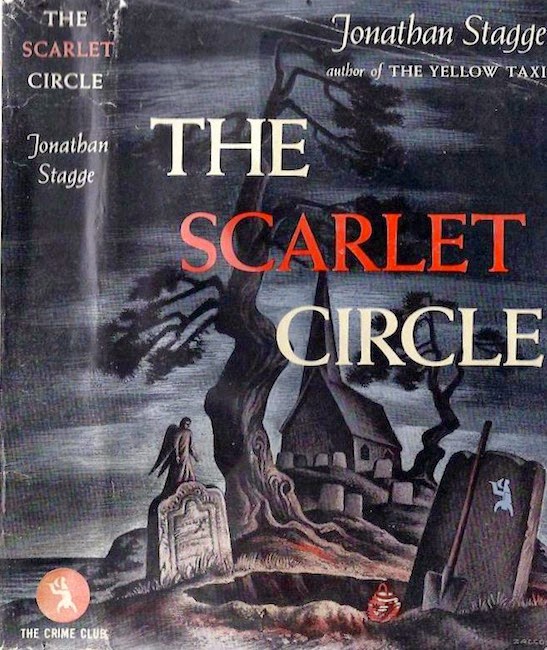
Like most mysteries featuring Dr. Hugh Westlake and his mischievous daughter Dawn The Scarlet Circle (1943) begins with one of the little girl's observations. One night she sees a strange pink light emanating from an abandoned church graveyard near the hotel where the two are vacationing.  Never reluctant to investigate strange and myster- ious events Westlake heads out to the graveyard and interrupts a shadowy figure who has been digging up a coffin. The pink light turns out to be a red paper Chinese lantern and it will signify gruesome events to come. A few nights later another Chinese lantern is found glowing over the strangled corpse of one of the hotel guests. Inexplicably, a mole on her cheek is encircled with a scarlet ring drawn on with lipstick. Could this be the work of a homicidal maniac?

Typical of the Dr. Westlake series the crimes are tinged with a macabre touch, the atmosphere is brooding and menacing. This is perhaps the most Gothic of Stagge's detective novels with its Poe-like emphasis on graves, exhumed coffins, a lugubrious nearly necrophiliac undertaker named Mr. Usher, and a killer apparently obsessed with anatomical imperfections in his female victims. Later in the novel we learn the inhabitants of the Massachusetts town are mostly Portugeuse immigrants who still cling to Old World superstitions and folklore surrounding violent deaths. There are elements of the modern serial killer novel in the ritualized nature of the murders -- the Chinese lantern marking the crime site, the lipstick circle drawn around skin defects and wounds -- and eventually the final twist revealing the murder's motivation. The Scarlet Circle is a fine entry in one of the better American amateur detective novel series. With only nine books it is a shame it was such a brief run for Dr. Westlake.

Also reviewed on this blog is the first Dr. Westlake novel, The Dogs Do Bark

More about the Dr. Westlake mysteries by Jonathan Stagge:
Sergio Angelini on Turn of the Table
Curt Evans on The Scarlet Circle
Douglas Greene on The Yellow Taxi

*   *   *

Reading Challenge update:  Golden Age card, space O5 - "Book with a spooky cover"

Friday, July 26, 2013

FFB: The Dogs Do Bark - Jonathan Stagge

I have this idea that Richard Wilson Webb still hadn't recovered from his intensely lurid thrill ride with his writing partner Mary Aswell when the two of them concocted the brutal and savage crimes depicted in The Grindle Nightmare. One year later in what appears to be his first collaboration with his partner (in more ways than one) Hugh Wheeler he once more delved into noir territory in creating the murders in The Dogs Do Bark (1936). Oddly enough the book first appeared in England under the title Murder Gone to Earth before it was published by the estimable Doubleday Doran Crime Club under the title reviewed here. Although the level of violence never reaches the heights (depths?) of the butchery in The Grindle Nightmare this is definitely a book anyone would describe as grisly.

A nude woman's dismembered corpse is uncovered in a fox burrow at the tail end of a hunting expedition in the Massachusetts town of Kenmore. The body has been decapitated and is missing both arms. While the head does not turn up until the penultimate chapter the arm bones are soon found in the kennel that houses the bloodhounds for a hunt club. The flesh had been completely devoured by the ravenous dogs the night before. All this happens in the first two chapters. Grisly enough for you? But there's more.

Dr. Hugh Westlake, in his debut as Stagge's series detective, is promptly deputized by the local policeman giving him the chance to turn amateur detective with some authority. Prior to the discovery of the murdered woman Westlake had been consulted by Louella (Aunt Lulu) Howell, one of those garrulous fearful invalids that turns up in mysteries of this era. She is fearful of the baying hounds a sure omen of horrible things to come. Nurse Leonard who had been caring for the Aunt Lulu has recently been fired for indiscretions observed on the job. She was convinced the nurse was dallying with her husband, an unattractive dumpy man who Westlake has hard time envisioning as an object of desire. But could the nude corpse be Nurse Leonard?

Then there's Elias Grimshawe. A Bible thumping fundamentalist of the worst kind (yes, they had them back in the 30s, too) he has been battling with the horsey crowd and their obsession with fox hunting for a long time. That the body is found on his property during another of their bloody hunts angers him beyond reason. His daughter Anne who is rumored to have been carrying on with several men, some of them married, has also gone missing. Grimshawe startles Westlake and Inspector Cobb when in referring to the murder victim he quotes an Old Testament passage about Jezebel being fed to the dogs. No one but the the detective duo knew about the dog kennel business. They ask Grimshawe to go to the morgue to identify the body. Grimshawe is adamant that the victim is Anne.

The atmosphere builds to one of Gothic dread set up perfectly with the opening paragraph in which Dawn, Westlake's ten year-old daughter, is seen chanting an old nursery rhyme ("Hark, hark, the dogs to bark/The beggars are coming to town...") while standing at an open window and listening to the howling bloodhounds. Little does she know exactly why they are howling, but her precocious allusion is just as chilling as Aunt Lulu's prediction of horrible events to come. Once again as in The Grindle Nightmare animals are at the mercy of the murderous fiend on the loose and soon a horse is killed by an unusual method nearly killing its owner in the process.

Horses and hunting will play a prominent role throughout the story. So too will the Grimshawe property which Westlake and Cobb learn Anne would have received on her twenty-fifth birthday. The property is of interest to several characters in the book and provides an obvious motive, especially for Walter, Anne's handsome and athletic brother.

Handsome men with athletic builds are another recurring motif in the book and in others in the series. The descriptions of male physique stand out like posing gym boys in comparison to how the women are described and signal to me another kind of fascination of the authors. At times the rhapsodic physical accounts approach the kind of recitals of male beauty you would expect to find in the pages of a bodice ripper. I wouldn't exactly call these passages homoerotic, but they are very noticeable and perhaps revealing of the two men who wrote the book.

Dawn, who will later become more active in the series, is depicted here as a cute little prop used mostly for comic effect. For the most part she behaves like a kid but often she has an oddly precocious and inconsistent vocabulary. In one scene Webb and Wheeler have her confuse the word distinguished for extinguished. Then later she will correctly use the word ominous in sentence. She has a kind of schizoid role -- at times a mysterious oracle as in the opening paragraph and later when she helps her father with offhand comments, at other times a goofy awkward kid obsessed with rabbits. Dawn has always a problem for me in these books. It doesn't help matters much that Westlake refers to her by the ironic endearment "brat" and rarely calls her by name. Still in this first appearance the relationship between father and a daughter is honest and affectionate. Dawn didn't annoy as much as she does in other books.

The Dr. Westlake books would go on to feature equally bizarre and unusual crimes with a tendency towards the Gothic. Turn of the Table has a murderer who might be a vampire. The Stars Spell Death uses astrology and superstition as a springboard for the plot. In The Yellow Taxi the writers recycled the equestrian themes found in the first book as well as lifting the climactic barn fire towards the end of The Dogs Do Bark and duplicating it even to the point of Westlake's escape through an upper level window. Perhaps the most haunting and chilling entry is The Scarlet Circle with its unearthed graves, corpses daubed with lipsticked circles, and the creepy Talisman Inn.

As a beginning to a short-lived series The Dogs Do Bark shows great promise. Veteran detective novel readers may catch on early to the surprise twist in the tale, but that won't ruin what is essentially a fine example of a traditional detective novel with an ample amount of puzzling plot points, intriguing characters and evocative atmosphere.

Below is the complete list of detective novels featuring Dr. Westlake and his daughter Dawn. Those reviewed elsewhere on this blog have links.

Dr. Westlake Detective Novels
The Dogs Do Bark (1936) UK title: Murder Gone To Earth
Murder by Prescription (1938) UK title: Murder or Mercy?
The Stars Spell Death (1939) UK title: Murder in the Stars
Turn of the Table (1940) UK title: Funeral For Five
The Yellow Taxi (1942) UK title: Call a Hearse
The Scarlet Circle (1943) UK title: Light from a Lantern
Death, My Darling Daughters (1945) UK title: Death and the Dear Girls
Death's Old Sweet Song (1946)
The Three Fears (1949)