Showing posts with label Swan Song. Show all posts

Saturday, October 30, 2021

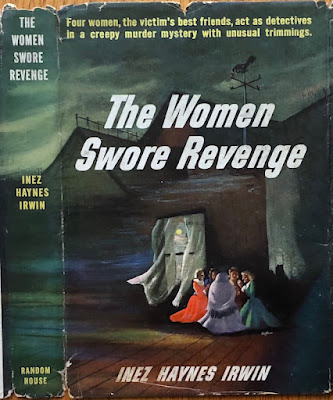
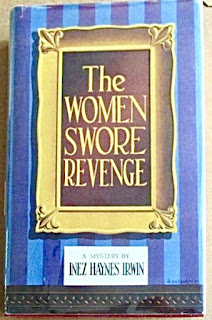
HALLOWEEN SPECIAL 1: The Women Swore Revenge - Inez Haynes Irwin

THE STORY:  Four women make a pact to bring to justice the murderer of their dear friend Lizbeth More who was stabbed on Halloween after a terrifying poltergeist encounter and a visit by a bizarrely masked individual peering in through the windows of More's home.  Years before, Lizbeth's fiance Arthur was also stabbed to death, on the night before they were to be married. As there was little evidence Arthur's murder was never solved and his killer is is still at large. Are the two deaths related and were they committed by the same person?  Chief of Police Patrick O'Brien investigates and receives more than ample help from a trio of amateur sleuths.

THE CHARACTERS:  The Women Swore Revenge (1946) is divided into multiple sections told from one character's view point, either in first person (Mary and her policeman husband) or third person (amateur sleuths Malo Wrenshurst and Patience Wilbor).  Although the title and blurb on the US edition's dustjacket imply that the four women who make their pact will turn sleuth it really is only two of them who become amateur detectives even going to extremes by assuming alternate identities. Mrs. Wrenshurst, a community theater actress, goes so far as donning a wholly unnecessary disguise complete with dowdy wardrobe, turban and wig. They have, as Wilkie Collins coined in The Moonstone caught a "severe case of detective fever." And they do remarkably well in their roles. A third sleuth is Michael Penchard, Lizbeth's gardener, whose flight from town triggers a police search and fuels gossip that he is the killer. Actually Penchard has left town to follow someone he believes is the true murderer. By sheer chance he and Malo Wrenshurst will meet up in a seedy hotel in Boston where the two will trade stories and share evidence they have collected.

The amateur detective scenes are rich with detail. In fact the entire book is overflowing with lush details on how homes are furnished, what the gardens and grounds of those homes look like, lists of the flowers and trees that seem like catalogs, and painstakingly described layouts of how rooms in the houses are arranged. So it's no surprise when Irwin turns her pen to action sequences that they too are elaborately described. Her writing is as exact and focussed as a cinematographer's camera. Malo's keen eye finds a locket embedded in the vines that have covered the doorway to an abandoned icehouse. Mike's eyewitness account tells of a strange "flying creature" swinging from branches in More woods like some kind of Tarzan wannabe. Patience travels to upstate New York and does a thorough search for the true identity of Whiting Vane, a polio crippled antique collector and mystery man who lives near the Mores. All these and more are highlights in this engrossing detective novel.
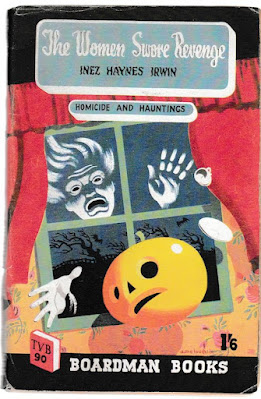
ATMOSPHERE: The More house has a history of being haunted dating back to the late nineteenth century.  Legendary and written accounts tell of poltergeist activity with dishes and glasses being smashed, paintings falling from walls and furniture being overturned with no person anywhere in sight. Lately the poltergeist has started up its mischievous destruction again mystifying Lizbeth and frightening her two female servants. The oddest part of this haunting is the appearance of figures dressed in old clothing. They take the shape of four old women on their knees praying. On two separate occasions these figures turn up mysteriously in rooms previously unoccupied. Irwin handles these scenes with a deft hand and manages to pull off a genuinely creepy atmosphere. Most of her misdirection works, but some more astute readers may see through Irwin's deceit.  Still, she succeeds in making it seem as if some supernatural force is at work. The descriptions of the grotesque face at the window turn truly horrific when it is discovered what exactly that mask at the window really was.

As the various detectives delve into the past we learn that some characters have carnival and circus work in their past. Gossip turns to the possibility of a circus performer being the murderer. And the fact that all the victims in the book are stabbed in the back had me immediately thinking of my favorite Golden Age motif - knife throwing.  This coupled with the presence of a crippled character had me spinning an elaborate scheme of how the murders were accomplished and who the killer was. I was close, but there was no way I was going to come up with the truth because I fell for some of Irwin's misdirection that even a novice reader of detective novels might have discounted. Irwin pulls off a genuinely surprising resolution that borrows from the insane ideas of Harry Stephen Keeler coupled with nightmarish plot twists reminiscent of horror writers of the pulp magazines. She won major points with me for her grotesque touches.

If there is anything to fault this highly imaginative, spooky and macabre Halloween mystery it is the unnecessarily lengthy wrapping up of the various mysteries.  For reasons known only to Irwin she has O'Brien gather the survivors and the innocent characters to deliver a typical Golden Age detective novel lecture that explains everything. But over 75% of the lecture has already been told to us by other characters earlier in the story. And those present know everything that O'Brien is telling them!  All that O'Brien needs to tell these characters (and the reader, of course) is the motive for the murders and the explanation of the poltergeist and the thing at the window.  I confess that I skipped over many paragraphs in this irksomely rambling penultimate chapter.  Also the last section is improperly named for one character when it should be named for Patrick because his is the primary point of view not the person for who Part 9 is named. Ah well. Despite these quibbles the book still has a corker of a mystery plot.
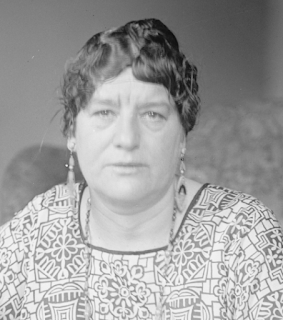
THE AUTHOR:  Inez Haynes (1873-1970) was an active member of the women's suffragette movement and an avowed feminist her whole life.  She is best known for her early 20th century non-fiction writing on women's rights, women's biography as well as some feminist novels notably Gertrude Haviland's Divorce (1925). Her first works were published under Inez Haynes Gillmore her name when she was married to Rufus Gillmore, journalist and mystery writer who diehard fans may know for his Van Dine pastiche The Ebony Bed Murders (1932).

Haynes divorced Gillmore shortly before the onset of World War 1 but continued to write under her married name.  In 1916 she married Will Irwin, another journalist and sometime novelist, who astonishingly also wrote murder mysteries. His two detective novels star Rosalie La Grange, a medium/con artist turned sleuth. Irwin used these novels as a vehicle to voice his distrust and skepticism of the spiritualist movement. The Irwins lived in Europe during WW1 and both were war correspondents for English language newspapers.

In addition to her feminist works Haynes wrote Angel Island (1908), an allegorical feminist fantasy (some call it science fiction but there's little science to it); a series of children's books about Little Maida, a girl who is raised by her wealthy father after her mother dies; and the five detective novels featuring Chief of Police Patrick O'Brien. Interestingly, her detective novels are set in the fictional town of Satuit, based on her life in Scituate, Massachusetts where she and Irwin spent most of their summers and where Haynes settled after her husband died in 1948.

THE SERIES:  The Women Swore Revenge (1946) is the fifth and final detective novel Irwin wrote featuring Patrick O' Brien and his wife Mary. Once again, I chose to read the author's last book first at some cost.  Two previous cases are mentioned in passing, one was getting so detailed a I skipped over the entire section for fear that Irwin would reveal too much. I'm discovering more and more that some writers never thought over this particularity bad habit of possibly spoiling previous books as they continued to add to their characters' adventures.  So a warning that anyone interested in tracking down Irwin's mystery novels that it would be a good idea to read the others first before you get to this final book. However, be warned:  Murder Masquerade (1935), the first in the series, is a very young and naive book completely different from The Women Swore Revenge which in comparison is highly sophisticated. The difference in tone and writing is remarkable. I can only surmise that Bennett Cerf who was editor at Random House shaped up Irwin as a writer when she was under contract to his publishing house. But more on Irwin's early mystery novels and her books as a children's author which seem to have influenced Murder Masquerade when I review that book next month.


Patrick O'Brien Detective Novels
by Inez Haynes Irwin

Murder Masquerade (1935)
   published in the UK as Murder in Fancy Dress (1935)

The Poison Cross Mystery (1936)

A Body Rolled Downstairs (1938)

Many Murders (1941)

The Women Swore Revenge (1946)

Friday, July 2, 2021

SWAN SONG: The Intimate Journal of Warren Winslow - Jean Leslie

Today I introduce a new category for the blog -- the "Swan Song" post.  This will be devoted to a writer's final book in the crime fiction genre if not their final book altogether. Often I read a last book of a writer that's new to me without realizing that it was in fact their final book in their entire output.  Rarely do I do this consciously. I prefer to start at least in their mid-career if not at the very beginning when sampling a new writer. And so I thought I'd give a category to last books since it seems to be a n odd and coincidental reading habit of mine that is happening more and more frequently.  

The Intimate Journal of Warren Winslow (1952) is also one of the many books I've purchased this year that were tagged by Doubleday's Crime Club with the ! logo as a mystery that promises "Something Special.” I've previously written about this tagging/categorization of the Crime Club books from the late 1940s through the early 1960s in other posts. Most recently I specifically wrote about the "Something Special" category which has been a lure for me over the decades in choosing books published by the Crime Club imprint,  in my post on The Magic Grandfather by Doris Miles Disney.  

Warren Winslow is a bestselling novelist suffering from a heavy case of self-doubt as he impatiently waits to hear from his publisher on when his latest novel is to be released.  Both his agent and the publisher seem to be dragging their feet in making a decision. To pass the time and occupy his obsession Winslow creates a diary capturing his thoughts and emotions on everything that is haunting him including his failing relationship with his wife, his dwindling creative powers, his past life as the wunderkind of the bestseller list and the insidious seed of jealousy that grows monstrously out of control. By the time the first diary is filled with his invective towards John Bailey, a rising writer who respects Warren and pays too much attention to Warren's wife Robin, Warren Winslow reveals himself to be a man overcome with a dangerous mixture of jealousy and self-doubt. He starts a second diary with the news of the fate of Thence to a Lonely Dwelling, a novel that he thinks will be his crowning achievement.  The manuscript, however, has been rejected.

The diaries soon grow to four full volumes and jealousy gives way to murderous rage.  We not only read of Warren's dwelling on his past glory as a novelist, but learn of his tortured childhood, his strange relationship with his wife and her mother, how he met both women, the affair he thinks Robin and Bailey are having, and his plans to put an end to John Bailey as his rival in love and the bestseller list. The murder plan is carried out but there are surprises in store for both Warren Winslow and the reader when he begins to realize that the truth was clouded by fantastic imaginings. But by then it is too late for him.

As a portrait of a vain, petty man who fails to see his days in the limelight are long over The Intimate Journal... initially makes for some difficult reading. The first diary is dominated by the outpourings of a mean-spirited man angry he has grown old,  envious of better writers, jealous of younger men with good looks and wholly possessive of his much younger wife who seems to be straying from him. Only when the novel begins to focus on Winslow's nasty murder scheme does the book become taut with tension and less off-putting as the non-stop name calling and insulting of everyone he meets gives way to an obsession of revenge.

Intermingled with the story of Winslow's murder plot and jealousies is a subplot involving Winslow's secretary who has been entrusted with rewriting portions of Thence to a Lonely Dwelling in order to make the book more attractive to the publisher.  This at first seems to be merely story filler, a way to flesh out Winslow's struggle to confront his dwindling creative powers and compromising himself for the sake of money and a contract, but will prove to be one of the more intriguing twists to the novel as a whole.

One of the most interesting characters is Dr. August Fremling, a psychologist who is also one of Warren Winslow's biggest fans. Fremling keeps asking Winslow to visit him to look over his fine collection of glass, something that Winslow belittles in his diary confessing that the many invitations are unwelcome while publicly he dons his genteel mask of the urbane sophisticate and politely and repeatedly declines. Eventually he finds himself at a party at Fremling's home and he reluctantly enters the room with Fremling's glass collection. Winslow is astonished by the collection, ironically entranced by something he disparaged as a childish hobby. He goes into great detail describing the way the art objects are arranged and how the light passes through each object and fills the room with color. This unusual scene gives way to an odd intimacy between the two men and a mutual admiration builds up almost instantly.  Fremling then slyly offers up some observations about Winslow's life, insights that are frankly shocking to Winslow, all the while paying homage to his writer hero and flattering him with deft praise.

Jean Leslie cleverly has inserted Dr. Fremling into the story as a sort of detective of the soul. Leslie was not only a mystery writer but also an academic in the field of psychology. She uses Fremling as a sounding board for theories that she must have learned and taught in her studies. Winslow's family doctor has a brief speech about the importance of psychiatry to heal the minds and souls of modern men.  The scenes with Fremling also contain some of Leslie's most compassionate writing and allow us to see Winslow in a new light, dimming some of the glare of his reprehensible traits and allowing a soft glow of humanity to emanate from his bitter, envious body.

And she adapts her love of all things psychological in the context of this story about writers and writing, the struggles of creativity, and the burden of a guilty conscience. Winslow at one point offers up a not too original, but still insightful observation that novelists and actors have much in common. Later Dr. Fremling expounds on his theory of the writer's life as a source for his supposedly fictional work. His keen understanding of Winslow comes almost entirely from having pored over the novels, sometimes reading his favorites more than once. For Fremling Winslow's novels reveal exactly who is he and where he came from. Having already read some of the anecdotes from Winslow's past life in the pages of the first three diaries we know that Fremling has nailed the man with an eerie accuracy.

QUOTES:  All novelists are actors. What else is a novelist but a man playing many parts? He must be able to project himself into a dozen roles if he is to write with authority.

This morning I awakened in a state of great mental perturbation... It was as though I had come back suddenly from some black abyss and I could not help but wonder if I would have died in my sleep if I had not awakened when I did and defied the Dark Stranger.  Reason tells me this is fanciful, but the feeling persists. [...] It is childish to be afraid of the truth, but I am afraid.

Bailey is dead. He died to save our marriage. Then what is this new ghost that stands between [Robin and I]?  Is there any peace for me, anywhere?

"Are we to call Sabrina inventive genius or are we to assume that Bailey wrote from that great reservoir of experience which is man's private world? Does he "dream up" the conflicts, as you say, or does he express his own conflicts disguised in such a manner that we accept them as fiction? I say this is what the writer does, sometimes consciously and sometimes unconsciously," Fremling said. "I would go further that that and say that the intensity of the inner struggle is positively correlated with the need to write."

Dennis Malcolm, Winslow's physician:  "Our culture has placed certain restraints upon a man so that he may not handle them for himself.  Confronted with a situation in which his behavior would be anti-social he must take his choice between driving the conflict underground or letting a psychiatrist help him to face it."