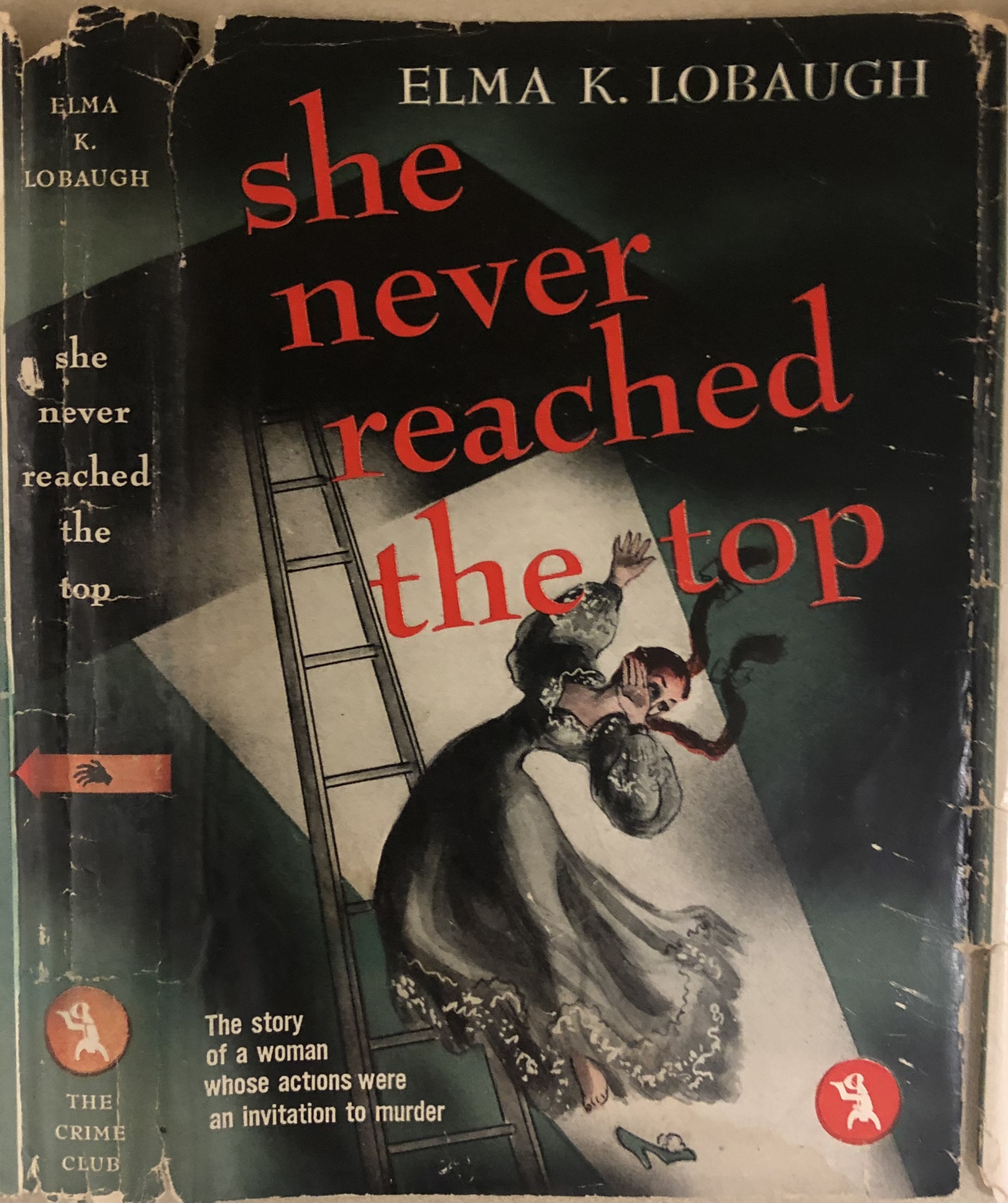
THE STORY: Dorothy marries divorced Edward, a non-fiction writer. All is well until Edward's children are sent to live with him. Caroline, Edward's ex-wife, has decided to move to California to start life anew and feels the children will only burden her. If her new life doesn't pan out and she returns to Chicago she'll ask for the children to move back with her. And so for Dorothy her romantic idyll in Edward's custom built home by the dune-lined shores Lake Michicgan in northern Indian comes to an abrupt end. The children are odd to say the least. And Stephen, Edward's 11 year-old son, is positively creepy. Life becomes increasingly tension-filled and soon Dorothy feels she is being persecuted by the children, abandoned by her husband, and imagines she is slowly losing her mind.
THE CHARACTERS: From the opening paragraph we get the sense that Dorothy, our narrator, is a fragile woman easily intimidated and a victim of a runaway imagination. The dust jacket illustration (see image at left) shows several surreal looking eyes that are meant to suggest the eyes in a portrait hanging on her bedroom wall. As Dorothy's persecution (real or imagined we are never really sure until the final chapter) continues the eyes in the portrait take on a sinister aspect and represent to her the eyes of everyone in the house -- her indifferent, apparently unloving, husband and the two judgmental children, especially the elder Stephen. I Am Afraid (1948) is a reverse fairy tale, a nightmare story for adults with Dorothy cast in the role of a victimized stepmother seemingly at the mercy of sinister stepchildren.
When Stephen first appears the reader knows there is something not quite right about the boy. He talks and behaves like a middle-aged man. He treats his stepmother not as a parent, but as someone to pity. Stephen has a patronizing manner about him. In his daily visits to Dorothy's bedroom with her morning or afternoon cup of tea he seems ingratiating and deferential, but Dorothy begins to imagine the boy has an ulterior motive. He doesn't act like a son or even a child when he's around her. She calls him strange and weird. She wonders if the tea should be drunk at all.
It doesn't help that Edward dismisses all of Dorothy's ideas when she attempts to discuss the boy's disturbing behavior. The boy is not athletic, disdains anything remotely boyish and shuns any type of play, preferring to read books. He's already suspect in the eyes of 1940s America. Imagine any American boy not wanting to play baseball or football and turn into a bookworm! Dorothy becomes increasingly frightened by the children, but especially Stephen. It's not just the bookishness that gives her pause. And it's only a mater of time before the strangeness gives way to malicious and dangerous acts.
There may no other suspense novel as intensely domestic as I Am Afraid. The small cast of characters helps build a claustrophobic atmosphere resulting in a stifling melodrama. Dorothy has no real friends outside of her immediate family and spends much of her energy trying to win over her stepchildren or trying to entice her husband back into her bedroom. The sex has gone from their marriage now that the children have arrived. Adding insult to injury Edward has retreated to his writer's den claiming a need for no distractions while he tries to hammer out his articles under the pressure of fast approaching deadlines.
The only other character worth mentioning is the neighbor Frank Henderson, a gym teacher and football coach at the elementary school. Dorothy goes for strolls along the shores of Lake Michigan and chances upon Frank walking his dog. They have a casual conversation that feels so alive and adult to Dorothy she finds a way to get out and go walking nearly every evening just in order to meet up with the coach and his dog. Little does she realize that her walks and utterly harmless friendship is under close observation.
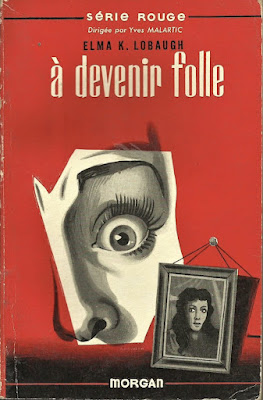 |
French translation of I Am Afraid
|
SETTING: While the house may be an oppressive and loveless place filled with portraits of staring eyes and oddball children too much in charge of the adults the locale is contrasted with the outside setting. Edward's home is situated in the dune lined shores of Northern Indiana. Lake Michigan and the dunes are favorite locations in Lobaugh's crime novels. For Dorothy the lake, the beaches, and the dunes surrounding the house serve as an idyllic escape from the sterile and claustrophobic home that increasingly seems like a prison.
INNOVATIONS: With a cast of only three adults, two children and one dog it seems almost as if it was meant to be a script for either theater or the movie screen. It's confined settings also make it prime material for a theatrical adaptation.
I think Dorothy's pre-occupation with her dwindling sex life was pretty modern for a book published in 1948. Clearly her life with Edward was a happy and passionate one prior to the arrival of the oddball kids, Emily and Stephen. Her private life with her husband all but disappears once the children are in the household. I was impressed with Lobaugh's insistence on making Dorothy a woman with desire and whose life requires sexual expression. Her descent into depression and isolation has a lot to do with her being ignored by her husband as much as it is about the weird and later thoroughly malicious behavior of her creepy stepson. There aren't many crime novels that address this aspect of marriages gone bad and the consequences of one isolated partners mental health.
INFLUENCES: The real thrill of this suspense novel doesn't occur until the final third of the book and involves lies, deception and spiteful violence. I can't help but think that Lobaugh was familiar with Lillian Hellman's The Children's Hour, a play first produced on Broadway in 1935 with its first of two movie adaptions in 1936. It became a standard choice of melodrama in colleges and community theaters by the mid 1940s. The ugly rumor spread by Stephen that serves as the climax of the book seems so entirely inspired by the malicious talk of Mary Tilford in Hellmann's play that it can't be mere coincidence. When Stephen is forced to confess to his lies in Lobaugh's novel the boy's fury and anger is like a madman's hysteria. His character foreshadows all the "Bad Seed" kids and demonic children that would flood the pages of popular fiction throughout the 1960s and 70s. In this regard Lobaugh's book prophesies an entire crime and horror novel subgenre decades before it became a cliché.
QUOTES: Their poise was more unnerving than if they'd come in the house screaming.
He kissed me good night, a sweet gentle kiss befitting my supposedly nervous, wrought-up state. I could have slapped him. He might have kissed me differently--as a woman, as a lover, as a wife.
I began to think that it was too bad we were civilized. If I were to slap him, if he were to hit me at least that would be honest. At least that would be more sincere than this quiet politeness that was a living lie.
(In reference to the painting that causes so much of Dorothy's paranoid anxiety) ...one of these days I'm going to throw something at that smirking bitch on the wall. I can pretend she's Stephen.
 AUTHOR: Elma Klinedorf Lobaugh (1907-1997) was born and raised in Indiana where she lived most of her life. In 1928 she graduated with honors from University of Chicago. Among her first jobs was labor analyst for the Indiana State Employment Service. She wrote three crime novels under her own name then disappeared from the Crime Club roster for four years. In 1946 her melodramatic novel The Devil Is Loneliness was published by the second tier house A. A. Wyn. Described as a "steel mill soap opera" by one newspaper reviewer it was her only mainstream novel. When she resurfaced in the 1950s as a mystery writer she used the pen name "Kenneth Lowe" and was once again published by Doubleday's Crime Club. The Lowe crime novels are all set in Indiana and at least one (Haze of Evil) deals with murder and crime in the steel industry. Some of them are set in a fictional town called Merrittville which is most likely modeled on the real Indiana city of Merrillville. At least two of her novels were translated into French: I Am Afraid became A devenir folle (literally "to become crazy) and L'Envoûtements (Bewitchments) was the translated version of her sophomore mystery, Shadows in Succession, a mystery involving voodoo in New Orleans.

(1946)
I Am Afraid (1949)
As Kenneth Lowe
Haze of Evil (1953)
No Tears for Shirley Minton (1955)
The Catalyst (1958)