Showing posts with label Mignon Eberhart. Show all posts

Saturday, August 12, 2023

Nice People Don’t Kill – F. W. Bronson

First mystery novels can be fascinating. What does the writer want to try out as an entry point into the world of the whodunit? Will it be a locked room murder? A noirish private eye novel? An inverted crime novel where we follow the murderer through the planning stages to the finally flawed crime? F. W. Bronson was not a neophyte writer when he tackled his first murder mystery. He already had three mainstream novels under his belt, published between 1926 and 1933. I thought this debut as a mystery writer might be an academic mystery judging from his biography that has Yale all over it.  Or maybe an ex-pat novel due to his having lived in Italy and elsewhere abroad in his post-college days. Never would I have thought he would choose to emulate Mary Roberts Rinehart and Mignon Eberhart, slightly satirizing the conventions of those Had I But Known mystery writers in his ironically titled Nice People Don’t Kill (1940).

The novel is narrated by Coraly Ames, widow living in an unnamed Connecticut town located on the shores of Long Island Sound. Greenacres is the name of the estate left to her by her husband and it's here she adds to her modest inheritance by renting out the separate beach house to summer tourists. In the opening chapter her husband’s best friend “Mac” suggests she rent to Schuyler Adams, a prominent Wall Street executive. We are quickly introduced to a variety of the locals in town and Coraly’s neighbors who will turn out not too coincidentally to be acquainted with Adams. But of course they are! And those relationships are tainted with secrets and criminal activity. All of which leads to the grotesque murder of Adams while he is sunbathing in what initially appears to be an impossible crime. Sadly that angle is quickly dispensed with as a mysterious man in a white bathing suit was seen by several people. A couple of nervous witnesses also lose their lives, one in a bloody hatchet murder (shades of Rinehart!), when they attempt blackmail or foolishly speak of what they know in cryptic brisk phone conversations and – of course – are overheard.

A plethora of Golden Age-style clues offer up mini-puzzles in addition the overarching mystery of the murderer’s identity. A volume of Keats’ poetry, a book Adams always carried on him, vanishes and reappears several times. Greenacres’ telephones operate on a party line offering several opportunities for eavesdropping when someone picks up an extension – even in the beach house, a ten minute walk away, or in the guest house to the south of the main house. Someone has been staying in the boat house as suggested by sandwiches remnants, paper bags and a makeshift bed found there the day after the murder. Is the person who was surreptitiously using that shed as their private motel also the killer? Could that be the man seen in the white bathing suit digging around in the sand a few feet from the murder scene?


Beautifully detailed map endpapers of the various scenes of the crimes
Nice People Don't Kill
(Farrar & Rinehart, 1941)
 

Bronson's characters are all familiar types to anyone who has read a mystery novel by Rinehart or Eberhart or any GAD mystery novel for that matter.  In addition to Coraly and her dead husband's pal "Mac" the cast consists of a momma's boy with a respiratory condition and his overprotective jealous mother, a mystery woman with a secret past, gossipy nervous servants, the middle aged military man and his much younger wife, the skipper of Adams' yacht "Blackbird" and the yacht's steward who acts as Adams' valet and cook on land. No one really has any depth and because they are representative of mystery archetypes they are fairly predictable in their thoughts and behavior. Thankfully, Sheriff Davey Jones is an intelligent policeman and provides well needed gravitas, common sense and shrewd detective skills throughout the book. Though Coraly fancies herself an amatuer sleuth she's a bit inept and severely impaired by her obvious biases and favoritism. Only Susan Carlisle, a young woman who appears quite unexpectedly on the scene and ends up staying in the guest house on Greenacres' porperty, comes across as slightly complicated or at least ambiguous in her motivations. She definitely has a past and I was bothered that Coraly seemed to believe Susan’s every word and action. Unlike the easily duped heroine/narrator I suspected Susan was definitely up to no good. Similarly, a gaggle of servants at Greenacres may appear to be just inconsequential supporting characters but the reader should pay close attention to them for they will play major roles later in the novel as their own secrets are also revealed.

With our heroine constantly hinting at future events that the reader has yet to encounter it’s an obvious but often heavy-handed homage to that “feminine” subgenre that detective fiction maven Jacques Barzun enjoyed disparaging. The novel is littered with spins on typical HIBK writing style. I was getting a bit irritated with her too. Here’s a sampling of what occurs in every chapter until the middle of the book:

It's odd to realize now that instead of welcoming Schuyler Adams with practically open arms I should have thrown the money in his face and ordered him off the property.

It didn't seem terribly important at the time--but that bit of carelessness almost cost me my life.

He might have added that my [inquest] testimony -- though of course he didn't know at the time -- contained the most important clue in the whole baffling, nerve-racking case.

Francis Woolsey Bronson
(1901-1966)
More annoying is her firm belief that “nice people don’t kill” echoing a sentiment that Carolyn Wells highlighted in The Technique of the Mystery Story and often mentioned in her detective novels written 20 years before this book was published. Coraly further elaborates on her sadly stereotypical views of humanity by surmising that the culprit responsible for the savage murders can only be Captain Lipari, the evil looking, mustachioed, limping skipper of Blackbird moored in the nearby harbor. It took me awhile to realize that Bronson was sending up the narrow-minded, overly optimistic women who populate the typical HIBK novels of the 1920s and 1930s. Ultimately, the reveal of the crazed murderer in the final chapters is pleasantly surprising even if Bronson (in the voice of Coraly) decides to present us with a silly melodramatic fake climax fulfilling some of Coraly’s predictions that didn’t quite fool me. Even a HIBK narrator has a few tricks up her sleeve to keep her readers baffled.

F. W. Bronson Detective Novels
Nice People Don’t Kill (1940)
The Uncas Island Murders (1942)
The Bulldog Has The Key (1949)

Wednesday, June 22, 2022

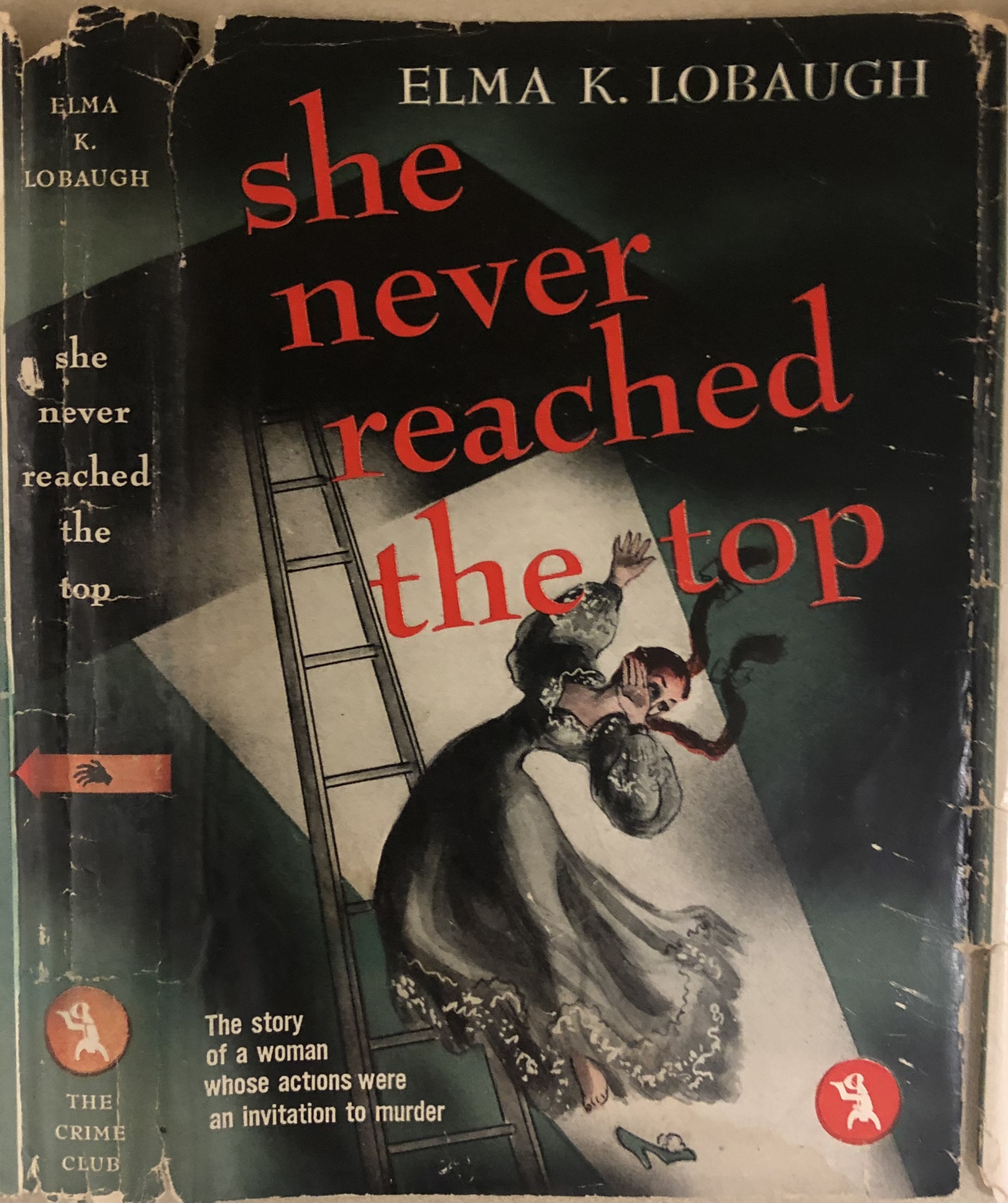
She Never Reached the Top - Elma K. Lobaugh

Elma K. Lobaugh's first mystery She Never Reached the Top (1945) was lauded by the editorial team at Doubleday Doran's "Crime Club" as "unusually competent."  But that, my friends, is an understatement like all true raves.  Very few first time popular fiction writers bother with thematic elements in that much maligned genre known as the whodunnit. A murder mystery is often dismissed as a trifle of a book, a mere entertainment as Graham Greene used to categorize his action-filled yet wholly intellectual espionage thrillers. Lobaugh's story is imbued with an soupçon of superstition and other-worldly events that not only add a frisson of terror to the house party haunted by past violent deaths and literally haunted by a ghost but enhance her theme of random violence as an act of chance and fate.  This is a thought-provoking murder mystery, and ultimately a bit of a transgressive novel in how Lobaugh treats her subject matter and how her "detectives" deal with the murder that only they have uncovered -- and then covered up.

Like many of Lobaugh's books this one is set in Indiana and like her later I Am Afraid (reviewed here) the story takes place in a house on the dune-lined shores of Lake Michigan.  The house itself features prominently and its bizarre unfinished state pays homage to the many weird architectural features of houses in books by John Dickson Carr, Carolyn Wells and Hake Talbot. The house in She Never Reached the Top, as the title may imply, has some missing staircases and incomplete steps leading to the second floor. Years ago a woman fell to her death from one of these unfinished staircases while using the DIY solution, a ladder that had no guardrails on the unexposed side.

Much of She Never Reached the Top seems mired in the past and the death of that unfortunate woman who fell from the ladder infects the house with doom.  Especially as the legend of the ghost has attached to it the prophecy that only those "who have been disappointed in love" will be cursed to hear and see the specter. Jennie Simpson, our Eberhart inspired narrator, is such a disappointed lover.  She reluctantly accepts an invitation to join the house party after a recent break-up with her boyfriend Peter.  Actually not much is know about why she and Peter are no longer together.  Did he die?  Was he killed in the war?  Did her just dump her for another woman?  We never really find out.  But thoughts of Peter and "what might have been" are never far from Jennie's mind.  And Jennie does hear the sounds of the ghost running to the ladder and the eerie brief silence just before the inevitable thud.  The reader just knows those noises are not a ghost at all but someone who has met the same fate as the woman from the past. But who could it have been?

Trendy floating staircases pose
similar possible fatal mishaps
When in the morning screams are heard and Pam, the youngest member of the house party, comes running into the breakfast room out of breath, in shock, and muttering, "I stepped on her! Oh my God, I stepped on her!" we have the proof of no ghost and a real corpse. It comes as no surprise that the troublesome wild woman, Margot Spendler, a free spirited, brazenly sexual woman who flirted with everyone including young Pam, was the victim.  But was it only an accident?  Bit by bit Jennie, Skip and Jim find evidence that Margot's death was a cleverly carried out murder. And each time they find evidence one of three either says nothing to the others or destroyys what they find. Will Margot's death be avenged?  Some of the "detectives" think it better to keep it all quiet.  The final chapter is satisfyingly thorough in explaining how the murder was accomplished. And there is a minor surprise in the identity of that killer. The final solution, however,  is entirely unconventional in how Lobaugh metes out her version of Justice.

I particularly enjoyed some of the occult sequences like when Jennie is goaded into reading palms.  Lobaugh treats the scene at first like a parlor game, but lets us know that Jennie takes palmistry very seriously, almost as if she is a psychic.  When Margot insists that Jennie look at her palm Jennie is terrified to discover that the flirtatious sexpot has no heart line. Furthermore, that her life line vanishes when it should extend to the wrist.  Could there be any more doom-laden foreshadowing than that?  There are other scenes tainted by superstition and many tales told about the ghost who first fell to her death that add to the fated atmosphere. Additionally, Lobaugh employs macabre folk songs (Jim is a professional piano player obsessed with melancholy tunes) and frequent recitations of lugubrious poetry to further play up her theme of lives pre-destined to violence.

She Never Reached the Top is (of course) rather hard to find anywhere. Currently, there are only four copies for sale from online sellers.  I never find Lobaugh's books in stores when I go book hunting.  Adding to the difficulty of locating copies is that it was published only in the US and only in hardcover.  Why it never received a paperback reprint (or even a cheap hardcover reprint from Triangle Books or Grosset & Dunlap) during Lobaugh's lifetime is another mystery that perhaps may never be solved.  It definitely deserved another life outside of the Crime Club edition. I'd say that Elma K. Lobaugh's work is due for a revival.  This is not only "unusually competent," it's rather a brilliant example of the mystery novel that defies categorization and one that dares to break several hallowed rules for a still young genre that too often was entirely formulaic.

Friday, February 26, 2021

FFB: Dead of Winter - Christopher Hale

One day last week I was literally snowbound and decided to dig into my various winter themed murder mysteries which led me to Dead of Winter (1941) by Christopher Hale. Initially, I had set aside a small pile of Hale mysteries for a post on the series character Lt. Bill French for my ongoing "Neglected Detectives" blog feature. However, this introduction to Hale (yes, it’s the first book I’ve ever read by “him’) and French was such a winner that I had to highlight the book in a solo post.

THE STORY:  A ski party turns deadly when a monstrous blizzard —98” according to a radio emergency weather report!—leaves a group of Michigan friends stranded in the home of Mrs. Enid Beauregard while a killer targets the guests.

THE CHARACTERS:  Brett Collins is our narrator who introduces us to the various guests who include her fiancé Hadley, itching to get a loan of $10,000 from anyone who will listen to him; Homer Bence, a 62 year-old plumbing salesman and former business partner of Enid’s ex-husband; jovial boyish Norman Prescott and his oddly aloof girlfriend Judy; Rhoda Norwood, a flighty blond known for her award-winning golfing skill and almost equal skiing talent; and Capt. Toby Woodward, Hadley’s rich uncle who spends much of his time chasing women. Brett is his latest would-be conquest. In fact, he daringly proposes marriage to her practically in front of Hadley. Rhoda is not happy about that, however, for she is in love with Toby. This sets up a houseful of volatile emotions, passionate tempers and money grubbing relatives. Toby has murder victim written all over him from the moment he appears and it’s not long before he fears for his life.

He claims that his bedside glass of water had been poisoned. He demands someone give him a container so he can pour in a sample of the tainted water and head out into the storm to the police station so that it can be tested. He’s already sampled the water and it tastes oddly bitter. Homer also tastes the water and says it has definitely been spiked with something. With that second opinion out in the open Toby storms up to his room promising to suit up for the blizzard and trek the four miles to town on his snowshoes. After an entire days passes and Toby does not return everyone is afraid something horrible has happened.

Hadley goes snooping in Toby’s bedroom when his uncle does not return. He find his wallet now empty of its original $500. Beneath the bed Hadley finds the container with the poisoned water as well as a tray holding his uncle’s dental bridge. How could Capt. Woodward have left the house without any of those things? To leave behind the poison sample is the most alarming as that was his reason for leaving the house in the first place. Hadley confides in Brett and suspects that someone has killed Toby. But where is the body?

When the police finally show up landing in a seaplane on the semi-frozen lake nearby and do a thorough search of the area Captain Woodward’s body is found frozen solid in a ravine. Was it an accident? Did he lose his way in the storm? Lose his balance perhaps and fall? Or was he sent toppling to his death? Evidence proves he was killed his face his smashed in as if he fell or was shoved in to the ground and yet the body was found face up in the snow. Lt. Bill French implies that Woodward’s body was moved from the original spot where he died. French has several theories and is leaning towards murder, but he tells everyone they will have to wait for autopsy results to learn if Toby was drugged or poisoned.

INNOVATIONS:  The story is filled with all sorts of nifty bits – a curious cat turns up dead in someone’s bedroom; someone is nearly killed by a tree felled for firewood; someone monkeying around with poison bottles and chloroform; and a second murder is pulled off in a locked and almost sealed room. Only the window is open and yet there are no footprints beneath the snow-covered ground below. How did the murderer get out of the room? Forgery, stolen objects, and bigamy also feature in the plot. Everyone, of course, has a well-guarded secret, most of all the murderer.

INFLUENCES: The more I sampled of Dead of Winter the more I got strong flavor accents of Mignon Eberhart. Hale manages to create a creepy atmosphere and a well maintained sense of paranoia and claustrophobia both aspects that permeate most of Eberhart’s murder mysteries. Like Dead of Winter Eberhart’s mysteries also tend to feature small groups of suspects in isolated environments. Having a woman protagonist who filters all the characters personalities through her viewpoint also had a heavy Eberhart vibe. Additionally, the narrative mirrors Eberhart’s favorite ploy of making the female narrator’s love interest the primary suspect, a fictional convention Eberhart pioneered and so often imitated throughout the 1930s and early 1940s by mostly women writers who saw Eberhart as the idol of the American mystery novel that it became a formulaic trope for decades after and continues to this day. Hale does a brilliant job of shifting blame and suspicion among her characters but laying it thick on Hadley. For a while it seems that no one else could possibly be the killer. Then we have two other possibilities with stronger motives and opportunity. Finally, in a last minute twist Hale pulls out her wild card and slaps it on the table. I was truly surprised in the ingeniously done finale.

Frances Ross Stevens
aka "Christopher Hale"

THE AUTHOR:  There is not much about Christopher Hale on the internet, primarily because it is a pseudonym. Once I started hunting under the writer’s real name I hit some gold. In the December 14, 1947 issue of Detroit Free Press I found the obituary of Frances Ross Stevens (1895 – 1947), the true identity behind the pen name of “Christopher Hale.” Over on the left is the photo that accompanied the obituary -- perhaps the only photo of Stevens in the whole of the internet. Note that the date of her death has been inaccurately reported all over the internet, she died one year earlier than 1948.

Stevens appeared to be married based on her name, but nothing was mentioned about her husband who she either divorced or who predeceased her. Stevens grew up in Michigan, the setting for most of her mystery novels, and had two brothers and one sister, Margaret, who was also a writer. She died at the home of her brother William Ross in the well-to-do Detroit suburb of Royal Oak, Michigan where apparently her other siblings also lived. According to Ellen Nehr's research in Crime Club Compendium Stevens worked as an advertising copywriter in Cincinnati and Detroit prior to moving to Grand Rapids, Michigan and becoming a full time novelist. With the exception of her first book, Smoke Screen (1935), all her mystery novels were published by the esteemed “Crime Club” imprint of Doubleday Doran. Her mysteries were regularly reviewed in Kirkus Reviews, The Saturday Review and the New York Times with consistently favorable write-ups that called attention to her clever plotting, engaging characters and often humorous dialogue.

Lt. Bill French Detective Novels 
Stormy Night (1937)
Murder on Display (1939)
Witch Wood (1940)
Dead of Winter (1941)
Exit Screaming (1942)
Murder in Tow (1943)
Hangman's Tie (1943)
Midsummer Nightmare (1945)
Rumor Hath It (1945)
Deadly Ditto
(1948)
He's Late This Morning (1949)
Going, Going, Gone (1950) - published only in the UK
 (NOTE: This is not a UK title of a previously published US title. You'll find this claim on various websites and it's wrong.)

Saturday, March 21, 2020

FFB: The Inconvenient Corpse - E. P. Fenwick

THE STORY: Maggy Simon, assistant to newspaper columnist Sebastian Evers, reluctantly agrees to accompany him to a Catksills retreat for his annual winter reunion with a group of friends he's known for years. TO everyone's surprise an actress acquaintance of Sebastian's shows up at the rendezvous point in New York City saying that Sebastian u; has invited her along to the Catskills.  He denies it a but she insists and sees it all as a practical joke. Maggy no longer feels like a fifth wheel as Anna Rose lives up to all the cliches of a flashy showgirl attracting the attention of all the men in the group. Jealousies and squabbles eventually flair up on their first night while the wintry weather worsens and threatens to leave the travellers snowbound in the cabin. Then Anna Rose disappears and terror descends on the cabin in the Catskills.

THE CHARACTERS: The Inconvenient Corpse (1943) was E. P. Fenwick's debut as a mystery writer. Maggy is our protagonist and we follow her thoughts and adventures as the novel is told from her point of view, but thankfully in not in first person so we avoid the dreaded HIBK flourishes that I was worried would infiltrate the story. Accompanied by her pet Boston Terrier Sammy Maggy often seems like she tiptoed out of a Tintin comic book. The dog of course is key to uncovering the truth about the actress' disappearance and actually leads Maggy to finding the dead body that gives the book its title. For the most part Maggy escapes the trappings of the usual HIBK heroine. Though she is not constantly regretting what she should have done, she does suffer from Hamlet-like indecision and makes some foolish mistakes in deliberating over her choices and waiting too long reveal the truth. Her overly cautious nature will complicate matters for Sebastian who is suspect number one with the police as well as the rest of the reunioin group. Still Maggy is smarter than your average HIBK gal, not at all ditzy, yet suspicious of everyone including her boss who we think she has a secret crush on.  Her eye wanders to the tall handsome Vic Homan, deputy to Sheriff Caldwell and he returns the flirty gazes when not speedily taking notes with his lightning speed steno skills.

The suspects are pretty much familiar to readers of mystery fiction. Morgan Dillard, the the requisite glamor girl with an aloof and superior nature to provide some sexual tension between the young woman as they vie for attention of Sebastian. At first when Morgan offers to chauffeur Maggy up to the cabin we think she will be Maggy's friend and confidante, but Morgan clearly has ulterior motives. And there's an equally aloof young man, Prof. Harold Jameson, to act as Sebastian's foil. He's obviously attracted to Morgan. This all adds romantic and sexual entanglements in a tale that will eventually be about sex and jealousy.

Anna Rose, of course, is practically wearing a sign around her neck "I Will Be Murdered" when she enters the story. Her flamboyant extroversion, borderline vulgar talk, and shapely figure and stunning face arouse emotions in everyone, both men and women.  She's Trouble with a capital T that rhymes with C that stands for corpse. Poor Anna. She's the only character in the bunch with spice and life in her and we wish she would have had the chance to hang around longer, stir up a lot more trouble, before someone decides to send her to the Theater of Heavenly Footlights.

Rounding out the group of guests is the strange married couple the DeVries. Freddy first comes off as an offensive dirty old man making cracks about the younger women's attractiveness, then transforms into a prissy old man with indignant rants and "How dare you?" remarks that send the reader's eyeballs rolling. His wife is a meek and mild "nervous case" sheltered and protected by her self-righteous husband for the bulk of the story. Susan DeVries seems at first to be a charming New York sophisticate, but she quickly falls to pieces when Anna disappears then turns up dead. Susan spends much of the book confined to her bedroom and Freddy won't let anyone, even the police, near her.

ATMOSPHERE & INFLUENCES: The strength of the book lies not so much in its familiar, overdone plot, but in the atmosphere of terror and paranoia that infects the group as they learn that Anna's flight led to her murder. Suspicions arise and everyone turns on each other. Sebastian is the primary target of all the invective and acrimony as they think he committed a crime of passion. They all believe Anna Rose was his mistress and they had a fight and he killed her. Only Maggy is willing to disbelieve this rather outrageous scenario.

US first edition (Farrar & Rinehart, 1943)
courtesy of The Passing Tramp blog
Given this very familiar storyline, it's all too easy to figure out what's going on and who the culprit is. No real fault of the writer who is very talented in conveying paranoid fear and true terror. Fenwick seems to be drawing form a couple of very popular writers of her time - Mignon Eberhart and Dorothy B. Hughes. Maggy is very much modeled on the kind of protagonists we find in Eberhart's novels of women in peril, drawn to a man suspected of murder and eager to clear his name. But it is Hughes' crime novels riddled with frissons of terror, psychopathic criminals, paranoia in wartime when anyone might turn out to be a killer or a spy that The Inconvenient Corpse most resembles. Maggy's discovery of Anna Rose's body is one of the most chillingly effective parts of the entire book, even if she is accompanied by a curious Boston Terrier. Fenwick allows us into Maggy's head at key moments in the book sharing in her fear, the claustrophobia of the cabin in a wintry landscape, and the hypocrisy of Sebastian's friends. The emphasis is on terror and not detection. When the story is focused on Maggy's fears and suspicions it is at its most engaging and thrilling.

Working with a such a small group of character in a confined setting usually lends itself to a puzzle that will be less than puzzling. What matters here are the fireworks of volatile emotions and the intriguing dynamics between a gorup of friends who find out they have little in common, too many secrets, and they begin to see the verity in the motto "an honest enemy is always better than a friend who lies."

THE AUTHOR: Elizabeth Phillips Way (1916-1996) wrote both crime fiction and mainstream novels as "E. P. Fenwick" and later "Elizabeth Fenwick". In 1948 she befriended Flannery O'Connor when they were both living and working at the writers' colony Yaddo in Saratoga Springs, NY. I'll not bother wth anymore as Curt Evans has done a good job of digging up some tidbits on the life of Fenwick. You can visit his blog post for all you want to know to about her and view a few rare photos off the writer. He has also reviewed five of her books. The first three she wrote as E.P. Fenwick are cursorily discussed in this post. He also reviewed Poor Harriet and Disturbance on Berry Hill back in 2015.

EASY TO FIND? There are no modern reprints of The Inconvenient Corpse that I can verify. The book was published only in the US by Farrar & Rinehart and had one paperback reprint three years after the hardcover edition (Pony Books #62, 1946). The Pony Books edition is the most common in the used book market offerd at trelatively afforadble prices. The striking surreal cover illustration is most likely the work of "Im-Ho", the duo of Sol Immermann and Lawrence Hoffman, prolific book cover illustrators throughout the 1940s. For the short lived history of Pony Books (only 22 books over it's one year of business) see this in-depth article and bibliography by book collector and historian Kenneth Johnson.


Friday, April 12, 2019

FFB: Murder Draws a Line - Willetta Ann Barber & R. F. Schabelitz

THE STORY: Christopher "Kit" Storm has a moderately successful career as a commercial artist in his Manhattan studio. On occasion he serves as an artistic consultant to police drawing sketches of crime scenes and evidence in lieu of using a police photographer. Kit becomes implicated in a murder when the across-the-hall neighbor is found brutally stabbed inside his studio and the police start viewing Kit as a suspect rather than a colleague.

THE CHARACTERS: The narrator for Murder Draws a Line (1940), and the entire series, is Sheridan Locke, Kit's fiancée in this book, later his wife. Sherry is a children's book writer and is cajoled by her artist paramour into becoming the documentarian, so to speak, of their adventures in murder. But she goes about it in an entirely verbose and overwrought manner. One imagines that Sherry read way too many Mary Roberts Rinehart novels in her day (or at least Willetta Barber did). The narration is drowning in words, bursting to the seams with minutiae and unnecessary tangents, and burdened by the often annoying intrusion of the phrase "Had I known..." Even Rinehart never resorted to those telltale words as often as Barber does in the guise of Sherry Locke. In a review of this book in the August 10, 1940 issue of The Saturday Review the pseudonymous Judge Lynch said "Plot excellent, characters vivid, numerous illustrations -- but superabundance of had-I-but-knowing annoys cranky judge." I started to count them all but gave up when it exceeded 15 instances well before the novel's midway point.

Our heroes: Sherry Locke,
Kit Storm and Det. Tony Shand
I sincerely hope that Barber abandons this type of writing in later books because she is a fine storyteller and an excellent plotter. Her debut novel is a fine example of a traditional detective novel and its most unique aspect, what makes it truly noteworthy, is the inclusion of the illustrations (see "Innovations" section for more). She also has the gift of creating nuanced characters who seem like real people. It's a shame that she manages to undermine all her talent by ruining the suspense with all her heavy-handed foreshadowing. Only once did she make it work to her advantage when she discussed a bloody baseball bat before the bat became bloody. The passing remark (coming as the final sentence of a chapter as nearly all these HIBK remarks do) makes you think that Kit will be attacked yet again after being shot at once. In truth, however, the way the baseball bat gets bloodied has nothing to do with Kit and is one of the most horrific surprises in the book.

The cast of characters is large and as vivid as Judge Lynch says they are. We get all types of suspects from blustery and temperamental Alessandro Marioti, a failed opera singer, to Albert Putnam, nervous lovelorn singing student of Freda Bransen's. In an attempt to fill in the puzzle of Freda's life Barber finds it necessary to dig into her past and introduce nearly every person she ever encountered. As a result we get several bogey characters who serve no purpose whatsoever and who offer little insight into Freda other than superficial commentary. They exist only as the many examples of vain upper-crusters of Manhattan's elite. However, one supporting player from Freda's past appears to deliver the bombshell piece of evidence. She is a flighty, bubbly and garrulous ex-member of the Metropolitan Opera chorus. Freda has also worked there for a time as did the fiery Marioti. Daisy Jackson (aka Mrs. Elmer Schlummer) is a delight in her one big scene. What she has to say is key to understanding why Freda was killed and wraps up the bigger mystery of why the murder took place in Kit's studio.

The story is fascinating as an early example of a murder mystery that revolves around the identity of the victim and her past life. Kit and Sherry knew very little of their neighbor who lived across the hall. Freda Bransen was a lonely spinster who took in singing students as her sole source of income in her tiny studio apartment. But the day she stops by to deliver a letter for Kit mistakenly put in her mailbox changes her life and brings her past speeding into the present. Both Kit and Sherry slowly discover who Freda was, what she was escaping from, and how her past came to bring about her violent death. In one of the most poignant passages in the book Sherry sums it all up: "All at once, as I sat there listening to Daisy Jackeson's blithe and insensate jabberings, the horror attending [Freda's] dying seemed of no great importance. The real tragedy lay in what her life had been, not in the guise of its end. She had had so little, and that little she had not kept for long. A pitiful few years of happiness, perhaps, before her own dark destiny had caught up with her, never to let her again escape. It seemed to me suddenly unbearable that this should have been so."

Other interesting suspects include the dentist who lives upstairs, Peter Rollins, who seemed to be too interested in Freda's money; John Hunt, another of Barber's ne'er-do-well New Yorkers who at first seems like a superficial guy with no skills or ambition (he's a part time artist's model) but whose background in the military as a psychologist will play a significant factor in an intriguing subplot; and Ralph Whitley, a friend of Kit and Sherry's who stops by frequently to show off his very good caricature drawings but who is harboring a deep, dark secret.

INNOVATIONS: The Christopher Storm mysteries are unique in all of detective fiction because they include Kit's sketches (provided by artist Schabelitz) some of which have clues to help the reader solve the mystery. I believe these novels were the first of their type. Many detective novels, notably the The Baffle Book solve-it-yourself mysteries also published by The Crime Club, often included maps, floor plans and other sketches to help the reader visualize the crimes. No other detective novels from the Golden Age that I know of include a police artist whose sketches reveal his perceptions of the crime scene, the suspects and curious incidents that add to the mystery. As Sherry says of his method: "Kit has long since given up trying to explain that by drawing he sometimes sees things which would otherwise have gone unnoticed. That more than once, what looked perfectly correct to the eye proved completely out of drawing when sketched, thereby giving him a sure clue something was definitely wrong." Tony Shand has learned many times, she continues, the value of Kit's unusual technique in gathering evidence. This is why he often calls on Kit for help and a second eye. Obviously, he cannot avoid Kit's involvement since the crime took place in his own home and workplace. Even more significant is the fact that in this first novel drawing and painting are crucial to the plot. There are two very important sketches which actually reveal the identity of the killer and a work of art that Kit was working on provides one of the most noteworthy clues. The sketches are a mixture of full page portraits, drawings of the rooms, and idly drawn cartoons revealing Kit's thought processes. Most of the sketches include Kit's commentary along the perimeter of the art work. I've included several examples in the post.

THINGS I LEARNED: The deluded and vain Marioti exclaims to the police: "I shall be a great tenor. As great even as Melchior." Not being too much of a opera fan I was clueless who he meant. Are you as curious as I was? Probably not, but I'll tell you anyway. Lauritz Melchior was a Danish American opera singer who was the leading Heldentenor at the Metropolitan Opera for three decades, from the late 1920 through the early 1950s. He specialized in Wagner and made the previously lesser-thought-of German composer one of the better regarded musicians in opera companies. Thanks to Melchior's fantastic singing, a voice remarkable for carrying over the orchestra, Wagner's work became mainstay of opera repertoire in the US.

When Ralph Whitley first appears in Kit's studio carrying a portfolio and talking of his pictures Sherry thinks he is "just another Thornton or Model Guild chap, with the inevitable photos." Once again I was clueless. She is referring to Walter Thornton Modelling Agency, at the time of the story one of the "Big Three" in model agents in New York. Thornton, like many of the characters in this book, started out as an artist's model and then gained connections to the more lucrative fashion photography side of modelling. He opened his agency located in the Chrysler Building in 1929 and it lasted until 1955. Some of his clients included a bevy of gorgeous soon-to-be movies stars like Susan Hayward, Lizabeth Scott, Lauren Bacall and Grace Kelly.

THE AUTHORS: Although a newsletter published by the Doubleday Crime Club claimed that Barber and Schabelitz were married this does not appear to be true. Willetta Ann Barber (1911-1977) married Matthew Smith, an actor and writer, in 1948 and there is no record of her marrying any other person. She was the step-daughter of shipping magnate Edward J. Barber, son of Irish immigrant James Barber who founded Barber Steamship Lines of which Edward became president in 1917. [Small Worldism: In 1942, the Barbers lived in my hometown of Ridgefield, CT on a thrillingly hilly street where I regularly rode my bicycle while growing up!] Supposedly Willetta was one of Schabelitz' models according to that same newsletter article. But I have no way of knowing whether that's true or not. You can see a photo of her posing on one of her stepfather's passenger ships here. Just scroll down to the entry on Willetta Ann Scott.

DJ illustration by Schabelitz
A Song of Sixpence by Frederic Arnold Kummer
Rudolph Frederick Schabelitz (1884-1959) began his career as a portrait painter and exhibited at a few galleries when he was only 22. Quickly he became better known for his book and magazine illustrations. He was one of several well regarded book illustrators who showed their work at The Society of Illustrators' exhibit in 1919. His work is found in numerous novels of the early 20th century, illustrations for magazine stories, and commercial advertising art. One of the more unusual aspects of his career was when his highly prized fashion drawings were offered by The Woodruff Art Service on a subscription basis to department and clothing stores via a trade magazine called The Haberdasher. He even contributed the interior artwork to two issues of the Shadow pulp: May 1946 (The Curse of Thoth) and June 1946 (Alibi Trail). Schabelitz was married in 1910 and I found no record of a divorce making the tale of his marriage to Barber even more suspicious.

EASY TO FIND? Some of the Kit Storm mysteries were reprinted in paperback, but not his debut in print. Published only in the US by Doubleday Crime Club and later reprinted by Doubleday owned Sun Dial Press, Murder Draws a Line is relatively scarce. I found only eight copies of both first edition and reprints for sale using the usual online book search services. Only two of those come with dust jackets. Prices range from $29 for a reading copy to $100 for a VG/VG copy with DJ. There are an additional six copies held at various US academic libraries as well as The Library of Congress. It's a possibility your local library may have a copy.

Christopher Storm Detective Novels
Murder Draws a Line (1940)
Pencil Points to Murder (1941)
Drawn Conclusion (1942)
Murder Enters the Picture (1942)
The Noose is Drawn (1945)
Drawback to Murder (1946)
The Deed is Drawn (1949)

Friday, November 30, 2018

FFB: Don't Open the Door - Anthony Gilbert

Don't Open the Door (1945) is Anthony Gilbert's seventeenth novel featuring lawyer-detective Arthur Crook with an opening that calls to mind cliches of 19th century sensation fiction and old black and white movies we used to watch on "The Late Show". Very late at night, walking down fog covered streets, Nurse Nora Deane makes her way to the home of her latest charge, an invalid named Adela Newstead. Nora is helped along through the maze of fog by a passing Good Samaritan. While safely ushering her to the Newstead's front door he finds out her occupation, her employer's name, her age, that she's an orphan and basically friendless. She learns only his name -- Sammy. Nora clearly doesn't subscribe to the old adage about strangers and conversation.

When Nora meets Mrs. Newstead she seems frightened and agitated. A soon as her husband leave the two alone together Adela gives Nora an address book, tells her to call Herbert and not to tell her husband. Nora promises to do so, but foolishly waits until the next day. That night Mrs. Newstead dies unexpectedly.  The reader a cannot but help suspect foul play and the culprit seems to be no one else but Arthur, the husband.  But can it really be as simple as that?

I was expecting this to turn into something along the lines of the Had I But Known School of mystery fiction pioneered by Mary Roberts Rinehart and Mignon Eberhart. Nora truly seemed to be one of those dimwitted heroines who sees everything too late and then regrets not taking action earlier. So much of the first few chapters seemed all too familiar, I'd read it before many times. I was haunted by similar scenes in Eberhart's The Patient in Room 18, Rinehart's The Window of the White Cat, Some May Watch by Ethel Lina White as well as her chilling short story "An Unlocked Window". The US publishers must have recognized this aspect of the book for they changed the original prosaic title to the luridly Gothic Death Lifts the Latch.

US 1st edition (Smith & Durrell, 1946)
But I should have known better than to expect anything formulaic from Anthony Gilbert who excelled at using well-worn motifs of mystery fiction and exploiting them in unusual ways. For soon Nora is following up on Mrs. Newstead's request to get in touch with Herbert Webster who turns out to be her brother and only living relative. Herbert is very suspicious of his sister's sudden death. When Sammy turns up at the Newstead home looking for Nora, Albert begins to get a little panicky. And the reader too is certain that Arthur is guilty of his wife's murder. But just how did he manage it?

The brilliance of Don't Open the Door lies in a clever touch in the the narrative structure. Gilbert has us follow the murderer in certain sections told from that point of view. We are almost convinced who we are supposed to think he is. Yes, the murderer is identified with a male pronoun late in the novel. But the story is told in such a way that the person we think he is turns out to be completely wrong.

Once again this mystery novel is remarkable for Gilbert's skillful blend of subgenres. Never fully satisfied with the confines of detective novel formulas Gilbert will always veer out of whodunnit territory into the land of thrillers. Equally comfortable in either mode Gilbert often enjoyed exploring viewpoint, playing with narrative, and focussing on the culprit's actions and motives while the heroes and heroines desperately try to uncover the truth before more mayhem occurs. In Don't Open the Door the touches are so matter-of-fact the reader is convinced that Gilbert has all but told us the killer's name. However, the final pages come with Gilbert's trademark unexpected twist, one that may come as a real shock to those not keen to her tricks or who failed to pay close attention to subtle details.

US 1st paperback
(Bantam #768, 1950)
Crook enters the story in the final third after Nora is abducted. Together with Sammy Parker and a reporter Roger Trentham the trio race against time to find the missing nurse. There will be another murder, a mysterious car wreck at the bottom of a cliff known for suicides, and some last minute surprises before all turns out well and an ingenious killer is literally unmasked.

QUOTES: Arthur Crook: "The woman with a conscience. If you ask me a conscience is like a Rolls-Royce. It's ostentatious unless you're sure you can afford it."

Getting past Crook was something quite different. Because in spite of what he'd just said he knew a lot about Crook, and he'd sooner be cornered by a rat. You can kick a rat off sometimes, but Crook would be as difficult to escape as an octopus.

He grinned in his turn; and he went on grinning till he looked like the wolf after it had eaten Red Riding Hood's grandmother.

"Marriage can be as wild as the jungle. I ought to know. I sometimes wondered if I'd married the original Tarzan."

Friday, May 27, 2016

FFB: Said with Flowers - Anne Nash

THE STORY: Doris Trent and Nell Witter are two middle-aged women who own The Flower Shop in Pinecrest, a northern California town not far from the San Francisco Bay area. It's a few days before Christmas and their only employee has slipped, fallen, broken both legs and is now recuperating in a hospital. How will they ever cope with the onslaught of last minute Christmas orders for people who say it with flowers? A fortuitous visit from a stranger who just happens to have a wealth of knowledge about plants and flowers and is charming to boot seems to be "a gift from God," as Nell puts it. His name? Barney Miller! But he's not a cop. They hire him on the spot. He works well with the customers and does a better job with choosing and carefully wrapping plants than poor Patrick in the hospital.  Can he be too good to be true? Is it too coincidental that he appeared so conveniently? When a woman is found dead in the alley behind the shop and it appears to be yet another victim of a serial killer who has been murdering beautiful young women Doris and Nell suspect Barney may have chosen their shop as a hideout while he continues a murder spree. Of course the mystery of why Barney is at the shop proves to be more complicated than that.

ATMOSPHERE: Said with Flowers (1943) was one of the many "specialty mysteries" that were cropping up in the late 1930s and throughout the 1940s. Perhaps already the savvy editors at Doubleday Doran's esteemed Crime Club imprint who published Nash's book had recognized that murder mysteries set in florists, libraries, department stores and other unusual locales with women amateur sleuths terrorized by stalking murderers were just the gimmick to sell more books to insatiable readers craving new spins on the detective novel.

This was Anne Nash's first book. From the very first paragraph it is clear Nash is emulating the Mignon Eberhart school. As narrated by Doris, who prefers to go by the nickname Dodo, the story is littered with lines like this: "And it was I--unknowingly, innocently, but it was I nevertheless--who helped the murderer commit the crime." And throughout the novel Dodo wavers between trusting Barney as a good worker then disbelieving his presence is anything but sinister and a curse. Barney is made to be the obvious villain of the piece, but anyone who has read these kinds of books just knows that all his mysterious behavior will prove not to be villainous but purposeful, albeit for ulterior motives that are not fully revealed until the closing chapters. There is a burgeoning forbidden romance as well and the reader is meant to be rooting for the lovers to survive all the violence and terror, come out alive and well and headed for the wedding aisle.

The story is overly complicated by the subplot of the serial killer who inexplicably leaves drawings of fish on his victims. The search for this criminal, dubbed "The Karp Killer" by some cynical reporters, is almost completely unnecessary. There's never really any threat to anyone and the character exists only so that Barney can be suspected of being a charming psychopath on the lam. Despite an attempt to obfuscate and confuse the reader with weak red herrings it is clear that the murder of Rosalind Vance is merely a copycat killing because the crime doesn't fit the killer's M.O. Even though a fish drawing is pinned to her corpse she's too old, she was stabbed, and her body is found buried in a trash pile -- details that do not fit any of the circumstances of the previous nine victims' deaths. While all of this seems to be very modern for the 1940s remember that multiple murderer tales had been written by the scores throughout the 1930s, most of them by British writers, some even include the gimmick of copycat killing.

THE CHARACTERS: Dodo is a typical narrator of the Rinehart/Eberhart school. She's not really interesting and her indecision about Barney's guilt or innocence gets to be a bit wearisome. On the other hand her tart tongued partner Nell is more than welcome when she's on the page. Brash, forthright, opinionated and one helluva wiseacre Nell provides the much needed enlivening to all the HIBK claptrap that makes up much of the story. The suspects are types pulled from the Central Casting catalog of murder mystery characters. There is the embittered older sister, the devious husband, a ne'er do well creep who seems to be too interested in women half his age, an assortment of gossipy harridans haunting the florist shop with catty criticisms of wilted flowers and, of course, the young girl in peril who is the object of Barney's affection.

INNOVATIONS: There aren't many to be found here. The story is overloaded with plot devices pulled from the Victorian sensation novel trunk. There are many secrets in the characters' past including the old motif of a child born out of wedlock that shamed the family. Continuing in this vein Dodo has an unnaturally prudish reaction to Barney's penchant for heavy duty swearing. There are four separate references to one incident of Barney swearing up a storm of curse words and foul language that make him seem like the Devil incarnate. She talks about his speech being indicative of pure evil. It's all a bit laughable to most modern readers accustomed to salty and vulgar language.

I will mention an unusual use of a trained dog to literally sniff out clues. The minor policeman character Mark Tudor has a dog named Svea that helps find evidence. The dog comes in very handy at a climactic point late in the story.

Another notable aspect is the rare way with which Nash deals with grieving. Probably because the novel combines the backdrop of a florist's business with the irony of a murder taking place at Christmas time Nash takes advantage of the way people express their emotions through the purchase of flowers. The title of the book becomes a multi-layered metaphor. Grief is openly discussed in a way that made me notice how often that expression of emotion is so rarely brought up in detective novels of this era. When I came across this comment late in the novel I felt that my observation was even more justified: "What can we gain by learning anything more? [...] What good will it do to find out who killed Rosalind? It won't lessen our grief any." For her observations on the futility of crime solving in the face of inexplicable violence I give Nash several bonus points that more than make up for the shortcomings of her debut novel.

THE AUTHOR: Anne Nash wrote three books all of which feature Dodo and Nell and a couple which have Mark Tudor. Her fourth and last mystery novel is a stand alone with no series characters and is set in a California boarding house. The way Nash talks about Svea in Said with Flowers is indicative of a genuine love for dogs. She may have been involved in dog breeding or the care of dogs based on the descriptions of Svea and the dog's behavior in a way that only a true dog lover would write about the animals. In fact, her love of dogs plays a major role in her third novel, Cabbages and Crime, in which the two women travel to Death Valley to help run Dodo's cousin's dog boarding kennel and a murder once again involves them.

EASY TO FIND? Act now before midnight, as they say on TV infomercials. Said with Flowers was published in hardcover by the Crime Club in the US and Hammond in the UK. There is also a US paperback reprint by Bart House. All three editions pop up for sale every now and then with the paperback the easiest to find. Currently there are a handful of the Bart paperback copies being offered for sale online. As for the other mysteries by Nash your chances are much bleaker. I found very few copies of the third and fourth titles for sale and absolutely none of the second title Death by Design.

Ann Nash's Detective Novels
Said with Flowers (1943)
Death by Design (1944)
Cabbages and Crime (1945)
Unhappy Rendezvous (1946)

Friday, January 11, 2013

FFB: From This Dark Stairway - Mignon G Eberhart

From This Dark Stairway (1931) is Eberhart's fourth book to feature the sleuthing team of Nurse Sarah Keate and policeman Lance O'Leary. It follows her bravura locked room detective novel The Mystery of Hunting's End and nearly surpasses that book with yet another impossible crime. A physician enters an elevator with his patient on a hospital gurney headed for an operating theater. The elevator seems to malfunction or stall. When the elevator opens the physician is dead and patient and gurney are gone. But no one saw anyone get off or on at any of the other floors. The only explanation seems to be that patient killed doctor and fled. But how did he get away without anyone seeing him leave the elevator?

As is usual with Eberhart she sets the scene with a moody descriptive section that gives us a perfect rendition of the creepy stairway that the hospital employees are forced to use due to the mechanical problems of the only elevator that serves the four floors of Melady Memorial Hospital.  Sarah Keate tells us out of expediency she finds the stairway a better option even if it is dimly lit and rickety and spooky. There is a fair amount of HIBK type of narration in the opening chapters but this soon gives way to a tale of a motley group of nurses, doctors and eccentric patients all of whom become suspects in the murder of Dr. Harrigan.

There are cleverly placed clues, a few red herrings (remember them?), and an impressive show of misdirection especially in the final chapter. In addition to the puzzling and nearly impossible murder and disappearance in the elevator there is also the theft of an antique Chinese snuff bottle, the desire to find the formula for a new anesthetic drug called Slaepan, a missing surgical knife, the discovery of chewing gum on the doctor's body, and perhaps most significant of all the death of an unnamed Negro patient. In fact, in the penultimate chapter Lance tells Sarah that if the Negro patient had not died on that very night there would have been no murder.

I have read other reviews and criticism of the Sarah Keate novels which all seem to play up the HIBK elements and dismiss the detective novel portions as being middling to absent. Not so here. Keate does real detection even if much of it comes by accidental discoveries and coincidence. She seems to be present more often than is necessary during police interviews. Eberhart, however, gets away with this by making nearly all of the patients hysterics and oddballs who require a nurse present (at least according to head physician Dr. Kunce) so that the interrogation does not overly upset them.

I liked Eberhart's use of humor in this book, too. Sarah can often come across as a stuffy, old-fashioned spinster with Edwardian views about everyone's behavior, but here she shows off a modern self-effacement. There is a running gag about the mispronunciation of Dr. Kunce's name that wears thin by the midpoint of the book, but other nice touches include some digs at Sarah's spinsterhood, specifically her lack of sex appeal that she sarcastically acknowledges in her reporting of Sgt. Lamb's veiled insults.

Eberhart was known to me primarily as a suspense novelist and this is my first encounter with one of her true detective novels. She does an admirable job here. The characters are lively and strange. The action is well paced, the atmosphere grows increasingly eerie as the story approaches the denouement. I was never bored. The hospital setting even if set in the 1930s still felt modern to me with its staff adhering to stringent administrative protocol and the references to patient by their room number rather than their name. Three of the minor characters are called 301, 302 and 303, for example. This happens all the time in the real world of hospitals no matter how often nurses and residents are told to call a patient by their name. I know since I've worked in hospitals all my life.

What impressed me most of all was that From This Dark Stairway is one of the uncommon examples of a Golden Age detective novel in which the murderer's name is not revealed until the final sentence. This book is well worth seeking out for that tour de force bit of mystery writing alone.