Showing posts with label house party mysteries. Show all posts

Friday, October 16, 2026

FRIGHT FEST #3: House Party Murders - Edgar Allan Poe, Jr.

THE STORY:  Wayne Schofield is planning a house party for his friends at his estate in Wilmington, Delaware. But business takes precedence and he heads to Philadephia leaving his friends to set up and instruct the servants on what to do. Little does Wayne know that two of the servants hired are imposters, thieves looking to rob the guests when time is appropriate. Also, among his closest friends two marriages are on the rocks and philandering lovers are in attendance providing ample opportunity for jealous rages to be unleashed.  When Jack Skinner, Wayne's business partner, gets the feeling that the butler who speaks like an extra from a gangster movie is not the real McCoy he confronts the imposter and violence erupts.  Soon the house party guests are not only dealing with flowing champagne and high spirits but exploding bullets and flying knives.

THE CHARACTERS:  The first few chapters are overloaded with detailed exposition about the bed hopping quintet of main suspects. Hope and Jack Skinner are having marital difficulties. Hope is spending a lot of time with handsome, much younger, Ed Fitzhugh who is dreaming that Hope will divorce her husband and marry him.  Hope previously was with Sam Davis, Ed's best friend, who quickly tired of her and passed her off to Ed. Jack in the meantime has taken up with Rose Whitcombe who previously was with Sam.  Rose bizarrely is jealous of Hope who is now with Ed. Oh! and Ed and Jack look amazingly alike. They could be twin brothers. This of course will come into to play later on.

It was dizzying trying to keep all of this straight in my head. And while all this was being related Poe Junior decided to add another level of libido gone wild in the person of Carmen Yakatchie, a barmaid at The Black Cat Tavern. Carmen is described as the daughter of Romanian immigrants with gypsy blood. This un-PC term should signal to the reader Carmen is saddled with fraught emotions like easily triggered anger and jealousy. She vows to kill Ed and even fires a rifle at his car as he leaves the Black Cat after formally ending his affair with Carmen. If this sounds like a ridiculous soap opera that's because it is!  But have no fear the mystery elements are cleverly inserted into the storyline in several unexpected inverted detective novel styled narrative sections.

For the bulk of the novel the reader is in on lots of shifty goings-on, Poe Junior's way of creating suspense while also adding layers of deception and guilt to the busy storyline. We know about the two thieves who abduct the servants, tie them up, and assume their identities in order to rob the Schofiled home.  We know about Rose breaking into Wayne's study looking for an incriminating and embarrassing letter that she fears he will use to blackmail her. We know about Jack confronting the phony butler called "Bull" Bogart.  And we watch as Jack fires a gun at Bogart who was attacking him while at the same time another gun goes off followed shortly by a knife whizzing through an open second story window barely missing Jack's neck and sticking into the wall behind him.  [Knife throwing! Three characters are found to have this carnival skill.  For more about my favorite crime novel plot motif see this post.]

But wait -- there's more! Bogart is shot dead and Jack hides the body and dreams up an excuse for the missing servant. We watch him do all of this too. But his plan never really is carried out as he imagined. Someone interrupts him and later another character literally stumbles onto Jack's body outside in a remote part of the estate. He's been stabbed with a knife that Rose found in the study but which we know she put back into the top drawer of the desk. And right next to Jack is Bogart's body. What? Inspector Grimes must discover how Bogart was shot then dumped beside Jack. We know (and eventually Grimes will figure it out) that Jack hid Bogart's body in a clothes closet in Wayne's study where he shot the fake butler.  This is also the same study where Rose was looking for the letter and found the weird knife with a handle shaped like a woman's leg that is found in Jack's back. Who got into the study, took the knife and stabbed Jack? And how did Bogart's body get from the closet inside to outside the house next to Jack?

Whew! All this in only 63 pages. It's up to Inspector Grimes and his small cadre of diligrnt policemen to make sense of all the chaos.

INNOVATIONS: What I found most intriguing is how Poe Junior blended together the techniques of an author omniscient, inverted crime novel with the traditional narrative elements of a whodunit.  The first half is teeming with criminal behavior -- characters covering up crime scenes, moving corpses and what have you -- and as soon as Grimes appears on the scene the entire book shifts into a traditional detective novel. It's been several years since I've read such a clever tightly plotted book which at first seems chaotic and convoluted but turns out to be rather straightforward.  Close reading will allow the prominent clues to rise to the surface while the red herrings sink down into the murk. There is a lot of deception as you might imagine and the reader needs to watch for who is lying about their actions and whereabouts.

Artwork by Dean Spencer ©2022
As the author is supposedly related to the Master of the Macabre I expected this story to have some kind of homage to The Real E.A.P.  I guess including a bar called The Black Cat Tavern was a wink-wink kind of allusion.  I was ready to give up hoping for something more suited for a Poe story when around the halfway mark there is indeed a weird vignette. Turns out Wayne has devised a Halloween-like prank and hidden it in an abandoned well.  This is near a gazebo where he plans to escort all the guests for a late night meal and drinks.  I won't go into detail about this as it comes as a real surprise, but rest assured it is utterly bizarre and gruesome. Ultimately it is also utterly superfluous as it has nothing to do with the main story! When the machinery of the prank is engaged the bodies of the murdered characters are discovered and the prank is practically forgotten about. Prior to this happening the party approaches something like the hedonistic revelry in "Hop-Frog" and "The Masque of the Red Death.” But perhaps I was reaching for as many Poe allusions as I could.  Still, the requisite grotesquerie does appear. Poe would, I think, approve.

The House Party Murders (1940) is very much informed of action thrillers and at times has some ingeniously devised cinematic scenes.  I particularly liked a Hitchcockian bit. When Rose is finishing up her rifling of the desk she is interrupted by a knock at the door. She ducks down under the desk. The door we know from a few paragraphs previous has a lock that jams and the person who knocked tries to enter but can't get in due to the door knob malfunctioning. Then Rose look up and sees a face reflected in the glass of a framed photograph. There is someone outside looking into the study. She thinks she recognizes the face, but it quickly fades from view. It was like a screenplay moment.  Brilliant touch! Poe Junior has several other similarly concocted scenes that are almost like tightly framed and edited movie shots.

THE DJ: Took me a while to realize that the details in the DJ illustration are 100% accurate to a scene in the book where one of the woman characters also finds Jack's body. I added a close-up photo to show that the artist actually made the knife have a leg shaped handle.  A shoe is superfluously added, I think, to underscore the leg shape idea. But it is a naked woman's leg as described in the text, with no shoe. Also I'm sure the leg should be the other way around -- with the foot facing outward not meeting the blade.

EASY TO FIND?  A handful of copies turn up for sale on various bookselling sites, many with the intriguing dust jacket. My copy was for sale…sold within a single day after this post appeared. Happy hunting!

Friday, October 2, 2026

FIRST BOOKS: Madam Will Not Dine Tonight - Hillary Waugh

THE STORY: Valerie King is having a dinner party. She's invited eight guests, among them Sheridan Keith Wesley, a private detective. Included in Wesley's invitation is a $100 retainer.  He's being hired to attend the party...and do what, he wonders?  When he arrives he discovers a motley group of people none of whom claim to know one another.  But although all the guests showed up, their hostess did not.  Wesley and his wife Diane decide to do a tour of the grounds and they find Valerie's naked body in a remote forested area, her clothing torn and shredded all around her. She has been brutally stabbed and is very dead.

THE CHARACTERS: Madam Will Not Dine Tonight (1947) ultimately is the story of a blackmailer.  This is no real spoiler for it's discovered rather quickly that Valerie King gathered all her guests at the dinner party to reveal all their secrets. Shortly after the discovery of Valerie's body Wesley and the police open up a safe in her study and find all sorts of thing one wouldn't ordinarily stow away in a locked safe. Among the items are a framed photograph of two young men dating back to the late 1920s, a pile of letters, and a marriage license. Wesley figures that he was hired to make sure Valerie was protected from harm at the party. But someone caught onto to her plans much more quickly than she had thought out.

The suspects are quite a bunch of oddballs with some of them rather reprehensible.  The guests at the party eventually become the prime suspects and include: James Godfrey, a criminal lawyer who loves to talk about classic painters and their work; Gloria Van Ryne, a contemptible young woman living in the fast lane with a rap sheet for public drunkenness and illegal gambling who thinks she's above everyone else in the world; Charley Cromwell,  described as a "22 year -old playboy and heir to millions"; Jimmy Burns, a gossip columnist with zero journalistic ethics who stops at nothing to get the story he wants; the Webbs, husband & wife servants, who claim to know nothing of their employer Valerie King; the Webb’s suicidal son in love with Valerie; and a middle-aged couple, the Hammits — the husband in "big steel",  the wife a complacent theater fan recently having seen Harvey — seem to be completely innocuous until Wesley finds an incriminating photo that uncovers deep dark secrets

Wesley and his wife are a likeable duo and it's clear they are yet another married couple in a long line of cocktail loving, smart aleck husband & wife teams all of whom descend from the movie versions of Nick and Nora Charles.  I couldn't get Myrna Loy out of my head every time Diana was in a scene with her husband. Her obsession with mixing drinks and cracking wise only underscored the Nora Charles analogy. Thankfully, by the midpoint all this nonsense disappears. It's fun and light-hearted to be sure, and Waugh's sense of humor is often bitingly witty, but it's hardly original. By the mid-1940s nearly every husband and wife sleuthing team from Pam and Jerry North to Jeff and Haila Troy to the suburban dullards created by Theodora DuBois (can't even remember their names) were all like this. It was only the final chapter during which Sheridan Wesley shows his intensely creative and thoroughly underhanded ingenuity that rescued this novel from being only mildly entertaining with a handful of interesting scenes.

INNOVATIONS: The most exciting part of this mystery novel can't be discussed in a review. Well, not in too much detail. Waugh inserted one of his most obvious clues early in the novel, but never returns to it until the final chapter.  He drops this clue in a casual manner but the action described is so obvious to any diehard mystery fan that it sticks out blatantly. This casual action of Sheridan Wesley's while he is examining the murdered woman's study clearly signifies an oft-used mystery novel plot motif.  I made a note of it immediately and kept waiting for the bomb to drop.  It never does until the final chapter.

The plot motif was already a cliche by the time Waugh's novel was published having turned up multiple times throughout the 1920s and 1930s in now classic mystery novels by such people as Ellery Queen (several times in both novels and stories), John Dickson Carr, Agatha Christie and Ngaio Marsh.  I'm sure there are dozens of books by obscure writers that employed this plot gimmick, too. What makes Waugh's usage of such a cliche so innovative is the sly manner in which he has Wesley broach the topic while he is questioning all the suspects. Without ever once mentioning this aspect (basically a personality trait) he manages through clever questions to eliminate all but one person as the culprit. In the final chapter Wesley explains how he managed to bring up the topic and do it uniquely and subtly in each of his shared interrogations with Captain Slocum. I was flabbergasted at how this was accomplished using the "fair play" technique, completely unaware that Wesley, throughout the entire book, was very busy rooting out the one person with this trait. Waugh deserves a standing ovation for this aspect alone. For a writer's first detective novel it displays a truly stunning example of clever detective work.

THE AUTHOR:  Hillary Waugh (1920-2008) was born in Connecticut where he lived for most of his life. He graduated from Yale with a degree in art and upon graduation served in the Naval Air Corps during the final three years of WW2. While in the Navy he wrote and published Madam Will Not Dine Tonight. He went on to write two more private eye mystery novels featuring Sheridan Wesley then slowly moved away from standard P.I. mystery novels to suspense and police procedurals usually set in the suburbs of Connecticut, New York and other East Coast states. All of his books employ fair play techniques and some are stunningly plotted. His other best known series detective is Fred Fellows, a chief of police in a mythical Connecticut town, who appeared in eleven mystery novels. Waugh’s stand-alone detective novel Last Seen Wearing is considered a cornerstone in 20th century detective fiction.  It has been named as #12 of the best police procedurals ever written by the Crime Writer's Association and #6 in best police procedurals by the Mystery Writers of America (MWA). Last Seen Wearing was recently reprinted in the Library of Congress Crime Classics imprint series. While his fiction was never once nominated for an Edgar nevertheless Waugh received an Edgar nomination for non-fiction writing in 1991 for his textbook Hillary Waugh's Guide to Mysteries and Mystery Writing. He won the Grand Master Award from the MWA in 1989. Waugh was also the President of the MWA during 1969. And from 1971-1973 he served as First Selectman in his chosen hometown of Guilford, CT.  

Wednesday, September 23, 2026

MOONLIGHTERS - Lesley Frost, the Poet's Daughter

Part of discovering so-called forgotten writers and their books is that the discovery is actually more of a recovery. These books already exist and the people who wrote them may have been forgotten by the mystery reading public but often they are actually renowned. Witness Lesley Frost, whose only foray into adult mystery writing is Murder at Large. At the time of the book's publication she was known as a former employee of the Publisher's Association, an airplane factory worker during the summer and fall of 1918, and spent six months in the Hampshire Bookshop in Northampton, Massachusetts. All this according to an author bio sketch on the rear flap of the DJ for her first novel.  She also mentions that she opened her own bookstore in Pittsfield (also in Massachusetts) in 1924.  Her only book prior to the murder mystery was Come Christmas (1929), "a delightful anthology of Christmas songs, carols, poetry, prose and drama." But I don't think she was ever forgotten to many.  She was, after all, the eldest surviving child of America's renowned Poet Laureate, four time Pulitzer Prize winner for poetry, the one and only Robert Frost.

But let's get to this rather remarkable and utterly forgotten detective novel. Murder at Large (1932) is first and foremost noteworthy for it's eerie similarities to a novel that would not appear for another seven years, one that would dominate mysterydom as a rule breaking, seminal work. Often imitated but never surpassed that book is And Then There Were None (1939).  I was astounded by the similarities in Frost's archly satiric and sophisticated murder mystery which in addition to an innovative plot is chockful of literary allusions from Shakespeare to Kipling, from Euripedes to S. S. Van Dine. She seemed to have prophesied Christie's novel in a completely different fashion as the skeletal framework of Bristow & Manning's The Invisible Host (1930) seemed to prophesy Christie's story of ten murderers who escaped justice and are doomed to be executed while they struggle to survive on a remote island.

Though Frost's host is hardly an anonymous voice imparting doom from a record player there is nevertheless a Judge present in the story. He is, in fact, the host of a similar dinner party. Bertrand Whittaker plans to expose a group of murderers by publishing his private diary in which he details the identities of seven different criminals and the murders they got away with. Shortly after reading out a passage in which he embarrasses one guest by pointing out his connections to gangsters the lights go out and the diary is stolen. Only hours later, someone is found stabbed to death. But surprisingly it is not Judge Whittaker. It is one of the guests. That one murder sets in motion a decimation plot as one by one guests begin to vanish or turn up dead, all done in by an efficient and clever murderer who uses a variety of brutal methods.

Though these guests are not housebound they are on an island -- Long Island, NY to be specific. As the bodies are discovered all over the house and grounds the level of fear and paranoia is handled almost as deftly and frighteningly as the Grand Dame did herself in her own version of a now overused plot motif. Two of the women characters have intriguingly presented solo chapters in which we get to see their nervous breakdowns and the aftermath of dealing with the exposure of their crimes. One of the women spends much of the book regretting her crime (she shot her fiancé because he wouldn't marry her even though she was pregnant), reliving her past and dwelling on it all morbidly.  It's all very similar to the way Vera Claythorne is plagued with guilt over the boy she let drown. 

 
One difference in Frost's book is that the police are summoned and descend upon the house. As they sort out who killed three guests in one hour and try to prevent further deaths (they don't -- three more die and one escapes death through sheer luck by the book's finale) the amateur sleuth Ordway Belknap does his best to guide the seemingly inept policemen headed by Lt. Det. Silas Berry and Sgt. Stebbins to the truth. Belknap is another Philo Vance clone, one of many who pop up in mystery fiction throughout the 1930s when Vance was the dominating amateur sleuth in popular culture. Erudite, condescending and inappropriately flippant in the face of violent death we are told in the very first sentence that Belknap is himself a former judge. Well, actually an ex-magistrate. He and Whitakker have not only a history in and out of the courtrooms they have a couple of secrets that several of the accused murderers are trying to uncover.

Though it may come across as a nightmarish thriller Murder at Large really does turn out to be a detective novel. Some fair play clueing turns up in some cleverly done passages and the book ends with a requisite twist in the finale, one perhaps that may not be too difficult to figure out by diehard detective novel fans.  Still, Frost manages to pull off the finale with panache and sardonic wit. The ultimate similarity to And Then There Were None will be found in the final pages which just like Christie's book comes from the writing of the judge character.  It is uncanny how much this book has in common with Agatha Christie's masterpiece. While not exactly on the same par for there are a couple of histrionic scenes, some stilted dialogue, and hand-wringing melodrama from the more hysterical characters, Murder at Large ought to be read by anyone who considers oneself a devotee of the Golden Age. I think it ought to be recognized for being more of a forerunner to Christie's seminal mystery than all the attention lavished on The Invisible Host which only has the anonymous host's voice on the record and several bizarre murders in common.  It's possible that Agatha read both books and took bits and pieces from both to come up with her own inimitable version.

Lesley Frost Francis Ballantine (1899-1983) was the oldest daughter of Robert Frost. Of his five children Lesley lived the longest. After the publication of her Christmas anthology and this murder mystery she turned to writing children's books and often lectured on English literature. Among her children's books are Digging Down to China, Not Really, and Going on Two. In 1969 she also published a memoir entitled New Hampshire's Child: The Derry Journals of Lesley Frost.  During WW2 she was named head of the U.S. Information Library in Madrid and 20 years later founded a Spanish language and culture school in La Granja where she had a home.  Most interestingly, in 1952 she co-founded a third national political party, the American Women's Party, meant to get women elected into policy-making positions in federal government. That same year she married her second husband Joseph Ballantine who was involved in foreign affairs in Asia. With her first husband she had two daughters: Elinor Wilber, a Connecticut state representative, and Dr. Lesley Francis. Lesley Frost died in Fairfield, CT at the age of 82.

EASY TO FIND?  There are several POD editions of Murder at Large offered for sale online.  I cannot vouch for any of these copies, most seem to be from Create Space, Amazon's POD service. One has an anime style illustration on the cover (rolling my eyes).  Three US 1st editions are offered online and priced a bit high despite the book's scarcity.

Wednesday, June 22, 2022

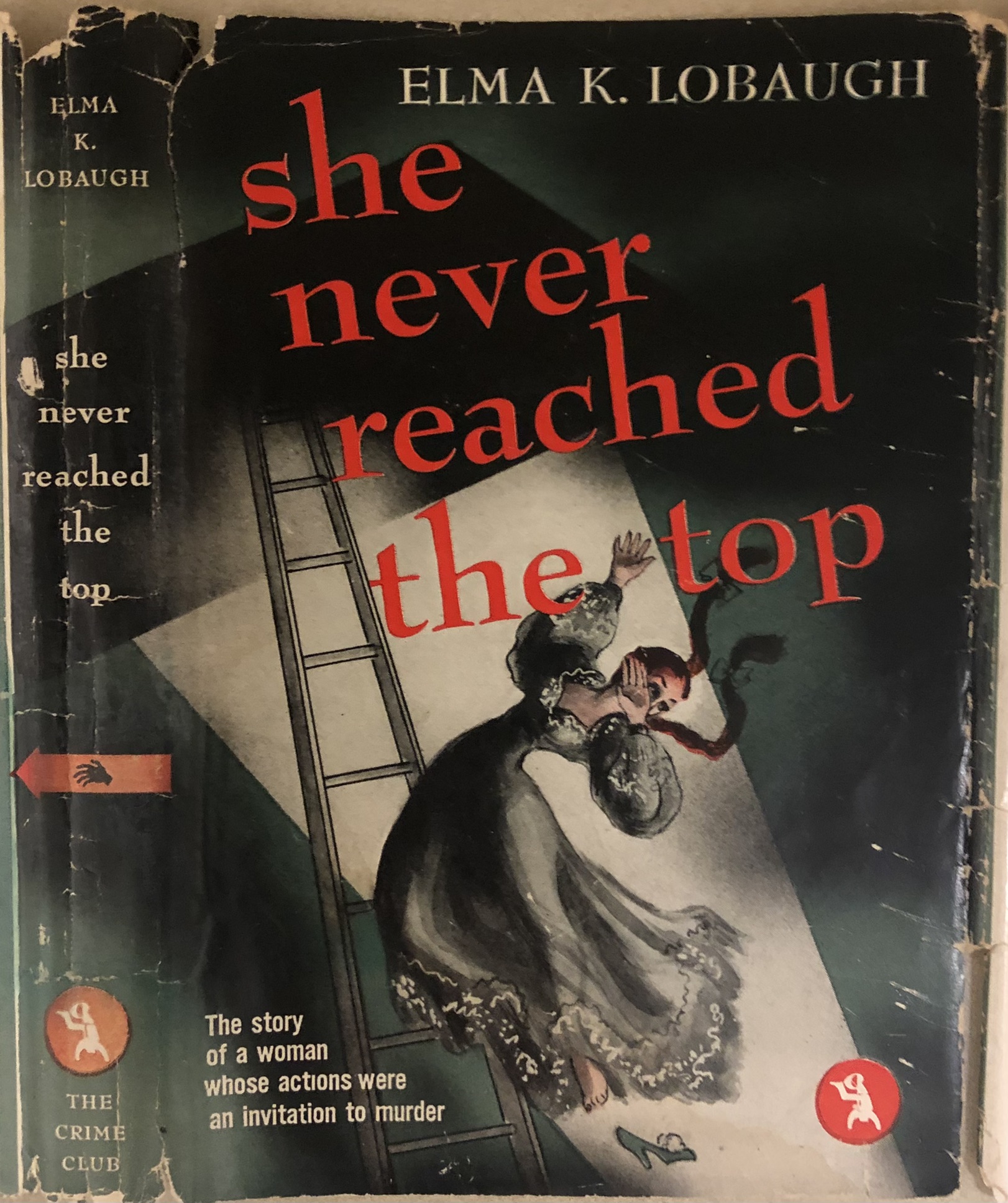
She Never Reached the Top - Elma K. Lobaugh

Elma K. Lobaugh's first mystery She Never Reached the Top (1945) was lauded by the editorial team at Doubleday Doran's "Crime Club" as "unusually competent."  But that, my friends, is an understatement like all true raves.  Very few first time popular fiction writers bother with thematic elements in that much maligned genre known as the whodunnit. A murder mystery is often dismissed as a trifle of a book, a mere entertainment as Graham Greene used to categorize his action-filled yet wholly intellectual espionage thrillers. Lobaugh's story is imbued with an soupçon of superstition and other-worldly events that not only add a frisson of terror to the house party haunted by past violent deaths and literally haunted by a ghost but enhance her theme of random violence as an act of chance and fate.  This is a thought-provoking murder mystery, and ultimately a bit of a transgressive novel in how Lobaugh treats her subject matter and how her "detectives" deal with the murder that only they have uncovered -- and then covered up.

Like many of Lobaugh's books this one is set in Indiana and like her later I Am Afraid (reviewed here) the story takes place in a house on the dune-lined shores of Lake Michigan.  The house itself features prominently and its bizarre unfinished state pays homage to the many weird architectural features of houses in books by John Dickson Carr, Carolyn Wells and Hake Talbot. The house in She Never Reached the Top, as the title may imply, has some missing staircases and incomplete steps leading to the second floor. Years ago a woman fell to her death from one of these unfinished staircases while using the DIY solution, a ladder that had no guardrails on the unexposed side.

Much of She Never Reached the Top seems mired in the past and the death of that unfortunate woman who fell from the ladder infects the house with doom.  Especially as the legend of the ghost has attached to it the prophecy that only those "who have been disappointed in love" will be cursed to hear and see the specter. Jennie Simpson, our Eberhart inspired narrator, is such a disappointed lover.  She reluctantly accepts an invitation to join the house party after a recent break-up with her boyfriend Peter.  Actually not much is know about why she and Peter are no longer together.  Did he die?  Was he killed in the war?  Did her just dump her for another woman?  We never really find out.  But thoughts of Peter and "what might have been" are never far from Jennie's mind.  And Jennie does hear the sounds of the ghost running to the ladder and the eerie brief silence just before the inevitable thud.  The reader just knows those noises are not a ghost at all but someone who has met the same fate as the woman from the past. But who could it have been?

Trendy floating staircases pose
similar possible fatal mishaps
When in the morning screams are heard and Pam, the youngest member of the house party, comes running into the breakfast room out of breath, in shock, and muttering, "I stepped on her! Oh my God, I stepped on her!" we have the proof of no ghost and a real corpse. It comes as no surprise that the troublesome wild woman, Margot Spendler, a free spirited, brazenly sexual woman who flirted with everyone including young Pam, was the victim.  But was it only an accident?  Bit by bit Jennie, Skip and Jim find evidence that Margot's death was a cleverly carried out murder. And each time they find evidence one of three either says nothing to the others or destroyys what they find. Will Margot's death be avenged?  Some of the "detectives" think it better to keep it all quiet.  The final chapter is satisfyingly thorough in explaining how the murder was accomplished. And there is a minor surprise in the identity of that killer. The final solution, however,  is entirely unconventional in how Lobaugh metes out her version of Justice.

I particularly enjoyed some of the occult sequences like when Jennie is goaded into reading palms.  Lobaugh treats the scene at first like a parlor game, but lets us know that Jennie takes palmistry very seriously, almost as if she is a psychic.  When Margot insists that Jennie look at her palm Jennie is terrified to discover that the flirtatious sexpot has no heart line. Furthermore, that her life line vanishes when it should extend to the wrist.  Could there be any more doom-laden foreshadowing than that?  There are other scenes tainted by superstition and many tales told about the ghost who first fell to her death that add to the fated atmosphere. Additionally, Lobaugh employs macabre folk songs (Jim is a professional piano player obsessed with melancholy tunes) and frequent recitations of lugubrious poetry to further play up her theme of lives pre-destined to violence.

She Never Reached the Top is (of course) rather hard to find anywhere. Currently, there are only four copies for sale from online sellers.  I never find Lobaugh's books in stores when I go book hunting.  Adding to the difficulty of locating copies is that it was published only in the US and only in hardcover.  Why it never received a paperback reprint (or even a cheap hardcover reprint from Triangle Books or Grosset & Dunlap) during Lobaugh's lifetime is another mystery that perhaps may never be solved.  It definitely deserved another life outside of the Crime Club edition. I'd say that Elma K. Lobaugh's work is due for a revival.  This is not only "unusually competent," it's rather a brilliant example of the mystery novel that defies categorization and one that dares to break several hallowed rules for a still young genre that too often was entirely formulaic.