Wednesday, August 9, 2023

Psst... Over Here!

Hello, there! Remember me? I think eight month’s hiatus is a little too long to have taken for what I thought was going to be “a little break”. What have I been up to? Oh, this and that…

I came to realize that like many collectors I had gradually turned into a monomaniac of sorts and I didn’t like it. My literary anecdotes were boring people and more importantly I was boring myself. I wanted to avoid vintage detective fiction for a while. It was long time that I returned to reading contemporary fiction of all types, reading non-fiction (!) that led me to seeking out the histories and memoirs that once upon a time I enjoyed even more than mystery novels. As I veered away from detective and crime fiction I rediscovered my passion for supernatural horror from all eras. In the process I learned that there has been a revival of “traditional” supernatural fiction in the past three years similar to the renaissance in detective fiction (both reissues and new writing). Quite an eye-opening surprise and a delightful one for someone like me who has always loved ghost stories, haunted house novels, and metaphoric treatments of the monster hiding under your bed.

And so after eight months I’ve come full circle and I’m ready to share with you some of the unusual and intriguing titles I’ve devoured since December 2022. Like this one…

Flowers for a Dead Witch by Michael Butterworth
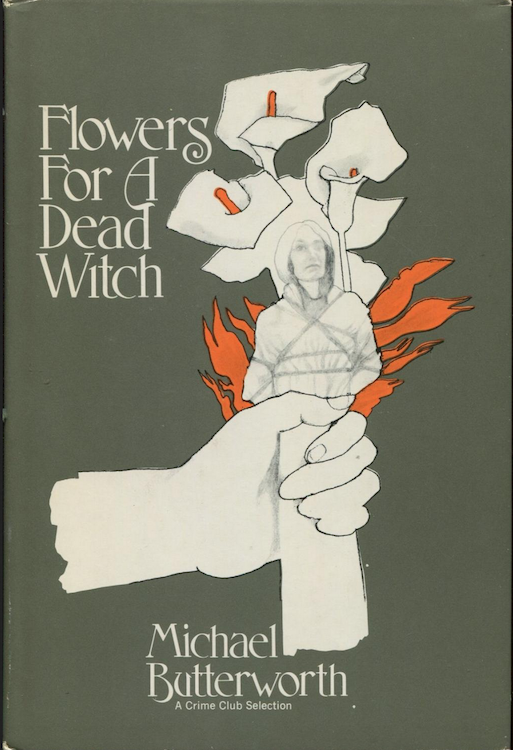
Readers of this blog will know that I love a good mystery novel dripping with Gothic elements and accented with witchcraft, hexes, black magic, voodoo, hoodoo or whatever the author is calling it. Butterworth’s third mystery novel is a brilliant example of the first revival of traditional mystery writing that occurred back in the 1970s. In Flowers for a Dead Witch (1971) he gives us what at first seems to be yet another of those Gothic “romances” that filled bookstore shelves and drugstore spinners five decades ago. Polly Lestrange travels from Canada to Suffolk to visit her bedridden ailing great-aunt in a crumbling medieval manor complete with moat surrounding the entrance. She is greeted by Miss Chesham, the great-aunt’s over protective companion who refuses the Polly’s request to visit the old woman. Even the local physician caring for Great Aunt Granchester insists that Polly leave the old woman alone. Well, what Gothic heroine is going to listen to either person? Certainly not this one and Polly determinedly breaks into the old woman’s room one windy and rainy night (of course it rains a lot in this book. It has too!) to discover… Oh, but that would spoil it all. The old woman has a secret of course and it will only be revealed in the final pages.

Before the startling conclusion – which I confess really took me by surprise – our plucky heroine will encounter a ragtag group of rebellious teens, rumors of a witchcraft cult cavorting naked in the moonlight, an ancient cemetery home to a mausoleum containing the corpse of a woman executed for witchcraft 400+ years ago, and literally stumble upon what appears to be the charred remains of that executed witch. But how is that possible? A 400 year old corpse of a woman burned at the stake would be nothing but rotting bones if not a pile of dust in 1971. The body found in the coffin in the mausoleum is freshly dead, and burned beyond recognition. When both the local reverend and his wife go missing whispers of foul play mix with the rumors of witchcraft.

This was the first book I’ve read by Michael Butterworth (1924 – 1986) who prior to turning his hand to bizarre crime and mystery novels was primarily known as a writer of comic books. Oh! A warning: Don’t confuse him with another (still living) writer of the same name who wrote science fiction novels and SF TV show novelizations. I had to notify the Admin of a crime fiction website that he conflated both Butterworths. I advised him to remove all the SF titles from the mystery writer Butterworth’s bibliography. He speedily updated that page on his website.

If Flowers for a Dead Witch is any indication of what Butterworth is capable of then I’m eager to check out as many of his other books that I can find. Most satisfying is that this is a legitimate detective novel with fair play clueing. Assiduous readers may catch onto what I overlooked as I foolishly fell for all of the writer’s rather clever red herrings. Butterworth mixes the formulaic plot of those 70s Gothic romances churned out by writers like Phyllis Whitney, Victoria Holt, and Mary Stewart with genuine mystery novel conventions and thankfully improves on both. Of course with a generous helping of creepy superstition and lurid witchcraft legends the plot is considerably spicier and more intriguing. I thoroughly enjoyed this book and completed it in a speedy two days. There are several copies available for sale out there in the vast shopping mall of the internet. I’m sure it ought to turn up in local libraries both in the US and UK. Check it out!


Michael Butterworth Crime & Detective Novels

The Soundless Scream (1967)
Walk Softly in Fear (1968)
Vanishing Act (1970) (US title: The Uneasy Sun)
Flowers for a Dead Witch (1971)
The Black Look (1972)
Villa on the Shore (1973)
The Man in the Sopwith Camel (1974)
Remains to be Seen (1976)
Festival! (1976)
X Marks the Spot (1978)
The Man Who Broke the Bank at Monte Carlo (1983)
  -- adapted into a musical: The Lucky Stiff by Ahrens & Flaherty
A Virgin on the Rocks (1985)
The Five Million Dollar Prince (1986)

As by “Sarah Kemp” – all feature Dr. Tina May, a psychiatrist detective
Goodbye Pussy (1978) (US title: Over the Edge)
No Escape (1984)
Lure of Sweet Death (1986)
What Dread Hand (1987)

Saturday, December 31, 2022

The Empty Bed - Herbert Adams

I read three books that were set around or on Christmas Day during December and have managed to finish only one in time for the end of 2022. One I stopped because it was so dull in its 33 pages of exposition but online reviews encourage me to finish it. It's only a novella of 79 pages and I thought I'd be done with it in a few hours!  The third I only started yesterday afternoon.  So those other Christmas mystery reviews will be showing up next week.

The Empty Bed (1928) features Jimmie Haswell, Adam's first series character, a solicitor who has a habit of stumbling into puzzling murder cases.  In this fourth book in the brief nine mystery novel series Haswell and his newlywed wife Nonna are invited to spend Christmas at "The Cedars", the estate of his friend Joyce Gurney.  Accompanying him are his friends Tony and Mollie Bridgman who both appeared in Adams' first mystery novel The Secret of Bogey House, also Haswell's debut.

When they arrive they soon learn that Joyce's Uncle Silas was bludgeoned by a medieval mace on Christmas Eve. Apparently he had interrupted a burglar who was attempting to rob the household.  A window was cut out in the hallway near the body and there are signs of a struggle. But soon Jimmie and the police dismiss the bludgeoning burglar theory when various puzzling aspects of the crime reveal themselves.

1.  Why was Vivian Gurneys bed not sleep in ?  Where did the nephew disappear to in the night?  And why has he not returned on Christmas Day? This seems to be the empty bed of the title. However, another empty bed will provide another clue in the denouement.

2. Who let loose the bloodcurdling scream that awoke the entire household?  Why will no woman admit to the scream?

3. Who took Vivian's knife and left it near the window in the hallway?  Was it used to cur out the glass from its leaded housing to make it appear a burglary took place?

4. Who left the mysterious note signed by "J" mentioning a secret late night tryst changed from midnight to one o'clock in the morning? Was it Joyce?  Or Jasper? Or someone else with a J initial outside of the home?

Silas is one in a long line of curmudgeonly misers with many relatives awaiting his money in the world of mysterydom so there are plenty of suspects and motives.  As the investigation proceeds there is also a lot of lying and covering up.  Jimmie begins to distrust his friend Joyce when she will not come clean. Eventually we learn of her secret engagement and that her fiancee showed up at "The Cedars" late Christmas Eve.  The fiancee becomes the prime suspect and shortly after the inquest the police arrest him.  Jimmie is sure the police have arrested the wrong person and works tirelessly to clear his name and find the real murderer -- a much more dangerous person who will strike again shortly after the arrest and even attempts to kill Jimmie.

No Herbert Adams mystery is without at least one game of golf. Despite the melting snow and sodden greens Jimmie and Tony make it to the links.  Really it's one of the most incidental and superfluous uses of the game in the plot.  In other Haswell mystery novels the murder happens on a golf course, in the clubhouse or nearby a golf course and the game takes more prominence.  In one mystery a character arranges a game of golf and in the guise of friendly conversation during the game coaxes vital info out of a suspect.

Another recurring aspect in Adams mystery is romance and love. In The Empty Bed we have a couple about to be engaged, one broken engagement, and a beautiful maid the object of many men's admiration. Love and romance are always on Adam's mind.  All works out well for all the various couples, but this time we also have the ugly side of sexual attraction and unbridled womanizing in a cad named Captain Hugh Rollings who makes passes at every woman in the story. He's like a Harvey Weinstein of the the 1920s. Rollings' kissing and groping (it has nothing to do with the mistletoe, that's just his excuse) lead to a nasty fistfight. Defending his wife, one of many women Rollings kissed and fondled without consent, Jimmie gives the Captain a sound beating suffering a few blows himself in the process. Merry Christmas, creep!

The Empty Bed seems to be Adam's first genuine detective novel.  Previously his novels mixed two genres - the adventure novel and the detective novel with the adventure aspect winning out. Though there is some fair play clueing in The Empty Bed, the finale is laden with too much inference and guesswork on Haswell's part.  In the last chapter we discover there was an eyewitness to the murder, someone who was protecting the murderer and guarding another secret.  This witness conveniently verifies everything that Haswell guessed at. I was slightly disappointed with that lazy way to explain away all the last minute clues thrown at us. Still The Empty Bed shows promise and by the time Adams writes The Crime in the Dutch Garden (1931) -- so far the best of the Haswell mysteries I have read and a superior fair play example of the bizarre murder method mystery plot -- Adams will have proven himself a contender in the genre.  That he was never elected into the Detection Club seems clearer to me based on so many detective/adventure hybrids and too much intuitive detective work in his first decade of writing.

As a Christmas tale the setting is only incidental and proves an excuse to get a houseful of murder suspects together. What surprised me, however, were the timeless insights into how Christmas celebration and holiday traditions haven't changed in over a century. Here are some choice holiday themed quotes from various characters:

CHRISTMAS MAGIC
What magic there is in the very name Christmas! None is too old to feel some thrill as the day dawns, and few too cynical to look forward to it without some hope of happiness beyond the ordinary.

RE-GIFTING
Mollie: "Years ago I started a present drawer. A few weeks after Christmas I pop into it all the things we shall never want. Of course we appreciate the kind intention and very often find someone who really likes the gift."

IT'S THE THOUGHT THAT COUNTS ...SORT OF
Nonna: "My rule is to give people something I'd like myself. So if you don't care for what you get, please give it back."

CHRISTMAS DINNER
Jasper (the ne'er-do-well sarcastic nephew): "Dinner was good, but conversation dull, dealing mostly with dead relatives -- 'Do you remember how Aunt Arabella lost her teeth in the soup?" -- and things like that. Family yarns we drag up every Christmas. After dinner we had a poisonous evening -- some music and old-fashioned whist for penny points."

GETTING ALONG
Sgt Inglis: "Did you quarrel with your uncle?"
Jasper:  "No. There was plenty of time for that. We arrive on Christmas Eve, and seldom quarrel before Boxing Day."

Finally, in the absolute last paragraph of the book I learned something fascinating. Jimmie apologizes to Nonna for their Christmas spoiled by crime and nearly the end of their marriage in that horrific attempt on his life. He promises he will make it up to her: "We'll go to Switzerland for the winter sports."  Was this the Olympics by any chance? I thought. Off I went a-Googling. And voila! Jimmie's mention of "the winter sports" to turned out to be the St. Moritz Winter Games of 1928.  They were, in fact, the first Winter Olympics organized separately, that is apart from the Summer Olympics. How's that for some real life inspirational detective work!