Saturday, April 9, 2022

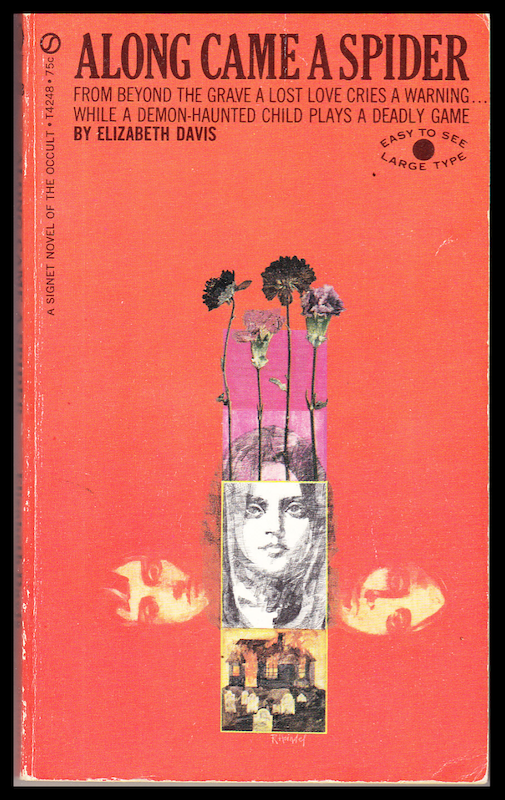
ALTERNATIVE CLASSICS: Along Came a Spider - Elizabeth Davis

I'm putting the sinister back into the Pretty Sinister Books blog this month as I tear through a pile of old horror novels and detective novels with supernatural and occult content.  Today's post also touches on the 1970s mania of the demon child in popular horror fiction.  I've read so much of this kind of book over the 11 years this blog has been around that I've finally decided to create yet another tag to label them all. If this is a subgenre in horror and mystery fiction that lights your chandelier you can click on the "Demon Child" tag at the end of this post and read more about them, perhaps find some obscure books dealing with killer children and demon-like adolescents.

Last month I had a mystery novel that incorporated a demon child motif -- well, more of a precursor to the Bad Seed trope -- in I Am Afraid (1948).  Today we go from the sublime and restrained domestic horror of that book to the outrageously ridiculous, horror bordering on parody in Along Came a Spider (1970).

Stephen, the nasty tween in I Am Afraid was 11 years old.  The bad kiddo in Elizabeth Davis' novel (apparently her sophomore effort in horror fiction under a second pseudonym) is remarkably only 9 years old. I found it incredibly hard to believe Anne Bishop, the evil little girl, was this young because for much of the book she comes across as a 45 year-old worldly wise woman.  But as you get to the the over-the-top finale our narrator posits her theory of why little Anne is such an adept sorceress.  She's basically the Wolfgang Mozart of black magic.

However, I'm getting way ahead of myself...

Davis's 2nd occult novel deals
with witchcraft and reincarnation
Inspired no doubt by Rosemary's Baby (1967) which almost single-handedly launched this new subgenre about children spawned from Satan and children possessed by demons, Along Came a Spider has been overshadowed by more well known (and better written) books employing this popular and by now hackneyed horror motif.  We have a wiseacre of a narrator in Eve Mercer whose colloquial voice is filled with idiomatic speech, sarcastic asides and a quasi stream-of-conscious narrative style that works against the suspense when Davis allows Eve to constantly interrupt her own thoughts. The narration is punctuated with dashes and ellipses as Eve trails off from one thought to the next like a distracted housewife running on a permanent caffeine high of extra strength Maxwell House.

The plot?  The Bishop family have moved in across the street and Eve fears her daughter Laurie has fallen under the diabolic influence of creepy little Anne, a primly dressed, too polite, too aloof miniature adult in the guise of a 9 year old girl.  Eve's first high-strung reaction to her daughter's new found friend comes when she learns that Anne is adept at painting. Laurie describes these paintings as nightmarish images of brutish monsters and other weird things she's never seen before.  They're so gory they look like they might have been painted with blood.  But Anne dismisses what was intended as an exaggeration by telling Laurie you can't paint well with blood. "It clots," says Anne's voice of experience, "and won't go on too smoothly."

The absurdity has entered the story early, my friends. This is only page 40!

There is an element of a detective novel in the story when Eve learns that the Bishop family knew a friend of a friend of a friend.  And so she hunts down some phone numbers and makes a couple of phone calls.  She reaches the boyfriend of a girl who died in an automobile wreck recently.  The young man tells Eve that his ex-girlfriend lived in the same building as the Bishops and ran into little Ann one day at the trash chute in the hallway. Anne was startled as she tried to shove something down the chute and quickly ran off leaving the object stuck. The now dead girlfriend went to see what Anne was trying to get rid of and found a mouse crucified on a handmade wooden cross.

It only gets more insane from here on.

There are strange rituals that Anne teaches her playmates. A girl dies in a cemetery but not before uttering a mysterious dying message.  Laurie begins to act strangely.  She has nightmares, disappears from her bedroom and can't be found late at night. Eve continues her detective work by consulting books on witchcraft and demonology and learns that Anne has been teaching Laurie and the other girls the ABCs of summoning demons and makes sure she is nowhere in sight when those rituals are being performed.

Ultimately the book is self-defeating because Davis allows Eve's hysterical imagination to get the better of her too often. The narration grows increasingly hyperbolic and her frequent wisecracks undermine the horror making it all seem like a black comedy.  Eve is also susceptible to superstition and imagines that her husband Jim who recently died has come back from the dead. He sends her warnings in her dreams, she hears his voice intoning "Move away! Take Laurie with you!"  Unfortunately as soon as that ghostly element is introduced Davis never follows through. Jim's ghost literally fades away as soon as he almost appears never to be talked of again. Davis seems to be suggesting that Eve might be headed for a nervous breakdown. Are we to think that Anne is innocent of all that Eve imagines her to be doing? The preposterous finale extinguishes that doubt as quickly as a sorcerer blowing out a scented black candle. But you must discover that on your own...if you dare.

You can read for yourself how this madness unfolds and whether or not Eve is a nut job or Anne is the spawn of a demon by buying one of the many copies available for sale out there in this vast shopping mall we call the internet.  I turned up about a baker's dozen in both English and foreign language translations.  It's an odd book, entertaining to be sure in an Alternative Classic way, but never really frightening at all.

Elizabeth Davis was born Lou Ellen Davis in Pennsylvania and raised her family in Connecticut.  Her fascination with witchcraft and psychic phenomena led to two other novels of crime and occult:  Suffer a Witch to Die (1970) and There Was an Old Woman (1971).  The 1971 novel was adapted for TV in 1972 and re-titled Revenge!  The made-for-TV movie has a script by Joseph Stefano (best known for his screen adaptation of  Psycho) and stars Shelley Winters (in one of the many badass biddy roles she succumbed to in middle age) and Bradford Dillman.

Wednesday, March 30, 2022

FIRST BOOKS: The Seven Sisters - Jean Lilly

Mr. Spencer, a gemologist, visits newlywed Nancy and Stanley Kent at the famed Prentice mansion. He informs them that he is doing research on the renowned Prentice Dowry Chain, an elaborate jeweled necklace made up of seven star sapphires known as the Seven Sisters. Much to Mr. Spencer’s dismay Nancy, Mrs. Prentice’s granddaughter, has never heard of the Prentice Dowry Chain and knows nothing about its existence among the many valuables in the house. Stanley, however, a clever young man if there ever was one, leads Spencer to a portrait of one of the Prentice ancestors. It’s Nancy’s great grandmother who is wearing an elaborate necklace and Spencer stands in awe of the painting sighing almost inaudibly, “The Seven Sisters!” Spencer allows the family to try and locate the necklace and he promises to return at a later date hopefully to examine the jewels in person. Thus begins a strange and macabre adventure involving buried secrets, stolen jewels, and murder.

I was utterly unprepared for what awaited me in the pages of The Seven Sisters (1928), the first mystery novel of Jean Lilly. The rambling narrative meanders through Stanley and Nancy’s courtship, an overview of Prentice genealogy, the setting up of the house, the relegation of the dozens of ancestral portraits that covers the walls, etc. etc. and so forth. This meandering all seemed to be going nowhere for the first 75 pages. Finally when Spencer shows up and delivers his two page monologue on the mineral composition of gemstones, the phenomenon of asterism, the difference between faceted gem cutting and the en cabochon method I started to see this would be yet another mystery novel about a missing item of jewelry and the crimes that follow in the wake of the jewels’ recovery. Little did I know that the story would take a bizarre detour into the land of pulpish gore and macabre thrills.

A star saphhire displaying
the asterism effect
Nancy’s grandmother Penelope, the only occupant in the Prentice home other than the handful of servants, refuses to talk about the Seven Sisters. A few days after Spencer showed up she dies of fright when a different strange man appears and confronts her and her gardener/handyman about the Prentice Dowry Chain. Just before Penelope dies she utters a fragmented message: “Under…oak...next…” Stephen takes the message to be a literal clue to the necklace’s hiding place, most likely beneath one of the oak trees that line the property. He spends one night digging and to his shock (and the reader’s) he uncovers some skeletal remains. Buried with the bones he finds an engraved pocket watch. Only a capital R is legible while the other two letters in the monogram have been worn away.

Increasingly the story becomes like Harry Stephen Keeler webwork concoction. An apt analogy because this is a book from E. P. Dutton, publisher of Keeler’s books from 1927 through 1942. Along with disinterred skulls and skeletons and the engraved pocket watch we get anonymous letters, a mystery woman residing in Room 34 of a hotel on Andover Road, an acrobatic burglar, and another buried body!

Surprisingly, with a small pile of buried corpses and a break-in at the Prentice home there’s not a single policeman in sight. Stephen in trying to protect the family name does call the coroner but tells him as little as he thinks the coroner needs to know. Stephen may be clever with his dying messages and handy with a shovel but he’s extremely foolish not to report the nuttiness going on at the Prentice property. His foolhardy decision to protect his wife’s family reputation leads to more death and violence. Coroner Bailey then takes matters into his own hands. He and Stephen turn sleuth and ultimately, after various wild adventures and more crime, the greedy culprits are tracked down, the necklace is recovered and the secret of the skeleton buried beneath the oak tree is explained.

Jean Lilly is as mysterious as the goings on in this debut novel. I know more about her husband and daughter than I do about her.  Jean McCoy Lilly (1886-1961) was born in Michigan and died in Pennsylvania.  She married Scott Barrett Lilly, well known professor of engineering at Swathmore College,  for whom an endowed scholarship is still named.  Her daughter Mary, born in 1910, graduated from Swathmore in 1933, studied painting at the Philadelphia Art institute and taught art there. Later she spent much of her life as an art teacher at Charlestown Elementary School in Malvern, PA.

Lilly is the author of four mystery novels with the last, Death Thumbs a Ride (1940), the easiest to find and the only other Lilly book that has been written about on the internet. While her first crime novel has no series character another Lilly mystery novel I own but have yet to read -- Death in B Minor (1934) -- features Bruce Perkins, her lawyer-detective who appeared in the last three books.

The Seven Sisters exists only in one US edition and is the scarcest of all the Lilly mystery novels. It was not reprinted in either hardcover or paperback during the author’s lifetime. While I enjoyed this oddity I wouldn’t break my neck (or bankbook) tracking down a copy. Despite its strange turn of macabre events it’s typical of 1920s American mysteries: not really a traditional detective novel but rather an adventure thriller overloaded with preposterous coincidences. Ultimately it all ends in a sadly predictable finale. With its old-fashioned prose style, unusual narrative tricks and creaky plotting it all reminded me of a book that might have been written in the late Victorian or early Edwardian era by either Richard Marsh or Mary Elizabeth Braddon.