Harold Morton Prince, popular jazz composer and musician is shot dead in his home at the start of Blues for the Prince (1950). His collaborator, a song arranger named "Stuff" Magee, is seen fleeing the crime scene and is expertly knocked down by a cop who uses his billy club as a boomerang. Now Magee is hospitalized with a coma. Found on Magee is a briefcase with documents proving that the Prince was a fraud. His one time collaborator claims he wrote all of the Prince's music. He wanted the Prince to admit it and split his fortune or Magee would go public and ruin Prince's reputation and essentially end his career.
Carney Wilde is hired by Larry Owens, ex-fiance of the Prince's daughter. He wants closure and he wants the truth. Owens hopes learning the truth might help repair his relationship with Martha Prince. Wilde takes the case because he's a jazz enthusiast himself and is a great admirer of the Prince's music. He thinks the whole scheme of Magee's is nothing more than lies and the work of a desperate blackmailer. He wants to prove the Prince was a true musician and that his music is his own. But soon he learns his jazz idol is not the folk hero that newspapers and the fans have made him out to be.
From Martha he learns that her father was "a cheap loud man with bad taste...primitive in his music just as he was in life." From Lt. Grodnik he uncovers the Prince's a "foot long" police record of drunk and disorderly charges. The Prince was also addicted to drugs and at this late stage in his career apparently needed the junk to calm him down so he could perform civilly in front of an audience. Carney is none too happy to have taken up the case. The digging up of dirt gets messier and uglier the more questions he asks.
Eventually the case turns to the hunt for Arabella Joslin (aka Bella Joe), a singer in cahoots with Stuff Magee to defraud the Prince out of royalties and discredit him as an original songwriter. When we finally meet the singer she turns out to be a hardass of a pistol packin' Mama. She hates cops and loathes private eyes. Carney barely escapes with his life when she pulls out her double barrelled Derringer.
Spicer knows his jazz music and the story is as much an exploration of the jazz scene as it is another early version of the corrupt family crime dramas like those of Ross Macdonald. Notable too is Spicer's handling of race issues that are rather advanced for a book published in 1950. Carney Wilde manages to clear the Prince's name, repair a bit of the musician's scarred reputation, and heal a very wounded family when he finally discovers how and why the blues man died. Though purists may object to one of the last twists in the finale the novel still has Spicer's trademark realism, honesty in emotion, and an unexpected poignancy in the story's resolution.
Previously on PSB is this review of The Dark Light, Bart Spicer's debut mystery novel and the first of seven books featuring Carney Wilde.
Crime, Supernatural and Adventure fiction. Obscure, Forgotten and Well Worth Reading.
Showing posts with label Carney Wilde. Show all posts
Friday, July 19, 2013
Friday, January 18, 2013
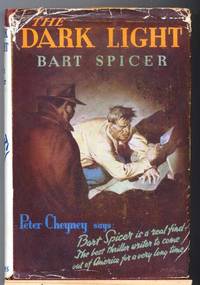
FFB: The Dark Light - Bart Spicer
"The uneasy breath of a nasty idea kept pace with me." -- Carney Wilde in The Dark Light
For anyone who has read all the Philip Marlowe books and all the Paul Pine novels and still craves a private eye in a similar vein with more than a few nods to the great Chandler I recommend the work of Bart Spicer. His Carney Wilde is a tough guy with a heart and in his debut The Dark Light (1949) is struggling to make a living at his game. Enter Deacon Andrew Jackson who wants Wilde's help in locating Matthew Kimball, the missing preacher from the Shining Light Church. As with all missing person cases in a private eye novel Wilde will face some dirty doings and a few murders along the way.
There is touch of Ross Macdonald in this first book but I'm guessing it's mere coincidence since only The Moving Target had been published by 1949. That Spicer chose to include one of the typical wealthy and morally corrupt families in this book is not all coincidence but the similarities to what Macdonald would soon be known for are. The Prentices really aren't all that bad as the story progresses but there is a creepy mother-son relationship depicted in Mrs. Prentice's devotion to her hunky son Alec. Also her daughter Alicia at first appears to be one of the many predatory females that populate private eye novels. She gets an eyeful of Wilde and wants more. So she invites herself along in Wilde's investigation by sitting in his car and refusing to leave until he starts the car and takes her with him.
I particularly liked this Chandleresque passage that comes early in the book:
The detection in this book is also a highlight. Unlike most private eyes who rely on intuition and guesswork Carney Wilde has the skills of a logical detective more often seen in the work of Ellery Queen. In tracking down Matthew Kimball to a Manhattan hotel he finds the illusion of a inhabited room but a few odd elements that make him suspect Kimball was never in the room. Chief among those clues are a radio speech without the changes he made on the original and a pair of eyeglasses with an old prescription. Combining these finds with some astute questioning of Deacon Jackson and the staff of Kimball's optometry store Wilde is faced with the fact that an impostor checked into the hotel.
What begins as a simple missing persons case soon becomes almost more than Wilde can handle. He finds himself enlisting the aid of his old army buddy who also happens to be a private detective working in New York to do some legwork and save on his commuting from Pennsylvania. He also finds himself collaborating almost against his will with Lt. Grodnick who thinks Kimball will turn up alive somewhere with a woman on the side. Wilde who has a much better understanding of human nature and without ever having met Kimball knows this is the wrong read on the preacher. Wilde will end up confronting blackmailers, an angry bigot with a sexually ravenous daughter, some talkative bartenders, and a nosey landlady before he manages to put all the pieces together and stop a killer who wants to protect a deep, dark secret.
At journey's end Spicer piles on too much melodrama in what Grodnick calls "a Philo Vance like set up" but just getting to know this detective, a wise guy with a compassionate heart, in his debut was well worth the trip. I'm ready to start on the second and third books in the series and will report back on Carney Wilde's progress in the private eye biz.
For more on Carney Wilde and Bart Spicer see the excellent info on this page at The Thrilling Detective Website.
The Carney Wilde Private Eye Novels
The Dark Light (1949)
Blues for a Prince (1950)
The Golden Door (1951)
Black Sheep Run (1951)
The Long Green (1952)
The Taming of Carney Wilde (1954)
Exit, Running (1959)
For anyone who has read all the Philip Marlowe books and all the Paul Pine novels and still craves a private eye in a similar vein with more than a few nods to the great Chandler I recommend the work of Bart Spicer. His Carney Wilde is a tough guy with a heart and in his debut The Dark Light (1949) is struggling to make a living at his game. Enter Deacon Andrew Jackson who wants Wilde's help in locating Matthew Kimball, the missing preacher from the Shining Light Church. As with all missing person cases in a private eye novel Wilde will face some dirty doings and a few murders along the way.There is touch of Ross Macdonald in this first book but I'm guessing it's mere coincidence since only The Moving Target had been published by 1949. That Spicer chose to include one of the typical wealthy and morally corrupt families in this book is not all coincidence but the similarities to what Macdonald would soon be known for are. The Prentices really aren't all that bad as the story progresses but there is a creepy mother-son relationship depicted in Mrs. Prentice's devotion to her hunky son Alec. Also her daughter Alicia at first appears to be one of the many predatory females that populate private eye novels. She gets an eyeful of Wilde and wants more. So she invites herself along in Wilde's investigation by sitting in his car and refusing to leave until he starts the car and takes her with him.
I particularly liked this Chandleresque passage that comes early in the book:
I got in my car and went home for a cold bath. I lay back in the water, getting up enough interest to keep my date with Alicia. I had the courtroom stink in my nose and it didn't mix well with Alicia. The dead sourness of unwashed bodies and disinfectant and brutality and fear and the clumsy maneuvering of justice. I got out of the tub and tried to rub some of it off.What makes Spicer's private eye different from most of the detectives of this type is that Carney Wilde is first and foremost a businessman. He's worried about his small firm and in his debut he's just learning to play the game. The entirety of Chapter 6 is devoted to his backstory in which we learn he was a member of the CID in the army who returned to work as a house detective for a department store. His former boss at that store, an astute businessman who made a killing in real estate and banking, hired Wilde as a security consultant and with that money he was able to start his own private detective firm. But the clients aren't rushing in. When they do show typically they are like Deacon Jackson, barely able to afford a day's work. But Wilde needs business and he takes what he can get. The chapter also goes into great detail outlining his work with an insurance company. It's a contact Wilde desperately needs. If he can get an insurance company as a regular client he'd have it made. He is hoping to earn some extra cash by giving testimony in a robbery case of great concern for a certain insurance company. With that money Wilde envisions buying a new car, a new office with a staff of three, and plenty more.
![]() |
| UK edition, (Collins, 1950) |
What begins as a simple missing persons case soon becomes almost more than Wilde can handle. He finds himself enlisting the aid of his old army buddy who also happens to be a private detective working in New York to do some legwork and save on his commuting from Pennsylvania. He also finds himself collaborating almost against his will with Lt. Grodnick who thinks Kimball will turn up alive somewhere with a woman on the side. Wilde who has a much better understanding of human nature and without ever having met Kimball knows this is the wrong read on the preacher. Wilde will end up confronting blackmailers, an angry bigot with a sexually ravenous daughter, some talkative bartenders, and a nosey landlady before he manages to put all the pieces together and stop a killer who wants to protect a deep, dark secret.
![]() |
| Bart Spicer as he appears on the rear DJ panel of the 1st edition |
For more on Carney Wilde and Bart Spicer see the excellent info on this page at The Thrilling Detective Website.
The Carney Wilde Private Eye Novels
The Dark Light (1949)
Blues for a Prince (1950)
The Golden Door (1951)
Black Sheep Run (1951)
The Long Green (1952)
The Taming of Carney Wilde (1954)
Exit, Running (1959)
Subscribe to:
Posts (Atom)


