Showing posts with label American Magazine. Show all posts

Friday, July 8, 2016

FFB: Three Men Out - Rex Stout

We're saluting Rex Stout today in a web-wide reading of his books for the Friday's Forgotten Book meme hosted by Patti Abbott though most of his books, I think, are hardly forgotten. I chose to continue my reading of the Nero Wolfe canon with Three Men Out (1954). This volume includes three novellas all of which were published under different titles in The American Magazine between September 1952 and December 1953. All of them were subsequently reprinted one or more times in Ellery Queen's Mystery Magazine. As with most of the Nero Wolfe books the US paperbacks were first printed by Bantam and remained in print from the 1950s throughout the 1980s. I liked all of these long short stories for various reasons, but the first one seemed the weakest of the lot.

"Invitation to Murder" was originally published as "Will to Murder". The first title is uttered by Herman Lewent as part of his introductory dialogue. Lewent is both client and victim in the story. As the second (original) title may suggest to a wily Wolfe reader the novella is about a large inheritance, the money and estate that Lewent feels he's been cheated out of. He seeks out Archie and Wolfe to help him find out what happened to his share of his father's estate which was inherited by his sister. She died suspiciously of ptomaine poisoning after eating a plateful of artichoke appetizers at a party and Lewent thinks that someone in her husband's household killed her. Reluctantly, Wolfe takes on the case and Archie is sent to the home of Theodore Huck, the wheelchair bound husband, in a somewhat undercover capacity to smoke out the killer...if in fact there is one. When Lewent dies Archie is tasked with finding a real murderer. He and Wolfe try to prove that Lewent was murdered because of his knowledge of Mrs. Huck's suspicious and conveniently timed death.

The suspect list is small in this story and therefore the sniffing out of the culprit is not at all difficult. Besides the invalid husband who is the most fleshed out of the characters, there is his nephew Paul Thayre, an aspiring composer of "modern music" and Huck's three female employees: a housekeeper, a secretary, and a nurse. None of these women is really s given any full treatment as a character. They're sort of ciphers. Archie of course is attracted to a few of them, notably Mrs. O'Shea, the buxom, hip swinging, widowed housekeeper who he thinks is Huck's secret paramour. But when Lewent's murder by bludgeoning is examined closely there really can be only one possible killer. The only surprise here is how the body was moved from the actual murder site to where Archie literally stumbled over it. Not much of a mystery tale and though Wolfe solves it with his usually aplomb anyone could figure out this one.

A better mystery and better tale is "The Zero Clue" which resembles the work of Ellery Queen. It's no wonder that the story was reprinted four times in EQMM between 1963 and 1976. The Wolfe novella includes a rather puzzling dying clue, a plot device practically invented by the Queen writing team.

This is also one of the few times we learn that Wolfe had a rival in the private detective business, though this detective is of a most unusual sort. Leo Heller is what one might call a probability detective. As an ex-professor of mathematics Heller made a name for himself by using the laws of probability in determining the outcomes of anything from a horse race to a political election. He then turned to becoming a private detective of sorts using his various calculations and formulae in helping people with everything from completing business deals to locating missing persons. Archie says the rumor has it Heller was so successful that he was pulling a six figure income. Heller crossed paths with Wolfe in one case where they had the same client but Wolfe was fired when the client thought he was moving too slowly. Heller then delivered for the client but he used much of the data and info gathered by Wolfe's operatives which led to Wolfe's negative opinion of Heller as a man of ethics in the private detective world.

The dying clue in "The Zero Clue"
Now Heller wants to hire Wolfe to verify his suspicions of a client who may be a criminal. Wolfe is still steamed about the past and his anger is only intensified when Archie tries to get permission to take the case because Wolfe and Theodore are in the midst of dealing with a thrip invasion in the orchid greenhouse. Archie goes to Heller's office anyway and finds him dead with Cramer and other police already investigating. On the desk in Heller's office the police find eight pencils and one eraser arranged to form what appears to be the initials NW. Cramer is convinced that the rivalry between the two got the better of Nero Wolfe and he had Archie take out Heller like a hitman. Wolfe, however, sees through the meaning of the dying clue almost immediately and asks the police to pay close attention to anything involving the number six.

The suspects include all of the prospective clients who were in the waiting room or who had recently paid a visit to Heller's office. Among them are a nurse who wanted Heller to help her uncover the identity of the person who firebombed her hospital; a society dame with a cache of anonymous letters that hint at blackmail; an egotistical inventor with a temper who sought out Heller to provide him with the missing formula to make his latest invention workable; and Karl Busch noted as a man of "NVMS" (no visible means of support) on the police notes Archie spies. Busch seems to be the criminal of the bunch for he wanted Heller's help in winning a horse race. Heller provides him with the name of the horse to bet on but with a name like Zero Busch was too superstitious to accept it as the real winner.

Wolfe listens to all their stories and sees that not only was his first thought about the dying clue wrong, but that Heller's mathematics background is actually the key to the entire case. And armed with some arcane knowledge he gathers from a textbook about the history of mathematics he not only solves Heller's murder but discovers the person who blew up the hospital where Susan Maturo, the nurse, worked. The story is not exactly fair play since it requires that the reader also have that arcane knowledge, but it's nevertheless a superior mystery story with some of the best plotting for a story set in a single room I've read in a long time. This could easily be adapted for the stage and it should be!

The last story of the bunch "This Won't Kill You" is equally good, but because it deals with baseball I tended to waver in and out of it. In fact, I skipped entire pages at the start of the story that described the baseball game that Archie, Wolfe and a visiting chef from Paris are attending. There are some funny moments with Wolfe indignant about the chairs in the stands that obviously will not accommodate his mammoth size. (Wolfe's need to find suitably large furniture to sit in is a running joke in all three stories.) There is all sorts of 1950s name dropping of baseball players that went right over my head, too.

The story is about the drugging of four baseball players on the New York Giants and the murder of a fifth player suspected of drugging them. The large cast of characters includes a showgirl wife who is the object of many a player's roving eyes and who supplies the story with a subplot that goes on a bit too long. The real mystery is so tied up with the game of baseball that for me it didn't mean much. The mystery was well told but sports fans would appreciate it a lot more than someone like me who doesn't give a damn about professional athletics. For me the biggest mystery was the decision of the Viking editors to change the verb in the original title "This Will Kill You" to a negative.

Overall, a good collection with the second and third novellas the best of the trio. But for me "The Zero Clue" is absolutely top notch. It also appears to be the unanimous appraisal for that novella. "The Zero Clue" turns up in the top five (some rank it as #2) of all 39 novellas in numerous "Best of Nero Wolfe" lists all over the internet and in several reference books.

Friday, May 13, 2016

FFB: Three for the Chair - Rex Stout

It's not really right to ever include any of Rex Stout's crime fiction in the Friday's Forgotten Book posts, but here I go anyway. How can anyone call Nero Wolfe forgotten?  I needed to find some books published in 1957 and all I could find were British writers among my shelves. I wanted to devote more time to US writers this year, especially when it came to contributing to Rich Westwood's "Crime of the Century" monthly posts where we write about books published in a specific year. By chance I stumbled across my beat up book club edition of Three for the Chair and was glad to see a copyrighted date of 1957. I'll just gloss over the fact that all three novellas in the book were originally published in magazines in 1955 and 1956 if that's all right with everyone. And now that's all out of the way -- let's move on, class.

I was excited to return to Nero Wolfe after having completely given up on him for over forty years. As luck would have it Three for the Chair seems to be very atypical for Stout, at least from my foggy memories of the novels I've already read. Among the three novellas in this book there are two very well plotted mysteries, one of them including a borderline impossible crime.  I was very surprised and delighted with those stories. As for the third...

My least favorite of the trio was "Immune to Murder".  Because I work in a hospital when I see the word immune I immediately think of viruses, infectious diseases and vaccines. I thought this was going to be a medical mystery of sorts. Here the word immune had nothing to do with medicine or biology. It exemplifies why I wasn't thrilled with Nero Wolfe as a kid since the story is not so much a mystery as it is a tale of the legal issues of diplomatic immunity. It's also about fly fishing and cooking trout.

It's one of two stories in the book where Wolfe and Archie leave Manhattan and his brownstone haven where Wolfe would prefer to be.  The private eye has been invited to a mountain lodge in the Adirondacks to prepare a special gourmet trout dish for a group of visiting diplomats. But just before the dinner is to be served one of the guests is found with his head bashed in and floating face down in the river.  There's not much of a mystery here and the identity of the killer got a sort of "So what?" reaction from me. The real interest in the story is Wolfe's attempt to work around New York laws dealing with the treatment of diplomats and the surprising news that anyone who dares to arrest a diplomat can be charged with a crime himself. There is a very minor mystery of why he chose not to cook any of the fish caught by the man who invited him to prepare the trout in the first place.

Much better is the first story called "Nero Wolfe and the Vanishing Clue" when it was originally published in The American Magazine and given a much simpler title of "A Window for Death" in this triple play book. Bertram Fyfe dies unexpectedly of pneumonia after telling his relatives that he was looking into his father's death. Bert was tried and acquitted for murder several years ago when his father died from negligence. Someone left a bedroom window open during a snowstorm which was a direct cause of his father's death. That the son has now died from pneumonia just as his father did is more than just coincidence. David Fyfe hires Wolfe to look into his brother's suspicious death.  He thinks murder has been done, especially since there's a lot of money that will be inherited and shares in a uranium mining operation in dispute.

The story has a kind of Agatha Christie feel to it with the crime in the past and the family members fighting for their share of the money left to them in the dead man's will.  Similar to "Immune to Murder" there is a recurring theme of a negative clue, so to speak.  Much is made of the two hot water bottles that were found empty in Fyfe's bed the morning he died.  The nurse insists she left them full, but when the body was discovered one of the brothers found that they were both empty and dry. This is the vanishing clue of the magazine published title. This puzzle of the empty hot water bottles is tied to the purchase of some mango flavored ice cream, if you can believe that, making it even more like a Christie story.

Continuing another coincidental pattern in my reading this year the murder method is yet another instance of a bizarre way to kill someone. It tends to crop up in Golden Age novels more often than I would've expected. This instance makes the fifth use of this particular substance as a means to do in someone. Stout's variation is utterly fantastic, hugely risky and probably not very fatal.  But that doesn't detract from an entertainingly told and cleverly thought out criminal problem for Nero Wolfe.

The best of the lot is the final story in the book "Too Many Detectives". It's the second story in which Wolfe is out of his element and the safety of his brownstone on 35th Street. This time he and Archie have traveled to Albany where they and several other private detectives are required to give testimony in a hearing on illegal wiretapping practices among licensed private detective agencies in New York state.  We learn that in 1956 there were 590 licensed PIs in New York, and 423 of them were in New York City.  That's not counting the employees who at the time required no license.

Among the PIs being questioned is Dol Bonner who appeared way back in 1937 in her own novel Hand in Glove and also teamed up with Tecumseh Fox in Bad for Business (1940).  She and her employee Sally Colt keep Archie's wavering eye very busy as he sums them up both as professional colleagues and potential dating material. When Sally shows a taste for alcohol she loses points with him.  I didn't remember that he never drank booze in the novels unless this is something that develops in the later books.

This story is funnier, more involved, has a lively cast of unusual characters, and has the most genuine detective work out of all three stories.  The mystery of a murdered con man who under a variety of aliases hired each of the five detectives to perform some spying and eavesdropping on phone calls is not just confined to who and why he was killed. They must discover his real identity and his motivation for the elaborate trickery employed in the wiretapping jobs. Each of the other detectives seems to have some secret reason for not admitting to being taken in by the con artist. And when the Albany D.A. serves a warrant for Wolfe's arrest the story kicks into high gear.

When I went to The Wolfe Pack website to hunt for illustrations for this post I found a rating sheet for all 39 novellas created by Rex Stout fan Robert Schneider. Interestingly, my assessment of these three stories matched exactly his ratings.  Schneider ranked "Too Many Detectives" the highest with an A-. It comes in at #5 out of all 39 novellas -- in the Top Ten, no less.  "A Window for Death" which he compared to a Ross Macdonald novel (I can see that) earns a B+  and ranks 16/39 while the trout cooking story was ignominiously ranked at #32 getting slapped with a D for "dearth of detection". I'd say D for dull. Unless you like reading about fishing, descriptions of Archie's salivating over the two attractive women, and some arcane tidbits about New York State law the story is pretty lousy as a mystery.

Should you come across a copy -- and there hundreds of copies out there --of this book I'd very much recommend the other two novellas. I had such a fun time with Nero Wolfe, Archie Goodwin and the rest of the gang this time around that I'll be digging up some more Rex Stout in this book museum of a home.  I'm very much interested in these novellas now as they seem to be quite varied and show Stout's unusual experimenting with plotting and detective fiction gimmickry.

Tuesday, July 12, 2011

Q Patrick & the Pseudonym Enigma

The young and rugged Hugh Wheeler
The Q. Patrick pseudonym is one of those puzzling oddities of the mystery writing realm that has nothing to do with a fictional murder. For still unknown reasons it underwent multiple changes of writing partners. When Richard Webb first started writing detective novels he had as his partner Martha Mott Kelley. Together the duo wrote Cottage Sinister (1931) and Murder at the Women's City Club (1932). In 1933 Webb decided to go it alone as a mystery novelist. His solo effort as Q. Patrick was Murder at Cambridge. Then out of the blue it seemed Webb teamed up with another woman, Mary Louise Aswell, and with her wrote S.S. Murder (1933), The Grindle Nightmare (1935). Sometime in 1936 he found Hugh Wheeler. It is with Wheeler he continued the Q. Patrick pseudonym as a writing partnership until Webb quit writing in 1950. The two men also created another pseudonym - Patrick Quentin - and the marvelous husband & wife detective team of the theater, Peter & Iris Duluth.

Webb and Wheeler wrote quite a few remarkable novels together under both pseudonyms. But I'm wondering if the Q. Patrick novellas I have read in the pages of The American Magazine were the work of Webb alone. These two novellas are markedly different in tone, fairly formulaic in plot, excessively melodramatic with some preposterous ideas, and have some excruciatingly rendered dialog. They don't have the Wheeler-Webb flair. For me it was not so important to learn whodunit in these two novellas as it was to discover who actually wrote the stories. They seem like Q. Patrick impostor works.


"Exit Before Midnight" appeared in the October 1937 issue. It's a fairly routine story employing one of the most overused of detective story tropes - a group of characters in a setting cut off from the outside world who are systematically killed. That they are trapped in a locked office building with a power failure and that a board meeting of shareholders has brought them together did not help to enliven the proceedings for me. I find nothing at all exciting about big business having worked in offices all my life. Even if a corporate merger seems timely in this day and age, one that took place in 1937 between a fictional chemical processing company and a dye manufacturer seemed utterly dreary to me. The stock characters didn't help matters either.

Prior to the shareholder meeting a secretary discovers a threatening note naming seven of the primary shareholders in Leland & Rowley as potential murder victims. The anonymous note writer warns that the vote to merge the two companies must not be passed. If it does, he will begin killing those named in the note and will continue doing so until they change their voting results by midnight. Sound like a 1930 B movie programmer? It is. It does not improve any either.

There are sheets ripped from a desk calendar left on each victim. The remaining characters tremble in fear as they watch the calendar change from December 31 to January 1 then suddenly jumping ahead to January 4. One victim is found, but they know that two more are planned.  Exclamations marks are used in abundance in the dialog. Who is the killer? Who will survive? Does it matter?


It's all handled perfunctorily with wretched dialog, paranoid characters accusing each other histrionically or acting and talking so cool and sarcastic as to be unreal. There is a also a requisite "romance" between the secretary and two of her male suitors that is inserted at a point in the story that slows down the action. It all reminded me of dozens of movies I'd seen before and that were done far better. Although this predates And Then There Were None by about three years, the action in the story for me was too familiar and not at all handled in any original manner. Detection is at a bare minimum and limited to the observations of the secretary who the reader follows from start to finish although she is not the narrator.

The Big Clock by Kenneth Fearing is the only "trapped in an office building" mystery story that holds any excitement for me. It's far superior to this yeoman effort by Q. Patrick. No surprise that "Exit Before Midnight" has never been reprinted outside of the magazine. At least not according to my reference books and research.

The better of the two novellas (but not by much) is "The Jack of Diamonds." It was the lead work of fiction in the November 1936 issue. It is also --as far as my research tells me-- the first time a Q. Patrick story was published in The American Magazine.

Once again we have a small cast of characters who are cut off from the rest of the world. In this case we have an invited group of guests who are to attend a skating party at the home of Theo Vanderloon. Only a few hours into the weekend there is a snowstorm that makes the roads impassable and the intense wind knocks out the electricity and presumably the telephone. (Another power failure! Didn't Wheeler and Webb have better ideas than these cliches?) The butler must act as maid, cook and footman since the host has sent the other servants away for the weekend. He's the best character in the story. I watched him closely as he was clearly intended to be someone that was to be taken for granted yet it was obvious that the authors (author?) would make him a key player in the denouement.

It's sort of a subversive story since it tells the tale of a group of blackmail victims conspiring to murder their tormentor. They will lure him to the sabotaged lake which has a pre-cut hole in the ice, cause him to fall through the ice and leave him to drown in the freezing water, thereby making his death look accidental. Nice people. That they will be skating at night seems to raise no questions of suspicion among any of them. But I'm sure the police would remark on that immediately. However, the plot backfires. It has to otherwise there would be no real story. And what follows is at least somewhat more interesting and even a bit exciting than what happens in "Exit Before Midnight."

The title refers to a playing card dealt out to one of the characters who is elected to dispatch the nasty blackmailer when their targeted victim fails to fall through the ice as planned. At least it wasn't called "Ace of Spades." That was one bit of novelty in this improvement over the other story.

There is yet another routine romance (love at first sight no less), even more melodramatic dialog, and a bunch of stock characters including an opera singer who bursts into snippets of arias at the most ridiculous and inappropriate times and a young ingenue with the unfortunate name of Carmelite who actually says to her besotted lover "Take me away from all of this!" That was only one of the many examples of hackneyed speech that sent me into fits of eyeball rolling, head shaking and groaning. But this time the story works. And there is actually a bit of suspense. Although I easily managed to figure out one of the tricks in the story there was a final twist in the last few paragraphs that, although not truly surprising, did manage to elude me.

The sappy love at first sight scene in "Jack of Diamonds"
Out of curiosity I went in search of other Q. Patrick stories or novellas that were published in The American Magazine.  At the Fiction Magazine database I found four more, one of which is a story featuring Peter & Iris Duluth and published under the Q. Patrick pseudonym rather than Patrick Quentin. I'll be searching the internet and elsewhere to see if anyone is offering these issues for sale. If affordable, I'll be purchasing some of them.  I'm curious to see if they get any better.  I certainly hope so. 

The involved merry-go-round of Q. Patrick partner changes (both writing and otherwise) is detailed in a series of comments at the Golden Age of Detection website page for Patrick Quentin. You can read about Webb, Aswell and Wheeler at length (little is known about Kelley, sadly) by clicking here. Scroll down to the bottom of the page and read the comments section for interesting tidbits about the three writers and intimations on Webb and Wheeler's personal life.

Tuesday, July 5, 2011

Estate Sale Bonanza - July 2, 2011

Just for a lark Joe and I went on an estate sale road trip and hit about nine sales in one afternoon.  Most of them were a complete bust as far as books were concerned.  If I was interested in old bedroom furniture, though, it would've been a big success.  Every house I went into had a striking fourposter bed, or a quaint vanity and mirror table, or an impressive armoir.  It wasn't until I went into the last two houses that I found the kind of thing I'm always in search of.

The first house had a nice library of old mystery novels including:

Red Wind by Raymond Chandler - the 1st hardcover printing from Tower Books.  Most people don't realize that this is also considered a first edition and NOT a reprint even though Tower Books is primarily known as a reprint house. 
The High Window by Chandler (Tower books reprint)
The Adventures of Sam Spade by Dashiell Hammett - 1st hardcover from Tower books (but a 2nd printing) Later in the car I discovered this was only a reading copy due damage to the boards and some scribbles on the endpapers.

But for 50 cents a book who really cares. None of them had dust jackets unfortunately

Other mystery books I picked up at that sale were Dead Skip by Joe Gores and Cop Killer (1st US edition with DJ in excellent condition) by Maj Sjowall & Per Wahloo.  This is a Martin Beck book that I had yet to find in a a decent US edition. Now I can get rid of the placeholder book club edition I have.

Also in this house I found several books by Antoine de Saint-Exupery but only took Flight to Arras -- a first edition, the one in the best condition, and one that I don't have a copy of nor have I read.  Wind, Sand, and Stars is one of my favorite books of all time.  It's a memoir, but it reads like a novel. His books about being a pilot during wartime are some of the best aviation memoirs.

It was the very last house located in Zion all the way up by the Wisconsin border that we found our genuine treasures. Zion was founded by an eccentric Scottish evangelist, John Alexander Dowie, who named most of the streets after towns, prophets, and other personages found in the Old Testament. On our way to the estate sale house located on Enoch Street we passed streets named Gideon, Galilee, Ezra, Ezekiel, Bethesda, Jericho, and most of them were in alphabetical order. I was very intrigued by that. When we got to the house I found that the "old books," as described in the ad, turned out to be exclusively religious textbooks, hymnals and other related books.  I was disappointed but had I known more about Zion I would have been prepared for something like that.

It seemed that we made a very long drive for absolutely nothing.  Just before we decided to leave the house, however,  I saw on the floor in a corner of the den a pile of The American Magazine.  I noticed on the cover of one issue the name Kelley Roos, an American husband and wife mystery writing team. Suddenly, I remembered that many of Rex Stout's novels and novellas appeared in The American Magazine before being published as books by Farrar & Rinehart and later Viking Press.  I immediately enlisted the help of Joe and we started flipping through the Table of Contents of all of the magazines.

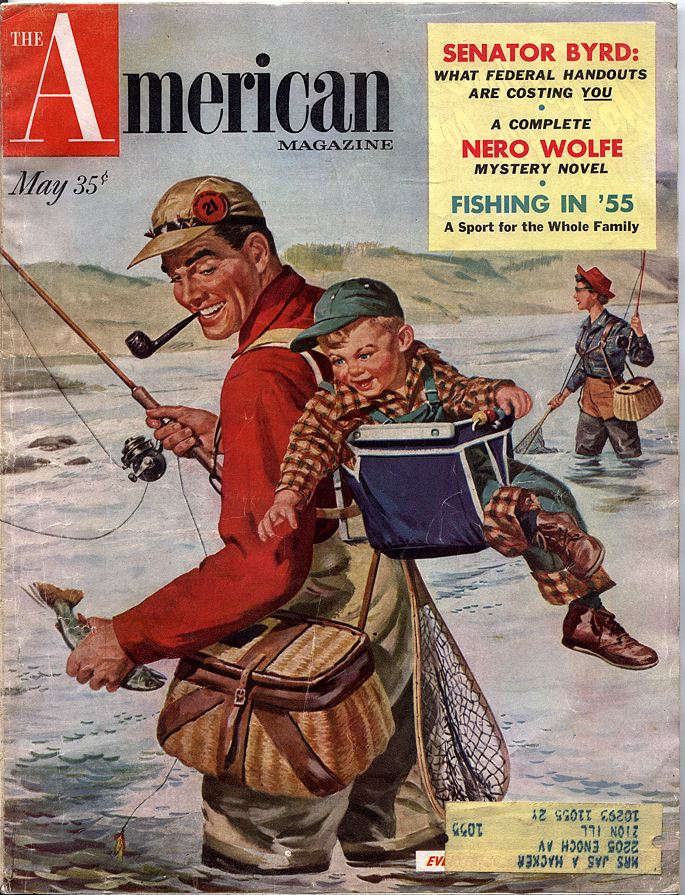
At first I only looked at the magazines from the 1930s hoping I would find an installment from The Rubber Band or Too Many Cooks or any of the early Nero Wolfe novels.  But then we decided to look in the 1950s copies as well since they were in much better condition. Bingo! On the cover of one from 1955 was the brightly lettered ad proclaiming:  A complete NERO WOLFE mystery novel. It turned out to be "The Last Witness" - really a novella not a novel - later published as "The Next Witness" in the book Three Witnesses. We also found an issue with the final installment of The Red Box (illustration from that is pictured at the left).  And there were more surprises in store as we made our way through the entire stack.


After much flipping of pages and dirtying all of our fingers with the dust and grime of a house occupied by four successive generations of one family we found quite a nice pile of forgotten gems of mystery fiction.  Here is the list with a surprising variety of writers and styles.

Octavus Roy Cohen - "The Frame-Up" story featuring detective Jim Hanvey (June 1928)

P. G. Wodehouse - "The Missing Mystery" story (December 1931)
Max Brand - "Masquerade" a mystery novella not a western (June 1936)
Leslie Charteris - "The Saint and the Siren" story (same issue as the Brand novella0
Q. Patrick - "The Jack of Diamonds" novella (November 1936)


Alexandra Brown - "Curtain for an Actress" novella (April 1937)
Rex Stout - last installment of The Red Box (same issue as the Brown novella)

Q. Patrick - "Exit Before Midnight" novella (October 1937)
Kelley Roos - "Deadly Detour" novella (August 1952)
Kelley Roos - "The Case of the Hanging Gardens" novella (July 1954)
Rex Stout -  "The Last Witness" novella (May 1955)


Not a bad haul. The big bonus was that everything in the house was at half price since it was the final day of the sale. We ended up paying $20.50 for the stack of nine magazines. Lots of reading and reviewing to come - especially the Kelley Roos and Q. Patrick stories which I don't think have been published anywhere in book format.