Showing posts with label Swedish writers. Show all posts

Saturday, January 22, 2022

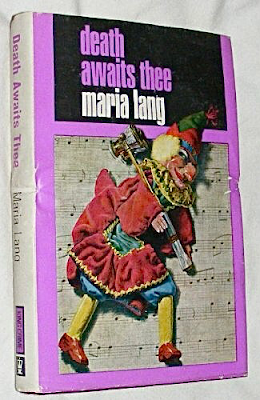
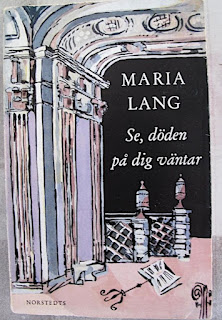
Death Awaits Thee - Maria Lang

A warning before you proceed: If you've read the work of Maria Lang, recently made available to mystery fans one more time in the trio of English translations, and enjoyed her work prepare for a minor diatribe. Lang has been touted as the "Agatha Christie of Sweden" among other laudatory and hyperbolic sobriquets. I always take those marketing and critical assessments with a grain of salt if I don't entirely disregard them while rolling my eyes. But it usually indicates to me a slight understanding that the writer being compared to the Grand Master herself has a grasp on the traditions of the pure detective novel. My first sampling of Lang's work showed me she loves a mystery and aspires to greatness but falls short by a long shot. She understands narrative formula, detective novel conventions and motifs, and the quirkiness of bizarre puzzling murders and we get a lot of that in Death Awaits Thee (1955), originally published in Swedish as Se döden på dig väntar. Yet it all leads to a muddle and ends with a whimper, not the bang of surprise we all want from a detective novel.

First off, and granted this spoiled my enjoyment of the book as a whole, was the choice of translator Joan Tate to Anglicize the entire book.  Death Awaits Thee takes place in a thoroughly Swedish locale -- the very real Drottningholm Theater built in 1766, a marvel of Swedish architecture and European history and now a UNESCO World Heritage Site.  It's one of the only theaters in all of Europe that still retains original 18th century scenery pieces and restored hand-operated theatrical machinery of that era.  Photographs of the theater flood the internet, stories of visits to this historic place also appear by the hundreds in all languages.  It's worth trawling the internet and reading some of the better posts and articles if you have time.  With a murder mystery redolent of Swedish history and atmosphere one would hope that the book would stay thoroughly Swedish. But it hasn't.
1.  All references to Swedish currency have been changed to pounds. What a hassle it must have been to convert the money amounts. Or did she even bother with that?  An amount of 800 pounds is missing during the story and is somewhat crucial to the plot. But is it actually 800 pounds?  Or was it 800 krona and the translator simply substituted pounds without bothering to calculate the British equivalent?

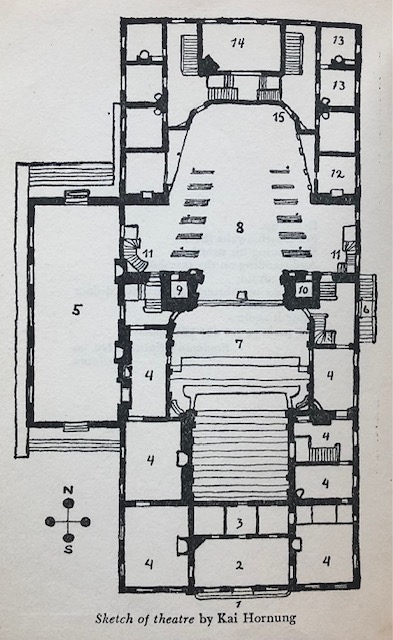
2.  The character names -- with the exception of Puck Bure, Lang's female protagonist and not-so-good amateur sleuth, and an opera singer named Jill Hassel -- have all been changed to easily comprehended British names.  This infuriated me.  For those interested the English names are Teresa, Diana, Stephen, George Geraldson (whose surname is also changed), Richard, Matthew and Edwin.  See the photo below for the real names Maria Lang gave her cast of characters. I found an online version of the original text from which I took several illustrations for this post. You can match the names to see how Tate robbed them of their real identity. I've typed the British substitutes above in the order they appear in the list below.
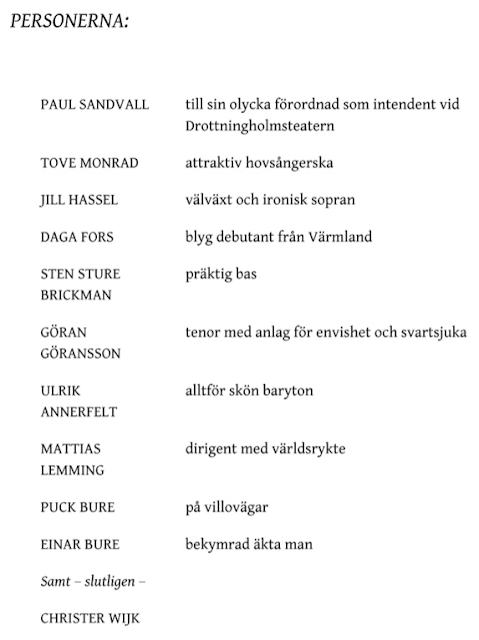
3. And this is the most upsetting part -- the translation itself is a pretentious Anglicization of awkward syntax, heavy use of British idioms and vernacular in the dialogue, and other elements that take you out of the Land of Lingonberries and Pancakes and transport you to the Land of Bangers and Mash.

In the long run Joan Tate and the editorial staff of Hodder & Stoughton have fairly ruined the book by wringing nearly all that is Swedish from its admittedly thin pages.
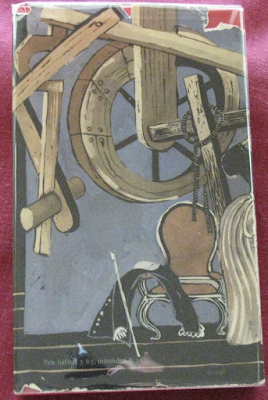
The thunder machine as depicted
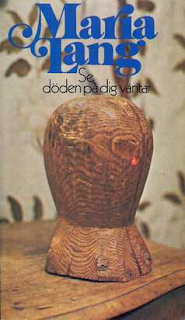
on rear cover of Swedish edition

As for Lang's story it starts off rather intriguingly with a prologue resembling a mantra-like monologue in Puck's voice in which she looks back on the violence and mystery in a rather heavy-handed poetic style.  Then we are introduced to the characters who seem a lively bunch and reminded me of the kind of quirky types you'd encounter in a Ngaio Marsh theater mystery or the witty detective novels of Christianna Brand.  Christie didn't come to mind at all at actually.  The characters, however, become increasingly one note relying on a lone personality trait  to distinguish them from each other (raging jealous lover, foppish gay boy, tart tongued bitch, etc.). Most were entirely lacking in complexity or depth. Only a handful ever felt like real people rather than puppets being manipulated for the sake of the plot alone.

The plot concerning a production of Cosi Fan Tutte and a murdered opera singer, her body found crushed and disfigured in special effects device known as the "thunder machine," offers the reader a smattering of mysteries not the least of which is how was she actually killed and why was she carried up to the machinery-laden attic and shoved through the small opening of the effects device.  Motives are aplenty and tend to revolve around the impassioned and egocentric actors we find in theater mysteries. Jealousy, envy, hatred -- you name it, it's here.

But as for clues? Or the fair play aspect that one would think would be present given Lang's comparison's to her heroine and the writer she attempts to imitate?  Few and far between.  I can only recall two real clues!


Too much of the story comes far too late in the book.  Prior to the arrival of Christer Wijk (surname altered to Wick in this "translation"), who appears only in the final two chapters, we are treated to intensive back story among the theater troupe and the rambling fantasies of Puck who is tempted to have an affair with Matthias Lemming, the opera conductor. The murder investigation is conducted by a non-series detective and his team. Then when Wijk finally appears he interrogates the characters for a third time (!) recalling the work of Carolyn Wells.  I wonder if Lang read any of her books.  In the end this felt more like a Wells novel than any other woman mystery writer Lang has been compared to. The suspects lie and withhold information just like Wells' characters and are coerced or manipulated into finally telling the truth when Wijk shows up.  He does no real detective work at all.  He relies on what his predecessor and police team have already done, notices discrepancies in stories, then simply gets people to tell the truth.  And like Wells' "transcendental detective" Fleming Stone, Wijk subsequently intuits and guesses using "psychology" to ferret out the murderer.  In the end the killer delivers a long confessional monologue, once again just like the majority of Wells' mystery novels. It's all disappointing, a real let down with all this questioning and re-questioning.

To be fair there are elements that I admired like when conductor and production director Matthias Lemming tells the full story about his volatile relationship with his ex-wife Tova, the murder victim.  I also liked the characters of Ulrik and Jill who were the most lively out of the bunch of opera singers.  Ulrik is Lang's token gayboy character and Jill is the mean-spirited bitch of the opera company.  I guess it's always fun for writers to indulge themselves and let go of their reins when writing these types of characters.  Lang certainly enjoyed those two for their scenes always enliven the tone of the book.
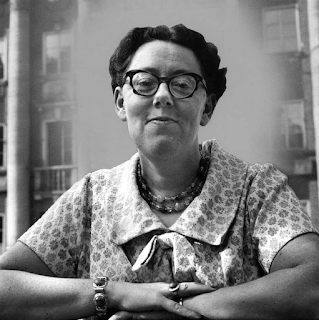
Maria Lang, circa 1950s
One of Lang's very modern touches is her inclusion of sexuality in her stories. Death Awaits Thee is the story of a woman who loved life and sex and apparently indulged herself with anyone -- male or female, young or old -- who struck her fancy.  Gay and lesbian characters appear in many of Lang's books (a lesbian couple feature prominently in her first mystery published in 1949) and sexual relationships are key to an understanding of the motives behind many of the murders in her novels. In this regard she is one of the pioneers in bringing murder mysteries into modern times. Had she really had skill as a novelist she might have become the Swedish forerunner of Ruth Rendell or Minette Walters. At times I thought of both of them while reading this novel, especially when Lang's mystery got down and dirty in revealing Tova's rampant sexuality and her disturbing secret that led to her divorce from Lemming.

Death Awaits Thee is the seventh Christer Wijk murder mystery, so it comes fairly early in Lang's career which spanned from 1949 to 1990.  If Death Awaits Thee is any indication of Lang's work as a whole then I'm afraid I'm not interested in reading any more as much  as she has been recommended to me by a couple of people I've met at mystery conferences and in emails I've received.  Those of you who read Swedish, of course, have all 43 novels to choose from. Those of us who only read English, however, have just three translations.  The others are Wreath for a Bride, aka Kung Liljekonvalje av dungen (1957) and No More Murders, aka Inte flera mord (1951). The most recent editions of these three English translations released in 2014 are available only as digital books from Mulholland Books. Alternatively, you can spend half a lifetime as I did trying to track down older editions in paperback and hardcover. They seem to be disappearing as the years fly by. But if those too are the translated and Anglicized work of Joan Tate then it's further justification for avoiding the books.

Tuesday, March 5, 2019

NEW STUFF: The Wolf & the Watchman - Niklas Natt och Dag

The Wolf and the Watchman
by Niklas Natt och Dag
orig published as 1793
translated from Swedish by Ebba Segerberg
Atria/Simon & Schuster
ISBN: 978-1-5011-9677-5
373 pp. $28
Publication date: March 5, 2019

Stockholm, 1793. One year after the assassination of King Gustav III at a masked ball. Two years after the Swedish navy defeated the Russians at the Battle of Svensksund that ended to the Russo-Swedish war. There is new albeit limited religious freedom for Roman Catholics and Jews, torture as a tool to gain confessions from prisoners has been outlawed, capital punishment is limited to only a short list of crimes. And yet amid all these reforms the city is a seething brutal cesspool of political corruption, lax morality, and heinous murder. Recently recovered from the filthy (formerly freshwater) lake known as the Larder is a horrific find -- the limbless corpse of a man who has also been blinded had his tongue cut out. Two men join forces to track down the vile murderer and also discover the identity of the pathetic victim.

The Wolf and the Watchman of the title are the two men who from a detective duo of sorts. Cecil Winge, is the wolf -- a lawyer who is called in by the Swedish police to help in unusual criminal cases. He is aided by the man who pulled the body from the fetid water, war veteran and sometime watchman Mickel Cardell. Mickell is also an amputee who regularly suffers from "phantom limb syndrome" years after his injury. His experience of losing his arm to a literal hack of a shipboard surgeon is of benefit to Winge when the two examine the gruesome wounds on the corpse. Mickell is able to show the age of each wound based on how it has healed, the look of the scar tissue, the manner in which skinflaps were grafted. He does a better job at revealing how the man must have suffered for days or weeks than the coroner, an indifferent bureaucrat who barely cares.

Winge also find clues about the body based on an embroidered cloth that the body was wrapped in. Clever questioning of area drunks and vagrants reveals that a sedan chair with unusual green paint and matching curtains was abandoned temporarily within walking distance of the Larder. Winge then follows the clues of the sedan chair and the embroidered cloth to a notorious brothel where he learns of an unthinkable fate the victim underwent prior to his death and disposal in the polluted lake.

Here is a historical novel that mixes some intensely perverse nightmares of the past with modern day horror worthy of yet another installment in the already too long series of Saw murder movies. Natt och Dag seems to be exploiting Sweden's dismal past as a commentary on our own dark and seedy times. Uncontrolled pollution, rampant disease, sexual indulgences are described with an almost gleeful relish while power plays, sadism and wicked revenge dominate the narrative. There is little room left for goodness.

Rare are the times when Cardell is allowed to voice his moral outrage in his vociferous voice and violent reactions. When those moments come the reader finds himself wishing for the villains to at last receive their comeuppance. This is a nihilistic world, one where survival of the fittest means nothing, it is only about survival. The weak have more than their fair share of struggling to survive while the powerful abuse and exploit all in their way.

Winge is among the weak though he does a good job of hiding it. He is suffering from the end stages of tuberculosis. He wonders if he will live to see the close of this murder case with the offensive criminal not only brought to justice but mercilessly executed. There is one such execution scene described with the kind of raw, grisly detail that makes the book often difficult to stomach.

The novel is divided into four books and the second part titled "The Blood and Wine" is probably the toughest section to wade through. It tells the story of Kristofer Blix. His selfish carousing and gambling land him at the mercy of a slavish moneylender who then sells Blix's debts to a mysterious and reclusive nobleman. Blix is basically imprisoned in the nobleman's home, kept at bay by a savage and hungry dog, exploited for his skills as an apprentice surgeon, and forced to commit acts of atrocity that will haunt him for the rest of his brief life.

Niklas Natt och Dag
(photo: © Gabriel Liljevall)
Part three ("The Moth and the Flame") relates the life of Anna Stina Knapp who, of course, also suffers a cruel trick of Fate. She is accused of prostitution by a man whose sexual advances she rejected, arrested, found guilty in a kangaroo court and sentenced to a year and a half in prison. Then the bulk of the section deals with life in a prison workhouse for women who toil endlessly at spinning wheels creating wool thread for textile manufacturers. Their sentence is literally measured out in threads rather than years. The Greek mythological analogies we are thankfully spared. One cannot help but think of Dickens and Atwood's Alias Grace while reading of Anna's harsh life and the foul treatment of the women at the hands of the sadistic guards and a sanctimonious preacher.

Anna plots an escape with the help of some other prisoners. This is actually the most exciting part of the book and the least repellent for it deals mostly with a strong minded woman tenaciously holding onto her dignity, her chastity, and her moral conscience. Will she triumph? Will she succeed in her escape? And how does she figure in the tale of the unfortunate limbless and nameless body so horrifyingly slaughtered? We find out all the answers in part four when the story returns to the detective duo and their murder investigation with Anna appearing towards the end in one of the novel's unexpected plot machinations.

Natt och Dag won an award for Best Debut of 2017 from the Swedish Academy of Crime Writers. The book is being praised by several European newspaper reviewers and literary experts. It's been compared to Umberto Eco's The Name of the Rose, The Alienist and any other novel that mixes detective fiction with history. All of this praise is a bit excessive for the book is far from a masterpiece, not really very original, nor even very enlightening or factual about Sweden's history in 1793. What it is -- a truly unabashed 21st century sensation novel inspired by the penny dreadfuls of the past, also overloaded with gore, sadism, and unspeakable acts. Admittedly, some sections have truly thrilling edge-of-your-seat excitement and much of the plot is not at all predictable. Still it is more than indulgent in heaping on the depths of human degradation and perversity that crowd its pages. What we have here basically is a "shilling shocker" in sham literary packaging. A novel meant for this New Age of Horrors Unlimited. And if there's also an award for that, I wouldn't be surprised at all.

Tuesday, February 12, 2019

NEW STUFF: An Elderly Lady Is Up to No Good - Helene Tursten

An Elderly Lady Is Up to No Good
by Helene Tursten
translated from Swedish by Marlaine Delargy
Soho Press
ISBN: 978-1-64129-011-1
185 pp. $12.99
Publication date: Nov. 6, 2018

I cannot resist any book about a badass biddy. I've written about the nasty senior citizen women characters found in novels of Shelley Smith, Anthony Gilbert, Ethel Lina White and even an old lady serial killer whose garden is a veritable poisoner's paradise. But not since my meeting Lucilla Teatime in Lonelyheart 4122 have I encountered such a wily, deadly and unexpectedly amusing old lady as Maud, Helene Tursten's 88 year-old spinster who will not have her tranquil easy-going life upset by anyone.

An Elderly Lady Is Up to No Good is a collection of five short stories each of them detailing Maud's past life and her current reign of terror in an apartment building located in Göteborg, Sweden. Through a legal loophole Maud has been able to live in her apartment rent free her entire life and her neighbors are not too happy about it. They've managed to get her to pay a monthly assessment to help with upkeep and maintenance of the building, but as for any other expense Maud has managed to keep every krona since the end of World War 2. And she's not about to give up her home to anyone who ruffles her feathers in any way.

Each of the five stories begins with an inoffensive slight that most of us would dismiss as minor irritation. But not Maud.  Be it an intrusively friendly neighbor, a squabbling couple in the apartment above her, or the news of her ex-fiance getting married at the age of ninety Maud finds the highest personal affronts in the most innocuous events. In each instance she is compelled to take drastic measures, often to deadly extremes.

Conveniently, in most cases the slights Maud suffers turn out to be covers for more insidious designs and ulterior motives as in the first story about an obnoxious modern artist whose horrifying sculptures express her disdain for the patriarchy.  Jasmin is a figure of obvious ridicule, a parody of the worst of ultra feminism compounded by talentless dabbling in modern art. The story is both a satire of the insanity of modern art and a nasty story of revenge that calls to mind Roald Dahl's wicked sense of humor. Jasmin's latest creation -- a disgustingly laughable mobile of monstrous penises suspended from a height of sixteen feet and dubbed "Phallus III Hanging" --  inspires in Maud nothing vaguely approaching an appreciation of art but rather an ultimatum that deliciously sums up Tursten's ideas of art criticism.  In each of the stories Maud's solutions to her various "problems" become ever increasingly violent and deadly.

Helene Tursten
(photo ©Peter Knuston)
Along the way we get to learn about her rather pathetic life as caretaker to her older sister who suffered what appears to be a grandiose nervous breakdown.  Charlotte, Maud's elder sibling by eleven years, was a concert pianist but then fell victim to what Maud's mother described as "an attack of nerves" that left Charlotte unable to play music and helpless to care for herself. In later stories we discover that this breakdown was a serious mental illness aggravated by paranoia and intense phobias that made caring for Charlotte a truly hellish life for Maud. Added to these troubles is the sad engagement to a man she dearly loved that backfired and left Maud loveless and alone for the rest of her life.  The entire volume depicts Maud's lifelong mission of retribution for everyone who betrayed or wronged her.

As an added bonus the final two stories feature Tursten's series police characters better known from her novels - Irene Huss and Embla Nyström.  They investigate the death of an antique dealer who met a grisly death in Maud's apartment while she apparently was on vacation.  The murder investigation is told in two separate stories: the first ("The Antique Dealer's Death") is told from the viewpoint of an elderly neighbor, in the second ("An Elderly Lady Is Faced with a Difficult Dilemma") Maud's viewpoint sheds light on the ambiguous details of the crime with a two page coda told from the police women's viewpoint. These final two tales (which must be read in the order in which they appear in the book) reveal Maud at her most diabolical and criminally inventive self.

This is a slight book easily polished off in only a couple of hours.  Yet each story packs a wallop. Tursten can mix black humor with poignancy and have us rooting for Maud to commit the most horrific atrocities and long for her to get away with everything. Her victims may be truly awful people, but is Maud truly worse than them?  She is a woman who seems to no longer care about anything now that she is in her twilight years.  All that matters to her are life's simple pleasures -- travel to foreign countries, warm climates and cool breezes, peace and quiet in her rent free home, and a nice cheese sandwich and a bottle of Carlsberg while watching old movies on TV.

Here is a book highly recommended for those with a penchant for dark farcical comedy and evil thoughts of delicious revenge perpetrated on the ugly people who have wronged us.