THE STORY: The Illinois Grand Opera Federation is being plagued by gruesome deaths. The opera company's small group of divas are turning up dead. All of the methods employed mimic the deaths of heroines in their repertoire. Dr. Thackery Place teams up with John Tracy, a reporter who serves as narrator, the police and members of the Cook County DA's office to put an end to the slaughter and bring the murderer to justice.
THE CHARACTERS: Thackery Place, a criminologist by profession, previously appeared in The C.V.C. Murders (1929) in which he also investigated a mad killer eliminating members of a criminal watchdog agency called the Citizens Vigilance Committee. Had he been popular he might have gone on to more adventures and been noteworthy as an early practitioner of criminal profiling in multiple murder cases. As he only appeared in these two books he is more of an anomaly. Modeled on the many intuitive detective who draw on psychology and behavior more than physical evidence, Place is alternately omniscient and cryptic throughout The Opera Murders (1933). Both books draw on the popularity of the bestselling Philo Vance series of this era. So much inspired that the book is narrated by an observer who acts less of a Watson than a recorder of the case just as S.S. Van Dine does in the Vance novels. The D.A. office is very much involved similar to both the Van Dine and early Ellery Queen books.
In many theater based mystery novels it is usually the cast of performers who are the most interesting and dominate the plot. In The Opera Murders the performers are supporting characters and the victims. We rarely get to know them fully. The first victim is dispatched so early the only way we get to know anything about her is in a letter she writes to another singer, Valeria Millefiore, who later ends up a victim. Instead of the performers, designers, and technicians, the action turns attention to the Board of Directors. Unlike any other theater mystery I've read in any era, let alone the Golden Age, The Opera Murders lets the reader in on the business aspect of how a theater -- or in this case an opera company. In fact, it's not even the artistic business end but the financial end. We read of the people who fund the performing arts, make it possible for the company to exist in the first place, and how their influence can make or break the opera company.
INNOVATIONS: Serial killer novels in this era tended to have bizarre plots. Thanks to The Bishop Murder Case (1929), America's first true bestseller among detective novels, a weird thematic angle became part of the expected plot line. The Opera Murders is no exception. The deaths in Madama Butterfly, Rigoletto and Aida serve as inspiration for the gruesome killings in this mystery. Dr. Place spends a lot of time trying to make sense of this macabre touch and trying to get the police to believe this is the pattern. Other weird touches like a Japanese doll and an American flag placed at the scenes of the first murder add to the surreal aspect of this serial killer. When the police puzzle over the size of a canvas bag at another murder scene thinking it might be a bag for storing sails Place reminds them of the plot of Rigoletto trying to convince the police the bag is a prop from the opera company's storage.
Because this book is the work of journalists newspaper reporting plays a heavy part in the story. The highlight of the novel -- perhaps the actual climax -- is a lengthy newspaper article inserted into the text of the novel outlining a police search in churches across Chicago. The article goes into great detail about horrific desecration of numerous church basements when Dr. Place insists that the final victim has been entombed alive as in the finale of Aida.
QUOTES: Place remarked that the machinery through which the day's news is ladled out to the public resembles the tides, the winds, the seismic disturbances of the earth and other cosmic forces in its disregard for such purely human institutions as breakfast.
"Every good crime needs some slightly mad person to lend it color."
THE AUTHORS: "Kirby Williams" is the alter ego for three journalist who all began their careers working for Chicago newspapers: Irving Ramsdell, William A. Norris, and William Parker. Of the three I learned the most about Ramsdell who later left Chicago for Wisconsin where he was theater critic for the Milwaukee Sentinel. In 1940 he headed out West and became the city editor for The Los Angeles Times. Ramsdell also wrote a play in the mid 1930s but it apparently was never produced. The three men wrote only two detective novels both featuring Dr. Place before they gave up fiction for the more demanding world of newspapers.
EASY TO FIND? There are currently six five copies of this book for sale online. Most of them are fairly cheap but all come without a DJ. The only copy available with the rare DJ (the one shown in this post) was recently sold in my online listings.
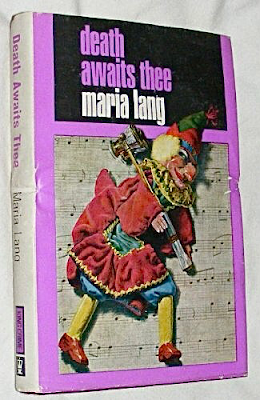
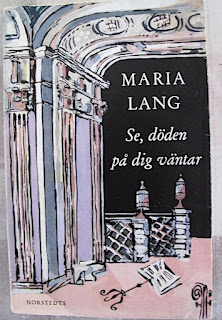
A warning before you proceed: If you've read the work of Maria Lang, recently made available to mystery fans one more time in the trio of English translations, and enjoyed her work prepare for a minor diatribe. Lang has been touted as the "Agatha Christie of Sweden" among other laudatory and hyperbolic sobriquets. I always take those marketing and critical assessments with a grain of salt if I don't entirely disregard them while rolling my eyes. But it usually indicates to me a slight understanding that the writer being compared to the Grand Master herself has a grasp on the traditions of the pure detective novel. My first sampling of Lang's work showed me she loves a mystery and aspires to greatness but falls short by a long shot. She understands narrative formula, detective novel conventions and motifs, and the quirkiness of bizarre puzzling murders and we get a lot of that in Death Awaits Thee (1955), originally published in Swedish as Se döden på dig väntar. Yet it all leads to a muddle and ends with a whimper, not the bang of surprise we all want from a detective novel.
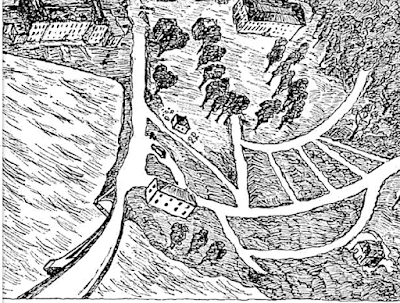
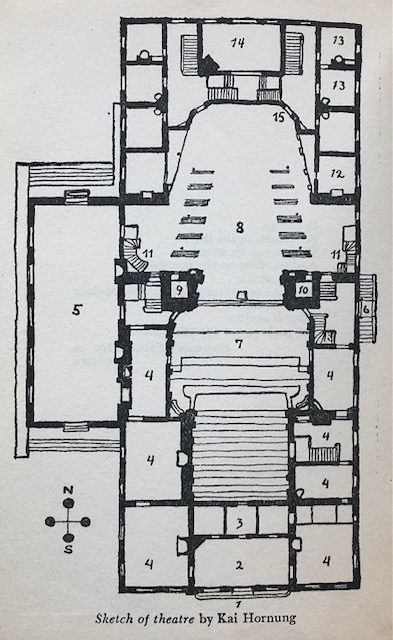
First off, and granted this spoiled my enjoyment of the book as a whole, was the choice of translator Joan Tate to Anglicize the entire book. Death Awaits Thee takes place in a thoroughly Swedish locale -- the very real Drottningholm Theater built in 1766, a marvel of Swedish architecture and European history and now a UNESCO World Heritage Site. It's one of the only theaters in all of Europe that still retains original 18th century scenery pieces and restored hand-operated theatrical machinery of that era. Photographs of the theater flood the internet, stories of visits to this historic place also appear by the hundreds in all languages. It's worth trawling the internet and reading some of the better posts and articles if you have time. With a murder mystery redolent of Swedish history and atmosphere one would hope that the book would stay thoroughly Swedish. But it hasn't.
1. All references to Swedish currency have been changed to pounds. What a hassle it must have been to convert the money amounts. Or did she even bother with that? An amount of 800 pounds is missing during the story and is somewhat crucial to the plot. But is it actually 800 pounds? Or was it 800 krona and the translator simply substituted pounds without bothering to calculate the British equivalent?
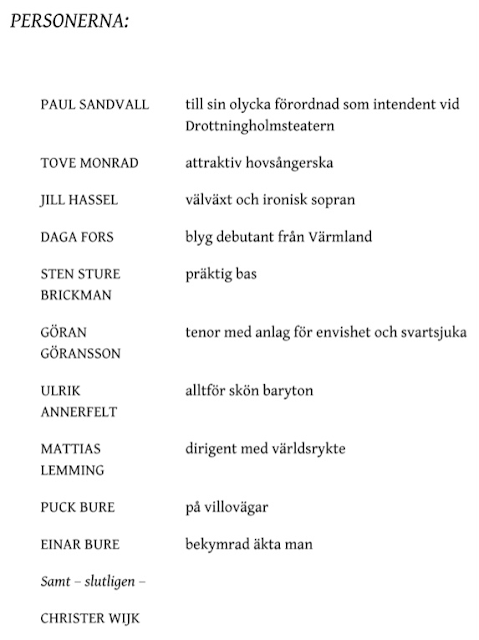
2. The character names -- with the exception of Puck Bure, Lang's female protagonist and not-so-good amateur sleuth, and an opera singer named Jill Hassel -- have all been changed to easily comprehended British names. This infuriated me. For those interested the English names are Teresa, Diana, Stephen, George Geraldson (whose surname is also changed), Richard, Matthew and Edwin. See the photo below for the real names Maria Lang gave her cast of characters. I found an online version of the original text from which I took several illustrations for this post. You can match the names to see how Tate robbed them of their real identity. I've typed the British substitutes above in the order they appear in the list below.
3. And this is the most upsetting part -- the translation itself is a pretentious Anglicization of awkward syntax, heavy use of British idioms and vernacular in the dialogue, and other elements that take you out of the Land of Lingonberries and Pancakes and transport you to the Land of Bangers and Mash.
In the long run Joan Tate and the editorial staff of Hodder & Stoughton have fairly ruined the book by wringing nearly all that is Swedish from its admittedly thin pages.
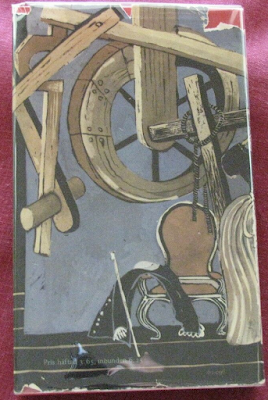
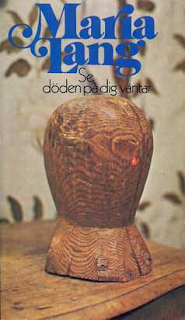
The thunder machine as depicted on rear cover of Swedish edition
As for Lang's story it starts off rather intriguingly with a prologue resembling a mantra-like monologue in Puck's voice in which she looks back on the violence and mystery in a rather heavy-handed poetic style. Then we are introduced to the characters who seem a lively bunch and reminded me of the kind of quirky types you'd encounter in a Ngaio Marsh theater mystery or the witty detective novels of Christianna Brand. Christie didn't come to mind at all at actually. The characters, however, become increasingly one note relying on a lone personality trait to distinguish them from each other (raging jealous lover, foppish gay boy, tart tongued bitch, etc.). Most were entirely lacking in complexity or depth. Only a handful ever felt like real people rather than puppets being manipulated for the sake of the plot alone.
The plot concerning a production of Cosi Fan Tutte and a murdered opera singer, her body found crushed and disfigured in special effects device known as the "thunder machine," offers the reader a smattering of mysteries not the least of which is how was she actually killed and why was she carried up to the machinery-laden attic and shoved through the small opening of the effects device. Motives are aplenty and tend to revolve around the impassioned and egocentric actors we find in theater mysteries. Jealousy, envy, hatred -- you name it, it's here.
But as for clues? Or the fair play aspect that one would think would be present given Lang's comparison's to her heroine and the writer she attempts to imitate? Few and far between. I can only recall two real clues!
Too much of the story comes far too late in the book. Prior to the arrival of Christer Wijk (surname altered to Wick in this "translation"), who appears only in the final two chapters, we are treated to intensive back story among the theater troupe and the rambling fantasies of Puck who is tempted to have an affair with Matthias Lemming, the opera conductor. The murder investigation is conducted by a non-series detective and his team. Then when Wijk finally appears he interrogates the characters for a third time (!) recalling the work of Carolyn Wells. I wonder if Lang read any of her books. In the end this felt more like a Wells novel than any other woman mystery writer Lang has been compared to. The suspects lie and withhold information just like Wells' characters and are coerced or manipulated into finally telling the truth when Wijk shows up. He does no real detective work at all. He relies on what his predecessor and police team have already done, notices discrepancies in stories, then simply gets people to tell the truth. And like Wells' "transcendental detective" Fleming Stone, Wijk subsequently intuits and guesses using "psychology" to ferret out the murderer. In the end the killer delivers a long confessional monologue, once again just like the majority of Wells' mystery novels. It's all disappointing, a real let down with all this questioning and re-questioning.
To be fair there are elements that I admired like when conductor and production director Matthias Lemming tells the full story about his volatile relationship with his ex-wife Tova, the murder victim. I also liked the characters of Ulrik and Jill who were the most lively out of the bunch of opera singers. Ulrik is Lang's token gayboy character and Jill is the mean-spirited bitch of the opera company. I guess it's always fun for writers to indulge themselves and let go of their reins when writing these types of characters. Lang certainly enjoyed those two for their scenes always enliven the tone of the book.
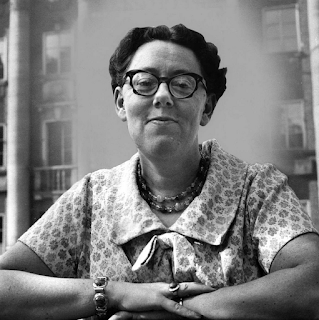
Maria Lang, circa 1950s
One of Lang's very modern touches is her inclusion of sexuality in her stories. Death Awaits Thee is the story of a woman who loved life and sex and apparently indulged herself with anyone -- male or female, young or old -- who struck her fancy. Gay and lesbian characters appear in many of Lang's books (a lesbian couple feature prominently in her first mystery published in 1949) and sexual relationships are key to an understanding of the motives behind many of the murders in her novels. In this regard she is one of the pioneers in bringing murder mysteries into modern times. Had she really had skill as a novelist she might have become the Swedish forerunner of Ruth Rendell or Minette Walters. At times I thought of both of them while reading this novel, especially when Lang's mystery got down and dirty in revealing Tova's rampant sexuality and her disturbing secret that led to her divorce from Lemming.
Death Awaits Thee is the seventh Christer Wijk murder mystery, so it comes fairly early in Lang's career which spanned from 1949 to 1990. If Death Awaits Thee is any indication of Lang's work as a whole then I'm afraid I'm not interested in reading any more as much as she has been recommended to me by a couple of people I've met at mystery conferences and in emails I've received. Those of you who read Swedish, of course, have all 43 novels to choose from. Those of us who only read English, however, have just three translations. The others are Wreath for a Bride, aka Kung Liljekonvalje av dungen (1957) and No More Murders, aka Inte flera mord (1951). The most recent editions of these three English translations released in 2014 are available only as digital books from Mulholland Books. Alternatively, you can spend half a lifetime as I did trying to track down older editions in paperback and hardcover. They seem to be disappearing as the years fly by. But if those too are the translated and Anglicized work of Joan Tate then it's further justification for avoiding the books.
For the handful of people who read the last “Moonlighters” article on an actress who dabbled on the side as a mystery writer (Dulcie Gray) you may have thought I started up this feature and promptly abandoned it because the promise of the next installment on a literature professor turned mystery writer never materialized. Did I abandon the idea altogether? (you may be wondering). I say unto you, “Taint true, kiddos!” Today marks the return of “Moonlighters” and I hope to make this a monthly or bimonthly feature for the rest of the year.
Today we have the opera singer Queena Mario, well-loved lyric soprano who performed with five different opera companies and was with the illustrious Metropolitan Opera from 1922 to 1938. While still working as a singer in 1934 she wrote her first of a trio of mystery novels. All three, none too surprisingly, are set in the world of opera with plots revolving around such familiar works as I Pagliacci, Samson & Delilah and Gounod’s version of the Faust story.
I’ve only read her first book and judging from the less than kind reviews of her other two mystery novels it’s probably better to stop right there. Murder in the Opera House (1934) is ably plotted and energetically written with a truly original murder method directly tied to the world of opera and theater. For that reason I would recommend the book to those enjoy vintage detective fiction for its bizarre and outre plot elements. But the characters, unfortunately, left me wanting; they tend to come from a dusty trunk of cliched stereotypes.
Editha Fleischer & Queena Mario in Hansel & Gretel
Metropolitan Opera, Dec 25, 1931
That Mario performed in the Met’s production of I Pagliacci in March 1934 is no coincidence when you discover that the plot of her novel features a dual production of that opera along with Cavalleria Rusticana, both one act operas and both often presented together in a double bill. Are any of these characters modelled on the actual cast members of Leoncavallo’s opera, one wonders? I certainly hope not. Mario’s fictional cast is as temperamental and hot-headed as any cast of opera singers you could imagine in their worst possible stereotypes. From the vindictive and passionate Consuelo Elvado who plays the doomed Nedda in the opera and the victim in the murder mystery to the ludicrously jealous and dictatorial conductor Luigi Velucci, a short-statured egomaniac, sort of a Napoleon of Time …uh, Tempo.
Our detective duo are made up of Carey Van Horn, "the world's greatest criminal psychologist" and Manhattan D.A. Merrick Townsend. This is their only appearance in her books (the other two have amateur detectives) and they make a good team. But to fill up the pages we are saddled with a love story subplot between Van Horn and Diana Pearson, a character who is not at all a suspect in the crime but who has a slightly suspicious nature related to something else entirely. The entire subplot is a distraction and when Van Horn is with Diana he tends to become embarrassingly boyish.
When Mario sticks with her theater background, her impassioned singers, the efficient stage crew, and focusses on the detective work the book is a mild success. As a debut detective novel from a woman not known for her fiction writing (although she had been a journalist prior to studying singing) Murder in the Opera House is an admirable piece of entertainment. Mario does well with planting her clues, trying her best to throw in a few red herrings, but it is painfully obvious by the middle of the book who the culprit is. As soon as Van Horn discovers one key piece of evidence the game is up. Additionally, her valiant attempt to make the murder an impossible crime -- a shooting that occurs during a performance in front of an audience with no sign of the weapon anywhere on stage or in the wings -- does not quite live up to the reader's expectations.
The most intriguing feature of this theatrical mystery novel is the focus on the backstage world. Specifically, Mario gives us a literal bird’s eye view of how an opera is run. There are two key scenes that take place on the catwalks high above the stage amid the terraced ledges of the fly system and the maze of booms from which the lighting instruments are hung. Very rarely has any mystery writer allowed a reader such a detailed tour into the arcane area of stage management and lighting design. Lighting cues and technical effects are crucial to understanding how the murder was committed. The murder weapon itself is utterly bizarre and incredibly ingenious for a novel of any age, let alone our beloved Golden Age. Something similar may have been employed in more modern theater mysteries, but I am sure that this is a first time it was employed in all of detective fiction.
Queena Mario (1896-1951) was born in Akron, OH to James Tillotson, who was a Civil War drummer boy, and Rose Sinathinos. She grew up in Plainfield, NJ and moved to New York as a young adult to write newspaper columns for The Telegram, The Evening World and The Sun. She wrote under her own name Queena Tillotson and a house name, "Florence Bryan," for a column called "Talks with Your Children." While working as a journalist she saved her money and began taking singing lessons. After being twice turned down by the Met she was hired by Fortune Gallo for his San Carlo Opera Company. She made her professional debut with that company in Tales of Hoffman on Sept 4, 1918. She chose to perform under Queena Mario by shortening her middle name Marion.
She went on to sing with Scotti Opera Company and Ravinia Opera Company travelling across the united States with the former. Finally, on Thanksgiving Day in 1922 she made her Metropolitan Opera debut as Micaela in Carmen. She also performed for six seasons with San Francisco Opera and sang at the renowned Paris Opera House in 1925. For details on her career in San Francisco see this article and the SF Opera blog. According to her New York Times obituary: "She achieved her greatest popularity as Gretel in Hansel and Gretel and it was as Gretel she bade goodbye to the Metropolitan in a special afternoon performance on Dec 26, 1938." A bit of trivia: the Met's 1931 production of Hansel and Gretel featuring Mario in her first Met performance of her signature role was the first live radio broadcast of a Met opera.
The Times goes on to note: "Beginning in 1931 she taught for three years at the Curtis Institute in Philadelphia. She also taught voice and operatic acting at the Julliard Graduate School, and for some years conducted her own private studio."
In addition to Murder at the Opera House Mario's mystery novels include Murder Meets Mephisto (1942) , and Death Drops Delilah (1944). Isaac Anderson, mystery novel reviewer for The New York Times was taken with her debut saying "... she is able to make the setting and the people of the opera fairly convincing, but she is not so successful in her delineation of the other characters in the book. [The book]...is not a great detective story, but it has its exciting moments." Neither of the later two mysteries was as favorably reviewed as her debut. Below are capsule reviews I took from old editions of "The Criminal Record," the mystery novel column that appeared in The Saturday Review for over three decades.
And for true opera buffs here's Queena Mario performing a Pucchini aria during an NBC 1932 radio show: