Showing posts with label Reginald Davis. Show all posts

Monday, July 25, 2022

Reprints Looming on the Horizon

I was hoping that I would be able to give you some wonderful news about a few reprints, but alas there are delays with one exciting reprint that was supposed to be out this fall.  Some of you may have already discovered that it's in the works if you've been out there a-Googling.  But I promised the publisher not to promote it until the rights are officially cleared and it's taking some time.  But rest assured the book will be here, just a bit later than planned.  Assiduous readers will find more details in a recent comment exchange at the bottom of a past post on said book.  I will say no more until I'm allowed to.

However! Don't get your panties in a bunch, gang.

There is other exciting news I can announce -- Cecil Wills detective novels are coming back!

Those lovable rascals who run Ramble House have teamed up with yours truly and they will be reissuing two rather scarce, very early Wills mystery novels featuring his series detective Geoffrey Boscobell. Both should be out by the end of this year, possibly sooner.  Author in Distress, Will's debut mystery  novel and the first with Sgt. Boscobell, will be the first released followed shortly thereafter by a new edition of the third Boscobell mystery novel Death Treads.  Plans are to reissue both as retro mapbacks the way many of the early Ramble House detective novels and mystery novels paid tribute to the highly collectible original Dell Mapbacks back in the early 2000s when RH was first reprinting Golden Age mystery fiction.  With artwork by Gavin O'Keefe and partly inspired by the maps and floor plans found in the original books I have provided these promise to be attractive new editions.  I'll be writing up a brief study of the Boscobell detective novels as a foreword to both new editions.

But that's not all, kiddos!

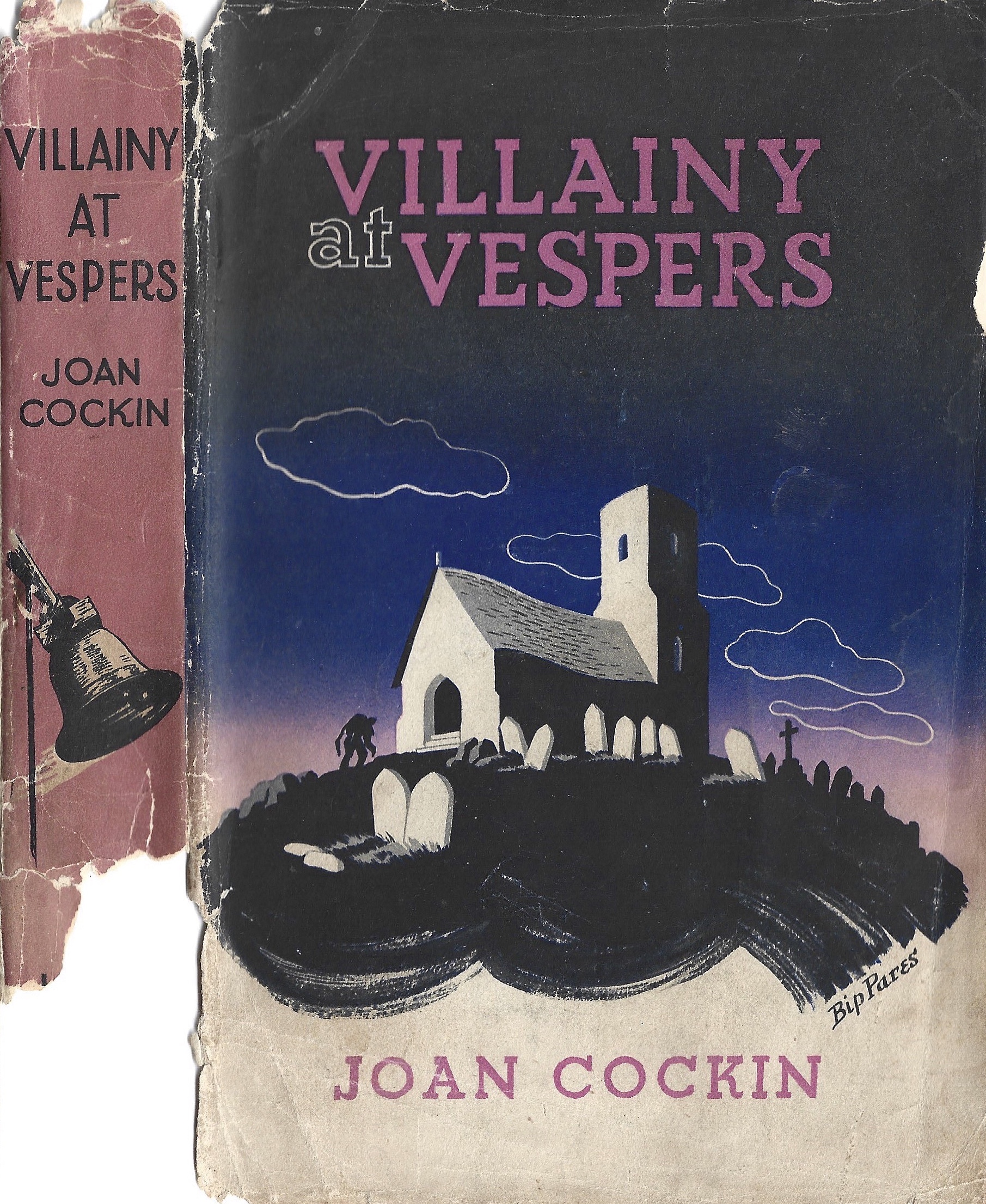
Galileo Publishers -- the same fine company that reprinted Clifford Witting's mysteries and will continue to do so over the next couple of years -- have secured the rights to the extremely hard to find mystery novels of Joan Cockin.  Her quirky detective novel, Villainy at Vespers, about the arcane art of brass rubbing, smuggling and bizarre murders was reviewed here at PSB back in February 2020.  All three of Cockin's detective novels starring her policeman Inspector Cam are planned for release over a two and half year period.  Villainy at Vespers will be the first. I believe it comes out in the fall or around Christmas.  It will be followed by Curiosity Killed the Cat (actually the first of the three mysteries) and end with Cockin's  highly elusive (dare I say rare?) and last mystery novel Deadly Ernest.  I've never seen a copy of that third book in my lifetime and I'm eager to get my hands on a review copy.

And the pièce de résistance, mes amies?

After years of thinking about creating my own imprint it's finally happening.  If all goes well Pretty Sinister Books will burst forth into the indie press world with the complete works of forgotten American writer Elma K. Lobaugh in the coming months.   I also have plans to reissue the nearly impossible to find detective novels by the highly original, utterly inventive, deliciously witty and thoroughly bizarre Reginald Davis. The line-up will then focus on dozens of under-appreciated and overlooked early 20th century American mystery writers whose books have languished in the Limbo of Out-of-Printdom for too long.

So much to look forward to as we head into the dog days of summer and autumn wends its brisk breezes and falling leaves our way.

Onward and upward!

Friday, May 3, 2019

FFB: Nine Days' Panic - Reginald Davis

THE STORY: Nine Days’ Panic (1937) is an absurdist black comedy that is also a send-up of all manner of detective novel conventions. The madcap plot incorporates mysterious disappearances, vanishing corpses, the impossible substitution of people for skeletons, disguises and impersonation, Celtic legends and cult rituals, and ribald and farcical humor.

THE CHARACTERS: Littleford in the Vale is at the mercy of a madman with a bizarre sense of humor. We begin with the theft of a prize winning vegetable marrow and village idiot “Mazed Thomas” playing detective and accusing the Mr. Stiggins, mayor of the village, as the culprit. Shortly thereafter, Thomas' body is found bludgeoned and surrounded by the smashed remnants of the formerly impressive giant squash. On the same day Bessie Luscombe, daughter of the owner of the local pub The Prodigal Son, disappears from her bedroom and a red skeleton is found in her place. Also, a man dressed in obnoxious mustard yellow plus-fours is found hanging from a tree. However, when the police go to look for the body they find only the rope freshly cut and no corpse in sight. Are the events of the night over yet? No! 95 year-old Rowland Pye has also disappeared from his home and yet no one saw him leave through the front door.

What to make of all this madness? Despite the talk of ominous death rattles and the presence of a legendary fetch the police will have none of the local's superstitious nonsense. They know a real human is behind all these shenanigans and they are determined to ferret out the miscreants, pranksters and kidnappers – and a possible murderer.

Over the course of nine days more young women will disappear and more skeletons will pop up in the strangest places. Local P.C. Wilks is relieved when Major Tinmouth, the Chief Constable of Littleford on the Vale, decides to call in Scotland Yard. Inspector Ipswich and his resourceful cohort Sgt. Pike (with a very unusual talent) take over the investigation and soon turn up the corpse of the hanged man, but are baffled by the near daily vanishings of young women. They still haven’t a clue where the women have gone.

Amateur sleuths only complicate matters. After receiving an anonymous note informing him of his impending death Rev. Timity joins forces with Dr. Appleby and Dr. Smyth-Crowcombe, the director of Barrow House, a nearby sanitarium and mental institution. Together the three men examine the clues and try to learn the whereabouts of the missing girls. A note left at the scene of one of the disappearances takes the form of a cryptic rhyme: “I do go with my sisters to search for the way./We go to seek in the valley./Light in the dark. Life in the grave./Karedwan—Karedwan—Karedwan!” Eventually this will lead the physicians to research village folklore and ancient Celtic rituals meant to summon the goddess mentioned in the rhyme’s final line. Davis once again finds ample opportunity to explore his fascination with superstition, this time delving into arcane Celtic legends and the forgotten works of the 6th century poet Taliesin.

The village is thrown into chaos with crimes bordering on the absurd. At one point Dr. Smyth-Crowcombe exclaims, “This is becoming ridiculous!” And of course it is. Yet on reflection it is also terrifying. Fear is exactly what the mysterious force behind all the confusion is after. He (or is it they?) needs the village to be so frightened that they won’t set foot outside their homes. For there is of course an ulterior motive to all the insanity of skeletons in beds, missing girls, and corpses that suddenly turn out to be very much alive. All will be discovered in the intricate underground labyrinth of tunnels that lead to a cavern of secrets and untold horror.

INNOVATIONS: The book is replete with all sorts of amusing literary allusions and folkloric discussions. There is a lengthy section on the existence of ghosts led by Dr. Appleby talking about the “cutting short of a normal span of life by violence” and expanding on the concept of the restless spirit and hauntings so common in ghost stories. Rev. Timity then takes up the discussion adding his opinions on the metaphysical and spiritual sides of the argument.

Daniel Biggs (aka Happy Dandy) is an eccentric young man who as far as the villagers are concerned is the new “Mazed Thomas”, and even battier than the former village idiot. He has a remarkable way of talking leading the reader to suspect Dandy may not at all be as “mazed” or stupid as he seems to be. In one amusing scene he spars humorously with the police by quoting Lewis Carroll. He talks about galumphing back from Moping Copse, the aptly named Gothic scene of the hanging. Inspector Denman then asks, “What’s all this beamish boy stuff?” Dandy tells him he found a bit of rope. “You were going to say you found it on a Tumtum tree, weren’t you? But if you tell me that you’ve been snaring Jubjub birds or slaying Jabberwocks—I’ll slay you!

THINGS I LEARNED: I learned all about Taliesin who is credited with writing a poem called “The Spoils of Annwn” which serves as the inspiration for one of the villain’s bizarre plans. Annwn is the name of the Otherworld in Celtic mythology. In that poem I also learned all about Karedwan – or Cerridwen – an enchantress found in Welsh mythology sometimes referred to as a patron goddess of witches and wizards (according to a mythology website I uncovered). The spelling variations of her name -- from Davis’ Anglo phonetic rendering to Cereduin – made it a bit difficult to find out exactly what Davis meant by Karedwan. Only when Taliesin and his poem were mentioned late in the novel did all my Googling pay off.

QUOTES: The amateur sleuths pore over a hand delivered letter and Rev. Timity says: “Very neatly printed. That eliminates about seventy –five percent of my parishioners, I think.”
“Seventy-five percent? Why Good Lord, Timity, it eliminates ninety-nine point nine percent of the population of Littleford in the Vale!”

One day, a man shuts and locks the door on an empty room in his house and pockets the key. The next, he produces the key, unlocks and opens the door. And what does he see? White rabbits? Pigeons fluttering out of top hats? A magician’s nymph still smiling happily after being tied up in a box and spitted through and through by many swords before your very eyes? No, ladies and gentlemen. This trick has been performed before none of the crowned heads left in Europe. Now – on with the light. Off with the sheet. Hey presto!

One dead man, ladies and gentlemen, with puffy swollen face, and the end of a rope knotted round his throat. No deception whatever.

EASY TO FIND? Of the three mystery novels Reginald Davis wrote this one is the easiest to find. However, very few copies are currently for sale and most of them are in the Doubleday Crime Club US edition. The UK edition is not too surprisingly rather scarce. Finding one in a DJ as I did last month was a rather coup. My copy is a later edition based on its cheaper price 4/6 (rather than the standard 7/6 for a first edition) as well as a complete listing of all three books mentioned on the front flap of the DJ.

Friday, April 5, 2019

FFB: The Crowing Hen - Reginald Davis

THE STORY: "Whistling women and crowing hen/Are neither good for God nor men." This rhyme serves as epigraph to this intensely Gothic, very creepy story of a village plagued by fears and superstition and menaced by a ghastly creature with a strange crowing call and claw-like hands they've dubbed The Crowing Hen (1936). Danes Priory is to be sold to a young couple about to be married but they might be changing their minds when one of the estate agents falls to his death out of a second story window supposedly at the hands (claws?) of The Crowing Hen. Is the house haunted by the 15th century ghost of this horrible creature or is a sinister human behind all the horrors?

THE CHARACTERS: The book is populated with a coterie of Dickensian characters who sport odd names that might have been lifted from a late 19th century sensation novel. There is the vicar Melton Fellnoakes, an antiquarian and bibliophile whose avocation is studying the legends of the Fitz Dane family and keeping up on superstitious beliefs. The vicar has a wizened snoop of a housekeeper named Harriet Weevil. Bob Scotcher is the local antiques dealer who has a sideline in stolen goods made known to us in the very first scene. A travelling pedlar (Davis' preferred spelling) is hawking his lucky charms to anyone foolish or superstitious enough to buy them. The estate agents intent on getting rid of the white elephant property Danes Priory are named Vowles and Sprigge. And a local pub haunt named Smarty Wiffen seems to be in cahoots with Bob Scotcher, both of them are responsible for the theft of Lady Herdley's diamonds -- which will feature in a subplot throughout the telling of the story. Some of this motley crew will fall victim to the Crowing Hen and no one will escape the watchful eyes of the police inspector who eventually reveals himself after taking off his disguise just like a supersleuth out of a dime novel of days gone by.

Terry Hyland and his fiancee Shirley Esdale are much taken with Danes Priory and want to make it their home after their wedding. They know little about its storied past. But when Fellnoakes lectures Terry about the Fitz Dane dynasty, the bizarre birth of a monstrous child and the madness that befell its mother Terry is certain that someone is exploiting the village legends in order to keep curious minds away from the house. Davis makes no secret that Dane Priory is being used for criminal purposes, showing us the criminals hiding out in its dusky rooms and stowing their stolen goods in secret compartments. But could they too be victims? It appears that a mad killer is after anyone that goes near or enters the house.

There is yet another character, more of a narrative device I suppose, that is definitely reminiscent of 19th century fiction. That is our omniscient narrator who often directly addresses the reader, taking us on detours out of one scene and directing us to another part of the village to eavesdrop on a conversation, or watch one character take up some amateur sleuthing on the grounds of Danes Priory, or follow someone into a secret passageway. Davis manages to construct simultaneous scenes that resemble parallel editing in a movie -- two scenes in different locations playing out simultaneously  -- and uses his narrator's voice to guide us by the hand as it were from one location to another. Thankfully we are spared the Gentle Reader address but that doesn't stop Davis from indulging himself in sentences like this one: "But there is ample time, while P.C. Westerner is telling Terry about the one or two things noticed by him that enabled him to put two and two together, for us to hurry down the hill after [the] Detective Inspector."

ATMOSPHERE: The Crowing Hen (1938) is teeming with Gothic excesses and a macabre set pieces. There is even an impossible problem. After the first victim has been placed into a coffin inside the church while awaiting burial, bloody footprints are found on the floor encircling the coffin. And a statue known as "Flat Face" which has a habit of teetering from its pedestal is missing. Somehow all this was done while the church was completely locked and no one was seen leaving while it was under watch. The statue eventually turns up in an unexpected location that may recall a plot device used by John Dickson Carr.

Michelham Priory, one of England's most haunted places.
Possible inspiration for Danes Priory?
Davis draws from a litany of Gothic romances from the past piling on as many plot conventions and features as he can. In addition to the omnipresent bloody footprints and the non-stop eerie crowing of the bird-like creature haunting Hayes Coombe we get premature burial, an animated statue, deaths from sheer fright, talking and reanimated corpses, a voice from beyond the grave that makes telephone calls, and dead chickens found in locked chests.

UK Edition (Bles, 1936)
(courtesy of Andrew Parry)
INNOVATIONS: The theft of the diamonds seems to be the only crime amid this abundance of mysteries. No one can really explain how Sprigge fell from the window and the death is labeled an accident though it seems like it might be murder. Still, even with this questionable death and the obvious identity from the start of the diamond thieves The Crowing Hen is very much a traditional detective novel with a crafty policeman and a couple of clever amateur sleuths who unravel all the tangled webs and solve the myriad riddles.

The cinematic touches mentioned above in the narrative structure (parallel editing with words so to speak) and a talent for using dialogue in place of description make me think that Davis might have been involved in either radio scripts or screenplay writing. Maybe both? I was unfortunately unable to prove either surmise.

THE AUTHOR: Reginald Davis wrote three detective novels, the first two of which were published by the estimable Doubleday Crime Club in the US. On the dust jacket blurb for The Crowing Hen, his first novel, he is described as "a young English writer who seems destined to become a figure of importance in the field of mystery fiction." Based solely on this novel he most definitely was a promising talent of the bizarre and outre styled fantastic detective novel. But no one seems to know a thing about him. All of my diligent internet searching came up with nothing. An email to Bill Pronzini (who was kind enough to send me a photo of the extremely scarce dust jacket) was otherwise fruitless in gathering information about Davis. He told me that even Robert Adey, noted detective fiction collector, locked room mystery novel enthusiast and scholar, could dig up little about Davis. If anyone knows anything about Reginald Davis, the mystery writer, any bit of biographical data would be most be appreciated.

EASY TO FIND? Not at all. What else is new around here? I have managed to locate all three books and will be reading and reviewing them in the coming months. Of the three books only his second, Nine Days' Panic, seems easy to find in the used book market. A few days after I completed reading The Crowing Hen I bought the only copy offered via online dealers of his third novel which few people among detective fiction fans knew existed until the late 1980s. That's how obscure Reginald Davis and his mystery novels are.

Detective Novels of Reginald Davis
The Crowing Hen (1936)
Nine Days' Panic (1937)
Twelve Midnight Street (1938)