Showing posts with label Christopher Fowler. Show all posts

Wednesday, December 2, 2015

Things I Learned While Reading Detective Fiction, part 3

For a quasi Luddite like myself a smart phone was one of the last things I ever wanted to purchase. Begrudgingly I have come to recognize how handy the phone can be. Like satisfying my never waning curiosity. In the "pre smart phone" days if I came across some arcane tidbit while reading I would make a note of it and then wait until I had computer access to look it up. Now I just pull out the phone and get the answer immediately. Odd names, unfamiliar places, historical events, mythological creatures, even foreign words and phrases are no longer mysteries that remain to be solved along with who did in Lady Gertrude Horsey-Ridingsworth in the locked, sealed and unusually hot conservatory. All my questions are answered instantaneously with a few simple keystrokes.

And with that long winded introduction out of the way let’s segue into this year’s annual post dedicated to only a smidgen of the really cool trivia I’ve gleaned in my reading of both long forgotten and contemporary crime and supernatural fiction.

1. Ever hear of the kylin? Probably not. All you sinologists probably prefer qilin, the accepted transliteration of this Chinese word. In fact, it took me a while to find it online since it was spelled kwylin in The Golden Salamander by Victor Canning where I first came across the word. It’s a mythical Chinese creature and according to a Chinese cultural website the qilin (kylin or however you wish to spell it) "is somewhat like a deer, with horns on the head and scales over the body. Its tail is like that of an ox's. The kylin is said to be an animal of longevity that could live for 2,000 years. It is also believed that the beast could spit fire and roar like thunder." Supposedly the kylin appeared to presage the arrival or passing of a wise person or a powerful leader. Its image is used on talismans, art and sculpture to signify good luck, prosperity and intelligence. One of the "Four Divine Creatures" the kylin is second only to the dragon in terms of importance in Chinese mythology. So how come we’ve never heard of it? We’ve certainly seen plenty of them in movies, post cards and Chinese restaurants. Check out the photo used here. Time to start a "Remember the kylin!" movement.

2. British life jackets were made of cork during World War 2 and blackout procedures so well known on land throughout urban England were also in place on ocean liners. This comes to you courtesy of the madcap plot in Nine -- And Death Makes Ten by Carter Dickson , also known as Murder in the Submarine Zone. I also learned all about George Robey (1869-1954), a music hall performer who is mentioned in passing in the novel. He apparently was very popular in the pantomime scene in the early part of the 20th century and was well known for his crazy eyebrows exaggerated and enhanced by make-up.

Thomas Hood
3. I had only heard the name Eugene Aram in the context of an obscure book by Bulwer-Lytton. Little did I know that the man was a real person. Eugene Aram was a resourceful philologist and linguist prior to becoming a notorious murderer. The story of Aram’s crime was made popular one year earlier than Bulwer-Lytton's novel in a lyrical ballad by poet Thomas Hood (1799-1845). Thanks, Joan Fleming, who dropped several allusions to the poem and Eugene’s fate in her crime novel Polly Put the Kettle On.

4. World history has always been lacking in my knowledge. Not much of what I learned decades ago in high school stayed locked in my memory bank. Thanks to my voracious reading, however, I’m always learning something new. In Captain Cut-Throat by John Dickson Carr I received a crash course in the Napoleonic Wars and got more than I ever would want to know about Joseph Fouché, Napoleon’s Minister of Police who serves as a leading character in one of Carr’s most successful historical crime novels.

A early Murphy drip
It ain't for brewin' java.
5. Long forgotten medical procedures tend to crop up a lot in vintage crime novels. I learned all about the Murphy drip and proctolysis in The Cat Saw Murder. You know what a proctologist studies and treats, right? Well, back in 1909 Wisconsin surgeon John Benjamin Murphy invented a very early alternative to intravenous and subcutaneous injections that focussed on a human's rear end as an entry. It was primarily used like an enema to administer fluids and drugs when the regular oral method was not viable. Here I thought a colonoscopy was the worst possible medical procedure a human could endure.

6. The Strangler Vine by Miranda Carter was one of the best historical adventure novels I’ve read in recent years. I learned all about the amoral business practices of the East India Company, how they had their own army (!) and how the company operated on its own agenda disregarding all rules, regulations and humanity in their plan to take over India and subjugate its people. Long live imperialism! (That’s sarcasm, gang.) Yes, it’s a novel but Carter used numerous historical texts and diaries as research in order to tell her story. Eye opening and highly recommended.

7. Ancient Egyptian burial practices and the mythology of Egypt served as the background for The Game of Thirty by William Kotzwinkle. The name of an unrecognizable god or goddess appeared about every five pages and their importance in ancient Egyptian beliefs filled those pages. Rather thrilling for a mythology junkie like me. What wasn’t so thrilling was the pedophile subplot that polluted the rest of the pages. Seemed like every other book published in the mid 1990s was about murderous pedophiles. I always avoid these books and was pissed off that Kotzwinkle included one in his plot.
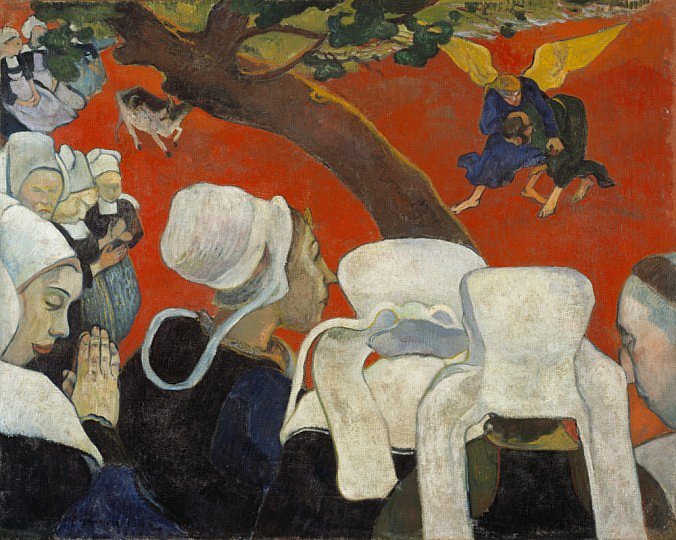
"Vision after the Sermon" by Paul Gaughin is featured
prominently in Death in Brittany by Jean-Luc Bannalec

8. I learned a heck of a lot about Paul Gauguin and (to me at least) the obscure group of artists who made up the Pont-Aven School in the fascinating German crime novel Death in Brittany (originally published as Bretonische Verhältnisse). I thought Gauguin moved to Tahiti and did all his most well known work in the South Pacific. Little did I know that he founded an entire style of painting in the small town of Pont Aven in Western France, that his early work done here is considered by the locals to be the birth of modern painting, and that he is celebrated throughout Brittany. Someday I’d like to visit this part of France which we completely bypassed the first time I travelled there.

9. Who doesn't learn something arcane when devouring a Christopher Fowler book? Take his latest, The Burning Man. Its pages are chock full of Guy Fawkes facts and legends and the origin of burning effigies that led to the annual celebration of the Gunpowder Plot. But I never need to double check on anything when reading his books because Fowler always gives you *all* the details you'd ever want.  And then some!

10. Even a former Brit Lit student like me needs a refresher in his supposed field of expertise. So when I came across Malbecco in a blink-and-you’ll-miss-it allusion in Catherine Aird's excellent impossible crime novel His Burial Too I was not so surprised that he turned out to be a minor character in The Faerie Queen. I wasn’t a fan of Edmund Spenser back in my college days. I tend to forget everything about that epic poem other than the Bower of Bliss section and that I found most of it boring as hell. Turns out that using the name Malbecco is an arcane way to call someone a paranoid jealous husband. He’s in Book III, Canto X (et al.) of Spenser’s seemingly endless poem if you want to read about him. I think an Othello allusion would've sufficed. What a show off that Catherine Aird is. Witty and smart, but a show off.

Wednesday, February 13, 2013

NEW STUFF: The Invisible Code - Christopher Fowler

Each new Bryant & May crime novel brings with it the anticipatory thrill of discovering more arcana of London that Christopher Fowler loves to share with his readers. (There should be a word for all these nuggets of England's past. Londoniana? Albionisms? Mull those over.) The latest escapade of the Peculiar Crimes Unit or PCU does not disappoint. Within the labyrinthine plot of The Invisible Code (2012) the reader is treated to the fascinating world of Sir John Soane's museum housed at 13 Lincoln's Inn Fields; the secrets of the "Scarlet Thread" and what it means to the Knights Templar; St. Bride's, the church of journalists; and more tidbits about the occult that always work their way into the adventures London's much maligned and unappreciated specialized police squad. For fans of vintage crime and adventure novels there is the added bonus of allusions to the work of Dennis Wheatley and especially a particular title by Fritz Leiber.

Oskar Kasavian (familiarly known to the PCU staff as The Prince of Darkness), an executive in the Home Office, is the top level overseer of this unusual police unit set up to protect the public. He is also their number one enemy. For years Kasavian has been doing his best to shut them down and now Arthur Bryant and John May are surprised to be called into his office for a personal favor. He needs their specialized help in handling the embarrassing public behavior of his wife Sabira who is becoming increasingly erratic and violent. She's been raving about demons and witches and seems to have submerged herself into a world of paranoid imaginings. Kasavian thinks for that reason the PCU team are perfect for discovering the cause of Sabira's delusions. Or are they delusions? And what about the odd death of the woman found in St. Bride's Church who apparently was the target of some children playing an RPG called Witch Hunter? Like all PCU cases the coincidences prove to have more significance the further the team plows.

Arthur Bryant talks about the importance of connections and patterns at one point in the book. This is the basis for all the PCU books. There is a wealth of information that at first comes at the reader in random incidents, then are fired out in rapid succession. Fowler, unwittingly perhaps, is one of the greatest modern practitioners of an old subgenre known as the webwork novel. Harry Stephen Keeler was the best known American writer of webwork novels. He even wrote a manifesto -- "The Mechanics (and Kinematics) of Web-Work Plot Construction" -- about the art of creating a single story out of random multiple narrative threads. John Russell Fearn, prolific British pulp magazine writer of SF and detective fiction, credited Keeler with influencing him in his SF webwork stories.

Synopsis in diagram form depicting the webwork plot of Keeler's Voice of the Seven Sparrows (1924)
Fowler's story incorporates the mysterious death of Amy O'Connor in the opening chapter, the death of a character in a previous novel, the madness of Sabira Kasavian, and several other apparently random acts of violence in a tour de force of webwork plotting. Webwork might be called the fictional counterpart of a conspiracy theorist's obsessive hunt for nefarious patterns real and imagined in the operations of global conglomerates and world politics. Allusions in The Invisible Code to modern paranoid thrillers like Ira Levin's Rosemary's Baby and the movie The Parallax View add another level of enjoyment to the randomness that will eventually reveal a pattern of sinister construction. The novel is the best of this type I have read in all of the ten Bryant & May detective series. Though there is sometimes a tendency towards didactic dialogue passages -- the kind typified by forensic crime TV shows and The X Files -- Fowler mostly manages to introduce the Albionisms (I used it!) in a way that flows naturally out of the densely compacted action.

Bryant & May find a victim in St Bride's Church
(Artwork by Keith Page)
 The series characters each have a turn in the spotlight with some interesting developments in Janice Longbright's life and the usually bickering partnership of detective constables Colin Bimsley and Meera Mangeshkar. Dan Banbury and Giles Kershaw do their usual forensic wizardry in the morgue and in the technosphere. Maggie Armitage, the "white witch", is featured prominently offering much lore and occult knowledge to help Arthur Bryant in explaining some of the baffling elements of the case. And, finally, we are introduced to a new character, Mr. Merry, who appears to be a 21st century Aleister Crowley and who promises to be a formidable foe in the future books as hinted at in a teasing final chapter.

Sampling the escapades of the Peculiar Crimes Unit can be an addictive reading experience but also a dangerous one. In relating to us his love for all things bizarre and strange about the city he loves so unabashedly Fowler not only fuels a crime fiction lover's taste for the bizarre he is something of an alluring siren for the armchair traveller in all of us. He sings a song of London better than any music hall chanteuse. This armchair traveller has been tempted more than once to dip into the savings for a overseas trip to see up close and personal the many unusual places recounted in these extremely entertaining books. And that's the kind of connection I like between a writer and his readership.

Bryant & May and The Invisible Code by Christopher Fowler
Transworld/Doubleday,  August 2012
ISBN: 978-0857520500 (hardcover in UK and Canada only)
GBP 16.99

Available as an eBook and audio book in the US now
US hardcover edition release date is unknown

Friday, April 15, 2011

FFB: Broken Boy - John Blackburn

Readers who enjoy the Peculiar Crimes Unit detective novels of Christopher Fowler and are impatient for the next Bryant & May adventure into the bizarre and macabre should turn to the works of John Blackburn as a more than suitable substitute. His books are amazingly similar in structure and theme to Fowler's work. Blackburn also shares Fowler's interest in arcane legends and folklore as well as the secrets of old London's infrastructure and architecture. I have to thank Mike Ripley for sending me a promo on Top Notch Thrillers, a reprint line he edits for Ostara Publishing. In that email there was some info on Blackburn that prompted me to investigate this writer. Though Blackburn wrote straight crime and straight espionage as well, it is his own special blending of crime supernatural and espionage that has made him according to the Top Notch Thriller publicity "the link between Dennis Wheatley and James Herbert."

One of the most intriguing of Blackburn's thrillers is his fourth book, Broken Boy, published in 1959 in his native England and released in the US in 1962. The melding of crime, detection, and the supernatural ranks with the best of not only Fowler but groundbreaking genre-benders like Dennis Wheatley, A. Merritt and the stories of Seabury Quinn. While Blackburn is not shy to indulge in pulpy thrills like those last three writers he is more interested in the psychological motivations of characters who employ the occult and supernatural for their own selfish purposes.

The book begins as any standard detective novel with the investigation of a crime. What at first seems like a brutal murder of a prostitute dumped beneath a bridge by an angry and savage john will prove to be something far more complex. General Charles Kirk and his fellow Home Office agents, Michael Howard and Penny Wise, are called in when the prostitute is identified as Gerda Raine, a former East German spy, with a particularly callous and sociopathic nature. She is linked to the selling of British government secrets in exchange for a British passport that would allow her a freer life. But while the reader may think this will morph into a spy novel he will be dead wrong. When Kirk visits Gerda's apartment he meets her very strange landlady and the landlady's son. He also finds a weird idol in her room.

Queen Ranavalona I - a nasty piece of work
The title refers to that idol - a disturbing figurine of apparently African origin with blind eyes and unnaturally disjointed arms and legs. It is this object that leads Kirk and his team to the discovery of a strange cult in the town of Minechester. With the help of an anthropologist and a medical doctor Kirk learns that the idol is tied to ancient black magic studies with their roots in the French Revolution era that made their way to Madagascar where purportedly they were adopted by the very real historical figure of Ranavalona the Cruel. 

Mothers and sons play a big part in the story. Each mother Kirk and his team encounter has the odd habit of referring to her no longer living husband in this fashion: "My husband? Oh, he...died." In each case a slight pause before the word "died." Kirk only realizes this strange speech pattern very late in the book. It's a subtle clue to a larger and nightmarish revelation.

There is a point in the book where one of these women reveals her true nature and the entire book shifts in tone. It's a real "Aha!" moment for the reader. What seems like just another detective story with some bizarre plot elements instantly transforms itself. From this point on I kept thinking of the old TV series The Avengers. The finale, however, is something straight out of a 1960s Hammer horror movie or even the weird menace pulps of the 1930s. There is a perfect scene where one of the villains shouts out "You fool. You wretched, interfering, foolish fool." And she punctuates each adjective by slapping her bound captive across the face. How's that for a throwback to the pulp era?

Broken Boy is the kind of book I crave. It has the perfect blend of action and detection, the surreal and the supernatural, and the utterly bizarre. When I come across something as weird as this I want to find every other book the writer has written and read them all. As a matter of fact I've already ordered four more Blackburn supernatural thrillers and eagerly await their arrival in my book crammed house.

Reviews of other John Blackburn thrillers on this blog are hyperlinked in the lists below.

The General Charles Kirk Supernatural Thrillers
  # also with Marcus Levin and Tania

John Blackburn, circa 1959
A Scent of New-Mown Hay (1958)
  US paperback reprint title: A Reluctant Spy
A Sour Apple Tree (1958)
#Broken Boy (1959)
The Gaunt Woman (1962)
#A Ring of Roses (1965) US title: A Wreath of Roses
Children of the Night (1966)
Nothing But the Night (1968)
#The Young Man from Lima (1970)
The Household Traitors (1971)
#For Fear of Little Men (1972)
#The Face of the Lion (1976) - Marcus Levin only
#The Sins of the Father (1979)
A Beastly Business (1982) - crossover book features Bill Easter & Peggy Tey (see below)
The Bad Penny (1985) - with Bill Easter

Other Supernatural & Bizarre Thrillers
   * feature Bill Easter & Peggy Tey
Bury Him Darkly (1969)
Blow the House Down (1970)
Devil Daddy (1972)
*Deep Among the Dead Men (1973)
Our Lady of Pain (1974)
*Mister Brown's Bodies (1975)
*The Cyclops Goblet (1977)
A Book of the Dead (1984)

Crime, Espionage & Suspense
Dead Man Running (1960)
Blue Octavo (1963) US title: Bound to Kill
Colonel Bogus (1964) US title: Packed for Murder
The Winds of Midnight (1964) US title: Murder at Midnight
Dead Man's Handle (1978)