Friday, March 8, 2013

FFB: Murder Among Friends - Lange Lewis

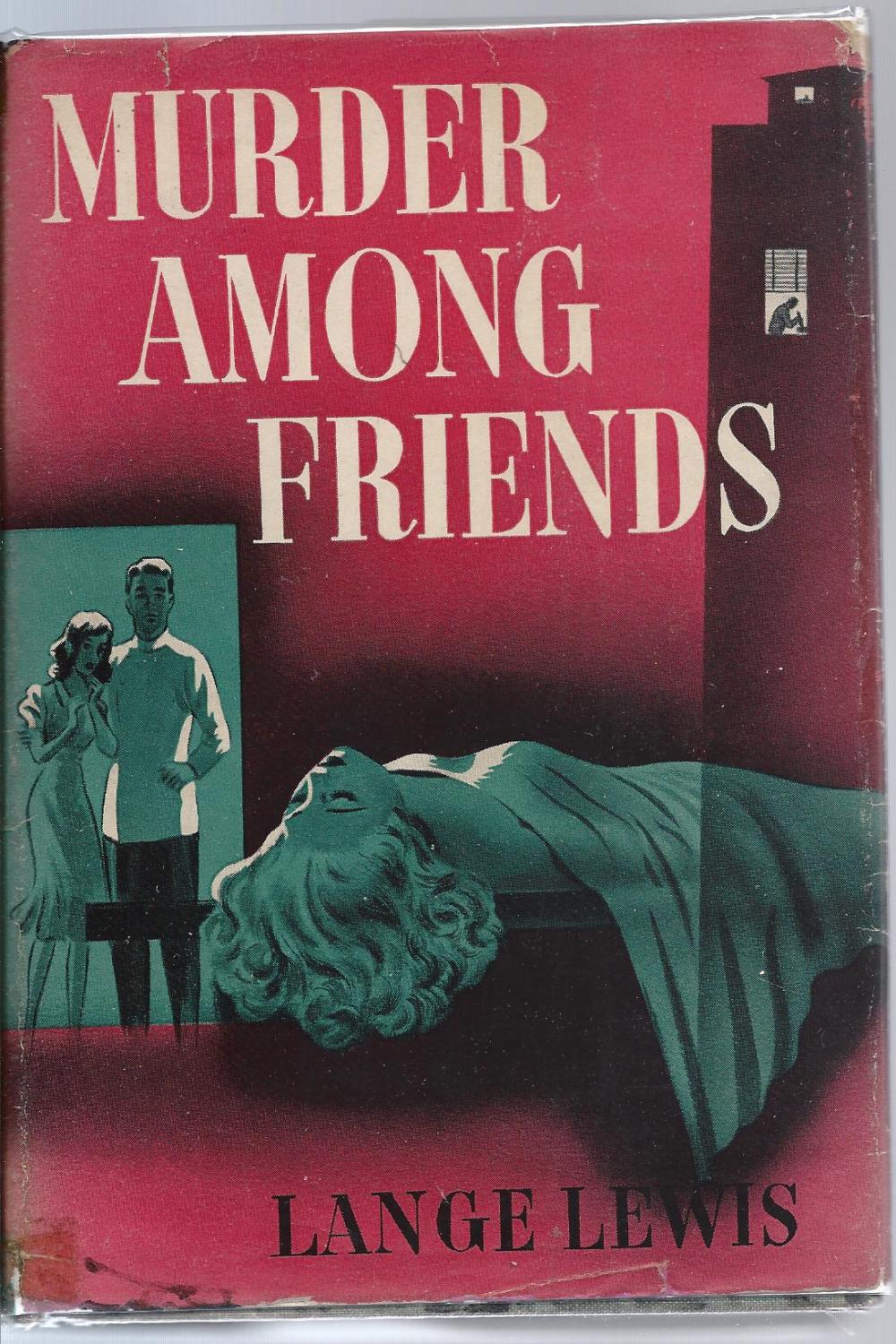
US 1st edition (Bobbs Merrill, 1942)
Kate Farr is about to start her new job as secretary to the Dean of Students at an unnamed medical college in southern California.  She is replacing Garnet Dillon, a woman who up and disappeared leaving behind a cryptic note to her boss and not a word to any of her many friends on campus. Just so happens Kate's one time boyfriend John Greenwood is currently an intern there and he takes her on a tour of the school's many buildings. One of their first stops is the cadaver room where they meet Griswold whose job it is to embalm the bodies donated for science. Kate reluctantly agrees to see their latest donation.  When the sheet is removed from the body the two men gasp. Kate sees a blond woman with long red fingernails.  As Lange writes: "Kate realized that Garnet Dillon had come back."

Murder Among Friends (1942) is the first detective novel by Lange Lewis, the pen name for novelist Jane Benyon. The book introduces readers to Lieutenant Richard Tuck, a policeman who relies on a blend of reason and imagination in solving his cases. When reason fails him as he pores over the evidence he resorts to putting himself in the murderer's place and imagining possible scenarios that often defy logic.  He is described as unsentimental but by the book's conclusion we discover he has a deeply hidden compassion not often seen in the usual tough cops of 1940s era crime fiction. 

Garnet Dillon we learn was more than a secretary. She was a close friend with many of the students, mostly male students who were attracted by her stunning good looks and drawn to her vivacious personality.  Dean Calder, her boss, however quickly points out to Lt. Tuck that his secretary was not too smart and a little too friendly.  He also confides that she seemed to be staunchly conservative in her personal beliefs and more than once hinted that she had an unsophisticated, almost childlike, view of life after death. Tuck will interview many of the close circle of Garnet's friends who make up the pool of suspects, but it is always the victim who is the focus of the investigation.  Lange's book in many ways anticipates the now modern trend of looking to the victim's life first to help understand the crime.

Paperback edition (Bart House, 1946)
The further Tuck delves into Garnet's life the more mysterious she becomes. She is not at all the naive flirt she was thought to be. She had multiple secrets, the most intriguing being one that she left written on some notepaper in which she refers to "the thing that follows me everywhere."  She seems to be haunted by "this thing" yet no one who called her a friend can recall her appearing anxious or fearful.

But there is something for all the woman in town to fear. A stalker has been killing women and taking their purses as trophies. Already five women have been killed in remote areas surrounding the campus.  Not so coincidentally Garnet's purse was stolen from the place where she died. Tuck thinks Garnet may have been the most recent victim of this stalker dubbed "Black Overcoat" by the newspapers and police. Tuck's police co-workers doubt it. After all, the stalker's victims were stabbed and Garnet was poisoned. While the other police track "Black Overcoat" Tuck concurrently continues his investigation of Garnet's death. Eventually the two storylines intersect in an original twist.

Beyond the crime plots, however, is the story of Garnet Dillon's life. When her secrets are uncovered her life takes on a deeply poignant aspect that elevates this novel from its genre roots resulting in an uncommonly moving story. Amid all the modern elements like high tech discussions of the medical effects of digitalis and a character who is conducting genetic research is a heart wrenching story of a woman seemingly doomed by Fate and circumstance and loved too deeply by her friends.

Thursday, March 7, 2013

The Charing Cross Mystery - J. S. Fletcher

Next to Edgar Wallace I believe J.S. Fletcher was the most prolific writer of detective novels and adventure thrillers in the earliest portion of the Golden Age of crime fiction. His strength was always in dreaming up multi-layered plots, populating them with large casts of characters who usually spoke in fair replications of British and foreign dialects, and keeping the reader's attention engaged with an explosion of action sequences. But like most genre writers who churned out story after story he suffered from a dire case of repetition.

With the exception of only a few of his thrillers which venture into the realm of science fiction and fantasy if you read one Fletcher novel you can usually predict what the rest of them will be like. A murder or two, a theft of a valuable piece of jewelry, a villain of the Napoleon of Crime variety, blackmail, a handsome and witty amateur sleuth (usually a lawyer or reporter), and a wily policeman who teams up with the amateur. Throw it all into blender, push a high button speed, and serve in a tall frosty glass with a some biscuits or scones.

The Charing Cross Mystery (1923) is less of a detective novel (though it tries very hard to be one) than it is one of Fletcher's rapidly paced pursuit thrillers. It begins in a subway train car headed for Charing Cross station. Superintendent Hannaford (Ret.) confides with James Granett that he has located a woman who escaped arrest for fraud eight years ago. Hannaford has cut out her picture from a newspaper article as proof and shows it to Granett. Shortly after this somewhat confidential talk -- overheard by our hero, a young barrister named Hetherwick -– Hannaford drops dead, the victim of some agonizingly fatal poison. Granett goes in search of a doctor but never returns. Hetherwick is left to explain to the police and a passing doctor what happened.

Intrigued by what he overheard Hetherwick is curious to uncover the identity of the woman in the photo and would like to find Hannaford's murderer. He joins forces with Inspector Matherfield and together they uncover a complex web of multiple crimes related to the fraudulent sale of a diamond necklace.

Soon it doesn’t matter who killed Hannaford and the other victims or really why they were killed. Fletcher is not satisfied with a murder or two in this story. He tosses into his potent crime fiction cocktail every crime one can think of: blackmail, extortion, theft, check fraud, and kidnapping. The kidnapping eventually becomes the focus of the story as Hetherwick, his law office aide, and a variety of policeman led by Matherfield try to locate the kidnap victim and put an end to the reign of terror begun by a duo of master criminals. In addition to this circus juggler's act of criminal activity Fletcher dares to throw into the ring the time worn detective novel cliché of mistaken identity related to twins!

The book is fairly typical of the crime fiction of the time. Nothing very original or surprising occurs though the supporting cast of characters comprised of a lively and colorful bunch provides for some entertaining moments and amusing dialogue. What makes the book slightly notable is the sheer inventiveness of the multi-dimensional plot and the fast pace with which Fletcher manages to churn out set piece after set piece. It would have made a fabulous movie serial during the silent era as the chapters tend to end with cliffhangers or melodramatic pronouncements. The US edition apparently was originally serialized as my copy published by G.P. Putnam & Sons states it is copyright by Consolidated Magazine Corporation, who published among other periodicals The Blue Book Magazine where Tarzan debuted.

The Charing Cross Mystery is now available as the inaugural volume in a series of vintage crime reprints published by Oleander Press. The imprint, dubbed "London Bound", plans to highlight long out of print books that have been recommended by a British bookseller and former judge for the CWA Gold Dagger Award. Here is how they describe the imprint:

LONDON BOUND – A series of classic crime novels, largely from the Golden Age of detective fiction, faithfully transcribed, re-set and reprinted by Oleander under the series name London Bound - owing, unsurprisingly, to their all being set in the nation's capital.
Each title will be released in a limited hardcover edition as well as affordable paperback editions. Other authors whose work will be reprinted include Henry Holt, William LeQueux, and the exceptionally rare detective novel Fatality in Fleet Street by Christopher St. John Sprigg. I was so excited about the Sprigg book I immediately pre-ordered it. That one is not out until June 2013.

UPDATE, JAN 2015: Oleander Press suspended operations of the "London Bound" imprint series sometime in the summer 2013. Only three titles ever saw the light of day: The Charing Cross Mystery, Fatality in Fleet Street and Doctor of Pimlico by William LeQueux. The planned releases of books by Henry Holt (still mentioned on their website) were abandoned.