Friday, June 27, 2025

Death at the Helm - John Rhode

THE STORY: A fisherman and his son come across a small pleasure cruiser run aground a sandbar. Their shouts to whoever was piloting the boat were of no use and they sail out to see if they can rescue whoever is on board. No one is at the helm. But there are two passengers on board, a man and a woman, and both are dead. The boat is beginning to list and the fishermen leave to find someone to tow the boat off the sandbar and then call the police. Preliminary investigation finds that both were poisoned but identifying that poison and how it was administered will take quite a while. Suicide is considered until Jimmy Waghorn consults with Dr. Priestley who suggests that there are several possibilities other than suicide and murder should not be ruled out.

THE CHARACTERS:  Ted Farningham - brother to the dead man. A painter who has lots of information about his brother George and the mystery woman on board the boat.

Polly Farningham - Ted's wife who has a lot of opinions about who killed the two people. Knowing what she knows of George she absolutely refuses to believe in a suicide pact.

Hugh Quarrenden, K.C. - high profile trial lawyer who Waghorn soon learns has a wide knowledge about toxicology.  Husband to the dead woman. Stern, stoic, nearly emotionless he nevertheless loved his wife dearly. He knew of her affair and tolerated it seemingly. Is his stoicism a mask for a hatred that drove him to end the shame of infidelity by killing both people?

Collard - butler at Worsely House, the Quarrenden home.  Like all good servants he sees more than he will ever tell. Only when murder is introduced does Collard begin to talk about secrets Mrs. Quarrenden was none too good at hiding.

Sir Clarence Farningham - Father to George and Ted. Notably involved in the Purity Society, "pledged to unrelenting warfare against adultery in every aspect." He had no tolerance for his son's love affair. Possible motive for eliminating son and lover, ignominious sinners undeserving of living?

Sgt. Playfoot - the local policeman who makes the first investigation of the crime scene. Excellent detective skills. Collaborates with Jimmy Waghorn for the first half of the book.  A nicely done intelligent police sergeant for a change!

Jack Benover - Mrs. Quarrenden's devoted brother and George's co-worker at an international brokerage company. He and George were being considered for a promotion that would lead to a relocation to South America.

A variety of well drawn minor characters consisting of fishermen, shopkeepers, and two police forensic analysts. I particularly liked Isaac and his son, the fishermen who find the bodies; Mr. Wallis, one of the chemical analysts; and two shopkeepers in Little Huntley.

INNOVATIONS:  As Jacques Barzun comments in his Catalog of Crime entry for Death at the Helm (1941) this is one of the better Dr. Priestley mystery novels for clueing and detection.  Like many of the John Rhode novels the book is mostly a "howdunnit" with a large part of the story devoted to discovering the poison employed and exactly how it was ingested. There are two autopsies and multiple analyses of food and water taken from the grounded boat, the Lonicera. 

Interestingly in a side remark from one of the policemen, we learn that the boat is named after the Latin name for coral honeysuckle, one of the many bits of botanical trivia that flood the story. Botany features prominently, especially when Waghorn gets a tip that the poison most likely is a vegetable alkaloid. Mrs. Quarrenden picked several flowers while ashore in a short visit in a village called Little Huntley. These flowers were found in a broken vase that fell from the table where George and his paramour had tea prior to their deaths. Waghorn begins to suspect that somehow one of those plants might be poisonous and found its way into their food or drink.

Then there is the bottle of Hampden's Gin Blimp, a commercially prepared cocktail recently being marketed. Where did it come from? Quarrenden did not allow any alcohol in his home other than wine and sherry.  Cocktails and any alcoholic ingredients needed to prepare them were forbidden because he hated the idea of frivolous alcoholic concoctions and the new rage for drinking as entertainment. As the investigation continues the bottle seems to be the most likely method for introducing the poison. And yet the cork and cap were not tampered with. It's a quasi-impossible crime of sorts.

This was an engrossing story mostly for the intensive police work related to the poison. There is a bit too much of repeat visits to suspects who are encouraged to be more forthcoming. Several characters tend to hold back or deceive the police team.  Dr. Priestley appears in only three scenes in the latter portion of the novel in which he suggests how the murder was committed, including one in which he has Waghorn and Hanslet sample some whiskey that ends with quite a surprise for the policemen. In the end, as with many of the Rhode mystery novels I've read, the identity of the murderer is hardly surprising, but the manner in which the story wraps up does have a bit of a shocking finale.

EASY TO FIND? This one seems to be one of the most difficult titles to find among the Dr. Priestley detective novels. Only one copy is offered for sale online. I lucked out at a library sale this year back in the spring where I found a rebound copy of the 1941 US edition in pretty good condition. This title was not reprinted in paperback edition in the US and I don't know if there is one in the UK or Canada. A truly rare book, I'd say.  Perhaps try brick & mortar libraries or those online digital libraries I never bother looking at.

Tuesday, June 17, 2025

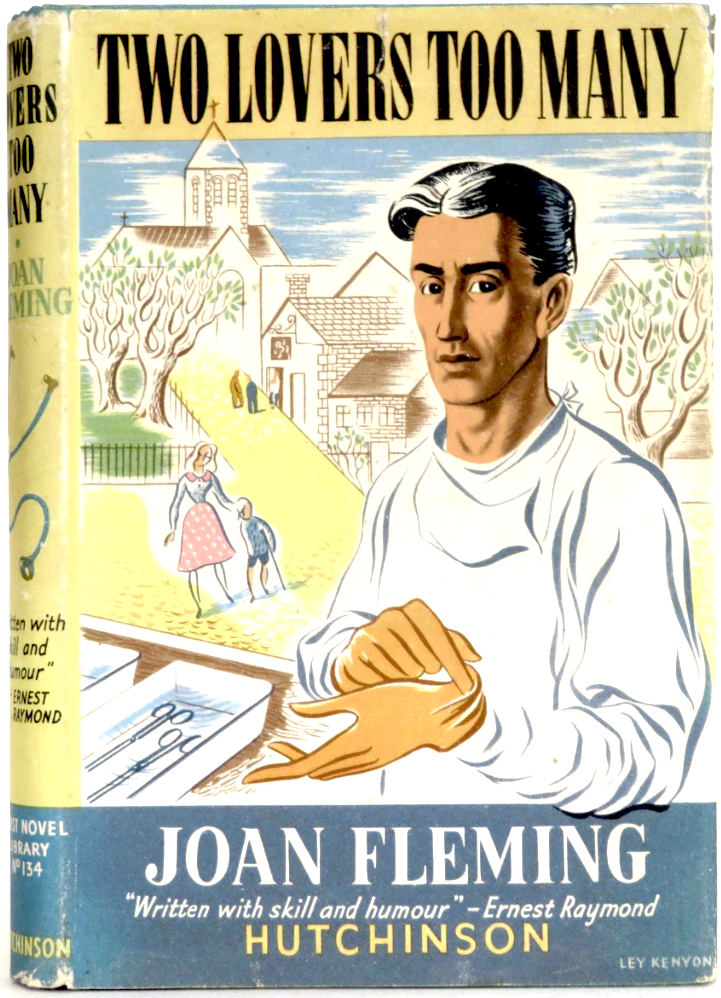
FIRST BOOKS: Two Lovers Too Many - Joan Fleming

Don't be fooled by the title or the odd illustrations on the DJs of Two Lovers Too Many (1949). It may seem like a melodramatic hospital romance novel based on the title and illustrations, but this debut crime novel from Joan Fleming is an innovative work incorporating aspects of the detective, suspense and horror novels. In fact, Fleming is prophetic in predicting how scientific discoveries and advances can be perverted in the hands of a criminally minded individuals bent of exacting revenge. Her insight into the possible exploitation of science is nightmarishly resonant for our violently troubled 21st century.

As the title implies, the story is about a lover's triangle -- or rather quadrangle as we will learn by the midpoint. Despite what the title says there are actually three men vying for a woman’s attention.  Daisy Walkern, a vapid femme fatale concerned with only herself and sexual conquests, is rescued from her life as single mother by Alan Walkern, the gallant but very homely and disabled (he has a club foot) physician. He marries Daisy and becomes stepfather to her unruly child Barney. While married to Alan, Daisy becomes pregnant and they eventually have a second son, Peter. But while married to Walkern Daisy continues her life of teasing and taunting any man who will pay attention to her.

When the book opens Alan Walkern is dead. And one of Daisy's "lovers" is dead, apparently a suicide by gun.  Paul Lathbury is found in the hayloft of a barn shot dead.  But the gun is nowhere to be found. How then can the death be a suicide?  Did someone remove the gun to prevent anyone thinking the handsome, well-liked, highly successful man killed himself? Another young doctor, Alastair Southery, is assigned as a locum tenens to fill in for Dr. Walkern until a new physician can be hired. Alastair begins an innocuous investigation with only a few questions concerning Paul's death. But the most senior physician in town, Dr.  Forty, an associate of Dr. Lathbury and Dr. Walkern is not satisfied with the police work. He is also concerned about an odd coincidence.  Dr. Walkern supposedly died from aplastic anemia and Dr. Lathbury whom Alastair is working for, is currently being treated for the same condition.  How is it that both of the town's doctor's contracted anemia within months of each other when prior to that both men had no signs of any chronic illness? Dr. Forty is relentless in pursuing this medical coincidence.  He even suggests that Walkern's death and Paul Lathbury's death are related because they were linked to Daisy Walkern.

Though he at first dismisses Dr Forty's wild speculation that someone is killing men who cross Daisy -- could it be Daisy herself? -- Alastair finds himself cast into the role of a medical detective.  He begins subtly questioning everyone in the village, eventually spying on them and doing a little snooping into their homes and personal belongings. When a medicine bottle turns up missing he begins to think that Dr. Forty's theories may have some truth in them. Alastair discovers that what can cure illness can also induce illness and he is determined to expose the murderer and prevent more deaths.

Some of the supporting characters provide welcome relief in a story fraught with tension and danger.  Alastair befriends a seven year boy, the son of a talented portrait painter Calliope Eldernell who earns her primary income as a servant in the Lathbury home. Both Calliope and her son Tim serve as the common sense characters who seem to be Alastair's only friends and provide the groundwork for what ultimately is a happy ending for this trio. Tim is a delight and Calliope, a troubled woman who doubts her own artistic talent, provides hope in a book that is largely doom-laden and focused on the darkness within everyone else in the village.

Fleming's first crime novel is utterly fascinating. She has created both a medical detective novel and a horror novel simultaneously. The murder method turns out to be diabolical.  It's a modus operandi first introduced as a fictional murder method back in the late 19th century by a handful of astute short story writers like L. T. Meade, but not truly explored by 20th century crime writers until the WW2 era. A master of innovation in the crime novel Fleming has never been noted to follow genre formula. She often employs imaginative twists and trenchant satiric touches both of which are on display in this first novel that promised so much. Many of her later novels are superior and this first effort definitely predicted great things for her. It’s a shame so few people know of her work and that 95% of her crime novels are out of print.