Saturday, August 12, 2023

Nice People Don’t Kill – F. W. Bronson

First mystery novels can be fascinating. What does the writer want to try out as an entry point into the world of the whodunit? Will it be a locked room murder? A noirish private eye novel? An inverted crime novel where we follow the murderer through the planning stages to the finally flawed crime? F. W. Bronson was not a neophyte writer when he tackled his first murder mystery. He already had three mainstream novels under his belt, published between 1926 and 1933. I thought this debut as a mystery writer might be an academic mystery judging from his biography that has Yale all over it.  Or maybe an ex-pat novel due to his having lived in Italy and elsewhere abroad in his post-college days. Never would I have thought he would choose to emulate Mary Roberts Rinehart and Mignon Eberhart, slightly satirizing the conventions of those Had I But Known mystery writers in his ironically titled Nice People Don’t Kill (1940).

The novel is narrated by Coraly Ames, widow living in an unnamed Connecticut town located on the shores of Long Island Sound. Greenacres is the name of the estate left to her by her husband and it's here she adds to her modest inheritance by renting out the separate beach house to summer tourists. In the opening chapter her husband’s best friend “Mac” suggests she rent to Schuyler Adams, a prominent Wall Street executive. We are quickly introduced to a variety of the locals in town and Coraly’s neighbors who will turn out not too coincidentally to be acquainted with Adams. But of course they are! And those relationships are tainted with secrets and criminal activity. All of which leads to the grotesque murder of Adams while he is sunbathing in what initially appears to be an impossible crime. Sadly that angle is quickly dispensed with as a mysterious man in a white bathing suit was seen by several people. A couple of nervous witnesses also lose their lives, one in a bloody hatchet murder (shades of Rinehart!), when they attempt blackmail or foolishly speak of what they know in cryptic brisk phone conversations and – of course – are overheard.

A plethora of Golden Age-style clues offer up mini-puzzles in addition the overarching mystery of the murderer’s identity. A volume of Keats’ poetry, a book Adams always carried on him, vanishes and reappears several times. Greenacres’ telephones operate on a party line offering several opportunities for eavesdropping when someone picks up an extension – even in the beach house, a ten minute walk away, or in the guest house to the south of the main house. Someone has been staying in the boat house as suggested by sandwiches remnants, paper bags and a makeshift bed found there the day after the murder. Is the person who was surreptitiously using that shed as their private motel also the killer? Could that be the man seen in the white bathing suit digging around in the sand a few feet from the murder scene?


Beautifully detailed map endpapers of the various scenes of the crimes
Nice People Don't Kill
(Farrar & Rinehart, 1941)
 

Bronson's characters are all familiar types to anyone who has read a mystery novel by Rinehart or Eberhart or any GAD mystery novel for that matter.  In addition to Coraly and her dead husband's pal "Mac" the cast consists of a momma's boy with a respiratory condition and his overprotective jealous mother, a mystery woman with a secret past, gossipy nervous servants, the middle aged military man and his much younger wife, the skipper of Adams' yacht "Blackbird" and the yacht's steward who acts as Adams' valet and cook on land. No one really has any depth and because they are representative of mystery archetypes they are fairly predictable in their thoughts and behavior. Thankfully, Sheriff Davey Jones is an intelligent policeman and provides well needed gravitas, common sense and shrewd detective skills throughout the book. Though Coraly fancies herself an amatuer sleuth she's a bit inept and severely impaired by her obvious biases and favoritism. Only Susan Carlisle, a young woman who appears quite unexpectedly on the scene and ends up staying in the guest house on Greenacres' porperty, comes across as slightly complicated or at least ambiguous in her motivations. She definitely has a past and I was bothered that Coraly seemed to believe Susan’s every word and action. Unlike the easily duped heroine/narrator I suspected Susan was definitely up to no good. Similarly, a gaggle of servants at Greenacres may appear to be just inconsequential supporting characters but the reader should pay close attention to them for they will play major roles later in the novel as their own secrets are also revealed.

With our heroine constantly hinting at future events that the reader has yet to encounter it’s an obvious but often heavy-handed homage to that “feminine” subgenre that detective fiction maven Jacques Barzun enjoyed disparaging. The novel is littered with spins on typical HIBK writing style. I was getting a bit irritated with her too. Here’s a sampling of what occurs in every chapter until the middle of the book:

It's odd to realize now that instead of welcoming Schuyler Adams with practically open arms I should have thrown the money in his face and ordered him off the property.

It didn't seem terribly important at the time--but that bit of carelessness almost cost me my life.

He might have added that my [inquest] testimony -- though of course he didn't know at the time -- contained the most important clue in the whole baffling, nerve-racking case.

Francis Woolsey Bronson
(1901-1966)
More annoying is her firm belief that “nice people don’t kill” echoing a sentiment that Carolyn Wells highlighted in The Technique of the Mystery Story and often mentioned in her detective novels written 20 years before this book was published. Coraly further elaborates on her sadly stereotypical views of humanity by surmising that the culprit responsible for the savage murders can only be Captain Lipari, the evil looking, mustachioed, limping skipper of Blackbird moored in the nearby harbor. It took me awhile to realize that Bronson was sending up the narrow-minded, overly optimistic women who populate the typical HIBK novels of the 1920s and 1930s. Ultimately, the reveal of the crazed murderer in the final chapters is pleasantly surprising even if Bronson (in the voice of Coraly) decides to present us with a silly melodramatic fake climax fulfilling some of Coraly’s predictions that didn’t quite fool me. Even a HIBK narrator has a few tricks up her sleeve to keep her readers baffled.

F. W. Bronson Detective Novels
Nice People Don’t Kill (1940)
The Uncas Island Murders (1942)
The Bulldog Has The Key (1949)

Wednesday, August 9, 2023

Psst... Over Here!

Hello, there! Remember me? I think eight month’s hiatus is a little too long to have taken for what I thought was going to be “a little break”. What have I been up to? Oh, this and that…

I came to realize that like many collectors I had gradually turned into a monomaniac of sorts and I didn’t like it. My literary anecdotes were boring people and more importantly I was boring myself. I wanted to avoid vintage detective fiction for a while. It was long time that I returned to reading contemporary fiction of all types, reading non-fiction (!) that led me to seeking out the histories and memoirs that once upon a time I enjoyed even more than mystery novels. As I veered away from detective and crime fiction I rediscovered my passion for supernatural horror from all eras. In the process I learned that there has been a revival of “traditional” supernatural fiction in the past three years similar to the renaissance in detective fiction (both reissues and new writing). Quite an eye-opening surprise and a delightful one for someone like me who has always loved ghost stories, haunted house novels, and metaphoric treatments of the monster hiding under your bed.

And so after eight months I’ve come full circle and I’m ready to share with you some of the unusual and intriguing titles I’ve devoured since December 2022. Like this one…

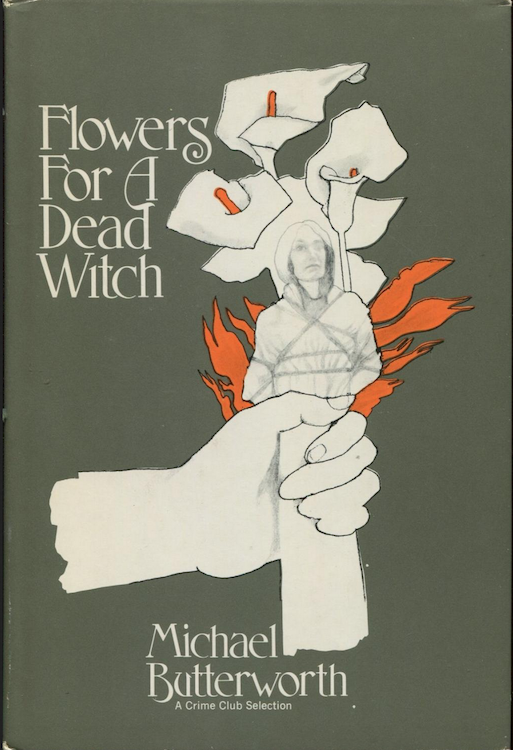
Flowers for a Dead Witch by Michael Butterworth

Readers of this blog will know that I love a good mystery novel dripping with Gothic elements and accented with witchcraft, hexes, black magic, voodoo, hoodoo or whatever the author is calling it. Butterworth’s third mystery novel is a brilliant example of the first revival of traditional mystery writing that occurred back in the 1970s. In Flowers for a Dead Witch (1971) he gives us what at first seems to be yet another of those Gothic “romances” that filled bookstore shelves and drugstore spinners five decades ago. Polly Lestrange travels from Canada to Suffolk to visit her bedridden ailing great-aunt in a crumbling medieval manor complete with moat surrounding the entrance. She is greeted by Miss Chesham, the great-aunt’s over protective companion who refuses the Polly’s request to visit the old woman. Even the local physician caring for Great Aunt Granchester insists that Polly leave the old woman alone. Well, what Gothic heroine is going to listen to either person? Certainly not this one and Polly determinedly breaks into the old woman’s room one windy and rainy night (of course it rains a lot in this book. It has too!) to discover… Oh, but that would spoil it all. The old woman has a secret of course and it will only be revealed in the final pages.

Before the startling conclusion – which I confess really took me by surprise – our plucky heroine will encounter a ragtag group of rebellious teens, rumors of a witchcraft cult cavorting naked in the moonlight, an ancient cemetery home to a mausoleum containing the corpse of a woman executed for witchcraft 400+ years ago, and literally stumble upon what appears to be the charred remains of that executed witch. But how is that possible? A 400 year old corpse of a woman burned at the stake would be nothing but rotting bones if not a pile of dust in 1971. The body found in the coffin in the mausoleum is freshly dead, and burned beyond recognition. When both the local reverend and his wife go missing whispers of foul play mix with the rumors of witchcraft.

This was the first book I’ve read by Michael Butterworth (1924 – 1986) who prior to turning his hand to bizarre crime and mystery novels was primarily known as a writer of comic books. Oh! A warning: Don’t confuse him with another (still living) writer of the same name who wrote science fiction novels and SF TV show novelizations. I had to notify the Admin of a crime fiction website that he conflated both Butterworths. I advised him to remove all the SF titles from the mystery writer Butterworth’s bibliography. He speedily updated that page on his website.

If Flowers for a Dead Witch is any indication of what Butterworth is capable of then I’m eager to check out as many of his other books that I can find. Most satisfying is that this is a legitimate detective novel with fair play clueing. Assiduous readers may catch onto what I overlooked as I foolishly fell for all of the writer’s rather clever red herrings. Butterworth mixes the formulaic plot of those 70s Gothic romances churned out by writers like Phyllis Whitney, Victoria Holt, and Mary Stewart with genuine mystery novel conventions and thankfully improves on both. Of course with a generous helping of creepy superstition and lurid witchcraft legends the plot is considerably spicier and more intriguing. I thoroughly enjoyed this book and completed it in a speedy two days. There are several copies available for sale out there in the vast shopping mall of the internet. I’m sure it ought to turn up in local libraries both in the US and UK. Check it out!


Michael Butterworth Crime & Detective Novels

The Soundless Scream (1967)
Walk Softly in Fear (1968)
Vanishing Act (1970) (US title: The Uneasy Sun)
Flowers for a Dead Witch (1971)
The Black Look (1972)
Villa on the Shore (1973)
The Man in the Sopwith Camel (1974)
Remains to be Seen (1976)
Festival! (1976)
X Marks the Spot (1978)
The Man Who Broke the Bank at Monte Carlo (1983)
  -- adapted into a musical: The Lucky Stiff by Ahrens & Flaherty
A Virgin on the Rocks (1985)
The Five Million Dollar Prince (1986)

As by “Sarah Kemp” – all feature Dr. Tina May, a psychiatrist detective
Goodbye Pussy (1978) (US title: Over the Edge)
No Escape (1984)
Lure of Sweet Death (1986)
What Dread Hand (1987)