Sir Mark Fleet is stabbed in full view of an audience while delivering a speech in front of a painting called "The Red Lady." Although it was possible for someone to hide behind the painting it is determined that no one was in the crammed space even though it was cleaned as if to obliterate footprints in the dust. It appears that it was impossible for anyone to have stabbed Sir Mark and yet he was killed. Later the body is taken from the bedroom prior to it being delivered to the coroner for an autopsy. It is found on a burning haystack. Why would someone steal the body and set it on fire?
Dr. Hailey starts to uncover a strange financial scheme that led to Sir Mark leaving a sizable legacy to a young woman who he barely knew. In trying to get to the bottom of this mess Hailey discovers that Sir Mark had recently consulted with a spiritualist. So Hailey himself visits the spiritualist under the pretense of contacting the spirit of Sir Mark to find out why he left the money to the girl. Through the medium he learns of yet another young woman who knew Sir Mark. No sooner has the information been divulged the medium is stabbed amid some typical contrived Wynne business and in chasing the intruder out of the séance room Hailey discovers the body of the butler also stabbed.
Before the novel is through two more people are killed -- one in a similar apparently impossible stabbing death. Faster moving than most earlier Wynne books, heavy on dialogue, but plods down a bit with all the rigmarole about the financial chicanery and the writing of the wills that were behind the motive for the deaths of Sir Mark and all the other victims. Still out of Wynne's high output of sometimes dreary, often humorless mystery novels this is definitely one of his best.
Crime, Supernatural and Adventure fiction. Obscure, Forgotten and Well Worth Reading.
Tuesday, March 8, 2011
Friday, March 4, 2011
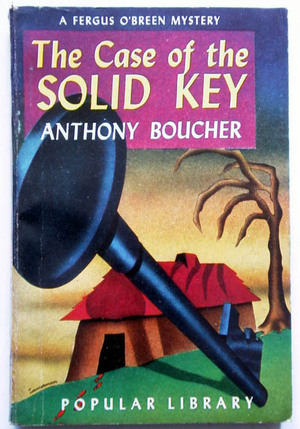
The Case of the Solid Key (1941) - Anthony Boucher
One of the reasons I love reading vintage mysteries is that I learn so many odd facts. The most recent tidbit: apparently the gums shrink in the mouth of a corpse after an extended period of time. This may well have been covered on an episode of one of the many versions of the CSI dynasty, but I doubt it. It's too low tech and not disgusting enough for CSI. The best vintage mysteries (in my reading it tends to be the Americans more than the Brits) are chock full of these nuggets of arcane information.
These days killers may dress in lint free coveralls and cover their crime scenes in plastic sheeting for easy disposal of blood, hair, fibers and other pesky detritus that might give them away. Or they may pour gallons of bleach over the crime scene to eradicate that troublesome genetic info left behind. Gone are the days when a murderer had to use his ingenuity to mislead or cover up a crime. Now it's all about science. That's right I'm blaming DNA technology for ruining crime fiction. And especially for putting a damper on writers' imaginations. Give me a corpse with shrunken gums so a murderer can shove a set of someone else's dentures in the mouth and have the corpse misidentified. That's misdirection! Did I say not disgusting enough for CSI? I take that back.
Somewhere Fergus O'Breen picked up this fact of gums shrinking after death and relays it to his Watson Norman Harker, a budding playwright from Oklahoma, and the ever exasperated Lt. A. Jackson in his penultimate adventure The Case of the Solid Key. The corpse in question -- which may or may not be sporting its own dentures -- is discovered in the locked theatrical workroom where the victim had been experimenting with fire effects. Unfortunately, the fire effect seems to have exploded rendering the face utterly unrecognizable – thus the need to resort to dental records for identification. The victim is Rupert Carruthers, a shady theater owner who financed the company through extortion. The suspects are a motley group of actors and actresses, the stage manager, the company manager and a playwright.
This is a theater mystery. With actors and actresses in the list of suspects the reader should be on the lookout for impersonation, insincere emotions, volatile temperaments and plenty of heavy drinking. It's also a theater situated in Hollywood and many of the actors have motion picture careers on their minds. Fergus O'Breen's sister Maureen just happens to be a publicity agent at Metropolis Pictures. The movie studio and Maureen play a secondary but integral role in an unusual subplot involving one of the actresses with whom Norman is smitten.
This is yet another example of a detective novel with multiple solutions and one in which the detective gets it all wrong. Fergus realizes too late that he overlooked a rather obvious fact which shifted all the other evidence making his rather brilliant solution nothing more than one of his fanciful theories. There is a lot of banter between Lt. Jackson and O'Breen about the difference between police work and private eye sleuthing. Jackson even reveals he's rather well read in detective fiction:
The Fergus O'Breen books are breezy, clever and pretty tricky to boot. I'd suggest you keep your eyes peeled for one of the many paperback editions of any of the five titles. For your book hunting pleasure they are all listed below.
Fergus O'Breen Novels
The Case of the Crumpled Knave (1939)
The Case of the Baker Street Irregulars (1940)
The Case of the Solid Key (1941)
The Case of the Seven Sneezes (1942)
Short story collections
The Compleat Werewolf (1969) - two short stories w/ O'Breen
Far and Away (1955) - one story w/ O'Breen
These days killers may dress in lint free coveralls and cover their crime scenes in plastic sheeting for easy disposal of blood, hair, fibers and other pesky detritus that might give them away. Or they may pour gallons of bleach over the crime scene to eradicate that troublesome genetic info left behind. Gone are the days when a murderer had to use his ingenuity to mislead or cover up a crime. Now it's all about science. That's right I'm blaming DNA technology for ruining crime fiction. And especially for putting a damper on writers' imaginations. Give me a corpse with shrunken gums so a murderer can shove a set of someone else's dentures in the mouth and have the corpse misidentified. That's misdirection! Did I say not disgusting enough for CSI? I take that back.
Somewhere Fergus O'Breen picked up this fact of gums shrinking after death and relays it to his Watson Norman Harker, a budding playwright from Oklahoma, and the ever exasperated Lt. A. Jackson in his penultimate adventure The Case of the Solid Key. The corpse in question -- which may or may not be sporting its own dentures -- is discovered in the locked theatrical workroom where the victim had been experimenting with fire effects. Unfortunately, the fire effect seems to have exploded rendering the face utterly unrecognizable – thus the need to resort to dental records for identification. The victim is Rupert Carruthers, a shady theater owner who financed the company through extortion. The suspects are a motley group of actors and actresses, the stage manager, the company manager and a playwright.
This is a theater mystery. With actors and actresses in the list of suspects the reader should be on the lookout for impersonation, insincere emotions, volatile temperaments and plenty of heavy drinking. It's also a theater situated in Hollywood and many of the actors have motion picture careers on their minds. Fergus O'Breen's sister Maureen just happens to be a publicity agent at Metropolis Pictures. The movie studio and Maureen play a secondary but integral role in an unusual subplot involving one of the actresses with whom Norman is smitten.
This is yet another example of a detective novel with multiple solutions and one in which the detective gets it all wrong. Fergus realizes too late that he overlooked a rather obvious fact which shifted all the other evidence making his rather brilliant solution nothing more than one of his fanciful theories. There is a lot of banter between Lt. Jackson and O'Breen about the difference between police work and private eye sleuthing. Jackson even reveals he's rather well read in detective fiction:
"I'll admit," said Jackson, "that Rupert Carruthers was asking for murder. On purely psychological grounds, maybe this looks like a murder case, but the physical evidence is too strong the other way."Later, just to rile O'Breen, Jackson does a little role reversal:
"Too strong is right. It's so strong it smells. No natural death could ever be so congoddamedclusively natural."
Jackson grinned. "You've been reading Chesterton again. Bad influence."
"In the meantime, Fergus, let me call your attention to one fact: there's only one conceivable advantage that that solid key has over an ordinary key."I liked this thoroughly American mystery novel. I've been reading far too many Brits with far too many plots about someone who makes the fatal mistake of announcing he is changing his will in front of all his heirs. It was a refreshing change to have a story about acting and the movie business, scenes set in coffee shops and bars, jokes about comic books and Lifebuoy soap, and a rambunctious detective swearing up a storm with tongue twisting conglomerations like the one above. (But I tried it. Just not natural, not at all something that comes trippingly off the tongue.)
"And that is?"
"That,"said Lt Jackson, "is its disadvantage."
"Hey! Fergus protested. "I'm supposed to be the brilliant if eccentric sleuth that makes cryptic remarks. Remember?"
"Sorry, I could not resist it."
![]() |
| from the DJ of The Compleat Werewolf |
Fergus O'Breen Novels
The Case of the Crumpled Knave (1939)
The Case of the Baker Street Irregulars (1940)
The Case of the Solid Key (1941)
The Case of the Seven Sneezes (1942)
Short story collections
The Compleat Werewolf (1969) - two short stories w/ O'Breen
Far and Away (1955) - one story w/ O'Breen
Subscribe to:
Posts (Atom)