Showing posts with label mythology. Show all posts

Tuesday, September 23, 2025

Now Seek My Bones - S. H. Courtier

THE STORY:  A monster crocodile. A private zoo of venomous snakes. An 18th century ship that disappeared. A lost treasure. And the return of an ancient cult of Crocodile Men. Sounds less like a mystery novel and more like a lost screenplay for another Indiana Jones sequel (though Indy definitely would not be happy about the snakes). These are the bizarre elements that feature in the plot of Now Seek My Bones (1957) which is more of an adventure thriller than it is a detective novel. This macabre crime novel ventures into horror territory frequently when an Australian obsessed with his ancestors from Revolutionary era France is found dead in his swimming pool that borders a marshland and draws water from its natural source. He was apparently attacked and killed by a giant crocodile that got through a sabotaged mesh fence designed to prevent entry of fish and other aquatic life. The horrible death is called a grisly accident and dismissed. When the novel opens the family is preparing for the man's funeral. "Digger" Haig, one of Courtier's clever often arrogant series policeman characters, suspects murder and makes his way surreptitiously to the McGorrie ranch to get to the bottom of the skulduggery.

THE CHARACTERS: The ostensible protagonist and something of an aide to Haig is Jeff Galloway, affectionately known as Galley by most of the women in the story. A reporter and friend of the slain Rann McGorrie, Galley is disturbed because he learned of Rann McGorrie's death from an obituary. No one from the family informed him of the death and so he heads to Port Crosby to attend the funeral. When he arrives we meet the members of the small funeral party, mostly relatives of McGorrie.

Kit McGorrie - Rann's daughter who at first seems to be a naive and flighty young girl. But no one is truly what they appear to be in this novel.

Aunt Hilary - Rann's sister, the imperious substitute matriarch of the clan. She insists that her brother died in a bizarre accident. That there is no killer at large...until the ranch is invaded by the strange men wearing crocodile masks who have modeled themselves after a cult of dream-timing indigenous people of decades past.

Norman McGorrie - Rann's nephew. From the outset it seems Norman is nothing but bad news and many readers will peg him as the villain. Sullen, quick tempered, resentful and violent. Hardly anything likeable about Norman. Don't be so quick to judge. Courtier does a fine job of misleading everyone in this mystery novel.

Marion Steele - a mystery woman of sorts. Passed off as a close friend of Kit's but Digger Haig knows who she really is. Galley (and the reader) will also learn her true identity and why she showed up at the McGorrie home after Rann's death. Her interest in 18th century France may have a lot to do with her presence at the ranch.

Hooker Trull - business associate of Rann.  Of all the characters Hooker is a kind of cipher for much of the book.  He seems only to be present as an attraction for the women in the story.  His role is made clearer in the in the final chapters.

Gosh Laffey - The most authentically Australian character of the lot. Immensely likeable, teeming wiht eccentricity, and harboring lots of secrets he is eager to share with Galley. Gosh is the owner of the private reptile zoo a self-styled herpetologist though not a professional one by any means. He has over 150 snakes in a zoo he keeps ont he south end of the property. The collection of snakes consists of both venomous and harmless native Australian species. The star serpent, so to speak, being David, a carpet python (a constricting snake and non-venomous) he often wears around his neck.  The snakes are not just unusual decor for the novel. Their presence will be exploited in a terrifying action sequence that is better left as a surprise.

Once Digger Haig reveals himself in an intriguing scene the cast will grow to include some indigenous peoples among them King Jimmy of the Crocodile Tribe, also known by his native name Koolakuk, who provides much of the history of the crocodile men, where they came form, their purpose and what they are up to now. Also we meet a tracker named Sammy who is the only one of a group of local men who takes his role as a policeman aide seriously. His work in determining how many men invaded the ranch after studying footprints in the dirt and examining broken branches is some of the most helpful native detective work to Haig. 

INNOVATIONS: From McGorrie's fascination with his French ancestors to the story of the crocodile men it's difficult to know where to start in pointing out the originality and innovation. Courtier's strength as a mystery novelist will always be his talent for uncovering some of the uncommon, often just plain weird, aspects of Australian culture and history. Whether it's in his love of the native animal life peculiar to the continent or the mysterious ways of indigenous people and their arcane mores each Courtier crime novel will offer up some fascinating tidbit. Now Seek My Bones, only his fourth mystery novel, offers more than a tidbit, it's a veritable cornucopia of trivia, history and secrets of the natural world. The story gives a crash course in native snakes of Australia, instructs on the difference between the harmless snakes and the deadly ones. The most deadly of all is the taipan. One nasty specimen makes its home in Goff's zoo and it will feature in a terrifying scene late in the book.

The climax of the book occurs when a book on Australian 18th century shipwrecks is found and a story of a missing ship and its mysterious cargo (oh yes it's all related to 18th century France) is related to Haig and Galley by the equally mysterious Marion Steele. She also reveals an unusual rhyming code that Rann McGorrie composed that when solved will lead the trio to a highly unusual hidden treasure. From this point on the book kicks into high adventure mode with many cinematic action sequences. Some enterprising filmmaker ought to grab a hold of this book and turn it into a movie. It's ripe for a 21st century movie-going public with an insatiable appetite for action movies. Underwater cavern exploration and shipwrecks and monster crocodiles?  Can't you hear the money rolling in like the crashing surf?

Somehow Courtier manages to weave in the shipwreck to McGorrie's obsession with his French ancestors and also wrapping up the reason that the crocodile cult was revived in the utterly unexpected finale that takes place in a sort of submerged cavern accessible only at low tide. Nothing is predictable in this thoroughly bizarre, often chillingly macabre, adventure-cum-mystery novel.  Yes, there is also an unveiling of the truly surprising murderer, but that comes almost as an anticlimax amid all the rest of the over-the-top adventure sequences consisting of underwater hunts, nighttime seiges, captures, rescues, and mayhem galore.

EASY TO FIND? Not at all. You may have luck if you live in Australia. I'm sure the libraries have loads of Courtier's books. My copy purchased just last year was the first one I'd seen since I started looking for all of his exceptionally good mystery novels -- most of them extremely hard to find -- back in 2014 or so. Good luck in locating another copy!

Friday, April 2, 2021

FFB: Golden Guilt – Francis Gerard

THE STORY:
Sir John Meredith is off on another adventure involving kidnapping, revenge and another bizarre cult that hints at supernatural origins. In the prologue of Golden Guilt (1938) two men and one girl are “anointed” and banished to the Place of Fire “never to return until such a time as [they] have restored that which is lost and have avenged the sacrilege.” This outlandish thriller with a smidgen of a detective novel plot is populated with Aztec descendants, Russian gangsters, Mexican terrorists, a gang sporting tattoos of Three Clasped Hands, and a group of zealots from a lost kingdom in search of the legendary Golden Fleece.

THE CHARACTERS: Meredith does his best to prevent the kidnapping of Lord Allingham’s son Bobby with the help of his wife Juanita, Sgt Beef (who is remarkably related to Leo Bruce’s Sgt Beef!), Bradford and Col. Merryweather-Winter. Along the way two characters from previous books turn up, Sir Hector MacAllister and Clifford Craigworth, and assist our heroes in the complicated plot.

Add this title to the ever growing list of mystery novels and thrillers with a burial vault break-in. (I swear I need to do a post on this topic soon). After a funeral the Allingham family vault is discovered broken into and smashed coffins littering the interior of the chamber. Evidence points to the M.O. of “Soup” Smith, a notorious safecracker and burglar who preferred dynamite over picking locks to gain entry. Smith was recently released from prison and the search is on to track him down.

Some of the supporting characters were my favorite people in the heavily populated story and Gerard enjoys taking advantage of their eccentricity to indulge in his ever-present ribald and vulgar sense of humor. Lord Marshington, for example, is an aristocrat obsessed with growing roses. Meredith apologizes for interrupting him while in his garden and Sgt Beef is appalled when he hears his lordship mention he was planning on putting muck into Dorothy Perkins bed. Beef thinks the worst of this “supposed gentleman” who would throw horse manure into a woman’s bed chamber. The scene turns into an Abbot and Costello routine of wordplay and misunderstanding thankfully lasting only a few lines. But even in its brevity it made me laugh out loud.

INNOVATIONS: Like Secret Sceptre Gerard peppers his story with frequent allusions to Golden Age detective fiction writing and characters which supports my theory that these books are meant to be a send-up of the entire genre. See the QUOTES section for some of the better references.

This was my second favorite of the weirder entries in Francis Gerard’s series featuring Meredith, a British Foreign Office agent turned policeman. Brimming with action and eccentric characters Golden Guilt is another is Gerard’s near parodies of the ultra-heroic adventure thriller which originated with H. Rider Haggard and his books about Alan Quatermain and Leo Vincey then carried into the often self-parodying adventures of pulp magazine heroes. As for the capture and reveal of the villains of the piece all is not as obvious as it first appears. Gerard does a fine job of misdirecting the reader into believing that one character is the brains of the kidnapping then performs a nifty reversal in the final pages. In doing so he simultaneously supplies the requisite twist to the crime plot making this more than satisfying as a detective cum adventure novel.

THINGS I LEARNED: One of the women characters is wearing a “…really complicated, though apparently severe black Hartnell dress.” Ignorance of early 20th century designers led me to look up Norman Bishop Hartnell (1901-1979). Probably much better known in the UK than in the US Hartnell was a fashion designer who did most of his work for the Royal Family. He was given the honor of Royal Warrant as Dressmaker to the Queen Mother in 1940 and the same for Elizabeth II in 1957.

QUOTES: “We found everybody’s finger-prints there…!” He snorted “You’d have thought, wouldn’t you, with all this damn silly rubbishy detective-fiction stuff that’s written nowadays that everybody, down to a three-year-old, would know not to handle a thing like that.”

“I’m not really trying to behave like a detective in a book, but you know the more I read detective fiction the more I realize that the detective heroes are quite right to behave as they do and keep their mouths shut until the denouement. After all, nobody likes to look a fool…”

“And you’re equally certain that there’s no pointer anywhere?” suggested Meredith. “No nice bloody thumb-marks left on a clean piece of white paint, for instance? No scented or monogrammed handkerchiefs dropped outside the window? No uneven footprints clearly indicating the presence of a red-haired French sailor off a Dutch boat with a bad limp in his right foot, and no butts of cigarettes of a tobacco only smoked by members of the Egyptian Embassy”? . . . No, I suppose not.” John sighed. “I always think those fellows in fiction have the easier job of the two.”

There had always been an amicable feeling of rivalry between Matthew Beef and his more famous cousin Sergeant William Beef, who has so signally put the amateur detectives in their place in the case which had made his name, and which had been chronicled by Mr. Leo Bruce under the heading The Case for Three Detectives. Moreover, Beef, who rather fancied himself at darts, could never quite beat his cousin William […] who was apt to be a little superior with Matthew over his recent successes.

“A stone jar which contains vitriol contains an evil thing, but the jar isn’t responsible for its contents. Madness is an evil, there’s no getting away from that; but does that necessarily make the madman, the vessel housing this horrible ill-balance, an evil thing?”

EASY TO FIND? Much to my surprise I found several very affordable used copies of Golden Guilt. There are couple of the Thriller Book Club edition (some with dust jackets) as well as the Cherry Tree paperback offered for sale from various online sellers. But be warned – the later Cherry Tree paperback reprints tend to be considerably abridged from the original text. Even more remarkable I also found six copies of the US first edition and two of the UK edition (later printings each) all of them were under $20. One of the UK edition comes with a DJ in better condition that the one I picture here. The remaining of the hardcover copies (with and without DJs) range in prices from $30 for the UK ed in DJ to $100 for a US first edition in “about fine” condition with a “very good or better” dust jacket. As far as I know none of the Francis Gerard books have been reprinted since the 1950s. Happy hunting and reading!

Friday, August 9, 2019

FFB: Gate of Ivory, Gate of Horn - Philip Craig

US 1st edition (Doubleday, 1969)
THE STORY: A quartet of unlikely exploring adventurers set out for a little known island off the coast of Sweden. There they hope to find proof that the events described in the epic poem Beowulf were based on historical fact. Professor Cyril Ashman is sure that they will find Beowulf's tomb and a hoard of ancient treasure on the island.

THE CHARACTERS: Gate of Ivory, Gate of Horn (1969) is narrated by grifting poker player Luther Martingale who has a past littered with trouble and scandal. He was forced out of Weststock College by an angry manipulative literature professor who learned that Luther was responsible for getting his niece pregnant. Subsequently she chooses to have an abortion. Prof. Ashman not knowing the truth of the matter suspects that Luther abandoned her and left her to take care of matters on her own. Luther's future depends on his getting a college degree and that degree has to be from Weststock all because of his wealthy relative. Aunt Delia has taken a liking to her nephew and is proud of the Martingale men having a long history of being matriculated from Weststock. If Luther manages to graduate successfully with a degree from Weststock he will be her sole heir and stands to gain millions from her estate.

As the novel opens Luther is engaged in an elaborate scheme to win as much money as he can in a series of poker games from his very poor card playing opponents. Hopefully he can use the winnings to bribe his way back into the good graces of the Weststock admissions team. Astoundingly, he finds himself with the title to a yacht after a round of feverish games (and a combination of wily skill and incredible luck) in which he trounced a foreigner named Beorn Wiglafson. Luther having taken all his money leaves Wiglafson with no other choice but to offer up the yacht as collateral in lieu of cash poker stakes.

"Beowulf fights the dragon"
illustration by Lynd Ward
(Heritage Press Ltd Ed., 1939)
When Luther learns that Prof. Ashman has an obsession with discovering the tomb of Beowulf, who he is certain is not just a legendary figure of the epic poem but a real person, Luther comes up with a plan to make the literature professor's dream come true. Using his newly acquired yacht, a few choice crew members, and some obscure manuscripts the professor owns, he will find the island and Beowulf's tomb and burial site.

Gate of Ivory, Gate of Horn is the story of the band of adventurers made up of Luther; Dottie, Luther's former girlfriend and hopefully future wife; Professor Ashman, her uncle; and Beorn who after a violent attempt to re-possess his yacht is surprisingly recruited to helm Gate of Horn and navigate safely across the Atlantic to the Scandinavian coastline. The bulk of the story is made up of a detailed nautical adventure in which slowly but surely Luther and Beorn become comrades at sea, Beorn's gruff malevolent nature gives way to his inherent affability and the two become an excellent team as they sail the alternately calm and furious ocean. Without Beorn's near supernatural knowledge of weather and oceanography Luther would never have made it to the island. When they two men meet up with Uncle Cyril and his niece (who wisely flew to Copenhagen ahead of the sailors) everyone is in for awesome shocks and marvelous surprises on the island of Beowulf's ancestors.

UK 1st edition (Macmillan, 1970)
Craig has a deft manner in sketching out his four characters. There are fascinating cat-and-mouse scenes between Prof. Ashman and Luther in both the beginning of the book and the ironic finale. He tries his best to make Dottie appear to be an independent woman not so easily taken advantage of, but we only see her through Luther's arrogant chauvinistic eyes and she often comes across as a horrible depiction of an abused woman. At one point he refers to her as "a sexy wench by any standard" and actually says this about her when she refuses his advances in their post-abortion relationship: "I watched her undulate away. If only I had the character to assault her! A good rape might do her good." It's extremely hard for me to see this as wit or ironic humor in the context of the first 45 pages. Thankfully this is the only instance of raunchy offensive chauvinism but it ruined my opinion of Craig as a writer. He was 35 at the time and working in a liquor store after being fired from a college for being too liberal with his teaching methods and too coarse in his writing. Callow youth? Who knows.

Truly the best part of the book is Beorn. The way Craig manages to transform his character from indignant and malevolent poker loser to comrade at sea to deceitful Judas is remarkable. Beorn is described as a giant Viking, ageless in appearance, menacing in his physicality, and otherworldly in his knowledge of Mother Nature and her fickle ways. At one point I was certain it would be revealed that he was an immortal descended from Beowulf's ancestors and warrior colleagues. As it turned out I was not far off the mark. There is one glaring clue Craig gives very early in the book and does not refer back until the climax once the four adventurers reach the island. It's an ingeniously calculated moment. I'm sure most readers will miss it and the climax will come as a nifty and gasp inducing surprise. Beorn is genuinely the best character in the book and it is thanks to his magnetic presence I whipped through this 190 page novel in practically a single day.

THINGS I LEARNED: As you can imagine sailing and ship navigation are prominent throughout the story. I learned loads of yachting terms and all sorts of unusual facts like the use of a completely different set of sails during stormy weather.

Beowulf, illustration by Lynd Ward
There are several sections that discuss the history of the Beowulf epic poem, its various translations, and the continuing (at the time) debate on whether or not the poem is based on historical fact. Prof. Ashman uses Schliemann's discovery of Troy as proof of the historicity of Homer's Iliad as the basis for his own expedition to prove Beowulf was real. Among the many facts I learned (perhaps relearned since I did study Beowulf in my high school Brit Lit class) was the earliest English translation dates to about 1000, three centuries after its initial Scandinavian composition.

The novel's title comes from a passage in The Odyssey when Odysseus is speaking to Penelope of dreams and she answers him that dreams are hard to understand. The passage Ashman quotes from memory is: "Twain are the gates of shadowy dreams,/The one is made of horn, the other ivory;/Such dreams as pass the portals of ivory/Are deceitful, and bear tidings that are unfulfilled./But the dreams that pass through the gate of horn/Bring true issue to whoever of mortals behold them." Beorn's yacht is named Gate of Horn.

QUOTES: It was no surprise that men of those times, unlettered, unable to know anything of the world beyond their senses, except for what old men and bards told of past days and far lands, were so filled with fatalism and superstition. In literal darkness, it is easy to accustom yourself to the fragility of life, to the necessity of bravery, and to the ready belief in monsters. How else could a man of that time feel? Without books to tell him of his history, to keep his mind sure, in the accumulated experience of the men who preceded him and wrote down their experience, he was, in every generation, a First Man in an unknown world.

Men alone, without history. No wonder that the bards sang of heroes, for the people were in need of heroes to prove by their might and valor that men could survive or, failing that, could, in death, triumph against their enemies and, nearly, death itself.

(courtesy of philiprcraig.com)
THE AUTHOR: Philip R. Craig was born in 1933 in Santa Monica California, raised on a small ranch in Colorado. He studied religion and philosophy at Boston College during the late 1950s where he facetiously claimed he really majored in fencing and minored in bridge (two pastimes that crop up in his mystery fiction much later in his life). In 1962 he achieved an MFA in creative writing at the prestigious University of Iowa Writers' Workshop and went on to teach English and writing at several small colleges in Massachusetts. Gate of Ivory, Gate of Horn was published by Doubleday's Crime Club in 1969, but he would not have another novel published for two decades. He is best known for a series of mystery novels set on Martha's Vineyard where he and his family eventually settled (his wife was originally from Edgartown). A longtime member of several crime fiction writing associations and attendee of many mystery writing conferences Craig's career includes over twenty mystery novels and one cookbook written in collaboration with his wife. He died in 2007. For more on his books and a detailed and wittily composed biography visit his website, still maintained by his family.

Wednesday, April 11, 2018

NEW STUFF: A Different Kind of Evil - Andrew Wilson

A Different Kind of Evil by Andrew Wilson
Atria Books/Washington Square Press
(Simon & Schuster)
ISBN: 978-1501145094
336 pp. $16 (paperback)
Publication date: March 13, 2018

Agatha Christie is back in a sequel to the first book by Andrew Wilson (A Talent for Murder, 2017) which presented an alternative story to the reason for her amnesia episode back in the 1920s. A Different Kind of Evil takes place only two months after that headline making event that brought Christie a bit of international notoriety and has repercussions in her latest adventure in crime solving. Also based on her vacation in the Grand Canary Islands taken in the February following the Harrowgate Incident this second novel allows her to become a legitimate sleuth and not a would-be murderer. Her intended escape to Paradise for rest and relaxation turns into a detour into a den of vice and haven for hellish violence. Fans of Christie's mystery novels who might have been disappointed with the lack of detective novel features in the previous book will have nothing to complain about in this book. There are plenty of dead bodies, lots of clues in a wonderful homage to traditional detective novel storytelling, all culminating in a mind-blowing finale that dares to thumb its nose at those traditions while at the same time delivering a satisfying and thrilling ending to the multiple mysteries.

I hesitate to talk about the plot at all. And, in fact, I'm not going to. Imagine that! This is a book that is best read knowing as little as possible. I suggest you not read the plot blurb or any of the publicity related to it. Still, I cannot resist indulging in my knowledge of the Christie Canon by dropping a few hints for her diehard fans. Know that if you are among the cognoscenti who have read all her books and count among your favorites such prizewinners as Evil Under the Sun, Death on the Nile, Cards on the Table, Murder at Mesopotamia and Triangle at Rhodes there will be plenty for you to enjoy. I found elements of all of those books from a Salome Otterbourne clone in the person of the garrulous Mrs. Brendel to the feuding lovers Guy Trevelyan and Helen Hart who recall several similar couples in Christie's books. The inclusion of some Afro-Caribe occult rituals recall the voodoo business poor Linda Marshall got up to in Evil Under the Sun. Gerard Grenville, the occult master of Tenerife in A Different Kind of Evil and a standout creation among the intriguing cast, will remind Christie fans of many similar sinister types from Mr. Shaitana (Cards on the Table) to the creepy "witch" Thyrza Grey (The Pale Horse). None of these references are spoilers in any way, as they will be quite obvious nods to Christie's books by those well acquainted with them.

Set in the Canary Islands on Tenerife and its surrounding villages and beaches A Different Kind of Evil includes absorbing detail on mythology, culture and religion of the islands. With two archeologists and one geologist in the cast of characters frequent discussions of those sciences allow Wilson to enhance an already colorful setting. Of particular interest and what made the book even more unique as a mystery novel were the background on the Guanches (the pre-colonial indigenous people of the Canary Islands), their practice of mummification and death rituals, the mythology related to the volcano Mount Teide, and some fascinating details on the demon figures known as Tibicenas. I doubt anyone will be familiar with any of those topics unless they are anthropologists or students of arcane mythology.

Though Wilson's book is ingeniously clued in a manner very much in keeping with the Grand Dame's time honored methods of planting her clues as well as her skill in creating ample misdirection I very much doubt even the most astute readers will be able to outguess Wilson in his brilliant homage to Christie's life and work. With only a few sentimental indulgences when the story veers away from mystery to domesticity and motherhood in dealing with Agatha and her daughter Rosamund, Wilson keeps the focus on the many crimes plaguing Tenerife and its expatriate community. He succeeds in creating a pervading atmosphere of amorality and unnerving random violence when he sticks to his murder mystery plot. By far this is one of the most admirably performed and accomplished Christie pastiches in quite some time. Wilson matches Christie's talent in plot structure and mechanics, use of unusual characters, and multiple compellingly told mysteries in a book worthy of standing alongside any of the Grand Dame of Mystery's books.

Wednesday, December 2, 2015

Things I Learned While Reading Detective Fiction, part 3

For a quasi Luddite like myself a smart phone was one of the last things I ever wanted to purchase. Begrudgingly I have come to recognize how handy the phone can be. Like satisfying my never waning curiosity. In the "pre smart phone" days if I came across some arcane tidbit while reading I would make a note of it and then wait until I had computer access to look it up. Now I just pull out the phone and get the answer immediately. Odd names, unfamiliar places, historical events, mythological creatures, even foreign words and phrases are no longer mysteries that remain to be solved along with who did in Lady Gertrude Horsey-Ridingsworth in the locked, sealed and unusually hot conservatory. All my questions are answered instantaneously with a few simple keystrokes.

And with that long winded introduction out of the way let’s segue into this year’s annual post dedicated to only a smidgen of the really cool trivia I’ve gleaned in my reading of both long forgotten and contemporary crime and supernatural fiction.

1. Ever hear of the kylin? Probably not. All you sinologists probably prefer qilin, the accepted transliteration of this Chinese word. In fact, it took me a while to find it online since it was spelled kwylin in The Golden Salamander by Victor Canning where I first came across the word. It’s a mythical Chinese creature and according to a Chinese cultural website the qilin (kylin or however you wish to spell it) "is somewhat like a deer, with horns on the head and scales over the body. Its tail is like that of an ox's. The kylin is said to be an animal of longevity that could live for 2,000 years. It is also believed that the beast could spit fire and roar like thunder." Supposedly the kylin appeared to presage the arrival or passing of a wise person or a powerful leader. Its image is used on talismans, art and sculpture to signify good luck, prosperity and intelligence. One of the "Four Divine Creatures" the kylin is second only to the dragon in terms of importance in Chinese mythology. So how come we’ve never heard of it? We’ve certainly seen plenty of them in movies, post cards and Chinese restaurants. Check out the photo used here. Time to start a "Remember the kylin!" movement.

2. British life jackets were made of cork during World War 2 and blackout procedures so well known on land throughout urban England were also in place on ocean liners. This comes to you courtesy of the madcap plot in Nine -- And Death Makes Ten by Carter Dickson , also known as Murder in the Submarine Zone. I also learned all about George Robey (1869-1954), a music hall performer who is mentioned in passing in the novel. He apparently was very popular in the pantomime scene in the early part of the 20th century and was well known for his crazy eyebrows exaggerated and enhanced by make-up.

Thomas Hood
3. I had only heard the name Eugene Aram in the context of an obscure book by Bulwer-Lytton. Little did I know that the man was a real person. Eugene Aram was a resourceful philologist and linguist prior to becoming a notorious murderer. The story of Aram’s crime was made popular one year earlier than Bulwer-Lytton's novel in a lyrical ballad by poet Thomas Hood (1799-1845). Thanks, Joan Fleming, who dropped several allusions to the poem and Eugene’s fate in her crime novel Polly Put the Kettle On.

4. World history has always been lacking in my knowledge. Not much of what I learned decades ago in high school stayed locked in my memory bank. Thanks to my voracious reading, however, I’m always learning something new. In Captain Cut-Throat by John Dickson Carr I received a crash course in the Napoleonic Wars and got more than I ever would want to know about Joseph Fouché, Napoleon’s Minister of Police who serves as a leading character in one of Carr’s most successful historical crime novels.

A early Murphy drip
It ain't for brewin' java.
5. Long forgotten medical procedures tend to crop up a lot in vintage crime novels. I learned all about the Murphy drip and proctolysis in The Cat Saw Murder. You know what a proctologist studies and treats, right? Well, back in 1909 Wisconsin surgeon John Benjamin Murphy invented a very early alternative to intravenous and subcutaneous injections that focussed on a human's rear end as an entry. It was primarily used like an enema to administer fluids and drugs when the regular oral method was not viable. Here I thought a colonoscopy was the worst possible medical procedure a human could endure.

6. The Strangler Vine by Miranda Carter was one of the best historical adventure novels I’ve read in recent years. I learned all about the amoral business practices of the East India Company, how they had their own army (!) and how the company operated on its own agenda disregarding all rules, regulations and humanity in their plan to take over India and subjugate its people. Long live imperialism! (That’s sarcasm, gang.) Yes, it’s a novel but Carter used numerous historical texts and diaries as research in order to tell her story. Eye opening and highly recommended.

7. Ancient Egyptian burial practices and the mythology of Egypt served as the background for The Game of Thirty by William Kotzwinkle. The name of an unrecognizable god or goddess appeared about every five pages and their importance in ancient Egyptian beliefs filled those pages. Rather thrilling for a mythology junkie like me. What wasn’t so thrilling was the pedophile subplot that polluted the rest of the pages. Seemed like every other book published in the mid 1990s was about murderous pedophiles. I always avoid these books and was pissed off that Kotzwinkle included one in his plot.

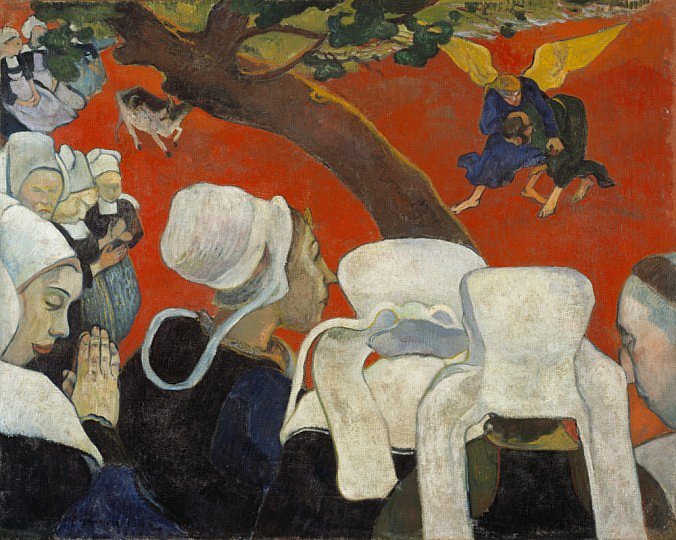
"Vision after the Sermon" by Paul Gaughin is featured
prominently in Death in Brittany by Jean-Luc Bannalec

8. I learned a heck of a lot about Paul Gauguin and (to me at least) the obscure group of artists who made up the Pont-Aven School in the fascinating German crime novel Death in Brittany (originally published as Bretonische Verhältnisse). I thought Gauguin moved to Tahiti and did all his most well known work in the South Pacific. Little did I know that he founded an entire style of painting in the small town of Pont Aven in Western France, that his early work done here is considered by the locals to be the birth of modern painting, and that he is celebrated throughout Brittany. Someday I’d like to visit this part of France which we completely bypassed the first time I travelled there.

9. Who doesn't learn something arcane when devouring a Christopher Fowler book? Take his latest, The Burning Man. Its pages are chock full of Guy Fawkes facts and legends and the origin of burning effigies that led to the annual celebration of the Gunpowder Plot. But I never need to double check on anything when reading his books because Fowler always gives you *all* the details you'd ever want.  And then some!

10. Even a former Brit Lit student like me needs a refresher in his supposed field of expertise. So when I came across Malbecco in a blink-and-you’ll-miss-it allusion in Catherine Aird's excellent impossible crime novel His Burial Too I was not so surprised that he turned out to be a minor character in The Faerie Queen. I wasn’t a fan of Edmund Spenser back in my college days. I tend to forget everything about that epic poem other than the Bower of Bliss section and that I found most of it boring as hell. Turns out that using the name Malbecco is an arcane way to call someone a paranoid jealous husband. He’s in Book III, Canto X (et al.) of Spenser’s seemingly endless poem if you want to read about him. I think an Othello allusion would've sufficed. What a show off that Catherine Aird is. Witty and smart, but a show off.