Showing posts with label occult. Show all posts

Saturday, October 31, 2026

HALLOWEEN SPECIAL: Mandrake - Oliver Sherry


THE STORY:  Research student of the arcane arts, and sometime occult detective, Tom Annesley has traveled from America at the request of some friends in London to search for their missing friend Hilda Brown. His search takes him to the town of Haddeston where he encounters a powerful sorcerer who has penetrated the darkest secrets of alchemy and Black Magic and discovered how to create and prolong life with the aid of a mandrake root. A series of hair-raising adventures ensues as Tom and his new found friends, Ethel Derrington and Rev. Hamilton Sturt, set out to put an end to Baron Habdymos and his rampant evil.

THE CHARACTERS: Mandrake (1929) is modeled on both early 19th century fairy tales and Victorian era "penny dreadful" shockers. Baron Habdymos, a thoroughly venal and evil sorcerer bent on dominating all mortal men, outdoes anything Dr. Nikola or Fu Manchu accomplished in any of their occult thrillers. In creating this master of the Black Arts Oliver Sherry has added one of the most horribly memorable villains in early 20th century supernatural fiction. Not only can he create life using ingredients that are more disgusting and flesh-creeping than those employed by the Weird Sisters at work with their double-bubbling troublesome cauldron he has the ability to shapeshift into any human of his choosing (as long as he has murdered them) and transmogrify into animals. Just like Fantomas with his many disguises one never knows when the evil Baron will be appearing in any given scene in some other form -- either human or animal -- which only adds to the spinechilling surprises.

Our trio of heroes Tom, Ethel and Mr. Sturt -- are the heroic, pure of heart and intelligent.  A fourth hero is added to this trio when Mr. Sturt's servant Dunsmore selflessly risks his life to pursue the Baron in one of his many disguises. Dunsmore views himself a stoic and less spiritual than the others thinking this will be beneficial in dealing with such an other-worldly adversary. However he, like the other three, underestimates the range of the Baron's arcane skills. 

Unlike other fictional occult detectives like Carnacki, Miles Pennoyer, Jules De Grandin and John Silence, Tom does not consider himself a master of the supernatural lore. He confesses he is still a student and sees his dearth of knowledge, ironically, to be his greatest asset. He glibly remarks to Sturt: "A student is rather too inclined to value knowledge apart from its use.  It is a kind of foolishness one is compelled to admire and imitate if one can."

Mr.  Sturt is the perfect foil for Tom. He has more common sense and coupled with his deep religious faith he is a voice of both reason and goodness. The two men also share a belief in amulets and talismans.  Tom wrote a book on the subject and Sturt read the work with great interest. He talks about a cross of gold and rubies that was stolen from him by the sinister Dr. Demos, one of the Baron's many alter egos, and we learn from Tom that artifact was most likely one of the hundreds of "rosy crosses" created by the Rosicrucians to protect them from evil.

Amulets and magical artifacts play a large part in the story.  Tom gives an iron ring to Ethel that he tells her is a powerful amulet that will protect her from the Baron.  Later it becomes an engagement ring when inevitably Tom falls in love with the young woman. Their almost instantaneous romance is one of the glaringly obvious fairy tale motifs Sherry includes.  There is even an almost unintentional comical moment when Ethel under an evil hypnotic spell is saved from the Baron's telepathic clutches when Tom out of love gives her a meaningful tender kiss. Ah, the course of true love saves the day!

INNOVATIONS:  The strongest aspects and the most thrilling parts of Mandrake are the Gothic excesses, the sheer number of supernatural incidents and the manner in which Sherry constructs his tale to end all of these action sequences with cliff hanger endings at the close of each chapter.  Even within each chapter there are cliffhangers and sudden shifts to other locales.  At times it seems as if Mandrake was modeled on a Saturday morning silent movie serial. The book certainly has enough moments that would work extremely well on screen. There is even one sequence when the townspeople of Haddeston rise up in revolt against the evil Baron and storm his usually shunned fortress of a house armed with torches, pitchforks, crowbars and other tools of the angry rural mob. It's right out of a Universal Pictures 1930s monster movie -- except it was written a couple of years before any of them were ever made.

In addition to fairy tale elements like magic rings, a magic mirror that foretells the future, transformations, and the power of true love's kiss, the book is teeming with "penny dreadful" grotesquerie and macabre set pieces.  Each chapter is packed with supernatural manifestation that surprise and shock both the characters and the reader.  The Baron works his evil magic in bizarre and unusual manners not often encountered in supernatural fiction.  Learning about the use of the mandrake root to create a homunculus then transforming it into a full size humanoid creature was eye-opening.  This may be used in contemporary horror but I've not come across a similar folk horror touch in any of the books I've read in this genre. The variety of identities that the Mandrake inhabits at the command of the Baron is sort of mind-boggling.

The constant shifting of scenes also creates a great deal of suspense for the reader knows so much more than many of the characters do. We can only hold our breath hoping against hope that none of our heroes fall into the many traps we know are being laid for them. Tom, the perennial student, has a foolhardy manner. His desire to know as much as he can leads him to more than his fair share of mortal danger and near deathtraps.

As the story progresses it becomes wilder and more fantastic as if Sherry was trying to outdo himself with every passing page. Whether the book was first published as a serial has never been determined, but it seems likely for it certainly reads as if it was designed to be read that way.  Even as I thought nothing could be more outlandish that the previous scene Sherry continues to impress with his lurid and macabre imagination. The most grotesque and shocking scene occurs late in the book when Tom is nearly run over twice by a madman in a sports car and he seeks refuge in the home of a miserly old man.  The house turns out to be no haven, but rather a literal house of horrors. I not only gasped, I actually cried out "Oh my God!" at one point while tearing through the paragraphs of this scene.

THE AUTHOR:  Oliver Sherry was the pseudonym of Irish poet and writer George Edmund Lobo (1894-1971).  In the limited edition reissue of Mandrake (Medusa Press, 2010) Richard Dalby, noted supernatural fiction scholar, has written a brief biography of the man. Dalby notes that while Mandrake was Lobo's first novel of the supernatural he supposedly wrote a second thriller called Brood of Death which was listed in Lobo's Who's Who in Literature (1930) entry.  However, no publication of that title is recorded in any reference books or newspapers.

EASY TO FIND? Mandrake has been an elusive collector's book for several decades now. There is exactly one copy of the 1929 Jarrold's edition of Mandrake for sale from noted sci fi/fantasy/supernatural fiction bookseller L. W. Curry.  And it's got a hefty price tag. I recommend you purchase a copy of the reprint from Medusa Press.  There are no used copies of this reissue for sale primarily because the book is 1. so scarce anyone will want to keep their copy and 2. it's beautifully designed and typeset. The photographs in this post are all of the Medusa Press edition.  There were only 350 copies printed and I have no idea how many are left now that 16 years have passed since it was published. But I got mine only two and half weeks ago. There may still be some copies for sale. And good news! The original price has been reduced by 25%, only $30 now.  Order directly from the publisher.  Here's a shortcut link for you.  


Monday, August 31, 2026

The Case of the Missing Sandals - Nancy Barr Mavity

THE STORY:  James "Peter" Piper, bespectacled, lanky reporter "with an ugly face" working for the Herald somewhere in northern California, is allowed access to the murder scene at a religious cult's colony. The victim, the domineering cult leader who calls herself Luna, claimed to be a witch in league with Satan. She is found both stabbed and shot, her hands bound in a strange fashion with the cord taken from a green and red bathrobe. Even more peculiar is she is found barefoot.  Earlier the same day she was killed Piper had a brief interview with Luna related to an accusation of the theft of $10,000 from one of her followers, He had seen her striking black satin sandals and knows she would never be caught dead without them. And yet she was. What happened to the shoes?  And why was she both shot and stabbed?

THE CHARACTERS:  The first half of The Case of the Missing Sandals (1930) deals too heavily with Earl Vincent who wrote some love letters found on Luna's body. He is the prime suspect for the police and the fact that he fled California on a freighter further underscores his probable guilt.  Several chapters are devoted to finding Vincent. Piper and police pursue the freighter and try to intercept it with a tug boat but Captain Marquand refuses to stop for the tug radioing the police that they will have to wait for the freighter to pull into port in Los Angeles.  When the ship arrives and the crew depart they discover that Vincent has vanished from the ship.  After another protracted pursuit Piper tracks down the young man and forces him to tell an elaborate story that convinces Piper that the lovelorn boy, supposedly in love with the murdered cult leader, is innocent of the crime. The police, however, refuse to look further than Vincent.

Once Piper turns his attention on the Luna Colony, the book becomes interesting, less laden down with monologues and overwriting, and focuses on detective work. Piper uncovers multiple suspects each with their own peculiar motives. Among the more fascinating characters are:

Ruth Morgan - Earl Vincent's girlfriend who serves as a foil for Piper.  She is determined to clear her beau's name announcing she is willing to do anything to find the real murderer.  In a chapter well past the midpoint she and Piper engage in the requisite tabulation scene in which Piper reviews all suspects, their motives and opportunities while Ruth listens patiently sorting out the probable from the preposterous and often ending each summation with her verdict of "not proven."

Frances "Frank" Hodgson - of all the suspects Frank is the most unique.  She dresses in men's clothes, professes an obsessive love for Luna and is caught by Piper at the murder scene long after police have left searching for what she claims is a special perfume Luna used to make for her. Based on her frantic behavior and twitchy nerves Piper sees through her lies, immediately coaxes a confession from her. She is a drug addict looking for her fix. Turns out Luna was not only a cult leader but a drug dealer. The more we learn about Frank the more we discover that she is a lesbian. Mavity is never daring enough to come right out and use that term however, but couches it all in euphemism and baroque phrases: "But this woman was patently one of Nature's tragic misfits, a victim of the warping fate that had veered her life away from its normal channels." Mavity goes on to describe Piper's assessment of Frank's personality (who he insists on calling Frances though she prefers Frank) with great empathy and feeling. When he sees that Frank is using her left hand due to an injured right hand he starts to formulate a theory that she could have killed Luna. The murderer stabbed Luna in such a manner that reveals a left handed assailant. And still listening to her story and seeing how she left behind a vase of cut flowers for her crush Piper confesses he is "somewhat more sympathetic to the murderer than to the victim." It is a poignant sequence in the book -- one of many such sympathetic musings for a misfit suspect. Still as is often the case in early 20th century fiction Frank is yet another gay character painted as disturbed and doomed: "Just how far toward madness her jealous obsession might have carried her he could not guess."

Albert Jackson - the blind caretaker and gatekeeper at Luna Colony.  Jackson, a Black man, is no stereotype or comic figure, thankfully.  He has two dignified scenes of gravitas with Piper towards the end of the book during which he likens himself to Piper. Both manage to see the truth, he tells Piper, while others live in darkness. There are interesting contrasts between real faith and spirituality and the pursuit of false idols also mentioned in these scenes. Mavity manages to pull off these scenes with a sophisticated touch using simple language and metaphor, never resorting to heavy handed preaching. Albert is a finely drawn character, perhaps the wisest of all people Piper meets and interviews.

Charlie Russell - A young cult member sent to the Luna Colony by his mother to be cured of a so-called bewitchment she feels has cursed her boy. Piper knows this is all superstition for it is obvious that Charlie, in both physiognomy and behavior is mentally deficient. His facial feature are described in such a manner as to match those of children born with what was once called Down's syndrome, now known as trisomy 21. When some new details about the case are revealed Charlie becomes the new lead suspect in the eyes of the police.  Charlie's presence, yet another outlier in this myriad cast, allows for Piper once again to show his emotional side.

Carey - Apart from Mrs. Russell Carey is Charlie's only ally and protector.  Described by Piper as a colorless, bland man not much older than Charlie he is something of an enigma. He appears to be one of the "true believers" of the Luna Colony. Later he refers to himself as an occult researcher.

Oscar Miller - One of Luna's many lovers and the object of envy and jealousy among many of the male members of the Colony.  He is seen hiding something of great importance in the hole of a tree trunk.  Piper later retrieves this object and confronts Miller.  He also owns a rifle that matches the caliber of the bullet used.  In fact, many of the characters own rifles that could be the murder weapon.

Amos Perkins - a mystery man who hires Harrison, a hire-powered lawyer to represent Earl Vincent. A handwritten note is sent to Harrison asking that he prove Vincent is not guilty of the murder.  Enclosed with the note is $1000 in cash.

INNOVATIONS: When Mavity finally gets down to brass tacks after the Earl Vincent section is disposed of The Case of the Missing Sandals is truly an intriguing, complex and engrossing mystery novel.  Piper is very much in line with the many reporter sleuths of early 20th century detective fiction. Ostensibly passing himself off as a cynic he is, in fact, a humanitarian with an open mind and a skill at abstract, often wildly imaginative, thinking.  In the tabulation sequence Piper finally reveals to Ruth Morgan that he is convinced that the solution of the case lies not in factual analysis but to put oneself into the mindset of someone wholly devoted to the world of superstition. The murder is almost ritualistic what with the strangely colored cord used to bind the victim and the outrageous use of two murder methods to kill Luna. The placement of love letters on her breast after she was dead and -- most importantly -- the removal of her shoes both seem to underscore a kind of supernatural ritual, or a curse placed upon her. Ruth Morgan tries to accept  Piper's theory as a possibility but it all sounds too outlandish to her practical mind.

Of course, Piper is on the right track. For in the end it all really comes back to the title of the novel.  While perusing a non-fiction work called Witches Still Live -- an actual book by Theda Kenyon published in 1926 by Ives Washburn (see photo) -- Piper stumbles across the reason Luna's shoes were stolen. Armed with this arcane trivia and with the help of Andrews, his photographer colleague at the Herald, he sets a trap for the murderer in a well done, somewhat stunning, finale.

QUOTES: Piper: "The story isn't dead, even temporarily. [...] There are angles to it -- angles and angles. And while the other reporters are all enjoying the lull and concentrating on Vincent, I'll be out angling the angles -- a regular complete angler I'll be."

Piper: "When you try to figure [all these motives] together, its enough to make you dizzy. And as for proof-- say, if I saw one single little sold fact that didn't change its shape while I was looking at it, I'd faint from sheer amazement!" 

Jackson: "There's two kinds of darkness. There's them that walks in darkness because they can't see their way ahead, and there's them that have eyes and see not. It ain't your fault if it's still dark. You used your eyes as good as you could. That's how I know you're him that was sent. The spirit of darkness is on this place. The spirit of fear is on it. You can't see it, and you can't touch it, but you can feel it. Because you can feel the thing that can't be seen, you'll use your eyes to see when the light comes. That's why you were sent."

 Jackson: "Facts are dangerous things to throw around when you don't know the meaning of 'em."

THE AUTHOR:  Much to my surprise Nancy Barr Mavity (1890-1959) has an entire Wikipedia page devoted to her life and work as a journalist, novelist and author of non-fiction works.  I won't bother to repeat any of it here.  But I will draw your attention to her book Sister Aimee (1931) published one year after this novel was released by Doubleday Doran's Crime Club.  Sister Aimee was the first full biography on Aimee Semple McPherson and it's not too coincidental to draw comparison between that charismatic evangelist (possibly a criminal and fraud) to the power mad, exploitative and cruelly Satanic Luna who dies so horribly in this detective novel. Apparently many of Mavity's crime novels are based on true crime cases.  Further details on which cases inspired her novels can be found in an introduction written by Randal Brandt, research librarian and curator of a crime fiction library at UC/Berkeley, that appears in the Penzler American Mystery Classics reprint of The Tule Marsh Mystery, Mavity's debut novel as a detective fiction writer.

EASY TO FIND? Several copies of the US edition are  available for sale from a variety of online bookseller with prices ranging from  $14 for a reading copy to $48 for a VG copy.  There is one copy with a VG+ dust jacket priced at $425.  I found no UK editions for sale.  I did not look for copies in internet archives but there may be one out there. I have a copy of this book myself, but will not sell it as it is signed by the author and inscribed to her fellow California journalist Alma Whitaker. Took me a while to decipher the addressee’s last name, but that’s definitely the name. In the brief inscription Mavity calls Alma "Best of the Good Scouts", a term Piper also uses to describe his co-worker Andrews, the photographer. A photo of the smeared inscription is included in this post.

Wednesday, August 9, 2023

Psst... Over Here!

Hello, there! Remember me? I think eight month’s hiatus is a little too long to have taken for what I thought was going to be “a little break”. What have I been up to? Oh, this and that…

I came to realize that like many collectors I had gradually turned into a monomaniac of sorts and I didn’t like it. My literary anecdotes were boring people and more importantly I was boring myself. I wanted to avoid vintage detective fiction for a while. It was long time that I returned to reading contemporary fiction of all types, reading non-fiction (!) that led me to seeking out the histories and memoirs that once upon a time I enjoyed even more than mystery novels. As I veered away from detective and crime fiction I rediscovered my passion for supernatural horror from all eras. In the process I learned that there has been a revival of “traditional” supernatural fiction in the past three years similar to the renaissance in detective fiction (both reissues and new writing). Quite an eye-opening surprise and a delightful one for someone like me who has always loved ghost stories, haunted house novels, and metaphoric treatments of the monster hiding under your bed.

And so after eight months I’ve come full circle and I’m ready to share with you some of the unusual and intriguing titles I’ve devoured since December 2022. Like this one…

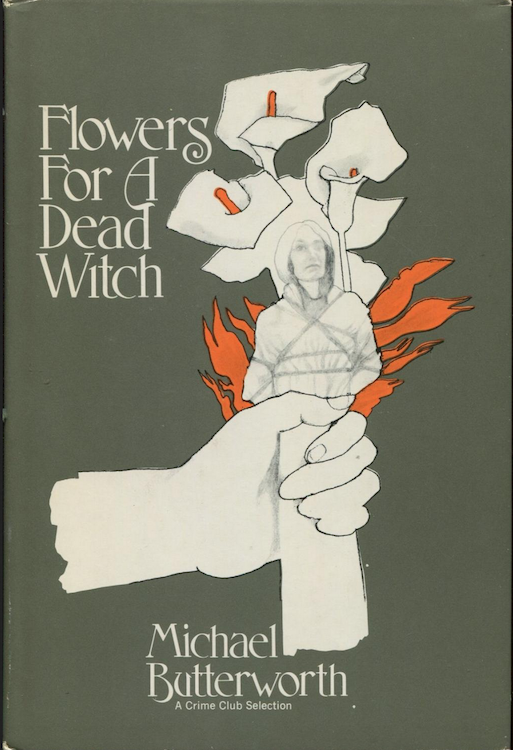
Flowers for a Dead Witch by Michael Butterworth

Readers of this blog will know that I love a good mystery novel dripping with Gothic elements and accented with witchcraft, hexes, black magic, voodoo, hoodoo or whatever the author is calling it. Butterworth’s third mystery novel is a brilliant example of the first revival of traditional mystery writing that occurred back in the 1970s. In Flowers for a Dead Witch (1971) he gives us what at first seems to be yet another of those Gothic “romances” that filled bookstore shelves and drugstore spinners five decades ago. Polly Lestrange travels from Canada to Suffolk to visit her bedridden ailing great-aunt in a crumbling medieval manor complete with moat surrounding the entrance. She is greeted by Miss Chesham, the great-aunt’s over protective companion who refuses the Polly’s request to visit the old woman. Even the local physician caring for Great Aunt Granchester insists that Polly leave the old woman alone. Well, what Gothic heroine is going to listen to either person? Certainly not this one and Polly determinedly breaks into the old woman’s room one windy and rainy night (of course it rains a lot in this book. It has too!) to discover… Oh, but that would spoil it all. The old woman has a secret of course and it will only be revealed in the final pages.

Before the startling conclusion – which I confess really took me by surprise – our plucky heroine will encounter a ragtag group of rebellious teens, rumors of a witchcraft cult cavorting naked in the moonlight, an ancient cemetery home to a mausoleum containing the corpse of a woman executed for witchcraft 400+ years ago, and literally stumble upon what appears to be the charred remains of that executed witch. But how is that possible? A 400 year old corpse of a woman burned at the stake would be nothing but rotting bones if not a pile of dust in 1971. The body found in the coffin in the mausoleum is freshly dead, and burned beyond recognition. When both the local reverend and his wife go missing whispers of foul play mix with the rumors of witchcraft.

This was the first book I’ve read by Michael Butterworth (1924 – 1986) who prior to turning his hand to bizarre crime and mystery novels was primarily known as a writer of comic books. Oh! A warning: Don’t confuse him with another (still living) writer of the same name who wrote science fiction novels and SF TV show novelizations. I had to notify the Admin of a crime fiction website that he conflated both Butterworths. I advised him to remove all the SF titles from the mystery writer Butterworth’s bibliography. He speedily updated that page on his website.

If Flowers for a Dead Witch is any indication of what Butterworth is capable of then I’m eager to check out as many of his other books that I can find. Most satisfying is that this is a legitimate detective novel with fair play clueing. Assiduous readers may catch onto what I overlooked as I foolishly fell for all of the writer’s rather clever red herrings. Butterworth mixes the formulaic plot of those 70s Gothic romances churned out by writers like Phyllis Whitney, Victoria Holt, and Mary Stewart with genuine mystery novel conventions and thankfully improves on both. Of course with a generous helping of creepy superstition and lurid witchcraft legends the plot is considerably spicier and more intriguing. I thoroughly enjoyed this book and completed it in a speedy two days. There are several copies available for sale out there in the vast shopping mall of the internet. I’m sure it ought to turn up in local libraries both in the US and UK. Check it out!


Michael Butterworth Crime & Detective Novels

The Soundless Scream (1967)
Walk Softly in Fear (1968)
Vanishing Act (1970) (US title: The Uneasy Sun)
Flowers for a Dead Witch (1971)
The Black Look (1972)
Villa on the Shore (1973)
The Man in the Sopwith Camel (1974)
Remains to be Seen (1976)
Festival! (1976)
X Marks the Spot (1978)
The Man Who Broke the Bank at Monte Carlo (1983)
  -- adapted into a musical: The Lucky Stiff by Ahrens & Flaherty
A Virgin on the Rocks (1985)
The Five Million Dollar Prince (1986)

As by “Sarah Kemp” – all feature Dr. Tina May, a psychiatrist detective
Goodbye Pussy (1978) (US title: Over the Edge)
No Escape (1984)
Lure of Sweet Death (1986)
What Dread Hand (1987)

Friday, April 23, 2021

FFB: Pray for the Dawn - Eric Harding

THE STORY:  The relatives of explorer and trader in African artifacts Nathan Claymole are summoned by invitation to visit him at his remote home isolated on a island surrounded by a torrential stream called the Boa. Some will be meeting him for the first time in their lives. In the letters of invitation Nathan has promised that each person will "learn something to your advantage." Little do they know what the night has in store for them.  A weird ritual is about to take place on this night of the full moon, the dead will rise, and the family will fear for their lives as they Pray for the Dawn (1946).

THE CHARACTERS: The novel is narrated by ballet dancer, and sometime actor Barry Vane, nephew to Nathan Claymole. Barry is down on his luck due to a disabling injury that has ended his career as a dancer and performer.  Lack of work has resulted in dire financial straits for Barry.  He is hoping that this "something to his advantage" promised in the invitation will be a boost to his impoverished bank account. There are seven other relatives who are also eager to find out why they were invited and what news Nathan has for them.

Caroline Claymole - Nathan's sister. A religious zealot and termagant extraordinaire who spends much of her time harassing and belittling her daughter...

Betsy - mousy bespectacled teenager browbeaten into submission by her tyrant of a mother. She seems to have no personality at all, or has had it eradicated by her overprotective mother's domination.  But Betsy has a shocking secret that will change how she is viewed by everyone later in the novel.

Uncle Oscar - Caroline's wimpy cousin who spends much of the book silent and hiding in the shadows.  But he also has a secret and a hidden aspect to his seemingly Casper Milquetoast persona

Jonah Clay - the oldest of the guests, Nathan's uncle and Barry's great uncle. Ancient and barely able to walk he is described by Barry as "Death outliving the grave." Nearly forgotten by the group he snoozes and mumbles in a corner until it's time to escort him upstairs to his room

Sylvia Claymole - the ingenue of the piece is lovely to look at, generous and kind to Betsy. Drawn to Barry's gentleman’s nature she will soon fall to pieces and become the most paranoid and fearful of the group.

Bret Janson - the American cousin and requisite dashing yet arrogant man that always shows up in these stories of gathered relatives. He spends a good portion of the book drinking heavily to fend off his fears  

Tobias Judd - husband to one of Nathan's nieces who has apparently died unknown to the host. Judd has come in her place eager to learn what was promised to his wife.  He is the most suspicious of the group and Nathan is wary of ulterior motives.  Judd will turn out to be the most human, the one with the most common sense and, as the most level headed and courageous, ultimately he is the detective hero.

Nathan is assisted in his large lonely house by an African servant named Kish.  This is perhaps the one aspect of the book that will prevent it from ever being reprinted. Kish's presence allows Harding to go to unnecessary lengths in talking about "jungle primitives" and the ominous nature of exotic foreigners. The book is littered with paragraphs contrasting civilized British life with the dark impulses of the jungle, the savage nature of Africans. What little interior decoration can be found in Nathan's home consists of African and South African artifacts. Strange masks and weapons decorate the walls and --most bizarrely -- shrunken heads also pop up in the decor scheme. Kish is not just a servant but also the personification of the Voice of Doom constantly uttering ominous statements in his pidgin English like "Dead sometimes come to life" and "Have care Boss. Strange ground."

And of course there is N'olah, the dwarf witch doctor whose corpse has been kept in an alcove room underneath a staircase.  Nathan and Kish have kept a vigil all night, the 10th anniversary of the death of the South American shaman of the lost tribe of the Javiros who live in the Amazon jungles. [Yes, there was a corpse kept in the house for an entire decade.]  Nathan expects that the witch doctor will be resurrected after some odd ritual magic and African mumbo jumbo. His guests are quite rightly disturbed and frightened.

When the body vanishes due to a mix-up in the changing of the guard, so to speak, between Nathan and Kish the guests’ reactions range from unsettled to outright terror.  Many of them actually believe that the corpse has come to life. After hearing the strange story Nathan has told about why he and Kish brought the body back from South America the relatives are convinced the zombie is out for revenge.  A search is arranged with Toby leading one group and Nathan leading another. They two groups head off to find out if the corpse has come to life or if it was ever a corpse to begin with.  Eerie events, fights, scuffles, and attacks occur for the next several hours. Nathan orders that the bridge crossing the violently coursing stream be destroyed which will prevent N'olah from leaving but also prevents all the guests from escaping the island.  When Jonah is found strangled in his bedroom the novel begins to seem more and more like And Then There Were None redux with a zombie on the loose as the killer. At this point horror and hysteria are unleashed at full throttle.

ATMOSPHERE:  Speaking of hysteria unleashed...  Most striking to me is the manner in which Harding sustains the dread, fear and paranoia. It infects the entire group like a horrible virus. Oscar, the wimp, is seen growling and snarling at Barry. Sylvia loses control and keeps ranting about their collective demise: "Eight nooses!  Eight guests!  We're all going to be murdered!"  But it is Caroline's transformation from spinsterish finger-wagging Bible thumper to full-blown religious maniac that serves as the climax of the book.  

In one of the longest and creepiest sections of the novel Barry, Sylvia and Toby pursue Caroline into the labyrinthine cellars of Nathan's ancient home.  There Caroline finds Kish in front of a firelit altar performing an outlandish ritual complete with African chanting, and ecstatic dancing.  She and Kish have a battle and she ends up destroying a wooden idol he was directing his chanting toward.  Caroline has made both a literal and figurative descent into madness all because her daughter has gone missing.  She fears the worst and no one can find Betsy.  In the midst of her insane fight and destruction of the idol she reveals the deep dark secret that is at the core of Betsy's lack of personality.  It's a shocker of a confession and gave me a thought. I suddenly realized that there was a parallel to this book and Stephen King!

Caroline --who is called Carrie by her relatives -- is a religious zealot overly protective of her mousy personality-less daughter who everyone else sees as a freak. Ring any bells? This coincidence just blew my mind. Caroline, her relationship with Betsy, the heavy-handed quoting of Biblical passages and general over-the-top religious kookiness uncannily foreshadow Margaret White and her relationship with her own freak daughter in King's debut novel Carrie written three decades later. Both Carrie White and Betsy Claymole have a secret connected to violence. While Betsy is not a telekinetic monster when enraged she is just as murderously dangerous.  Perhaps it's a wildly imaginative stretch to think that King might have come across Pray for the Dawn in his youth, but he has been known to borrow from everywhere, horror comic books to old TV movies, for his plots.  Of course it might all be coincidence but it's a mighty crazy coincidence, if you ask me.

INNOVATIONS:  Harding includes an "Author's Note" (see the photo at right) at the start of the book stating that Pray for the Dawn is not a detective novel. He goes into detail to justify why the book is structured the way it is and why it shouldn't be considered a "fair play" detective novel, but rather an adventurous thriller. But that disclaimer, of sorts, is a huge red herring. The book is indeed a detective novel, albeit a very unconventional one. Scattered throughout the story are multidinous red herrings all of which I fell for alongside several cleverly planted clues that can lead you to figuring out exactly what is going on, who the murderer is, and why Jonah and one other person were strangled.

It is not unfair of me to reveal that all of the supernatural events will turn out to be rationalized. For all the hysteria and horror encountered within the pages of this genuinely terrifying and thrilling book there is no black magic at work, no ghosts, no zombies.  But it is rather obvious at the midpoint of the book as Toby Judd reminds Barry and Sylvia that the spooky events are all being engineered by some madman. But exactly who is it?  What happened to the dwarf witch doctor's corpse? Why are the nooses being used to strangle the victims? And what is the purpose of the secret dossier on all the guests which reveals the details of their lives including all their secrets?

THE AUTHOR:  Eric Harding is perhaps a pseudonym for a writer that no one knows very much about. He is the author of only two crime novels Pray for the Dawn (1946) and Behold! the Executioner! (1939), both titles so scarce that they are nearly impossible to find anywhere. I found only one person of note who used Eric Harding as a pseudonym but he turned out to be Eric Harding Thiman (1900 - 1975) organist, composer of songs and church music and Professor of Harmony at Royal Academy of Music.  Thiman's biographical information is rich with his accomplishments as a musician, composer and academic and I learned that he wrote a few songs early in his career using the name Eric Harding.  Is he also responsible for these two bizarre crime novels in that guise?  Anyone who knows anything about either man, please feel free to enlighten us all in the comments.

Friday, March 12, 2021

FFB: The Crime in the Crystal - Robert Hare

THE STORY: Portrait painter Elton Cleeves sees a vision of his nephew he before the man is found dead. Cleeve’s vision showed his nephew grasping one wrist then holding the other arm outstretched before collapsing. Minutes later Cleeves receives a telephone call informing that his nephew’s body has been found in a wood not far from the uncle’s home, he has been clubbed to death, a wound to the left temple and a bruise on his right wrist – exactly as in the painter’s vision. Believing he is clairvoyant Elton begins to investigate the crime by psychic means. He consults a crystal ball and believes he has seen The Crime in the Crystal (1933)

THE  CHARACTERS: His physician Dr. Adrian Berwick is concerned for Elton’s mental health. He thinks the elderly man is crumbling under stress and suffering from hallucinations. Adrian confiscates the crystal ball and keeps a watch on his patient. A physical examination raises concerns about the possibility of poison. Berwick does some sleuthing by analyzing chemical properties of Elton’s art supplies and uncovers a shocking plot.

Meanwhile Inspector Gearing is beginning his investigation of Dr. Michael Cleeves’ murder. Though the many routine interrogations we learn that Cleeves, the nephew, was an intolerable hedonist, nearly always drunk, gambling, and leading a libertine’s life. Uncle Elton lost all respect for his nephew, had turned his back on him and instead focused his attention and affection on his grandniece, Helena, the physician’s daughter. There are two guests of the physician who have moved into a small cottage on the Cleeve’s estate and they have had an insidious influence on Helena, normally a simple conservative young woman, almost a relic of the Edwardian era like her great uncle, she is surrendering to her father and his guests’ wild pursuit of cafes, bars and urban nightlife. Uncle Elton convinces Insp. Gearing that these guests, a brother and sister named Vincent and Irene Youles, have had a hand in his nephew’s death. Vincent has been paying extra attention to Helena with the intent of proposing marriage. Irene had been flirting with Dr. Cleeves and seemed to be thinking the same. The Youles, Elton tells the police, are nothing but “avaricious adventurers” and he is certain they plotted to do in the doctor hoping that Helena would inherit his money.

The joke’s on them, however, for Elton had several weeks ago disinherited Michael and made Helena his primary beneficiary. This makes the possible poisoning of Elton Cleeves all the more sinister. It is entirely possible that the Youles are so eager to marry rich that they will murder anyone who stands in the way of their plot to gain control of Helena’s money.

INNOVATIONS: Gearing and Dr. Berwick make an interesting detective team. Berwick with his scientific mind and a clearheaded common sense outlook contrasts with the near inhuman determination and obsessive mind of Gearing. Amusingly, Berwick tutors himself on “Investigation, Criminal” by reading a lengthy entry in an encyclopedia in the Cleeves library. He looks to this anonymous article as his inspiration to find the killer of Dr. Cleeves’ and the poisoner trying to murder Elton Cleeves.

All the while the idea of clairvoyance, omens, messages from beyond and the ability to have visions about the past and future haunt both Dr. Berwick and Elton Cleeves. A watercolor portrait of what appears to be Helena as a child turns up, but the date of 1885 proves it cannot be the grandniece because she was not born until 1911. Is it possible that this painting is also proof that Elton has some psychic gift? Could he have foretold the birth of his nephew’s daughter decades before she was even alive?

QUOTES:   All things are born and make their first growth in the dark, and premature exposure may kill them. So it is with ideas.

Was not the whole world made up of strange and extraordinary things which only the dullness of our senses had reduced to the level of the drab and commonplace?

The reawakening of memory! he pondered upon that, and with the thought there came -- as though it had sprang from the crystal itself -- an idea as startling in its inception as it was terrible in its implications, a supposition not quickly to be set aside. The shadows which darken the corners of a room...have a disturbing quality in their shapelessness which induces the beholder to clothe them with images of his own creation; because there is nothing we fear so much as a thing without form. ...[A]re they real, or must we account them the unnatural vapors of a disturbed imagination? For it is to be remembered, Adrian realized, that there are shadows in the corners of the mind as well as in the rooms of an old country house.

SUMMATION: The Crime in the Crystal is the first of three works of ingenious crime fiction by American writer Robert Hare. It’s a remarkable debut, such that in marketing the book Longman’s managed to get bestselling detective novelist J. S. Fletcher to write a laudatory foreword in which he succinctly describes why the book is a noteworthy contribution to the genre. Fletcher summed up Hare's work: "The highest praise that can be given to this first effort is to say that here is a story not only worth telling but told in really distinguished fashion." This is no hype, circa 1933, it's 100% accurate.

Hare’s second novel was an equally praiseworthy amalgam of inverted crime novel and detective novel The Doctor’s First Murder (1933) He rounded out his trio of works with The Hand of the Chimpanzee (1934), an over-the-top homage to weird menace stories of the 1930s pulp magazines like Dime Detective that nevertheless is an ingeniously plotted, albeit lurid and outlandish, traditional detective novel. I have recently discussed ad nauseum all three of these books in the "In GAD We Trust" podcast about rare and hard to find books that deserve reprinting. Having finally read the first of this trio of highly inventive and imaginative detective novels I will just reiterate what we’ve all said many at time: Will some enterprising publisher please reprint these books? Thank you.

Tuesday, February 23, 2021

Don't Rely on Gemini - Vin Packer

What’s your sign, girl?
Is it compatible to mine?

If your sign matches mine
Think of what we'll have
We'll be making babies together, forever

“What’s Your Sign, Girl?” - Danny Pearson/Tony Sepe

When I first moved to Chicago I religiously checked my own horoscope on my birthday in the Sun-Times because they include a section called “If Your Birthday Is Today…” and below would be a paragraph about what the coming year had in store for me – and the thousands of other people born in the same day, of course. I would cut it out, put it on my fridge, and review it on the day before my birthday. Invariably it was 90% wrong. But I never bothered to think about all those other people who were born on the same day in the sign of Sagittarius. How did the year work out for them?

That’s the premise of Don’t Rely on Gemini (1969), “a suspense and astrological novel” from the wildly inventive Vin Packer, aka M. J. (Marijane) Meaker. I didn’t for a second believe the hype on the paperback's cover promising “the most gripping spellbinder since Rosemary’s Baby.” For some reason throughout the early 1970s anything that remotely had anything to do with occult, supernatural or even New Age topics were tied to either Rosemary’s Baby (1967) or The Exorcist (1971) or both. The astrology element in this book is used merely to study the concept of parallel lives. A savvy and better-read editor would have done well to compare Packer’s novel to the works of Charles Dickens because coincidence and family secrets run rampant in this book. But would a quasi-literary analogy like that sell books? You bet your crystal talisman, it wouldn’t.

So let’s start with this concept of astro-twins living parallel lives. Astro-twins are unrelated people, complete strangers, who were born in the same year on the same date at the same time. Everyone has at least one astro-twin – well, actually everyone has hundreds, perhaps thousands of astro-twins. And that ought to make all you only children feel a lot less lonely, right? You have myriad siblings who are your astro-twins. But in all likelihood you will never meet them or know them. Regardless, they may be living a life similar to your own. That’s at the core of Don’t Rely on Gemini. And yes, the astro-twins we will meet are born under the sign of Gemini. According to all the mumbo jumbo we are forced to read Gemini is apparently one of the least favorable signs of the twelve in the crazy mixed-up world of the Zodiac. Not just unreliable and mercurial in temperament and obsessive about jobs and hobbies and projects, but apt to lose interest in those projects because of that gosh darned unreliable, mercurial personality.

Archie Gamble is the head writer of a TV special featuring the renowned astrologist Anna Muckermann. In order to add legitimacy to the show Mrs. Muckermann wants to talk about astro-twins and have a few on the air to talk about their lives. Mrs. M has documented evidence of several cases of astoundingly parallel lives in astro-twins that she offers up to Gamble, one case dates back to the days of George III. She insists that the TV show will be a huge draw if people are confronted with the truth of two strangers with the same star charts leading similar lives. This she claims will be proof that the rotation of the planets and other celestial activities do indeed rule our lives. When the moon in the seventh house and Jupiter aligns with Mars not only will peace guide the planets but the ratings will probably go sky high. Or so Mrs. Muckermann and Archie hope.

Staff members including Archie Gamble himself give out their birthday info and ads are placed in newspapers to lure in prospective volunteer astro-twins. There are several bites. The most fascinating comes from Margaret Dana who volunteers her husband Neal as a match to Gamble’s birthday data. She invites Gamble and his wife Dru to her home to meet her husband and discuss the possibility of appearing on the TV show. Sounds like fun, right? But this is a crime novel. Guess what follows? Worse than Mercury in retrograde, my friends. Being born in the house of Gemini with Saturn rising adds up to a volatile Molotov cocktail of a star chart as we will soon find out.

A fight happens at the Dana household just as the Gambles are about to arrive. In the course of the heated argument someone dies as the result of an accident and then – Ding, dong! It’s Archie and Dru on the front porch ready for dinner. And a dead body at the foot of a staircase inside. A bottle of wine is not going to solve this inconvenience.

But that’s not the worst of it. Neal Dana never knew about the Gambles coming because his wife was being coy in holding back the surprise of the evening. Neal, you see, was hoping that his wife was going out to her Italian lesson so he could have yet another secret tryst with his adorable mistress Penny. While making up a tale about his wife leaving the house and ushering the Gambles off his porch Dru Gamble hears a woman crying in a back room somewhere. She is sure it’s Margaret but she and Archie agree to leave because something certainly is not right and they are clearly not welcome. So the Gambles drive away.

Then… Archie loses control of his car going down the treacherous hill that leads to and from the Dana house. He crashes into a tree. They have to go back to the house and ask for help. Just as Neal Dana is about to bury the body in the backyard!

Don’t Rely on Gemini sounds initially like a lurid tale from the preposterous world of pulp fiction. Noirish to the core everyone seems utterly doomed amid the insanely surreal action and a pile-up of plot contrivances. Meaker, however, is playing with a loaded deck here. Each contrivance and coincidence is carefully calculated to twist the story toward her theme as she dares to play with superstition and fatalism in allowing her characters to surrender to fate rather than make well thought out decisions. She manages to juggle the ostensibly absurd moments with a very deadly combination of characters who are easily manipulated and those who give in to obsessive thoughts. Mrs. M proves to be perhaps the most dangerous person of all. In her zealous beliefs and dire pronouncements she contaminates the Gamble’s marriage and their relationship by planting seeds of doubt and foretelling impending doom if the couple does not follow her advice. Saturn is ruling their lives; failure to heed all the warnings will lead to disaster. The law of astro-twins does not lie!

The real conflict, however, has nothing to do with astrology. It is the Gambles’ perception of reality. They know nothing about Penny and Neal, unlike the reader, and they assume that a car that belongs to Penny is actually Margaret’s, that each time they see the green scarfed woman in the Ford Falcon they think they see Margaret. Dru learns of Margaret’s affair with a young man from a diary and letters she finds through yet another one of the many coincidences Meaker packs into her story. At the same time Archie is trying to decide whether Neal’s parallel life is worth putting on TV Dru is trying to protect Neal Dana from discovering his wife’s affair.

But, of course, we know what Archie and Dru don’t – that Margaret is dead. That Neal is having an affair of his own with Penny. Neal becomes dangerously obsessive about Margaret, his guilt overpowering him. Penny is fearful she is losing her older lover and she’s right. She can never hope to gain back his attention when he’s drowning in such a powerful nostalgia, she cannot compete with the memory of the perfect wife he is creating in his mind. Nothing can tarnish that memory just as no one can bring Margaret back to life. Someone is going to have to pay the price for that horrible accident. But wait…was it an accident? Didn’t Penny push Margaret down the stairs?

Don’t Rely on Gemini is not only an intriguing thematic exploration of the perils in surrendering to fate it’s also a pop culture smorgasbord of late 1960s America. The book is brimming with brand names, musicians, movie stars and authors including mystery writers Margery Allingham and Mary Stewart. Everything from various models of domestic and imported automobiles to Barry Farber, radio talk show host on WOR and WMCA. Even the plus size dresses and a joke about the maternity line of Lane Bryant crop up in the story. Rock and folk music play in the background of certain scenes as much as Archie’s favorite recordings of operatic arias. Neal disappears into his record collection as well in one of the telling moments playing up the parallel life angle. He plays selections from The Pajama Game original cast album or classical piano music from a William Kappell record to conjure up memories of his dead wife. At other times it feels as if the characters are like the intellectuals of Helen McCloy’s sophisticated Manhattan of the 1940s for the novel is also inundated with literary allusions covering Shakespeare, D. H. Lawrence and the 17th century poem “The Meditation” by – get ready for another coincidence – the obscure philosopher and theological poet John Norris. I could have written an entire blog post on "Things I Learned" alone there was so much popping up within this story.

This was the last novel Meaker wrote using her "Vin Packer" pen name.  The 1970s found her turning to juvenile novels which apparently were her most successful books.  I have acquired several of the Packer books over the years, but oddly this most recent one (originally purchased for last year's "Friday Fright Night" meme but proved less suited for that Halloween feature) is the first I've read.  I'll be digging out the other Vin Packer books I own and tearing through them throughout the rest of this year. Stay tuned.

Monday, April 13, 2020

HORROR SHOW: Tiger Girl - Gordon Casserly

Despite the subtitle on the original first edition cover of this genuine supernatural novel Tiger Girl (1932) is not really a love story. But is most definitely set in the jungles of India. True, there is an underlying love triangle being played out between two men vying for the attention of the young woman, but it is not the focus of the plot. Why it was marketed as a romantic love story amazes me. Anyone hoping for a hearts and flowers traditional romance would have been sorely disappointed -- most likely appalled -- at what they found in the pages of this outlandish ghost story. Here's just a sample:
  • Vampiric gray-furred tiger
  • Demonic female phantoms
  • Reanimated corpses
  • Astral projection
  • Telekinesis
  • Death by mind control
  • Cult that performs human sacrifice
Personally, I was not expecting a love story at all. And I was genuinely thrilled with what I found in this enthralling and thoroughly researched work of supernatural fiction. More thrills than I ever expected, in fact.

Alan Stuart is our hero, Margery Webb our plucky heroine, and Morton, Stuart's rival and the novel's human antagonist. When a a grey skinned tiger invades the Indian tea plantation owned by Margery's father Stuart turns hunter determined to track down the man-killer. He is warned by the superstitious locals that this will be no easy task for the tiger he is looking for is not an animal but a demon. Legend has it the shaitan kills only women and drains their bodies of blood. Bullets do not seem to harm this predator as Stuart soon finds out in his several battles with the phantom beast.

Meanwhile Morton plots revenge after he is spurned by Margery who he was hoping to marry. Morton allies himself with a powerful yogi who practices black magic and has paranormal skills including astral projection and the ability to revive corpses. Stuart must also contend with a mad elephant on the rampage and a bizarre religious cult that worships Kali for whom the tiger acts as a sort of human sacrifice delivery service.

A scene in which a minor character who, while looking for the rogue elephant hides himself high in a tree, witnesses the cult's ritual ceremony is one of the most gruesome in the book. But the climax of the book surpasses the cult sequence with genuine horror and follows with several scenes of more mystery and supernatural incidents. The action keeps building to an unnerving finale with a completely unexpected twist similar to something one might encounter in a murder mystery.

Tiger Girl has been one of the most elusive supernatural thrillers for decades having been out of print for over seventy years. Vintage copies are difficult to track down or absurdly priced when they ever so rarely turn up for sale. Thanks to Bruin Asylum and the efforts of some savvy collectors of supernatural fiction there is a new and affordable edition of this minor classic. Bruin Asylum's reissue has a brief but detailed biography of Gordon Casserly, highlighting his military service and life in India, as well as discussing his handful of adventure and supernatural novels. The new edition ends with an appendix consisting of an engrossing chapter from Occult Science in India and Among the Ancients (1875) by Louis Jacolliot, a non-fiction work briefly mentioned in the novel's story. His writing is just as evocative, fascinating and thrilling as Casserly's fictional story.

I urge fans of  forgotten supernatural and horror novels to buy a copy of this formerly out of print minor masterpiece. This attractively produced volume proves that it really was worth the long wait to have a new copy at a very affordable price.

Friday, April 10, 2020

FFB: The Footprints on the Ceiling - Clayton Rawson

In preparation for my upcoming "In GAD We Trust" podcast with JJ (of The Invisible Event) on stage magic, theatrical devices and misdirection in GAD fiction I thought I'd finish up the series of Great Merlini mysteries which shamefully have been on my shelves for over twenty years and still remain unread. I did not get along with Death from a Top Hat (1938) when I read it decades ago, but I did very much enjoy all of the Don Diavolo stories Rawson wrote as "Stuart Towne" which I gobbled up within days and wished there were more. Since I was approaching this read from an older and wiser perspective and also because I was specifically looking at tricks and misdirection I did enjoy The Footprints on the Ceiling (1939) almost as much as the Don Diavolo novellas. There are still elements of the Great Merlini novels that irritate the hell out of me and I'll talk about those in the podcast, but here's my basic impression of the book along with "Things I Learned" (as you will with any of Rawson's mystery stories and novels) that seem to make up about 75% of the book.

This is one of the many mysteries between 1900 and 1940 dealing with spiritualism debunking and the trickery and gadgetry that was (and probably still is) employed by fake mediums and phony psychics.  Two characters from Death from a Top Hat re-appear in Footprints on the Ceiling in an altogether different light and play much larger roles in the novel.

Merlini is going to host a new radio show on NBC called "The Ghost Hour" and his pal Colonel Watrous asks him to come to Skelton Island where their former associate from Death from a Top Hat Madame Eva Rappourt is hosting a seance for agoraphobic Linda Skelton obsessed with psychic phenomena and the drug induced trances she thinks will help cure her of her mental illness. Watrous is beginning to think that Madame Rappourt, whose powers he previously extolled in a book called Modern Mediums, is in fact one of the most clever frauds he ever encountered. Merlini and his playwright friend Ross Harte (our narrator) travel to Skelton Island armed with skepticism and infrared cameras hoping to catch the medium in the act of an elaborate charade and expose her with the photographs they plan to take while the seance is conducted in the dark.

Of course something goes wrong the minute they arrive on the island.  On route to the seance Merlini tells Harte about the legend of a pirate who supposedly haunts the island.  The two men see lights in an abandoned house on the north end of the island and rush to investigate. There they find the rigid dead body of Linda Skelton who has apparently been poisoned with cyanide. How and why did an agoraphobic who never left the main house end up so far away? And who killed her?

The story is one of the most complicated plots I've read of any era, let alone the Golden Age.  It's filled to the brim with baffling incidents that all seem to be impossible. A fire that no one could have started, the transporting of Linda's body to the haunted house, a bullet that seems to have traveled around a corner at 45 degree angle, a seemingly encoded message found on a typewriter ribbon, a nude body found in a locked hotel room, and of course the titular marks found on the ceiling at the scene of Linda Skelton's death. Magic, misdirection, acrobatics and clever gadgets all play a part in the solution of the various mysteries and murders.

There are many mini-lectures in this murder mystery reminding me of one of the issues I had with Death from a Top Hat. Rawson is one of the writers who likes to fill his books with arcane information and minutiae and go on at length. It was like reading a 1930s version of an X-Files script. But at least in the TV show those lectures were brief. We get overly detailed lectures on caisson disease ("the bends") and the precautions needed in decompression to prevent that condition; the diagnosis, causes and treatment of agoraphobia; three pages listing shipwrecks and lost treasures and the 1939 dollar values placed on those treasures ranging between 8 to 100 million; and three other things I'll discuss in the Things I Learned section. Had these lengthy lectures been condensed or removed the book could easily be 25 - 75 pages shorter. OH! and there are Van Dine-like footnotes, too!

The cast of characters consists of so many rascals, evidence tinkerers, vengeful would-be murderers, that at one point it almost seems like a parody of Murder on the Orient Express (1934). As a consequence of the convoluted shenanigans of this shifty devious group, in addition to unmasking the somewhat surprising murderer, everyone is arrested for some offense and hauled away by the police. The many pronouncements of this teeming mass of miscreants and their misdeeds makes for a long trawl through the final chapters consisting of three -- count 'em three -- summing-up explanations unnecessarily peppered with tangential commentary and sarcastic quips from Merlini. It goes on interminably and the many readers will no doubt find themselves agreeing with the impatient and irascible Inspector Gavigan who keeps demanding that Merlini get to the point faster.

Original map of Skelton Island used as frontispiece in US 1st edition
(Click to enlarge for to see all the detail)

THINGS I LEARNED:  Simon Lake (1866-1945) was a mechanical engineer and inventor who specialized in designing and building submarines and salvage equipment for the burgeoning underwater construction industry and salvage and recovery businesses.  He is mentioned in passing and provides a major clue to a fine detail in a portion of the solution. For more on Lake's ingenious work visit this website.

This is more of a refresher for me rather than something wholly new, but Ross Harte launches into monologue mode in the chapter titled "Thirty Deadly Poisons" with a litany of toxic chemicals. He reminds us that photography is one of the most poisonous professions of the pre-World War 2 era and could prove hazardous to one's health if not fatal.

I learned of an unusual dermatological side effect of the use of silver nitrate in medicine called argyria. It's an irreversible condition in which the silver turns one's skin blue-gray. Merlini talks of the Blue Men (and sometimes women) who suffered from this horror and tells Harte and Dr. Gail many of these people joined circus sideshows in order to make a living and escape shame and embarrassment in "normal" civilization.

Even with the long lectures, the complicated plot and several subplots, and Merlini's insufferable ego and sarcasm it cannot be denied that Rawson has made the book exciting and action filled. The opening chapters read more like an adventure novel than a murder mystery. Footprints on the Ceiling mixes haunted house legends, pirate lore, the search for lost treasure, deep sea diving techniques and new inventions, con artists and fraudulent spiritualism, and circus performers in a dizzying plot of inventive murders and ingenious criminality. Rawson almost succeeds in making his second novel a brilliant addition to American mysteries of the Golden Age. His penchant for show off esoterica so reminiscent of the Philo Vance and Ellery Queen novels and the innumerable instances of shunning the fair play techniques of his colleagues, however, keep this mystery novel from being a true masterpiece. As it stands it can only be thought of as a clever and entertaining diversion.

Friday, July 26, 2019

FFB: Possession - L. P. Davies

US 1st edition
(Doubleday Crime Club, 1976)
THE STORY: After his half brother Eddie dies in a motorcycle crash Morgan Astey travels to the quiet Wiltshire village of St. Martin to visit Eddie's grave and gather his belongings. To his shock he discovers the gravesite desecrated. Rumors surface of the cemetery vandalism being related to Macumba, a Brazilian syncretic religion that blends worship of Catholic saints with rites and rituals of African religions. Among other things Macumba followers believe that spirits of the dead can temporarily inhabit the living. As Morgan tries to find out why someone would dig up Eddie's grave Albert Cranshaw, a local gardener and odd job man, begins to behave strangely. He shows up in Eddie's old room, sits down to tea with Eddie's old landlady, and calls people by nicknames only Eddie knew. Is it possible that Eddie has returned from the grave and has Albert in his Possession (1976)?

THE CHARACTERS: Morgan Astey does not plan to spend as much time in St. Martin ,but the disturbance to his half brother's grave raises a variety of question and the news of a possible Macumba cult involved is as fascinating to him as it is aggravating. Another thing that he finds curious is that everyone tells him that Eddie's face was unharmed in the accident, one that should have shattered his body as he supposedly lost control of his motorcycle near a craggy hairpin turn by a rocky cliffside. And yet Eddie's body suffered only a few broken bones and a broken neck. Morgan is further suspicious of foul play after talking to a knowledgeable mechanic working on repairs to Eddie's motorcycle. He tells Morgan of some strange things found on the bike that would be inconsistent with a wreck on that cliffside.

UK 1st edition
(Robert Hale, 1976)
Morgan teams up with Pat, daughter of the owner of St. Martin's newspaper, to ferret out the truth about Eddie's death and the strange behavior of Albert who seems to be "the new Eddie." In their adventures they meet Prof. Boyle, an eccentric academic who studies the slow worm and conducts weird scientific experiments; Boyle's sinister butler/companion George who may have a criminal past; a clique of corrupt millionaire businessmen; and Albert Cranshaw, the man with an inexplicable behavior change that may be rooted in the occult.

One of the memorable supporting players is Detective Sergeant Wright whose skill in manipulating and exploiting people is enviable. Wright has made it his business to know everyone's business and he uses his knowledge of the private lives of St Martin's citizenry to his advantage. So talented is Wright is getting others to do his bidding that Morgan realizes almost too late the policeman has employed him as an unofficial investigator. In suggesting to Morgan mysterious aspects about Eddie's death and inveigling him to seek answers to those questions Wright manages to get Morgan to do his job for him. Toward the end of the book Wright congratulates Morgan for successfully acting out in this unofficial capacity in one of their many tea room conversations. The policeman has an almost unquenchable craving for the various bakery treats offered at the many tea shops and cafes in town. He is always meeting Morgan in one of these shops where he can get yet another sampling of a tasty biscuit or tea cake, always proffering them to Morgan who almost always refuses.

INNOVATIONS: In Possession we have yet another unusual treatment of loss of identity from the pen of L. P. Davies. In previous novels Davies used amnesia in his crime novels or blended loss of identity with science fiction in telling stories of extraterrestrial aliens passing themselves off as humans and vice versa, yet always managing to turn any novel into one of mystery and detection, even if it's more of a metaphysical detection than a police investigation. In his later career Davies turned away from science fiction themes and picked up on the 1970s trend in popular fiction of using occult and supernatural themes in his plots. The background of Macumba in Possession is minimal at best yet makes it all the more intriguing when trying to figure out if the mystery of Albert Cranshaw's personality transformation is a con job and a sinister use of extremely good acting to cover up for ulterior motives or a genuinely mystifying supernatural phenomena. I was reminded of the use of Santeria in Ramona Stewart's The Possession of Joel Delaney (1970) and the eerie other worldly events in The Reincarnation of Peter Proud (1973) by Max Ehrlich, two popular contemporary occult novels that would also become movies in the late 1970s.

THINGS I LEARNED: 1. Pat, editor/reporter/Jill of all trades, has a habit of exclaiming “What the Betty Martin?” I thought maybe this was some sort of Cockney slang, but I was wrong. It’s a lot more involved than that. Ready?

On a Linguistics internet forum I discovered that the origin of this phrase first appeared in Brewer’s seminal Dictionary of Phrase and Fable. Brewer claims it comes from an anecdote about a sailor who overheard someone in a foreign church utter the Latin phrase “Ah mihi, bea’te Martine” (Ah grant me, Blessed Martine). And that the sailor “could not make much out of it but it seemed to him very much like ‘All my eye and Betty Martin.’ ” Brewer defines the phrase as a regionalism that means something seen or heard is all nonsense.

St. Martin of Tours and the beggar
But wait! The Latin is probably wrong another person says. It is probably “mihi beate Mater” (Grant me, Blessed Mother). And then the debate gets very scholarly and someone goes to the trouble of quoting at length references to the phrase in a 1780 book on slang by John Badcock tracing the origin to prayers and invocations made to St. Martin of Tours, the patron saint of innkeepers and reformed drunkards. [A patron for reformed drunkards! Is there one for just plain ol’ sots who haven’t seen the blazing light of sobriety?]

Then there is someone else who believes that the Latin phrase was alluded to in a poem by Coleridge that includes the lines: “ All my I! All my I!/He’s a heretic dog who but adds Betty Martin.” And that this led to the phrase becoming misheard and interpreted as “All my eye!” which gives us the commonly heard “All my eye and Betty Martin!” another slang phrase that means basically “What a load of malarkey!” a favorite Irish exclamation in the Norris household. In the US you often hear someone say (usually a mature and older person) “My eye!” when they disbelieve someone or think something is baloney.

All of it sounds like pretty good etymological research to me. You can decide on your own if the Latin for Blessed Martin or Blessed Mater later transmogrified into Betty Martin.

2. The crux of Professor Murton Boyle’s research is studying the behavior of Anguis fragilis, described throughout the novel as a type of worm. Many jokes are made about the poor man’s dreary personality and boring life making a career out of the study of worms. Davies always leads the reader to believe he is talking about the kind of worms the early bird goes after, earthworms that is. But Davies seems not to have understood what the animal truly is. Because it’s not a worm, it’s a reptile! The confusion comes no doubt in misinterpreting literally the layman’s name of “slow worm.” Regardless of its nickname "slow worm" Anguis fragilis is nevertheless a reptile, one of two species of legless lizard and it resembles not a worm but a snake.

The differences between a snake and a legless lizard are numerous: snakes have no eyelids, legless lizards do; snakes have forked tongues, legless lizards do not, etc. In no way could it be confused with a worm. Part of Boyle’s research and one of the unusual mysteries solved involving what Pat and Morgan think is a strange hieroglyphic code reveals that the slow worms Boyle studies were taught to run through mazes. I can imagine a legless lizard, a snake like creature, learning to do this, but I absolutely cannot believe that a worm (as Davies thought the thing was) could be taught to navigate a maze no matter how simple or complex. In any case, he was terribly wrong about the creature that Boyle studies and it sort of ruins the book a bit when you get to that portion of the story.

L. P. Davies (circa 1976)
THE AUTHOR: Leslie Purnell Davies (1914-1988) was born in Crewe, England and graduated from Manchester University. In addition to writing numerous short stories under a variety of pseudonyms as well as twenty crime fiction and science fiction novels he was a pharmacist, optician, a tobacconist, and a painter in Rome. From about 1968 to the late 1970s he lived in Wales, then moved to the Canary Islands where he lived in happy retirement from writing.