Showing posts with label S. H. Courtier. Show all posts

Tuesday, September 23, 2025

Now Seek My Bones - S. H. Courtier

THE STORY:  A monster crocodile. A private zoo of venomous snakes. An 18th century ship that disappeared. A lost treasure. And the return of an ancient cult of Crocodile Men. Sounds less like a mystery novel and more like a lost screenplay for another Indiana Jones sequel (though Indy definitely would not be happy about the snakes). These are the bizarre elements that feature in the plot of Now Seek My Bones (1957) which is more of an adventure thriller than it is a detective novel. This macabre crime novel ventures into horror territory frequently when an Australian obsessed with his ancestors from Revolutionary era France is found dead in his swimming pool that borders a marshland and draws water from its natural source. He was apparently attacked and killed by a giant crocodile that got through a sabotaged mesh fence designed to prevent entry of fish and other aquatic life. The horrible death is called a grisly accident and dismissed. When the novel opens the family is preparing for the man's funeral. "Digger" Haig, one of Courtier's clever often arrogant series policeman characters, suspects murder and makes his way surreptitiously to the McGorrie ranch to get to the bottom of the skulduggery.

THE CHARACTERS: The ostensible protagonist and something of an aide to Haig is Jeff Galloway, affectionately known as Galley by most of the women in the story. A reporter and friend of the slain Rann McGorrie, Galley is disturbed because he learned of Rann McGorrie's death from an obituary. No one from the family informed him of the death and so he heads to Port Crosby to attend the funeral. When he arrives we meet the members of the small funeral party, mostly relatives of McGorrie.

Kit McGorrie - Rann's daughter who at first seems to be a naive and flighty young girl. But no one is truly what they appear to be in this novel.

Aunt Hilary - Rann's sister, the imperious substitute matriarch of the clan. She insists that her brother died in a bizarre accident. That there is no killer at large...until the ranch is invaded by the strange men wearing crocodile masks who have modeled themselves after a cult of dream-timing indigenous people of decades past.

Norman McGorrie - Rann's nephew. From the outset it seems Norman is nothing but bad news and many readers will peg him as the villain. Sullen, quick tempered, resentful and violent. Hardly anything likeable about Norman. Don't be so quick to judge. Courtier does a fine job of misleading everyone in this mystery novel.

Marion Steele - a mystery woman of sorts. Passed off as a close friend of Kit's but Digger Haig knows who she really is. Galley (and the reader) will also learn her true identity and why she showed up at the McGorrie home after Rann's death. Her interest in 18th century France may have a lot to do with her presence at the ranch.

Hooker Trull - business associate of Rann.  Of all the characters Hooker is a kind of cipher for much of the book.  He seems only to be present as an attraction for the women in the story.  His role is made clearer in the in the final chapters.

Gosh Laffey - The most authentically Australian character of the lot. Immensely likeable, teeming wiht eccentricity, and harboring lots of secrets he is eager to share with Galley. Gosh is the owner of the private reptile zoo a self-styled herpetologist though not a professional one by any means. He has over 150 snakes in a zoo he keeps ont he south end of the property. The collection of snakes consists of both venomous and harmless native Australian species. The star serpent, so to speak, being David, a carpet python (a constricting snake and non-venomous) he often wears around his neck.  The snakes are not just unusual decor for the novel. Their presence will be exploited in a terrifying action sequence that is better left as a surprise.

Once Digger Haig reveals himself in an intriguing scene the cast will grow to include some indigenous peoples among them King Jimmy of the Crocodile Tribe, also known by his native name Koolakuk, who provides much of the history of the crocodile men, where they came form, their purpose and what they are up to now. Also we meet a tracker named Sammy who is the only one of a group of local men who takes his role as a policeman aide seriously. His work in determining how many men invaded the ranch after studying footprints in the dirt and examining broken branches is some of the most helpful native detective work to Haig. 

INNOVATIONS: From McGorrie's fascination with his French ancestors to the story of the crocodile men it's difficult to know where to start in pointing out the originality and innovation. Courtier's strength as a mystery novelist will always be his talent for uncovering some of the uncommon, often just plain weird, aspects of Australian culture and history. Whether it's in his love of the native animal life peculiar to the continent or the mysterious ways of indigenous people and their arcane mores each Courtier crime novel will offer up some fascinating tidbit. Now Seek My Bones, only his fourth mystery novel, offers more than a tidbit, it's a veritable cornucopia of trivia, history and secrets of the natural world. The story gives a crash course in native snakes of Australia, instructs on the difference between the harmless snakes and the deadly ones. The most deadly of all is the taipan. One nasty specimen makes its home in Goff's zoo and it will feature in a terrifying scene late in the book.

The climax of the book occurs when a book on Australian 18th century shipwrecks is found and a story of a missing ship and its mysterious cargo (oh yes it's all related to 18th century France) is related to Haig and Galley by the equally mysterious Marion Steele. She also reveals an unusual rhyming code that Rann McGorrie composed that when solved will lead the trio to a highly unusual hidden treasure. From this point on the book kicks into high adventure mode with many cinematic action sequences. Some enterprising filmmaker ought to grab a hold of this book and turn it into a movie. It's ripe for a 21st century movie-going public with an insatiable appetite for action movies. Underwater cavern exploration and shipwrecks and monster crocodiles?  Can't you hear the money rolling in like the crashing surf?

Somehow Courtier manages to weave in the shipwreck to McGorrie's obsession with his French ancestors and also wrapping up the reason that the crocodile cult was revived in the utterly unexpected finale that takes place in a sort of submerged cavern accessible only at low tide. Nothing is predictable in this thoroughly bizarre, often chillingly macabre, adventure-cum-mystery novel.  Yes, there is also an unveiling of the truly surprising murderer, but that comes almost as an anticlimax amid all the rest of the over-the-top adventure sequences consisting of underwater hunts, nighttime seiges, captures, rescues, and mayhem galore.

EASY TO FIND? Not at all. You may have luck if you live in Australia. I'm sure the libraries have loads of Courtier's books. My copy purchased just last year was the first one I'd seen since I started looking for all of his exceptionally good mystery novels -- most of them extremely hard to find -- back in 2014 or so. Good luck in locating another copy!

Monday, January 27, 2025

Let the Man Die - S. H. Courtier

Supt. Ambrose Mahon comes to Corelia Bush Nursing Hospital to prevent a murder.  An anonymous note implies someone will die on night of May 11-12, the anniversary of a hatchet murder that took place 22 years ago.  Let the Man Die (1961) also features a ghost legend and weird activities that add a tinge of supernatural to the story. Red roses are mysteriously left beneath the portrait of a man who was accused of the murder and who later committed suicide in prison.  Along with the rose is a note: "No one sent roses the day I died." Whenever the ghost appears witness say it smells of the hospital -- an odd antiseptic or oil-like aroma lingers in the air after it vanishes. Suspects include a variety of oddball residents of the nursing home each suffering form a different ailment, the doctor in charge, and two nurses on staff.

With all the ghost business I can't help but think that this is Courtier's homage to Carr.  But also it must be a homage to Clayton Rawson.  Two of the  characters turn out to be magicians. A young woman named Estelle figures out how a card trick is done and Courtier goes to great lengths to describe how it works.  Another character is good at quick changes into street clothes. It is clear that illusion and trickery will figure in the plot and the reader should be on his toes the moment that magic appears. I know I was paying too close attention. And yet in the end I was thoroughly surprised in the the eyebrow raising final pages. It was bloody brilliant! Talk about misdirection. He nearly matched the master John Dickson Carr himself with a genius surprise.

And the ultimate retro touch:
a plan of the Nursing Home!
I don't want to discuss the plot of this very involved and multi-layered story with all the mysteries being traced back into the past. The story truly must be experienced with as little as known as possible. The unraveling and the slow reveals keep piling up on one another but the plot tricks never seem messy or convoluted.  Not only is there the murder and suicide of 22 years ago, there is another mysterious death uncovered, a possible suicide and loads of masquerade and illusions. For a book published in 1961 its remarkably retro. The book is teeming with Golden Age conventions and truly feels like a love letter to the plot heavy books of the 1930s and 1940s.

Hands down I think this is Courtier's masterpiece. Always a innovator when it comes to finding new ways to commit murders or set crimes in unique Australian settings, Courtier almost always remains very contemporary in motives and characterizations. Let the Man Die is very different. It is perhaps the closest Courtier came to replicating an old-fashioned traditional detective novel.

Unfortunately, it's very scarce and only one copy is available for sale online. However, I will be selling my shortly! I'll put it up as an auction because I know there will be lots of interest. Oh! Mine has the equally scarce DJ (seen above), unlike the other copy for sale.

Thursday, January 16, 2025

A Year in Review (part 1)

Sometimes a sudden change in one's life is all one needs to reevaluate what gives life purpose, meaning and most importantly joy.

I am now retired.  It was planned for this year, but came six months earlier than anticipated.  I was made an offer I couldn't refuse, so to speak. In the past two weeks I have had to fast forward all my planning that I was going to spread out over three months. Then yesterday a financial emergency had me spending close to three hours cancelling auto-payments and reorganizing that part of my life.  When it was all solved, I sat back and reflected. I realized that 2025 is a year of new beginnings in more ways than I ever anticipated. With new beginnings comes a re-evaluation of what I missed doing and what brought me not only satisfaction but actual joy. And here I am again.

When I left the blog I entered a new phase of creativity in the world of theater which I had also abandoned back in 2013 or so.  I've had modest successes (though very little monetary reward) but it was all exhilarating and joyous, aspects that were greatly missing from my life for decades. Now I'm finding a balance between theater and blogging as well as a return to bookselling. Slowly but surely you will find me selling online in at least two places in the coming weeks.  But for now let's catch you up on what I read over the past year and a half. Well, at least the most noteworthy books.

In 2024 I spent much of my time reading newly published books, discovering writers working now as opposed to being obscure, forgotten and usually very dead. Here are some highlights for those who mix their vintage reading with contemporary and new books:

  • Benjamin Stevenson - Everyone on this Train is a Suspect (2023) and Everyone This Christmas Has a Secret (2024) I think this guy is one of the best traditional mystery writers out there. He worships fair play motifs, and also sort of sends up the rules and conventions of traditional detective novels. I love the meta-fiction part of each book. His novels are not only puzzling and engaging but very witty with a offbeat sense of humor.
  • Tom Mead - Cabaret Macabre (2024) Loved this rule breaking impossible crime mystery. The best of his three novels so far, I think.
  • Margot Douaihy - Scorched Grace (2023) and Blessed Water (2024)  Features a chain-smoking, heavily tattooed, queer nun. How's that for modern? Pretty much a fair play mystery writer. BUT! You must read them in the order listed. The second book spoils the first book three times. Ugh. Luckily, I read them in order.
  • Angie Kim - Happiness Falls (2023) A domestic tragedy mystery that deals with a teenager with autism and the violent accident that lead to his father's death. Profoundly moving.
  • B.R. Myers - A Dreadful Splendor (2022) The best of the historical mystery novels I read that dealt with spiritualists and ghosts. A fraudulent medium is rescued from prison and given the opportunity to prove her "talent" is genuine when a rich man offers her legal representation in court if she can show evidence that his dead wife has moved on to eternal peace in the afterlife.  Set in 19th century England.  This first novel won the Mary Higgins Clark award from the MWA who also do the Edgar awards.
  • Stuart Turton - The Last Murder at the End of the World  (2024) Inventive, complex genre blending mystery/sci-fi commenting on the prevalence and encroaching dangers of AI. Oddly, there was a TV show (A Murder at the End of the World) that seemed to have been inspired by this book if not outright plagiarized. The plot of the TV show was more an And Then There Were None ripoff, but ultimately the use of AI in each work resulted in essentially the same story as each finale was almost identical.
  • I read a slew of horror novels and ghost stories in 2023 and 2024 and would love to rave about those too, but I have to move on to the vintage nuggets of gold from 2024. Following the habits of a few of my fellow vintage mystery bloggers I'll pick the best vintage mystery I read each month last year.  And here are the first six...

    JANUARY:  Lady in a Wedding Dress - Susannah Shane, aka Harriette Ashbrook (1943) What a coup this was! I've been looking for this book for over a decade.  Then when copy turned up on Ebay I snagged it for only $18. Three days later another copy was offered on Ebay and this one had a DJ and was only $15.  Steals, both of them! (Don't worry. I'm not a greedy bastard. I'll be selling the one without the DJ and it's in excellent condition.)  This was an exciting, complex mystery novel but does not (As I originally thought) feature her series private eye Christopher Saxe.  It's an involved puzzler featuring a dress designer who is murdered and the bride who is discovered in a blood stained dress moments after the murder occurs. Did she do it? In my reading notes I described the climax as a "Thunderstorm of hurricane proportions: car wrecks, accidents, power failure. Blood transfusion reveals shocking secret..."  Hits a lot of excitement buttons for me.

    FEBRUARY:  The Man Who Broke the Bank at Monte Carlo - Michael Butterworth (1983) Comic crime novel about a shoe salesman who in order to inherit his dead unce's estate must comply with a bizarre last wish according to the eccentric's will.  The nephew must take the uncle's dead body to Monte Carlo on an all expense paid vacation and gamble away a set amount of money. How on earth is he going to pull that off? If he fails, then the money goes to a charity that cares for rescue dogs. Along the way the woman who owns the Universal Dog Home of Brooklyn becomes his partner in the vacation adventure.  Gangsters, disguises, silliness galore.  Amazingly, this book was turned into an award winning musical called Lucky Stiff by Stephen Flaherty & Lynn Ahrens, the duo best known for Ragtime and Once on This Island.  This was one of their earliest collaborations.

    MARCH:  The Forest Mystery - Nigel Burnaby (1934)  Obscure and definitely forgotten writer (a journalist during the 30s and 40s) who wrote only five mystery novels.  This one is about woman who has escaped from an asylum whose nude body is found in a wooded area off a remote country road. The body is battered and almost unidentifiable. Her husband is implicated in the crime and must clear his name. Intriguing plot twists with an ending that reminded me of Anthony Berkeley's early rule-breaking mystery novels. Innovative and often witty. Was so unusual that I bought two more of his books. Still have yet to read those.

    APRIL: No real winner this month. I read four new books (three of them superior and two already mentioned above in the modern section. Only read one vintage mystery: Too Much of Water by Bruce Hamilton (1958).  I didn't really like it. Not up to the level of his other earlier novels, two of which I reviewed here at Pretty Sinister Books. Very talky, little action and an unsatisfactory, slightly contrived, resolution with one of the deaths turning out to be an accident.  Only good thing about the book was the cool DJ and the plan of the cruise ship that was the novel's setting.

    MAY:  Swing High Sweet Murder - S. H Courtier (1962)  One of my favorite mystery writers.  A shame his books are so damn hard to find.  Miraculously, I bought five of Courtier's books in the past two years and read almost all of them in 2024. All but one had a lot to recommend them. This is an impossible crime mystery about a tennis coach found hanged in a treehouse which serves as a fire tower for the area. Set in Australia, of course, with his series detective policeman "Digger" Haig. It cries out to filmed because the setting is so unusual and demands to be seen rather than imagined.  I had to re-read passages to figure out how the house was built in this massive tree.  Features a minor character who is developmentally delayed and has the talent of mimicking indigenous bird calls.  The tennis background is also fascinating making this doubly tempting for sports mystery fans as well as impossible crime devotees.

    JUNE:  It Happened in Boston? - Russell H Greenan (1968)  Utterly bizarre, often contemplative and prophetic, thoroughly entertaining. For once it’s a book that is easy to find and affordable to buy in cheap paperback copies.  Highly recommend this unclassifiable "mystery". While not exactly a detective novel it does qualify as a crime novel but that aspect is the least of its merits. Absurd, satiric, trenchant and witty.  Greenan was sui generis among the writers of the mystery world. In an ideal world everyone would know him, his books would have received several awards, and he'd still be in print. One plus -  this book was reprinted by The Modern Library in 2003 with an intro by Jonathan Lethem. But I think that edition had a small print run. I dare not summarize nor mention any of the story of It Happened in Boston? for it must be personally experienced. The most surprising aspect of this book is it's about the art world and NONE of the blurbs on ANY of the editions mention this facet of the story. Those who enjoy art mysteries or novels about the art world take note! I thoroughly enjoyed this book. A true must read for people who love imaginative fiction of any type. With a mystery or without -- it's a damn fine book. 

     I'll post the next six months' worth of highlights of 2024 vintage mystery reading later this week.

    "If you build it, they will come." So goes the famous line in the movie Field of Dreams. And they did come to this blog for years and years.  Perhaps if I rebuild, then they will return.  If you are one of them now reading this, thank you for returning.  I hope to stay here for as long as I can this time. 

    Sunday, August 7, 2022

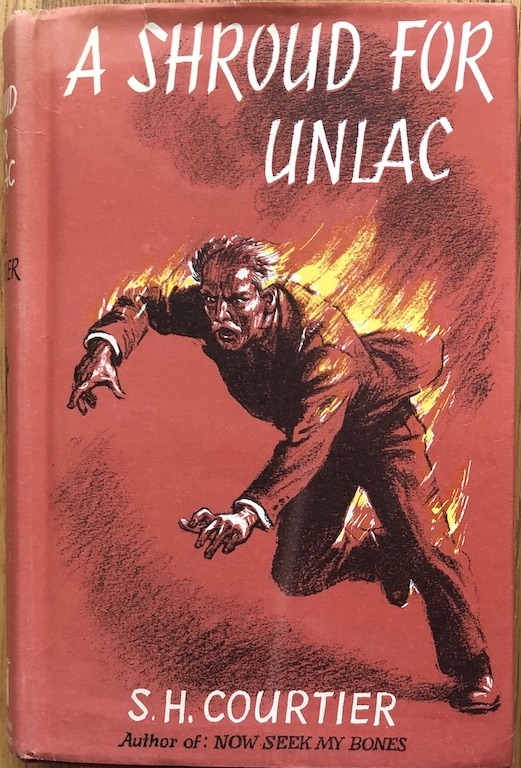
    IN BRIEF - A Shroud for Unlac - S. H. Courtier

    In Courtier's fourth detective novel once again this Australian writer explores an aspect of the culture in the land Down Under.  This time it's sheep ranchers, and specifically sheep ranchers who are involved in selling wool to textile companies.  But as Courtier is also one of the finest practitioners of bizarre crime novels he adds an extra twist that borders on science fiction. A Shroud for Unlac (1958) opens just prior the the opening of a textile exhibition on the grounds of Robert Unlac's vast sheep ranch  A secret area cordoned and fenced off contains his greatest invention, or rather cultivation, that will be unveiled at the exhibition.  Before the exhibit can officially open Unlac dies in a tragic fire that destroys most of this cultivated product and the storage of valuable seeds. Autopsy reveals that Unlac, though burned so dreadfully, actually died of a heart attack.  And oddly his clothing was apparently drenched in gasoline. Was it an accident or diabolically arranged sabotage and murder?  Superintendent Ambrose Mahon is on the scene to uncover a horrible plot and unmask the killer. 

    So what exactly is this cultivation?  What's going on at Lirra Down Sheep Station that has all the ranchers of merino wool sheep on edge, some truly frightened?  It's the acres and acres of a new cotton hybrid that Unlac has developed.  Fibers of this miracle cotton he calls ininja yield an equally miraculously durable textile impervious to ripping and tearing and nearly all staining. It's no wonder that someone tried to destroy the fields where thousands of the plants were growing behind heavily secured fencing. And no wonder why Unlac was killed. A miracle fabric would not only put sheep wool ranchers out of business but make possible millions for the owner of the plant seeds  and the secret hybridization process.

    Courtier in his usual manner weaves a complex plot that involves jealous business men, deep dark family secrets, and a cultural war between aboriginal people and modern Australians interested only in making money. The cast of characters is once again a varied group of Aussies and "abos". I learned a new word (as I always do reading Courtier's books).  Myall is obsolete Australian slang derived from aboriginal languages that means "stranger" or "ignorant person."  Like most local dialects it was appropriated by white men and turned around to a mean "wild" or "uncivilized" or used in a negative connotation as a synonym for any aboriginal person. No matter what meaning the reader chooses for this odd term there is a nearly anonymous man, described only as a myall, who early in the book is found strangled outside the grounds of Lirra Down. This crime almost dismissed by the police (almost forgotten by this reader, as well) has later repercussions as the story unfolds.

    The murder of Unlac is presented as something of an impossible crime for it is unknown how the killer managed to get to the odd storage area where the body was found burned to an unrecognizable corpse. Nor is it known how the killer could have escaped such a conflagration. Having read many of Courtier's books I should have known how this would be explained as the solution uses a detective novel convention repeatedly employed in his books even if it is a cliche device. However, in the story's context this cliche is pulled off with ingenuity.  Some diabolical wizardry utilized in the arson recalls John Rhode's gadget-ridden detective novels.

    A Shroud for Unlac is fairly scarce these days. Luckily, exactly two copies are available for sale online.  Act now! as they used to say in old 70s American TV commercials. This book comes highly recommended as do most of the mysteries by Sidney H. Courtier, an undeservedly forgotten writer who continually surprises with his originality and invention. A review of one of his best novels -- almost topping The Glass Spear, his incomparable debut mystery novel  -- is coming next week.  It's a retro Golden Age mystery with a corker of an ending worthy of the intricate plotting of the much lauded Crime Queens who flourished in the 30s and 40s.

    Friday, August 13, 2021

    FFB: Murder's Burning - S. H. Courtier

    Stewart Hamilton revisits the site of a devastating fire in Murder’s Burning (1967) Several years ago fire raged over an Australian ranch destroying multiple homes, killing livestock, and claiming the lives of eight people including Hamilton’s friend Pete Carruthers. Two bodies were never found in the ruins and Hamilton feels compelled to literally rake over the past in search of clues to the fire’s origin and what happened to the two missing men.

    The story is a mix of two first person narratives and follows the style of many epistolary murder mysteries of the 19th and early 20th century. As Hamilton narrates the bulk of the story interspersed are reminisces of letters Carruthers wrote and sent to his friend when Hamilton was living and working in New Guinea. So we have Hamilton in the present revisiting the past via Carruthers’ first-hand accounts in the letters. There is some detection on Hamilton’s part as he digs and rakes through the five year old debris at the site of the fire. But ingeniously many of the clues to the multiple mysteries are to be found in Carruthers’ letters which are filled with richly detailed anecdotes and intensive character studies and psychological probing. Carruthers, who worked as a schoolteacher at the station school, we learn was fascinated with the people he met and lived with and was something of an armchair detective of the soul.

    The book gives some insight into how Australian ranches – or stations in the local parlance – are run highlighting the advanced firefighting methods and various escape plans always hovering in the minds of people who live with the threat of wildfire on a daily basis. But was this vast and destructive conflagration really a wildfire? As the story progresses more and more evidence turns up to suggest that the fire was set intentionally. Hamilton is sure he knows the identity of the arsonist but the real mystery, besides what happened to the bodies of Wallace Shelton and Saul Leguier, is why the fire was necessary. He begins to formulate theories and comes up with several conspiracies dominated by an overarching conspiracy of silence about why the fire was set and what happened to the missing men.

    A running theme of the book is “Sheltonian madness” a phrase used to describe the eccentric and wild thinking of Wallace Shelton who owned one of the stations. Apparently all the Sheltons had a tinge of madness in them which leads many of the survivors Hamilton talks with to believe that Shelton destroyed his own property. Subplots involve arranged marriages in the Shelton family; crazed criminal Rory Corbett, the local pariah and a scourge on the community; and naïvely flirtatious Lothario, Billy Chad, who has been handing out cheap jewelry with juvenile inscriptions of love to various women. All these stories and people complicate the main plot and lead Hamilton in various directions as he searches for a motive for the arson.

    Even more unusual than the Australian setting and the multiple storylines of the many families living in an around the station is the macabre twist that dominates the story around the last third of the novel. Hamilton uncovers a secret passageway behind the ruins of a fireplace hearth on the Shelton property. After descending a small stone staircase Hamilton finds an underground labyrinth where eventually he discovers something that one would expect from a 18th century Gothic horror novelist. Believe me you will not be rolling your eyes or groaning in disbelief but gasping in horror once you learn what Hamilton finds in the cavernous rooms beneath the fire ravaged ranch. All I can add without ruining the novel is that the large one word blurb plastered on the rear cover of my paperback edition -- “Grisly!” New York Times -- is an understatement.

    As much as this bizarre touch was completely unexpected and a little over-the-top it made for a truly thrilling finale. I was not only led down the garden path by Courtier and his expertise in employing dual narrators I was more than pleased that the Gothic excesses ultimately all made sense and explained almost all the mysteries that Hamilton uncovered during his dredging up of the past.

    The recurring motif of “Sheltonian madness” also comes to dominate the story. We learn that the madness is both figurative and literal. If the reader is wise enough to read everything in the book (as I repeatedly mention one ought to do with any book) ) then the Acknowledgment that serves as a brief foreword to the novel will have prepared the reader for an unusual plot element towards the hair-raising finale. I did read those two sentences that precede the story, but had almost forgotten about it by the end. 

    Sidney H. Courtier’s superior debut detective novel The Glass Spear (1950) was previously reviewed here back in 2014 and is very much deserving of a reprint. Murder’s Burning, written 17 years later, is just as good for a variety of reasons, but it does have a rather slow burn until Hamilton discovers the secret passageway. Then it kicks into high gear and makes the trip to the end all the more exciting. I have more reviews of Courtier’s books coming in the fall. I think his books surpass Arthur Upfield’s as some of the best of Australian crime writing in giving readers unfamiliar with the land Down Under excellent insight into Australian culture, climate, geography and sociology.

    TRIVIA: Oh! one final note that only true book collectors and rabid mystery fans like me will appreciate.  My paperback copy was previously owned by Edgar award winning American mystery writer Joe Gores (1931-2011).  He signed the book and dated it (see photo at right). The SF, I surmise, means San Francisco where he bought the book. He also lived there much of his life and that noir drenched city of both fiction and real life is where his own private eye character Dan Kearney lived and worked.

    Friday, May 2, 2014

    FFB: The Glass Spear - S. H. Courtier

    
    Australian 1st edition,
    (Invincible Press, 1950)
    Sometimes the discovery of a forgotten writer yields such a surprising variety of interesting work it's both a blessing and a curse. Exhibit A: Sidney Hobson Courtier who later was published more simply as S.H. Courtier. With the exception of two books reissued by the independent Australian publisher Wakefield Press none of his books are in print and many of them are near impossible to get a hold of. As usual when a writer's books go out of print and copies are hard to come by the prices being charged in the rapidly vanishing used book market are way off base. Why I wonder does someone charge over $50 for a beat up paperback by a relatively obscure writer whose books have been out of print for decades? What is the point? Can the seller tell you anything about the writer? Usually not. Does he even care? "Oh it's scarce," you'll be told. Scarcity does not automatically make a book valuable. Plain and simple. Good books that deserve to be read cannot be had by the general public when avaricious booksellers make these books unaffordable by charging absurdly exorbitant prices. But more to the point why when a writer is as good as Courtier aren't more of his books in print?

    Take for instance Courtier’s very first mystery novel. Unique in concept, told with suspense and excitement, an original work both as a fine example of detective fiction and a good novel. In the guise of a confounding murder mystery The Glass Spear (1950) explores the relationship between aboriginal Australian people and the dominating white man. It's a fascinating blend of the traditional country house mystery spiced up with a generous amount of Gothic atmosphere and Australian tribal mysticism. Imagine if you can a detective novel written by Arthur Upfield in collaboration with Charlotte Bronte and Tony Hillerman and you are on your way to understanding how unusual and bewitching The Glass Spear can be.

    Dick Thewan fresh out of the Australian army is summoned back to Kinie Ger, the Australian sheep ranch where he grew up. His boyhood friend Jacqueline (Jay to her friends) has appealed to him to help out with the mismanagement of the ranch and some other troubles brewing in the household. A few miles short of the entrance to the ranch a falling tree branch causes a near car wreck almost crushing Dick inside. He can't help but think of it as an omen. Oddly, in his tortured imagination he thinks it might have been a murder attempt. Does someone want him to stay away so much that they would resort to murder?

    The homestead at Kinie Ger is in turmoil. Dick's childhood friend and one of the current ranch hands Steve and Jay are odds. Steve, a former prisoner of war, is a volatile personality causing more trouble than he's worth at the ranch. And the reclusive matriarch Huldah seems to have powerful control over everyone as she makes her demands and orders heard through the internal phone system that works as a sort of intercom. For the past several years Huldah has remained in a self-imposed exile at Kinie Ger, never leaving her bedroom suite at the front of the house. She allows only two people to enter her private domain -- Lucy Danes, who acts as cook and housekeeper for her; and Burton Lensell "nominal head of Kinie Ger, intense anthropologist, reluctant sheepman, and bewildered guardian to a set of children who stood in various degrees of relationship to him." Huldah's presence adds a Jane Eyre Gothicism to the story, a mysterious and imperious woman whose motives for shutting herself up remain hidden to all.

    
    US 1st Edition (A. A. Wyn, 1950)
     Burton is busy with preparations for the upcoming Easter corroboree -- a ceremonial ritual involving tribal costumes and masks, dance and acting. Several members of the ranch are involved in the theatrical presentation to take place on a sacred island accessible only by boat. At the climactic moment of the play the participants dance around a tribal mound. Burton notices that the mound so painstakingly created and placed dead center has moved several feet from its original spot. During the dance the actors stab at the mound as part of an aboriginal ritual and in doing so uncover a dead body. It is Henry Carpenty, a depised local rancher and troublemaker. His throat is cut. An autopsy reveals the fatal wound to have been caused by the glass arrowhead of a spear kept in a private museum back at Kinie Ger.

    There are hints of the supernatural, too. A prowler has been seen around the grounds. Dick finds footprints that indicate the use of footwear woven of bark, feathers,and fur and believed by natives to render the wearer invisible. This is a work of kurdaitcha -- a kind of aboriginal magic usually with evil intent. When a second murder occurs, this time in the locked museum at Kinie Ger, Superintendent Ambrose Mahon begins to think that a clever murderer is exploiting the fearful aspects of tribal culture to confound the police and frighten the locals.

    The Glass Spear is an excellent example of an anthropological detective novel. Courtier includes a glossary of tribal words and Australian flora and fauna to help non-Aussies in understanding the often alien world of the aborigines. The detective work is top notch with plenty of puzzling mysteries surrounding the two deaths not the least of which is the mystery surrounding the intimidating Huldah. The story culminates in a shocking surprise and a revelation of a family secret that has shamed Kinie Ger for decades.

    I've read many mystery novels by Australian writers using their country's rich culture and distinctive landscape, but I've never encountered a book like The Glass Spear which is so entirely Australian. Here is a story that can only have taken place Down Under. And I'll say no more for fear of giving away the best parts. If you come across a copy of this book I'd advise you to snap it up and read it. It's one of the most unique novels I've read this year.

    * * *


    Reading Challenge Update: Golden Age Bingo Card, space O4 - "An Author You've Never Read Before"