Showing posts with label haunted houses. Show all posts

Tuesday, September 8, 2026

Murder Mansion - Herman Landon

THE STORY:
Donald Chadmore, newly released from prison for an assault charge has come to his uncle Theodore's home in order to protect him from a possible attack. He takes his uncle to the library at the ancient gloomy Chadmore home known to locals as "Mystery Mansion" and locks both of them inside.  The heavy door is bolted twice and locked from the inside. All windows are barred. There is no way anyone can get inside. And yet spectral music plays from the piano in the corner of the library and a shadowy figure emerges from the darkness. Uncle Theodore cries out to Donald. Donald fires his revolver at the shadowy figure. He goes to the divan where his uncle was sitting but it's empty.  Uncle Theodore is found behind the furniture piece on the floor. He's been shot. Not only shot but stabbed with an antique dirk that Donald had handled only a few hours ago and which was left in the hands of someone now locked upstairs in the attic. Who was the shadowy figure and how did it get in to kill Theodore Chadmore?

HIGHLIGHTS: Murder Mansion (1928) is another Herman Landon pulp extravaganza.  Think of any pulp magazine story trope and its bound to be in this novel.  Several beatings and fistfights, abduction, two locked rooms, a haunted house, a family curse, hidden jewels, strange legacies, disguise and masquerade, ventriloquism, a dying message, and a handful of gangsters all make their appearances in this story. The entire book is surprisingly well written (at times rather literary), cleverly plotted, and often laugh out loud funny.  Landon can't help but pile on the Gothic excesses and melodrama which tend to turn up the moody atmosphere to 11, 12 or even 13 too often. Still it's a helluva story, well told and teeming with fun characters, innovation, exciting incidents, and enough puzzling elements to keep any hardcore GAD fan glued to the pages.

THE CHARACTERS:  This book has a huge cast of characters but even some of the most minor characters have memorable moments. There are too many to list, including six mystery guests who turn up for a secret meeting with Theodore on the night of his murder. Below are the best of the cast.

Donald Chadmore - Our ostensible protagonist and an amateur sleuth of sorts. As the book continues he is more of a victim of circumstance, chosen by the villains of the piece to take the fall for his uncle's death as well as being blamed for several other bizarre activities. His  dancing partner, both literal and figurative is...

Gloria Westcott - The Bright Young Thing of the book. A real Jazz Age girl complete with 1920s lingo she shows off to her "big boy."  One wonders why she  turns up so often too coincidentally in the most unusual locations. All will be explained later in the book. She's an utter delight providing much of the lightheartedness to offset the heavy-handed strum and drang whenever Donald and Gloria exploring dark passages or dealing with yet another thunderstorm. I loved the Jazz era slang she slings around as easily as she does the foxtrot.

Samuel Peterkin - Valet who works at a luxury hotel, on loan to Donald for his stay and travels to Mystery Mansion to help him as not only valet, but personal assistant.  Peterkin can't help but offer up his talents as a detective and comes up with an ingenious idea to solve the locked room murder. He turns out to be the real sleuth of the book despite the presence of police, a D.A. and a private detective working for the prosecutor's office.

Milliken - Investigator for D.A. Mott. Won't have anything to do with ghosts or locked rooms. The whole crime gets his goat.  "It ain't natural!" he continually pronounces. He can't stand anyone who "blows froth" at him.  Some kind of 1920s slang, I gathered, for telling lies or making up stories (a running gag in the last third of the book). He has a few excellent scenes showing off his detective skills. Notably, he proves that the odd placement of Donald's fingerprints found on the dirk show that Donald could not have stabbed his uncle. Almost everything and everyone he encounters in this case is classified as "unnatural." Nevertheless, he's determined to find the real reasons for the murder and dismiss all the claptrap.

Mr. Amicus - A very dead character whose presence is always felt at Mystery Mansion.  Real name Jacob Hamilton Chadmore, he is Donald's great grandfather.  The story behind his self chosen moniker is too involved to explain here. But it is a bronze bust of the dead man and his promise to return from the grave on the anniversary of his death that keeps Theodore and his wife on their toes and often up late at night unable to sleep. They’re especially troubled every October 7, the night he died back in 1800 and something. The novel of course opens on October 7 and Theodore is killed on the anniversary night. Could it be a ghost that did him in?

Groody - A butler with a suitably weird name this servant to the Chadmore household is privy to several secrets that he won't reveal until the final chapter. He's a bit shifty but always answers Donald's questions honestly.  Trouble is Donald never asks the right questions.

"Doc Locks" - For a while I thought this exceptionally astute expert would turn out to be the detective. But he has only one scene and then he's gone. Neither a physician nor a PhD scholar "Doc Locks" is a nickname given to him by the police and the prosecutor's office. We never know his real name, still Doc is clearly the Gideon Fell of this novel. No locked rook can stump him. Through careful examination of any murder scene deemed a locked room and using his knowledge of criminal tricks and clever illusions he finds any secret passages and all possible means of exit and always proves a locked room is never hermetically sealed. Until this one, that is. Before he tells everyone that it seems impossible for anyone to have entered the locked room tells a few interesting true crime anecdotes like the one about the 19th c. French murderer who managed to infiltrate a locked room with a blazing fire in the hearth by coming down the wide mouthed chimney wearing an asbestos suit and a helmet with built-in oxygen tank!

John Pagan - One of six guests who were to visit Theodore Chadmore on the night of his death. He arrives t dressed in white tie and tails, the only person in such formal attire. He has an unusually deep and theatrical voice that Donald recognizes as belonging to someone he heard plotting his uncle's death. That person calls himself Staglawn.  Much of the book involves characters trying to uncover the true identity of Staglawn. Pagan denies being the murder plot mastermind. He also has a hilarious running gag of sorts that takes the form of an aversion to certain vocabulary and vernacular.  When anyone uses these words he responds with outrage and satirical wit: "Candid? Abominable word! Just as if anyone could be candid in this world of sham and pretense and stupid amenities!" See the quotes section for a couple more of these amusing outbursts.

QUOTES: Gloria: "Secrets should only be told in the moonlight."

Donald: "What do you think, Milliken? Do I look like a murderer?"
Milliken: "You do.  All the murderers I've seen looked innocent."

Pagan: "Hunch? I detest that word. It's a lazy man's designation of an idea he is too indolent to think out clearly."

Pagan: "Kindness? That's another word I detest. What we call kindness is only inverted selfishness." 

"This will be a lesson to me," Don added. "I'll never again trust strange women."
"Poor Don!" Gloria gave a mock sigh. "Everything is a lesson to you, isn't it, Don? But you always forget."

Peterkin: "[Valeting is] the best education in the world. Keep a man waiting two minutes for his trousers before he's had his morning coffee, and you learn as much about human nature as it would take you two years to learn in any other way. To know human nature, you've got to study it in the raw, with the frills off. Sometimes I've found it awfully raw, sir." 

THINGS I LEARNED:  Mr. Amicus is a great devotee of Haydn and remarkably has learned several haunting themes from his opera The Devil on Two Sticks.  Prior to any Mr Amicus manifestation in the library the weird dissonant music from this opera plays on the piano.  I was intrigued by "dissonant" music from Haydn most of whose music I think of as bright and melodious.  Lo and behold!  It is true that he wrote the music for an opera titled Der Krumme Teufel (his first full opera written at the age of 19) based on the 17th century French satirical novel by Alain-René Lesage translated as The Devil on Two Sticks. But how Mr. Amicus can play the music is the ultimate unsolved mystery of Murder Mansion.  According to all accounts I found online Haydn's opera is a lost work and though there are archival copies of the libretto no sheet music nor any recordings are known to exist. The only anecdote I could find connected to the actual composition was told in an 19th century collection of composer biographies. Here it is related that Hadyn and Josef von Kurz, his librettist collaborator, had a discussion on how to capture in music the sound of a thunderstorm.  Haydn could not come up with a suitable musical motif.  In frustration he slammed his hands on the keyboard and his companion exclaimed, "That's it!" Probably someone's vivid imagination at work. Landon certainly makes the music seem creepy in his lush descriptions. Don't know why he didn't use something more immediately recognizable like "Danse Macabre". I guess music that doesn't exist is easier to work with for a novelist; he can make it sound any way he wants it to sound. 

THE AUTHOR:  Herman Landon (1882-1960) was born in Stockholm and came to the United States with his family in 1895. At one time he worked as a journalist for the Washington Herald where he was feature writer and a managing editor. His primary fame, however, is as a pulp magazine short story writer and crime fiction novelist.  Throughout his fiction writing career lasting from 1907 to 1942 he wrote close to 200 short stories and 20 novels. He created several popular series characters for the pulp magazines among them The Gray Phantom (who may have been the inspiration for Batman), The Picaroon, Godfrey Usher, and Kingdon Cole. Some of his Picaroon stories were collected into book format and published in the UK only. Most of his stories were published in Street & Smith magazines with the majority of them (more than two thirds of his total output) appearing in Detective Story Magazine and Detective Fiction Weekly. His stories also appeared in 10 Story Book, The Blue Book, The Smart Set, The Corner Magazine. and The Popular Complete Stories. Some of his stories were adapted into silent movies.

EASY TO FIND?  Nearly impossible these days I'm sorry to report.  I found one copy available for an cheap price due to its poor condition. Looks beat to hell, but if you don't mind reading copies (I certainly don't when the book is extremely hard to find) then it's waiting for you. Two copies (maybe only one listed at two different sites) translated into French also turned up for sale. My copy in VG condition, pictured at top of this post, was sold within 12 hours of the post appearing. Sorry to anyone who was looking for it earlier. 

UPDATE:  Remarkably, three days after this review was posted I checked for copies of Murder Mansion and discovered all were sold. Even the French translated copies! Also sold were two copies of The Forbidden Door (before I even mentioned it in the comment below). Oddly, another copy of Murder Mansion has turned up. That one final copy is the Liveright 1st edition and is priced exorbitantly. It will cost you well over $300 including shipping and taxes if you live in the US. Even more if you live outside of the US. But the copy has four torn pages. In pieces! Still, I am sure that someone will buy that book soon. That and a roll of Scotch tape. 

Thursday, October 30, 2025

HALLOWEEN SPECIAL: Sinister House - Leland Hall

The most uncanny thing about my reading Sinister House (1919) is not so much the content of this fine tale of a haunted house and malevolent ghosts but my timing.  A few days after I started the book I attended a performance of the new stage thriller Paranormal Activity (conceived and directed by Felix Barrett, written by Levi Holloway) based on the series of horror movies of the same name. The play deserves a post all to itself and I will have to refrain from talking about it here. But the eerie coincidences between a supernatural novel written more than a century ago and a play only written one year ago are seriously unreal. They both begin as commentary on routine living then morph slowly into tales of malign presences infecting the living. There is even a manifestation that takes place in the novel that is exactly the same as a fleeting moment in the play I saw.  That's chillingly coincidental and mindbogglingly uncanny as far as I’m concerned!

Leland Hall's novel starts out so utterly mundane that he includes lectures on the real estate business, building concerns and one of the characters' disdain for developmental communities which were already a blight on American neighborhoods in 1919, at least according to Leland Hall. Then the routine of everyday life gives way to disturbing and unsettling events. The first major shift in the story happens when the narrator Pierre is visited -- during a torrential thunderstorm, no less -- by his neighbor Eric Grier who has recently moved into a ramshackle home on the outskirts of the cookie cutter development known as Forsby. He has returned from a business trip in Buffalo, walked from the train station as there were no cabs at that late hour and when he saw the light on in Pierre's house hoped to gain entry and shelter from the storm. Eric is eager to get home to his new bride Julia who he could not stop thinking of while he was away.

Immediately, there is a discussion of the difference between the two homes in the novel. Pierre's house in Forsby is wholly modern made of cement with a "granolithic walkway" leading up to the front door, equipped with modern plumbing including turn-of-the-century fad of exposed pipes and, of course, electricity. Eric's 19th century home is still trapped in the past made almost entirely of wood and stone and no modern conveniences. Gaslight and fireplaces providing heat and illumination, water is fetched from a well. Eric is beginning to behave differently and Pierre and his wife Annette notice that Julia is especially happy in the gloomy house when her husband is absent. At first Pierre cannot understand why the two young newlyweds have moved into such an eyesore of a house. Annette finds nothing at all attractive about the place neither outside nor in. But Julia seems happy and finds comfort in its old-fashioned atmosphere. Pierre, however, finds that atmosphere chilling -- literally and figuratively.

Frontispiece from the US 1st edition,
illustrations all by Haydon Jones
 

It seems a malign influence has permeated the house and is infecting Eric. One night when Pierre, his wife and three year-old son Bobbie are traveling home their car breaks down with not one but two flat tires. They are forced to seek out help and shelter from the Griers. Little Bobbie is terrified of setting foot in the house having had his fertile young imagination stimulated by some strange fairy tales his mother has told him, notably one about the Loreley. In her version the siren sings tempting songs in order to lure men to the death and she eventually eats them! Bobbie calls the Grier home the "Singing House" and does not want to go in. His mother manages to calm him until he sees Eric. Bobbie has a fit of hysterical screaming crying out: "No, mama! Get him away, get him away! Don't let him touch me. He's going to eat me!"

Annette's cousin Giles is the primary skeptic in this cast. He is certain that Eric did not just stumble upon the house in Stanton by accident as he claims. Pierre learned that the house belonged to Morgan Snart, "an eccentric old man, very religious," and his  homely daughter Huldah "who had taken to religion even more entirely than her father." Giles digs into the Snart's past and uncovers secrets about the two that belie their supposed good character and surface religious demeanor. He also finds out a bit more about Eric but is circumspect in relaying that news to everyone.  Compounding this mystery is a forbidden room that Julia insists Eric never open. It remains locked for the majority of the novel. When it is opened out of necessity terror reigns down upon everyone.

Sinister House is clearly a precursor to Shirley Jackson's pioneering haunted house novel The Haunting of Hill House published five decades later in its depiction of a malign presence in an evil house that affects one single person. Hall's novel is both prophetic and iconoclastic in that he defies the traditions of Gothic literature by making the man the object of the haunting and not the woman. In fact, both Julia and Annette are the voices of reason throughout the entire book. It is the men who suffer the most -- from fear, susceptibility, and rash judgment -- when the evil presences finally manifest themselves and carry out their wicked plans. True Julia is targeted in a frightening scene (see illustration plate at right) but it is Eric, Pierre and even Giles who are the sorriest victims suffering both physical and psychological injury more than either of the women.

QUOTES:   I say it walked; but really it moved in some half-human, half-fiendish gait, slowly yet in springs. It was the shape of a tall woman. ...as this thing passed along the wall, its insubstantial head was turned to me, so that I was subjected to a lidless stare of incredibly sinister malice.

Books which teach etiquette of the drawing room had better put in a special clause to warn students against behaving before their hosts as if they were seeing the hideous family specter pass along the wall of the dwelling in which they are being entertained.

There's nothing like a familiar unpleasant job to keep the mind from brooding. 

Giles: "Dead men rise up never --read even your poets.  Ghosts breed in the living. That's where we'll catch them."

Truly I believe that the past was dead to [Eric]. By force of his will to live he had made it as if it had never been. He denied it to himself. And if he denied it to himself, it was no lie for him to deny it to others.

It doesn't do any good at all to say "Boo!" at the past if you're afraid of it.

THINGS I LEARNED:  Pierre talks about his intolerance for lack of modern utilities at the Grier house. He mentions one of his pet peeves is the presence of cannel coal in so many country homes and how he much prefers gaslight. Cannel coal, also called  candle coal and oil shale, was used in the 19th century for its bright and steady flame. Because it burned longer than wood it was a preferred choice for home fireplaces. Its compact dense structure also made it an easily carved material for sculpture, ornaments and jewelry.

Pierre comforts an injured Giles in the finale and describes himself as "kneeling like a Mussulman beside him in the gloom." He's not talking about an apple sauce brand or a misspelling of a he-man here. Mussulman is an archaic term for anyone of the Islam faith. We use the word Muslim now.

THE AUTHOR:  Leland Hall (1883-1957) was born and raised in Massachusetts. I was unable to locate a newspaper obituary online to share other biographical info. According to his gravestone shown in a photo at Find A Grave he was born in Malden and was laid to rest there alongside one of his relatives. Based on the dates this is most likely his father. Anyone with info on Hall is welcome to email more info or comment below. I can't even verify any other books he may have written. I'm curious about his work, if any more exists.

EASY TO FIND? Copies of the original edition are few and far between.  I found only two copies, priced rather steeply, of the US edition (Houghton & Mifflin, 1919) offered for sale online. It was first reprinted in hardcover in the 1970s by the private publisher Bookfinger in a limited edition of about 500 copies. Some if those turn up frequently for sale at affordable prices. Finally, there is a comparatively cheaper reprint in a paperback omnibus (Hippocampus Press, 2008) that is still out there in the used book market and available brand new from the publisher. In addition to Sinister House you get another classic haunted house novel in that two-fer reprint:  Cold Harbor by Francis Brett Young. 

Wednesday, August 20, 2025

The Croaking Raven - Gladys Mitchell

THE STORY: Despite its gruesome deaths by falling and crushing in a Norman castle The Croaking Raven (1966) is very much like a 21st century mystery. You know the kind:  tea parties and bakeries and gossipy characters, one of whom has an unusual profession. Like a tour guide of a castle who turns into an amateur sleuth when someone falls down a flight of stairs and dies.

It's Hamish Gavin's tenth birthday and for his present he has demanded that his family rent a castle in the advertisement he found in a local newspaper.  They do so and off they all go along with Dame Beatrice Bradley in tow.  Part of the lease requires the renters to open the grounds to visitors twice a week for four or five hours. Hamish can't wait to turn their rental property into a tourist trap. He mans the card table and collects the admission fee of a half crown, charges another shilling for parking cars in the courtyard and persuades his policeman father Robert Gavin, also a talented sketch artist, to whip up some souvenir drawings for yet another money making opportunity. All goes well until they start getting requests to see the bloodstains and are pestered with jokey queries about the ghost.

Bloodstains? Ghost? Did someone die in the castle? And how long ago was that?

Yes, indeed there was a death. Tom Dysey fell down the stairs the evening following a dreary party two years ago. And the rumors of a ghost are not just stories when the renters hear singing at night coming from within the walls and Hamish sees a white clothed figure appear in the dining room then slowly shrink and disappear into the floor. Is the castle truly haunted?  Hamish, his mother Laura, and Dame Beatrice turn sleuthing ghostbusters to find out what exactly is going on in the Dysey estate. Not much later after they settle in another person falls to his death.

CHARACTERS:  There's quite a large cast here and nearly everyone is a Dysey forcing Dame Beatrice and the others to refer to nearly everyone by their first name. There's Tom, the first victim of death by falling, and his brothers Eustace and Cyril.  Cyril's wife whose first name I don't even recall because she's always referred to as "Cyril's wife" nearly every time in order to avoid confusion with the other Mrs. Dysey (widow of Tom) whose first name is Henrietta. She goes by Etta but she's rarely called Mrs. Dysey because another Henrietta turns up and she also claims to be a Mrs. Dysey.  Who exactly is she supposed to be married to?  Tom?  Eustace?  We never find out the truth about this other Henrietta until the final third of the book. This other Henrietta appears only once in the story as a comic figure. She is a tourist who claims to be psychic and refuses to pay admission to the castle as she is a member of the historical society and she should be exempt.  This second Henrietta may appear only once but her persona hovers over all the proceedings.

Then there are the Carters who we also learn late in the book are related to the Dyseys because the grandmother was born Charlotte Dysey and is the great aunt of all the other Dyseys. And did I forget Bonnamy Dysey?  Henrietta Dysey (Tom's widow, that is) had a memorial plaque in his name placed on the outer walls of the castle and everyone assumes he's dead. But is he really?

Chillingham Castle courtyard,
supposedly the most haunted
castle in the UK
The tangled web of Dyseys and Carters, two mysterious deaths and an absent relative make up only a small sample of the many unanswered riddles. Dame Beatrice wants to make sense of it all but it will take a lot of intense questioning and probing to unravel the skeins of ambiguity. Not many people are willing to cooperate until the second, in some cases third, confrontation with the formidable Beatrice Lestrange Bradley.

We get a cameo from Jonathan Bradley (the Dame's younger son) and his cipher of a wife Deborah, too.  Jonathan helps explain the mystery of the ghost and in so doing uncovers a secret passage. Not a real spoiler as this happens very early in the book. The secret passage plays a very large part in the story.

The best characters in any Gladys Mitchell mystery are the supporting players.  I will mention Percy Bellairs, the gardener at the castle and Mrs. Dysey (Cyril's wife) as two of the most interesting and intriguing of this rather large cast.  And Hamish is an utter delight. Precocious to be sure, as most of Mitchell's child characters usually are, but delightful nonetheless.  Mitchell was a former schoolteacher and you can tell her love of children whenever they appear in her books.  They are almost all infectiously affable.  Sadly, he disappears with his father for the bulk of the book. Robert and Hamish both return at the end and luckily mother Laura (secretarial assistant/business associate to Mrs. Beadley for many of the novels) has a surprise for him when she reveals the secret of the ghost in the final paragraphs. It's a tidy and heartwarming way to end the novel.

Tom Dysey falls down a newel stairway
or spiral staircase to modern readers

INNOVATIONS:  Detection occurs in The Croaking Raven but much of it take place offstage, peripherally mentioned and then discussed after the fact at length in wordy dialogue laden passages. For example: Why don't we follow Dame Beatrice into the priest's hole and watch her train her flashlight as she explores the space and then lands her light on the second corpse that dies by falling? Instead we get these two sentences: "So saying, she ducked under the low doorway and made for the steps. It was a long time before she reappeared." Considering Mitchell's predilection for outré plot elements, legends, ghosts, and hauntings this was a huge missed opportunity for added creepiness. Nearly all of the book is devoted to lengthy Q&A sessions that are often interrupted forcing Dame Beatrice to seek out individuals two or three times to pester them again for the questions still unanswered.

I must mention one thing that I marvel at when I read a Gladys Mitchell mystery novel. She is a master at rendering regional dialects. Never does she ridicule speech patterns or odd vocabulary, it is always done with authenticity and respect. No other writer of crime fiction is as skilled at this as Gladys Mitchell. Truly! I've read hundred of books with phonetic dialects and 90% are just wretchedly mimicked (revealing more about the author's sense of hearing than accurate vocal inflections) or an utter mockery of the dialect. Mitchell loves the rhythm, the elisions, and the rich and unusual vocabulary and slang. Reading the dialogue of Bellairs, the gossipy gardener and Cyril's wife, an angry woman whose speech always reveals her tone and hidden frustrations, were for me the best parts of this novel. I could definitely hear their voices as I read those passages.

Only the final third of the novel really delivers the goods. Much of the detective work is surmising about primogeniture, birthright, birth order in the Dysey family and trying to secure a motive for the two deaths of the Dysey brothers.  Is it a greedy fortune hunter?  Is it revenge for the "bastard" child Henry whose parentage is never really known until the final pages? All the familial rehash, genealogy and talk of who will inherit got to be dreary. Only when the Raven's Hoard is mentioned do things finally pick up. This is a legend about a hidden treasure stowed away by Jesuits during the late 18th century. Then a bible is stolen, and returned mysteriously, rudely dumped in a pig sty. Soon Dame Beatrice is off on another puzzle solving adventure that will involve a strange code found in underlined passages in a text book on household care.  All these odd plot maneuvers are typical of Gladys Mitchell, reminding me again of the strange gimmicks in contemporary cozy mystery novels.

Overall,  The Croaking Raven is kind of a mixed bag. As usual, Mitchellesque epigraphs head each chapter. This time she selects passages from a variety of obscure Scottish folk songs to hint at the content of each chapter. Even with these atmospheric touches, attempting to inject eerie frissons with their allusions to ghosts and violent death, The Croaking Raven meanders along with intermittent thrills and a few surprises until its somewhat predictable end. The villains are not a surprise, some of the mysteries fizzle out, others never fully explained, and the finale seems too pat. I'd recommend this only to those who are Mitchell completists.

EASY TO FIND? Not really. I bought my copy decades ago and I've not seen one since. There is no US edition and I know of no paperback reprint since it was first published in 1966. But! I'm offering mine for sale online and just lowered the price. It's the only copy currently for sale.

Saturday, October 30, 2021

HALLOWEEN SPECIAL 1: The Women Swore Revenge - Inez Haynes Irwin

THE STORY:  Four women make a pact to bring to justice the murderer of their dear friend Lizbeth More who was stabbed on Halloween after a terrifying poltergeist encounter and a visit by a bizarrely masked individual peering in through the windows of More's home.  Years before, Lizbeth's fiance Arthur was also stabbed to death, on the night before they were to be married. As there was little evidence Arthur's murder was never solved and his killer is is still at large. Are the two deaths related and were they committed by the same person?  Chief of Police Patrick O'Brien investigates and receives more than ample help from a trio of amateur sleuths.

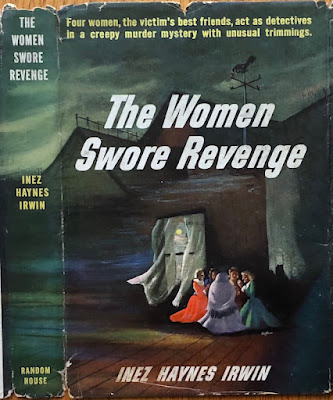
THE CHARACTERS:  The Women Swore Revenge (1946) is divided into multiple sections told from one character's view point, either in first person (Mary and her policeman husband) or third person (amateur sleuths Malo Wrenshurst and Patience Wilbor).  Although the title and blurb on the US edition's dustjacket imply that the four women who make their pact will turn sleuth it really is only two of them who become amateur detectives even going to extremes by assuming alternate identities. Mrs. Wrenshurst, a community theater actress, goes so far as donning a wholly unnecessary disguise complete with dowdy wardrobe, turban and wig. They have, as Wilkie Collins coined in The Moonstone caught a "severe case of detective fever." And they do remarkably well in their roles. A third sleuth is Michael Penchard, Lizbeth's gardener, whose flight from town triggers a police search and fuels gossip that he is the killer. Actually Penchard has left town to follow someone he believes is the true murderer. By sheer chance he and Malo Wrenshurst will meet up in a seedy hotel in Boston where the two will trade stories and share evidence they have collected.

The amateur detective scenes are rich with detail. In fact the entire book is overflowing with lush details on how homes are furnished, what the gardens and grounds of those homes look like, lists of the flowers and trees that seem like catalogs, and painstakingly described layouts of how rooms in the houses are arranged. So it's no surprise when Irwin turns her pen to action sequences that they too are elaborately described. Her writing is as exact and focussed as a cinematographer's camera. Malo's keen eye finds a locket embedded in the vines that have covered the doorway to an abandoned icehouse. Mike's eyewitness account tells of a strange "flying creature" swinging from branches in More woods like some kind of Tarzan wannabe. Patience travels to upstate New York and does a thorough search for the true identity of Whiting Vane, a polio crippled antique collector and mystery man who lives near the Mores. All these and more are highlights in this engrossing detective novel.

ATMOSPHERE: The More house has a history of being haunted dating back to the late nineteenth century.  Legendary and written accounts tell of poltergeist activity with dishes and glasses being smashed, paintings falling from walls and furniture being overturned with no person anywhere in sight. Lately the poltergeist has started up its mischievous destruction again mystifying Lizbeth and frightening her two female servants. The oddest part of this haunting is the appearance of figures dressed in old clothing. They take the shape of four old women on their knees praying. On two separate occasions these figures turn up mysteriously in rooms previously unoccupied. Irwin handles these scenes with a deft hand and manages to pull off a genuinely creepy atmosphere. Most of her misdirection works, but some more astute readers may see through Irwin's deceit.  Still, she succeeds in making it seem as if some supernatural force is at work. The descriptions of the grotesque face at the window turn truly horrific when it is discovered what exactly that mask at the window really was.

As the various detectives delve into the past we learn that some characters have carnival and circus work in their past. Gossip turns to the possibility of a circus performer being the murderer. And the fact that all the victims in the book are stabbed in the back had me immediately thinking of my favorite Golden Age motif - knife throwing.  This coupled with the presence of a crippled character had me spinning an elaborate scheme of how the murders were accomplished and who the killer was. I was close, but there was no way I was going to come up with the truth because I fell for some of Irwin's misdirection that even a novice reader of detective novels might have discounted. Irwin pulls off a genuinely surprising resolution that borrows from the insane ideas of Harry Stephen Keeler coupled with nightmarish plot twists reminiscent of horror writers of the pulp magazines. She won major points with me for her grotesque touches.

If there is anything to fault this highly imaginative, spooky and macabre Halloween mystery it is the unnecessarily lengthy wrapping up of the various mysteries.  For reasons known only to Irwin she has O'Brien gather the survivors and the innocent characters to deliver a typical Golden Age detective novel lecture that explains everything. But over 75% of the lecture has already been told to us by other characters earlier in the story. And those present know everything that O'Brien is telling them!  All that O'Brien needs to tell these characters (and the reader, of course) is the motive for the murders and the explanation of the poltergeist and the thing at the window.  I confess that I skipped over many paragraphs in this irksomely rambling penultimate chapter.  Also the last section is improperly named for one character when it should be named for Patrick because his is the primary point of view not the person for who Part 9 is named. Ah well. Despite these quibbles the book still has a corker of a mystery plot.

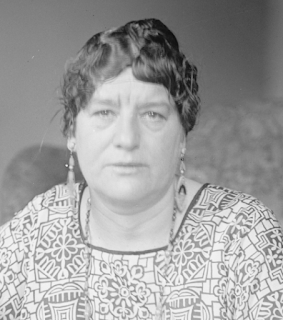
THE AUTHOR:  Inez Haynes (1873-1970) was an active member of the women's suffragette movement and an avowed feminist her whole life.  She is best known for her early 20th century non-fiction writing on women's rights, women's biography as well as some feminist novels notably Gertrude Haviland's Divorce (1925). Her first works were published under Inez Haynes Gillmore her name when she was married to Rufus Gillmore, journalist and mystery writer who diehard fans may know for his Van Dine pastiche The Ebony Bed Murders (1932).

Haynes divorced Gillmore shortly before the onset of World War 1 but continued to write under her married name.  In 1916 she married Will Irwin, another journalist and sometime novelist, who astonishingly also wrote murder mysteries. His two detective novels star Rosalie La Grange, a medium/con artist turned sleuth. Irwin used these novels as a vehicle to voice his distrust and skepticism of the spiritualist movement. The Irwins lived in Europe during WW1 and both were war correspondents for English language newspapers.

In addition to her feminist works Haynes wrote Angel Island (1908), an allegorical feminist fantasy (some call it science fiction but there's little science to it); a series of children's books about Little Maida, a girl who is raised by her wealthy father after her mother dies; and the five detective novels featuring Chief of Police Patrick O'Brien. Interestingly, her detective novels are set in the fictional town of Satuit, based on her life in Scituate, Massachusetts where she and Irwin spent most of their summers and where Haynes settled after her husband died in 1948.

THE SERIES:  The Women Swore Revenge (1946) is the fifth and final detective novel Irwin wrote featuring Patrick O' Brien and his wife Mary. Once again, I chose to read the author's last book first at some cost.  Two previous cases are mentioned in passing, one was getting so detailed a I skipped over the entire section for fear that Irwin would reveal too much. I'm discovering more and more that some writers never thought over this particularity bad habit of possibly spoiling previous books as they continued to add to their characters' adventures.  So a warning that anyone interested in tracking down Irwin's mystery novels that it would be a good idea to read the others first before you get to this final book. However, be warned:  Murder Masquerade (1935), the first in the series, is a very young and naive book completely different from The Women Swore Revenge which in comparison is highly sophisticated. The difference in tone and writing is remarkable. I can only surmise that Bennett Cerf who was editor at Random House shaped up Irwin as a writer when she was under contract to his publishing house. But more on Irwin's early mystery novels and her books as a children's author which seem to have influenced Murder Masquerade when I review that book next month.


Patrick O'Brien Detective Novels
by Inez Haynes Irwin

Murder Masquerade (1935)
   published in the UK as Murder in Fancy Dress (1935)

The Poison Cross Mystery (1936)

A Body Rolled Downstairs (1938)

Many Murders (1941)

The Women Swore Revenge (1946)

Friday, October 16, 2020

FRIDAY FRIGHT NIGHT: London After Midnight - Marie Coolidge-Rask

London After Midnight
– the stuff of legends. For those of you not in the know let me fill you in. It’s one of those “lost films” from the silent era, meaning that no known prints exist today. The negative was destroyed in a warehouse fire back in the 1960s. The hunt continues for anyone on the planet who might have a copy of the movie. Interest in this supposed horror movie – one of many from Tod Browning, the child of the night who gave us macabre silent movies like The Unholy Three (1925) and The Unknown (1927), the notorious circus thriller Freaks (1932), and the first movie version of Dracula (1930) – was so obsessive that back in 2002 a movie maven “reconstructed” the film using photo stills and a copy of the screenplay. I’ve never seen it, it’s been called everything from "a brilliant video evocation" to "a huge waste of time and energy." All this leads me to my own fascination with the movie. I had hoped one day I would see it after learning about it in a book on movie monsters I read when I was about 13 years old. But later around my college years when I discovered its legendary status as a lost film I all but gave up hope. Then sometime around 1999 or 2000 I stumbled upon a copy of the Photoplay Edition of London After Midnight through sheer serendipity at an antique mall. And when I discovered it was only $8 I could barely contain my excitement. As I paid that ludicrously cheap price I felt as if I were stealing it.

Photoplay Editions of silent movies are considered collector’s items to the cognoscenti who are drawn to books adapted for the movies. Photoplay Editions are the actual novels the movies were based on or novelizations of movie screenplays that contain photo stills of the movie. A select few of these Photoplay Editions are considered crown jewel of sorts to bibliophiles and movieholics. London After Midnight is one of them. Of course finding a Photoplay Edition with the remarkable color photo dust jackets would make it even more of a treasure. Mine is unsurprisingly lacking the dust jacket. But all of the eight photographs are intact and unharmed.

All this brings me to the actual book and story of London After Midnight. Marie Coolidge Rask, working from Tod Browning’s screen story and the scenario of Browning's frequent co-collaborator Waldemar Young, penned the novelization of the movie. This is all we have to go by as to the film’s story and content. That and, of course, the myriad movie stills that have been reproduced for decades. Some of the eight stills from the Photoplay Edition are featured as illustrations for this post. I was hoping for an eerie tale of madness, murder and vampires and a few good frights. After all Lon Chaney, the Man of 1000 Faces, was the star of the movie. He was terrifying as the first screen Phantom of the Opera and still, IMO, the best non-singing performer in that role. Based on photos in the book he played two roles in the movie. But as is the case with many of these longed for reading experiences that finally come to fruition reading the story was a huge let down. London After Midnight – at least the novelized version of the story – is a messy and transparent murder mystery couched in Gothic excesses and weird or supernatural incidents that all turn out to be rationalized.

Ingredients: one haunted house, a suspicious suicide, a murder made to look like the work of a vampire, two creepy and kooky neighbors who put on a spook show for the police investigating the murder, a plethora of mysterious incidents and a ridiculous number of characters in disguise or using alter egos. It all reminded me of early 20th century French detective novels with their fascination with policemen in disguise and fantastical plot elements. Browning who concocted the story may well have been a fan of not only Bram Stoker and Edgar Allan Poe but Maurice LeBlanc, Gaston Leroux and Marcel Allain, creator of master criminal Fantomas, the English translations of those books were still selling well in the US in the late 1920s.


Pictured left to right: Conrad Nagel as Lucy's lover Jerry Hibbs,
Henry A. Walthall as Sir James and Lon Chaney in his
second role as Prof. Burke(called Colonel Yates in the novelization)


Chaney as the Man in the Beaver Hat

Much of the novel’s mystery involves uncovering the identity of the Man in the Beaver Hat and his sidekick, an unnamed female character referred to only as the Bat Girl. We are led to believe that they are vampires, that they can transform into bats which fly about the rooms of Balfour House and roost in the rafters of that reputedly haunted house. Five years ago Balfour House was the site of former owner Roger Balfour's suicide who may be the Man in the Beaver Hat come back to life as a vampire. How else could his name in his exact handwriting appear on a new lease for Balfour House when only the Man in the Beaver Hat signed the contract?

And what of the mysterious appearance of Colonel Yates, straight from India, who claims to be a former military comrade of Sir James Hamlin, whose ward is Lucy Balfour, Roger’s beautiful daughter? Why did the Colonel show up so conveniently just as Balfour House was leased by the Man in the Beaver Hat? Why does Yates know so much about the occult, and vampires in particular?

Rask's storytelling is modeled on a cumbersome Edwardian prose style infused with stilted dialogue, overly complex sentence structure, antiquated vocabulary, and an abundance of histrionics and melodrama. She gives away the fact that the suicide is a murder almost immediately and is clumsy in trying to create suspense and surprise revelations. It is very obvious from the start who killed Roger Balfour and his son Harry. Even the motive is obvious. And that perhaps is the creepiest part of the book. In the book’s denouement the killer has been hypnotized into recreating Roger Balfour's murder. Reading the killer’s pronouncement of his love for a 15 year-old girl and his “covetousness of her since she was an infant" was nauseating and gave me chills in a manner completely unintended by the writer. Not exactly the kind of thing that reads well at all in the 21st century.

For those readers who absolutely must read London After Midnight to have their curiosity satisfied you are in luck. Couch Pumpkin Classics, a POD outfit, released a reprint of this Photoplay Edition in both paperback and Kindle digital versions. A hardcover is also available in the used book market for a hefty price. I know nothing about Couch Pumpkin's other works (if there are any), but this reprint does contain an informative introduction outlining the history of the movie’s legendary status as a lost film and goes into greater detail about the “reconstruction” of the movie done in 2002 for Turner Movie Classics. But be warned: the story is less than thrilling, a tepid variation of a Scooby-Doo cartoon plot, and I guarantee major disappointment. Better to look at the stills and let your own imagination conjure up your own private version of a fine example of macabre moviemaking with genuine frights and thrills.

Next week’s Friday Fright Night episode will be a vast improvement on this offering.

Friday, November 15, 2019

FFB: Boo Hoo: Not So Scary Houses of Horror - Carolyn Wells & Michael Crombie

Today's Friday's Forgotten Book post is on two books that belong more to Alternative Mystery category and are forgotten with good reason. Both published in the early 1930s each book shares some conventions already becoming mystery novel cliches in this early period. Horror House is an example of Carolyn Wells at her most turgid and unimaginative self pulling out every hoary cliche -- or as she would put it "hackneyed device" -- and then some. Michael Crombie (aka James Ronald, one of my favorite unsung and under-appreciated writers of the Golden Age) does the same in The House of Horror but at least he does it with tongue firmly planted in cheek. Both writers are known for their offbeat sense of humor: Wells was a punster and wordplay enthusiast, while Ronald was a master of witty banter and bitchy comebacks. But while both writers show their skill at comic scenes and dialogue neither book is a very good detective novel.

Let's dispense with Well's horror first. Horror House (1931) is her 51st mystery novel! It comes in her mid career, with 50 detective novels and close to that in juvenile books already under her belt. She was a veteran by 1931 and would write another 31 books before she called it quits in 1942. One would expect some snappy modernity to her writing by this point. But no, like so many of her 30s and 40s novels this one is still redolent of that bygone era when she was only a fledgling mystery writer. Her indefatigable detective Fleming Stone was growing ever grayer -- meaning colorless rather than aging -- and tiresome displaying his "transcendental" gifts at amateur sleuthing. The convoluted and utterly preposterous story is one of Wells' many attempts to emulate her more successful contemporaries. On the surface Horror House most resembles The Greene Murder Case(1928) in that it is yet another of those family decimation plots. A diabolical murderer is knocking off the members of a single household, one by one, using as many methods as he can get his hands on. Not satisfied with bullets (Wells has never used a gun in her books because she said she knew nothing about them and couldn't be bothered to learn) Wells' killer in Horror House dispatches his victims by stabbing, poisoning, automobile sabotage, and strangling.

15 century gauntlet
(courtesy: Metropolitan Museum of Art website)
The strangulation is particularly baroque as it is carried out with gauntlets taken from a suit of armor, affectionately dubbed Max by the Bailey family. But the victim had also partaken of alcoholic punch spiked with knockout drops in order that the strangling could be efficiently carried out. Clue #1 - murderer is not too strong and therefore either a woman or a feeble old person theorizes our genius Fleming Stone. If you know Wells then of those choices there is only one possibility and the murderer's identity is a dead giveaway. Nevertheless, I pressed on hoping that the book would elicit some cheap thrills, some more weird murders or an odd example of her histrionic melodrama. Instead I got cheap laughs, often at Carolyn Wells' expense.

Luckily not a secret passage in sight in this one, but the absence of that frequently used hackneyed device is made up for in annoyance factor by her choice of vocabulary and her treatment of one of the female characters. Poor Agnes, a housemaid of "exquisite beauty" prone to sneaking into Mrs. Bailey's boudoir to "loll in the luxurious furnishings" and dip into her mistress' cosmetics, is dismissed as an airhead. Referred to as "dumbbell" and having "an unattractive personality" she is relegated to the dumpster of red herrings, yet another example of Wells' overt class prejudice and snobbishness. The servants in Wells' books are never given any signs of cleverness, intellect or vivaciousness. Agnes may be beautiful but her beauty is of the Old Testament 'sinful' type -- to tempt men and be symbolic of the foolishness of vanity.

If you aren't irritated by this supercilious worldview then the strange word choices ought to set your eyes a-rolling. Some examples? Wells prefers inutile to 'useless', persiflage rather than 'mocking banter' pops up twice, a hostile witness at an inquest is heard "murmuring anathema all around". Instead of simply saying that Owen Bailey snorted she writes "well mannered though he was, [Owen] gave utterance to a sound that is colloquially known as a snort." All of those examples occur on a single page! I grew impatient with her florid syntax and antiquated vocabulary. Clearly this is her equally antiquated sense of humor giving rise as we approach the climax of the book, but I just wanted her to get the point as I reached a body count of four victims and occurrence of a second inquest in a nearly 300 page novel.

Her final affront is the constant drawing parallels between detective fiction and "real life." As if the book we are reading is supposed to be some kind of extremely hip and modern 1930s crime novel reflective of the violent world of gangster ridden America. The plot and crimes are as ludicrously fantastic as the fiction she is constantly alluding to.

It was a relief that Wells had not resorted to filling her Horror House with secret passages as she usually does. But the same cannot be said of Michael Crombie. The House of Horror (1935) is a veritable labyrinth of secret passages, underground tunnels, priest holes and hidden rooms. There are so many passageways in Hunter's Keep, Wilmer Basingstoke's house, I was half expecting someone to press on a wooden panel and, rather than sending a gigantic portrait swinging open on its well oiled, hidden hinge and stepping into a shadowy corridor between the walls, to be spontaneously disintegrated and sent into another dimension. For not only are there people creeping about in these hidden corridors there are multiple disappearances of four separate characters, including the bloody corpse of Wilmer Basingstoke himself.

Coincidentally, this book also talks about about detective fiction, but there is an express purpose for it. Basingstoke is a crime writer. He began with true crime, Capote style true crime that uses the conventions of fictional narrative rather than reportage. He then branched out into murder mysteries. We get to read two full chapters of one of his novels over the course of The House of Horror. Peter Wootton, our lead detective -- in an effort to explain the relationship of the victim to the prime suspect, an escaped criminal known as "the Basher" -- pulls down a book from the Basingstoke's crammed library shelves and reads aloud from it to his Watson. Here was a chance for James Ronald (aka "Crombie") to show off his gift for narrative shifting but the tone and style of Basingstoke's book within the book is no different than the book we are reading about the characters at Hunter's Keep. Written with more blood and thunder and colloquial language the book-within-the-book serves no purpose at all. Those two chapters could easily have been replaced with a short dialogue scene. Wooton could have explained in a few sentences how Basingstoke wrote of his adventures in amateur sleuthing by turning them into novels and changing the names of those involved.

The whole of The House of Horror is lacking in any genuine thrills or scares. The title is hyberbolic and obviously meant to attract people like me with a taste for cheap lurid entertainment. The ploy of the title worked, but I can't say I'm at all satisfied with what I got. I'm sure some will find what occurs in its pages to be wildly entertaining. I only kept on reading for a few of the characters.

Philip Lavery and Irma Dering are two perfect embodiments of wealthy layabouts posing as sufferers of ersatz weltschmerz, bored with everyone except each other. Irma is a delight of brusque opinions and catty dismissals, a welcome contrast to the virginal goodness of Lucy Halperin. We're probably meant to hate Irma as much as Lucy does for her superior posturing and cruel barbs, but I thought Irma Dering was one of the best characters in the book. She crumbles under pressure when the body count gets too high and she has a wonderfully frank scene with Lucy where she admits to her fraudulent persona and wishes she could be more real like Lucy. These were the moments that made the book worth sticking with. However, The House of Horror overall is presented like a genuine parody of the country house murder mystery. In terms of plot it is the most stereotypical story I've read from Ronald who usually displays a more original and ingenious imagination in his crime fiction.

Despite the caustic humor and witty banter as a mystery novel this House of Horror is more House of Ho-hum. Ultimately, the various mysteries are self-defeating, the book one long shaggy dog story. Those of you who have read The Curse of the Bronze Lamp by Carter Dickson may know what I mean by that. Its abundance of cliches and "hackneyed devices", the ridiculous amount of secret passages and all the rest of its pseudo-Gothic trappings tip off the reader to the anticlimactic revelation in the final chapter. The House of Horrors collapses like a house of cards and the time spent reading of its many "baffling" disappearances and gruesomely bloody deaths proves to have been a waste, the story as flimsy as the pasteboard playing cards metaphorically lying at our feet.

Thursday, October 31, 2019

HALLOWEEN SPECIAL 1: The Shapes of Midnight - Joseph Payne Brennan

I've known Joseph Payne Brennan as the creator of Lucius Leffing, a Sherlockian style consulting detective, who appears in two books.  Although I own one other collection of Brennan's more varied horror tales and ghost stories I've never read any of them. Then I stumbled across this paperback in one of my all too infrequent (these days at least) bookstore jaunts. With the introduction by horror guru Stephen King I figured it was about time to acquaint myself with Brennan's short stories without Leffing.

The Shapes of Midnight (1980) contains Brennan's classic story "Slime", perhaps the most often anthologized of his stories. First appearing in print in a 1953 issue of Weird Tales "Slime" tells a gruesome tale from a twisted imagination reminiscent of a more terrifying version of The Blob, that old monster movie starring a very young Steve McQueen before he became a 1970s movie icon of action films. It's one of the best stories in a decidedly mixed bag most of which are variations on the themes of haunted houses and witchcraft.

King, as is usual when he gets into his fanboy mode, is gushing in his praise for Brennan's work. Too often I found most of the stories to be familiar in plot and theme and I wasn't sure what King saw in them. There was lots of imitation of better writers like Hodgson and Blackwood and more than an ample amount of Lovecraftian homage. However, King's favorite of this volume, "Canavan's Back Yard", is justly praised as a work of ingenuity, originality and genuine thrills. It most resembles Hodgson's classic novel of an alternate universe The House on the Borderland, yet I could not help but draw comparison to "The Open Door" by Saki in that both tales deal with the horror of the unknown. What's really out there? is the question the reader asks himself when reading "Canavan's Back Yard." Unlike Saki's story, which turns out to be nothing more than a nasty girl's joke, Brennan's story of the desolate and decaying backyard is one of true terror.  He relies on the reader's imagination, for the most part, to fill in the blanks. These are the best types of horror stories. No gut spilling, blood soaked explosions of violence, just the eerie quiet of a man haunted by a compulsion to wander into the "blowing brindle grass and rotting trees" of his ugly and forbidding backyard. What is it that draws him there?  What did he see that left him literally speechless when he returned?  The narrator and the reader are curious to discover what lies out there waiting to be discovered. If the quasi explanation that Brennan supplies is less than satisfying that is no real fault of the storyteller.  But I wish he had spared us the few paragraphs that discuss a witch's curse, an utterly prosaic touch in light of the truly chilling effects he had created throughout the story by mere suggestion.

Joseph Payne Brennan (circa 1950s)
This is sadly a formulaic touch that I find a bit disappointing when reading all these stories one after the other.  Brennan tends to undermine the real terror he has created in the reader's imagination by explaining the mystery.  For me, it is the absence of a solution to the otherworldly mysteries in supernatural and classic horror stories that make them successful. A gifted horror writer plants a seed in the reader's imagination and lets it fester there. Those images created by the reader himself linger in the memory long after the book has been closed.

Amid the many haunted houses ("The Horror at Chilton Castle," "The House on Hazel Street," "House of Memory") we get "The Diary of a Werewolf" with its touches of deeply black humor,  the riddle story of an enigmatic creepy barber in "Who Was He?", the village idiot Henry Crotell of "The Willow Pattern" whose curiosity gets the better of him when he finds a partially burned book in the ashen remains of a destroyed house, a radioactive zombie that is "The Corpse of Charlie Rull", and some Lovecraft inspired horror in "The Pavilion", "Slime" and "Disappearance."

Modern horror fans will find "The Impulse to Kill" one of Brennan's most compelling and prescient stories. In it we follow the rantings of a nameless murderously obsessed narcissist who sees himself as a vigilante of sorts. Originally published in 1959 this story foreshadows the entire serial killer genre and in particular the kind of sociopathic killer like Dexter who kills criminals and amoral people who have escaped capture, trial and imprisonment. To these self-appointed executioners the criminals on the loose deserve to die. This story more than any of the others disturbed me deeply. The tone is bleak and narcissistic. The story perfectly encapsulates the nihilistic ego at work in all its destructive power. "The Impulse to Kill" has echoes of Robert Bloch's early stories about mad murderers and the work of crime writers like Jim Thompson whose book The Killer Inside Me is eerily similar in tone, style, and worldview. And Brennan accomplishes in a mere ten pages what Thompson needed a full length novel to explore.

For those eager to sample Brennan's work there is good news. Dover Publications has reprinted two of his collections including this one. Both were released back in July of this year. I'm sure they are easy to find at your favorite online bookseller, if not directly from Dover.

Wednesday, June 26, 2019

NEGLECTED DETECTIVES - Simon Gale

"By the golden apples of Hesperides!" Simon Gale is one amusingly boisterous detective.

Recently I learned of a trio of books featuring one of Gerald Verner's unusual and least known series detectives, Simon Gale.  The marketing info led me to believe that these were inspired by the books of John Dickson Carr with promises of haunted houses, weird legends, tales of past crimes and a plot similar to those that Harry Stephen Keeler specialized in -- save the wrongly imprisoned person from execution.  While the Carr analogy promised so much the only real thing that Simon Gale has in common with him is his detective's love of beer and the habit of crying out bizarre literary and historical inspired exclamations like "By the seven plagues of Egypt!" and "By the nine lives of Grimalkin!"

To date these are the best mysteries I've read by Verner. Much of their delight and success is due to Simon Gale, a larger than life character who will remind diehard detective fiction fans of other beer guzzling, blustery, and opinionated sleuths like Sir Henry Merrivale and Professor Stubbs. Gale is a professional portrait painter who comes to crime solving by accident.  With only a handful of newsworthy successes Gale has gained a reputation as a criminologist and is more than happy to help when puzzling murders come his way. In his second adventure in crime Sorcerer's House (1956) he encounters a haunted house with an ominous curse. Whenever light appears in the window of Long Room at Threshold House someone will soon will die, usually violently.

Alan Boyce, American publisher, is compelled to investigate during a thunderstorm when a strange light emanates from Threshold House. When he arrive on the scene there are no lights in any windows. But the body of Paul Meriton is found just below Long Room. It appears he has either fallen or jumped from the window.  Perhaps he was pushed? But there is no sign of anyone having been in the house other than Meriton and Boyce. Gale steps in immediately examining the scene personally and starts with prying questions that soon reveal the complicated relationship of Meriton and his wife Fay who supposedly left him for another man but seems to have utterly vanished. There are whispers of mental illness, insanity and hints of murder in Fay's past. Gale is determined to find her and get at the truth, put an end to rumors and learn whether or not she is responsible for not only the death of her husband but two other people as well.

Verner excels at creating a creepy Gothic atmosphere and draws from the conventions of Gothic literature in this detective novel. Tension is relieved by the frequent humorous bouts of beer drinking and the litany of Gale's odd exclamations recalling Dr. Fell's "Archons of Athens!" Unfortunately, once again his plot gets away from him and his attempts at misdirection misfire when he shows his hand too many times. A last minute effort to bamboozle the reader fails miserably and astute readers may find themselves recalling a moment in the early pages during the discovery of Meriton's body that stood out like a sore thumb.  The resolution comes as an anticlimax and makes this second effort the weaker of the two.

Much more successful is Noose for a Lady (1952), Gale's actual debut as a detective. Here Gale is asked to look into the case of Margaret Hallam in prison for poisoning her husband and about to be executed in only a few days. He must race against the clock and sort out who among the seven suspects was the truly guilty party.

Every one of the suspects has a secret involving a crime of some sort. Gale meets up with Mrs. Barrett, the Hallam housekeeper; Miss Ginch, a spiteful church lady; Mr Upcott, an effeminate collector of rare china; Major Ferguson, the typical ex-solider; Mrs. Langdon-Humpreys an archetype of the imperious harridan and her niece Vanessa; and Dr. Evershed, the usual local physician who turns up in these village mysteries. The story begins to resemble a sort of homage to And Then There Were None with each secret revealing each of the seven suspects to be more vile and odious than the preceding one interviewed. Among the crimes are murder, mass slaughter during war, negligence leading to a suicide, out of wedlock childbirth and other social "horrors" of the era. But who among these people felt it necessary to poison John Hallam, a sadistic man who collected books on torture and cruelty, and who also dabbled in blackmail?  Gale aptly sums up this lurid case: "Murder's a queer thing. It's like suddenly turning on a bright light in an old, damp cellar. All kinds of nasty, crawling things go scuttling away to their holes to get out of the glare."

There are at least two well executed shocking surprises before we reach the truth behind Hallam's poisoning murder. The story is an exciting one what with all the secrets being uncovered and the twist before the denouement is actually the most interesting and unexpected part of the book. Yet again I have to admit that Verner has let me down in the end. The ending is histrionic in the extreme, the murderer is ludicrously far-fetched and makes the entire story seem preposterous. Too much is explained away as madness as it is in Sorcerer's House and it is a disappointing finale to an otherwise genuinely fascinating and well constructed detective novel.

Noose for a Lady had an interesting previous incarnation and later life besides being a novel. According to Chris Verner, the author's son, it was first written for radio and later was adapted in a  faithful movie version. The movie poster appears above as it was adapted for the DVD case. John Grant of the Noirish movie blog has reviewed the movie in his usual perspicacious and informative style. However, I don't suggest you read it until after you read the book or see the movie as he gives away several plot elements better left unsaid.

There is a third and final book (The Snark was a Boojum) which I have not purchased nor read.  That last book in the Simon Gale trilogy was unfinished when Gerald Verner died in 1980 and his son has completed it. It was published for the first time by Ramble House a few years ago is is available for sale along with the two other books offered by Endeavor Books in both paperback and digital editions.

Simon Gale is one of the best of Verner's many series detectives. He's colorful, keen eyed and sharp witted, often providing riotously funny laugh-out-loud moments amid the eerie luridness that pervades his investigations. Despite Verner's flaws in plotting and his penchant for high melodrama and operatic displays of villainy in the final pages I highly recommend these two books for anyone unfamiliar with his work. They are most definitely the best of the Gerald Verner mysteries I've read as far as character, atmosphere and detective elements with Noose for A Lady ranking slightly higher than Sorcerer's House in terms of "bang for your buck" mystery quality.

"By the cloven hoofs of Pan!" What are you waiting for? Go buy a copy of one of these books.