Showing posts with label Mary Roberts Rinehart. Show all posts

Monday, July 13, 2026

FIRST BOOKS: The Swan Island Murders - Victoria Lincoln

There is nothing more upsetting than falling for the hype on a book jacket. The Swan Island Murders (1930) with its striking Art Deco influenced illustration of a silhouetted damsel being threatened by claw-like hands and the promise of "mystery, horror and detection" was enough to lure me in. While there is plenty of mystery and a smattering of rudimentary detection on display there is little horror to thrill a 21st century reader.  This is a book of its age when its intended audience surely would've been thrilled by the exotic and bizarre plot elements but which led me to spend time on outside research as I found fault with the author's supposed arcane knowledge of Indian religion and mythology that dominates the story,

The story mostly involves the guests at an impromptu house party hosted by wealthy eccentric Nahum Gould, a collector of Indian esoterica and a variety of Southeast Asian artifacts. The rear of the book jacket leads one to believe that the poor souls stranded on Swan Island are at the mercy of a mad strangler. This is not the case. Two Portuguese immigrant workers are strangled over the course of the novel (so a partial truth) but none of them are major characters at the house party. Instead, the focused crime is that one of the guests is shot dead, a presumed suicide for much of the book. The editorial staff at Farrar & Rinehart seemed more intent on selling the book under false pretenses and playing up to the contemporary demand for sensational popular fiction.  Had they told the truth about the book they would've been "spoiling" the surprises. Of course, I think nothing of diving right and telling you that this book is really about abnormal psychology and monomania related to arcane Indian mythology and its effect on Indian criminal culture.

Connie Steel is our narrator very much modeled on a Mary Roberts Rinehart amateur female detective easily affected by eerie atmosphere and with a tendency to talk about madness far too often. Swan Island, as you might predict, is a fog enshrouded lonely place and Gould's mansion is an imposing and dreary, shadow-filled haven well suited for a reclusive eccentric obsessed with the Mysterious And Inscrutable East. Victoria Lincoln does an admirable job of laying on thick this atmosphere of dread signalling "horrible things to come" with typical HIBK prose like "...but that boat was to come and go again without carrying any one of us away from Swan Island." More typical are Lincoln's florid stylistic touches like this: "How dreadfully right I had been...when I had thought that all our proportions were chemically incorrect, and that some cataclysmic reaction was bound to take place."  This odd chemistry metaphor pops up two times later in the book. She heightens the mystery and terror when we learn that Nahum Gould is so fearful and paranoid he has turned the house into an impenetrable fortress. All the windows have steel frames, there is only a single key for every door lock in the place with no copies and only the butler Gomez or Gould's secretary Torres are allowed to keep these original keys. Gould himself keeps only the key to his bedroom which has a heavy oak and steel door, steel enmeshed windows and other security overkill enhancements making his bedroom more of a prison cell. He speaks in a hushed voice of keeping "It" out and is constantly on guard, especially at night .

Needless to say someone manages to kill the playwright John Parsons and as Connie and her fiance Edward Benedict soon discover the murderer can only be one of the four remaining guests, Gould, or one of his employees. Gomez has a son Joe with developmental delay who in true period fashion is referred to as "the idiot" throughout the novel. Though he is slow to comprehend anything asked of him Joe's father says the boy can have days when he is perfectly lucid. Joe is the first one suspected of being the mad strangler and also the shooter until the stunningly beautiful (she has to be, right?) Nana Moeller, a German actress about to appear in Parsons' latest play, insists that she knows John committed suicide. There is evidence to disprove this suicide theory and that the death is a cleverly covered up murder. Not the least of these clues is a blood stained book written in Urdu that has vanished from the library when Parsons was shot.

A blood stained book written in Urdu?!

This is the single most interesting facet of the novel. Not to mention Lincoln's most macabre and original touch. It will prove key to the solution of all that is baffling about the strangling murders as well as John Parsons' death. Unfortunately, the revelation in the final chapters is so far removed from a fair play traditional detective novel that it called to mind the most popular American detective of the era -- Philo Vance.  I'm sure Victoria Lincoln read her fair share of both Rinehart and Van Dine prior to writing her first mystery novel because apart from the Rinehart style narration, and the Rinehart-like emphasis on terror and madness infecting everyone, ultimately the book is an esoteric treatise much like a Philo Vance detective novel. Thankfully Lincoln spares us pedantic footnotes, but the final chapter is overloaded with arcane trivia about a criminal subculture that thrived in 19th century India. Sadly, the finale is also littered with misinformation and poorly Anglicized spellings of terms and mythological figures and haphazardly mixes fact and legend. I had to sort it all out in about 90 minutes of internet searches and reading up on the incarnations of Kali until I found Bhawani which is the modern spelling of what Lincoln renders in her novel as B'wannee. She also seems to believe that T'huggee (once again her odd spelling) is an actual religion rather than a criminal class.

Victoria Lincoln, age 26 (circa 1930)

THE AUTHOR: Victoria Lincoln (1904 - 1981) was born in Fall River, Massachusetts and claims (on her author bio on the DJ for this mystery novel) that as a child she managed to make the acquaintance of that town's most famous resident Lizzie Borden. She attended Radcliffe College and graduated in 1926. The same year she married her first husband Isaac Watkins who was a graduate student in fine art at Harvard. She had her first child, Penelope, with him. A few years after her first novel was published she divorced Watkins and in 1933 married Victor Lowe, professor of philosophy at Johns Hopkins University.

Her New York Times obituary mentions only her mainstream novels and her non-fiction but not her debut novel, The Swan Island Murders, her first and only foray into mystery and thriller fiction. Among her other works are February Hill (1934) adapted for the stage by George Abbot under its new title The Primrose Path. In 1940 The Primrose Path was made into a movie starring Ginger Rogers, Joel McCrea and Marjorie Rambeau who was nominated for an Oscar for Best Supporting Actress as a mother who turns to prostitution to support her family. Lincoln's other fiction includes Grandmother & the Comet (1944), The Wind at My Back: Three Short Novels (1946), Celia Amberley (1949) and Out from Eden (1951). Notable among her non-fiction works are the Edgar Award winning biography/true crime work A Private Disgrace: Lizzie Borden by Daylight (1967) and her last book on the life of St. Theresa of Avila. She lived with her husband Victor Lowe and her family in Baltimore until her death in 1981. 

Saturday, August 12, 2023

Nice People Don’t Kill – F. W. Bronson

First mystery novels can be fascinating. What does the writer want to try out as an entry point into the world of the whodunit? Will it be a locked room murder? A noirish private eye novel? An inverted crime novel where we follow the murderer through the planning stages to the finally flawed crime? F. W. Bronson was not a neophyte writer when he tackled his first murder mystery. He already had three mainstream novels under his belt, published between 1926 and 1933. I thought this debut as a mystery writer might be an academic mystery judging from his biography that has Yale all over it.  Or maybe an ex-pat novel due to his having lived in Italy and elsewhere abroad in his post-college days. Never would I have thought he would choose to emulate Mary Roberts Rinehart and Mignon Eberhart, slightly satirizing the conventions of those Had I But Known mystery writers in his ironically titled Nice People Don’t Kill (1940).

The novel is narrated by Coraly Ames, widow living in an unnamed Connecticut town located on the shores of Long Island Sound. Greenacres is the name of the estate left to her by her husband and it's here she adds to her modest inheritance by renting out the separate beach house to summer tourists. In the opening chapter her husband’s best friend “Mac” suggests she rent to Schuyler Adams, a prominent Wall Street executive. We are quickly introduced to a variety of the locals in town and Coraly’s neighbors who will turn out not too coincidentally to be acquainted with Adams. But of course they are! And those relationships are tainted with secrets and criminal activity. All of which leads to the grotesque murder of Adams while he is sunbathing in what initially appears to be an impossible crime. Sadly that angle is quickly dispensed with as a mysterious man in a white bathing suit was seen by several people. A couple of nervous witnesses also lose their lives, one in a bloody hatchet murder (shades of Rinehart!), when they attempt blackmail or foolishly speak of what they know in cryptic brisk phone conversations and – of course – are overheard.

A plethora of Golden Age-style clues offer up mini-puzzles in addition the overarching mystery of the murderer’s identity. A volume of Keats’ poetry, a book Adams always carried on him, vanishes and reappears several times. Greenacres’ telephones operate on a party line offering several opportunities for eavesdropping when someone picks up an extension – even in the beach house, a ten minute walk away, or in the guest house to the south of the main house. Someone has been staying in the boat house as suggested by sandwiches remnants, paper bags and a makeshift bed found there the day after the murder. Is the person who was surreptitiously using that shed as their private motel also the killer? Could that be the man seen in the white bathing suit digging around in the sand a few feet from the murder scene?


Beautifully detailed map endpapers of the various scenes of the crimes
Nice People Don't Kill
(Farrar & Rinehart, 1941)
 

Bronson's characters are all familiar types to anyone who has read a mystery novel by Rinehart or Eberhart or any GAD mystery novel for that matter.  In addition to Coraly and her dead husband's pal "Mac" the cast consists of a momma's boy with a respiratory condition and his overprotective jealous mother, a mystery woman with a secret past, gossipy nervous servants, the middle aged military man and his much younger wife, the skipper of Adams' yacht "Blackbird" and the yacht's steward who acts as Adams' valet and cook on land. No one really has any depth and because they are representative of mystery archetypes they are fairly predictable in their thoughts and behavior. Thankfully, Sheriff Davey Jones is an intelligent policeman and provides well needed gravitas, common sense and shrewd detective skills throughout the book. Though Coraly fancies herself an amatuer sleuth she's a bit inept and severely impaired by her obvious biases and favoritism. Only Susan Carlisle, a young woman who appears quite unexpectedly on the scene and ends up staying in the guest house on Greenacres' porperty, comes across as slightly complicated or at least ambiguous in her motivations. She definitely has a past and I was bothered that Coraly seemed to believe Susan’s every word and action. Unlike the easily duped heroine/narrator I suspected Susan was definitely up to no good. Similarly, a gaggle of servants at Greenacres may appear to be just inconsequential supporting characters but the reader should pay close attention to them for they will play major roles later in the novel as their own secrets are also revealed.

With our heroine constantly hinting at future events that the reader has yet to encounter it’s an obvious but often heavy-handed homage to that “feminine” subgenre that detective fiction maven Jacques Barzun enjoyed disparaging. The novel is littered with spins on typical HIBK writing style. I was getting a bit irritated with her too. Here’s a sampling of what occurs in every chapter until the middle of the book:

It's odd to realize now that instead of welcoming Schuyler Adams with practically open arms I should have thrown the money in his face and ordered him off the property.

It didn't seem terribly important at the time--but that bit of carelessness almost cost me my life.

He might have added that my [inquest] testimony -- though of course he didn't know at the time -- contained the most important clue in the whole baffling, nerve-racking case.

Francis Woolsey Bronson
(1901-1966)
More annoying is her firm belief that “nice people don’t kill” echoing a sentiment that Carolyn Wells highlighted in The Technique of the Mystery Story and often mentioned in her detective novels written 20 years before this book was published. Coraly further elaborates on her sadly stereotypical views of humanity by surmising that the culprit responsible for the savage murders can only be Captain Lipari, the evil looking, mustachioed, limping skipper of Blackbird moored in the nearby harbor. It took me awhile to realize that Bronson was sending up the narrow-minded, overly optimistic women who populate the typical HIBK novels of the 1920s and 1930s. Ultimately, the reveal of the crazed murderer in the final chapters is pleasantly surprising even if Bronson (in the voice of Coraly) decides to present us with a silly melodramatic fake climax fulfilling some of Coraly’s predictions that didn’t quite fool me. Even a HIBK narrator has a few tricks up her sleeve to keep her readers baffled.

F. W. Bronson Detective Novels
Nice People Don’t Kill (1940)
The Uncas Island Murders (1942)
The Bulldog Has The Key (1949)

Saturday, March 21, 2020

FFB: The Inconvenient Corpse - E. P. Fenwick

THE STORY: Maggy Simon, assistant to newspaper columnist Sebastian Evers, reluctantly agrees to accompany him to a Catksills retreat for his annual winter reunion with a group of friends he's known for years. TO everyone's surprise an actress acquaintance of Sebastian's shows up at the rendezvous point in New York City saying that Sebastian u; has invited her along to the Catskills.  He denies it a but she insists and sees it all as a practical joke. Maggy no longer feels like a fifth wheel as Anna Rose lives up to all the cliches of a flashy showgirl attracting the attention of all the men in the group. Jealousies and squabbles eventually flair up on their first night while the wintry weather worsens and threatens to leave the travellers snowbound in the cabin. Then Anna Rose disappears and terror descends on the cabin in the Catskills.

THE CHARACTERS: The Inconvenient Corpse (1943) was E. P. Fenwick's debut as a mystery writer. Maggy is our protagonist and we follow her thoughts and adventures as the novel is told from her point of view, but thankfully in not in first person so we avoid the dreaded HIBK flourishes that I was worried would infiltrate the story. Accompanied by her pet Boston Terrier Sammy Maggy often seems like she tiptoed out of a Tintin comic book. The dog of course is key to uncovering the truth about the actress' disappearance and actually leads Maggy to finding the dead body that gives the book its title. For the most part Maggy escapes the trappings of the usual HIBK heroine. Though she is not constantly regretting what she should have done, she does suffer from Hamlet-like indecision and makes some foolish mistakes in deliberating over her choices and waiting too long reveal the truth. Her overly cautious nature will complicate matters for Sebastian who is suspect number one with the police as well as the rest of the reunioin group. Still Maggy is smarter than your average HIBK gal, not at all ditzy, yet suspicious of everyone including her boss who we think she has a secret crush on.  Her eye wanders to the tall handsome Vic Homan, deputy to Sheriff Caldwell and he returns the flirty gazes when not speedily taking notes with his lightning speed steno skills.

The suspects are pretty much familiar to readers of mystery fiction. Morgan Dillard, the the requisite glamor girl with an aloof and superior nature to provide some sexual tension between the young woman as they vie for attention of Sebastian. At first when Morgan offers to chauffeur Maggy up to the cabin we think she will be Maggy's friend and confidante, but Morgan clearly has ulterior motives. And there's an equally aloof young man, Prof. Harold Jameson, to act as Sebastian's foil. He's obviously attracted to Morgan. This all adds romantic and sexual entanglements in a tale that will eventually be about sex and jealousy.

Anna Rose, of course, is practically wearing a sign around her neck "I Will Be Murdered" when she enters the story. Her flamboyant extroversion, borderline vulgar talk, and shapely figure and stunning face arouse emotions in everyone, both men and women.  She's Trouble with a capital T that rhymes with C that stands for corpse. Poor Anna. She's the only character in the bunch with spice and life in her and we wish she would have had the chance to hang around longer, stir up a lot more trouble, before someone decides to send her to the Theater of Heavenly Footlights.

Rounding out the group of guests is the strange married couple the DeVries. Freddy first comes off as an offensive dirty old man making cracks about the younger women's attractiveness, then transforms into a prissy old man with indignant rants and "How dare you?" remarks that send the reader's eyeballs rolling. His wife is a meek and mild "nervous case" sheltered and protected by her self-righteous husband for the bulk of the story. Susan DeVries seems at first to be a charming New York sophisticate, but she quickly falls to pieces when Anna disappears then turns up dead. Susan spends much of the book confined to her bedroom and Freddy won't let anyone, even the police, near her.

ATMOSPHERE & INFLUENCES: The strength of the book lies not so much in its familiar, overdone plot, but in the atmosphere of terror and paranoia that infects the group as they learn that Anna's flight led to her murder. Suspicions arise and everyone turns on each other. Sebastian is the primary target of all the invective and acrimony as they think he committed a crime of passion. They all believe Anna Rose was his mistress and they had a fight and he killed her. Only Maggy is willing to disbelieve this rather outrageous scenario.

US first edition (Farrar & Rinehart, 1943)
courtesy of The Passing Tramp blog
Given this very familiar storyline, it's all too easy to figure out what's going on and who the culprit is. No real fault of the writer who is very talented in conveying paranoid fear and true terror. Fenwick seems to be drawing form a couple of very popular writers of her time - Mignon Eberhart and Dorothy B. Hughes. Maggy is very much modeled on the kind of protagonists we find in Eberhart's novels of women in peril, drawn to a man suspected of murder and eager to clear his name. But it is Hughes' crime novels riddled with frissons of terror, psychopathic criminals, paranoia in wartime when anyone might turn out to be a killer or a spy that The Inconvenient Corpse most resembles. Maggy's discovery of Anna Rose's body is one of the most chillingly effective parts of the entire book, even if she is accompanied by a curious Boston Terrier. Fenwick allows us into Maggy's head at key moments in the book sharing in her fear, the claustrophobia of the cabin in a wintry landscape, and the hypocrisy of Sebastian's friends. The emphasis is on terror and not detection. When the story is focused on Maggy's fears and suspicions it is at its most engaging and thrilling.

Working with a such a small group of character in a confined setting usually lends itself to a puzzle that will be less than puzzling. What matters here are the fireworks of volatile emotions and the intriguing dynamics between a gorup of friends who find out they have little in common, too many secrets, and they begin to see the verity in the motto "an honest enemy is always better than a friend who lies."

THE AUTHOR: Elizabeth Phillips Way (1916-1996) wrote both crime fiction and mainstream novels as "E. P. Fenwick" and later "Elizabeth Fenwick". In 1948 she befriended Flannery O'Connor when they were both living and working at the writers' colony Yaddo in Saratoga Springs, NY. I'll not bother wth anymore as Curt Evans has done a good job of digging up some tidbits on the life of Fenwick. You can visit his blog post for all you want to know to about her and view a few rare photos off the writer. He has also reviewed five of her books. The first three she wrote as E.P. Fenwick are cursorily discussed in this post. He also reviewed Poor Harriet and Disturbance on Berry Hill back in 2015.

EASY TO FIND? There are no modern reprints of The Inconvenient Corpse that I can verify. The book was published only in the US by Farrar & Rinehart and had one paperback reprint three years after the hardcover edition (Pony Books #62, 1946). The Pony Books edition is the most common in the used book market offerd at trelatively afforadble prices. The striking surreal cover illustration is most likely the work of "Im-Ho", the duo of Sol Immermann and Lawrence Hoffman, prolific book cover illustrators throughout the 1940s. For the short lived history of Pony Books (only 22 books over it's one year of business) see this in-depth article and bibliography by book collector and historian Kenneth Johnson.


Friday, April 12, 2019

FFB: Murder Draws a Line - Willetta Ann Barber & R. F. Schabelitz

THE STORY: Christopher "Kit" Storm has a moderately successful career as a commercial artist in his Manhattan studio. On occasion he serves as an artistic consultant to police drawing sketches of crime scenes and evidence in lieu of using a police photographer. Kit becomes implicated in a murder when the across-the-hall neighbor is found brutally stabbed inside his studio and the police start viewing Kit as a suspect rather than a colleague.

THE CHARACTERS: The narrator for Murder Draws a Line (1940), and the entire series, is Sheridan Locke, Kit's fiancée in this book, later his wife. Sherry is a children's book writer and is cajoled by her artist paramour into becoming the documentarian, so to speak, of their adventures in murder. But she goes about it in an entirely verbose and overwrought manner. One imagines that Sherry read way too many Mary Roberts Rinehart novels in her day (or at least Willetta Barber did). The narration is drowning in words, bursting to the seams with minutiae and unnecessary tangents, and burdened by the often annoying intrusion of the phrase "Had I known..." Even Rinehart never resorted to those telltale words as often as Barber does in the guise of Sherry Locke. In a review of this book in the August 10, 1940 issue of The Saturday Review the pseudonymous Judge Lynch said "Plot excellent, characters vivid, numerous illustrations -- but superabundance of had-I-but-knowing annoys cranky judge." I started to count them all but gave up when it exceeded 15 instances well before the novel's midway point.

Our heroes: Sherry Locke,
Kit Storm and Det. Tony Shand
I sincerely hope that Barber abandons this type of writing in later books because she is a fine storyteller and an excellent plotter. Her debut novel is a fine example of a traditional detective novel and its most unique aspect, what makes it truly noteworthy, is the inclusion of the illustrations (see "Innovations" section for more). She also has the gift of creating nuanced characters who seem like real people. It's a shame that she manages to undermine all her talent by ruining the suspense with all her heavy-handed foreshadowing. Only once did she make it work to her advantage when she discussed a bloody baseball bat before the bat became bloody. The passing remark (coming as the final sentence of a chapter as nearly all these HIBK remarks do) makes you think that Kit will be attacked yet again after being shot at once. In truth, however, the way the baseball bat gets bloodied has nothing to do with Kit and is one of the most horrific surprises in the book.

The cast of characters is large and as vivid as Judge Lynch says they are. We get all types of suspects from blustery and temperamental Alessandro Marioti, a failed opera singer, to Albert Putnam, nervous lovelorn singing student of Freda Bransen's. In an attempt to fill in the puzzle of Freda's life Barber finds it necessary to dig into her past and introduce nearly every person she ever encountered. As a result we get several bogey characters who serve no purpose whatsoever and who offer little insight into Freda other than superficial commentary. They exist only as the many examples of vain upper-crusters of Manhattan's elite. However, one supporting player from Freda's past appears to deliver the bombshell piece of evidence. She is a flighty, bubbly and garrulous ex-member of the Metropolitan Opera chorus. Freda has also worked there for a time as did the fiery Marioti. Daisy Jackson (aka Mrs. Elmer Schlummer) is a delight in her one big scene. What she has to say is key to understanding why Freda was killed and wraps up the bigger mystery of why the murder took place in Kit's studio.

The story is fascinating as an early example of a murder mystery that revolves around the identity of the victim and her past life. Kit and Sherry knew very little of their neighbor who lived across the hall. Freda Bransen was a lonely spinster who took in singing students as her sole source of income in her tiny studio apartment. But the day she stops by to deliver a letter for Kit mistakenly put in her mailbox changes her life and brings her past speeding into the present. Both Kit and Sherry slowly discover who Freda was, what she was escaping from, and how her past came to bring about her violent death. In one of the most poignant passages in the book Sherry sums it all up: "All at once, as I sat there listening to Daisy Jackeson's blithe and insensate jabberings, the horror attending [Freda's] dying seemed of no great importance. The real tragedy lay in what her life had been, not in the guise of its end. She had had so little, and that little she had not kept for long. A pitiful few years of happiness, perhaps, before her own dark destiny had caught up with her, never to let her again escape. It seemed to me suddenly unbearable that this should have been so."

Other interesting suspects include the dentist who lives upstairs, Peter Rollins, who seemed to be too interested in Freda's money; John Hunt, another of Barber's ne'er-do-well New Yorkers who at first seems like a superficial guy with no skills or ambition (he's a part time artist's model) but whose background in the military as a psychologist will play a significant factor in an intriguing subplot; and Ralph Whitley, a friend of Kit and Sherry's who stops by frequently to show off his very good caricature drawings but who is harboring a deep, dark secret.

INNOVATIONS: The Christopher Storm mysteries are unique in all of detective fiction because they include Kit's sketches (provided by artist Schabelitz) some of which have clues to help the reader solve the mystery. I believe these novels were the first of their type. Many detective novels, notably the The Baffle Book solve-it-yourself mysteries also published by The Crime Club, often included maps, floor plans and other sketches to help the reader visualize the crimes. No other detective novels from the Golden Age that I know of include a police artist whose sketches reveal his perceptions of the crime scene, the suspects and curious incidents that add to the mystery. As Sherry says of his method: "Kit has long since given up trying to explain that by drawing he sometimes sees things which would otherwise have gone unnoticed. That more than once, what looked perfectly correct to the eye proved completely out of drawing when sketched, thereby giving him a sure clue something was definitely wrong." Tony Shand has learned many times, she continues, the value of Kit's unusual technique in gathering evidence. This is why he often calls on Kit for help and a second eye. Obviously, he cannot avoid Kit's involvement since the crime took place in his own home and workplace. Even more significant is the fact that in this first novel drawing and painting are crucial to the plot. There are two very important sketches which actually reveal the identity of the killer and a work of art that Kit was working on provides one of the most noteworthy clues. The sketches are a mixture of full page portraits, drawings of the rooms, and idly drawn cartoons revealing Kit's thought processes. Most of the sketches include Kit's commentary along the perimeter of the art work. I've included several examples in the post.

THINGS I LEARNED: The deluded and vain Marioti exclaims to the police: "I shall be a great tenor. As great even as Melchior." Not being too much of a opera fan I was clueless who he meant. Are you as curious as I was? Probably not, but I'll tell you anyway. Lauritz Melchior was a Danish American opera singer who was the leading Heldentenor at the Metropolitan Opera for three decades, from the late 1920 through the early 1950s. He specialized in Wagner and made the previously lesser-thought-of German composer one of the better regarded musicians in opera companies. Thanks to Melchior's fantastic singing, a voice remarkable for carrying over the orchestra, Wagner's work became mainstay of opera repertoire in the US.

When Ralph Whitley first appears in Kit's studio carrying a portfolio and talking of his pictures Sherry thinks he is "just another Thornton or Model Guild chap, with the inevitable photos." Once again I was clueless. She is referring to Walter Thornton Modelling Agency, at the time of the story one of the "Big Three" in model agents in New York. Thornton, like many of the characters in this book, started out as an artist's model and then gained connections to the more lucrative fashion photography side of modelling. He opened his agency located in the Chrysler Building in 1929 and it lasted until 1955. Some of his clients included a bevy of gorgeous soon-to-be movies stars like Susan Hayward, Lizabeth Scott, Lauren Bacall and Grace Kelly.

THE AUTHORS: Although a newsletter published by the Doubleday Crime Club claimed that Barber and Schabelitz were married this does not appear to be true. Willetta Ann Barber (1911-1977) married Matthew Smith, an actor and writer, in 1948 and there is no record of her marrying any other person. She was the step-daughter of shipping magnate Edward J. Barber, son of Irish immigrant James Barber who founded Barber Steamship Lines of which Edward became president in 1917. [Small Worldism: In 1942, the Barbers lived in my hometown of Ridgefield, CT on a thrillingly hilly street where I regularly rode my bicycle while growing up!] Supposedly Willetta was one of Schabelitz' models according to that same newsletter article. But I have no way of knowing whether that's true or not. You can see a photo of her posing on one of her stepfather's passenger ships here. Just scroll down to the entry on Willetta Ann Scott.

DJ illustration by Schabelitz
A Song of Sixpence by Frederic Arnold Kummer
Rudolph Frederick Schabelitz (1884-1959) began his career as a portrait painter and exhibited at a few galleries when he was only 22. Quickly he became better known for his book and magazine illustrations. He was one of several well regarded book illustrators who showed their work at The Society of Illustrators' exhibit in 1919. His work is found in numerous novels of the early 20th century, illustrations for magazine stories, and commercial advertising art. One of the more unusual aspects of his career was when his highly prized fashion drawings were offered by The Woodruff Art Service on a subscription basis to department and clothing stores via a trade magazine called The Haberdasher. He even contributed the interior artwork to two issues of the Shadow pulp: May 1946 (The Curse of Thoth) and June 1946 (Alibi Trail). Schabelitz was married in 1910 and I found no record of a divorce making the tale of his marriage to Barber even more suspicious.

EASY TO FIND? Some of the Kit Storm mysteries were reprinted in paperback, but not his debut in print. Published only in the US by Doubleday Crime Club and later reprinted by Doubleday owned Sun Dial Press, Murder Draws a Line is relatively scarce. I found only eight copies of both first edition and reprints for sale using the usual online book search services. Only two of those come with dust jackets. Prices range from $29 for a reading copy to $100 for a VG/VG copy with DJ. There are an additional six copies held at various US academic libraries as well as The Library of Congress. It's a possibility your local library may have a copy.

Christopher Storm Detective Novels
Murder Draws a Line (1940)
Pencil Points to Murder (1941)
Drawn Conclusion (1942)
Murder Enters the Picture (1942)
The Noose is Drawn (1945)
Drawback to Murder (1946)
The Deed is Drawn (1949)

Friday, May 6, 2016

FFB/FIRST BOOKS: Mare's Nest - Carlyn Coffin

THE STORY: After suffering a disabling injury in Puerto Rico that leaves her left leg crushed from a terrible riding accident Salina "Sally" Nash is sent back the US to recuperate at her brother's horse farm ironically dubbed "Mare's Nest." While there she undergoes a rigorous treatment plan to regain the use of her leg under the care of two physicians, one nurse and a physical therapist. She also becomes the inadvertent witness to a blackmailer's plot and assists one of the doctors who has ambiguous ties the federal government in the solution of several bizarre murders.

CHARACTERS: Sally Nash is a sort of early female example of "Jeff" Jeffries, Jimmy Stewart's wheelchair bound photographer from Rear Window. Coffin's character in Mare's Nest (1941) pre-dates Woolrich's narrator whose original story "It Had to be Murder" appeared in Dime Detective magazine in February 1942. The similarities of the leg injured narrator are remarkable even to the inclusion of a masseur and physical therapist just as Jeff has the wisecracking Thelma Ritter as Stella, the insurance company nurse/masseuse. Also notable is Coffin's use of an eavesdropping bit that is very reminiscent of Lucille Fletcher's classic radio play (and later movie) "Sorry, Wrong Number." In the opening chapter Sally overhears a muffled conversation below her bedroom window. At this point she is bedridden (though later her cast is removed and she is able to use a wheelchair and then finally crutches) and can't move at all to see who is below. She can only rely on her ears yet is barely able to make out the second voice though the first is clearly a man's. Distinctly she hears the second voice say, "Someday someone will kill you!


Because of the plot device of a recuperating narrator invalid the story is often limited to Sally's bedroom and the adjoining library but it never feels claustrophobic. On occasion Sally is lifted into her wheelchair and makes it down to the first floor as in the first few chapters where she joins the rest of the house guests for a dinner party being held by her brother Martin Hood, a wealthy playboy and world traveler, who intends on making an announcement about his life and estate. But the majority of the story takes place upstairs in the two rooms where Sally is being watched over and treated. The library that adjoins her bedroom becomes of great interest later on when certain incriminating documents are being searched for and the contents of Martin's safe need to be explored.

The guests for the weekend include Martin's explorer buddy the foppish Richard Fenniton; Katherine Wells, Martin's fiancee, Peggy Embrie, one of Martin's old flames who thinks she is going to marry Martin; the "ugly faced" Dr. Edmunds the younger of Sally's two physicians, Miss Baer, a nurse with dreams of working on a ship hopefully one piloted by Richard. The servants include Miranda, a stern and extremely articulate African housekeeper; Hebe, a black maid who seems to be used for comic effect but soon proves to be as formidable as the housekeeper.

Rounding out the cast is the mysterious Dr. Wagner who enters the story when Martin dies from a sudden illness but whose death turns out to be an insidious form of poisoning that nearly goes undetected. The actual method is once again utterly bizarre (lots of these lately) and interestingly also incorporates the horse motifs that recur throughout the novel. Wagner is a forensic pathologist but as the story progresses he takes on a more sinister role and reveals that he must have ties to either the CIA or FBI though it is never stated which. That the story is set in Maryland makes the presence of federal government agents all the more likely. Sally never knows who among the many servants and workmen visiting "Mare's Nest" may actually be working for Dr. Wagner and this adds another layer of paranoia to this very well told story.

INNOVATIONS: The entire novel is modeled after the Had I But Known/Woman in Peril formula as created by Mary Roberts Rinehart. In fact, it was one of four "Honorable Mention" novels that was awarded a publication contract in the second annual Mary Roberts Rinehart Mystery Writing Contest sponsored by her husband's publishing company Farrar & Rinehart. Coffin's novel was obviously the best of the four runners-up because unlike the previous years Honorable Mentions hers was the only book published on its own. The other three also-rans in 1941 had their books published in an omnibus blandly titled Three Prize Murders advertised on the rear panel of the Mare's Nest dust jacket. Of those three writers only Edith Howie went on to write more mystery books.

As an example of the HIBK suspense thriller Mare's Nest is original in concept, literate in style without ever being self-consciously "prosey", and incorporates some brilliant scenes of detection and misdirection. If the culprit is not altogether surprising towards the end that is no real criticism against Coffin. She delivers a first novel that is so accomplished, well plotted and filled with interestingly complex and often unexpectedly fresh characters that the book might well be the work of a veteran.

The murder method is alluded to in an epigraph where Coffin tells us she learned of its existence in a book by African American writer Zora Neale Hurston. I immediately thought, "A voodoo murder!" since the Hurston book Coffin read was Tell My Horse, about life in Haiti and Jamaica. Was I ever surprised when Dr. Wagner describes exactly how Martin was killed. Made my skin crawl. This extremely unusual means of murder and its geographic origins prove to be one of the most important clues in identifying the killer who must have a knowledge of the country and its customs.

THE AUTHOR: I thought I was so clever when I tried to prove that Carlyn Coffin was a pseudonym for the wife of noted English Professor and head of the English Department at Columbia University for over 20 years Harrison Steeves, who also coincidentally wrote a mystery novel (Goodnight, Sheriff) in 1941. The book is dedicated to "Harrison of whom I am very fond in all moods, including the subjunctive" and Coffin's bio on the rear DJ flap mentions that she the wife of a college professor. Aha! Must be a joke hinting that her husband is a English professor. But no, turns out that is her real name and her husband was Harrison Coffin, head of the humanities division of Union College in Schenectady, NY during the 40s and 50s. This was proved in a quick Google search to discover the closest college to Schenectady after I learned that both Coffins were living there according to the 1940 census. (Thanks Steve Lewis and Allen Hubin!) This led me to finding a 1986 newspaper interview with Coffin where she talked about her husband and her writing. Seems so obvious, right? Why not just look for Harrison Coffin to start with? Let's just say I like to make things difficult for myself.

Coffin went on to write a handful of detective stories, one of which I know was published in the short-lived Rex Stout's Mystery Monthly (May 1947) and one more novel Dogwatch (1944) which I will be reviewing in the future. Towards the end of her career she also wrote children's books including Noel and His Friends (1986) about a "clever rabbit".

EASY TO FIND?  Uh... What's the usual answer to that question, gang? That's right. Very few copies floating out there. Published only in a US hardcover Mare's Nest can join the pantheon housing the hundreds of rather scarce mystery novels I write about. I found only six copies for sale online. Libraries might turn up more copies. Mare's Nest was reprinted once but not as a paperback book. It appeared in the pulp digest Two Complete Detective Books (Spring 1942). The book really is good enough for a reissue. Why it wasn't reprinted in the 1940s or 1950s by a leading paperback publisher remains a mystery greater than those in its pages.

Friday, July 24, 2015

FFB: The Cat Saw Murder - D. B. Olsen

Well, I've done it. I've read a cat mystery for the first time in my life. And damned if I didn't enjoy it. It's a strange book, one of the earliest cat mysteries if not the utter first. Strange because it is far from what one would expect from a cat mystery. It's in the grand tradition of the Mary Roberts Rinehart school with all the foreshadowing and aggravating hinting at events yet to come that led to the disparaging label of "Had I But Known" plus all the Grand Guignol gruesomeness that was Rinehart's trademark. There's a grisly ax murder, some dismembered body parts, midnight traipsing in secret attic passageways, an attempt on our heroine's life as well as the cat's, and blood everywhere. Literally everywhere. Except on the cat, that is. The only eyewitness to the crime seen popping out of the murder room, the cat is spanking clean and wet as if she'd just been washed. Is it any wonder with all these Gothic trappings and bizarre elements that I lapped up this cat mystery like a saucer of milk?

The Cat Saw Murder (1939) marks the debut of one of those little old lady amateur sleuths that tend to drive me batty now that I'm closely approaching becoming a not-so-little old man myself. But I found Rachel Murdock to be one of the better incarnations of a tired stereotype from the Golden Age. She may be seventy years old, but she's sharp witted, spry and risk taking senior citizen. She fits right into the mold of the Badass Biddy taking on not only a malevolent married couple who indulge in blackmail as a hobby but a crazed and violent murderer who will stop at nothing to cover up the crimes.

The story involves Miss Murdock's niece Lily Stickleman who fears for her life and Samantha, a cat that has inherited a fortune. Miss Murdock makes her way to the beachfront hotel called Surf House, signs on as a guest, and digs into the mysteries of anonymous letters, blackmail and attempted murder.  When her sleuthing does not prevent Lily's murder and nearly leads to her own death Lt. Mayhew steps into the picture.  The two make an unlikely detective duo but each helps the other out, Mayhew saving Miss Murdock's life not once but twice, and together they uncover an involved and very deadly conspiracy.

D.B. Olsen is one of the many pseudonyms for mystery writer Dolores Hitchens who is probably best known for two crime novels written under her own name -- Sleep with Slander, called "the best traditional male private eye novel written by a woman" by Bill Pronzini in 1001 Midnights and Fools' Gold, a juvenile delinquent caper novel that became Godard's cult classic crime movie Bande à part.  In her early books written as Olsen she created two series characters Rachel Murdock and Professor Pennyfeather, most of which follow the template of traditional detective novels.

The Cat Saw Murder is a neatly done up puzzle of a mystery with some deft cluing, excellent characterization in the myriad beach hotel guests all of whom have multiple secrets, some offbeat humor, gory murders and a very neat surprise ending. The major clue that leads to the solution of the crime is not all that well hidden and I suspect veteran mystery readers will catch onto her extremely clever gimmick, one I've never seen used in any detective novel of any era. But for those who miss it the ending will be quite a surprise.  It certainly is one of the best examples of the least likely character as murderer.

There is one very odd thing about this book I want to mention.  It's written in both present and past tenses.  The entire first chapter starts off in the present tense, foreshadows three specific events in the plot, then shifts back in time to start the tale at the beginning and stays in the past tense. But periodically throughout the book Hitchens will shift gears abruptly when she wants to do her Rinehart School bit with more HIBK and foreshadowing and weirdly she decides to write in the present tense. It's really jarring and makes no real sense to me.  This odd writing technique may explain why most of her previous books were published by the low rent houses like Phoenix Press and Bart House.  It just doesn't read smoothly.  I'm trying to find her first three books (all released under other pseudonyms) to see if she did this a lot. Only with this unusual cat mystery with a senior citizen stepping into the lead role did she manage to make it to the "big time" when Doubleday's Crime Club published the book.  She remained with the US Crime Club throughout most of her writing career -- well into the 1950s when she also teamed up with her husband to pen a few railroad police thrillers.

Dolores Hitchens (in a rare photo!)
The Cat Saw Murder is --of course-- rather hard to find. After three years of looking I managed finally to get a cheap copy on eBay but it's beaten to hell and I ended up paying more for it than I would've had I found it in a store in similar condition. The Dell Mapback (my edition) is very scarce and extremely collectible because it's a low number in the series. As you can see above, it sports the giant keyhole logo that was used only on numbers 1 through 49. As of this writing there are exactly five copies for sale in various hardcover, paperback and digest editions.  The one Crime Club edition (without DJ) is only $22.50. A good price, I think, for a copy advertised in "near VG" condition.

Even if you hate the idea of a cat mystery I'd recommend you read this one both for its historical significance and for the story.  It may have started the entire subgenre and it's not at all what would anyone would expect from a cat mystery.

Friday, July 29, 2011

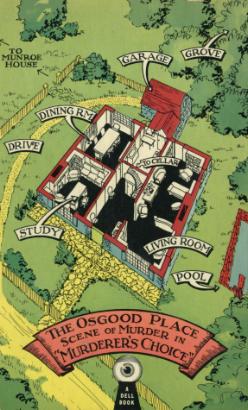
FFB: Murderer's Choice – Anna Mary Wells

There are few female private detectives in the novels and stories of the 1930s and 1940s. Some made appearances in the pulp magazines alone (Violet McDade & Nevada Alvarado, Carrie Cashin), some made it to novels by bestselling writers (Dol Bonner created by Rex Stout, Bertha Cool created by Erle Stanley Gardner). It's understandable that Grace Pomeroy, who makes her only appearance as a P.I. in Anna Mary Wells' second mystery novel, could get lost in the history of the genre. But Grace deserves some mention for her interesting background. She was formerly a psychiatric nurse and appeared as such in Well's debut mystery novel A Talent for Murder. In her second appearance, newly employed in her second career, Grace solves the strange case of an odious man who apparently committed suicide in order to frame his cousin for murder.

The story has an intriguing premise and is handled deftly in the first third of the book. Mystery writer Charles Osgood confronts his cousin Frank for whom he harbored a lifelong loathing with a horrifying prophecy. Osgood will commit suicide and make it look as if Frank killed him. He has taken out a $100,000 life insurance policy to provide the motive and assures Frank that evidence will surface that will lead police straight to Frank's door. When Charles dies of seemingly natural causes Frank seeks out Miss Pomeroy at the Keene Agency to help him find the evidence that will lead to his arrest and conviction before the police manage to find it.

Grace patiently listens to Frank's outrageous story but it takes some effort on her part to completely believe him. Her investigation of the odd circumstances surrounding Osgood's death takes her to lawyer Marcus Winterbottom who informs her that Osgood has squandered his fortune yet there is no record of how he managed to spend so much money in such a short period of time. No bills, no paperwork of any kind. And there is no record of the life insurance policy Frank insists Charles purchased prior to his death. Grace tells this to Frank and he gets the idea to gather all the interested parties in the case at Osgood's Connecticut estate where they will all hunt through the house in search of any documents that will support Frank's case and explain what happened to all the money.

At this point the story devolves into a spin on the typical Mary Roberts Rinehart novel with a variety of characters -- Frank's histrionic fiancee Kay, his domineering mother, a stolid housekeeper who wants the $1000 promised her in Osgood's will, the lawyer, and an ex-chorus girl claiming to be Charles' wife -- alternately bickering and insulting each other as they tear apart the house in search of hidden treasure, in this case the life insurance policy. I was also reminded of that old silent movie The Cat and the Canary minus the phantom jewel thief/killer. When Frank is found passed out in the wine cellar hallucinating and babbling it is at first thought that he is drunk until Kay reminds everyone that Frank doesn't drink alcohol. Then Grace, using her knowledge of nursing, suspects that he may have been poisoned. What if Charles had also been poisoned, she thinks? And Frank has just discovered the evidence of that poisoning in the cellar. Did Charles also intend that Frank be killed?

Wells has some fun with the detective novel tropes and even the work of her fellow mystery writers. Part of Grace's research into Osgood's motivation for his bizarre plan to incriminate Frank involves her reading eight of his novels back to back in one evening. In her reading she learns that Osgood specialized in the impossible crime type of mystery novel (a Polish countess has her jeweled necklace stolen from her while she's wearing it in a well lit ballroom, a man is shot in the chest surrounded by several cronies in his locked dining room, girl disappears without a trace while walking to the grocery store). His detective Silas Smith is a "rough and ready Midwestern farmer" who solves his cases "either by analogy from the simple homely experiences of the farm or by induction based on abstruse quotations from the works of Mark Twain or William Dean Howells." In an earlier scene she asks a hair salon employee if she has ever heard of Charles Osgood the mystery writer. The hairdresser, not the brightest bulb in the chandelier, can't even distinguish between a writer and a fictional character. She says, "Is he the fat one? [...] No, he's named after an animal or something. Do you mean the lawyer?" Apparently she's read a few but can't even remember the names of Nero Wolfe, Perry Mason or even Mr. Moto who she rudely calls "the Jap."

The plot to frame Frank and possibly kill him turns out to be even more complicated that originally thought. Grace using a combination of skilful interrogation, her knowledge of psychiatry and behavior, and a little medical research into the poisonous properties of herbs comes up with a whopper of a solution. What she does with her information is even more surprising in an ending that is rather subversive at the time of the book's publication.

NOTE:  Our congenial and ever efficient guest host this week is Todd Mason.  Click here to see the rest of the list for this week's edition of Friday's Forgotten Books.

Tuesday, May 10, 2011

The Strawstack Murders - Dorothy Cameron Disney

Promises, promises. I try my best to live up to them.  Here's my slightly overdue follow-up to TomCat's review several weeks ago on the impressive early work of Dorothy Cameron Disney.

Disney's second novel is practically a text book example of the Rinehart school.  The very first page contains a sentence that encapsulates the HIBK subgenre:
For it seems to me now...that I could have prevented the dreadful series of crimes which so hideously involved us all.
The line is spoken by Margaret Tilbury who will tell us the story of those dreadful crimes and reveal a tale of duplicity and treachery set in motion by a villainess who rivals the actions of Lydia Gwilt or any other  from Victorian sensation fiction. The opening of the book is subtle in its background details and exposition. There seems to be an overload of information and Margaret comes off as a babbling spinster obsessed with her health and her odd relation with her sister and brother-in-law. It is almost as if the story will become a family saga or a domestic soap opera.  But such details as Margaret's being treated for typhoid fever, an overheard phone conversation, and a servant's loss of a milk can are hardly extraneous. Nothing can be taken for granted. Nothing is ever mentioned offhand. Even the most ordinary and mundane activities will take on a sinister aspect.

It is the character of the duplicitous nurse Dorothy Fithian and her bizarre death that will involve the Tilbury household in a conspiracy to protect their own. Dorothy was far from likable. Yet no one no matter how off putting deserves to be strangled, shoved into a strawstack and left to suffocate, and then set aflame. But someone hated Dorothy enough to do that and more. When a member of the household is implicated Margaret and the family lawyer tamper with evidence in order to divert suspicion from one of their own. They replace a pair of gardening shears into a toolbox that they believe only one person could have moved. The family name is far more important to preserve than finding Dorothy 's killer.

Margaret and her relatives all seem to be playing amateur detective. Even the servants get involved. There is an attack on one of the family members (she apparently is struck on the head with a typewriter and survives!), there is the disappearance of some milk cans, a missing typewritten note and several other minor mysteries that follow the death of Dorothy. Margaret is puzzled by them all and wants to solve them before the police do. But Inspector Chant is way ahead of all of them. He confronts Margaret about her evidence tampering. She remains close mouthed about her involvement, Chant warns her that he will get at the truth one way or another and her refusal to cooperate will do more harm than good.

As if her fiddling with a pair of garden shears wasn't enough Margaret will attempt to figure out why a typewriter was placed beneath a bed and what happened to the note that was supposedly left inside. In doing so she endangers herself.  It is the fate of these HIBK heroines to snoop and then suffer strangling, mugging, blows to the heads and other violent attacks when they get "too close to the truth." Margaret will not escape completely unscathed.

As formulaic and drawn out as this novel seems it does keep the reader engaged. Margaret's narrative can sometimes get a bit irritating in its HIBK allusions to what has yet to happen for the reader but has already happened to her, however Disney does her best to keep these intrusions to a minimum. The detective novel aspects of the story are rather well done. It does have a fair play atmosphere. A truly astute reader could, in fact, unmask the killer. Yet Disney so cleverly hides the two crucial clues in the narrative that I am sure it will come as a stunning surprise when the murderer is pointed out by a surprise guest called in at the eleventh hour.