"I'm a wicked city woman. Like your mother warned you about."
- Lucille Ball in a classic episode of I Love Lucy
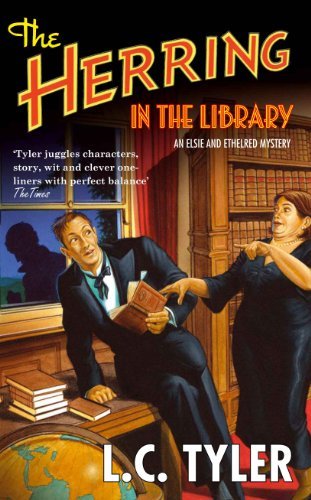
I could not help but think of that classic TV scene while reading The Herring in the Library. L.C. Tyler's latest metafictional romp is a farcical treatment of Keat's dangerously seductive "La Belle Dame Sans Merci." Portions of that dark Romantic poem by John Keats serve as apt bookends in yet another exploration of the femme fatale in a crime novel. I'm a literary egghead. I should be drawing allusions, as I usually do, from Victorian sensation fiction and hardboiled crime novels. Lydia Gwilt, Phyllis Dietrichson and Brigid O'Shaugnessy are better genre examples of the women who lead men to their ruin. But in poor Ethelred Tressider's case I could only draw analogies to Tennessee Ernie Ford and Lucille Ball. The femme fatale in Tyler's novel is admittedly far more wily and seductive that Lucy's campy vamp (a burlesque hybrid of Rita Hayworth's Gilda and Louise Brooks' Lulu), but Ethelred is just as gullible as Ernie Ford when succumbing to her tempting ways.
Tyler's La Belle Dame is Lady Annabelle Muntham who Elsie, Ethelred's outspoken agent, sees through immediately. And so should any astute reader. Ethelred has a habit of falling for women who have only their own self interest at heart. His ex-wife was at the core of the shenanigans in a previous book. Will he ever learn? Elsie is there to try and open Ethelred's eyes for the umpteenth time and steer him out of the path of another manipulative user. She'd have better luck with a blind man.
This time out Ethelred and Elsie face one of detective fiction's most experimental plot devices - the locked room. At the end of a dinner party the guests discover that their host, Robert Muntham, has been strangled in his locked library. It appears to have been impossible for anyone to have done the deed and left the room. The library door had two sliding bolts on the inside. The guests are forced to go outside the house and break the window in order to get into the library. But this is no ordinary locked room mystery. Don't be upset if there is a lack of wizardry in the Dickson Carr mode, but do look for some conventions turned upside down in Tyler's usual subversive style. Firstly, no one believes it's a murder and everyone is eager to accept it as suicide. Everyone except one person.
Lady Muntham will not accept the absurd notion of suicide. The police try to convince her that there have been cases of suicide by strangulation and even Ethelred is aware of some noteworthy true crime instances of this unusual method of shuffling off one's mortal coil. She teases and cajoles Ethelred to use his mystery writer skills and do some investigation of his own. Oddly enough, when Ethelred (and ever watchful Elsie, of course) begin their snooping and prodding evidence of an intruder begins to pile up, both physical evidence apparently overlooked by the police and two eyewitness accounts of a mysterious prowler wearing a blue suit. Lady Annabelle seems to be getting everything she wants out of the investigation. Elsie smells a rat. It's all a little too convenient. As the investigation continues each of the dinner party guests has a dirty little secret revealed complicating the plot as only the best of mystery stories do so well. Suddenly motives are popping up all over like...well, like red herrings. It seems that Annabelle may be right that some devilish magician managed to wring her husband's neck and dematerialize from the library.
As an added bonus we get our first look at the fiction of Ethelred Tressider. In his J. K. Elliott guise he writes historical mysteries set in the 14th century. Interspersed throughout the multiple narratives are chapters of this work in progress. Master Thomas, a customs agent and employee of the arrogant and talentless Geoffrey Chaucer who, if we are to believe Ethelred, got all his ideas for The Canterbury Tales from Master Thomas. There is a murder investigation in the book Ethelred is writing and it too has echoes in the locked room mystery of Muntham Court.
This was my favorite of the books so far. It was dense with literary allusions and it was all I could do to stop myself from jumping to my Cambridge Guide to check on all the references. The interconnections of the three story lines, the alternating narrations (a standard device in Tyler's books) and the trenchantly witty dialog (mostly in Elsie's wicked narration) all came together for a winning reading experience. This book deservedly won Tyler "The Last Laugh" award for best comic crime novel at this year's Crime Fest. A hearty congratulations to him. I eagerly await my copy of The Herring on the Nile soon to be released in the UK which I ordered several months ago. I no longer can wait for the US releases of these books.
NOTE (posted one day later): Forget to mention this. Although I own and reviewed the UK edition (pictured in the scan above) the US version should be available this month from Felony & Mayhem as the author himself reminded me in an email he sent. I knew this and had purposely waited to post this review until I knew the book would be available here in the US.
And for those unfamiliar with Lucy's wicked city woman, behold:
Crime, Supernatural and Adventure fiction. Obscure, Forgotten and Well Worth Reading.
Showing posts with label L C Tyler. Show all posts
Sunday, June 12, 2011
Monday, February 21, 2011
NEW STUFF: Ten Little Herrings - L.C. Tyler
"My name is Elsie."
"Hi, Elsie."
"And I am a chocoholic."
Maybe Elsie Thirkettle isn't headed for some strange 12 Step Program for truffle addiction, but her constant craving for chocolate certainly gets her into a sticky mess in the second of L.C. Tyler's farcical detective novels Ten Little Herrings. She steals a box of chocolates (evidence from a crime scene) and devours the contents nearly poisoning herself. She breaks out of a hotel under police sequester so that she can get her daily fix. But her prized box of Apollinaire chocolates is confiscated when she makes her crash landing re-entry in a scene right out of a Blake Edwards movie. Yes, chocolate is definitely her undoing. But I'm getting way ahead of myself.
Elsie meets up with her client, mystery writer Ethelred Tressider, in the Loire valley at a hotel hosting a stamp collecting fair. There are mysterious circumstances as to Ethelred's being there and he is, as usual, not forthcoming with Elsie. She would like to take him back to England but the murder of a British guest keeps them hostage of sorts when the local French police insist that all occupants remain until everyone can be interrogated. Just when Elsie and Ethelred think the police are done and they can leave another guest is killed. And then a third attack. The police continue to detain all guests.
It seems they have been cast in a parody of No Exit with a French hotel of exceedingly low standards serving as their private hell. No multi-channel cable TV, no spa, no exercise room, no real amenities at all. What to do beside roaming from the uncomfortably furnished, claustrophobic "lounge" to the dining room to the terrace in repeated cycles? Elsie decides she might as well get to the bottom of all the madness by turning detective and questioning the guests herself. Trouble is everyone else has the same idea. The hotel becomes a veritable beehive of amateur detection with even two Danish children armed with magnifying glasses and notebooks joining in the hunt to nab the murderer.
Elsie takes center stage for most of the story and there is a broader comic sensibility here than in the first outing where Ethelred was in charge of the narrative. There is still the interesting alternation between Elsie and Ethelred as narrators, but Elsie's is the dominant voice this time. She's determined to beat Ethelred at his own game.
For the first part of the book Ethelred lingers in the background, more of a distant observer than a true participant. His contributions to the story seem like a sardonic Rod Serling commenting on the action. He lectures us on murder methods ("I have always found poison immensely convenient." and "Stabbing somebody to death is easier than you think."), his personal life ("I number fictional characters amongst my closest friends."), and -- of course -- the life of a writer:
The final page ends with an utterly surreal bit that made me laugh out loud for the first time and left me hungry for the next book, The Herring in the Library. I'll have to order it pronto -- along with a box of some fine chocolates. But I think I'll skip the peach truffles.
NOTE: Ten Little Herrings has been nominated for an Edgar. The second time Tyler has received a nod for Best Original Paperback.
"Hi, Elsie."
"And I am a chocoholic."
Maybe Elsie Thirkettle isn't headed for some strange 12 Step Program for truffle addiction, but her constant craving for chocolate certainly gets her into a sticky mess in the second of L.C. Tyler's farcical detective novels Ten Little Herrings. She steals a box of chocolates (evidence from a crime scene) and devours the contents nearly poisoning herself. She breaks out of a hotel under police sequester so that she can get her daily fix. But her prized box of Apollinaire chocolates is confiscated when she makes her crash landing re-entry in a scene right out of a Blake Edwards movie. Yes, chocolate is definitely her undoing. But I'm getting way ahead of myself.
Elsie meets up with her client, mystery writer Ethelred Tressider, in the Loire valley at a hotel hosting a stamp collecting fair. There are mysterious circumstances as to Ethelred's being there and he is, as usual, not forthcoming with Elsie. She would like to take him back to England but the murder of a British guest keeps them hostage of sorts when the local French police insist that all occupants remain until everyone can be interrogated. Just when Elsie and Ethelred think the police are done and they can leave another guest is killed. And then a third attack. The police continue to detain all guests.
It seems they have been cast in a parody of No Exit with a French hotel of exceedingly low standards serving as their private hell. No multi-channel cable TV, no spa, no exercise room, no real amenities at all. What to do beside roaming from the uncomfortably furnished, claustrophobic "lounge" to the dining room to the terrace in repeated cycles? Elsie decides she might as well get to the bottom of all the madness by turning detective and questioning the guests herself. Trouble is everyone else has the same idea. The hotel becomes a veritable beehive of amateur detection with even two Danish children armed with magnifying glasses and notebooks joining in the hunt to nab the murderer.
Elsie takes center stage for most of the story and there is a broader comic sensibility here than in the first outing where Ethelred was in charge of the narrative. There is still the interesting alternation between Elsie and Ethelred as narrators, but Elsie's is the dominant voice this time. She's determined to beat Ethelred at his own game.For the first part of the book Ethelred lingers in the background, more of a distant observer than a true participant. His contributions to the story seem like a sardonic Rod Serling commenting on the action. He lectures us on murder methods ("I have always found poison immensely convenient." and "Stabbing somebody to death is easier than you think."), his personal life ("I number fictional characters amongst my closest friends."), and -- of course -- the life of a writer:
I had not done any actual writing for months but I nodded. Writers are used to deluding themselves that all sorts of things are 'work' – searching the Internet for references to themselves, checking their Amazon ranking, blogging, making coffee. I'd done a few of those. I was working.When Elsie makes the surprising discovery of a cache of diamonds in a train station locker and complicates matters by doing a switcheroo the plot takes off in full force. From this point forward I was reminded of many of the Inspector Clouseau movies - especially A Shot in the Dark. The one-liners and the broad comedy increase with a frenzy. Elsie does her best to finger the killer in one of those "Let's gather all the suspects together" scenes, but... well, let's say it doesn't go very well for her. There are more twists in the denouement than a go-go dancer on speed.
The final page ends with an utterly surreal bit that made me laugh out loud for the first time and left me hungry for the next book, The Herring in the Library. I'll have to order it pronto -- along with a box of some fine chocolates. But I think I'll skip the peach truffles.
NOTE: Ten Little Herrings has been nominated for an Edgar. The second time Tyler has received a nod for Best Original Paperback.
Labels:
comic crime,
Edgar Awards,
L C Tyler,
New Books
Saturday, January 29, 2011
NEW STUFF: The Herring Seller's Apprentice – L.C. Tyler
Surprise! Every now and then I like to remind myself I'm living in the 21st century. I'll be posting reviews of notable contemporary writers whose work is largely influenced by the guys and gals I love and whose books I think you ought to check out as well. Here's the first in a new category aptly called NEW STUFF.
I remember coming across in the Rue Morgue Press catalog this new series featuring a sardonic writer of mysteries, thrillers and romance novels. When I learned that the second book Ten Little Herrings earned an Edgar nomination I thought it was time to acquaint myself with Ethelred Tressider, the hack writer, and Elsie Thirkettle, his literary agent. So, of course I started with this one - the first book.
I remember coming across in the Rue Morgue Press catalog this new series featuring a sardonic writer of mysteries, thrillers and romance novels. When I learned that the second book Ten Little Herrings earned an Edgar nomination I thought it was time to acquaint myself with Ethelred Tressider, the hack writer, and Elsie Thirkettle, his literary agent. So, of course I started with this one - the first book.The book begins with a "Postscript" and ends with a section titled "In The Beginning." I thought I was in for a 21st century spin on the old inverted detective novel so masterfully handled by R. Austin Freeman and made popular on TV in "Columbo". But I was wrong. There is a hint that the reader knows that Tressider is up to something other than just tracking down a murderer, but the book does indeed follow the format of a traditional whodunit.
After an opening chapter introducing the jaded Tressider and his brash, vulgar agent Elsie (whose outbursts seem forced and not too funny) the book settles in for an intriguing blend of whodunit and con game thriller. Tressider's ex-wife Geraldine has apparently committed suicide. The police find a rental car in her name parked near the shoreline, inside the car an oddly written suicide note signed "Cordially yours, G Tressider (Mrs.)," and some clothes set out on the beach. When a strangled woman's body is found nearby and Tressider is asked to confirm its identity, he has a compulsion to discover what really happened. The plot takes a very strange turn with the introduction of a serial killer targetting blond women and the discovery of a secret Swiss bank account in Geraldine's name.
Tressider likes to talk about the construction of his books, how he misleads readers and his mixed feelings about "red herrings" to which the title alludes. He tells of how he built his first novel All on a Summer's Day out of a very simple premise - the misinterpretation of how a date was written - and how his hero Sergeant Fairfax in a single day solved a case ready to be filed as unsolved. That any novel could hinge on something as seemingly insignificant as whether 6/7 means July 6 or June 7 seems to poke fun at the minutiae that tend to flood traditional whodunits.
I'm not really sure if Tyler has an affection for the crime novel or if, like Tressider, he is plain fed up with all genre fiction. Because of his unmarketable multisyllabic name, Tressider writes all his books under appropriate pseudonyms: Amanda Collins for romance, J.K. Elliott for historical novels, Peter Fielding for mysteries. But as he tells us of each one he systematically condemns each genre. He belittles the detective novel and its obsession with plot gimmickry. He calls romance novels phony, insults the audience that devours them, and mentions how much he loathes writing sex scenes. He chose the end of the 14th century as the topic for his historical novels because "[it] is a well established fact that nobody had sex between 1377 and 1399." An embittered writer? Yes. The voice of the author L.C. Tyler himself? Unclear. But to be sure there are valid points made in all the digs. There are also playful and knowledgeable allusions to authors and fictional characters from the Golden Age plus a few mentions of contemporary writers so Tyler definitely knows his stuff. But does he really love the genre? I began to wonder if it was all play or if there was an undercurrent of ridicule rippling through his ideas.Whether or not Tyler thinks well of the detective novel is probably a moot point. It certainly doesn't detract from the book as a whole. It is soundly written, cleverly plotted and very funny (often coarsely so). If the reader catches on to Tressider's game early (as I did – at the exact moment the game occurs to him, in fact) this should not deter from finishing the book. There are several surprises in store. Not the least of which, as Tressider says to Elsie, is this:
"…I have to point out that here was your other mistake. You thought this was a detective story. In fact, it was love story all along."
L.C. Tyler's Mysteries (all dates are from the UK editions)
The Herring Seller's Apprentice (2007) - Edgar nomination as "Best Paperback Original"
Ten Little Herrings (2009) - Edgar nomination as "Best Paperback Original"
The Herring in the Library (2010)
Subscribe to:
Posts (Atom)

